

Buildings account for nearly 40% of global carbon emissions, yet until recently, most property valuations ignored this environmental elephant in the room. That changed on July 1, 2024, when the RICS Whole Life Carbon Assessment (WLCA) Professional Standard 2nd edition became mandatory for all assessments and planning applications[3]. As we navigate through 2026, chartered surveyors are fundamentally reshaping how they conduct building surveys and valuations by integrating comprehensive carbon data alongside traditional structural and financial metrics. This transformation in Whole Life Carbon Assessments in Building Surveys: Integrating PAS 2080 and RICS Sustainability Standards for 2026 Valuations is not just regulatory compliance—it's a market-driven evolution where environmental performance directly impacts property values and buyer appeal.
The convergence of RICS WLCA standards with PAS 2080:2023 carbon management processes has created a unified framework that chartered surveyors must now master. This integration means that every building survey conducted in 2026 requires dual expertise: traditional structural assessment combined with sophisticated carbon lifecycle analysis.
Key Takeaways
- Mandatory Carbon Reporting: Since July 2024, all RICS assessments must include whole life carbon calculations across four lifecycle stages (A0-D modules), with 60-year assessment periods for buildings[3]
- Dual Framework Integration: RICS WLCA 2nd edition provides measurement standards while PAS 2080:2023 establishes carbon management governance, creating complementary tools for surveyors[1]
- Valuation Impact: Properties with documented low carbon footprints and strong sustainability metrics command premium valuations in environmentally conscious markets throughout 2026
- Expanded Scope: The 2nd edition extends beyond buildings to all infrastructure projects, with mandatory unregulated energy reporting and new assessment modules including A0 (preconstruction) and B8 (employee commute)[6]
- Professional Development: Chartered surveyors require specialized training in carbon assessment methodologies, with RICS offering comprehensive certification programmes for 2026 practice[4]
Understanding the RICS WLCA 2nd Edition Framework for Building Surveys
The RICS Whole Life Carbon Assessment Professional Standard 2nd edition represents a fundamental shift in how chartered surveyors approach property evaluation. Released in 2023 and becoming mandatory in July 2024, this framework now extends to all types of built assets and infrastructure projects, significantly broadening its scope from the original 2017 edition[6].
The Four Core Lifecycle Stages
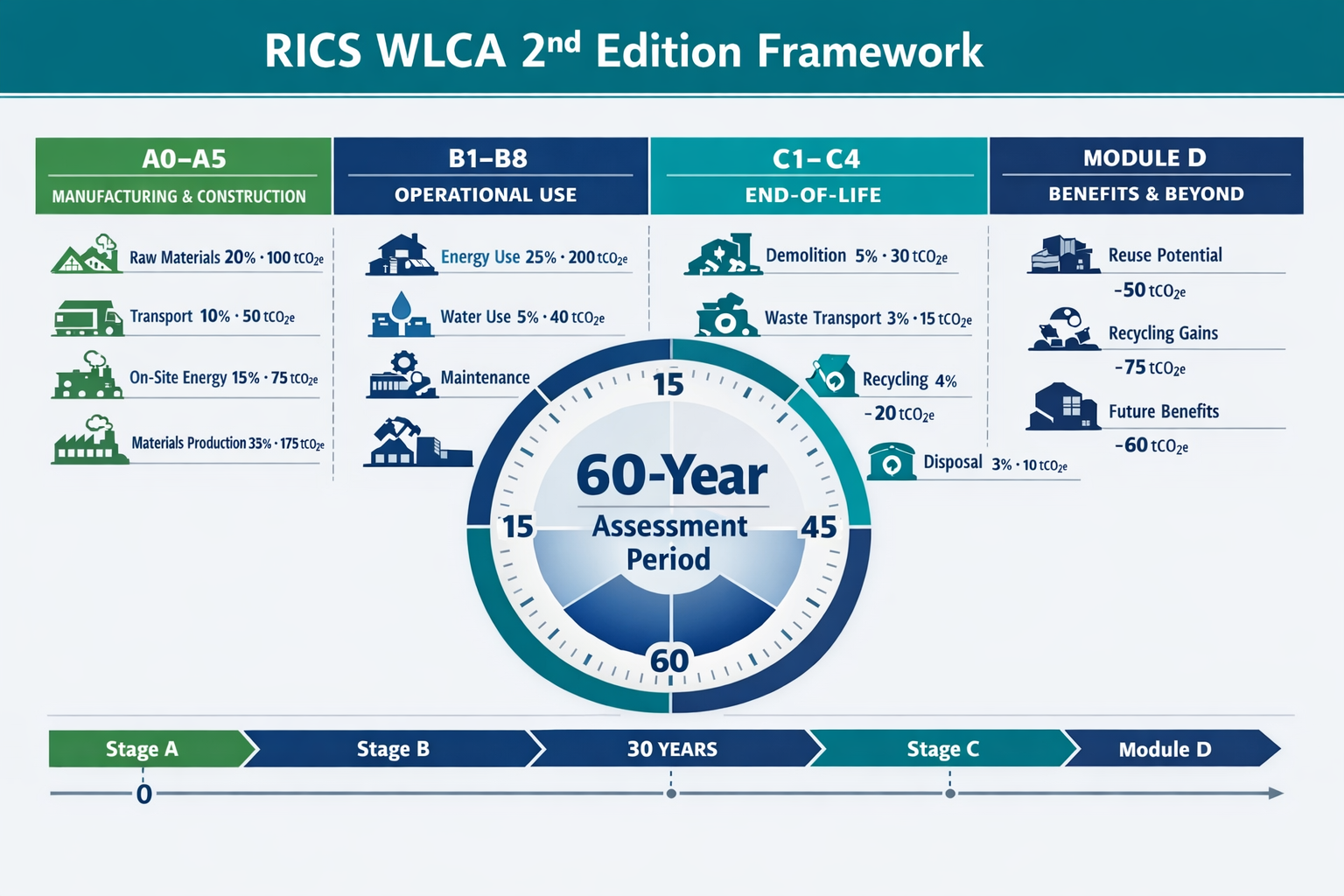
At the heart of whole life carbon assessments lies a comprehensive four-stage framework that surveyors must evaluate during property valuations:
Stage A: Upfront Carbon (Modules A0-A5)
- A0: Preconstruction activities and design stage emissions (new in 2nd edition)
- A1-A3: Raw material extraction, manufacturing, and transport
- A4: Transportation to construction site
- A5: Construction and installation processes
Stage B: In-Use Carbon (Modules B1-B8)
- B1-B5: Maintenance, repair, replacement, and refurbishment
- B6-B7: Operational energy and water use
- B8: Employee commute and vehicle emissions (new module)[6]
Stage C: End-of-Life Carbon (Modules C1-C4)
- C1-C4: Demolition, transport, waste processing, and disposal
Stage D: Beyond Building Boundary
- D1-D2: Material reuse benefits and generated electricity exported to grid (refined modules)[6]
Standardized Assessment Periods
The 2nd edition introduces clear timeframes that surveyors must apply consistently:
| Asset Type | Assessment Period |
|---|---|
| Buildings | 60 years |
| Fit-out Components | 20 years |
| Infrastructure | 120 years |
These extended periods ensure that buildings are designed and evaluated for longevity, fundamentally changing how surveyors assess property value and investment potential[5].
Mandatory Reporting Requirements
A critical change for chartered surveyors conducting building surveys in 2026 is the mandatory reporting of unregulated energy loads. Previously optional, assessments must now include:
✅ Complete Table 21 requirements
✅ Separate reporting of on-site renewable generation
✅ Grid electricity consumption
✅ All unregulated energy uses (plug loads, equipment, process energy)[3]
This comprehensive approach means that building surveys must now incorporate detailed energy modeling and operational projections, requiring surveyors to collaborate with mechanical and electrical engineers more closely than ever before.
Contingency Allowance for Early-Stage Assessments
Recognizing the uncertainty inherent in design-phase evaluations, the 2nd edition introduces a contingency allowance requirement. This addresses the challenge surveyors face when conducting valuations on proposed developments or major renovations where exact material specifications remain undefined[6].
Integrating PAS 2080:2023 Carbon Management into Building Survey Practice
While RICS WLCA provides the measurement methodology, PAS 2080:2023 establishes the governance framework and management processes that chartered surveyors must implement when conducting whole life carbon assessments in building surveys. This complementary relationship is central to understanding Whole Life Carbon Assessments in Building Surveys: Integrating PAS 2080 and RICS Sustainability Standards for 2026 Valuations[1].
The RICS-ICE Harmonized Framework
In a landmark collaboration, RICS and the Institution of Civil Engineers (ICE) established unified messaging that positions these standards as complementary tools rather than competing frameworks. This harmonization creates clarity for surveyors:
RICS WLCA Role: Defines what to measure and how to quantify carbon emissions
PAS 2080 Role: Establishes who is responsible and when decisions must be made[1]
This partnership enables "consistent, data-driven decarbonisation" across the built environment by ensuring comprehensive carbon footprint calculations that miss no significant emission sources[1].
PAS 2080 Governance Principles for Surveyors
When conducting building surveys that incorporate whole life carbon assessments, chartered surveyors must implement PAS 2080's governance structure:
🔹 Leadership and Accountability: Clearly defined roles for carbon management throughout the project lifecycle
🔹 Collaborative Decision-Making: Multi-stakeholder engagement in carbon reduction strategies
🔹 Lifecycle Thinking: Carbon considerations integrated from initial survey through end-of-life planning
🔹 Transparent Reporting: Documented carbon performance accessible to all stakeholders
Practical Application in 2026 Building Surveys
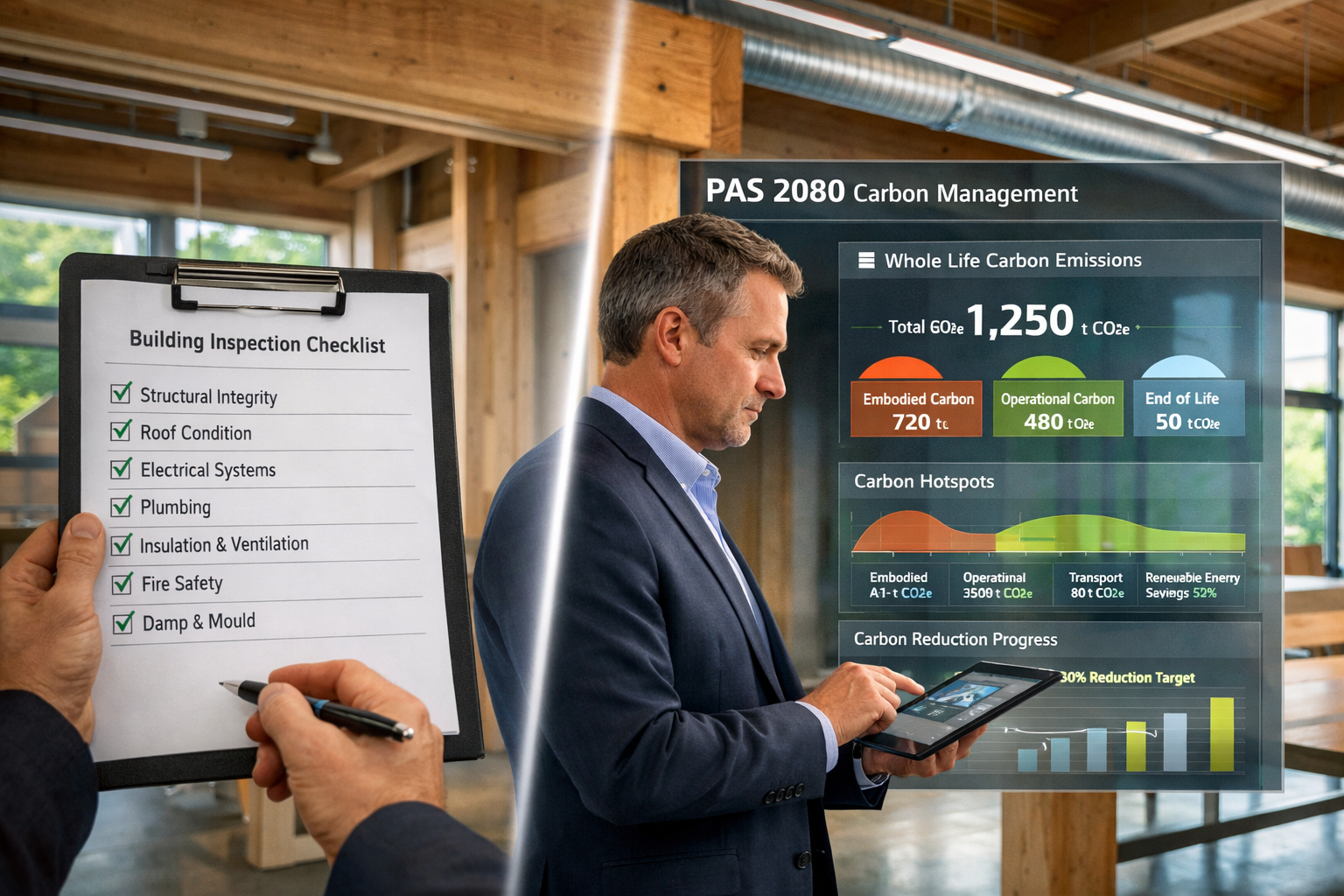
For chartered surveyors conducting comprehensive building surveys in 2026, the integrated RICS-PAS framework requires:
Pre-Survey Phase
- Establish carbon management roles per PAS 2080
- Define assessment boundaries using RICS WLCA modules
- Identify data sources for existing buildings or design specifications for new construction
Survey Execution Phase
- Collect structural and material data using traditional survey methods
- Document energy systems, insulation, and building fabric performance
- Gather operational data for B-stage calculations
- Assess retrofit potential and end-of-life considerations
Post-Survey Analysis
- Calculate carbon emissions across all lifecycle stages using RICS methodology
- Apply PAS 2080 governance to recommend carbon reduction strategies
- Integrate findings into valuation reports with sustainability metrics
- Provide actionable recommendations for carbon performance improvement
Alignment with International Cost Management Standards
A significant advancement in the 2nd edition is its alignment with International Cost Management Standards (ICMS) 3rd Edition. This integration allows surveyors to measure and report both carbon emissions and lifecycle costs simultaneously, creating a powerful tool for commercial valuations where financial and environmental performance are increasingly linked[1].
The ICMS alignment makes the standard globally applicable, positioning UK-trained chartered surveyors as leaders in international sustainable property assessment.
Impact on Property Valuations and Market Appeal in 2026
The integration of whole life carbon assessments into building surveys has fundamentally altered how properties are valued and marketed in 2026. Environmental performance is no longer a peripheral consideration—it's a core value driver that influences buyer decisions, financing availability, and long-term asset appreciation.
The Sustainability Premium in Property Markets
Properties with documented low carbon footprints and strong sustainability credentials are commanding measurable premiums across residential and commercial markets. Chartered surveyors conducting valuations must now quantify this "green premium" by analyzing:
Comparable Sales Analysis with Carbon Metrics
- Properties with verified RICS WLCA assessments showing superior carbon performance
- Energy Performance Certificate (EPC) ratings and their correlation with sale prices
- Retrofit investments and their return on investment through increased valuations
Understanding the relationship between EPC ratings and building surveys has become essential for accurate 2026 valuations, particularly as Minimum Energy Efficiency Standards (MEES) continue to tighten.
Buyer Appeal and Decision-Making Factors
Environmental consciousness has shifted from niche concern to mainstream priority. Surveyors must recognize that buyers in 2026 actively seek:
✨ Transparent Carbon Data: Complete RICS WLCA reports demonstrating lifecycle emissions
✨ Future-Proofing: Properties designed for longevity with low operational carbon
✨ Regulatory Compliance: Assurance that buildings meet current and anticipated carbon regulations
✨ Operational Cost Savings: Lower energy consumption translating to reduced running costs
✨ Financing Advantages: Access to green mortgages and favorable lending terms
Integration into Valuation Reports
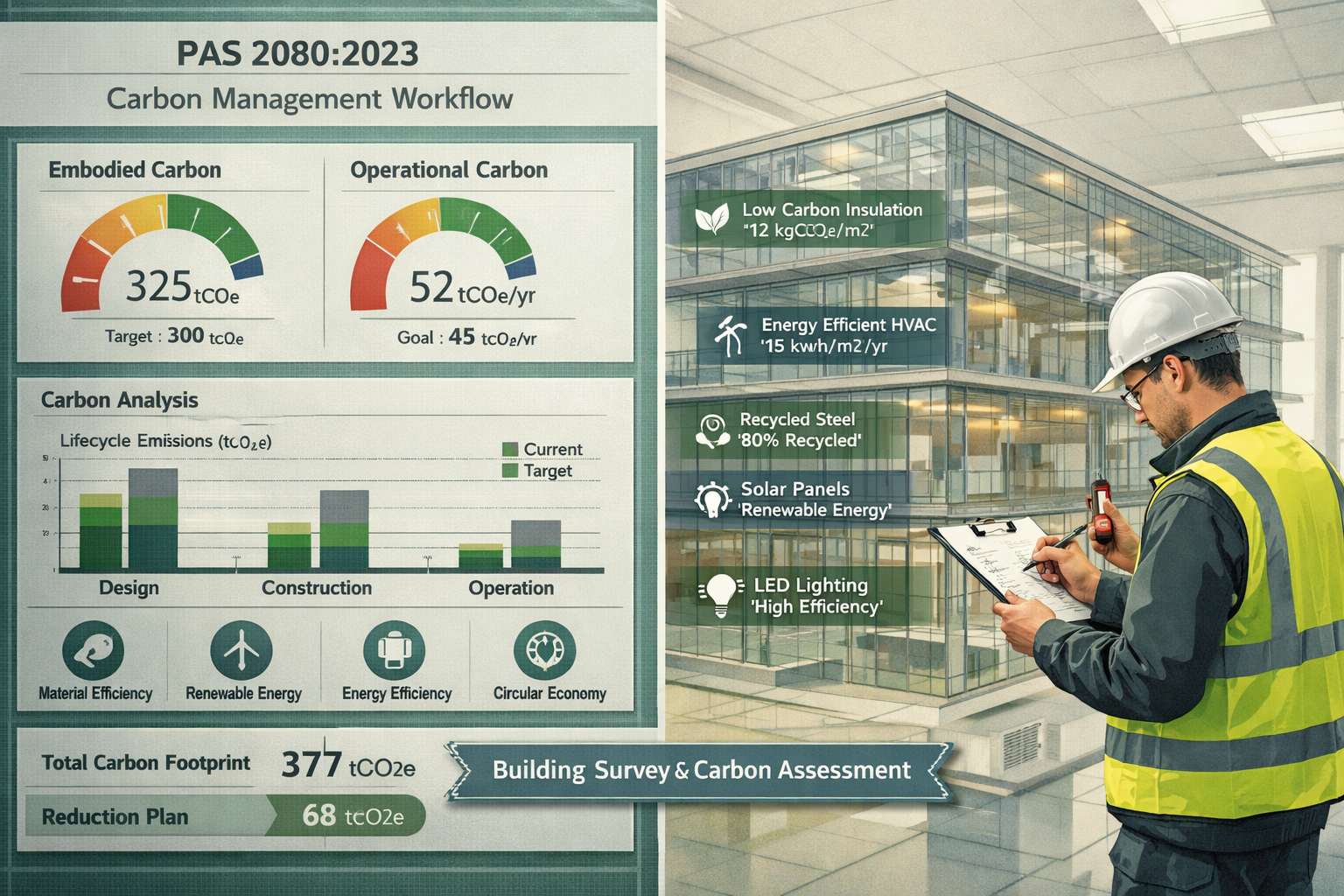
Modern property valuation reports in 2026 must include dedicated sections addressing sustainability performance:
Essential Carbon Assessment Components:
| Report Section | Content Requirements |
|---|---|
| Executive Summary | Overall carbon rating and comparison to benchmarks |
| Upfront Carbon (A) | Embodied carbon in materials and construction |
| Operational Carbon (B) | Annual emissions from energy use, maintenance, commuting |
| End-of-Life (C) | Projected demolition and disposal impacts |
| Module D Benefits | Potential for material reuse and renewable generation |
| Improvement Recommendations | Prioritized carbon reduction strategies with cost-benefit analysis |
| Valuation Adjustment | Quantified impact of carbon performance on market value |
Commercial Property Considerations
For commercial property valuations, whole life carbon assessments have become critical to tenant attraction and retention. Corporate occupiers increasingly demand:
- Carbon Neutral Operations: Buildings that support their net-zero commitments
- ESG Reporting Capability: Detailed emissions data for corporate sustainability reporting
- Regulatory Compliance: Assurance against stranding risk as carbon regulations tighten
- Reputational Benefits: Addresses that enhance corporate sustainability credentials
Surveyors must therefore assess not just the physical building condition but its capacity to support occupier sustainability objectives.
Financing and Investment Implications
Financial institutions have rapidly integrated carbon performance into lending and investment decisions. Properties with poor carbon profiles face:
⚠️ Higher borrowing costs or reduced loan-to-value ratios
⚠️ Difficulty securing institutional investment
⚠️ Increased risk of asset stranding as regulations tighten
⚠️ Limited buyer pool reducing liquidity
Conversely, properties with strong RICS WLCA performance benefit from:
✅ Access to green financing products with favorable terms
✅ Broader investor appeal including ESG-focused funds
✅ Enhanced resilience to regulatory change
✅ Premium valuations reflecting reduced risk profile
Professional Development and Training for Chartered Surveyors
The complexity of integrating Whole Life Carbon Assessments in Building Surveys: Integrating PAS 2080 and RICS Sustainability Standards for 2026 Valuations requires chartered surveyors to develop new competencies beyond traditional surveying skills.
RICS Training Programmes for 2026
RICS offers the Global Certificate in Whole Life Carbon Assessment (2026 Edition), a comprehensive training programme providing:
- Detailed introduction to RICS WLCA 2nd edition methodology
- ISO 14040/14044 compliance requirements
- Practical application of lifecycle assessment principles
- Integration with PAS 2080 carbon management processes
- Case studies and real-world assessment scenarios[4]
This certification has become increasingly valuable for surveyors seeking to differentiate their services in competitive markets.
Essential Competencies for 2026 Practice
Modern chartered surveyors conducting building surveys must develop expertise in:
Technical Skills:
- Carbon calculation methodologies across all lifecycle stages
- Energy modeling and operational emissions forecasting
- Material selection and embodied carbon databases
- Building physics and thermal performance assessment
- Renewable energy systems evaluation
Analytical Skills:
- Lifecycle cost-benefit analysis integrating carbon metrics
- Scenario modeling for retrofit and improvement options
- Risk assessment related to carbon regulations and market trends
- Comparative analysis using carbon benchmarks
Communication Skills:
- Translating complex carbon data into accessible client reports
- Presenting sustainability metrics alongside traditional survey findings
- Advising clients on carbon reduction strategies and investment priorities
- Collaborating with multidisciplinary teams including engineers and architects
Multidisciplinary Collaboration
Effective whole life carbon assessments require surveyors to work closely with:
- Structural Engineers: For material specifications and embodied carbon calculations (learn more about working with structural engineers)
- Mechanical & Electrical Engineers: For operational energy modeling and systems assessment
- Architects: For design-stage assessments and retrofit planning
- Quantity Surveyors: For cost integration using ICMS alignment
- Environmental Consultants: For specialized carbon databases and verification
Practical Implementation: Conducting Carbon-Integrated Building Surveys
For chartered surveyors implementing whole life carbon assessments in 2026 practice, a systematic approach ensures comprehensive and compliant evaluations.
Step-by-Step Assessment Process
1. Initial Client Consultation
- Determine assessment objectives (valuation, due diligence, planning application)
- Define scope using RICS WLCA modules relevant to project stage
- Establish PAS 2080 governance roles and responsibilities
- Agree reporting format and detail level
2. Data Collection Strategy
- For existing buildings: Site inspection with material identification
- For new construction: Design specifications and material schedules
- Energy consumption records (minimum 12 months for operational buildings)
- Maintenance and replacement histories
- Transport and logistics data for Module A4 calculations
3. Baseline Carbon Assessment
- Calculate embodied carbon using verified databases (ICE Database, EPD data)
- Model operational energy using dynamic simulation tools
- Project maintenance and replacement cycles over assessment period
- Estimate end-of-life scenarios based on material composition
- Quantify Module D benefits from reuse potential and renewable generation
4. Benchmarking and Analysis
- Compare results against RICS carbon benchmarks for building type
- Identify high-impact emission sources across lifecycle stages
- Assess regulatory compliance and future risk exposure
- Evaluate retrofit opportunities and improvement potential
5. Valuation Integration
- Quantify sustainability premium or discount based on carbon performance
- Adjust comparable sales data for carbon metrics differences
- Consider financing implications and buyer appeal factors
- Document assumptions and methodologies transparently
6. Reporting and Recommendations
- Present findings in standardized RICS WLCA format
- Provide executive summary accessible to non-technical audiences
- Prioritize carbon reduction strategies with cost-benefit analysis
- Include implementation roadmap with phased improvement options
Common Challenges and Solutions
Challenge: Data Availability for Existing Buildings
Solution: Use proxy data from similar buildings with adjustment factors, clearly document assumptions, and recommend monitoring systems for future assessments
Challenge: Uncertainty in Long-Term Projections
Solution: Apply contingency allowances per RICS guidance, conduct sensitivity analysis, and provide scenario modeling with different assumptions
Challenge: Balancing Detail with Practicality
Solution: Scale assessment detail to project value and decision-making needs, focusing on material emission sources while using simplified approaches for minor components
Challenge: Client Understanding and Buy-In
Solution: Provide clear visualizations, translate carbon metrics into financial impacts, and demonstrate regulatory and market drivers for carbon performance
Quality Assurance and Verification
To ensure credibility of whole life carbon assessments integrated into building surveys:
✓ Use verified carbon databases with documented sources
✓ Apply consistent methodology across comparable assessments
✓ Document all assumptions, data sources, and calculation methods
✓ Consider third-party verification for high-value or contentious valuations
✓ Maintain continuing professional development in carbon assessment methodologies
✓ Stay current with evolving RICS guidance and PAS 2080 updates
Regulatory Context and Future Trajectory
Understanding the regulatory landscape driving whole life carbon integration helps surveyors anticipate future requirements and advise clients on long-term property strategies.
Current UK Regulatory Framework
While RICS WLCA is mandatory for RICS members, broader regulatory adoption continues to evolve:
- Planning Applications: Increasing numbers of local authorities requiring WLCA for major developments
- Public Sector Projects: Government construction projects mandating PAS 2080 compliance
- Building Regulations: Future Parts updates expected to incorporate embodied carbon limits
- MEES Regulations: Continued tightening of minimum energy efficiency standards affecting operational carbon
International Alignment
The RICS WLCA 2nd edition's alignment with ICMS 3rd Edition and ISO standards positions it within broader international frameworks:
- EU Taxonomy: Carbon performance criteria for sustainable investment classification
- GRESB Benchmarking: Real estate sustainability assessment incorporating whole life carbon
- LEED and BREEAM: Green building certifications increasingly emphasizing lifecycle carbon
- UN Sustainable Development Goals: Built environment contributions to climate action targets[8]
Anticipated Developments Through 2030
Surveyors should prepare for:
📈 Mandatory Carbon Disclosure: Likely expansion of WLCA requirements beyond RICS members to all property transactions
📈 Carbon Budgets for Buildings: Absolute emission limits for new construction and major renovations
📈 Enhanced Operational Monitoring: Real-time carbon tracking replacing projected assessments
📈 Circular Economy Integration: Stronger emphasis on Module D benefits and material reuse
📈 Digital Integration: BIM and digital twins enabling continuous carbon assessment
Conclusion: The Future of Building Surveys is Carbon-Conscious
The integration of Whole Life Carbon Assessments in Building Surveys: Integrating PAS 2080 and RICS Sustainability Standards for 2026 Valuations represents more than regulatory compliance—it's a fundamental evolution in how the built environment is evaluated, valued, and managed. As we progress through 2026, chartered surveyors who master this integrated approach position themselves as essential advisors in an increasingly carbon-conscious property market.
The harmonized RICS WLCA and PAS 2080 framework provides surveyors with robust tools to deliver comprehensive assessments that serve multiple stakeholder needs: buyers seeking sustainable investments, lenders managing climate risk, developers pursuing planning approval, and occupiers meeting corporate sustainability commitments.
Key Success Factors for 2026 Practice
Technical Excellence: Maintain current competency in carbon assessment methodologies through ongoing training and professional development
Collaborative Approach: Build multidisciplinary networks enabling comprehensive assessments across all building systems and lifecycle stages
Clear Communication: Translate complex carbon data into actionable insights that inform decision-making and drive value
Market Awareness: Stay attuned to evolving buyer preferences, financing requirements, and regulatory developments affecting carbon performance
Quality Assurance: Apply rigorous methodologies with transparent documentation ensuring credible, defensible assessments
Actionable Next Steps
For chartered surveyors looking to enhance their whole life carbon assessment capabilities:
-
Enroll in RICS WLCA Training: Complete the Global Certificate in Whole Life Carbon Assessment to gain comprehensive methodology understanding[4]
-
Develop Technical Resources: Establish access to verified carbon databases, energy modeling tools, and assessment templates aligned with RICS standards
-
Build Professional Networks: Connect with engineers, architects, and environmental consultants to enable collaborative assessments
-
Update Service Offerings: Revise building survey services to explicitly include whole life carbon assessment as standard or optional enhancement
-
Enhance Client Communication: Develop clear reporting templates that integrate carbon metrics with traditional survey findings and valuation conclusions
-
Monitor Regulatory Developments: Stay informed on evolving requirements through RICS publications and industry forums
The property professionals who embrace this transformation will lead the industry through the critical decades ahead, delivering assessments that serve both immediate transaction needs and long-term sustainability objectives. The question for 2026 is no longer whether to integrate whole life carbon into building surveys, but how effectively surveyors can leverage these tools to deliver superior client value and contribute to meaningful decarbonization of the built environment.
References
[1] Rics And Ice Harmonise Messaging On Carbon Assessment And Manage – rics.org
[2] pbctoday.co.uk – pbctoday.co.uk
[3] Rics The Big Changes – greengage-env.com
[4] Certificate In Whole Life Carbon Assessment Training Programme – rics.org
[5] Watch – youtube.com
[6] Understanding The Rics Whole Life Carbon Assessment Standard – tsariley.com
[7] Whole Life Carbon Assessment – rics.org
[8] Whole Life Carbon Assessment Wlca Built Environment – globalabc.org