

The construction industry stands at a pivotal moment in 2026. Buildings and infrastructure account for nearly 40% of global carbon emissions, yet many property professionals still assess structures without considering their full environmental impact. The Royal Institution of Chartered Surveyors (RICS) has responded to this challenge with its updated Whole Life Carbon Assessment standard—a framework that fundamentally changes how surveyors evaluate, value, and report on built assets.
The Whole Life Carbon Assessment for Built Environment: RICS 2nd Edition Standard and Surveyor Integration in 2026 represents more than just an updated methodology. It establishes a mandatory approach for RICS members to measure carbon across an asset's entire lifecycle, from raw material extraction through demolition and disposal. For chartered surveyors conducting building surveys, valuations, and expert assessments, this standard creates new responsibilities and opportunities to provide comprehensive property intelligence.
Key Takeaways
- 🏗️ Mandatory compliance: The RICS 2nd Edition became mandatory for all RICS members on July 1, 2024, requiring carbon lifecycle data in whole life carbon assessments[1][9]
- 📊 Expanded scope: The updated standard covers all buildings and infrastructure across the complete asset lifecycle, significantly broadening the previous version's coverage[1][2]
- 👷 Surveyor integration: Building surveyors can now incorporate carbon metrics into condition reports, valuations, and expert testimony to provide holistic property assessments
- 🎓 Professional development: A comprehensive 140-hour Global Certificate programme equips built environment professionals with practical assessment skills[3][5]
- 💻 Technology enablement: RICS-validated software solutions streamline compliant reporting from design through construction and operational phases[4]
Understanding the RICS Whole Life Carbon Assessment 2nd Edition
What Changed in the 2nd Edition
The RICS Whole Life Carbon Assessment standard underwent significant evolution between its first and second editions. Released in November 2023 after gathering over 1,300 stakeholder comments during public consultation, the 2nd Edition addresses critical gaps identified in practical application[1].
Key modifications include:
- Enhanced reporting modules aligned with EN 15978 standards covering all lifecycle stages
- Refined element categorization for both buildings and infrastructure projects
- Standardized parameters and emissions factors ensuring consistency across assessments
- Updated transport impact calculations accounting for material movement and logistics
- Improved biogenic carbon methodology for timber and natural materials
- Comprehensive uncertainty analysis requirements for transparent reporting
- Clear decarbonisation pathways guidance for future carbon reduction[2]
The standard received official backing from the Department for Transport UK and Zero Waste Scotland, demonstrating cross-sector recognition of its importance[1]. This governmental support signals that whole life carbon assessment will increasingly influence planning decisions, building regulations, and property valuations.
Mandatory Compliance Requirements for RICS Members
Since July 1, 2024, the 2nd Edition has been mandatory for all RICS members conducting whole life carbon assessments[1][9]. This requirement fundamentally changes professional obligations for surveyors across multiple disciplines.
RICS members must:
✅ Apply the standard methodology to all relevant assessments
✅ Document and justify any deviations from the standard framework
✅ Maintain competency through continuing professional development
✅ Use validated calculation tools and current emissions factors
✅ Provide transparent reporting on assumptions and limitations
For building surveyors conducting property inspections, this creates an opportunity to differentiate services by offering carbon-conscious assessments that address both traditional structural concerns and environmental performance.
The Complete Lifecycle Approach
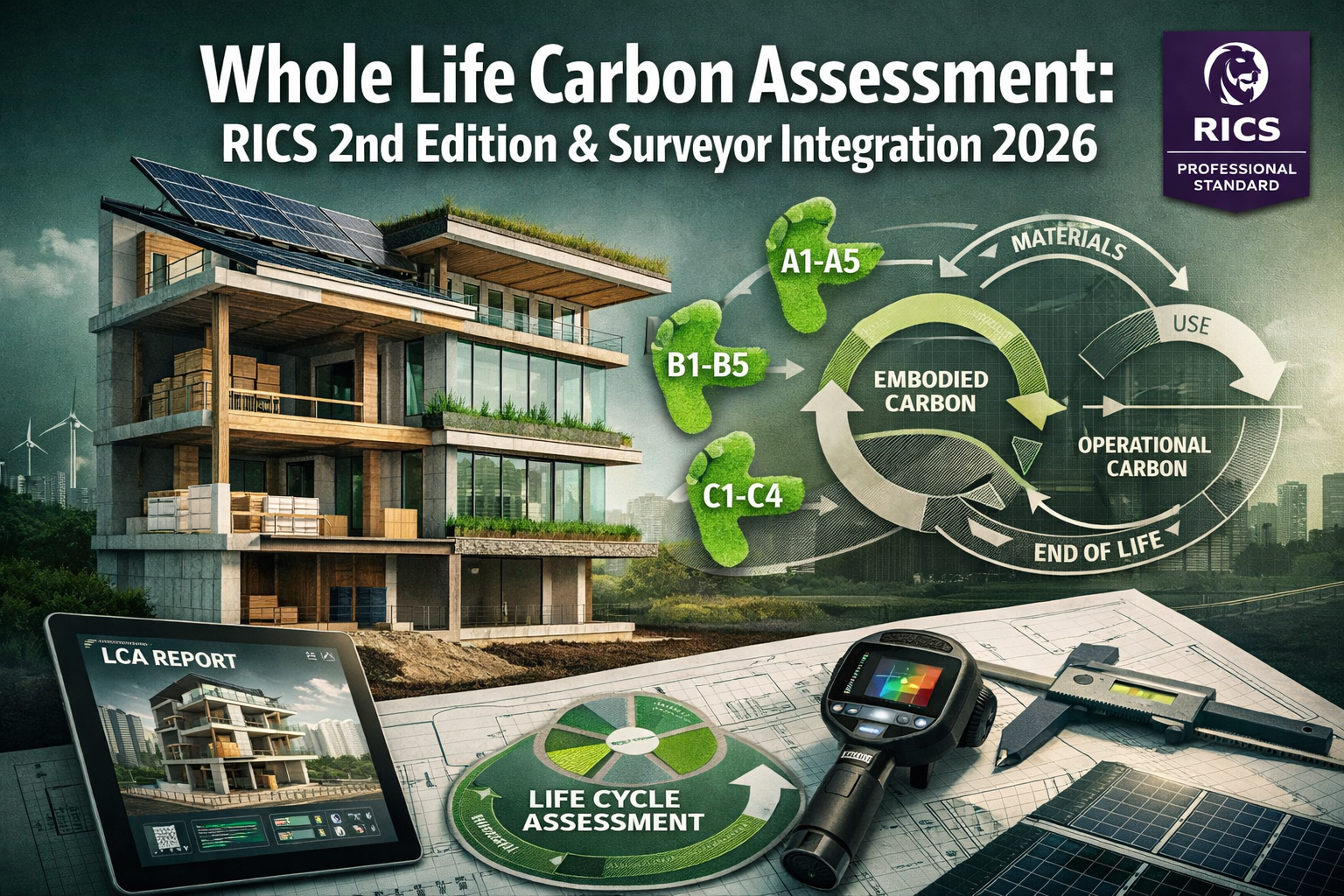
The Whole Life Carbon Assessment for Built Environment: RICS 2nd Edition Standard and Surveyor Integration in 2026 adopts a cradle-to-grave perspective, measuring carbon impacts across distinct lifecycle stages:
| Lifecycle Stage | Modules | Carbon Sources |
|---|---|---|
| Product Stage | A1-A3 | Raw material extraction, transport, manufacturing |
| Construction Stage | A4-A5 | Transport to site, construction processes |
| Use Stage | B1-B7 | Maintenance, repair, replacement, operational energy |
| End of Life | C1-C4 | Deconstruction, transport, waste processing, disposal |
| Beyond Building Life | D | Reuse, recovery, recycling potential |
This comprehensive framework ensures that surveyors consider not just operational carbon (energy use during occupation) but also embodied carbon (emissions locked into materials and construction processes). Research shows embodied carbon can represent 50-70% of a building's total lifecycle emissions for highly efficient structures[7].
How Surveyors Integrate Carbon Assessment into Professional Practice
Building Condition Reports with Carbon Metrics
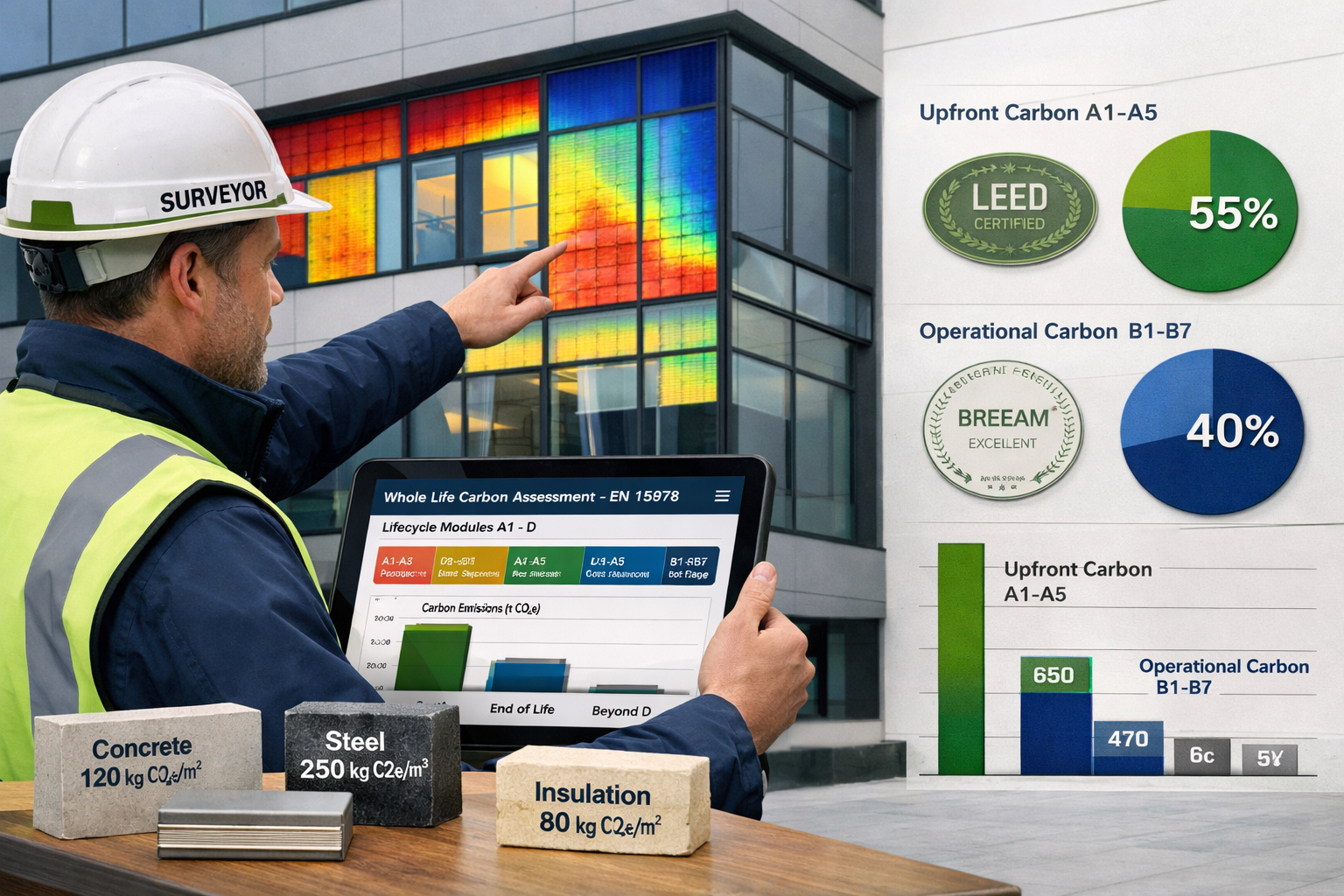
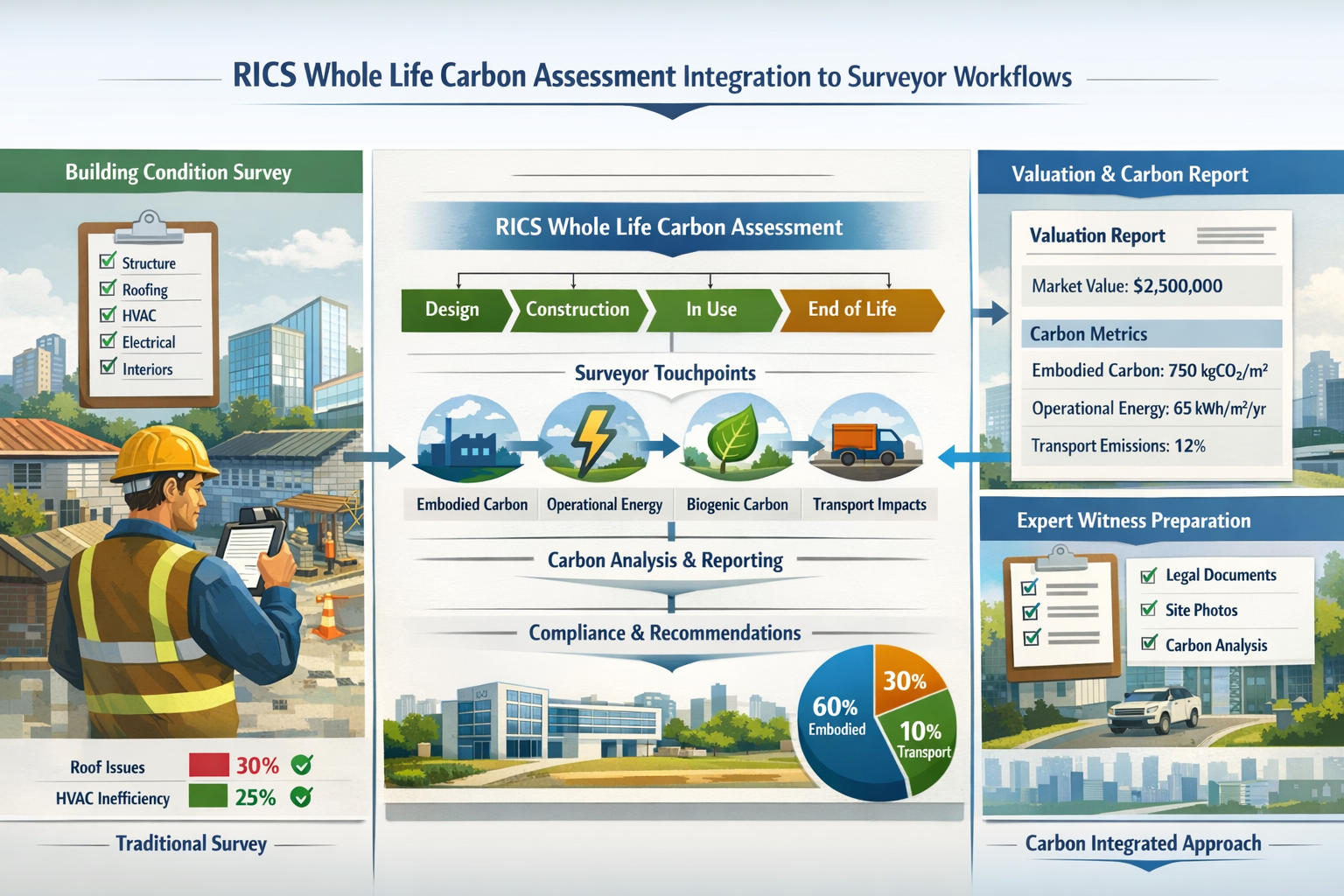
Traditional building surveys focus on structural integrity, defects, and maintenance requirements. The integration of whole life carbon assessment adds a critical environmental dimension to these reports.
Practical integration points include:
Material Assessment: When surveyors identify building materials during inspections, they can now reference embodied carbon values. For example, noting that concrete foundations contain approximately 150-200 kg CO2e per cubic meter provides context for renovation versus replacement decisions.
Maintenance Recommendations: Repair strategies can be evaluated not just on cost but on carbon impact. Replacing failed components with lower-carbon alternatives reduces future lifecycle emissions.
Energy Performance: Linking EPC ratings to operational carbon projections creates a complete picture of building performance over time.
Retrofit Potential: Identifying opportunities for carbon reduction through insulation, glazing upgrades, or renewable energy integration adds value to survey reports.
This enhanced approach benefits property buyers, owners, and investors who increasingly prioritize environmental performance alongside traditional property metrics. Surveyors who master carbon assessment position themselves as forward-thinking professionals aligned with 2026 market expectations.
Valuation Services and Carbon Considerations
Property valuations have traditionally focused on location, condition, and comparable sales data. The Whole Life Carbon Assessment for Built Environment: RICS 2nd Edition Standard and Surveyor Integration in 2026 introduces carbon performance as a material consideration affecting property value.
Carbon metrics influence valuations through:
🏢 Regulatory compliance: Buildings with poor carbon performance face potential obsolescence as regulations tighten
💰 Operating costs: High operational carbon correlates with elevated energy expenses, affecting net operating income
🌱 Market demand: Tenants and buyers increasingly prefer low-carbon properties
⚖️ Risk assessment: Stranded asset risk for high-carbon buildings in transition to net-zero economy
Surveyors conducting insurance reinstatement valuations can incorporate carbon data to recommend sustainable rebuild specifications. Similarly, matrimonial valuations benefit from comprehensive environmental performance data that affects long-term property value.
The RICS guidance document "Whole Life Carbon Assessments – a guide for clients," launched in March 2024, helps surveyors communicate carbon considerations to property owners and investors in accessible terms[1].
Expert Witness Testimony and Carbon Evidence
Surveyors serving as expert witnesses in property disputes, planning appeals, or dilapidations cases can now present carbon lifecycle data as material evidence. This integration strengthens professional testimony with quantifiable environmental metrics.
Application scenarios include:
Planning Appeals: Demonstrating that a proposed development achieves superior carbon performance compared to alternatives can support approval arguments.
Dilapidations Claims: Assessing whether repair or replacement represents the lower-carbon option provides objective criteria for dispute resolution. Understanding dilapidation protocols alongside carbon implications creates comprehensive expert analysis.
Defect Claims: Quantifying the carbon impact of construction defects that require remediation adds dimension to damage assessments.
Conservation vs. Redevelopment: Presenting lifecycle carbon analysis for heritage building retention versus demolition and rebuild informs preservation decisions.
Expert witnesses must maintain objectivity and transparency when presenting carbon data, clearly stating assumptions, data sources, and uncertainty ranges as required by the RICS standard[1][2].
Professional Development and Implementation Resources
The RICS Global Certificate Programme
Recognizing that effective implementation requires comprehensive training, RICS launched the Global Certificate in Whole Life Carbon Assessment programme. This structured educational pathway equips surveyors and other built environment professionals with practical skills for carbon assessment integration.
Programme highlights:
- ⏱️ Duration: 10-month enrollment period with flexible learning
- 📚 CPD Hours: 140 hours of continuing professional development credit
- 🎯 Target Audience: Surveyors, engineers, consultants, project managers, cost professionals, sustainability specialists[3]
- 📖 Curriculum Coverage: Core methodology, standardized terminology, step-by-step assessment processes, reporting requirements, case studies
The programme addresses the practical challenges surveyors face when implementing carbon assessment in real-world projects. Participants learn to:
✔️ Calculate embodied carbon for common building materials and assemblies
✔️ Model operational carbon across different building types and uses
✔️ Apply biogenic carbon methodology for timber structures
✔️ Conduct uncertainty analysis and sensitivity testing
✔️ Prepare compliant reports meeting RICS 2nd Edition requirements
✔️ Communicate carbon findings to non-technical stakeholders
For chartered surveyors seeking to maintain competitive advantage in 2026, this certification demonstrates commitment to comprehensive property assessment that addresses both traditional and environmental performance criteria.
Technology Solutions for Compliant Assessment
The complexity of whole life carbon calculation—involving thousands of material quantities, emission factors, transport distances, and operational projections—makes software solutions essential for practical implementation.
One Click LCA earned recognition as the world's first RICS-validated software for whole life carbon assessments[4]. This validation ensures that calculations align with the 2nd Edition methodology and produce compliant reporting outputs.
Key software capabilities include:
- 🔢 Automated calculations for all lifecycle modules (A1-D)
- 📊 Material databases with current emission factors
- 🔄 Design stage integration from conceptualization through as-built validation
- 📈 Scenario comparison for evaluating design alternatives
- 📋 Compliant reporting templates meeting RICS requirements
- 🔍 Uncertainty quantification for transparent analysis
The availability of validated software removes technical barriers that previously limited carbon assessment to specialized consultants. Surveyors can now incorporate lifecycle carbon analysis into standard practice without requiring advanced environmental engineering expertise.
Integration with PAS 2080:2023
The Whole Life Carbon Assessment for Built Environment: RICS 2nd Edition Standard and Surveyor Integration in 2026 operates alongside PAS 2080:2023, the British Standards Institution specification for carbon management in infrastructure. This complementary relationship creates a comprehensive framework for carbon-conscious construction.
PAS 2080:2023 establishes principles for:
- Carbon management throughout project delivery
- Organizational responsibilities and governance
- Target setting and performance monitoring
- Supply chain engagement and accountability
While RICS provides the assessment methodology, PAS 2080 guides the management processes that deliver carbon reduction. Surveyors working on infrastructure projects benefit from understanding both frameworks to provide comprehensive advice.
The alignment between these standards reflects broader industry movement toward standardized carbon accounting. As governments and private sector clients increasingly mandate carbon reporting, surveyors with dual competency in RICS and PAS 2080 frameworks position themselves as essential advisors for complex projects.
Practical Implementation Challenges and Solutions
Data Quality and Availability
One significant challenge surveyors face when conducting whole life carbon assessments involves obtaining accurate material quantity data and appropriate emission factors. Existing buildings often lack detailed construction documentation, requiring surveyors to estimate quantities from visual inspection and available records.
Practical solutions:
Phased Implementation: Begin with high-impact elements (structure, envelope, major systems) before addressing minor components. This approach delivers meaningful carbon insights without requiring exhaustive detail.
Generic Data with Uncertainty Ranges: The RICS standard acknowledges that perfect data rarely exists. Using industry-average emission factors with documented uncertainty ranges provides useful analysis while maintaining transparency about limitations[2].
Collaborative Assessment: Engaging with architects, engineers, and contractors during building surveyor access visits helps gather detailed material specifications and construction methodologies.
Software Databases: Validated assessment tools include comprehensive material libraries that reduce research burden for common building elements[4].
Client Education and Value Communication
Many property owners and investors remain unfamiliar with whole life carbon concepts in 2026, despite growing regulatory pressure and market awareness. Surveyors must effectively communicate why carbon assessment adds value to traditional property services.
Effective communication strategies:
📊 Visual Presentation: Charts comparing carbon performance to benchmarks make abstract concepts tangible
💷 Financial Translation: Linking carbon metrics to energy costs, regulatory compliance costs, and property values demonstrates economic relevance
🎯 Scenario Analysis: Showing carbon reduction potential through specific interventions helps clients understand actionable opportunities
📖 Plain Language: Avoiding technical jargon while maintaining accuracy ensures accessibility for diverse audiences
The RICS client guide launched in March 2024 provides templates and examples that surveyors can adapt for client communications[1]. This resource helps bridge the knowledge gap between technical assessment and client understanding.
Maintaining Professional Competency
The rapid evolution of carbon assessment methodology, emission factors, and regulatory requirements creates ongoing learning obligations for surveyors. The RICS 2nd Edition represents current best practice in 2026, but continued development is inevitable as climate science advances and policy frameworks evolve.
Competency maintenance approaches:
- 🎓 Regular CPD participation through RICS training programmes and industry seminars
- 📚 Engagement with updated guidance documents and technical bulletins
- 🤝 Professional networking with sustainability specialists and environmental consultants
- 🔬 Following research developments in building materials and construction techniques
- 💻 Software updates and validation reviews as tools evolve
Surveyors who view carbon assessment as a core competency rather than a peripheral add-on will find themselves better positioned to serve clients effectively as environmental performance becomes central to property decision-making.
The Future of Carbon-Conscious Surveying
Regulatory Trajectory and Market Drivers
The mandatory adoption of the Whole Life Carbon Assessment for Built Environment: RICS 2nd Edition Standard and Surveyor Integration in 2026 reflects broader regulatory momentum toward carbon accountability in construction. Several trends suggest this integration will deepen rather than diminish:
Strengthening Building Regulations: Governments worldwide are incorporating embodied carbon limits into building codes, moving beyond operational energy requirements.
Planning Policy Evolution: Local authorities increasingly require carbon assessments as part of planning applications, particularly for major developments.
Financial Sector Engagement: Lenders and investors apply environmental, social, and governance (ESG) criteria that include carbon performance metrics.
Tenant Expectations: Commercial and residential occupiers prioritize low-carbon buildings, influencing market values and rental premiums.
Surveyors who establish carbon assessment capabilities now position themselves ahead of these regulatory and market shifts. The skills developed through RICS 2nd Edition implementation will remain relevant and increasingly valuable as requirements expand.
Expanded Scope Beyond New Construction
While initial carbon assessment focus has centered on new construction, the RICS framework applies equally to existing building stock—which represents the vast majority of structures that will exist in 2030 and beyond. This creates significant opportunities for surveyors specializing in existing property assessment.
Retrofit and renovation projects particularly benefit from whole life carbon analysis:
- Comparing carbon impacts of repair versus replacement for building elements
- Evaluating heritage building retention versus demolition and rebuild scenarios
- Optimizing energy efficiency improvements for maximum carbon reduction
- Assessing embodied carbon in renovation materials and processes
Surveyors conducting condition surveys on existing properties can incorporate carbon metrics to guide maintenance strategies and capital improvement planning. This integration transforms reactive defect reporting into proactive carbon management advice.
Cross-Disciplinary Collaboration
Effective whole life carbon assessment requires input from multiple specialists: architects, structural engineers, mechanical engineers, quantity surveyors, and sustainability consultants. Professional surveyors increasingly serve as coordinators who synthesize diverse technical inputs into comprehensive property assessments.
This collaborative model benefits from:
Shared Data Platforms: Digital tools that enable multiple professionals to contribute to unified carbon models throughout project lifecycles.
Integrated Project Delivery: Contractual arrangements that align team members around carbon reduction targets alongside traditional cost and schedule objectives.
Multidisciplinary Training: Educational programmes that expose different professions to complementary disciplines, improving communication and coordination.
Surveyors who develop collaborative skills and understand adjacent disciplines will thrive in this integrated assessment environment. The ability to translate between technical specialties and client needs becomes increasingly valuable as projects grow more complex.
Conclusion
The Whole Life Carbon Assessment for Built Environment: RICS 2nd Edition Standard and Surveyor Integration in 2026 represents a fundamental evolution in how property professionals evaluate and report on built assets. No longer can surveyors limit their analysis to structural condition, defects, and market comparables. Environmental performance—measured through comprehensive lifecycle carbon assessment—has become an essential component of professional property advice.
For RICS members, the mandatory standard creates both obligations and opportunities. The obligation to conduct compliant assessments requires investment in training, tools, and processes. The opportunity lies in differentiation: surveyors who master carbon assessment provide more valuable, forward-looking advice that addresses client needs in an increasingly carbon-conscious market.
The integration pathway is clear. Begin with professional development through the RICS Global Certificate programme to build foundational competency. Adopt validated software solutions that streamline calculation and reporting processes. Start incorporating carbon considerations into existing survey services—building surveys, valuations, expert testimony—gradually expanding scope as experience grows.
Actionable Next Steps for Surveyors
- Assess Current Competency: Evaluate existing knowledge of carbon assessment methodology and identify learning gaps
- Enroll in Training: Register for the RICS Global Certificate in Whole Life Carbon Assessment or equivalent CPD programmes[3][5]
- Evaluate Technology: Research RICS-validated software solutions and select tools appropriate for practice scope[4]
- Update Service Offerings: Revise marketing materials and client communications to highlight carbon assessment capabilities
- Build Collaborative Networks: Establish relationships with sustainability consultants, environmental engineers, and other specialists
- Start Small: Incorporate basic carbon metrics into existing reports before expanding to comprehensive assessments
- Monitor Developments: Stay informed about regulatory changes, updated guidance, and evolving best practices
The transition to carbon-conscious surveying is not optional—it reflects the fundamental reality that property decisions must account for environmental impacts alongside traditional considerations. Surveyors who embrace this evolution position themselves as essential advisors for clients navigating the complex intersection of property value, regulatory compliance, and environmental responsibility.
The RICS 2nd Edition provides the framework. Professional development programmes provide the knowledge. Technology solutions provide the tools. Success requires commitment to integrating these resources into daily practice, transforming how surveyors serve clients and contribute to a more sustainable built environment.
References
[1] Rics Whole Life Carbon Assessment 2nd Edition Now In Effect – circularecology.com
[2] New Rics Whole Life Carbon 2nd Edition – support.etool.app
[3] Certificate In Whole Life Carbon Assessment Training Programme 200126 – rics.org
[4] Rics Whole Life Carbon Assessment Wlca 2nd Edition – oneclicklca.com
[5] Certificate In Whole Life Carbon Assessment Training Programme – rics.org
[7] Wlca Delivering The Future Of Carbon Assessment In The Built Environment – rics.org
[9] Whole Life Carbon Assessment – rics.org