

Roughly one in five UK property transactions collapses after a survey reveals defects the buyer had not anticipated — and many of those buyers had already received a reassuring nod from a builder friend who "had a look around." The gap between an informal contractor visit and a formal inspection by a RICS-accredited professional is not merely procedural. It can mean the difference between a sound investment and a money pit hidden behind freshly painted walls.
Understanding when do you need a chartered building surveyor rather than a builder's quote is one of the most practical questions any UK homebuyer can ask. This guide demystifies the two roles, compares what a formal Level 2 or Level 3 survey actually delivers against an informal contractor inspection, and explains the real-world legal, financial, and structural risks of getting that choice wrong.
Key Takeaways
- A chartered building surveyor holds a legally protected RICS qualification; a builder does not, and their inspection carries no professional liability.
- Formal surveys (Level 2 and Level 3) follow strict RICS standards and produce written, insured reports covering structural integrity, hidden defects, and legal considerations.
- Builder's quotes focus on the cost of visible repair work — they are not designed to assess overall property condition or flag latent risks.
- Older properties, those with visible defects, and any home requiring significant renovation almost always warrant a chartered surveyor over an informal builder's visit.
- Survey findings are a legitimate and powerful tool for price negotiation — often saving buyers far more than the survey fee itself.
What a Chartered Building Surveyor Actually Does
The title "Chartered Surveyor" is legally protected in the UK. Only individuals who have completed RICS-accredited education, passed the rigorous Assessment of Professional Competence (APC), and met ongoing professional development requirements are permitted to use it [3][6]. This is not a courtesy title — it is a regulated designation enforced by statute.
A chartered building surveyor conducts a systematic, methodical inspection of a property's physical condition. Their scope covers:
- Structural integrity — foundations, load-bearing walls, roof structure, and floor joists
- Fabric condition — brickwork, pointing, render, windows, and external cladding
- Hidden defects — damp penetration, timber decay, subsidence, and drainage issues
- Maintenance liabilities — items likely to require attention in the short and medium term
- Legal and regulatory flags — signs of unauthorised alterations, potential planning breaches, or building regulation non-compliance [4]
Crucially, chartered surveyors carry professional indemnity insurance. If their report misses a material defect and the buyer suffers financial loss as a result, there is a formal complaints and compensation route through RICS [1]. That accountability structure simply does not exist with a builder's informal visit.
For buyers considering different levels of formal inspection, the full building survey vs homebuyer survey comparison sets out the key differences in scope and cost clearly.
What a Builder's Quote Actually Covers
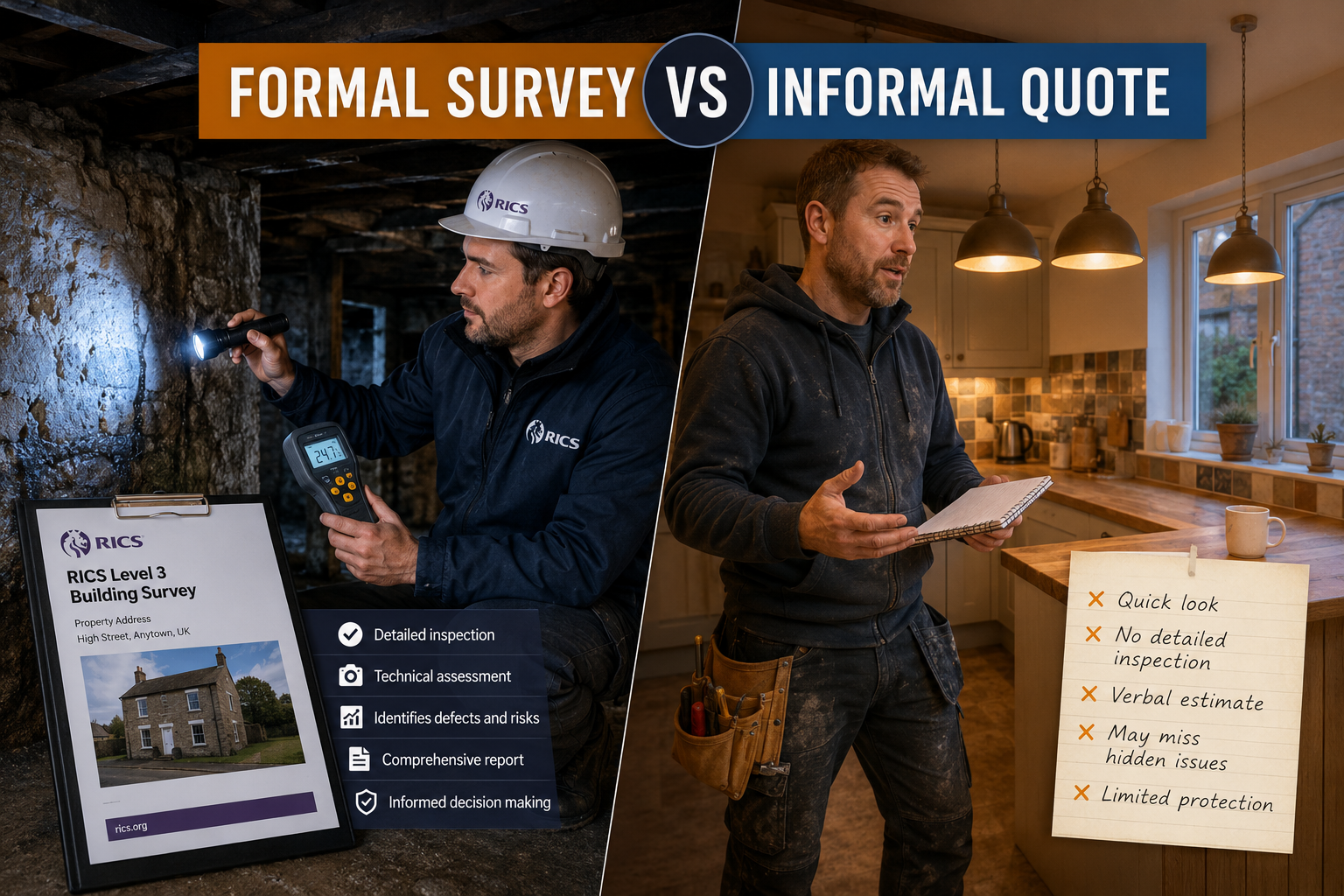
A builder's assessment is not a survey. It is an estimate of the cost to carry out specific, usually visible, repair work. A competent builder will identify a cracked render panel, a sagging gutter, or a kitchen that needs replacing. They will price those items and submit a quote.
What a builder's quote is not designed to do:
| Factor | Chartered Surveyor | Builder's Quote |
|---|---|---|
| Structural analysis | Yes | Rarely |
| Hidden damp investigation | Yes | Only if visible |
| Written liability-backed report | Yes | No |
| Legal/planning flag | Yes | No |
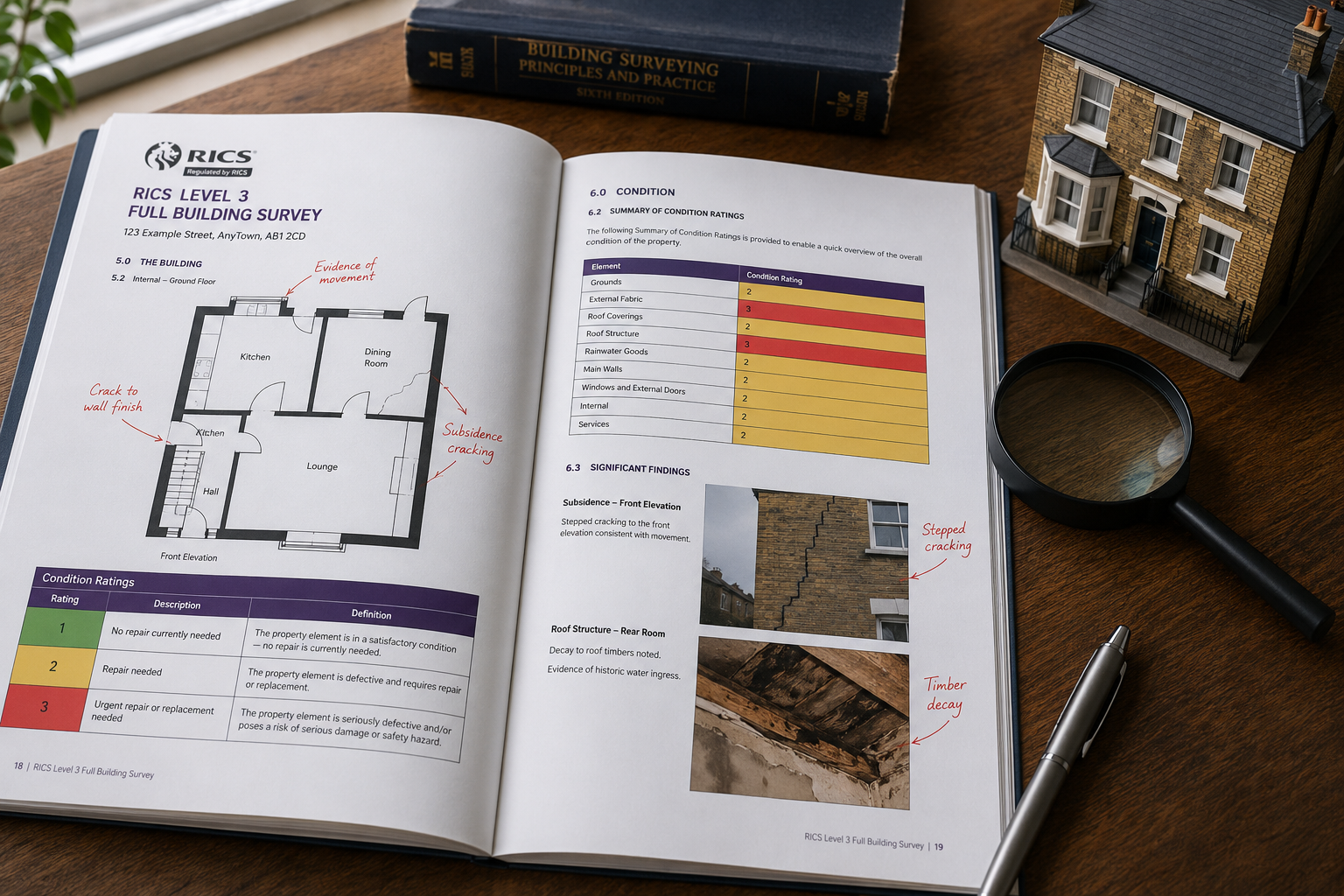
| Condition rating system | Yes (RICS 1-3) | No |
| Price negotiation document | Yes | Partial |
| Professional indemnity cover | Yes | No |
Builders are skilled tradespeople, but their commercial interest lies in securing the repair contract, not in providing a neutral, comprehensive assessment of the whole building [2]. A builder who spots a damp patch on a wall will price to treat that patch. A chartered surveyor will investigate whether that patch is symptomatic of a failed cavity wall tie, a bridged damp-proof course, or a drainage problem that runs under the entire ground floor — each of which carries a very different cost implication.
"A builder's quote tells you what it costs to fix what they can see. A chartered surveyor's report tells you what you are actually buying."
This distinction matters enormously when making one of the largest financial decisions of a lifetime.
Scenarios Where a Chartered Surveyor Is Essential
Understanding when do you need a chartered building surveyor rather than a builder's quote requires looking at the specific circumstances of the property and transaction. The following scenarios should be treated as strong indicators that a formal survey is non-negotiable.
Older and Period Properties
Any property built before 1930 — Victorian, Edwardian, or earlier — will have construction methods, materials, and layouts that require specialist knowledge to assess properly. Lime mortar pointing, solid wall construction, original timber floors, and older drainage systems all behave differently from modern builds and carry specific failure modes that a general builder may not recognise [5].
For buyers of Edwardian and older homes, understanding what a building surveyor looks for in period properties can help set realistic expectations before commissioning a survey.
Properties with Visible Defects
If cracks are visible in external brickwork, if floors feel uneven, if there are stains on ceilings, or if doors and windows are sticking, these are surface signals of potentially significant structural or moisture-related problems beneath. A builder may patch the visible symptom. A chartered surveyor will investigate the cause and assess whether the underlying issue is stable, progressive, or urgent.
Pre-Purchase on Any Non-New-Build Property
Mortgage lenders typically commission a basic valuation — not a survey. A valuation confirms the property is worth the loan amount; it does not assess condition in any meaningful depth. Buyers who rely solely on a mortgage valuation are taking a significant and largely unnecessary risk. The RICS building survey guide for homebuyers explains why this distinction matters so much in practice.
Before Major Renovation or Extension
If planning a loft conversion, rear extension, or structural alteration, a chartered surveyor can assess whether the existing structure is capable of supporting the proposed works and flag any pre-existing defects that would need remedying first. Understanding home extension cost considerations alongside a formal survey gives buyers a realistic picture of total project cost before committing.
Leasehold Properties
Leasehold purchases carry additional complexity. Service charges, major works obligations, and the condition of shared fabric all affect value and future liability. A chartered surveyor can assess the physical condition of the building as a whole, not just the individual flat — something a builder's quote on a single unit will never capture. For leasehold buyers, leasehold extension and enfranchisement valuations are a related consideration worth exploring.
The Real Cost of Getting This Wrong: Missed Structural Risks
The financial consequences of relying on a builder's opinion rather than a formal survey can be severe. Consider these real-world categories of missed risk:
Subsidence and Foundation Movement
A builder visiting a property may note cosmetic cracking and suggest repointing. A chartered surveyor will assess crack patterns, their location relative to structural elements, and whether movement is historic or active. Active subsidence can cost tens of thousands of pounds to remediate and may make a property unmortgageable or uninsurable without specialist cover.
Roof Structure Defects
Roof coverings are often partially visible; roof structures rarely are. Decayed rafters, failed trussed rafter joints, or inadequate support for a heavy tile covering may not be apparent from a visual inspection at ground level. A chartered surveyor will access roof voids where safe to do so and assess structural condition directly. For buyers wanting to understand what this inspection involves, the article on what a building surveyor can access during an inspection is a useful reference.
Damp and Timber Decay
Rising damp, penetrating damp, and condensation are frequently misdiagnosed — even by experienced builders. Chartered surveyors use calibrated moisture meters, thermal imaging where appropriate, and systematic investigation protocols to distinguish between causes. Untreated timber decay behind plasterwork can compromise floor joists and wall plates at significant cost. The causes of moisture in buildings article provides helpful background on how these problems develop.
Drainage and Services
A builder's quote will rarely include a drain survey or assessment of underground services. Collapsed drains, tree root ingress, or shared drainage arrangements can represent substantial liabilities invisible to any surface inspection.
How Survey Findings Drive Price Negotiation
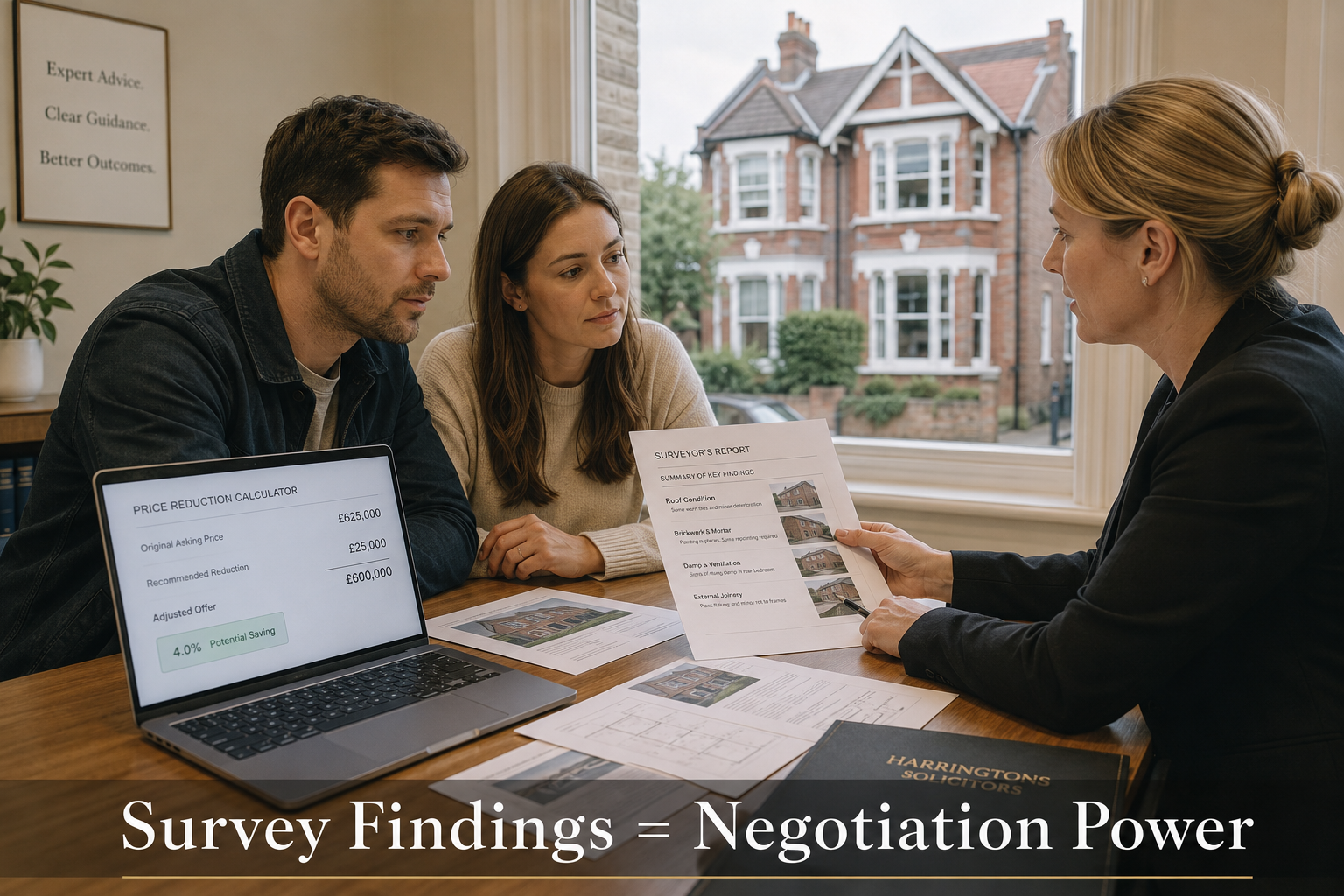
One of the most underappreciated practical benefits of commissioning a chartered building surveyor is the negotiation leverage a formal report provides. A written, professionally prepared document listing defects with condition ratings carries weight in a way that a builder's verbal estimate simply cannot.
Buyers who receive a Level 3 Full Building Survey identifying significant defects have a structured basis on which to:
- Request a formal price reduction from the vendor
- Ask the vendor to carry out remedial works before exchange
- Withdraw from the transaction without financial penalty if defects are material
Research consistently shows that survey findings result in meaningful price reductions in a significant proportion of transactions. For context on typical outcomes, the average price reduction after a survey provides useful data points for buyers entering negotiation.
A builder's quote, by contrast, is a commercial document produced by a party with an interest in carrying out the work. Vendors and their solicitors are unlikely to treat it with the same weight as a RICS-accredited surveyor's report.
Choosing the Right Level of Survey
Not all formal surveys are identical. RICS surveys are structured in three levels:
- Level 1 (Condition Report) — Basic condition overview, suitable for new or near-new properties in good condition
- Level 2 (Homebuyer Report) — Mid-range inspection with condition ratings, suitable for conventional properties in reasonable condition
- Level 3 (Full Building Survey) — Comprehensive investigation, recommended for older, larger, or defect-affected properties
For most resale properties, particularly those built before 1980 or showing any signs of defects, a Level 3 survey is the appropriate choice. The complete guide to choosing between Level 2 and Level 3 surveys helps buyers match the survey level to their specific property type and risk profile.
For buyers of new-build homes, the considerations are different — but a formal inspection is still advisable. The guide to surveys on new-build properties covers snagging and what to look for in that context.
Legal and Insurance Implications
Beyond the practical assessment of condition, a chartered surveyor's report carries legal and financial weight that a builder's quote does not.
Mortgage lender requirements: Many lenders will require a formal survey or valuation as a condition of the mortgage offer. A builder's quote does not satisfy this requirement.
Insurance: Some insurers require a survey report before providing buildings insurance on older or non-standard properties. A RICS report provides the documented evidence insurers need to set appropriate cover [5].
Legal disputes: If a defect emerges after purchase and the buyer wishes to pursue a claim — whether against the vendor for misrepresentation or against a surveyor for negligence — a formal RICS report is the documentary foundation of any such case. A builder's verbal assessment provides no such protection.
Planning and building regulations: Chartered surveyors are trained to identify signs of works carried out without consent. Unauthorised extensions, removed load-bearing walls, or loft conversions without building regulations approval can create significant legal complications at sale or remortgage. Identifying these issues before exchange allows buyers to seek indemnity insurance or require the vendor to regularise the works.
Conclusion: Making the Right Call Before Exchange
The central question — when do you need a chartered building surveyor rather than a builder's quote — has a clear answer for the vast majority of UK property purchases: almost always.
A builder's quote has genuine value once a property is purchased and specific repair works need pricing. It is not a substitute for independent, professional, liability-backed assessment of a property's overall condition before committing to buy.
Actionable next steps for UK homebuyers in 2026:
- Commission a Level 2 or Level 3 RICS survey on any resale property before exchange — match the level to the property's age and condition using the guides linked throughout this article.
- Do not rely on a mortgage valuation as a proxy for a condition survey — they serve entirely different purposes.
- Use survey findings as a structured negotiation tool, not just a list of problems.
- For older, period, or visibly defective properties, always opt for a Level 3 Full Building Survey rather than a Level 2 Homebuyer Report.
- Verify that any surveyor commissioned holds current RICS membership — check the RICS Find a Surveyor register directly.
The survey fee — typically between £500 and £1,500 depending on property size and survey level — is a modest cost relative to the purchase price and the potential cost of undetected defects. The professional accountability, written documentation, and negotiation leverage it provides are simply not available from any informal builder's assessment.
References
[1] What Is A Chartered Surveyor – rics.org
[2] Shall I Get My Builder Uncle To Check Out A House I M Buying Or A Professional Surveyor What S The – rellimsurveyors.co.uk
[3] Chartered Building Surveyor – regulated-professions.service.gov.uk
[4] What Is A Building Surveyor – rics.org
[5] What Is A Chartered Surveyor – reallymoving.com
[6] Chartered Surveyor – rics.org
How Prince Surveyors can help: explore our Level 3 building surveys or learn about our Level 2 vs Level 3 guide.