The RICS UK Residential Market Survey for early 2026 carries a phrase that should be on every valuation surveyor's radar: "early signs of recovery." After more than two years of subdued transaction volumes, compressed buyer demand, and relentless downward pressure on agreed prices, the needle has shifted. New buyer enquiries are rising. Agreed sales are ticking upward. And price expectations — flat for so long — are turning cautiously positive in most regions.
For valuation surveyors, this is not simply good news to relay to clients. It is a direct signal to revisit how risk is weighted, how commentary is framed, and how comparable evidence is selected and presented. Understanding what the 2026 RICS residential market turnaround means for valuation surveyors: risk weighting, commentary and client advice is now a professional obligation — not an optional update.

Key Takeaways 📋
- The 2026 RICS Residential Market Survey signals a cautious but meaningful recovery — surveyors must update risk weightings accordingly.
- Comparable evidence strategies need to shift: recent sales carry more evidential weight than stale pre-recovery transactions.
- Valuation commentary caveats should reflect market direction, not just a static snapshot.
- Client advice must be honest about the difference between a genuine turnaround and a temporary uptick.
- Professional liability risk increases when surveyors fail to update their methodology during market transitions.
Understanding the 2026 RICS Market Signal: What Has Actually Changed?
The RICS UK Residential Market Survey is the profession's most widely cited barometer of sentiment and activity. Its net balance scores — measuring the difference between surveyors reporting rises versus falls — have been negative or flat on price expectations since mid-2022. The shift observed in early 2026 is therefore statistically and professionally significant.
Key indicators from the early 2026 survey data include:
| Indicator |
Previous 12-Month Trend |
Early 2026 Signal |
| New Buyer Enquiries |
Negative net balance |
Turning positive |
| Agreed Sales |
Flat to declining |
Modest positive |
| Price Expectations (3-month) |
Negative |
Marginally positive |
| Price Expectations (12-month) |
Negative |
Clearly positive |
| Instruction Levels |
Rising (supply-led) |
Stabilising |
This combination — rising demand meeting stabilising supply — is the classic precondition for price recovery. However, the word "cautious" matters enormously. The RICS commentary consistently qualifies this recovery with references to affordability constraints, mortgage rate sensitivity, and regional variation.
💬 "A market turning from flat to cautiously rising is not the same as a bull market. Surveyors who conflate the two in their commentary expose themselves to professional risk on both sides."
For surveyors, the implication is clear: the methodology applied during a declining or static market is no longer fit for purpose without adjustment.
How Risk Weighting Must Shift in a Recovering Residential Market
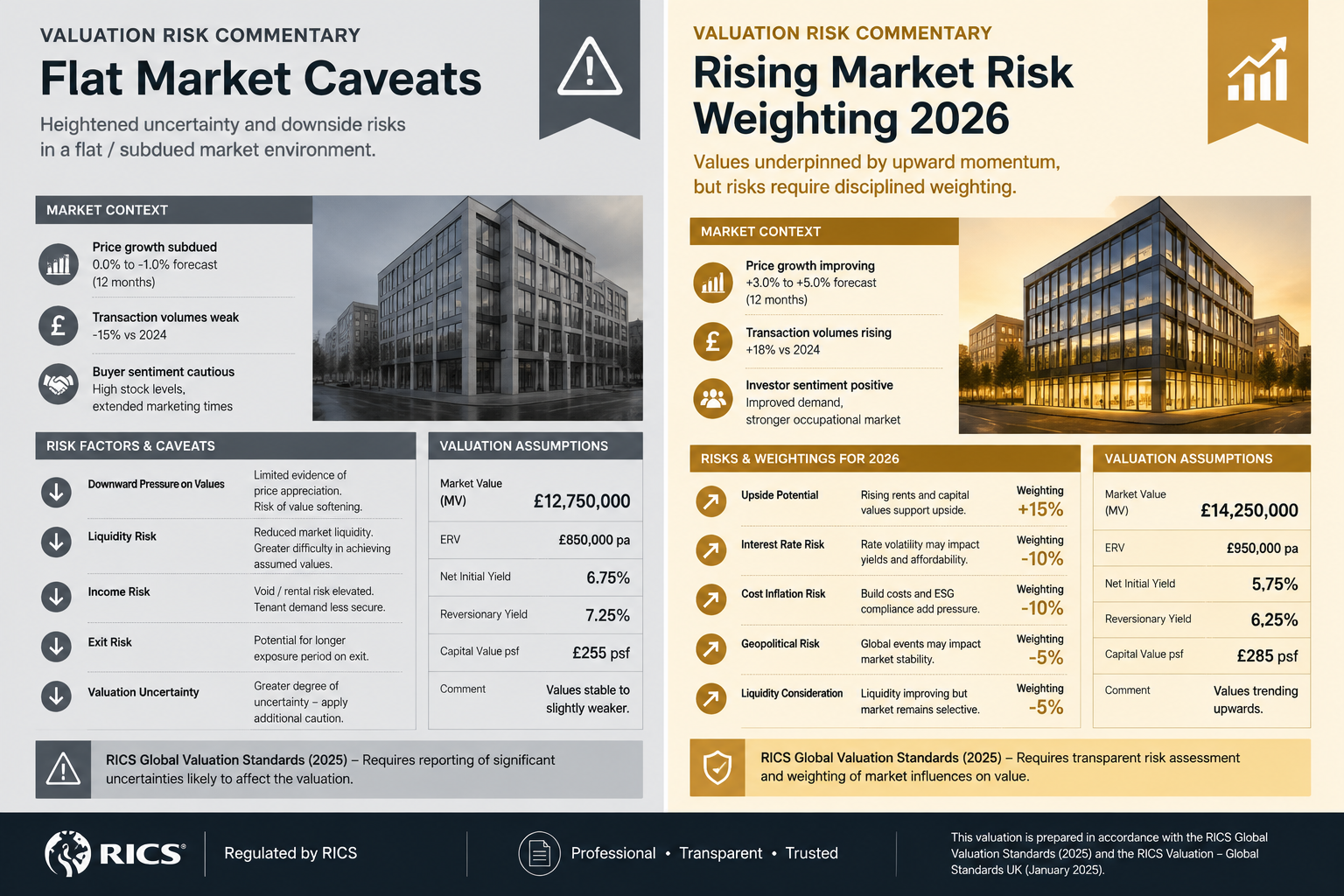
The concept of risk weighting in residential valuation refers to the degree of caution applied to the opinion of value — and how that caution is communicated in the report. During a falling market, surveyors typically weight their comparables conservatively, apply downward adjustments for time, and include strong caveats about market uncertainty.
A recovering market demands a recalibration of this approach. Getting it wrong in either direction creates professional exposure.
The Danger of Over-Caution in a Rising Market
When surveyors continue to apply falling-market risk weights during a recovery, the result is systematic undervaluation. This creates real-world harm:
- Mortgage lenders decline applications on properties that would support the loan
- Vendors receive misleading signals about achievable prices
- Buyers lose confidence in transactions that are fundamentally sound
The RICS Building Survey: why it's essential for home buyers principle applies here too — the value of professional surveying lies in accuracy, not reflexive conservatism.
The Danger of Under-Caution in an Early Recovery
Equally, a surveyor who treats early recovery signals as confirmation of a sustained bull run risks overvaluation. Early recoveries are fragile. Mortgage rate movements, employment data, or policy changes can reverse sentiment quickly. The RICS survey itself uses careful language for a reason.
A Practical Risk Weighting Framework for 2026
The following framework helps surveyors calibrate their approach during this transitional period:
🔴 High Caution Zones:
- Properties in locations where the recovery signal is weakest (check regional RICS data)
- Properties with structural issues that limit buyer pool (see Level 3 Building Survey guidance)
- Properties reliant on a single buyer type (e.g., first-time buyers highly sensitive to mortgage rates)
🟡 Moderate Caution Zones:
- Standard residential stock in recovering but not yet robust markets
- Properties where comparable evidence spans the flat-to-recovery transition
- New build properties where snagging issues may affect buyer confidence
🟢 Lower Caution Zones:
- Prime locations with strong demand fundamentals and limited supply
- Properties with recent, clean comparable evidence from post-recovery sales
- Properties where multiple offers have been received (strong market evidence)
Adjusting Valuation Commentary and Caveats: Practical Guidance
The commentary section of a residential valuation report is where professional judgement is most visible — and most scrutinised. Understanding what the 2026 RICS residential market turnaround means for valuation surveyors: risk weighting, commentary and client advice requires a direct look at how standard caveats need updating.
Outdated Commentary Patterns to Retire
During the 2022–2025 flat/declining period, many surveyors adopted standard caveat language such as:
- "The market remains uncertain and prices may be subject to further downward pressure."
- "Limited transaction volumes make it difficult to establish robust comparable evidence."
- "The opinion of value reflects current subdued market conditions."
These caveats were appropriate then. Applying them unchanged in 2026 is factually misleading and potentially negligent.
Updated Commentary Principles for 2026
1. Reflect market direction, not just market position
A valuation is a point-in-time opinion, but commentary should acknowledge the trajectory. Language such as:
"The opinion of value reflects current market conditions, which show early signs of recovery as evidenced by the RICS UK Residential Market Survey Q1 2026. Buyer enquiries are rising and price expectations are turning positive, though the recovery remains at an early stage and is subject to macroeconomic sensitivity."
This is more accurate, more useful, and more defensible.
2. Be specific about comparable evidence selection
In a transitional market, the age of comparables matters more than usual. A sale from 18 months ago reflects a different market. Surveyors should:
- Prioritise comparables from the last 3–6 months where available
- Apply explicit time adjustments where older comparables are used
- Note in commentary why certain comparables were weighted more heavily
3. Distinguish between sentiment and transaction evidence
The RICS survey measures sentiment — what surveyors expect. Transaction data from HM Land Registry measures outcomes. In an early recovery, sentiment often leads transactions by 3–6 months. Commentary should acknowledge this lag explicitly.
4. Address regional variation
The 2026 recovery is not uniform. London's prime markets, the South East, and parts of the Midlands are showing different trajectories. Surveyors operating across regions — for example, those covering Essex, Hampshire, or Oxfordshire — must tailor commentary to local conditions rather than applying a national narrative.
Comparable Evidence Strategy in a Transitional Market
Selecting and presenting comparable evidence is the technical backbone of residential valuation. The 2026 market transition creates specific challenges that require a deliberate strategy.
The Comparable Evidence Hierarchy for 2026
| Priority |
Comparable Type |
Weighting Guidance |
| 1st |
Sales agreed/completed post-recovery signal (Q4 2025–2026) |
Full weight |
| 2nd |
Sales from Q2–Q3 2025 (flat market, stabilising) |
Moderate weight with time adjustment |
| 3rd |
Sales from 2023–early 2025 (declining/flat market) |
Low weight; explicit downward adjustment needed |
| 4th |
Active listings (asking prices) |
Indicative only; note vendor expectations may lag recovery |
Handling Thin Evidence Markets
In locations where transaction volumes remain low — a legacy of the 2022–2025 slowdown — surveyors may face genuine comparable evidence gaps. The professional response is not to guess, but to:
- Extend the geographic search radius while noting this in commentary
- Use Land Registry price paid data with explicit time adjustments
- Reference RICS local market data and regional indices as supporting evidence
- Consider property development valuation principles where residual value analysis can supplement direct comparison
Client Advice in a Recovering Market: What Surveyors Should Be Saying

The professional duty of care extends beyond the written report. Verbal and written client advice must reflect the complexity of a transitional market. This is where what the 2026 RICS residential market turnaround means for valuation surveyors: risk weighting, commentary and client advice becomes most practically important.
For Buyer Clients 🏠
Buyers in 2026 face a specific dilemma: act now and potentially benefit from early recovery pricing, or wait and risk being priced out if recovery accelerates. Surveyors should not make this decision for clients, but should clearly communicate:
- What the valuation represents: A point-in-time opinion, not a guarantee of future value
- Market direction: The recovery signal is real but fragile
- Property-specific risks: Structural, legal, or condition issues that could limit resale value regardless of market conditions — a key reason why a thorough building survey remains essential
- Insurance implications: Ensure clients understand that insurance reinstatement cost valuations may need updating as rebuild costs have risen independently of market values
For Vendor Clients 🏷️
Vendors may be tempted to price aggressively on the back of positive market sentiment. Surveyors should advise:
- Early recovery pricing is not peak pricing — overpricing risks extended time on market
- Buyers remain mortgage-rate sensitive; affordability constraints are real
- Presentation and condition still matter significantly in a recovering market
For Lender Clients 🏦
Mortgage lenders rely on surveyors to protect their security. In a recovering market, lenders may push for higher valuations to support lending. The surveyor's obligation remains to provide an independent, evidence-based opinion. Key advice for lender-instructed work:
- Maintain independence; do not allow client pressure to inflate opinions
- Document comparable evidence selection rigorously
- Apply appropriate caveats about market trajectory without understating current values
For Matrimonial and Dispute Clients ⚖️
Surveyors instructed on matrimonial valuations or expert witness work face additional complexity in a transitional market. The date of valuation becomes critically important when market conditions are changing. Commentary must be precise about the specific market conditions on the valuation date and should not extrapolate recovery trends beyond what the evidence supports.
Professional Liability Considerations in a Market Transition
Market transitions are historically associated with increased professional negligence claims against surveyors. The reasons are structural:
- Lag in methodology update: Surveyors continue applying flat-market approaches in a rising market (or vice versa)
- Comparable evidence disputes: Parties disagree about which sales are most relevant
- Commentary ambiguity: Vague caveats that can be interpreted multiple ways
The RICS Red Book (Global Standards) is clear that valuers must take account of all relevant market evidence and market conditions at the date of valuation. In 2026, ignoring the recovery signal is not a defensible position.
Practical risk mitigation steps:
✅ Subscribe to and document review of RICS UK Residential Market Survey data monthly
✅ Maintain a contemporaneous record of comparable evidence considered and rejected
✅ Use clear, unambiguous language in commentary — avoid phrases that could be read as either bullish or bearish
✅ Seek peer review on complex or high-value instructions during transitional periods
✅ Ensure PI insurance coverage is current and adequate for the current market environment
Regional Spotlight: Where the Recovery Is Strongest in 2026
The national RICS signal masks significant regional variation. Surveyors should monitor local data actively. Based on early 2026 indicators:
- 🟢 Strong early recovery: South East commuter belt, select Midlands cities, coastal premium markets
- 🟡 Moderate recovery: Greater London (outer zones), South West, East of England
- 🔴 Lagging recovery: Parts of the North East, some urban flatted markets, high-rise new build sectors
For surveyors covering areas such as Guildford, Ealing, or Leatherhead, the South East recovery signal is particularly relevant and should be reflected in both risk weighting and commentary.
Conclusion: Actionable Next Steps for Valuation Surveyors in 2026
The 2026 RICS residential market turnaround is real, but it is not a green light to abandon professional rigour. The shift from flat to cautiously rising requires a deliberate, evidence-based recalibration — not a wholesale change of approach.
Immediate actions for valuation surveyors:
- Audit your standard caveat language — remove outdated declining-market language and replace with accurate 2026 market direction commentary
- Update your comparable evidence hierarchy — weight recent post-recovery sales more heavily and document this explicitly
- Regionalise your risk weighting — apply local RICS data, not just national sentiment, to every instruction
- Brief your clients clearly — distinguish between early recovery signals and confirmed sustained growth
- Review your PI position — market transitions increase claims risk; ensure coverage is adequate
- Stay current — commit to monthly review of RICS survey data and Land Registry transaction evidence
The surveyors who navigate this transition most effectively will be those who treat the 2026 recovery signal as a professional prompt to sharpen their methodology — not as permission to relax it. Accuracy, transparency, and evidence-based commentary remain the foundations of a defensible valuation in any market condition.


What the 2026 RICS Residential Market Turnaround Means for Valuation Surveyors: Risk Weighting, Commentary and Client Advice
The RICS UK Residential Market Survey for early 2026 carries a phrase that should be on every valuation surveyor's radar: "early signs of recovery." After more than two years of subdued transaction volumes, compressed buyer demand, and relentless downward pressure on agreed prices, the needle has shifted. New buyer enquiries are rising. Agreed sales are ticking upward. And price expectations — flat for so long — are turning cautiously positive in most regions.
For valuation surveyors, this is not simply good news to relay to clients. It is a direct signal to revisit how risk is weighted, how commentary is framed, and how comparable evidence is selected and presented. Understanding what the 2026 RICS residential market turnaround means for valuation surveyors: risk weighting, commentary and client advice is now a professional obligation — not an optional update.
Key Takeaways 📋
Understanding the 2026 RICS Market Signal: What Has Actually Changed?
The RICS UK Residential Market Survey is the profession's most widely cited barometer of sentiment and activity. Its net balance scores — measuring the difference between surveyors reporting rises versus falls — have been negative or flat on price expectations since mid-2022. The shift observed in early 2026 is therefore statistically and professionally significant.
Key indicators from the early 2026 survey data include:
This combination — rising demand meeting stabilising supply — is the classic precondition for price recovery. However, the word "cautious" matters enormously. The RICS commentary consistently qualifies this recovery with references to affordability constraints, mortgage rate sensitivity, and regional variation.
For surveyors, the implication is clear: the methodology applied during a declining or static market is no longer fit for purpose without adjustment.
How Risk Weighting Must Shift in a Recovering Residential Market
The concept of risk weighting in residential valuation refers to the degree of caution applied to the opinion of value — and how that caution is communicated in the report. During a falling market, surveyors typically weight their comparables conservatively, apply downward adjustments for time, and include strong caveats about market uncertainty.
A recovering market demands a recalibration of this approach. Getting it wrong in either direction creates professional exposure.
The Danger of Over-Caution in a Rising Market
When surveyors continue to apply falling-market risk weights during a recovery, the result is systematic undervaluation. This creates real-world harm:
The RICS Building Survey: why it's essential for home buyers principle applies here too — the value of professional surveying lies in accuracy, not reflexive conservatism.
The Danger of Under-Caution in an Early Recovery
Equally, a surveyor who treats early recovery signals as confirmation of a sustained bull run risks overvaluation. Early recoveries are fragile. Mortgage rate movements, employment data, or policy changes can reverse sentiment quickly. The RICS survey itself uses careful language for a reason.
A Practical Risk Weighting Framework for 2026
The following framework helps surveyors calibrate their approach during this transitional period:
🔴 High Caution Zones:
🟡 Moderate Caution Zones:
🟢 Lower Caution Zones:
Adjusting Valuation Commentary and Caveats: Practical Guidance
The commentary section of a residential valuation report is where professional judgement is most visible — and most scrutinised. Understanding what the 2026 RICS residential market turnaround means for valuation surveyors: risk weighting, commentary and client advice requires a direct look at how standard caveats need updating.
Outdated Commentary Patterns to Retire
During the 2022–2025 flat/declining period, many surveyors adopted standard caveat language such as:
These caveats were appropriate then. Applying them unchanged in 2026 is factually misleading and potentially negligent.
Updated Commentary Principles for 2026
1. Reflect market direction, not just market position
A valuation is a point-in-time opinion, but commentary should acknowledge the trajectory. Language such as:
This is more accurate, more useful, and more defensible.
2. Be specific about comparable evidence selection
In a transitional market, the age of comparables matters more than usual. A sale from 18 months ago reflects a different market. Surveyors should:
3. Distinguish between sentiment and transaction evidence
The RICS survey measures sentiment — what surveyors expect. Transaction data from HM Land Registry measures outcomes. In an early recovery, sentiment often leads transactions by 3–6 months. Commentary should acknowledge this lag explicitly.
4. Address regional variation
The 2026 recovery is not uniform. London's prime markets, the South East, and parts of the Midlands are showing different trajectories. Surveyors operating across regions — for example, those covering Essex, Hampshire, or Oxfordshire — must tailor commentary to local conditions rather than applying a national narrative.
Comparable Evidence Strategy in a Transitional Market
Selecting and presenting comparable evidence is the technical backbone of residential valuation. The 2026 market transition creates specific challenges that require a deliberate strategy.
The Comparable Evidence Hierarchy for 2026
Handling Thin Evidence Markets
In locations where transaction volumes remain low — a legacy of the 2022–2025 slowdown — surveyors may face genuine comparable evidence gaps. The professional response is not to guess, but to:
Client Advice in a Recovering Market: What Surveyors Should Be Saying
The professional duty of care extends beyond the written report. Verbal and written client advice must reflect the complexity of a transitional market. This is where what the 2026 RICS residential market turnaround means for valuation surveyors: risk weighting, commentary and client advice becomes most practically important.
For Buyer Clients 🏠
Buyers in 2026 face a specific dilemma: act now and potentially benefit from early recovery pricing, or wait and risk being priced out if recovery accelerates. Surveyors should not make this decision for clients, but should clearly communicate:
For Vendor Clients 🏷️
Vendors may be tempted to price aggressively on the back of positive market sentiment. Surveyors should advise:
For Lender Clients 🏦
Mortgage lenders rely on surveyors to protect their security. In a recovering market, lenders may push for higher valuations to support lending. The surveyor's obligation remains to provide an independent, evidence-based opinion. Key advice for lender-instructed work:
For Matrimonial and Dispute Clients ⚖️
Surveyors instructed on matrimonial valuations or expert witness work face additional complexity in a transitional market. The date of valuation becomes critically important when market conditions are changing. Commentary must be precise about the specific market conditions on the valuation date and should not extrapolate recovery trends beyond what the evidence supports.
Professional Liability Considerations in a Market Transition
Market transitions are historically associated with increased professional negligence claims against surveyors. The reasons are structural:
The RICS Red Book (Global Standards) is clear that valuers must take account of all relevant market evidence and market conditions at the date of valuation. In 2026, ignoring the recovery signal is not a defensible position.
Practical risk mitigation steps:
✅ Subscribe to and document review of RICS UK Residential Market Survey data monthly
✅ Maintain a contemporaneous record of comparable evidence considered and rejected
✅ Use clear, unambiguous language in commentary — avoid phrases that could be read as either bullish or bearish
✅ Seek peer review on complex or high-value instructions during transitional periods
✅ Ensure PI insurance coverage is current and adequate for the current market environment
Regional Spotlight: Where the Recovery Is Strongest in 2026
The national RICS signal masks significant regional variation. Surveyors should monitor local data actively. Based on early 2026 indicators:
For surveyors covering areas such as Guildford, Ealing, or Leatherhead, the South East recovery signal is particularly relevant and should be reflected in both risk weighting and commentary.
Conclusion: Actionable Next Steps for Valuation Surveyors in 2026
The 2026 RICS residential market turnaround is real, but it is not a green light to abandon professional rigour. The shift from flat to cautiously rising requires a deliberate, evidence-based recalibration — not a wholesale change of approach.
Immediate actions for valuation surveyors:
The surveyors who navigate this transition most effectively will be those who treat the 2026 recovery signal as a professional prompt to sharpen their methodology — not as permission to relax it. Accuracy, transparency, and evidence-based commentary remain the foundations of a defensible valuation in any market condition.