

By 2026, approximately 19 million UK homes still carry an EPC rating of D or below — yet the government's £15 billion Warm Homes Plan, launched in January 2026, has placed retrofit squarely at the centre of housing policy [1]. For chartered surveyors, this creates a pressing challenge: standard EPC ratings alone cannot capture the full economic story of a property's retrofit potential. Valuing UK properties with high retrofit potential — and helping buyers, lenders, and investors understand what 'future‑ready' really means — is now one of the most complex and consequential tasks in residential surveying. This article sets out a practical, Red Book‑compliant framework for quantifying that potential in 2026.
Key Takeaways 📋
- EPCs are a starting point, not a valuation tool — surveyors must go further by assessing fabric performance, retrofit pathways, and grant eligibility.
- The RICS Residential Retrofit Standard (2024) and mandatory ESG integration (from April 2026) have fundamentally changed how surveyors must document sustainability factors [2][4].
- Properties with EPC A ratings command a measurable 2.9% price premium per square metre; poor-rated stock faces growing discount pressure [6].
- Retrofit assessments cost £150–£400 and provide far greater depth than EPCs, making them a critical tool for informed valuations [8].
- Digital technology — including thermal imaging, drones, and 3D modelling — is transforming how surveyors assess fabric performance and retrofit viability [7].
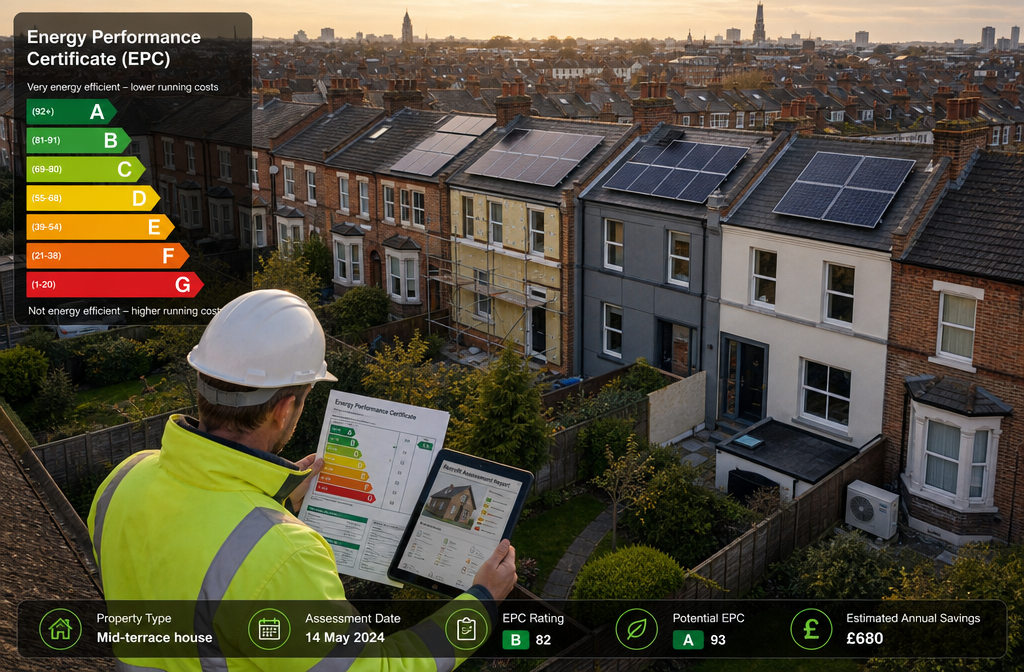
Why EPCs Fall Short: The Case for Retrofit-Informed Valuations
An Energy Performance Certificate tells you where a property sits today. It does not tell you how easily it could reach EPC B or A, what that journey would cost, or how much value that journey could unlock. For surveyors tasked with producing Red Book‑compliant valuations on older UK stock — Victorian terraces, Edwardian semis, 1930s bungalows — this gap is significant.
"The EPC is a snapshot. A retrofit-informed valuation is a roadmap."
Consider a solid-wall Victorian mid-terrace in South East London. Its EPC rating of E reflects its current fabric performance. But if the property sits in a street where the local authority is running a group retrofit scheme, has a south-facing roof suitable for solar PV, and qualifies for Great British Insulation Scheme funding, its realistic future value trajectory looks very different from a comparable property with none of those attributes. A valuation that ignores this context is incomplete.
What the RICS Residential Retrofit Standard Requires
In March 2024, RICS introduced the Residential Retrofit Standard to establish consistent, high-quality practice across the profession [2]. The standard requires surveyors to:
- Assess existing fabric performance — not just the EPC rating, but the actual condition of walls, roofs, floors, and glazing.
- Identify retrofit pathways — what measures are technically feasible given the building's construction type and condition.
- Flag grant and finance eligibility — including Warm Homes Plan funding, ECO4 obligations, and local authority schemes.
- Comment on installation quality risks — particularly relevant given the surge in heat pump and insulation installations under the Warm Homes Plan [1].
For surveyors carrying out a Level 3 Full Building Survey, this standard provides a natural framework for integrating retrofit commentary into the wider condition assessment.
ESG Integration: Now Mandatory
From 30 April 2026, RICS mandates the systematic integration of Environmental, Social, and Governance (ESG) factors into property valuations [4]. While this requirement initially targets commercial property, its principles are rapidly influencing residential practice. Surveyors are expected to:
- Identify and quantify sustainability-related value drivers (e.g., low running costs, renewable energy generation).
- Flag stranding risks — the likelihood that a property will become unmortgageable or unsaleable if minimum EPC standards tighten further.
- Document how retrofit potential affects market value, investment value, and special purchaser value under Red Book GN1 guidance.
A Practical Framework for Quantifying Retrofit Potential
Valuing UK properties with high retrofit potential requires surveyors to move beyond qualitative commentary and build a structured, evidence-based assessment into their reports. The following framework draws on current RICS guidance, the Warm Homes Plan, and emerging best practice.
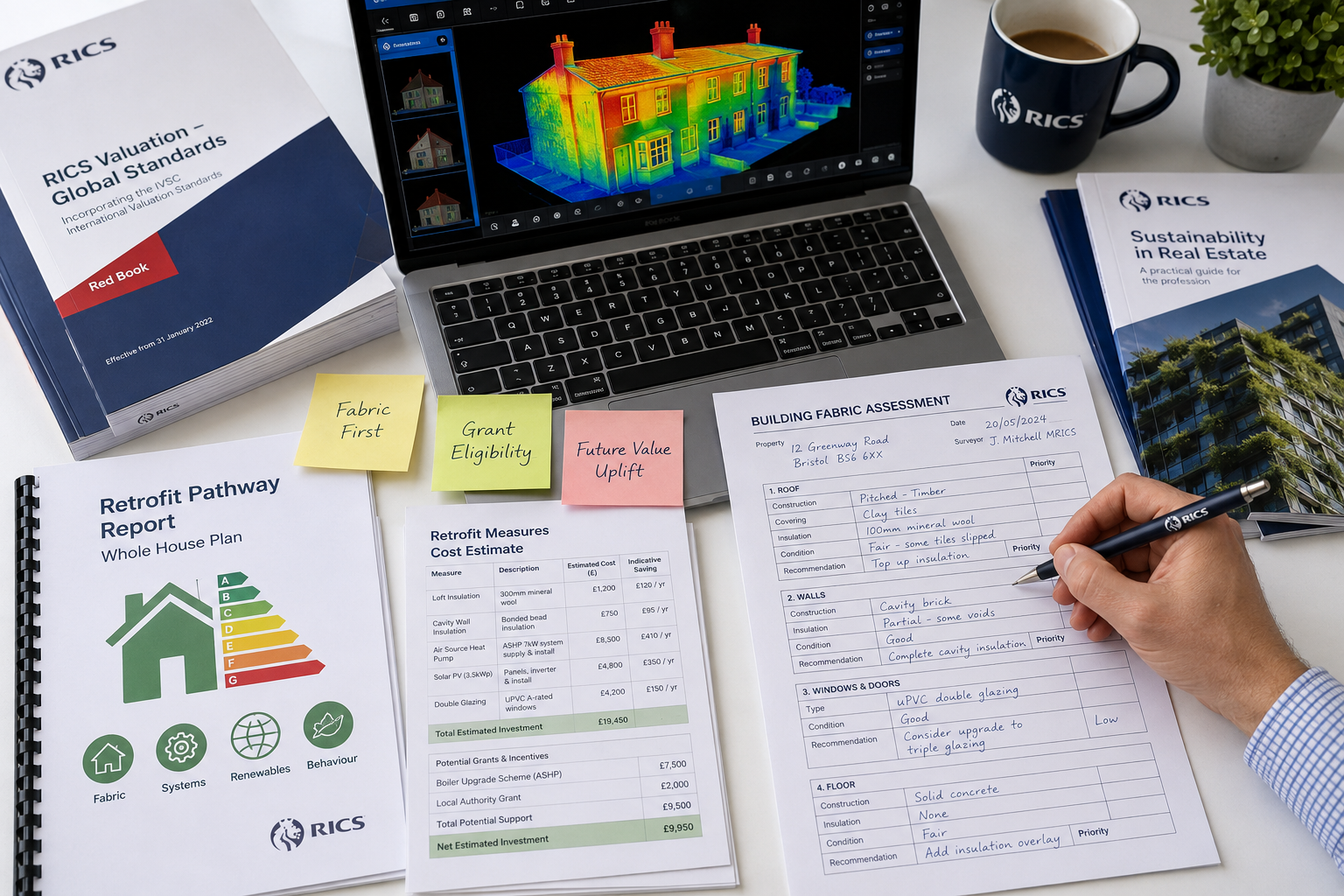
Step 1: Fabric-First Assessment 🏗️
The fabric-first principle — improving the building envelope before adding mechanical systems — is central to effective retrofit. Surveyors should assess:
| Building Element | Key Indicators | Retrofit Potential Score |
|---|---|---|
| External walls | Construction type (cavity/solid), existing insulation, condition | High / Medium / Low |
| Roof | Pitch, access, existing insulation depth, structural condition | High / Medium / Low |
| Windows & doors | Glazing type, frame condition, draught-proofing | High / Medium / Low |
| Floor | Suspended timber vs. solid, underfloor heating compatibility | High / Medium / Low |
| Services | Boiler age, radiator sizing, electrical capacity for EV/heat pump | High / Medium / Low |
A building pathology assessment is particularly valuable here, helping identify latent defects — such as moisture ingress or wood rot — that could undermine retrofit measures if left unaddressed. Understanding what causes moisture in buildings is essential before specifying insulation, since trapping moisture behind new cladding can cause serious structural damage.
Step 2: Retrofit Pathway Mapping
Once fabric performance is assessed, surveyors should map realistic retrofit pathways — the sequence of measures that will deliver the greatest energy and carbon savings for the least cost and disruption. Key considerations include:
- Construction type constraints: Solid-wall properties require external or internal wall insulation; cavity-wall properties are generally simpler and cheaper to treat.
- Heritage and planning restrictions: Listed buildings and properties in conservation areas face significant constraints on external alterations.
- Phasing: Not all measures need to happen at once. A credible pathway might span 5–10 years, with the most cost-effective measures first.
- Interaction effects: Installing a heat pump before improving insulation can be counterproductive. The sequence matters.
Retrofit assessments — which cost between £150 and £400 depending on property size and complexity — provide this level of detail and should be referenced or commissioned as part of the valuation process where appropriate [8].
Step 3: Grant and Finance Eligibility 💰
The Warm Homes Plan represents a generational shift in government support for home retrofit [1]. Surveyors should note in their valuation commentary:
- Great British Insulation Scheme eligibility (income-based and area-based criteria).
- Boiler Upgrade Scheme grants (currently £7,500 for air source heat pumps).
- Local authority flex funding — many councils are running area-based schemes targeting specific street types or tenure groups.
- Green mortgage products — lenders increasingly offer preferential rates for EPC A/B properties, which can affect mortgage valuation assumptions.
Grant eligibility can materially affect the net cost of achieving a higher EPC rating — and therefore the value differential between a property's current and future-ready state.
Step 4: Quantifying the Value Impact
Research consistently shows that energy efficiency is being priced into the UK market [6]. Key data points for 2026:
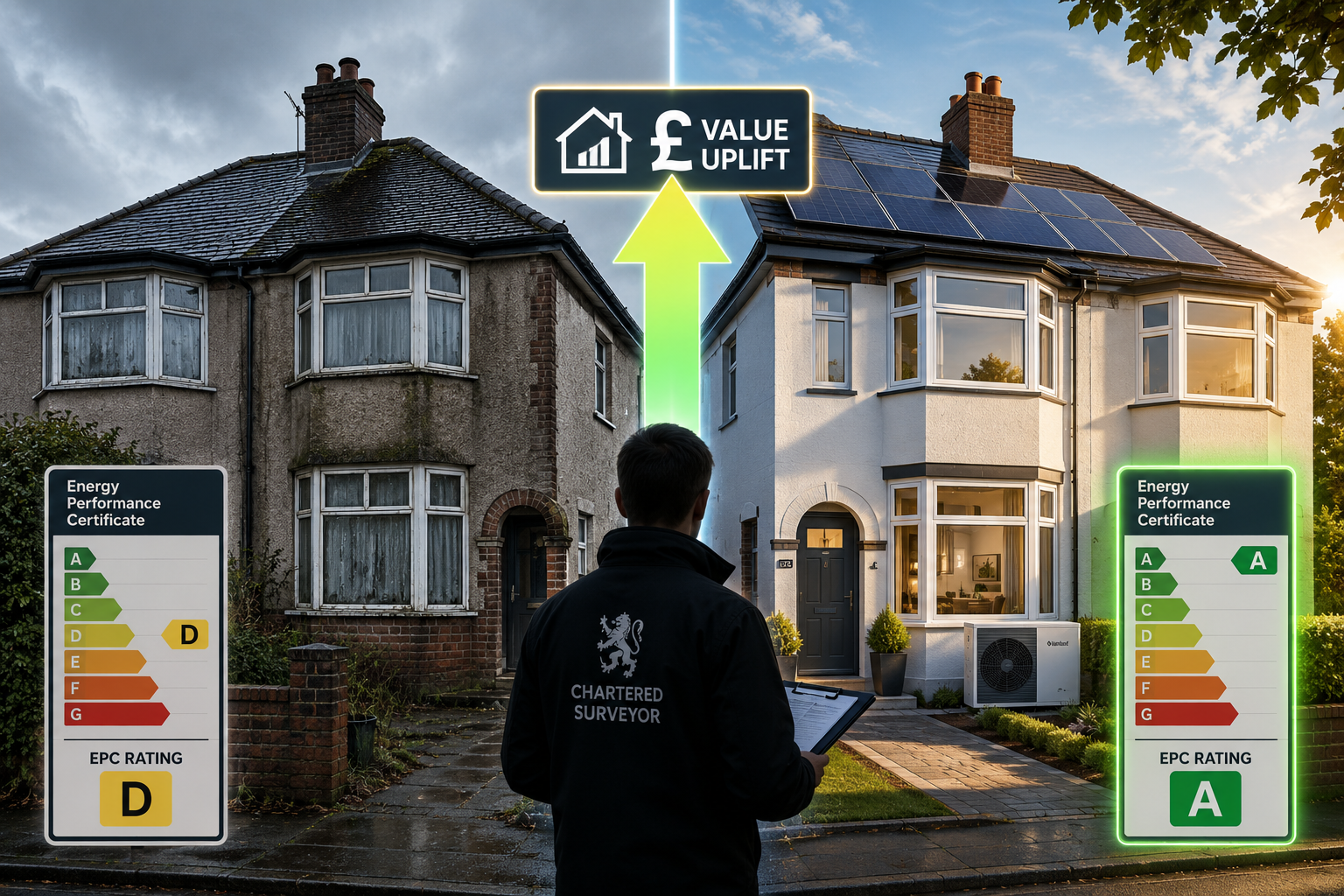
- EPC A-rated properties command a 2.9% premium per square metre over equivalent D-rated stock.
- EPC B and C properties may trade at discounts relative to A-rated equivalents, increasing the incentive for deep retrofit.
- The premium is most pronounced in owner-occupier markets and in areas with high energy costs.
For surveyors, the challenge is translating these averages into property-specific adjustments. The approach should be:
- Identify comparable sales with and without retrofit features in the subject property's market area.
- Apply a paired sales analysis where sufficient data exists.
- Where market evidence is thin, use a cost-to-cure approach — estimating the cost of achieving a target EPC rating and discounting this from the 'future-ready' value.
- Document assumptions transparently in Red Book valuation commentary, including sensitivity to grant availability and market conditions.
Step 5: Technology-Assisted Assessment 🔬
Building surveying in 2026 has been transformed by digital tools that make fabric assessment faster, more accurate, and more defensible [7]:
- Thermal imaging cameras: Identify cold bridges, missing insulation, and air leakage paths invisible to the naked eye.
- Drone surveys: Assess roof condition, chimney stacks, and solar PV suitability without scaffolding — particularly relevant given the role of roof condition in retrofit viability.
- 3D modelling and BIM tools: Create accurate fabric models for energy modelling and retrofit planning.
- Remote assessment platforms: Zero-contact valuations using photo imagery and questionnaires are increasingly used for preliminary assessments [10].
Surveyors should note that technology assists but does not replace professional judgement. The sourcing of specialist advice — from energy assessors, structural engineers, and mechanical services consultants — remains essential for complex retrofit cases.
Communicating Retrofit Potential in Red Book‑Compliant Reports
Valuing UK properties with high retrofit potential: how surveyors can quantify 'future‑ready' homes in 2026 is ultimately a question of professional communication as much as technical assessment. RICS members are integral to the UK's national retrofit strategy [5], and the quality of their written commentary directly shapes buyer, lender, and investor decisions.
What to Include in Valuation Commentary
A Red Book‑compliant valuation report on a property with significant retrofit potential should include the following elements:
1. Current fabric performance summary
- Describe construction type, estimated U-values where assessable, and visible deficiencies.
- Reference the EPC rating but contextualise it — note whether it reflects actual performance or a modelled estimate.
2. Retrofit potential narrative
- Identify the most impactful measures available given the property's construction and condition.
- Note any constraints (heritage, planning, structural) that would limit retrofit options.
3. Grant and finance landscape
- Summarise relevant funding streams available at the date of valuation.
- Note that availability is subject to change and recommend specialist advice.
4. Market value commentary
- Quantify the energy efficiency premium or discount applicable in the subject market.
- Where a cost-to-cure approach is used, set out the methodology clearly.
- Distinguish between Market Value (reflecting current market sentiment) and Investment Value (reflecting the specific buyer's ability to access grants or finance).
5. Risk flags
- Flag stranding risk if the property is likely to fall below future minimum EPC thresholds.
- Note any installation quality concerns relating to recent retrofit works — a growing issue as the Warm Homes Plan drives rapid installation [1].
Cladding and Multi-Storey Considerations
For flats in multi-storey buildings, surveyors must also apply the RICS second edition standard for valuing homes with cladding, effective from November 2026 [3]. Retrofit potential in these buildings is often constrained by:
- Shared ownership of the building envelope.
- Leaseholder consent requirements.
- Complex fire safety interactions with external wall insulation systems.
Surveyors working in this space should ensure their valuation commentary addresses both the retrofit opportunity and the governance constraints that affect its deliverability.
Budgeting for Retrofit: Helping Clients Plan Ahead
Part of a surveyor's value-add is helping clients understand the financial journey ahead. The budgeting for repairs and restoration section of a Level 3 survey is a natural place to integrate retrofit cost estimates alongside conventional repair costs. This gives buyers a complete picture of the investment required to bring a property to future-ready standard.
Typical retrofit cost ranges for common UK property types (2026 estimates):
| Measure | Typical Cost Range | Potential Grant Support |
|---|---|---|
| Cavity wall insulation | £500 – £1,500 | ECO4 / GBIS |
| External wall insulation (solid wall) | £8,000 – £20,000 | Warm Homes Plan |
| Loft insulation (top-up) | £300 – £600 | ECO4 / GBIS |
| Air source heat pump | £8,000 – £15,000 | Boiler Upgrade Scheme (£7,500) |
| Solar PV (4kW system) | £5,000 – £8,000 | Smart Export Guarantee |
| Triple glazing (whole house) | £8,000 – £15,000 | Limited direct grant support |
Conclusion: Actionable Next Steps for Surveyors in 2026
The shift toward retrofit-informed valuation is not a future trend — it is the professional standard expected of chartered surveyors right now. Here are the key actions to take:
✅ Upskill in retrofit assessment methodology — RICS and the Retrofit Academy both offer relevant CPD. RICS members are expected to be active participants in the national retrofit strategy [5].
✅ Integrate fabric-first assessment into every Level 3 survey — treat retrofit potential as a standard section, not an optional add-on. A full building survey is the appropriate vehicle for this level of analysis.
✅ Build a network of specialist advisers — energy assessors, retrofit coordinators, and mechanical services engineers whose input can be referenced in valuation commentary.
✅ Stay current on grant landscapes — the Warm Homes Plan funding streams are evolving rapidly. Valuations should note the date-specific grant position and recommend clients seek up-to-date advice.
✅ Use technology to strengthen evidence — thermal imaging and drone surveys provide defensible, objective evidence of fabric performance that strengthens both the survey and the valuation.
✅ Document ESG factors explicitly — from April 2026, this is a mandatory element of valuation practice [4]. Build it into your standard report templates now.
The UK's 19 million under-performing homes represent both a national challenge and a professional opportunity. Surveyors who can confidently quantify retrofit potential — going well beyond the EPC — will provide clients with genuinely valuable guidance and position themselves at the forefront of a rapidly evolving market.
References
[1] Rpsa Welcomes The 15 Billion Warm Homes Plan A New Era For Residential Surveying 101 – rpsa.org.uk
[2] Residential Retrofit Standard Home Surveys – ww3.rics.org
[3] Rics Publishes Updated Standard For Valuation Of Homes In Multi Storey Residential Buildings With Cladding – housingmmonline.co.uk
[4] Rics Update The New Standard For Esg In Commercial Property Valuation – utopi.co.uk
[5] Retrofit Assessment Surveyors Upskilling – ww3.rics.org
[6] Valuation Techniques For Uk Net Zero Retrofit Projects Rics Standards Amid 2026 Epc Mandates – nottinghillsurveyors.com
[7] Current Trends In Building Surveying Whats Changing In 2026 – asg-consulting.co.uk
[8] Retrofit Assessment Cost Uk – myepcupgrade.co.uk
[9] Valuing Rental Properties Under The Renters Rights Act 2026 Surveyor Adjustments For Section 21 Abolition – canterburysurveyors.com
[10] Zero Contact Property Valuation – gatewaysurveyors.co.uk