

Only 7% of rental properties in England were previously advertised as pet-friendly — a figure that the Renters' Rights Act has now blown wide open. [2] Since Phase 1 of the legislation came into force on 1 May 2026, landlords can no longer simply say "no" to a tenant's request to keep a pet. The result? A seismic shift in how rental properties are valued, insured, and surveyed. For chartered surveyors and landlords alike, valuing properties with pet permissions under Renters' Rights Act: surveyor risk assessments for reasonable refusals in 2026 leases has become one of the most pressing professional challenges of the year.
Key Takeaways 📋
- From 1 May 2026, landlords cannot unreasonably refuse a tenant's request to keep a pet in a rental property. [3]
- Over four million homes across England could now be open to pets under the new law. [2]
- Surveyors play a critical role in producing risk assessments that justify or challenge a landlord's reasonable refusal.
- Pet permissions can affect property valuations, insurance premiums, and end-of-tenancy dilapidations assessments.
- Landlords who charge unlawful pet-related fees face penalties of up to £7,000. [3]
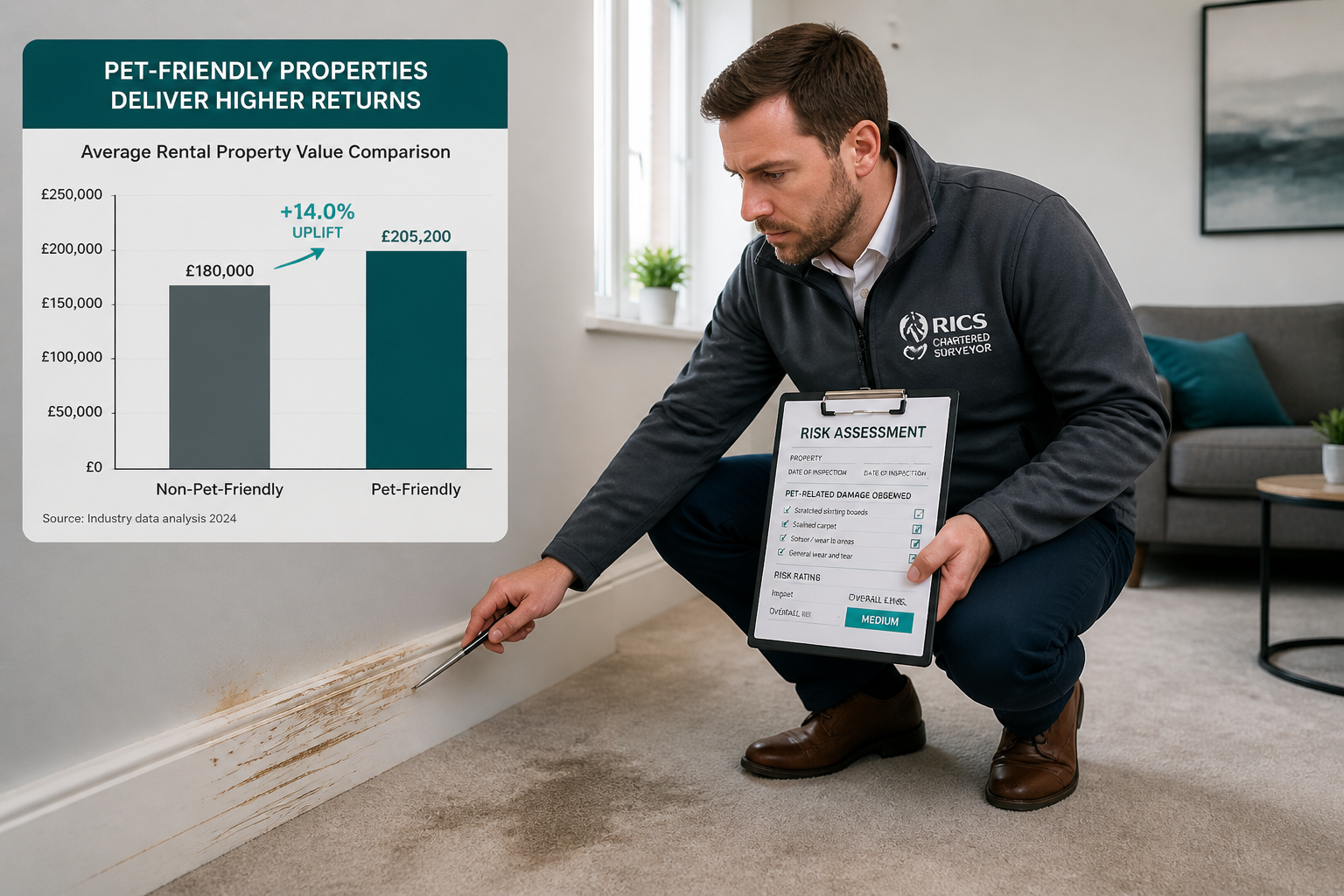
What the Renters' Rights Act 2026 Actually Changes for Pet Permissions
The Renters' Rights Act marks the most significant overhaul of the private rented sector in a generation. For tenants with pets, the change is transformative. Previously, most standard tenancy agreements contained blanket "no pets" clauses, and landlords faced no legal obligation to consider requests at all. [1]
The New Legal Baseline
Under the Act, which reached its critical Phase 1 milestone on 1 May 2026:
- All private tenancy agreements now include the right to request a pet, regardless of any existing no-pets clause. [3]
- Landlords must respond to a pet request within a defined timeframe and provide reasons if refusing.
- Tenants can formally challenge a refusal they consider unreasonable. [3]
- Section 21 "no-fault" evictions are abolished, meaning a landlord cannot evict a tenant simply for having a pet without consent. [3]
💬 "The abolition of Section 21 combined with mandatory pet request consideration fundamentally changes the risk calculus for every landlord in England."
What Counts as a "Reasonable Refusal"?
This is where the surveyor's role becomes essential. The Act does not define an exhaustive list of acceptable refusals, but accepted grounds include:
| Reason for Refusal | Likely Acceptability |
|---|---|
| Lease prohibits pets (leasehold property) | ✅ Likely acceptable |
| Property too small for the animal species | ✅ Likely acceptable |
| Structural vulnerability (e.g., listed building) | ✅ Likely acceptable |
| Tenant's allergies of other residents | ✅ Likely acceptable |
| General dislike of animals | ❌ Not acceptable |
| No specific reason given | ❌ Not acceptable |
For a landlord to mount a defensible refusal, professional evidence — typically from a chartered surveyor — is increasingly expected.
How Surveyors Conduct Risk Assessments for Pet Permissions
The surveyor's role in valuing properties with pet permissions under Renters' Rights Act: surveyor risk assessments for reasonable refusals in 2026 leases is not simply about identifying scratched skirting boards. It is a structured professional evaluation that feeds directly into legal and financial decisions.
The Risk Assessment Framework
A competent surveyor will typically assess the following factors:
1. Property Type and Construction
- Older properties with original timber floors, plaster walls, or heritage features carry higher risk from pet damage.
- A full building survey can identify pre-existing vulnerabilities that would be exacerbated by animal occupation.
2. Pet Species and Size
- A goldfish poses negligible structural risk. A large dog breed in a ground-floor flat is a different matter entirely.
- Surveyors categorise risk by species, breed, and number of animals.
3. Lease Conditions (Leasehold Properties)
- Many leasehold properties have superior lease terms that prohibit animals. A surveyor familiar with leasehold extension and enfranchisement valuations will understand how these covenants interact with the new Act.
- Where the freehold lease prohibits pets, a landlord's refusal is almost certainly defensible.
4. Ventilation and Moisture Risk
- Pet occupation can significantly increase moisture levels through additional humidity, cleaning water, and animal waste. This links directly to what causes moisture in buildings — a concern surveyors must factor into their assessments.
5. Existing Condition of the Property
- A property already showing signs of wear, damp, or structural stress may face disproportionate harm from pet occupation.
Producing the Risk Assessment Report
A surveyor's pet risk assessment report for a 2026 lease should include:
- 📝 Condition baseline — documented state of all surfaces, fixtures, and fittings before tenancy
- 🐾 Species-specific risk matrix — likelihood and severity of damage by animal type
- 💷 Estimated remediation costs — projected cost of making good at end of tenancy
- 🏠 Structural vulnerability notes — any features that warrant refusal or additional conditions
- 📋 Recommendation — accept with conditions, accept with insurance requirement, or grounds for reasonable refusal
This report can be used by landlords to justify a refusal to a tribunal, or to negotiate appropriate pet insurance conditions with the tenant.
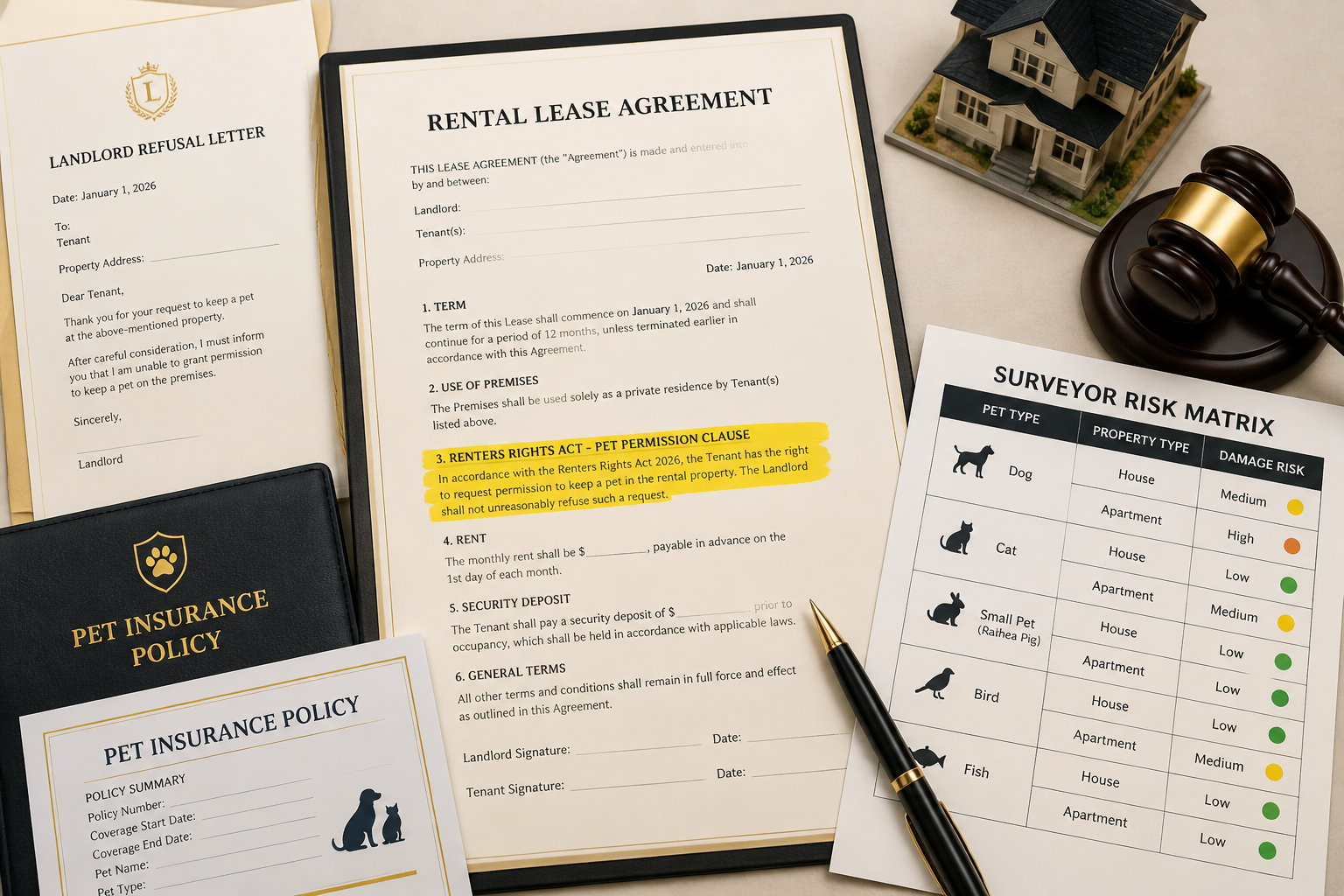
Valuing Properties with Pet Permissions Under Renters' Rights Act: Impact on Market Value and Dilapidations
The financial implications of the new regime extend well beyond the individual tenancy. Valuing properties with pet permissions under Renters' Rights Act: surveyor risk assessments for reasonable refusals in 2026 leases now requires surveyors to think about three distinct valuation dimensions.
1. 🏷️ Market Value Adjustments
The conventional wisdom that pet-friendly properties are worth less is being challenged. With over four million homes now potentially open to pets [2], landlords who proactively accommodate pets may actually attract a larger, more stable tenant pool. However, valuation adjustments remain relevant in specific circumstances:
- Higher wear-and-tear allowances must be built into rental yield calculations.
- Properties in blocks with superior lease restrictions may carry a valuation discount relative to freehold equivalents, due to the legal complexity of accommodating pet requests.
- Block management and service charge considerations become more complex when individual flats permit pets but communal areas remain restricted.
2. 🔧 Dilapidations and End-of-Tenancy Assessments
Dilapidations assessments are likely to become more contested under the new regime. Key points for surveyors:
- The baseline condition report (produced at the start of tenancy) becomes legally critical evidence.
- Pet-related damage must be distinguished from fair wear and tear — a nuanced professional judgement.
- Surveyors should understand the dilapidation protocols that govern how end-of-tenancy claims are calculated and challenged.
- Landlords cannot charge additional pet deposits or fees beyond what the Tenant Fees Act 2019 permits. Penalties for unlawful charges reach £7,000. [3]
💬 "The dilapidations assessment is now the primary financial protection mechanism for landlords who cannot charge upfront pet deposits."
3. 🛡️ Insurance Premium Impacts
Pet permissions affect building and contents insurance in measurable ways:
- Many insurers apply a loading of 5–15% on premiums for properties with confirmed pet occupation.
- Surveyors advising landlords should factor this into rental yield calculations and investment valuations.
- For commercial landlords or those with SIPP-held properties, the impact on SIPP pension valuations may be material and should be disclosed.
Grounds for Reasonable Refusal: What Surveyors Need to Document
The legal test of "reasonableness" will ultimately be decided by tribunals, but surveyors provide the factual foundation. Here is what a robust refusal case requires:
Documentation Checklist ✅
- Confirmed copy of superior lease clause prohibiting animals (leasehold)
- Surveyor's condition report with photographic evidence of vulnerable features
- Species-specific risk assessment with estimated remediation costs
- Evidence of structural issues that would be worsened by pet occupation (e.g., building defects survey findings)
- Written landlord response to tenant within the required timeframe
- Record of any alternative accommodation offered or conditions proposed
Common Mistakes Landlords Make
❌ Refusing without any written reason
❌ Citing "general policy" rather than property-specific evidence
❌ Failing to commission a professional condition report before the tenancy begins
❌ Attempting to charge a pet fee or rent premium without legal basis [3]
❌ Ignoring the tenant's right to appeal a refusal [3]
Surveyors who understand the RICS building survey standards are best placed to produce documentation that withstands tribunal scrutiny.

Regional Considerations for Surveyors in 2026
Pet permission risk is not uniform across England. Property type, tenure mix, and local market conditions all affect how surveyors should approach assessments.
Urban Leasehold Flats
In dense urban markets — particularly in areas like North West London or Essex — the majority of rental stock is leasehold. Superior lease restrictions on pets remain one of the most defensible grounds for refusal, but surveyors must verify the specific wording of each lease.
Suburban and Rural Houses
In suburban and rural markets, freehold houses with gardens present lower structural risk from pets. Surveyors in these areas may find that refusals are harder to justify, and that proactive pet permission (with appropriate conditions) is the more commercially sensible advice.
HMOs and Multi-Occupancy Properties
Houses in Multiple Occupation (HMOs) present unique challenges:
- Other tenants may have allergies or objections
- Communal areas are harder to protect from pet-related damage
- Licensing conditions may interact with pet permission obligations
Practical Steps for Landlords and Surveyors in 2026
The new landscape requires a more proactive and professional approach from both landlords and their advisers.
For Landlords
- Commission a baseline condition survey before any tenancy begins — this is now essential, not optional.
- Review your leasehold documents carefully if your property is a flat — superior lease terms may provide legitimate grounds for refusal.
- Update your tenancy agreement to reflect the new pet request process and any conditions attached to approval.
- Do not charge pet fees or attempt to increase rent specifically for pet occupation without legal advice. [3]
- Respond in writing to all pet requests within the required timeframe, with reasons if refusing.
For Surveyors
- Develop a standardised pet risk assessment template aligned with RICS guidance and the Renters' Rights Act 2026.
- Photograph all vulnerable surfaces at the start of every tenancy — skirting boards, carpets, doors, and garden areas.
- Understand leasehold covenant structures — this is increasingly central to defensible refusal advice.
- Stay current on tribunal decisions as case law develops around what constitutes a "reasonable" refusal.
- Factor pet occupation into dilapidations schedules with clear, species-specific damage categories.
Conclusion: A New Professional Standard for Surveyors
The Renters' Rights Act 2026 has not just changed the rules for tenants with pets — it has elevated the professional importance of the chartered surveyor in the landlord-tenant relationship. Valuing properties with pet permissions under Renters' Rights Act: surveyor risk assessments for reasonable refusals in 2026 leases is now a distinct and growing area of practice.
Landlords who ignore the new framework risk tribunal challenges, financial penalties of up to £7,000 [3], and reputational damage. Those who engage qualified surveyors to produce robust condition reports and risk assessments are far better positioned — both legally and commercially.
Actionable Next Steps
- 🔍 Commission a professional building survey before your next tenancy begins to establish a clear baseline condition.
- 📄 Review your lease documents — particularly if your property is leasehold — to identify any superior lease pet restrictions.
- 💼 Consult a chartered surveyor experienced in dilapidations and the Renters' Rights Act to develop a pet permission policy that is both compliant and commercially sound.
- 📊 Update your rental yield calculations to account for insurance loading, higher wear-and-tear allowances, and any valuation adjustments.
The properties that will perform best in the 2026 rental market are those managed with professional rigour — and the surveyor's risk assessment is now at the heart of that process.
References
[1] Watch – youtube.com
[2] Renters Rights Act Could Unlock Millions Of Homes For Renters With Pets – property118.com
[3] Renting With Pets – blog.goodlord.co