

The UK property market is experiencing a dramatic geographical split in 2026, with Northern England emerging as the unexpected powerhouse while traditional southern strongholds struggle under affordability pressures. For chartered surveyors and property professionals, understanding how to accurately value properties in this diverging landscape has never been more critical. Valuing Northern England Properties in 2026: RICS Strategies Amid House Price Surge and Regional Divergence requires sophisticated approaches that account for regional momentum, local market dynamics, and evolving buyer sentiment.
Recent RICS data reveals a striking transformation: while the national house price balance improved to -10% in January 2026—up from -13% in December and -19% in October 2025—the regional picture tells a far more nuanced story.[1][2] Northern Ireland, Scotland, and crucially, the North West and North of England continue posting price gains, directly contrasting with southern regions where London's net balance plummeted to -44%, representing the weakest performance across the entire UK.[1][2]
This geographical divergence presents both challenges and opportunities for property valuers working in Northern England's growth corridors.
Key Takeaways
- 🏘️ Northern regions outperform: The North West, North of England, and Northern Ireland show continued price growth while southern markets struggle with negative balances exceeding -30%
- 📊 Market sentiment improving: 43% of RICS respondents anticipate higher prices over the next twelve months—the most positive outlook since February 2025[2]
- 🎯 Town-level variations critical: Burnley recorded the highest house price growth in 2025, with North West towns including Rochdale, Blackburn, Liverpool, and Wigan posting gains exceeding 4%[3]
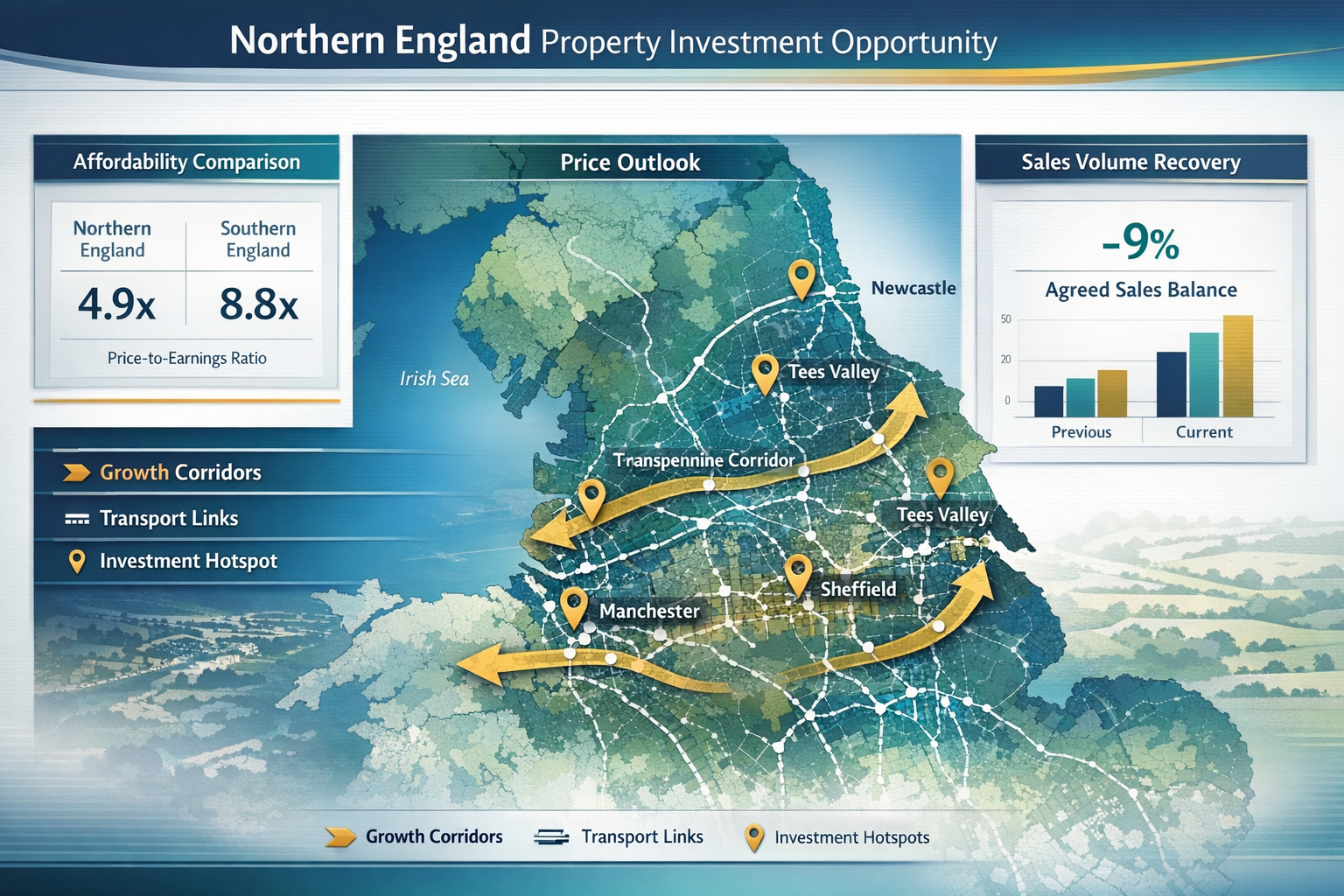
- 📈 Transaction recovery underway: Agreed sales net balance reached -9%, the least negative reading since June 2025, signalling stabilizing transaction volumes[2]
- 🔍 RICS valuation standards essential: Professional surveyors must apply rigorous RICS Home Survey Standards while incorporating regional growth factors and local market intelligence
Understanding the 2026 Regional Divergence in UK Property Markets
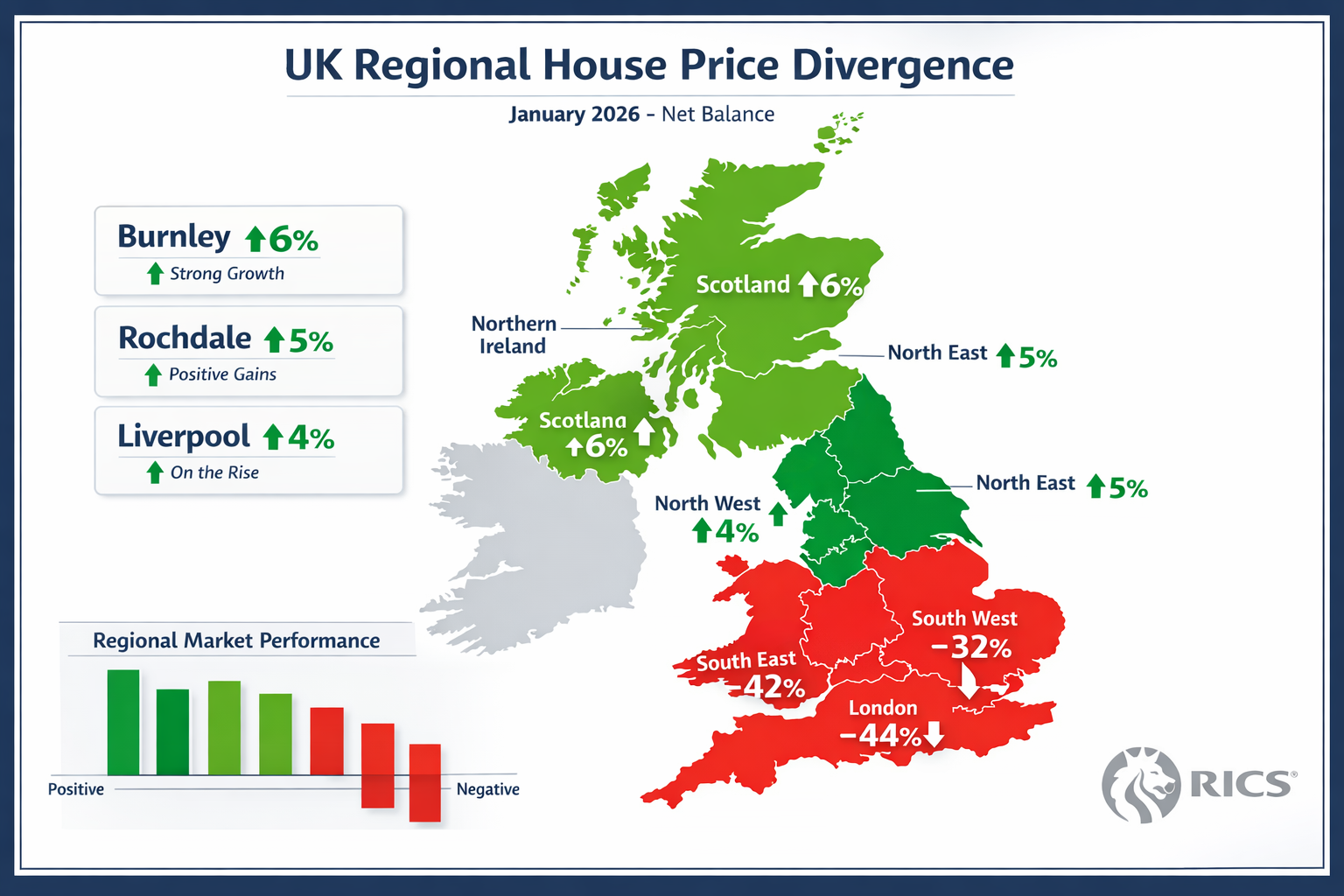
The geographical split dominating the UK property landscape in 2026 represents more than a temporary fluctuation—it reflects fundamental shifts in affordability, economic opportunity, and buyer preferences that surveyors must incorporate into valuation methodologies.
The Northern England Advantage
Northern regions have established themselves as the UK's property growth engines. According to RICS and Land Registry data, Northern Ireland posted the strongest performance across the UK, with the North of England and Scotland also demonstrating solid gains at the regional level.[3] This performance stands in stark contrast to historical patterns where southern markets, particularly London and the South East, traditionally led price appreciation.
Several factors drive this northern momentum:
Affordability differentials remain the primary catalyst. While average property prices in London and the South East continue to represent 10-15 times average earnings, many Northern England markets maintain more sustainable ratios of 4-6 times earnings. This affordability advantage attracts first-time buyers, young families, and investors seeking better rental yields.
Economic regeneration across Northern England cities has accelerated. Manchester, Liverpool, Leeds, and Newcastle have benefited from substantial infrastructure investment, expanding employment opportunities in technology, professional services, and creative industries. These economic fundamentals support sustained housing demand.
Remote working flexibility has permanently altered location preferences for many buyers. The ability to work remotely while enjoying lower living costs and higher quality of life has driven migration from expensive southern markets to more affordable northern alternatives.
Southern Market Challenges
The southern regions face compounding pressures that surveyors must acknowledge when conducting professional valuations:
London's -44% net balance in late 2025 reflects acute affordability constraints, stamp duty pressures on higher-value properties, and ongoing uncertainty around taxation policies affecting property investors and second homeowners.[1][2] The South East and South West similarly underperform with net balances of -42% and -32% respectively.[1]
These challenges create a two-speed market where valuation approaches must differ substantially based on regional context.
Market Sentiment Shifts
Despite regional variations, overall market sentiment shows encouraging improvement. The RICS survey revealed that 43% of respondents now anticipate higher prices over the next twelve months—the most positive outlook since February 2025—while 35% expect sales growth in the coming year, representing the strongest reading since December 2024.[2]
RICS Chief Economist Simon Rubinsohn noted there are "early signs that market conditions may be improving after a challenging period," though he cautioned that activity levels remain subdued and recovery will likely be gradual.[1]
For surveyors valuing Northern England properties, this improving sentiment provides additional support for growth projections, particularly when combined with strong regional fundamentals.
RICS Valuation Strategies for Northern England Properties in 2026
Accurately valuing Northern England properties in 2026 requires surveyors to adapt traditional methodologies while maintaining strict adherence to RICS professional standards. The RICS Home Survey Standards provide the foundational framework, but regional market dynamics demand additional considerations.
Comparative Method Adjustments
The comparative method remains the primary valuation approach for residential properties, but its application in Northern England's dynamic markets requires careful refinement:
Expand comparable timeframes: In rapidly appreciating markets like Burnley, Rochdale, and Liverpool—where price gains exceeded 4% in 2025[3]—comparables from six months ago may significantly undervalue current market conditions. Surveyors should:
- Prioritize recent transactions (within 3 months)
- Apply time adjustments reflecting documented local appreciation rates
- Weight recent comparables more heavily than older sales
- Consider pending sales and asking prices as supporting evidence
Micro-location analysis: Northern England markets demonstrate substantial variation at the postcode level. Properties in regeneration corridors, near new transport links, or in emerging neighborhoods may command premiums that broader area comparables don't capture. Detailed local knowledge becomes essential.
Transaction volume considerations: The agreed sales net balance of -9% indicates improving but still-subdued transaction volumes.[2] Limited comparable sales in specific submarkets may require surveyors to expand geographical search parameters while carefully adjusting for location differences.
Incorporating Forward-Looking Indicators
RICS standards require valuations to reflect market conditions at the valuation date, but understanding trajectory helps inform judgments about comparable selection and adjustment factors:
The three-month outlook has improved substantially, with the headline net balance rising to -6% from -14% previously.[1] For Northern England specifically, where prices trend higher, this forward momentum supports:
- Premium positioning for well-presented properties in high-demand areas
- Cautious optimism when properties show features aligned with buyer preferences (energy efficiency, home office space, outdoor areas)
- Recognition of scarcity value in tightly-supplied local markets
Property Condition and Improvement Potential
Northern England's housing stock includes substantial Victorian and Edwardian terraced housing, converted mills, and period properties requiring careful assessment. A comprehensive Level 3 Full Building Survey becomes particularly valuable in these contexts.
Surveyors should evaluate:
Improvement potential: Properties with scope for modernization, extension, or conversion may command premiums in strong markets where buyers seek value-add opportunities. Document these possibilities while noting associated costs and planning considerations.
Energy efficiency: With increasing focus on sustainability and rising energy costs, properties with superior energy performance certificates (EPCs) or potential for cost-effective improvements warrant recognition in valuations.
Structural integrity: Older Northern England properties may present issues including dampness, subsidence, or outdated building systems. Thorough inspection and appropriate deductions for remediation costs ensure accurate valuations that protect both buyers and lenders.
Investment Yield Considerations
Northern England's affordability advantage translates to superior rental yields compared to southern markets. For properties likely to attract investor interest, surveyors should:
- Calculate gross and net rental yields based on current market rents
- Compare yields to alternative investment returns and regional benchmarks
- Consider tenant demand factors (proximity to universities, employment centers, transport)
- Evaluate landlord regulatory compliance costs (EPC requirements, licensing schemes)
These investment metrics provide additional valuation support, particularly for properties in established rental markets like Manchester, Liverpool, and Leeds.
Implementing RICS-Compliant Valuation Tactics Amid Regional Growth
Professional surveyors must balance recognition of Northern England's growth trajectory with rigorous adherence to RICS standards that prioritize evidence-based, defensible valuations. The following tactical approaches help navigate this balance while delivering accurate, professional valuations.
Data-Driven Market Analysis
Successful valuation of Northern England properties in 2026 begins with comprehensive market research:
Leverage multiple data sources: Combine Land Registry price paid data, RICS residential market surveys, local estate agent intelligence, and auction results to build a complete market picture. The RICS survey showing new buyer enquiries improving to -15% in January 2026 from -21% in December and -29% in November indicates strengthening demand that local data can help quantify.[2]
Track town-level performance: National and even regional data masks significant local variation. Burnley's position as the highest-growth location in 2025, alongside strong performance in Rochdale, Blackburn, Liverpool, and Wigan[3], demonstrates the importance of granular market knowledge. Surveyors should maintain databases tracking:
- Quarterly price movements by postcode district
- Transaction volumes and time-on-market trends
- New development pipeline and planning approvals
- Infrastructure investment and regeneration initiatives
Monitor sentiment indicators: The shift to 43% of respondents anticipating price increases[2] represents improving confidence that influences buyer behavior and achievable prices. Regular review of RICS survey data, mortgage approval statistics, and consumer confidence measures helps surveyors anticipate market direction.
Risk Assessment and Scenario Analysis
While Northern England markets demonstrate strength, professional valuations must acknowledge risks and uncertainties:
Economic sensitivity: Northern regions' improving performance partly reflects economic regeneration that could prove vulnerable to national economic headwinds. Surveyors should consider how employment trends, business investment, and public sector spending might affect local markets.
Interest rate impacts: Although the market shows resilience, mortgage affordability remains sensitive to interest rate movements. Properties at higher price points or in areas with high loan-to-value borrowing may face greater vulnerability.
Regulatory changes: Evolving landlord regulations, planning policies, and taxation frameworks can significantly impact property values. Staying informed about property market legislation changes helps surveyors anticipate potential impacts.
For high-value or complex instructions, scenario analysis presenting valuations under different market assumptions provides clients with valuable context for decision-making.
Professional Inspection and Reporting Standards
RICS valuation credibility depends on thorough property inspection and clear, comprehensive reporting:
Systematic inspection protocols: Follow RICS Home Survey Standards[6] rigorously, ensuring consistent coverage of:
- Structural elements and building fabric
- Services and installations
- External areas and boundaries
- Environmental factors and location characteristics
- Legal and planning considerations
Photographic documentation: Comprehensive photography supports valuation judgments, provides evidence for comparable adjustments, and protects surveyors in case of disputes. Modern technology including drone surveys for larger properties or complex sites enhances inspection capabilities.
Clear valuation reasoning: Reports should transparently explain:
- Comparable selection criteria and adjustments applied
- Market trend analysis informing the valuation
- Property-specific factors affecting value (condition, location, features)
- Assumptions and limitations affecting the valuation
This transparency builds client confidence and provides defensibility if valuations are questioned.
Specialization and Local Expertise
The complexity of valuing properties amid regional divergence rewards specialization:
Develop geographic focus areas: Deep knowledge of specific Northern England markets—understanding local submarkets, development patterns, buyer demographics, and price dynamics—enables more accurate valuations than generalist approaches.
Build professional networks: Relationships with local estate agents, developers, planning officers, and other surveyors provide market intelligence that enhances valuation accuracy. Regular market engagement keeps knowledge current.
Invest in continuing professional development: RICS requires ongoing learning, but proactive engagement with training on regional markets, valuation methodologies, and emerging technologies (PropTech, data analytics, automated valuation models) maintains competitive advantage.
Surveyors who position themselves as Northern England property valuation specialists can command premium fees while delivering superior service to clients navigating these dynamic markets.
Technology Integration
Modern valuation practice increasingly incorporates technology while maintaining professional judgment:
Automated Valuation Models (AVMs): While AVMs provide useful benchmarks, they often struggle with unique properties or rapidly changing markets. Surveyors should use AVMs as one input alongside traditional comparable analysis rather than as definitive valuations.
Geographic Information Systems (GIS): Mapping tools help visualize comparable locations, identify location-specific value factors (transport links, amenities, environmental features), and support spatial analysis of market trends.
Data analytics platforms: Subscription services providing comprehensive transaction data, market analytics, and trend forecasting enhance research efficiency and depth. Integration with valuation report templates streamlines workflow while maintaining quality.
Digital inspection tools: Tablet-based inspection apps, laser measuring devices, thermal imaging cameras, and drone photography improve inspection accuracy and efficiency while providing enhanced documentation.
Technology should augment rather than replace professional expertise, with surveyors maintaining critical oversight of all valuation conclusions.
Navigating Specific Northern England Growth Corridors

Understanding the distinct characteristics of Northern England's key growth areas enables more nuanced valuations that reflect local market dynamics.
North West England: Leading Regional Growth
The North West demonstrates the strongest performance among Northern England regions, with multiple towns posting substantial gains:
Greater Manchester: The region's economic powerhouse continues attracting investment, employment growth, and population influx. Valuation considerations include:
- Proximity to Metrolink extensions and transport improvements
- Regeneration areas including Salford Quays, Ancoats, and Northern Quarter
- Rental demand from young professionals and students
- New-build apartment supply potentially constraining resale values in specific submarkets
Liverpool City Region: Liverpool, along with surrounding areas, demonstrates sustained growth driven by waterfront regeneration, cultural assets, and improving connectivity. Properties near the Baltic Triangle, Georgian Quarter, and planned developments warrant careful comparable selection reflecting emerging premiums.
Lancashire Towns: Burnley's position as 2025's highest-growth location[3], alongside strong performance in Rochdale and Blackburn, reflects affordability-driven demand and improving local economies. These markets often show:
- Strong first-time buyer activity
- Investor interest in rental properties with superior yields
- Renovation opportunities in period housing stock
- Sensitivity to local employment conditions
Surveyors valuing properties in these areas should maintain detailed knowledge of planning applications, infrastructure projects, and employment trends that influence local market trajectories.
Yorkshire and the Humber: Balanced Growth
Yorkshire demonstrates more moderate but sustainable growth across diverse markets:
Leeds: As a major employment center with thriving professional services, technology, and creative sectors, Leeds attracts both owner-occupiers and investors. Valuation factors include:
- City center apartment markets showing variable performance by development quality and location
- Suburban family housing in catchments for desirable schools
- Commuter towns benefiting from rail connectivity to Leeds and Manchester
- Student housing markets around university campuses
Sheffield and South Yorkshire: Regeneration efforts and affordability position Sheffield as an emerging opportunity market. Properties in areas benefiting from development investment or improved amenities may show premiums over broader market comparables.
York and North Yorkshire: Higher price points and heritage constraints create distinct market dynamics requiring specialized knowledge of conservation areas, listed building considerations, and tourism-related property demand.
North East England: Emerging Opportunities
The North East historically lagged other regions but shows improving fundamentals:
Newcastle and Gateshead: Urban regeneration, cultural assets, and university presence support steady demand. Waterfront developments and city center regeneration create localized growth pockets requiring careful comparable analysis.
Durham and surrounding areas: Heritage appeal and university presence create specialized markets with distinct buyer profiles and valuation considerations.
Coastal and rural areas: Northumberland and Durham coast properties attract lifestyle buyers and retirees, with valuations influenced by amenity access, views, and community characteristics rather than pure economic fundamentals.
Understanding these regional nuances enables surveyors to provide valuations that accurately reflect local market conditions rather than applying generic regional assumptions.
Practical Valuation Challenges and Solutions
Valuing Northern England properties in 2026 presents specific challenges that surveyors must navigate while maintaining RICS compliance.
Challenge: Limited Comparable Evidence
Issue: In smaller towns or specialized property types, recent comparable sales may be scarce, particularly during periods of lower transaction volumes.
Solutions:
- Expand geographical search radius while applying location adjustments
- Use older comparables with time adjustments based on documented market movements
- Consider asking prices and withdrawn listings as supporting evidence
- Leverage rental evidence to cross-check capital valuations via yield analysis
- Clearly document assumptions and limitations in valuation reports
Challenge: Rapid Market Movement
Issue: In high-growth areas like Burnley or Rochdale, comparable sales from even three months ago may not reflect current achievable prices.
Solution:
- Weight recent comparables more heavily
- Apply time adjustments based on local price index data
- Consider pending sales and recent asking prices
- Engage with local estate agents for current market intelligence
- Provide valuation ranges rather than single-point figures when uncertainty exists
- Recommend revaluation if significant time elapses before transaction completion
Challenge: Property Condition Variability
Issue: Northern England's older housing stock presents wide variation in condition, modernization, and maintenance quality that significantly affects value.
Solutions:
- Conduct thorough inspections documenting condition factors
- Quantify costs for necessary repairs or improvements
- Select comparables with similar condition profiles or apply adjustments
- Consider engaging structural engineers for properties with significant structural concerns
- Provide clear guidance on how condition affects the valuation conclusion
Challenge: Investment vs. Owner-Occupier Markets
Issue: Some Northern England properties attract primarily investor interest while others appeal to owner-occupiers, requiring different valuation approaches.
Solutions:
- Identify the most likely purchaser profile based on property characteristics and location
- Apply appropriate methodology (yield-based for investment properties, comparable-based for owner-occupier)
- Consider both approaches for properties with dual appeal
- Document the rationale for methodology selection
- Provide rental valuation alongside capital valuation for properties with investment potential
Challenge: New Development Competition
Issue: Substantial new-build development in some Northern England markets may constrain resale values for existing properties.
Solutions:
- Research new development pricing and incentives in the local area
- Consider how new-build alternatives affect demand for existing stock
- Recognize that period features, established gardens, and location may offset new-build appeal
- Document the competitive landscape in valuation reports
- Adjust comparables to reflect new-build competition where relevant
Addressing these challenges systematically while maintaining transparent documentation ensures RICS-compliant valuations that serve client needs and withstand scrutiny.
Future Outlook: Sustaining Northern England's Property Momentum
Understanding likely market evolution helps surveyors provide forward-looking advice alongside current valuations.
Factors Supporting Continued Growth
Several structural factors suggest Northern England's outperformance may persist:
Affordability advantage: As long as substantial price differentials versus southern markets persist, Northern England will continue attracting buyers seeking better value. This fundamental driver shows no signs of diminishing.
Infrastructure investment: Ongoing transport improvements, including Northern Powerhouse Rail proposals and local transport enhancements, should support continued economic development and property demand.
Economic diversification: Northern cities' success in attracting technology, professional services, and creative industries creates sustainable employment growth beyond traditional manufacturing bases.
Lifestyle migration: Remote working flexibility enables continued migration from expensive southern markets to more affordable northern alternatives offering quality of life advantages.
Demographic trends: Younger buyers and families priced out of southern markets represent sustained demand for Northern England's more accessible housing.
Potential Headwinds
Surveyors should also acknowledge factors that could moderate growth:
Economic uncertainty: National economic challenges, including inflation pressures, interest rate movements, and public sector spending constraints, could dampen buyer confidence and purchasing power.
Mortgage availability: Tightening lending criteria or reduced mortgage product availability could constrain demand, particularly for first-time buyers driving much of Northern England's growth.
Oversupply risks: Substantial new development in some markets could outpace demand growth, constraining price appreciation for existing properties.
Policy changes: Taxation or regulatory changes affecting property ownership, landlords, or housing markets could alter investment dynamics.
Regional economic shocks: Dependence on specific employers or industries in some Northern England towns creates vulnerability to localized economic disruption.
Strategic Positioning for Surveyors
To capitalize on Northern England's property opportunities while managing risks, surveyors should:
Develop specialized expertise in high-growth corridors and property types experiencing strongest demand
Maintain rigorous standards ensuring valuations remain defensible even if market conditions change
Build diverse client relationships across lenders, buyers, investors, and developers to understand multiple market perspectives
Invest in technology and data to enhance research capabilities and valuation accuracy
Engage in thought leadership by sharing market insights, contributing to professional discussions, and positioning as regional experts
Maintain professional networks providing current market intelligence and collaborative opportunities
The surveyors who successfully navigate Northern England's dynamic markets will be those who combine deep local knowledge, rigorous RICS methodology, and adaptive approaches that recognize evolving market conditions.
Conclusion
Valuing Northern England Properties in 2026: RICS Strategies Amid House Price Surge and Regional Divergence demands sophisticated approaches that acknowledge the UK's increasingly two-speed property market. While national indicators show tentative recovery—with the RICS house price balance improving to -10% in January 2026[1][2]—the regional picture reveals dramatic divergence between Northern England's growth corridors and southern markets facing acute affordability pressures.
For chartered surveyors and property professionals, this environment presents both challenges and opportunities. The North West, North of England, and Northern Ireland continue posting price gains, with specific towns like Burnley, Rochdale, Liverpool, and Wigan recording growth exceeding 4%.[3] Meanwhile, London's -44% net balance and similar weakness across southern regions create stark contrasts requiring fundamentally different valuation approaches based on location.
Key action steps for surveyors include:
✅ Strengthen local market knowledge through systematic tracking of town-level price movements, transaction volumes, and development activity
✅ Adapt comparable methodologies by prioritizing recent transactions, applying appropriate time adjustments, and recognizing micro-location variations
✅ Maintain rigorous RICS standards while incorporating forward-looking indicators and regional growth factors into professional judgment
✅ Leverage technology and data to enhance research capabilities while preserving essential human expertise and local knowledge
✅ Develop specialized expertise in Northern England growth corridors to position as trusted advisors for clients navigating these dynamic markets
The improving market sentiment—with 43% of RICS respondents anticipating price increases over the next twelve months[2]—provides cautious optimism for continued Northern England momentum. However, professional valuations must balance recognition of growth potential with acknowledgment of risks and uncertainties that could affect future performance.
By combining deep regional expertise, rigorous RICS methodologies, and adaptive approaches that respond to evolving market conditions, surveyors can deliver accurate, defensible valuations that serve client needs while maintaining the highest professional standards. Whether conducting comprehensive building surveys or providing professional valuations for lending or purchase decisions, expertise in Northern England's distinctive market dynamics will prove increasingly valuable throughout 2026 and beyond.
The regional divergence reshaping UK property markets isn't temporary—it reflects fundamental shifts in affordability, economic opportunity, and lifestyle preferences that will continue influencing valuations for years to come. Surveyors who recognize these structural changes and adapt their practices accordingly will be best positioned to serve clients effectively while building sustainable, successful professional practices.
References
[1] Rics House Price Balance – https://tradingeconomics.com/united-kingdom/rics-house-price-balance
[2] Uk Resi Survey Jan 2026 Report Shows Early Signs Market Recovery Despite Caution – https://www.rics.org/news-insights/uk-resi-survey-jan-2026-report-shows-early-signs-market-recovery-despite-caution
[3] Uk Economy Property Update February 2026 – https://www.rics.org/content/dam/ricsglobal/documents/market-surveys/uk-economy-property-update-february-2026.pdf
[4] Uk Residential Market Survey January 2026 – https://www.rics.org/content/dam/ricsglobal/documents/market-surveys/uk-residential-market-survey/UK-Residential-Market-Survey_January-2026.pdf
[5] Valuing Northern England Properties In 2026 Surveyor Tactics For Outpacing Southern Affordability Pressures – https://nottinghillsurveyors.com/blog/valuing-northern-england-properties-in-2026-surveyor-tactics-for-outpacing-southern-affordability-pressures
[6] Home Survey Standards – https://www.rics.org/profession-standards/rics-standards-and-guidance/sector-standards/building-surveying-standards/home-surveys/home-survey-standards