

The Southern UK property market stands at a pivotal crossroads in 2026. While buyer enquiries have improved from a concerning -21% in December 2025 to -15% in January 2026, the recovery remains fragile, particularly across London, the South East, and South West regions[2]. For chartered surveyors, property professionals, and stakeholders navigating these challenging waters, understanding Valuation Techniques for Stabilising Southern UK Markets: RICS Insights on Negotiating -15% Buyer Enquiry Dips in 2026 has never been more critical. This measured improvement—the third consecutive monthly gain—signals cautious optimism, yet the Southern regions continue to lag behind national averages due to persistent affordability challenges and economic uncertainty.
The Royal Institution of Chartered Surveyors (RICS) data reveals a market in transition: agreed sales reached -9%, the least negative reading since June 2025, while twelve-month price expectations surged to an impressive +43%[2]. However, these promising indicators mask significant regional disparities, with London recording the weakest net balance at -44% in November 2025, heavily influenced by taxation on higher-value homes[1]. For property professionals, the question isn't whether recovery will occur, but how to accurately value and position properties during this gradual stabilisation phase.
Key Takeaways
- 📊 Buyer enquiries improved to -15% in January 2026, marking three consecutive months of recovery from November's -29%, though Southern regions still lag national performance
- 🏘️ Regional disparities persist, with London, South East, and South West facing ongoing affordability challenges, requiring tailored valuation approaches for accurate market positioning
- 📈 Future outlook strengthens significantly, with twelve-month price expectations at +43% and medium-term sales expectations at +35%, the strongest readings in over a year
- 🎯 Accurate valuation becomes critical as markets stabilise, requiring chartered surveyors to balance current subdued activity with improving sentiment and expectations
- 💼 Professional RICS guidance emphasises gradual recovery dependent on mortgage rates and macroeconomic confidence, necessitating cautious but optimistic appraisal strategies
Understanding the Current Market Landscape: RICS Data and Southern UK Performance
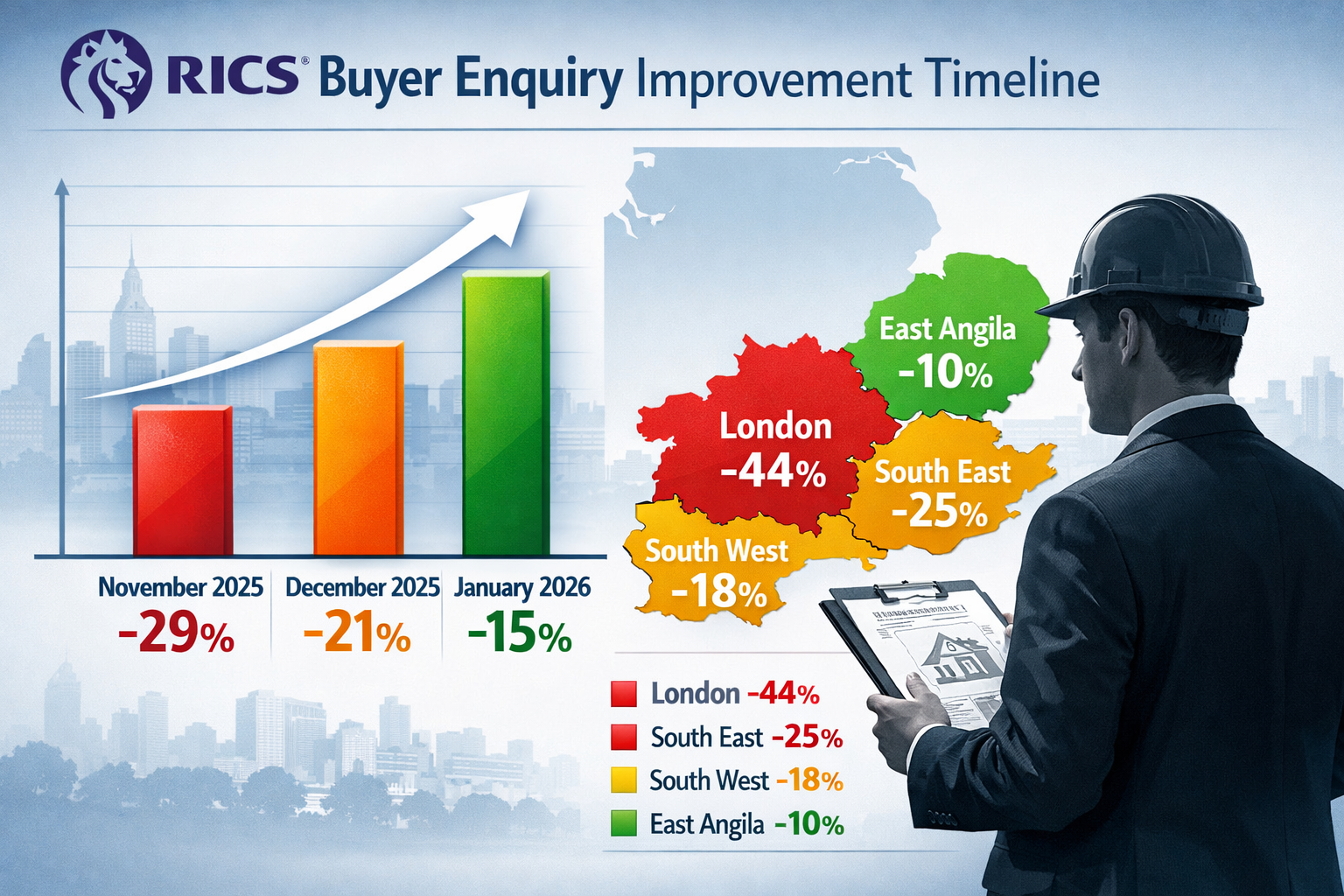
The Three-Month Recovery Trajectory
The improvement in buyer enquiries from -29% in November to -15% in January represents more than statistical fluctuation—it signals genuine market stabilisation[2]. This three-month consecutive improvement demonstrates that downward pressure on demand is easing, albeit gradually. For chartered surveyors conducting property valuations, this trajectory provides essential context for pricing strategies and market positioning.
The agreed sales metric, reaching -9% in January 2026, offers further evidence of market recovery[2]. This represents the least negative reading since June 2025, suggesting that while activity remains subdued compared to historical norms, the gap between buyer interest and completed transactions is narrowing. This convergence indicates improving market efficiency and provides surveyors with greater confidence in comparable sales data.
However, RICS Chief Economist Simon Rubinsohn emphasises caution, noting that any recovery is "likely to be gradual"[1][2]. This measured outlook reflects ongoing economic uncertainty, mortgage rate volatility, and persistent affordability challenges—particularly acute in Southern markets where property values remain elevated relative to regional incomes.
Regional Disparities: Why Southern Markets Lag
London, the South East, South West, and East Anglia continue to underperform the national average, creating unique valuation challenges for chartered surveyors operating in these regions[2]. London's particularly weak net balance of -44% in November 2025 reflects the compounding effects of higher property values, taxation on premium homes, and affordability constraints[1].
| Region | Buyer Enquiry Balance | Key Challenges | Valuation Considerations |
|---|---|---|---|
| London | -44% (Nov 2025) | Tax on higher-value homes, affordability crisis | Premium adjustments, tax impact analysis |
| South East | Below national average | Commuter belt uncertainty, price-to-income ratios | Local market segmentation critical |
| South West | Below national average | Second-home demand shifts, lifestyle migration changes | Dual-use property considerations |
| East Anglia | Below national average | Economic connectivity, employment patterns | Infrastructure impact assessment |
Despite these challenges, each Southern region has experienced moderation in the pace of decline, indicating that stabilisation is beginning[1]. For surveyors, this means valuation approaches must account for both current subdued activity and improving forward indicators—a delicate balance requiring sophisticated market analysis.
The chartered surveyors operating across South East London face particularly nuanced challenges, balancing inner-city dynamics with suburban affordability pressures. Similarly, professionals working in areas like Barnes must navigate the intersection of premium property values and changing buyer sentiment.
Price Expectations: The Optimism Paradox
One of the most striking aspects of the current market is the disconnect between current activity and future expectations. While buyer enquiries remain negative at -15%, twelve-month price expectations have surged to +43%—the most positive outlook since February 2025[2]. This represents a significant shift in market psychology and has profound implications for valuation strategies.
The house price balance itself improved to -10% in January 2026 from -13% in December, marking the third consecutive monthly improvement and the strongest reading since June[1]. This improvement, combined with medium-term sales expectations reaching +35% over twelve months, creates a complex valuation environment where current comparables may not accurately reflect near-future market conditions[2].
"The market is showing early signs of recovery, but activity remains subdued. Professionals must balance current caution with improving sentiment when conducting valuations." — RICS Market Analysis, January 2026
For chartered surveyors, this optimism paradox requires careful navigation. Overvaluing based on future expectations risks properties sticking on the market during the current subdued period, while undervaluing fails to capture the improving trajectory and may disadvantage sellers as recovery accelerates.
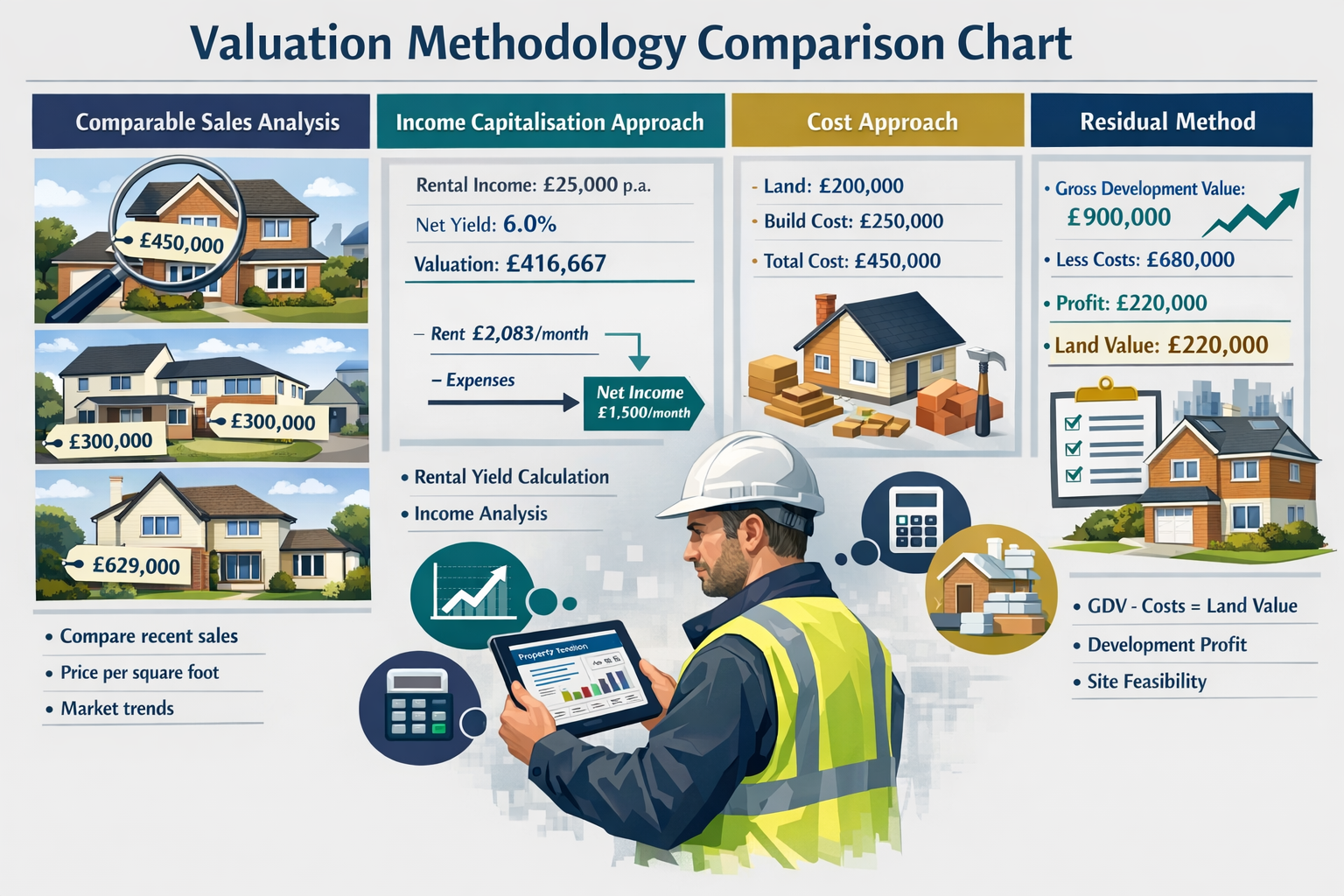
Core Valuation Techniques for Stabilising Southern UK Markets: RICS Insights on Negotiating -15% Buyer Enquiry Dips in 2026
Comparative Market Analysis in Declining Enquiry Environments
Comparative Market Analysis (CMA) remains the foundation of residential property valuation, but its application during periods of negative buyer enquiries requires enhanced sophistication. When enquiries sit at -15%, traditional comparable sales from six months ago may not accurately reflect current market realities[2].
Key CMA adjustments for 2026 Southern markets:
- ⏱️ Time-weighted comparables: Prioritise recent sales (within 3 months) over older transactions, applying monthly adjustment factors based on RICS price balance trends
- 📍 Micro-location analysis: Southern markets show significant variation even within postcodes; granular location assessment becomes critical
- 🏠 Property condition premium: Well-presented homes command disproportionate premiums in subdued markets with limited buyer competition
- 💡 Motivation indicators: Distinguish between distressed sales and market-reflective transactions to avoid skewing baseline valuations
- 📊 Volume context: Consider the number of comparable transactions; thin markets require broader geographic or temporal search parameters
The RICS Homebuyers Report provides essential framework for condition assessment that directly impacts comparative analysis. Properties requiring significant remedial work may face steeper discounts in cautious markets where buyers prioritise move-in readiness.
When conducting CMA in areas experiencing the most significant enquiry dips, chartered surveyors must also account for listing-to-sale price ratios. In markets with -15% enquiry balances, properties typically achieve 95-98% of asking price, compared to 98-100% in balanced markets. This discount factor must inform initial valuation recommendations to ensure realistic pricing that generates buyer interest.
Income Capitalisation Approach for Investment Properties
For buy-to-let and investment properties across Southern UK markets, the income capitalisation approach provides critical valuation insight, particularly during periods of buyer uncertainty. When enquiries decline, investors often become more active as they seek value opportunities, making accurate rental yield analysis essential.
The income capitalisation formula:
Property Value = Net Operating Income (NOI) / Capitalisation Rate
In 2026 Southern markets, capitalisation rates have adjusted to reflect both improving expectations and current caution. London investment properties typically show cap rates of 4.5-5.5%, while South East and South West markets range from 5.0-6.5%, depending on location quality and tenant demand stability.
Critical considerations for income approach valuations:
- Rental market resilience: Southern rental markets have shown greater stability than sales markets, with demand remaining robust despite economic uncertainty
- Void period adjustments: Factor realistic vacancy rates (typically 4-6 weeks annually in established markets)
- Management cost accuracy: Include realistic property management fees (10-15% of gross rental income)
- Maintenance reserves: Allocate appropriate provisions for ongoing maintenance (typically 1-1.5% of property value annually)
- Rental growth projections: Apply conservative growth assumptions (2-3% annually) aligned with RICS forward expectations
For surveyors valuing investment portfolios, the improving twelve-month outlook (+43% price expectations) suggests that capitalisation rates may compress slightly as investor confidence returns[2]. This anticipated compression should be factored into valuations while maintaining conservative current-market positioning.
Cost Approach and Residual Valuation Methods
The cost approach—calculating land value plus construction costs minus depreciation—provides particular value when assessing properties requiring significant renovation or redevelopment, scenarios increasingly common in Southern markets where older housing stock predominates.
Cost approach application in 2026:
Property Value = Land Value + (Replacement Cost – Depreciation) – Functional Obsolescence
In Southern UK markets, land values have shown relative stability even as buyer enquiries declined, reflecting long-term supply constraints. Construction costs, however, have experienced volatility due to material price fluctuations and labour availability, requiring surveyors to maintain current cost databases.
The residual method, particularly relevant for development sites and conversion opportunities, calculates value by working backward from projected end value:
Site Value = Gross Development Value (GDV) – (Construction Costs + Professional Fees + Finance Costs + Profit Margin)
For Southern markets in 2026, residual valuations must carefully balance current subdued activity against improving forward expectations. A development completing in 12-18 months will enter a potentially stronger market, justifying higher GDV assumptions aligned with the +43% price expectation trend[2].
Understanding property market legislation changes remains essential for residual valuations, as regulatory shifts can significantly impact development viability and end values.
Hedonic Pricing Models for Granular Market Analysis
Hedonic pricing models offer sophisticated valuation approaches particularly suited to Southern UK markets' complexity, where property values reflect multiple interacting characteristics. These statistical models disaggregate property prices into constituent attributes, enabling more precise valuations during market transitions.
Key hedonic variables for Southern UK markets:
- Structural characteristics: Square footage, bedroom count, bathroom count, parking provision, garden size
- Location attributes: Transport connectivity (particularly rail links to London), school catchment quality, crime rates, green space access
- Market timing: Transaction date relative to market cycle position
- Property condition: Age, renovation status, energy efficiency ratings
- External factors: Planning permission status, conservation area restrictions, flood risk
Advanced hedonic models can quantify the specific value contribution of each attribute. For example, analysis might reveal that in current South East markets, an additional bedroom contributes £45,000-£65,000 to value, while proximity to a high-performing school adds 8-12% premium, and excellent transport links contribute 15-20% uplift.
These granular insights enable surveyors to justify valuations with greater precision and provide clients with actionable improvement recommendations. During periods of -15% buyer enquiry dips, properties maximising high-value attributes command disproportionate market attention and achieve stronger pricing outcomes.
Strategic Application: Negotiating Valuations During Market Recovery
Balancing Current Reality with Forward Indicators
The central challenge facing chartered surveyors in 2026 Southern markets involves reconciling current subdued activity with strengthening future expectations. This balance requires transparent communication with clients about market positioning and realistic pricing strategies.
Framework for balanced valuations:
Current Market Value (CMV) = Conservative estimate based on recent comparables and current enquiry levels (-15%)
Forward-Looking Value (FLV) = Optimistic estimate incorporating twelve-month price expectations (+43%)
Recommended Listing Price (RLP) = CMV + (FLV – CMV) × Market Confidence Factor
The Market Confidence Factor (typically 0.2-0.4 in current conditions) reflects the probability that forward expectations materialise within the relevant timeframe. For properties likely to sell within 3-6 months, this factor should remain conservative (0.2-0.25), while properties with longer marketing horizons might justify higher factors (0.3-0.4).
This framework enables surveyors to provide clients with realistic current valuations while acknowledging improving market dynamics. It also facilitates productive negotiations with buyers, who may reference current subdued activity, and sellers, who focus on improving expectations.
Addressing Regional Variations in Valuation Approach
London-specific considerations require particular attention given the region's -44% enquiry balance and taxation pressures[1]. Properties valued above stamp duty thresholds face additional buyer resistance, necessitating strategic pricing that accounts for tax step-changes.
For properties in the £500,000-£925,000 range, positioning just below the higher-rate threshold can generate disproportionate buyer interest. Similarly, properties approaching the £1.5 million additional rate threshold may benefit from conservative valuations that keep transaction costs manageable.
South East markets present different challenges, with commuter belt properties experiencing varied performance based on hybrid working patterns and transport connectivity. Surveyors must assess individual property exposure to these trends, with well-connected locations commanding premiums while more remote areas face headwinds.
South West markets show particular sensitivity to lifestyle migration trends and second-home demand. Properties appealing to remote workers or retirees may justify valuations toward the optimistic end of ranges, while traditional holiday homes face greater uncertainty.
Professionals working in specific locations like Battersea, Chiswick, or Clapham must maintain hyperlocal market knowledge, as micro-market performance varies significantly even within London boroughs.
Leveraging Professional Surveys to Support Valuations
Comprehensive property surveys provide essential evidence supporting valuation conclusions, particularly important during market uncertainty when buyers scrutinise property condition more intensively. The difference between Level 2 and Level 3 surveys becomes critical in determining appropriate assessment depth.
Survey insights supporting accurate valuations:
- 🔍 Structural condition assessment: Identifies defects requiring cost adjustments to valuation
- 🏗️ Maintenance liability quantification: Calculates deferred maintenance costs that reduce net value
- ⚡ Energy efficiency evaluation: Determines improvement costs and potential value uplift from upgrades
- 🌧️ Risk factor identification: Highlights damp, subsidence, or other issues requiring valuation discounts
- 📋 Regulatory compliance status: Assesses building regulation adherence affecting marketability
Understanding what questions to ask during a building survey ensures comprehensive assessment that supports defensible valuations. This becomes particularly important when negotiating with buyers who may use survey findings to justify price reductions.
Research on average price reductions after surveys indicates typical adjustments of 3-7% in current markets, with significant defects occasionally justifying 10-15% reductions. Surveyors should anticipate these negotiations by conducting thorough pre-listing assessments and advising sellers on strategic remediation.
Preparing Properties for Optimal Market Positioning
Beyond accurate valuation, chartered surveyors provide value by advising clients on strategic property preparation that maximises achievable prices during subdued markets. When buyer enquiries sit at -15%, presentation quality disproportionately influences outcomes[2].
High-impact preparation recommendations:
- Address survey-identifiable defects: Proactively resolve issues that would emerge in buyer surveys, eliminating negotiation leverage
- Enhance energy efficiency: Install modern heating systems, improve insulation, upgrade windows—improvements that appeal to cost-conscious buyers
- Modernise presentation: Update kitchens and bathrooms cost-effectively, apply neutral decoration, improve kerb appeal
- Provide documentation: Compile building regulation certificates, planning permissions, warranties, and maintenance records
- Stage strategically: Professional staging increases perceived value and helps buyers envision occupancy
Guidance on preparing properties for market demonstrates measurable impact, with well-prepared properties achieving 5-12% premiums over comparable unstaged properties in current Southern markets.
For properties requiring specialist assessment, such as those with complex roofing systems, engaging RICS roof surveyors provides detailed condition reports that either support full valuations or identify necessary remediation before marketing.
Market Outlook and Strategic Recommendations for 2026-2027
Interpreting the +43% Price Expectation Signal
The surge in twelve-month price expectations to +43%—the most positive outlook since February 2025—represents a significant psychological shift in the Southern UK property market[2]. However, chartered surveyors must interpret this metric carefully, distinguishing between sentiment and likely reality.
Factors supporting optimistic expectations:
- 📉 Anticipated mortgage rate reductions: Market pricing suggests Bank of England rate cuts through 2026, improving affordability
- 💼 Economic stabilisation: Inflation moderation and employment stability support buyer confidence
- 🏗️ Persistent supply constraints: Limited new construction and planning restrictions maintain structural undersupply
- 🌍 International demand resilience: London and South East continue attracting global investment despite taxation
- 📊 Pent-up demand release: Buyers who delayed purchases during uncertainty may re-enter markets as confidence improves
Factors tempering expectations:
- ⚠️ Affordability ceiling: Price-to-income ratios in Southern markets remain historically elevated
- 🏛️ Political uncertainty: Potential policy changes affecting property taxation or regulation
- 🌐 Global economic risks: International economic headwinds could dampen UK growth
- 💰 Mortgage availability: Lending criteria remain stringent, limiting buyer pools
- 📍 Regional divergence: National optimism may not translate uniformly to all Southern submarkets
Prudent surveyors should interpret the +43% expectation as indicating direction rather than magnitude—markets are likely to improve, but achieving 43% price growth within twelve months appears unrealistic for most Southern segments. More probable scenarios suggest 3-8% growth across 2026-2027, with premium London locations potentially achieving 8-12% and constrained South East markets seeing 5-10% appreciation.
Medium-Term Sales Expectations and Activity Normalisation
The medium-term sales expectation reaching +35% over twelve months—the strongest reading since December 2024—suggests surveyors anticipate significant transaction volume recovery[2]. This metric carries particular importance for valuation strategy, as increased activity improves market liquidity and comparable data quality.
Implications for valuation practice:
- Enhanced comparable availability: More transactions provide richer data sets for CMA
- Reduced time-on-market: Increased buyer activity shortens marketing periods, supporting firmer pricing
- Improved price discovery: Active markets generate more accurate price signals than thin markets
- Greater negotiation balance: Sellers regain leverage as buyer competition intensifies
- Reduced uncertainty discounts: Market confidence reduces risk premiums embedded in valuations
For chartered surveyors, this improving activity outlook justifies gradual valuation adjustments that reflect strengthening fundamentals while maintaining current-market grounding. Properties entering the market in Q2-Q3 2026 may reasonably incorporate modest optimism premiums (2-5%) reflecting anticipated activity improvement.
However, RICS Chief Economist Simon Rubinsohn's caution about gradual recovery remains pertinent[1][2]. Activity normalisation will likely occur unevenly across Southern regions, with well-connected, affordably-positioned properties experiencing faster recovery than premium or remote segments.
Mortgage Rate Trajectory and Affordability Dynamics
Mortgage rate evolution represents the single most influential factor determining market recovery pace and valuation trajectory. Current market pricing suggests potential rate reductions through 2026, which would meaningfully improve buyer affordability and support the positive price expectations reflected in RICS data.
Affordability sensitivity analysis:
| Mortgage Rate | Monthly Payment (£400k, 25yr) | Affordability Impact | Valuation Implication |
|---|---|---|---|
| 5.5% (current) | £2,460 | Baseline | Current valuations |
| 5.0% (Q2 2026 scenario) | £2,335 (-5.1%) | Moderate improvement | +2-3% valuation uplift |
| 4.5% (Q4 2026 scenario) | £2,215 (-10.0%) | Significant improvement | +5-7% valuation uplift |
| 4.0% (optimistic 2027) | £2,100 (-14.6%) | Substantial improvement | +8-12% valuation uplift |
These calculations demonstrate how modest rate reductions generate disproportionate affordability improvements, particularly for first-time buyers and those stretching to purchase in Southern markets. Surveyors should monitor rate trajectory closely and adjust valuation assumptions accordingly.
However, affordability extends beyond mortgage rates to encompass deposit requirements, lending criteria, and income multiples. Even with rate reductions, Southern UK markets face structural affordability challenges requiring median household incomes of 8-12 times in many locations—well above sustainable long-term ratios of 4-5 times.
Tactical Recommendations for Chartered Surveyors
Based on Valuation Techniques for Stabilising Southern UK Markets: RICS Insights on Negotiating -15% Buyer Enquiry Dips in 2026, the following tactical recommendations provide actionable guidance for property professionals:
Immediate actions (Q1-Q2 2026):
✅ Maintain conservative baseline valuations grounded in current comparables and -15% enquiry reality
✅ Develop forward-looking scenarios incorporating +43% price expectations with appropriate probability weighting
✅ Enhance regional market intelligence tracking micro-market performance variations across Southern regions
✅ Strengthen survey integration ensuring comprehensive condition assessment supports valuation conclusions
✅ Communicate transparently with clients about market positioning, realistic pricing, and recovery timelines
Medium-term strategies (Q3 2026-Q1 2027):
📈 Gradually adjust valuation parameters as activity data confirms or refutes optimistic expectations
📊 Refine hedonic models incorporating emerging attribute value patterns in recovering markets
🤝 Develop buyer-seller mediation skills to navigate negotiations between current caution and future optimism
📍 Specialise in micro-markets building deep expertise in specific Southern submarkets showing divergent performance
💡 Invest in technology enhancing data analytics capabilities and valuation model sophistication
Long-term positioning (2027 onwards):
🎯 Build advisory capabilities beyond transactional valuation toward strategic property consultancy
🌐 Expand service integration connecting valuation, survey, and property improvement services
📚 Maintain continuous learning tracking RICS guidance evolution and market development
🔄 Develop client relationships supporting repeat business through market cycles
⚖️ Uphold professional standards ensuring RICS compliance and ethical practice throughout
For surveyors seeking to understand how to negotiate house prices down after surveys, the current market environment provides particular opportunities, as sellers facing -15% enquiry conditions show greater negotiation flexibility than in balanced markets.
Advanced Considerations: Technology, Data, and Professional Development

Leveraging Technology in Modern Valuation Practice
Digital transformation has fundamentally altered valuation practice, with technology enabling more sophisticated analysis, improved accuracy, and enhanced client communication. In 2026 Southern markets, where precision matters amid recovery uncertainty, technology adoption separates leading practitioners from laggards.
Essential technology capabilities:
- 🖥️ Automated Valuation Models (AVMs): Machine learning algorithms processing vast comparable datasets to generate baseline valuations
- 📱 Mobile survey applications: Digital inspection tools capturing comprehensive property data with photo documentation and instant reporting
- 📊 Market analytics platforms: Real-time data feeds tracking enquiry levels, pricing trends, and transaction volumes
- 🗺️ Geographic Information Systems (GIS): Spatial analysis tools identifying location-specific value drivers and risk factors
- 🤖 AI-powered insights: Artificial intelligence identifying market patterns and predicting value trajectories
However, technology augments rather than replaces professional judgment. The nuanced interpretation required for Valuation Techniques for Stabilising Southern UK Markets: RICS Insights on Negotiating -15% Buyer Enquiry Dips in 2026 demands human expertise that understands context, applies experience, and exercises discretion.
Leading chartered surveyors integrate technology systematically while maintaining the professional skepticism and market knowledge that distinguishes expert valuations from algorithmic outputs. This balanced approach delivers superior accuracy and client value.
Data Quality and Comparable Selection Rigor
Data integrity forms the foundation of defensible valuations, yet many practitioners underestimate the importance of rigorous comparable selection and verification. In markets experiencing -15% enquiry dips, data quality becomes even more critical as transaction volumes thin and outliers exert disproportionate influence[2].
Best practices for comparable data management:
- Verify transaction authenticity: Confirm sales completion through Land Registry data rather than relying on asking prices or estimated values
- Assess transaction motivation: Distinguish arm's-length sales from distressed transactions, family transfers, or other non-market circumstances
- Adjust for time systematically: Apply consistent monthly adjustment factors based on RICS house price balance trends
- Normalize property characteristics: Calculate adjustments for size, condition, location, and feature differences using evidence-based methodologies
- Document selection rationale: Maintain transparent records explaining comparable selection and adjustment decisions
For Southern UK markets, particular attention to micro-location granularity proves essential. Properties separated by mere streets may exhibit 10-20% value differentials based on school catchments, transport access, or neighbourhood character. Surveyors must resist the temptation to expand geographic search parameters excessively when local comparables are limited, instead applying careful adjustments to slightly more distant transactions.
The building surveyor expertise available across London demonstrates the importance of local market knowledge in identifying truly comparable properties and understanding value drivers.
Professional Development and RICS Compliance
Continuous professional development (CPD) ensures chartered surveyors maintain competence amid evolving market conditions, regulatory requirements, and professional standards. The RICS mandates ongoing learning, but leading practitioners exceed minimum requirements, recognising that expertise differentiation drives competitive advantage.
Priority CPD areas for 2026:
- 📖 Market cycle analysis: Understanding historical patterns and current positioning within property cycles
- 📜 Regulatory updates: Tracking changes to valuation standards, building regulations, and taxation
- 💻 Technology proficiency: Developing skills in data analytics, GIS, and digital valuation tools
- 🤝 Client advisory skills: Enhancing communication and consultancy capabilities beyond technical valuation
- ⚖️ Ethics and professional conduct: Maintaining highest standards of integrity and RICS compliance
RICS professional standards require valuations to reflect market value defined as "the estimated amount for which an asset should exchange on the valuation date between a willing buyer and a willing seller in an arm's length transaction, after proper marketing and where the parties had each acted knowledgeably, prudently and without compulsion."
This definition takes on particular significance during market transitions. The -15% buyer enquiry environment and +43% price expectations create tension between current transaction evidence and forward-looking sentiment[2]. Professional judgment must navigate this tension while adhering to the market value standard that emphasises current conditions over future speculation.
Risk Management and Professional Indemnity
Valuation accuracy carries significant professional liability implications, particularly in uncertain markets where pricing errors may generate client losses or transaction failures. Chartered surveyors must maintain robust risk management practices and appropriate professional indemnity insurance.
Key risk mitigation strategies:
- ✍️ Clear engagement letters: Define scope, limitations, and assumptions explicitly before commencing valuations
- 📋 Comprehensive reporting: Document methodology, comparable selection, adjustments, and reasoning transparently
- 🔍 Peer review protocols: Implement internal quality control with senior review of complex or high-value valuations
- 📚 Assumption documentation: Record market assumptions, data sources, and judgment calls clearly
- 🛡️ Insurance adequacy: Maintain professional indemnity coverage appropriate to practice size and risk exposure
In 2026 Southern markets, particular risk arises from over-optimistic valuations that incorporate excessive weight on improving expectations while underestimating current subdued activity. Surveyors must resist client pressure to inflate valuations, maintaining professional independence and evidence-based methodology.
Conversely, excessive conservatism that ignores genuine improvement signals may disadvantage clients and damage professional reputation. The balance requires careful judgment informed by comprehensive market knowledge and transparent communication with clients about valuation rationale.
Conclusion: Navigating Recovery with Professional Excellence
The Valuation Techniques for Stabilising Southern UK Markets: RICS Insights on Negotiating -15% Buyer Enquiry Dips in 2026 represent both challenge and opportunity for chartered surveyors and property professionals. The improvement from -29% to -15% in buyer enquiries signals genuine market stabilisation, yet Southern regions continue facing affordability headwinds and subdued activity relative to historical norms[2].
The dramatic surge in twelve-month price expectations to +43% and medium-term sales expectations to +35% reflects strengthening confidence and anticipation of continued recovery[2]. However, RICS Chief Economist Simon Rubinsohn's caution about gradual recovery remains essential context—optimism must be tempered with realism, and valuations must balance current evidence with forward indicators[1][2].
Core principles for successful navigation:
🎯 Ground valuations in current market reality while acknowledging improving trajectory
📊 Leverage multiple valuation methodologies to triangulate accurate property values
🔍 Maintain rigorous data quality and comparable selection standards
🤝 Communicate transparently with clients about market positioning and pricing strategy
📈 Monitor leading indicators including mortgage rates, enquiry levels, and regional performance
⚖️ Uphold professional standards and RICS compliance throughout practice
💡 Invest in technology and skills to enhance analytical capabilities and client value
For property sellers, the current environment demands realistic pricing aligned with -15% enquiry reality while positioning for anticipated recovery. For buyers, opportunities exist to negotiate effectively in subdued markets while recognising that improving conditions may limit future negotiation leverage.
For chartered surveyors, professional excellence requires balancing technical expertise with market judgment, data analytics with human insight, and current evidence with forward vision. Those who master this balance will guide clients successfully through market stabilisation and position themselves as trusted advisors for the recovery ahead.
Actionable Next Steps
For Property Professionals:
- Conduct comprehensive market analysis tracking RICS indicators monthly and adjusting valuation parameters accordingly
- Develop regional specialisation building deep expertise in specific Southern UK submarkets showing divergent performance
- Enhance survey integration ensuring condition assessment supports valuation conclusions and negotiation strategies
- Invest in client education helping buyers and sellers understand market dynamics and realistic expectations
- Build technology capabilities implementing digital tools that enhance accuracy and efficiency
For Property Sellers:
- Engage qualified chartered surveyors early in the process for accurate valuation and strategic pricing guidance
- Invest in property preparation addressing defects and enhancing presentation to maximise achievable prices
- Price realistically based on current comparables while positioning for anticipated market improvement
- Maintain flexibility in negotiations recognising -15% enquiry environment requires seller accommodation
- Monitor market evolution adjusting strategy as recovery progresses and buyer activity strengthens
For Property Buyers:
- Leverage current conditions negotiating effectively in subdued markets with reduced competition
- Conduct thorough due diligence including comprehensive surveys to identify value adjustments
- Secure financing early ensuring mortgage approval before making offers in improving markets
- Act decisively when suitable properties emerge, recognising that recovery may reduce future opportunities
- Consider forward value balancing current pricing with +43% expectation trajectory for long-term holdings
The Southern UK property market stands at an inflection point in 2026. The three-month improvement in buyer enquiries, strengthening price expectations, and moderating regional declines all signal that stabilisation is underway[1][2]. However, recovery remains gradual, dependent on mortgage rate trajectory, economic confidence, and ongoing affordability dynamics.
Chartered surveyors applying sophisticated Valuation Techniques for Stabilising Southern UK Markets: RICS Insights on Negotiating -15% Buyer Enquiry Dips in 2026 will successfully navigate this transition, delivering accurate valuations that serve client interests while maintaining professional standards. The path forward requires expertise, judgment, and adaptability—qualities that define professional excellence in any market environment.
References
[1] Rics House Price Balance – https://tradingeconomics.com/united-kingdom/rics-house-price-balance
[2] Uk Resi Survey Jan 2026 Report Shows Early Signs Market Recovery Despite Caution – https://www.rics.org/news-insights/uk-resi-survey-jan-2026-report-shows-early-signs-market-recovery-despite-caution
[3] Uk Economy Property Market Update February 2025 V2 – https://www.rics.org/content/dam/ricsglobal/documents/market-surveys/UK_Economy_Property_Market_Update_February_2025_V2.pdf
[4] Uk Economy And Property Market Update – https://www.rics.org/news-insights/market-surveys/uk-economy-and-property-market-update