

{"cover":"Professional landscape format (1536×1024) hero image featuring bold text overlay 'Valuation Techniques for 2026 Northern England Price Momentum' in extra large 72pt white sans-serif font with dark shadow effect, centered in upper third. Background shows dramatic aerial view of Manchester and Liverpool skyline with Victorian architecture and modern developments, overlaid with translucent RICS survey data charts showing upward price trends in green and downward southern trends in red. Color scheme: deep navy blue, emerald green, white, with subtle gold accents. High contrast professional composition with rule of thirds layout, magazine cover quality, editorial style with financial market aesthetic. Include subtle map outline of Northern England regions with heat mapping showing price momentum variations across different areas.","content":["Detailed landscape format (1536×1024) image showing professional chartered surveyor in modern Northern England office analyzing dual computer screens displaying RICS residential market survey data. Left screen shows interactive heat map of UK with North West region highlighted in green indicating positive price momentum, while South East and London appear in red showing decline. Right screen displays detailed net balance charts comparing regional performance with specific figures: North West +8%, London -40%, South East -24%. Desk features printed RICS February 2026 survey report, calculator, property photographs of Northern terraced houses and modern developments. Background shows large window overlooking Manchester cityscape. Lighting: bright natural daylight, professional business environment, clean modern aesthetic with blue and white color scheme.","Detailed landscape format (1536×1024) infographic-style image presenting comparative valuation adjustment framework for Northern versus Southern England properties. Split-screen composition: left side shows traditional Victorian terraced house in Leeds with upward trending price arrow and adjustment factors listed (+5% regional momentum, +3% local demand, -2% condition). Right side shows London townhouse with downward arrow and contrasting adjustments (-8% regional decline, -4% market sentiment, +2% location premium). Center features large RICS logo with professional surveyor silhouette holding clipboard. Include visual elements: percentage badges, calculator icons, property value comparison tables, trend line graphs showing diverging regional trajectories. Color scheme: professional teal, grey, white with accent colors differentiating positive (green) and negative (red) adjustments. Clean financial presentation style with clear typography.","Detailed landscape format (1536×1024) image depicting strategic planning scene for property valuation professionals focusing on medium-term market outlook. Conference room setting with large presentation screen displaying RICS 12-month forecast data showing +33% net balance for future price expectations. Table in foreground covered with regional market analysis documents, property valuation reports, and tablets showing interactive price momentum dashboards. Wall features large UK map with pins marking Northern England hotspots including Manchester, Liverpool, Leeds, Newcastle with connecting lines showing market correlation patterns. Include visual elements: forward-looking trend arrows, confidence interval charts, risk assessment matrices, professional surveying equipment. Diverse team of chartered surveyors reviewing documents in background. Lighting: professional meeting room ambiance with warm tones, contemporary business aesthetic, sophisticated color palette of charcoal, burgundy, cream, and gold accents."]"}

The UK property market in 2026 presents a tale of two nations. While headlines focus on declining prices across London and the South East, a remarkable story unfolds in Northern England—one of resilience, growth, and opportunity. For chartered surveyors navigating this divergent landscape, understanding Valuation Techniques for 2026 Northern England Price Momentum: RICS Strategies Beyond the South has become essential for accurate property assessments and client advisory services.
The February 2026 RICS Residential Market Survey reveals striking regional disparities that demand specialized valuation approaches. The North West of England continues to demonstrate positive price momentum while southern regions experience significant downward pressure, creating a complex environment where traditional valuation methodologies require careful adaptation.[2]
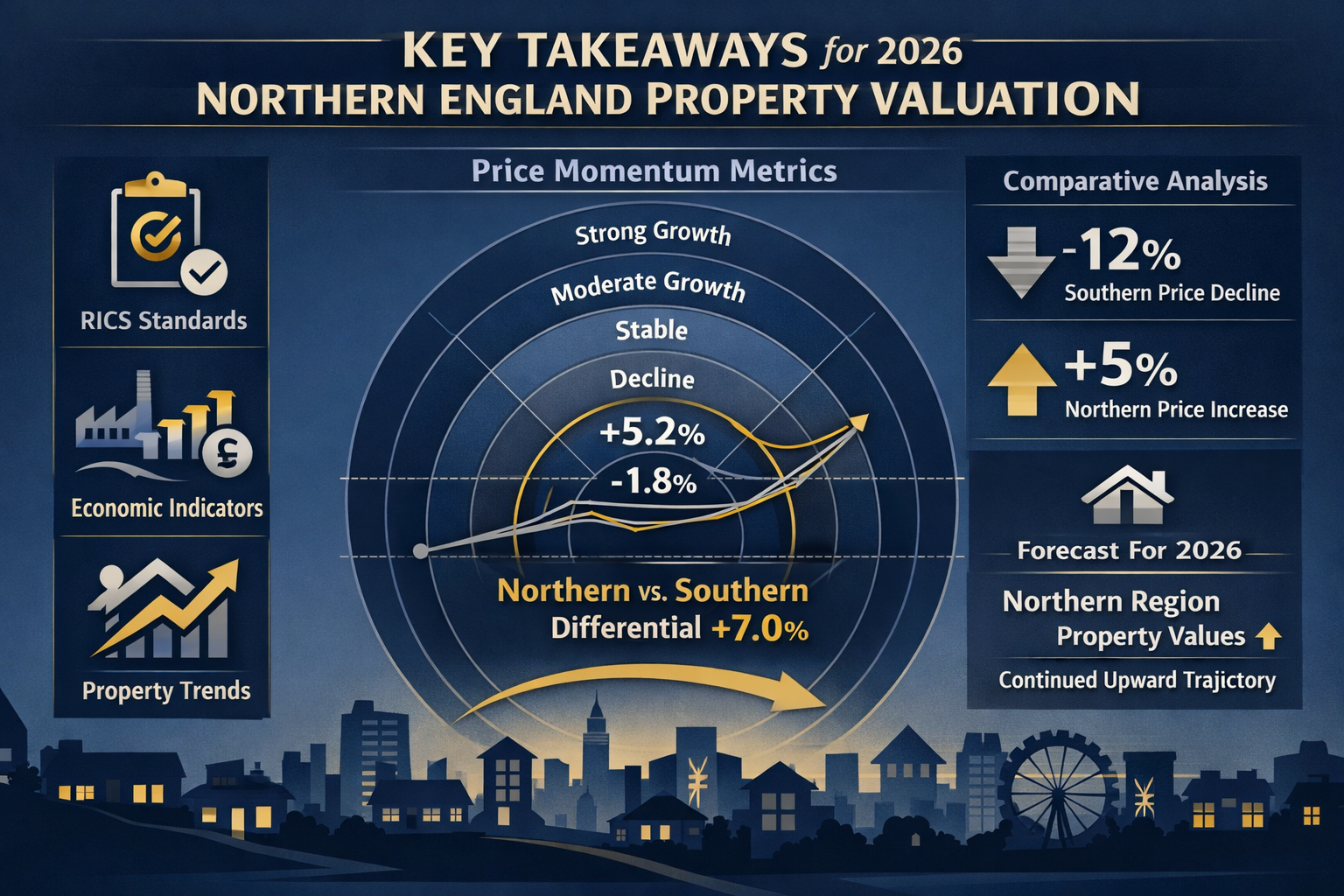
Key Takeaways
- 🏘️ Northern England shows relative resilience with the North West maintaining positive price momentum while London records a -40% net balance in February 2026
- 📊 Regional adjustment factors are critical for accurate valuations, with surveyors needing to apply different methodologies for Northern properties versus Southern counterparts
- 📈 Medium-term outlook remains positive with +33% of RICS contributors expecting price growth over 12 months, despite near-term weakness
- 🎯 RICS data provides authoritative evidence for defending valuations and expert witness testimony in Northern England property disputes
- ⚖️ Supply-demand dynamics differ significantly between regions, requiring location-specific analysis rather than national-level assumptions
Understanding the 2026 Regional Price Divide
The Northern England Advantage
The North West of England has emerged as a standout performer in 2026's challenging property market. While the national headline price momentum declined to -26% in February 2026 (down from -15% in January), Northern regions continue to buck this trend.[2] This divergence represents more than statistical noise—it signals fundamental shifts in buyer preferences, affordability dynamics, and economic activity distribution across the UK.
Several factors contribute to Northern England's relative strength:
Economic diversification: Cities like Manchester, Liverpool, and Leeds have successfully transitioned from industrial economies to thriving service, technology, and creative sectors. This economic transformation attracts younger professionals seeking career opportunities without London's cost burden.
Affordability premium: The price differential between Northern and Southern England remains substantial. Average property prices in the North West offer significantly better value, enabling first-time buyers and families to access homeownership more readily.
Infrastructure investment: Government commitments to Northern Powerhouse initiatives and transport improvements continue to enhance regional connectivity and desirability.
Remote work flexibility: The sustained shift toward hybrid working models has reduced the necessity of proximity to London, allowing professionals to prioritize space, affordability, and quality of life.
Southern Market Pressures
In stark contrast, London recorded a -40% net balance in February 2026, with the South East at -24% and East Anglia at -26%.[2] These figures represent significant downward pressure exceeding the national average by considerable margins.
The southern decline reflects multiple headwinds:
- Affordability constraints reaching critical thresholds
- Interest rate sensitivity affecting higher-value mortgages disproportionately
- Economic uncertainty impacting high-earning professional sectors
- Lifestyle reassessment driving migration toward more affordable regions
For chartered surveyors, these regional disparities necessitate fundamentally different valuation approaches. Applying London-centric assumptions to Northern England properties—or vice versa—risks significant valuation errors with potential professional liability implications.
Valuation Techniques for 2026 Northern England Price Momentum: Core RICS Methodologies
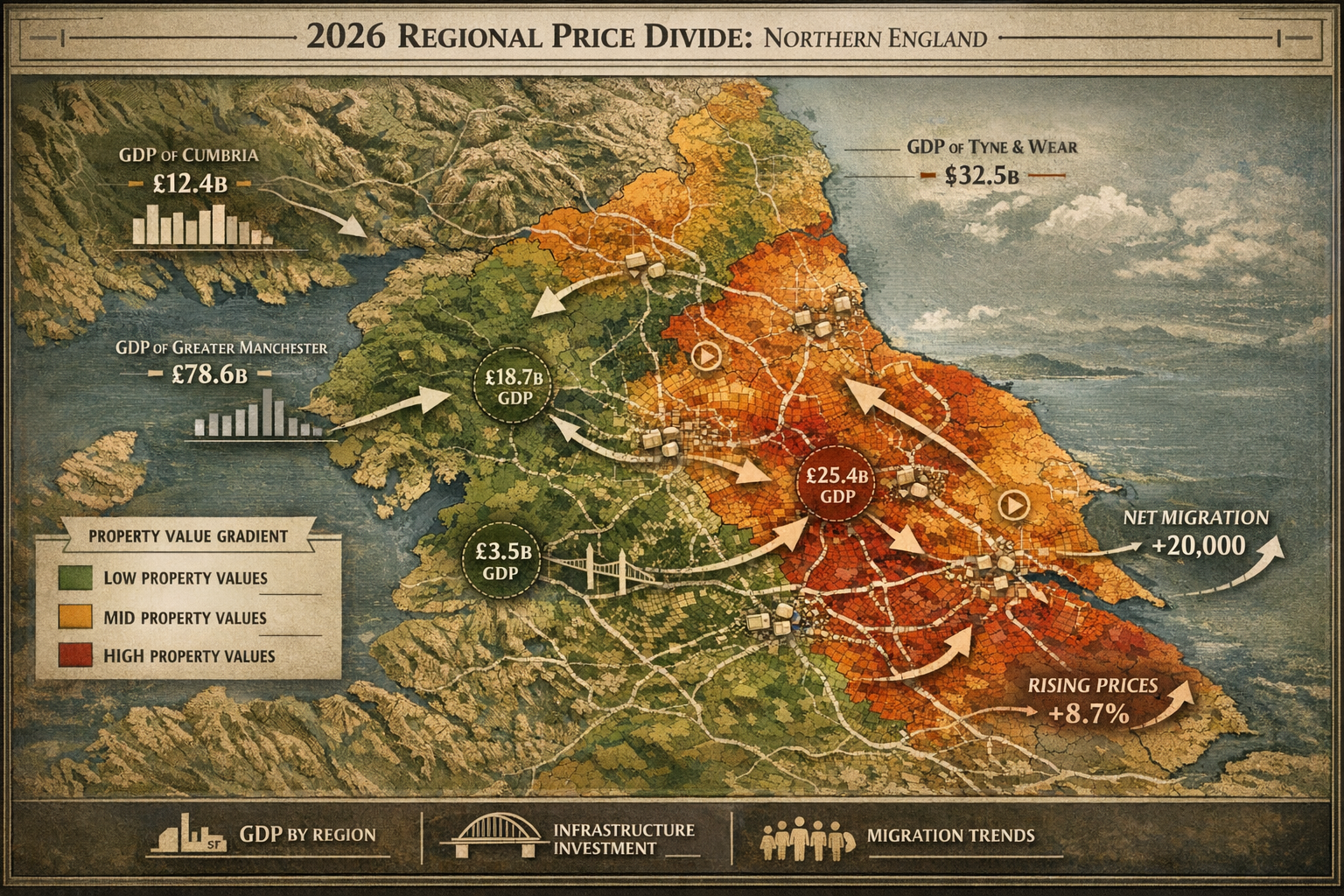
Regional Adjustment Factors
Professional property valuations in 2026 require explicit regional adjustment factors that account for divergent market conditions. The RICS Red Book Global Standards emphasize market-specific analysis, but practical application demands granular regional understanding.
Momentum Adjustments: When comparable evidence spans multiple months, surveyors must apply temporal adjustments reflecting regional price trajectories. A comparable sale from November 2025 in Manchester requires different time-adjustment factors than a London equivalent.
For Northern England properties showing positive momentum:
- Apply positive time adjustments (typically +0.5% to +1.5% monthly) when using older comparables
- Weight recent transactions more heavily in comparable analysis
- Consider forward-looking indicators from RICS survey data
For Southern England properties experiencing decline:
- Apply negative time adjustments (typically -0.5% to -2.0% monthly)
- Exercise caution with older comparables that may overstate current values
- Document market sentiment indicators supporting downward adjustments
Supply-Demand Analysis
The February 2026 RICS survey indicates new instructions remained in neutral territory at +2%, suggesting stable supply levels nationally.[2] However, regional variations require deeper analysis.
Northern England supply considerations:
- Assess local inventory levels relative to historical norms
- Evaluate new development pipeline and completion schedules
- Consider conversion of commercial properties to residential use
- Analyze planning permission trends indicating future supply
Demand indicators specific to Northern markets:
- Employment growth rates in key sectors
- Net migration patterns from southern regions
- Mortgage approval rates for regional lenders
- Investor interest in buy-to-let opportunities
Understanding what surveyors look at during property valuations becomes increasingly complex when regional factors diverge from national trends. Surveyors must document their regional analysis methodology explicitly within valuation reports.
Comparable Evidence Selection
Traditional comparable evidence selection prioritizes proximity, similarity, and recency. In 2026's divergent market, these principles require refinement:
Geographic boundaries: Narrow geographic search parameters for Northern England valuations. Market conditions can vary significantly between neighboring towns experiencing different economic trajectories.
Temporal weighting: Prioritize comparables from the past 3-6 months. Older evidence requires substantial adjustment and documentation.
Property type specificity: Ensure comparables match not just physical characteristics but also market segment. First-time buyer properties behave differently than family homes or investment properties.
Transaction type verification: Distinguish between:
- Arms-length open market sales
- Portfolio transactions
- Distressed sales
- Related party transfers
Each transaction type carries different weight in valuation analysis, particularly during periods of market stress.
RICS Strategies Beyond the South: Practical Implementation
Leveraging RICS Survey Data
The RICS Residential Market Survey provides the most authoritative sentiment data available for UK property markets. For surveyors working in Northern England, the January and February 2026 surveys offer critical supporting evidence for valuations.[1]
Net balance interpretation: The survey's net balance figures represent the percentage of respondents reporting increases minus those reporting decreases. A -26% national figure with Northern regions showing positive balances indicates significant regional outperformance requiring explicit recognition in valuation methodology.
Forward-looking indicators: Despite near-term weakness declining to -18%, the 12-month outlook of +33% suggests underlying market confidence.[2] Surveyors must balance current transaction evidence with forward-looking sentiment, particularly for development valuations or investment analysis.
Expert witness applications: When defending valuations or providing expert testimony, RICS survey data serves as authoritative market evidence. Specific net balance figures, regional comparisons, and temporal trends provide objective support for valuation conclusions.[1]
Adjusting for Market Sentiment
Market sentiment significantly influences property values, particularly during periods of rapid change. The February 2026 survey indicates fragile market confidence amid macroeconomic headwinds and interest rate concerns.[2]
Sentiment adjustments for Northern England:
- Positive sentiment premium (+2% to +5%): Where local market confidence exceeds national levels
- First-mover advantage: Properties in emerging Northern hotspots may command premiums
- Investment demand: Strong rental yields attract investor interest, supporting values
Risk adjustments for uncertain markets:
- Liquidity considerations: Adjust for potential extended marketing periods
- Buyer financing risk: Consider mortgage availability and affordability constraints
- Economic sensitivity: Assess local economic vulnerability to national headwinds
Professional surveyors should document sentiment factors explicitly, referencing specific RICS data points and local market intelligence.
Transaction Activity Analysis
Agreed sales activity weakened substantially in February 2026, posting a net balance of -12% compared to +35% the previous month.[2] This dramatic shift indicates reduced transaction velocity affecting market dynamics.
Volume adjustments: Lower transaction volumes reduce comparable evidence availability and increase valuation uncertainty. Surveyors should:
- Expand geographic search parameters cautiously
- Consider longer temporal periods with appropriate adjustments
- Weight higher-quality comparables more heavily
- Document evidence limitations transparently
Marketing period implications: Reduced transaction activity typically extends marketing periods. Valuations for lending purposes should reflect realistic disposal timelines, particularly for properties at higher price points or with unusual characteristics.
For those preparing properties for sale, understanding these dynamics becomes crucial. Our guide on preparing your property for market offers practical strategies for maximizing value in challenging conditions.
Advanced Valuation Considerations for Northern England

Development and Investment Valuations
Northern England's relative strength creates opportunities for development and investment activity requiring specialized valuation approaches.
Residual valuation adjustments: Development appraisals must reflect:
- Regional construction costs: Northern England typically offers lower construction costs than London
- Sales rate assumptions: Adjust absorption rates based on local demand indicators
- Finance costs: Extended development periods in uncertain markets increase holding costs
- Profit margins: Risk-adjusted returns should reflect regional market stability
Investment valuations: Rental investment properties in Northern England often demonstrate superior yields compared to southern equivalents. When conducting investment property analysis, consider:
- Yield compression potential: As capital values stabilize, yields may compress
- Tenant demand strength: Employment growth supports rental demand
- Regulatory environment: Licensing requirements and energy efficiency standards
- Portfolio strategy: Regional diversification benefits for institutional investors
Leasehold Considerations
Leasehold properties require additional valuation complexity, particularly when regional market dynamics diverge. Leasehold extension and enfranchisement valuations in Northern England must account for:
Deferment rates: The rate at which future reversion value is discounted should reflect regional market risk. Northern England's relative stability may justify lower deferment rates than more volatile southern markets.
Relativity: The relationship between lease length and property value varies by location. Regional market data should inform relativity assumptions rather than defaulting to national graphs.
Marriage value: In strong Northern markets, marriage value calculations may yield higher figures than comparable southern properties experiencing decline.
Handling Valuation Disputes
When valuations are challenged—whether by lenders, buyers, or in legal proceedings—robust methodology and documentation become critical. Understanding what to do if your home valuation is less than an offer helps navigate these situations.
Expert witness requirements: Surveyors providing expert testimony regarding Northern England valuations should:
- Reference specific RICS survey data points supporting regional analysis[1]
- Document comparable evidence selection criteria explicitly
- Explain regional adjustment factors with supporting market data
- Address alternative valuation approaches and explain methodology selection
- Maintain professional independence and objectivity
Professional indemnity considerations: Adequate documentation protects against professional liability claims. Valuation reports should include:
- Clear statement of assumptions and special assumptions
- Explicit regional market analysis
- Comparable evidence with adjustment explanations
- Limitations and uncertainties acknowledgment
- RICS Red Book compliance confirmation
Market Outlook and Strategic Positioning
Near-Term Expectations
The near-term outlook for early 2026 shows caution, with headline price expectations falling to -18% in February from -6% in January.[2] This deterioration reflects:
- Interest rate uncertainty: Market sensitivity to monetary policy decisions
- Economic headwinds: Inflation concerns and growth uncertainties
- Seasonal factors: Traditional spring market activity may be subdued
- Consumer confidence: Household financial pressures affecting buyer sentiment
For Northern England specifically, the relative resilience suggests these headwinds may prove less severe than in southern regions. Surveyors should monitor monthly RICS data releases for emerging trends.
Medium-Term Confidence
Despite near-term weakness, the 12-month outlook remains constructive with +33% of RICS contributors anticipating price growth.[2] This positive medium-term sentiment suggests:
- Market repricing completion: The substantial adjustment cycle appears largely complete[3]
- Fundamental support: Employment, demographics, and housing shortage provide underlying support
- Regional rebalancing: Continued shift toward more affordable Northern markets
- Interest rate stabilization: Expectations of monetary policy normalization
Strategic Implications for Surveyors
Professional surveyors serving Northern England markets should consider:
Specialization opportunities: Developing expertise in regional market dynamics positions surveyors as trusted advisors for clients navigating complex conditions.
Data infrastructure: Maintaining robust comparable databases with granular regional segmentation enables responsive, accurate valuations.
Client communication: Proactive market updates help clients understand regional dynamics and set realistic expectations.
Professional development: Staying current with RICS guidance, regional market research, and valuation methodology refinements maintains professional competence.
Network building: Relationships with local estate agents, developers, and institutional investors provide valuable market intelligence supplementing formal data sources.
For surveyors seeking to expand their regional expertise, exploring opportunities in chartered surveyor locations across Northern England can provide valuable market insights.
Regulatory and Professional Standards
RICS Red Book Compliance
All valuations must comply with RICS Valuation – Global Standards (the Red Book). In 2026's divergent market, particular attention should focus on:
Market value definition: Ensuring valuations reflect "the estimated amount for which an asset should exchange on the valuation date between a willing buyer and a willing seller in an arm's length transaction, after proper marketing and where the parties had each acted knowledgeably, prudently and without compulsion."
Basis of value selection: Clearly identifying whether market value, investment value, fair value, or another basis applies.
Assumptions and special assumptions: Documenting any departures from standard assumptions, particularly regarding market conditions or property characteristics.
Reporting requirements: Providing sufficient detail for users to understand the valuation basis, methodology, and conclusions.
Professional Liability Management
The divergent regional market creates elevated professional liability risks. Surveyors should:
- Maintain adequate PI insurance with coverage appropriate to valuation exposure
- Document methodology comprehensively within valuation reports
- Seek peer review for complex or high-value instructions
- Decline instructions outside competence areas
- Update market knowledge continuously through CPD activities
For complex valuation challenges, obtaining independent property valuations from experienced practitioners provides quality assurance.
Conclusion
The 2026 UK property market presents unprecedented regional divergence, with Northern England demonstrating remarkable resilience while southern regions face significant headwinds. For chartered surveyors, mastering Valuation Techniques for 2026 Northern England Price Momentum: RICS Strategies Beyond the South has evolved from professional advantage to essential competence.
The February 2026 RICS survey data provides authoritative evidence of this regional split, with London recording -40% net balance while Northern regions maintain positive momentum.[2] These disparities demand specialized valuation approaches that move beyond traditional national-level assumptions toward granular regional analysis.
Key Implementation Steps
Professional surveyors should take these actionable steps:
- Integrate RICS survey data systematically into valuation methodology and reporting
- Develop regional adjustment frameworks with documented rationale and supporting evidence
- Maintain current comparable databases with appropriate geographic and temporal segmentation
- Document methodology comprehensively to support professional standards and manage liability
- Monitor market indicators continuously through monthly RICS releases and local intelligence
- Invest in professional development focused on regional market dynamics and advanced valuation techniques
Looking Forward
While near-term uncertainty persists, the medium-term outlook suggests underlying market strength, particularly in Northern England's more affordable markets. The +33% net balance for 12-month price expectations indicates professional confidence in market recovery.[2]
For surveyors, developers, investors, and homeowners, understanding these regional dynamics creates opportunities to make informed decisions aligned with market realities rather than outdated assumptions. The property market's geographic rebalancing represents a structural shift likely to persist beyond immediate economic cycles.
Those seeking expert guidance on navigating these complex market conditions should consider contacting experienced chartered surveyors who understand regional nuances and can provide tailored advice.
The divergent market of 2026 challenges conventional wisdom but rewards those who adapt their approaches to reflect regional realities. By embracing RICS strategies specifically calibrated for Northern England's momentum while acknowledging southern market pressures, property professionals can deliver accurate, defensible valuations that serve clients' needs and uphold professional standards.
References
[1] Expert Witness Challenges In Northern England Price Surges Defending Valuations From January 2026 Rics Data – https://nottinghillsurveyors.com/blog/expert-witness-challenges-in-northern-england-price-surges-defending-valuations-from-january-2026-rics-data
[2] Uk Residential Market Survey February 2026 – https://www.rics.org/content/dam/ricsglobal/documents/market-surveys/uk-residential-market-survey/UK-Residential-Market-Survey_February-2026.pdf
[3] Valuation Adjustments For Stabilising Southern Markets Rics Tactics From January 2026 Survey Improvements – https://nottinghillsurveyors.com/blog/valuation-adjustments-for-stabilising-southern-markets-rics-tactics-from-january-2026-survey-improvements