

The property market can feel like a rollercoaster, especially when sentiment swings dramatically in just a few weeks. Between November 2025 and January 2026, UK house price expectations shifted from a pessimistic -29% to an optimistic +35%—a staggering 64-point reversal that left many property professionals scrambling to recalibrate their approaches. For chartered surveyors conducting valuation surveys in stabilizing markets, this rapid psychological shift presents both challenges and opportunities. Understanding how to adapt RICS techniques when price expectations shift from negative to positive has become essential for delivering accurate, defensible valuations that serve clients' best interests while maintaining professional standards.
This comprehensive guide explores the practical strategies surveyors need when navigating these transitional market conditions, where comparable evidence may be mixed, market psychology is rapidly evolving, and traditional valuation methods require careful adjustment.
Key Takeaways
✅ Market sentiment shifts require immediate methodological adjustments – Surveyors must recognize when psychological transitions outpace actual transaction data and adapt their comparable selection criteria accordingly.
✅ RICS Red Book Global Standards provide the framework – The latest edition (effective January 31, 2025) offers enhanced guidance for valuing in uncertain conditions, including material uncertainty declarations and appropriate caveats.[6]
✅ Weight comparable evidence by transaction timing – Recent sales during the positive sentiment phase carry different weight than transactions completed during negative market conditions, requiring careful temporal analysis.
✅ ESG and sustainability factors gain prominence – The updated RICS standard (effective April 30, 2026) mandates consideration of environmental, social, and governance factors, which become increasingly important as markets stabilize.[2]
✅ Professional judgment trumps automated models – While AVMs (Automated Valuation Models) provide data points, human expertise in interpreting shifting market dynamics remains irreplaceable during transitional periods.[5]
Understanding Market Stabilization: When Negative Sentiment Turns Positive

What Defines a Stabilizing Market?
A stabilizing market represents a transitional phase where property values and sentiment shift from decline or uncertainty toward growth and confidence. Unlike a clearly rising or falling market, stabilization periods feature:
- Mixed comparable evidence with sales reflecting different sentiment phases
- Increasing transaction volumes as buyers regain confidence
- Narrowing bid-ask spreads between seller expectations and buyer offers
- Reduced days on market for well-priced properties
- Improving mortgage availability and lending conditions
The 64-point sentiment swing observed between November 2025 and January 2026 exemplifies this phenomenon. Such dramatic shifts don't necessarily mean property values have already increased by corresponding amounts—rather, they signal changing expectations about future price movements.
The Psychology Behind Price Expectation Shifts
Market psychology plays a crucial role in property valuation, particularly during transitional periods. When sentiment shifts from negative to positive, several psychological factors influence both buyers and sellers:
Buyer Behavior Changes:
- Reduced negotiation aggression on survey findings
- Willingness to pay closer to asking prices
- Faster decision-making to avoid missing opportunities
- Increased competition for desirable properties
Seller Behavior Changes:
- Greater confidence in pricing strategies
- Reduced willingness to accept below-market offers
- Fewer price reductions after initial listing
- Extended time horizons for achieving target prices
For surveyors, understanding these psychological shifts is critical when interpreting comparable evidence and advising clients on property valuations.
RICS Market Indicators Across Regions
The RICS UK Commercial Property Monitor for Q4 2025 reports that "the UK commercial property market remains subdued, but early signs of stabilisation are emerging as sentiment improves modestly across occupier and investment markets."[2] This cautious optimism reflects the broader pattern of markets transitioning from negative to positive territory.
Internationally, regional variations demonstrate different stabilization timelines. The latest RICS APAC Commercial Property Monitor confirmed that "the commercial property sector is continuing its march into positive territory for the third quarter in a row amidst mixed signals for future performance."[2] This suggests that stabilization isn't uniform—some markets lead while others lag.
Key Regional Indicators (2026):
| Region | Sentiment Trend | Transaction Volume | Price Movement | Stabilization Stage |
|---|---|---|---|---|
| London | Improving | Increasing | Flat to slight growth | Early stabilization |
| South East | Mixed | Steady | Flat | Pre-stabilization |
| Midlands | Positive | Growing | Modest growth | Mid-stabilization |
| North | Strong positive | Robust | Moderate growth | Advanced stabilization |
| Scotland | Improving | Increasing | Flat to slight growth | Early stabilization |
Understanding these regional variations helps surveyors contextualize local market conditions within broader national trends.
Core RICS Valuation Techniques and Their Application in Transitional Markets
The RICS Red Book Framework: Foundation for Professional Valuations
The RICS Red Book Global Standards (effective January 31, 2025) provide the authoritative framework for property valuations worldwide.[6] For RICS members and regulated firms, compliance with these standards is mandatory when conducting formal valuations.
The Red Book emphasizes several key principles particularly relevant during market stabilization:
- Independence and objectivity – Valuers must remain unbiased despite market sentiment shifts
- Competence – Understanding transitional market dynamics requires specific expertise
- Transparency – Clear disclosure of assumptions, limitations, and market conditions
- Proportionality – The valuation approach should match the complexity and purpose
When conducting valuation surveys in stabilizing markets, the Red Book requires surveyors to clearly state the valuation date, define market value appropriately, and disclose any material uncertainties affecting the assessment.[1]
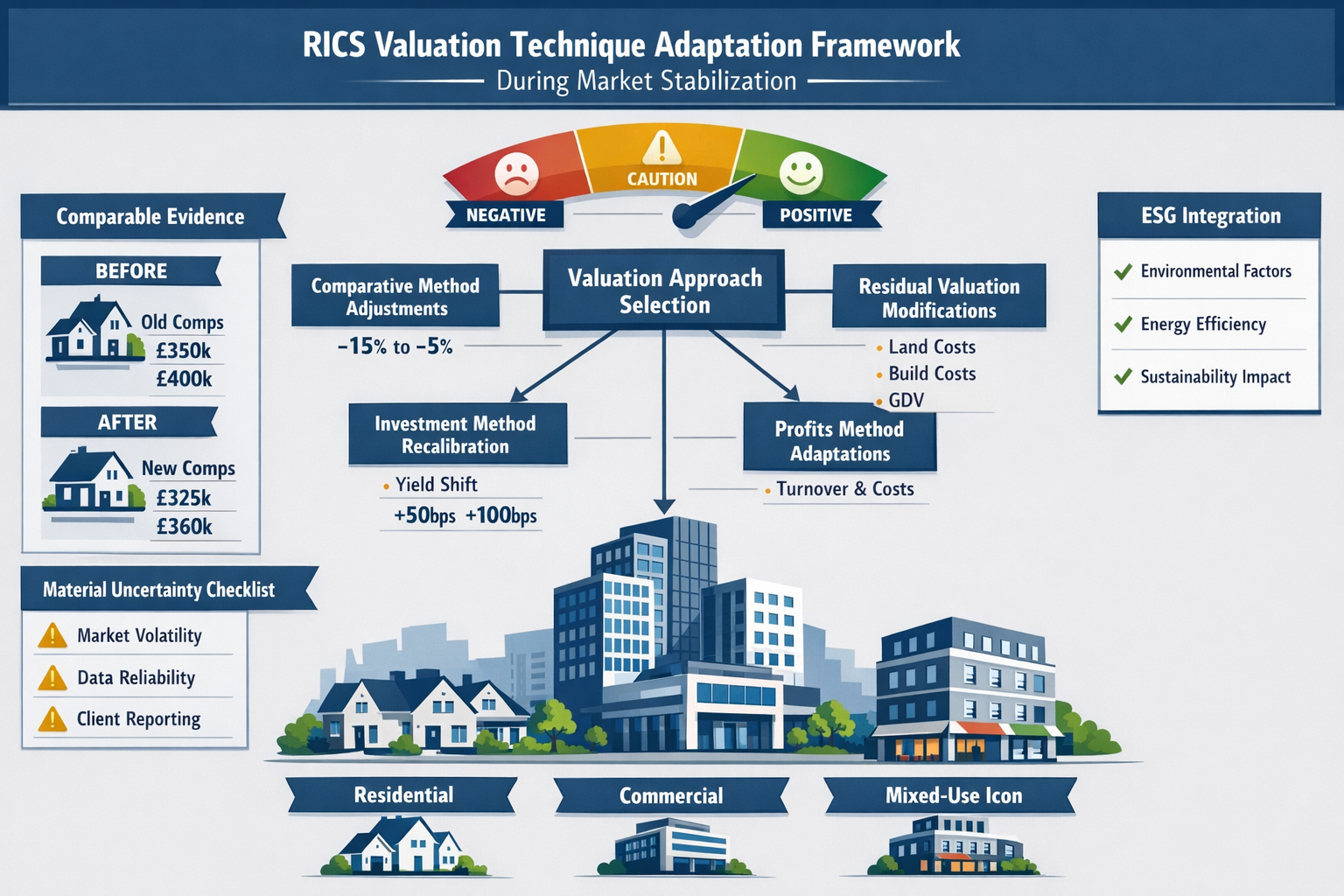
Material Uncertainty Clauses: When and How to Apply Them
During periods of rapid sentiment change, surveyors often face the question: should a material uncertainty clause be included in the valuation report?
According to RICS guidance on real estate valuation in extreme conditions, material uncertainty should be declared when "the valuer is faced with an unprecedented set of circumstances on which to base a judgment."[3]
Indicators that material uncertainty may be appropriate:
⚠️ Insufficient comparable evidence from the current sentiment phase
⚠️ Significant divergence between asking prices and achieved prices
⚠️ Rapid changes in lending criteria affecting buyer capacity
⚠️ External economic factors creating unpredictable market responses
⚠️ Limited transaction volume making trend analysis unreliable
However, surveyors should avoid overusing material uncertainty clauses. As markets stabilize and positive sentiment becomes established through actual transactions, the justification for declaring uncertainty diminishes. Professional judgment determines when sufficient evidence exists to provide a valuation without this caveat.
The Five Primary Valuation Methods and Market Stabilization Adjustments
RICS recognizes five main valuation approaches, each requiring specific adaptations during market transitions:
1. Comparative Method (Market Approach)
The comparative method relies on analyzing recent sales of similar properties. During stabilization, this method faces unique challenges:
Challenges:
- Comparables from negative sentiment periods may undervalue current market
- Recent sales may be limited as market transitions
- Adjustments for time must account for psychological shift, not just inflation
Adaptations:
- Weight recent transactions more heavily than older comparables
- Apply sentiment adjustment factors based on market intelligence
- Consider withdrawn listings and re-listings at higher prices as evidence
- Interview local agents to understand bid patterns and offer acceptance rates
For those conducting Level 3 building surveys, the comparative method provides the foundation for market value assessment, but requires careful calibration during transitional periods.
2. Investment Method (Income Approach)
For income-producing properties, the investment method capitalizes rental income to determine value. Stabilization affects this approach through:
Key Adjustments:
- Yield compression as investor confidence returns
- Revised growth assumptions for rental income
- Changed risk premiums reflecting improved market outlook
- Updated exit cap rates for disposal scenarios
The updated RICS standard on ESG and sustainability (effective April 30, 2026) adds another dimension, requiring consideration of how environmental performance affects long-term income potential and investor demand.[2]
3. Residual Method (Development Approach)
Used primarily for development sites, the residual method calculates value by subtracting development costs from projected end values. During stabilization:
Critical Considerations:
- Revised gross development value (GDV) assumptions reflecting improving sentiment
- Adjusted profit margins as development risk perception decreases
- Changed finance costs as lending conditions improve
- Updated sales rate assumptions for phased developments
4. Profits Method (Accounts Approach)
Applied to specialized trading properties (hotels, care homes, pubs), the profits method requires understanding how business performance relates to property value. Stabilization impacts:
Adjustment Areas:
- Improved trading projections as consumer confidence returns
- Revised capitalization rates for business earnings
- Changed market demand for operational properties
- Updated comparable transactions for specialized assets
5. Cost Method (Depreciated Replacement Cost)
Used for specialized properties without market comparables, the cost method estimates replacement cost less depreciation. While less sensitive to market sentiment, stabilization still affects:
Relevant Factors:
- Construction cost trends and material availability
- Contractor capacity and pricing
- Obsolescence factors in changing market conditions
- Land value assumptions for the hypothetical replacement
Adapting RICS Techniques When Price Expectations Shift from Negative to Positive
Temporal Analysis: Weighting Comparable Evidence by Transaction Date
Perhaps the most critical skill when conducting valuation surveys in stabilizing markets is properly weighting comparable evidence based on when transactions occurred relative to the sentiment shift.
Framework for Temporal Weighting:
Phase 1: Deep Negative Sentiment (Pre-November 2025)
- Comparables reflect distressed psychology
- Apply upward adjustment factor (typically 2-5%)
- Use primarily for establishing floor values
- Weight: 15-20% in final analysis
Phase 2: Transitional Period (November 2025-January 2026)
- Mixed signals with some early stabilization
- Moderate upward adjustment (1-3%)
- Useful for understanding trend direction
- Weight: 25-30% in final analysis
Phase 3: Positive Sentiment Established (Post-January 2026)
- Reflects current market psychology
- Minimal or no adjustment needed
- Most reliable for current value assessment
- Weight: 50-60% in final analysis
This temporal framework ensures that recent market psychology is properly reflected while avoiding over-reliance on potentially anomalous early transactions in the positive phase.
Adjusting for Sentiment vs. Fundamental Value Changes
A critical distinction surveyors must make is between sentiment-driven price changes and fundamental value changes. Not all price movements during stabilization reflect genuine value shifts.
Sentiment-Driven Changes (Temporary):
- Emotional buyer competition creating short-term premiums
- Seller optimism leading to ambitious asking prices
- Media-driven enthusiasm affecting specific locations
- Seasonal factors coinciding with sentiment improvement
Fundamental Value Changes (Sustainable):
- Improved employment prospects in the area
- Infrastructure investments enhancing location
- Planning policy changes increasing development potential
- Demographic shifts affecting demand patterns
When price expectations shift from negative to positive, surveyors must determine how much of the change represents sustainable fundamental improvement versus temporary psychological enthusiasm. This analysis directly impacts the average price reduction after survey findings and negotiation recommendations.
Incorporating Market Intelligence Beyond Transaction Data
Professional surveyors add value by understanding limitations of purely transaction-based analysis and applying appropriate adjustments based on current market intelligence.[5] During stabilization, supplementary intelligence sources become particularly valuable:
Essential Intelligence Sources:
📊 Agent Feedback
- Viewing-to-offer conversion rates
- Time to exchange after offer acceptance
- Proportion of asking price achieved
- Buyer profile changes (first-time vs. investor)
📊 Mortgage Market Data
- Approval rates and volumes
- Loan-to-value ratio trends
- Interest rate movements
- Lender appetite for specific property types
📊 Economic Indicators
- Employment data for the region
- Wage growth trends
- Consumer confidence indices
- Retail spending patterns
📊 Planning and Development Activity
- Planning application volumes
- Development commencement rates
- Infrastructure investment announcements
- Regeneration scheme progress
Integrating this broader intelligence with transaction data provides a more complete picture of market stabilization and helps surveyors make informed adjustments to comparable evidence.
Case Study: Residential Valuation During the 2025-2026 Transition
Property: Semi-detached Victorian house, 3 bedrooms, South London
Valuation Date: February 2026
Purpose: Purchase valuation for mortgage
Comparable Evidence:
| Address | Sale Date | Price | Adjustment Needed | Weighted Value |
|---|---|---|---|---|
| Comp A | August 2025 | £625,000 | +4% (negative sentiment) | £650,000 |
| Comp B | November 2025 | £640,000 | +2% (transitional) | £653,000 |
| Comp C | January 2026 | £665,000 | 0% (current sentiment) | £665,000 |
| Comp D | February 2026 | £670,000 | 0% (current sentiment) | £670,000 |
Analysis:
- Comp A reflects deep negative sentiment period (weight 15%)
- Comp B shows early transition (weight 25%)
- Comps C & D represent current positive sentiment (weight 60% combined)
Valuation Conclusion: £662,000
This approach ensures the valuation reflects current market conditions while acknowledging the transitional nature of recent price movements. The surveyor would note in the report that the market is stabilizing with positive sentiment, but that values should be monitored as the trend becomes more established.
Special Considerations for Different Property Types
Different property sectors respond differently to sentiment shifts, requiring tailored approaches:
Residential Property:
- Most sensitive to consumer confidence changes
- Rapid response to mortgage availability
- Strong correlation with employment security
- Seasonal factors can amplify or dampen sentiment effects
For guidance on residential valuations, RICS provides specific standards that address these unique characteristics.[4]
Commercial Property:
- Slower to respond to sentiment changes
- More influenced by business confidence than consumer sentiment
- Lease structures provide income stability during transitions
- Investment yields adjust gradually as sentiment improves
Development Land:
- Highly sensitive to sentiment shifts
- Option agreements may be renegotiated during transitions
- Planning status changes can coincide with market stabilization
- Residual valuations require careful GDV assumption updating
Specialized Properties:
- Each type responds differently based on operational factors
- Trading performance may lag or lead sentiment changes
- Buyer pool characteristics affect price sensitivity
- Comparable evidence often limited, requiring creative approaches
Practical Implementation: Tools and Techniques for Surveyors
Building a Dynamic Comparable Database
Effective valuation surveys in stabilizing markets require robust data management systems that can track and analyze comparable evidence across different sentiment phases.
Essential Database Features:
✅ Temporal Tagging – Record exact transaction dates and sentiment phase classification
✅ Adjustment Tracking – Document all adjustments applied and rationale
✅ Market Intelligence Fields – Capture days on market, asking vs. achieved price, buyer type
✅ Condition Coding – Standardize property condition assessment for accurate comparison
✅ Location Micro-Analysis – Track values at street level, not just broader areas
Modern surveying practices increasingly incorporate technology to enhance data collection and analysis. Drone surveys can provide comprehensive property documentation, while digital platforms enable real-time comparable tracking.
Developing Sentiment Adjustment Matrices
Creating standardized adjustment matrices helps ensure consistency when applying sentiment-based modifications to comparable evidence:
Sample Residential Sentiment Adjustment Matrix:
| Sentiment Phase | Timeframe | Base Adjustment | Premium Location | Standard Location | Secondary Location |
|---|---|---|---|---|---|
| Deep Negative | Pre-Nov 2025 | +3.5% | +4.5% | +3.5% | +2.5% |
| Transitional | Nov-Dec 2025 | +2.0% | +2.5% | +2.0% | +1.5% |
| Early Positive | Jan 2026 | +0.5% | +1.0% | +0.5% | 0% |
| Established Positive | Feb 2026+ | 0% | 0% | 0% | 0% |
These matrices should be regularly reviewed and updated based on actual market performance and refined through analysis of subsequent transactions.
Quality Assurance and Peer Review Protocols
During market transitions, quality assurance becomes particularly important to ensure valuations remain defensible and consistent with professional standards.
Recommended QA Practices:
🔍 Internal Review Checkpoints
- Comparable selection rationale documented
- Adjustment calculations verified independently
- Market intelligence sources cited and dated
- Assumptions clearly stated and reasonable
🔍 Peer Review for Complex Cases
- Second valuer reviews methodology
- Discussion of alternative approaches considered
- Challenge of assumptions and adjustments
- Documentation of professional disagreements resolved
🔍 Post-Valuation Monitoring
- Track subsequent sales of valued properties
- Compare valuation to achieved price
- Analyze variance and refine methodology
- Build institutional knowledge for future transitions
Understanding the difference between Level 2 and Level 3 surveys helps determine appropriate inspection depth for different valuation purposes, ensuring quality matches client needs.
Client Communication: Explaining Market Dynamics
Clients often struggle to understand why valuations may differ from their expectations during market transitions. Effective communication is essential:
Key Messages for Clients:
💡 Market Timing Matters – Explain how recent sentiment shifts affect value assessment
💡 Evidence-Based Approach – Demonstrate reliance on actual transactions, not speculation
💡 Professional Standards – Reference RICS requirements for objectivity and independence
💡 Uncertainty Acknowledgment – Be transparent about limitations during transitional periods
💡 Monitoring Recommendations – Suggest review timeframes if market continues evolving
For clients facing situations where home valuation is less than an offer, clear explanation of market dynamics helps them make informed decisions.
Emerging Considerations: ESG, Sustainability, and Future-Proofing Valuations
The New ESG and Sustainability Standard
The updated RICS global standard addressing ESG and sustainability in commercial property valuation becomes effective April 30, 2026.[2] This represents a significant evolution in valuation methodology, particularly relevant as markets stabilize and investors focus on long-term value drivers.
Key Requirements:
🌱 Energy Performance Assessment – EPC ratings and potential improvement costs
🌱 Climate Risk Evaluation – Flood risk, overheating potential, extreme weather resilience
🌱 Embodied Carbon Consideration – Construction materials and lifecycle carbon impact
🌱 Social Value Factors – Community impact, accessibility, health and wellbeing features
🌱 Governance Elements – Building safety compliance, management quality, stakeholder engagement
As markets shift from negative to positive sentiment, properties with strong ESG credentials often lead the recovery, commanding premium values from sustainability-focused buyers and investors.
How Sustainability Affects Value During Market Stabilization
Research indicates that sustainability features can significantly impact property values, particularly during market transitions when buyers become more selective:
Premium Value Drivers:
- Energy Efficiency: Properties with A/B EPC ratings achieving 5-10% premiums
- Renewable Energy: Solar panels and heat pumps adding tangible value
- Climate Resilience: Flood defenses and cooling systems reducing risk perception
- Future-Proofing: Adaptability to evolving regulatory requirements
Value Detractors:
- Poor EPC Ratings: E/F/G ratings facing increasing buyer resistance
- Retrofit Costs: Properties requiring significant upgrades to meet standards
- Stranded Asset Risk: Buildings unlikely to meet 2030/2050 targets
- Obsolescence: Outdated systems requiring complete replacement
When conducting valuations during market stabilization, surveyors must assess whether improving sentiment applies equally to all property types or whether sustainable properties are disproportionately benefiting.
Integrating Technology: AVMs, AI, and Professional Judgment
Automated Valuation Models (AVMs) and artificial intelligence tools are increasingly available to surveyors. However, professional guidance indicates that "professional surveyors add value by understanding AVM limitations and applying appropriate adjustments based on current market intelligence."[5]
Appropriate Use of Technology:
✅ Initial Value Estimation – AVMs provide starting points for analysis
✅ Comparable Identification – AI can rapidly identify potential comparables
✅ Data Pattern Recognition – Machine learning spots trends humans might miss
✅ Efficiency Enhancement – Automation handles routine data processing
Where Human Expertise Remains Essential:
🎯 Market Psychology Assessment – Understanding sentiment shifts requires human judgment
🎯 Property-Specific Factors – Unique characteristics that algorithms miss
🎯 Local Market Nuances – Micro-location factors affecting value
🎯 Professional Skepticism – Questioning data anomalies and outliers
🎯 Ethical Considerations – Maintaining independence and objectivity
The optimal approach combines technological efficiency with professional expertise, particularly during transitional market periods when algorithmic models may lag real-time sentiment changes.
Common Pitfalls and How to Avoid Them
Pitfall 1: Over-Reliance on Recent Outlier Transactions
During early market stabilization, occasional transactions at significantly higher prices can occur. These may represent:
- Emotional buyers paying premiums
- Properties with unique features not representative of the market
- Transactions with special circumstances (family sales, quick completions)
Avoidance Strategy: Always analyze outliers separately, understand the circumstances, and avoid letting single transactions disproportionately influence valuations. Maintain statistical discipline by identifying and appropriately treating outliers.
Pitfall 2: Insufficient Adjustment for Market Timing
Failing to adequately adjust comparables from different sentiment phases leads to valuations that don't reflect current conditions.
Avoidance Strategy: Implement formal temporal weighting frameworks and document adjustment rationale. Regularly review and refine adjustment factors based on subsequent market performance.
Pitfall 3: Ignoring Regional and Sector Variations
Assuming national sentiment trends apply uniformly across all regions and property types creates valuation errors.
Avoidance Strategy: Develop location-specific and sector-specific market intelligence. Understand that northern markets may stabilize differently than southern markets, and residential may lead or lag commercial sectors.
Pitfall 4: Premature Removal of Material Uncertainty
As markets begin stabilizing, surveyors may be tempted to remove material uncertainty clauses too quickly to appear confident.
Avoidance Strategy: Maintain material uncertainty declarations until sufficient transaction evidence exists from the positive sentiment phase. Document the specific criteria that would justify removal.
Pitfall 5: Neglecting to Update Assumptions
Using outdated assumptions about yields, growth rates, or market conditions undermines valuation accuracy.
Avoidance Strategy: Establish regular assumption review schedules. Maintain assumption libraries that are updated quarterly based on market intelligence and actual performance data.
Regulatory Compliance and Professional Standards

RICS Compliance Requirements During Market Transitions
The RICS Red Book Global Standards impose specific requirements that become particularly important during market stabilization:
Mandatory Compliance Elements:
📋 Terms of Engagement – Clear scope, purpose, and basis of value
📋 Competence Declaration – Confirmation of expertise in current market conditions
📋 Independence Statement – Disclosure of any conflicts or limitations
📋 Assumptions and Special Assumptions – Explicit statement of what is assumed
📋 Valuation Approach – Explanation of methodology selected and why
📋 Market Conditions Commentary – Description of current market state and trends
When markets are transitioning, the market conditions commentary becomes particularly critical, requiring detailed explanation of the sentiment shift and how it affects the valuation.
Record Keeping and Defensibility
Valuations conducted during market transitions face higher scrutiny if subsequently challenged. Comprehensive record keeping is essential:
Critical Documentation:
- Comparable Selection Process: Why specific comparables were chosen and others rejected
- Adjustment Calculations: Detailed workings showing how adjustments were derived
- Market Intelligence Sources: Dated records of agent consultations, market reports, economic data
- Professional Judgment Notes: Reasoning behind key decisions and alternative approaches considered
- Client Communications: Records of discussions about market conditions and valuation limitations
This documentation proves invaluable if the valuation is later questioned or if market conditions evolve differently than anticipated.
Insurance and Liability Considerations
Professional indemnity insurance becomes particularly relevant during market transitions when valuation accuracy is more challenging.
Risk Management Practices:
⚖️ Clear Scope Limitation – Define precisely what the valuation covers and excludes
⚖️ Appropriate Caveats – Include necessary limitations without undermining the valuation's utility
⚖️ Regular Insurer Communication – Keep insurers informed of market conditions and challenges
⚖️ Continuing Professional Development – Maintain expertise in evolving market conditions
⚖️ Peer Review for Complex Cases – Obtain second opinions on challenging valuations
Understanding statutory considerations and consequences of failing to act appropriately helps surveyors maintain professional standards and manage liability.
Future Outlook: Preparing for Continued Market Evolution
Monitoring Indicators for Sustained Stabilization
As 2026 progresses, surveyors must monitor whether the positive sentiment shift represents genuine market stabilization or temporary enthusiasm:
Sustainability Indicators:
📈 Transaction Volume Trends – Sustained increases suggest real market recovery
📈 Price Achievement Ratios – Asking prices being consistently achieved or exceeded
📈 Time on Market Reduction – Properties selling faster indicates genuine demand
📈 Mortgage Approval Rates – Lending support underpins sustainable price growth
📈 Economic Fundamentals – Employment, wages, and GDP supporting property demand
Conversely, warning signs might include:
⚠️ Increasing gap between asking and achieved prices
⚠️ Rising days on market after initial improvement
⚠️ Declining mortgage approvals despite positive sentiment
⚠️ Economic indicators weakening
⚠️ Increased use of incentives by sellers
Adapting to Potential Market Reversals
Markets don't move in straight lines. Surveyors must remain prepared for potential sentiment reversals:
Scenario Planning:
Scenario A: Sustained Positive Momentum
- Gradually reduce sentiment adjustments to zero
- Build comparable database from positive phase
- Focus on identifying new market drivers
- Monitor for overheating risks
Scenario B: Stabilization Plateau
- Maintain current adjustment frameworks
- Develop long-term comparable weighting
- Focus on fundamental value drivers
- Prepare for extended transitional period
Scenario C: Sentiment Reversal
- Reintroduce or increase material uncertainty clauses
- Weight more recent (negative) comparables heavily
- Reassess adjustment matrices
- Communicate proactively with clients
Continuing Professional Development
The rapidly evolving market conditions in 2026 underscore the importance of ongoing professional development:
Essential CPD Topics:
🎓 Market Analysis Techniques – Advanced methods for transitional markets
🎓 ESG and Sustainability – Understanding the new RICS standard requirements
🎓 Technology Integration – Effective use of AVMs and AI tools
🎓 Economic Indicators – Interpreting macro data for property implications
🎓 Regional Market Dynamics – Understanding local variations in national trends
RICS members should ensure their CPD activities specifically address valuation in uncertain or transitional market conditions, building expertise that differentiates professional judgment from automated approaches.
Conclusion: Excellence in Valuation During Market Transitions
Conducting valuation surveys in stabilizing markets requires surveyors to combine technical expertise, market intelligence, professional judgment, and clear communication. As price expectations shift from negative to positive, the challenges are significant—but so are the opportunities for professional surveyors to demonstrate their value.
The dramatic sentiment swing from -29% to +35% between November 2025 and January 2026 illustrates how quickly market psychology can change. Surveyors who successfully navigate these transitions understand that:
Professional valuations during market stabilization depend on:
✨ Rigorous comparable analysis with appropriate temporal weighting
✨ Integration of multiple intelligence sources beyond transaction data
✨ Transparent methodology clearly explained to clients
✨ Compliance with RICS standards including Red Book requirements
✨ Consideration of emerging factors like ESG and sustainability
✨ Balanced professional judgment that neither lags nor leads market reality
The RICS Red Book Global Standards provide the framework, but professional expertise brings these standards to life in practical application. Whether conducting building inspections and surveys for homeowners or complex commercial valuations, the principles of thorough analysis, professional skepticism, and clear communication remain constant.
Actionable Next Steps for Surveyors
Immediate Actions:
- Review and update your comparable database to clearly identify transaction dates and sentiment phases
- Develop or refine your temporal adjustment matrix based on local market evidence
- Enhance market intelligence gathering through systematic agent consultation and economic monitoring
- Review recent valuations to ensure they reflect current market stabilization
- Prepare client communication materials explaining market transition dynamics
Medium-Term Development:
- Participate in RICS CPD focused on valuation in uncertain conditions
- Study the new ESG and sustainability standard before April 30, 2026 effective date
- Build regional market expertise understanding local variations in national trends
- Develop technology integration strategies for AVMs and data analysis tools
- Establish peer review protocols for complex transitional market valuations
Long-Term Strategic Planning:
- Develop specialized expertise in specific property sectors or regions
- Build institutional knowledge systems capturing lessons from market transitions
- Create thought leadership through market commentary and analysis
- Enhance professional networks for market intelligence sharing
- Invest in technology infrastructure supporting sophisticated market analysis
The property market will continue to evolve, with sentiment shifts creating both challenges and opportunities. Surveyors who invest in developing robust methodologies for valuation surveys in stabilizing markets will be well-positioned to serve clients effectively, maintain professional standards, and build sustainable practices regardless of market conditions.
By adapting RICS techniques when price expectations shift from negative to positive, professional surveyors demonstrate the irreplaceable value of human expertise, ethical practice, and sound judgment—qualities that no automated system can replicate and that clients increasingly recognize as essential in navigating complex property markets.
References
[1] Rics Red Book Update – https://www.jll.com/en-uk/guides/rics-red-book-update
[2] Rics Publishes Updated Global Standard Esg Sustainability Commercial Property Valuation – https://www.rics.org/news-insights/rics-publishes-updated-global-standard-esg-sustainability-commercial-property-valuation
[3] Real Estate Valuation Extreme Conditions – https://ww3.rics.org/uk/en/journals/property-journal/real-estate-valuation-extreme-conditions.html
[4] Residential Valuations – https://www.rics.org/profession-standards/rics-standards-and-guidance/sector-standards/valuation-standards/residential-valuations
[5] Valuing Northern England Properties In 2026 Surveyor Tactics For Outpacing Southern Affordability Pressures – https://nottinghillsurveyors.com/blog/valuing-northern-england-properties-in-2026-surveyor-tactics-for-outpacing-southern-affordability-pressures
[6] Red Book Global – https://www.rics.org/profession-standards/rics-standards-and-guidance/sector-standards/valuation-standards/red-book/red-book-global