

The UK housing market in 2026 presents an unprecedented challenge for property professionals: a widening regional divide that demands fundamentally different valuation approaches across the country. While national forecasts predict modest 1-3% growth, this headline figure masks a dramatic story of northern momentum versus southern stagnation that requires Valuation Strategies for Northern vs Southern UK House Price Divergence in 2026: RICS Tactics for Surveyors to evolve rapidly.
Recent RICS data reveals a market in transformation, with Scotland and Northern Ireland leading growth at rates up to 11% annually—almost four times the UK average—while London languishes at just 1.3% growth[3]. For surveyors navigating this divergent landscape, traditional one-size-fits-all methodologies no longer suffice. The recovery emerging from affordable late-cycle markets in the North rather than prime southern segments demands region-specific adjustment techniques aligned with RICS Red Book standards.
Key Takeaways
- 📊 Regional divergence is widening: Northern Ireland shows 11% annual growth versus London's 1.3%, requiring distinct valuation frameworks for each region[3]
- 🎯 Bottom-up recovery pattern: The 2026 market recovery emerges from affordable northern markets rather than traditional prime southern property segments, reversing historical trends
- 📈 Sentiment split by timeframe: While +43% of surveyors expect higher prices over 12 months, near-term 3-month expectations remain flat at -4%, indicating delayed price movement[1][2]
- 🔍 Pre-offer valuations critical in the South: Southern homeowners must understand property values before making offers due to persistent affordability constraints and pricing challenges[3]
- ⚖️ RICS-compliant regional adjustments: Surveyors must apply different comparable selection criteria, adjustment factors, and market condition weightings based on regional performance
Understanding the 2026 Regional Price Divergence
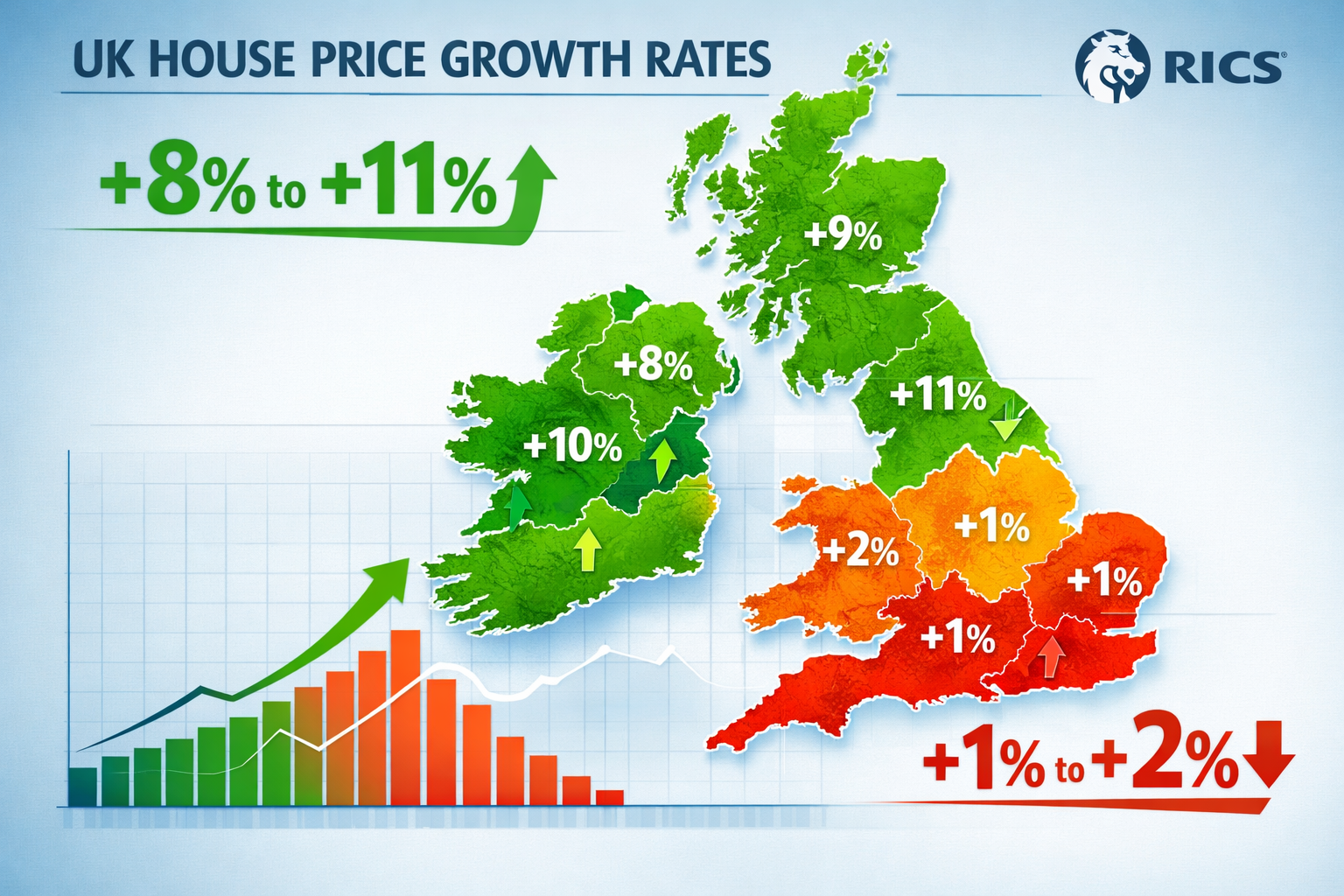
The North-South Divide in Numbers
The UK housing market has experienced regional variations throughout history, but 2026 marks an exceptional period of divergence that fundamentally alters valuation practice. The data paints a clear picture of two distinct markets operating under the same national umbrella.
Northern regions demonstrate robust momentum:
- Northern Ireland: 11% annual growth in the first nine months of 2025, the strongest UK performance[3]
- Scotland: Marginally stronger than the national average, with consistent upward trajectory
- North West and North of England: Respondents report prices moving higher, representing clear positive sentiment[1][2]
Southern regions face persistent headwinds:
- London: Only 1.3% annual growth, making it the weakest performing region across the UK[3]
- South East, South West, and East Anglia: Net balances more negative than the national headline average, though modest month-on-month improvements are emerging[1][2]
- Wales: Broadly matching the UK trend, serving as a middle ground between extremes[3]
This divergence reflects fundamental differences in affordability dynamics, employment patterns, and buyer demographics across regions. Understanding what house prices are doing in 2023 provides historical context for these current trends.
Market Stabilization Signals and Recovery Patterns
Despite regional variations, national-level indicators suggest the market is finding its footing after a challenging period. The national price net balance stands at -10%, representing four consecutive months of improvement from the low of -19% in October 2025[1][2]. This tentative stabilization signals a potential turning point, though surveyors must interpret this data through a regional lens.
"The 2026 recovery will emerge from more affordable late-cycle markets in the North, Scotland, and Wales rather than from prime property segments—requiring surveyors to adjust their approach based on regional market dynamics."[3]
This bottom-up recovery pattern represents a fundamental shift from historical norms where prime London and South East markets typically led price movements. For valuation professionals, this necessitates recalibrating assumptions about market leadership and comparable property selection.
Sentiment Divergence: Short-Term Caution vs Long-Term Optimism
RICS survey data reveals an intriguing split in professional sentiment that impacts valuation confidence levels:
12-month outlook (optimistic):
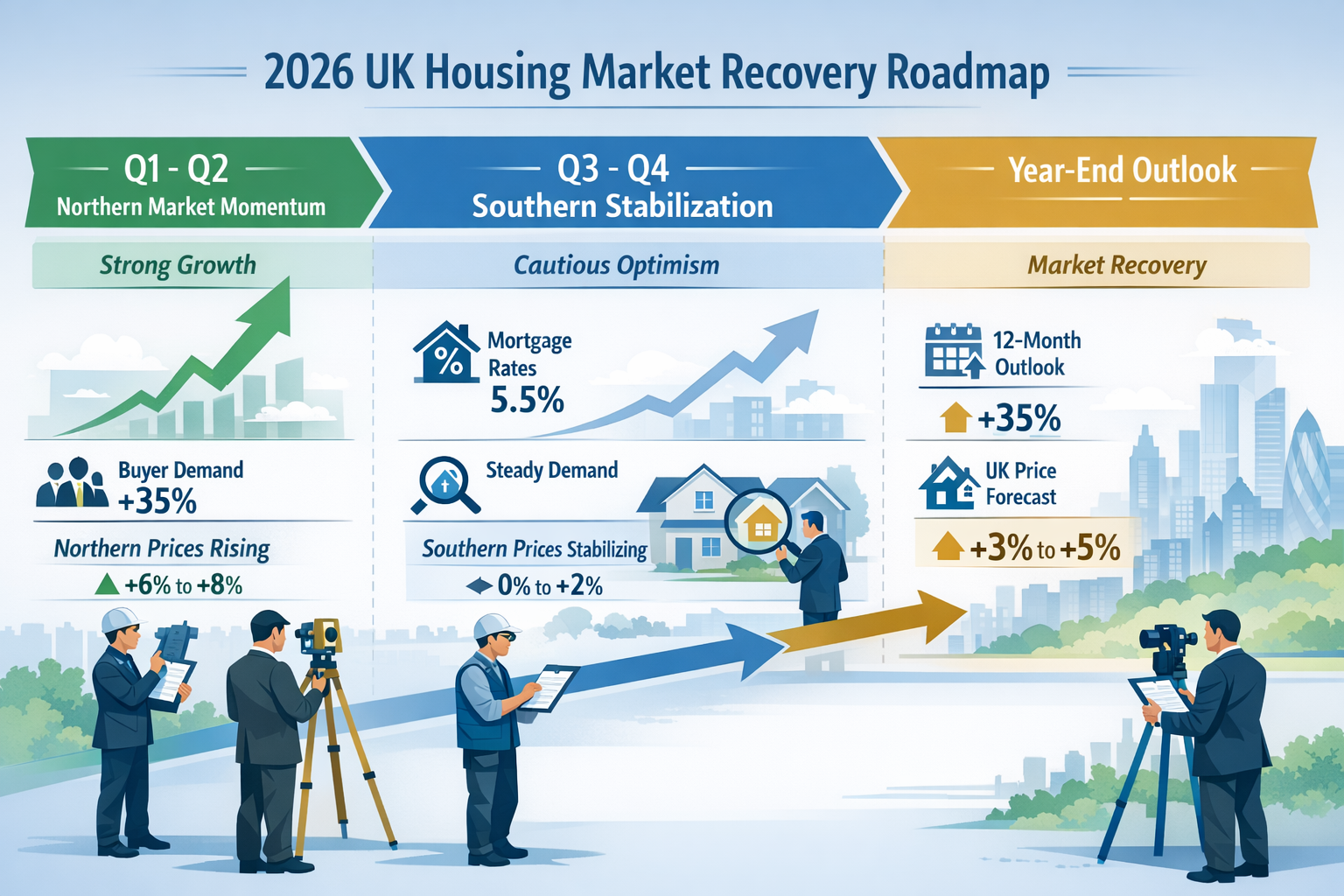
- +35% of respondents expect sales increases over the next year—the strongest reading since December 2024[1]
- +43% anticipate higher prices over the year ahead—the most positive outlook since February 2025[1][2]
3-month outlook (cautious):
- Short-term sales expectations eased to +4%, reflecting immediate economic uncertainty[1]
- Near-term price expectations remain flat at -4%, indicating surveyors expect delayed price movement[1][2]
This temporal divergence suggests that while structural market fundamentals are improving, immediate transactional activity faces headwinds from economic uncertainty, mortgage rate volatility, and buyer hesitancy. Surveyors conducting valuations must weight recent comparable evidence differently depending on the valuation purpose and timeframe.
Valuation Strategies for Northern vs Southern UK House Price Divergence in 2026: Regional Adjustment Methodologies
Northern Market Valuation Approaches
Valuing properties in high-growth northern regions requires dynamic adjustment techniques that capture momentum while avoiding over-optimism. RICS-compliant strategies for northern markets in 2026 include:
1. Time-Adjusted Comparable Analysis
When comparable sales occurred 3-6 months prior in a rising market, surveyors must apply appropriate time adjustments:
- Calculate monthly appreciation rates from multiple data sources (Land Registry, local agent feedback, RICS regional indices)
- Apply graduated adjustments rather than linear extrapolation (e.g., 0.8% monthly for months 1-3, 0.6% for months 4-6)
- Document adjustment rationale thoroughly to maintain RICS Red Book compliance
- Cross-reference with rental yield trends to validate capital growth assumptions
For properties in Northern Ireland experiencing 11% annual growth, this translates to approximately 0.9% monthly appreciation—a significant adjustment factor that must be applied judiciously[3].
2. Supply-Demand Imbalance Weighting
Northern markets often feature limited stock levels relative to buyer demand, creating upward price pressure:
- Assess local inventory levels (properties available per 1,000 population)
- Weight comparables based on competitive bidding evidence
- Apply premium adjustments (typically 2-5%) where multiple offer scenarios are documented
- Consider independent property valuation methodologies to ensure objectivity
3. Regional Economic Indicator Integration
Northern growth is supported by specific economic fundamentals that should inform valuations:
| Economic Factor | Impact on Valuation | Adjustment Consideration |
|---|---|---|
| Employment growth | Increased buyer pool | +2-4% premium in high-growth employment zones |
| Infrastructure investment | Future value uplift | +3-7% for properties near major projects |
| Affordability ratios | Sustainable demand | Validate price levels against income multiples |
| Population migration | Demographic shifts | Weight comparables from similar buyer demographics |
Southern Market Valuation Approaches
Southern markets, particularly London and the South East, require conservative, evidence-based methodologies that acknowledge affordability constraints and pricing pragmatism. Effective strategies include:
1. Realistic Pricing Frameworks
Savills' head of residential research emphasized that "pragmatism will remain key to achieving successful prime sales in 2026," particularly in southern markets[3]. This translates to specific valuation practices:
- Prioritize recent completed sales over asking prices or under-offer properties
- Apply downward adjustments for properties with extended marketing periods (typically -5% for 6+ months on market)
- Weight agent feedback heavily regarding buyer price resistance points
- Conduct pre-offer valuations to help clients understand realistic expectations before committing to purchases[3]
The importance of choosing the right property survey becomes even more critical in markets where pricing precision determines transaction success.
2. Affordability-Constrained Comparable Selection
In southern markets where affordability challenges persist, comparable selection must reflect buyer financing realities:
- Exclude cash-buyer transactions when valuing for mortgage purposes (they typically achieve premiums)
- Weight comparables from similar mortgage product users (first-time buyers vs remortgagers vs downsizers)
- Apply negative adjustments for properties exceeding local affordability thresholds
- Consider stamp duty band proximity (properties just below thresholds command premiums)
3. Micro-Location Premium Differentiation
Southern markets exhibit pronounced micro-location variations that northern markets may not replicate:
- School catchment premiums: Document and quantify (typically 5-15% in prime catchments)
- Transport connectivity: Crossrail, Underground zones, and commuter rail access create distinct value tiers
- Gentrification trajectories: Emerging areas require careful comparable selection to avoid overstating value
- Conservation area constraints: May suppress value in renovation-dependent properties
For specialized valuations such as leasehold extension and enfranchisement, southern market complexity demands additional expertise layers.
RICS Tactics for Surveyors: Implementing Compliant Regional Strategies
Red Book Compliance in Divergent Markets
The RICS Valuation – Global Standards (Red Book) provides the framework within which regional strategies must operate. Key compliance considerations for 2026's divergent market include:
1. Basis of Value Selection
Different valuation purposes may require different bases of value, particularly relevant in divergent markets:
- Market Value: Most common basis, but requires careful definition of "typical buyer" which varies dramatically between regions
- Investment Value: Increasingly relevant in northern markets where rental yields remain attractive
- Fair Value: For financial reporting purposes, requires consideration of regional risk premiums
2. Assumptions and Special Assumptions
Regional divergence necessitates explicit documentation of market condition assumptions:
✅ Document regional market conditions at the valuation date (growth trajectory, inventory levels, buyer sentiment)
✅ State explicitly whether time adjustments have been applied to comparables and the methodology used
✅ Clarify special assumptions regarding future market movements (particularly for development valuations)
✅ Disclose data limitations where regional comparable evidence is scarce
3. Uncertainty and Material Uncertainty Declarations
The current market environment may warrant material uncertainty clauses in certain circumstances:
- Southern markets with minimal transaction volumes may lack sufficient comparable evidence
- Rapidly appreciating northern markets may create valuation confidence challenges
- Economic uncertainty affecting buyer behavior may impact market value reliability
Data Sources and Market Intelligence
Effective regional valuation strategies depend on robust, region-specific data sources:
Primary Data Sources:
- Land Registry price paid data (3-month lag consideration)
- RICS regional house price surveys (monthly sentiment indicators)
- Rightmove and Zoopla asking price indices (leading indicators)
- Local estate agent feedback (qualitative market intelligence)
Secondary Intelligence:
- Mortgage approval data by region (Council of Mortgage Lenders)
- Regional employment and wage statistics (ONS)
- Infrastructure investment announcements (regional development agencies)
- Demographic migration patterns (census and ONS data)
For surveyors operating across multiple regions, maintaining region-specific comparable databases becomes essential. This might include partnerships with local specialists or subscription to enhanced data services.
Specialized Valuation Scenarios
Regional divergence creates unique challenges for specialized valuation types:
Matrimonial Valuations 📋
Matrimonial valuations in 2026 require particular sensitivity to regional timing:
- Northern properties may show significant appreciation during separation periods
- Southern properties may have stagnated, affecting equity division calculations
- Surveyors must clearly date valuations and explain regional market movements
Right to Buy Valuations 🏘️
Right to buy valuations face regional complexity:
- Northern social housing may have appreciated significantly, affecting discount calculations
- Southern properties may show minimal growth, impacting tenant purchase decisions
- Regional rental market strength influences investment value considerations
Insurance Reinstatement Valuations 🔨
Insurance reinstatement cost valuations must account for regional construction cost variations:
- Labor and material costs vary significantly between regions
- Northern building activity levels may create capacity constraints
- Southern markets may see reduced construction activity affecting contractor availability
Practical Implementation: Regional Valuation Workflows

Northern Market Valuation Workflow
Step 1: Market Context Assessment ⚡
- Review latest RICS regional data for specific area
- Assess local inventory levels and days-on-market trends
- Identify recent comparable sales within 3-month window
- Consult local agents regarding multiple offer frequency
Step 2: Comparable Selection and Adjustment
- Prioritize recent sales (within 3 months) to minimize time adjustments
- Select minimum 3-5 comparables from similar property types
- Apply time adjustments using documented monthly appreciation rates
- Consider supply-demand premium where multiple offers evidenced
Step 3: Value Reconciliation
- Cross-reference capital value against rental yield benchmarks
- Validate against affordability metrics (price-to-income ratios)
- Consider sustainability of growth trajectory
- Document confidence level and any uncertainty factors
Step 4: Client Communication
- Explain regional market context and growth drivers
- Clarify that valuations reflect current market conditions
- Highlight potential volatility in rapidly appreciating markets
- Provide context for lending or purchase decisions
Southern Market Valuation Workflow
Step 1: Affordability and Constraint Analysis 🎯
- Assess local affordability ratios and buyer financing capacity
- Review extended marketing period properties for pricing lessons
- Identify stamp duty band effects on comparable selection
- Evaluate micro-location premium factors
Step 2: Conservative Comparable Selection
- Extend search period (6 months) due to lower transaction volumes
- Exclude outlier sales (cash buyers, distressed sales)
- Weight recent sales more heavily than older comparables
- Apply negative adjustments for properties with extended marketing
Step 3: Pragmatic Value Conclusion
- Favor lower end of value range where evidence supports
- Consider buyer price resistance points from agent feedback
- Validate against realistic marketing period expectations
- Apply professional skepticism to optimistic comparable evidence
Step 4: Pre-Offer Guidance
- Provide clear value ranges rather than point estimates where appropriate
- Explain affordability constraints affecting the specific property
- Advise on realistic offer levels and negotiation positioning
- Clarify market timing considerations for purchase decisions
For properties requiring detailed structural assessment, understanding what is a Level 3 building survey helps integrate condition factors into regional valuation adjustments.
Future-Proofing Valuation Strategies: 2026 and Beyond
Adapting to Evolving Regional Dynamics
The regional divergence characterizing 2026 may not persist indefinitely. Surveyors must develop adaptive frameworks that respond to changing market conditions:
Monitoring Leading Indicators:
- Mortgage approval trends by region (3-month leading indicator)
- Rental market tightness (indicator of future capital growth)
- Infrastructure investment announcements (long-term value drivers)
- Regional employment and wage growth (affordability trajectory)
Scenario Planning:
- Develop valuation sensitivity analyses for different regional trajectories
- Consider mortgage rate impact scenarios (particularly for southern markets)
- Model potential convergence scenarios where regional gaps narrow
- Prepare for policy interventions that may affect regional dynamics
Technology and Data Integration
Modern valuation practice increasingly relies on technology-enhanced methodologies:
Automated Valuation Models (AVMs):
- Use as sense-check tools rather than primary valuation methods
- Recognize regional AVM accuracy varies (higher in data-rich southern markets)
- Apply professional judgment to override AVM outputs where regional dynamics warrant
- Document reasons for deviations from AVM estimates
Geographic Information Systems (GIS):
- Map comparable sales with regional heat-mapping
- Visualize micro-location premium patterns
- Identify emerging value corridors in northern growth markets
- Analyze transport connectivity and school catchment overlays
Big Data Analytics:
- Aggregate multiple data sources for regional trend identification
- Apply machine learning to comparable selection optimization
- Identify leading indicator correlations for regional forecasting
- Enhance market intelligence through sentiment analysis
Professional Development and Regional Expertise
The complexity of regional divergence demands continuous professional development:
- Attend RICS regional market briefings and webinars
- Develop networks with local surveyors in key regions
- Subscribe to regional property market intelligence services
- Participate in peer review processes to validate regional methodologies
- Maintain CPD records documenting regional market expertise development
Understanding RICS roof surveyor specializations and other technical competencies complements regional market knowledge for comprehensive valuation practice.
Risk Management in Divergent Markets
Professional Indemnity Considerations
Regional divergence creates specific professional indemnity risks that surveyors must manage:
Valuation Challenges:
- Rapidly appreciating northern markets may lead to retrospective claims if growth stalls
- Conservative southern valuations may face challenge if markets recover faster than anticipated
- Regional comparable scarcity may create defensibility challenges
- Client expectation management failures in divergent markets
Risk Mitigation Strategies:
- Document regional market context comprehensively in valuation reports
- Retain detailed comparable evidence and adjustment rationale
- Communicate uncertainty clearly where market conditions warrant
- Maintain robust file notes of client discussions and advice given
- Ensure PI insurance covers regional practice scope
Client Communication and Expectation Management
Effective communication becomes critical when regional markets diverge significantly:
For Northern Market Clients:
- ✅ Explain that current growth rates may not be sustainable indefinitely
- ✅ Clarify that valuations reflect current market conditions, not future projections
- ✅ Highlight risks of over-leveraging in rapidly appreciating markets
- ✅ Provide context for regional growth drivers and sustainability factors
For Southern Market Clients:
- ✅ Manage expectations regarding realistic pricing and marketing periods
- ✅ Explain affordability constraints affecting buyer behavior
- ✅ Provide evidence-based guidance on offer levels and negotiation strategy
- ✅ Clarify that current stagnation doesn't imply long-term value decline
Conclusion
The Valuation Strategies for Northern vs Southern UK House Price Divergence in 2026: RICS Tactics for Surveyors represent a fundamental evolution in professional practice, driven by unprecedented regional market variations. With Northern Ireland achieving 11% annual growth while London manages just 1.3%, the traditional one-size-fits-all approach to property valuation no longer serves clients or maintains professional standards[3].
Surveyors must embrace region-specific methodologies that acknowledge these divergent realities: dynamic time-adjusted comparable analysis for northern growth markets, and conservative affordability-constrained frameworks for southern regions. The bottom-up recovery pattern emerging from affordable late-cycle markets rather than prime segments requires recalibrated assumptions about market leadership and comparable property selection[3].
RICS Red Book compliance remains paramount, but implementation must flex to accommodate regional variations in data availability, market velocity, and buyer behavior. The temporal split in market sentiment—with +43% of professionals expecting higher prices over 12 months but only -4% in the near term—underscores the importance of timeframe-specific valuation approaches[1][2].
Actionable Next Steps for Surveyors
📌 Immediate Actions:
- Review and segment your comparable database by region, applying distinct adjustment methodologies
- Develop region-specific valuation templates that incorporate local market context sections
- Establish relationships with local agents and surveyors in key regions for market intelligence
- Update client communication materials to explain regional divergence and its valuation implications
📌 Medium-Term Development:
- Attend RICS regional market briefings and complete CPD on regional valuation techniques
- Implement technology solutions (GIS, enhanced data services) for regional market analysis
- Develop scenario planning frameworks for different regional trajectory outcomes
- Review and enhance PI insurance coverage for regional practice scope
📌 Strategic Positioning:
- Consider specialization in specific regional markets to develop deep expertise
- Build collaborative networks with surveyors in complementary regions
- Invest in regional market intelligence subscriptions and data services
- Position your practice as a regional valuation specialist through thought leadership
The 2026 housing market presents both challenges and opportunities for valuation professionals. Those who adapt their methodologies to acknowledge and respond to regional divergence—while maintaining rigorous RICS compliance—will deliver superior client value and position themselves for long-term professional success in an increasingly complex market landscape.
References
[1] Uk Resi Survey Jan 2026 Report Shows Early Signs Market Recovery Despite Caution – https://www.rics.org/news-insights/uk-resi-survey-jan-2026-report-shows-early-signs-market-recovery-despite-caution
[2] Uk Residential Market Survey January 2026 – https://www.rics.org/content/dam/ricsglobal/documents/market-surveys/uk-residential-market-survey/UK-Residential-Market-Survey_January-2026.pdf
[3] Housing Market First Time Buyers Mortgage Rates 2026 B2892886 – https://www.the-independent.com/news/uk/home-news/housing-market-first-time-buyers-mortgage-rates-2026-b2892886.html
[4] Valuation Strategies For The 2026 Uk Housing Recovery Regional Price Divergence And Surveyor Tactics – https://nottinghillsurveyors.com/blog/valuation-strategies-for-the-2026-uk-housing-recovery-regional-price-divergence-and-surveyor-tactics