


The Northern England property market is experiencing a remarkable transformation in 2026. While southern regions continue to struggle with depressed valuations, bungalows across the North West and North of England are emerging as unexpected stars of the housing recovery. According to the latest RICS residential market survey from January 2026, Northern regions are reporting prices trending higher—positioning them among the strongest performers nationally. This isn't merely a temporary fluctuation but represents a structural shift in UK property market dynamics that demands fresh valuation approaches.
For property professionals, investors, and homeowners, understanding Valuation Strategies for Northern England Bungalows in the 2026 Housing Recovery: RICS Insights has become essential. The RICS House Price Balance improved to -10% in January 2026, marking the third consecutive monthly improvement and the strongest reading since June 2025. This article leverages the latest RICS survey data to explore bungalow-specific valuation adjustments, defect identification through building surveys, and investment potential in this recovering market.
Key Takeaways
✅ Regional divergence is accelerating: Northern England bungalows are outperforming southern markets, with the North West and North reporting positive price trends while London languishes at -44% net balance.
✅ Bungalow demand remains robust: Post-holiday surveyor feedback confirms bungalows continue to attract strong buyer interest, driven by demographic shifts and downsizer preferences.
✅ Valuation adjustments require recalibration: The structural market shift demands new baseline assumptions, with RICS projecting the House Price Balance to reach +8% in 2027 and +12% in 2028.
✅ Building survey insights are critical: Identifying common defects in older Northern bungalows—from damp issues to roof deterioration—directly impacts valuation accuracy and negotiation leverage.
✅ Investment opportunities are emerging: Forward-looking valuations that account for regional recovery momentum can unlock significant returns for strategic buyers and portfolio investors.
Understanding the 2026 Northern England Housing Recovery Context
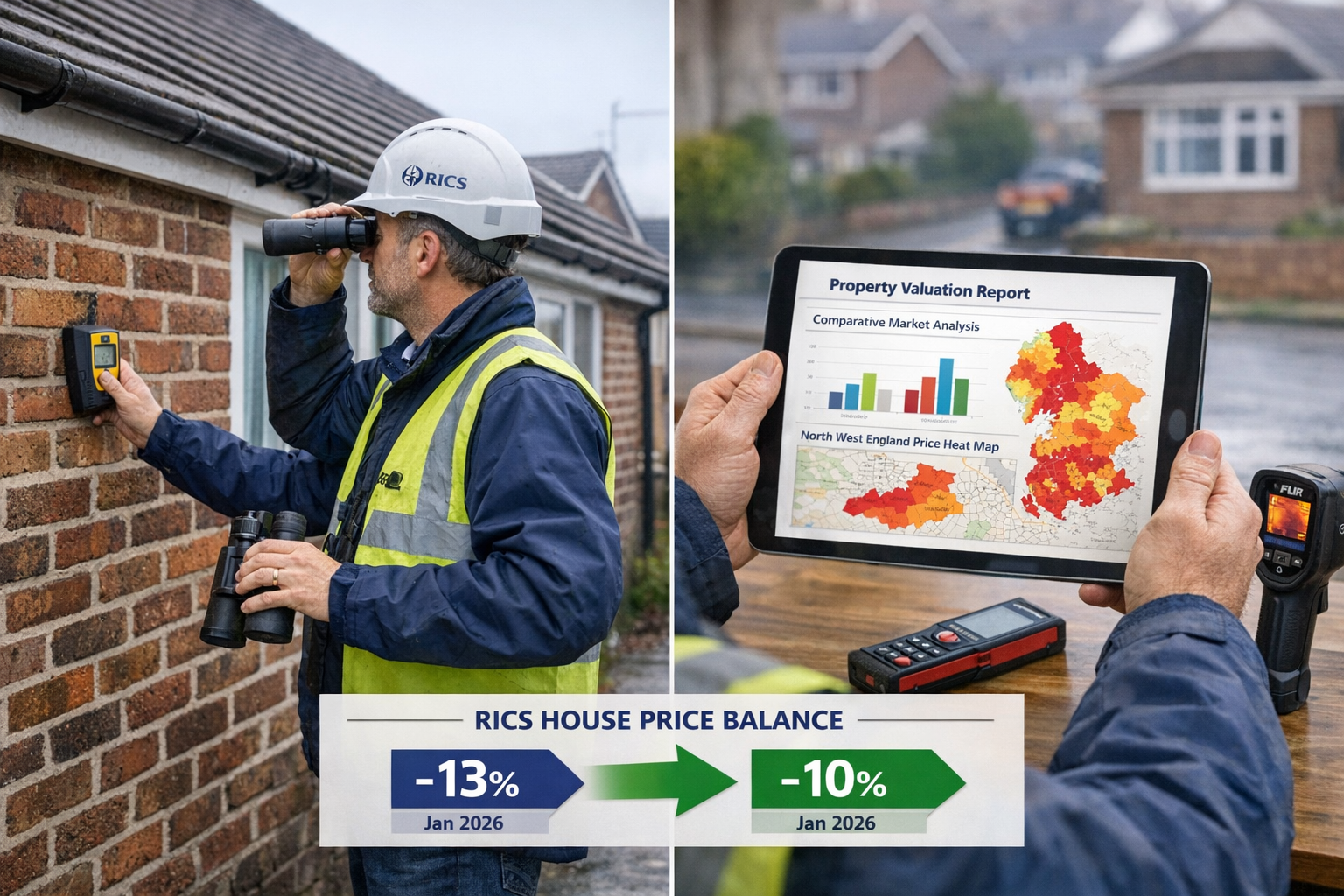
The housing market landscape across the United Kingdom has fractured along regional lines in 2026, creating unprecedented opportunities for those who understand the nuances. The RICS House Price Balance serves as the industry's primary barometer, measuring the net percentage of surveyors reporting price increases versus decreases. January 2026's reading of -10% represents substantial improvement from the -13% recorded in December 2025 and the -19% seen in October 2025.
Regional Performance Disparities
Northern England's performance stands in stark contrast to southern markets. While London reported a net balance of -44% in recent months, the North West and North of England have bucked the national trend entirely. This regional divergence creates specific implications for bungalow valuations:
| Region | Net Price Balance | Market Trend | Valuation Adjustment |
|---|---|---|---|
| North West | Positive trend | Rising | Upward revision needed |
| North of England | Positive trend | Rising | Upward revision needed |
| London | -44% | Declining | Conservative approach |
| South East | Below average | Stagnant | Cautious baseline |
| South West | Below average | Stagnant | Cautious baseline |
The three-month average net balance for prices stands at -10% as of January 2026, providing a smoothed baseline for comparative valuations. However, this national figure masks the significant regional variations that chartered surveyors must account for when assessing Northern England properties.
Buyer Demand Recovery Signals
Transaction velocity provides crucial context for valuation strategies. New buyer enquiries improved significantly to a net balance of -15% in January 2026, up from -21% in December and -29% in November. This sustained improvement indicates reduced downward pressure on demand-based valuations.
Equally important, agreed sales reached -9% in January 2026—the least negative reading since June 2025. For bungalow valuations specifically, this suggests that properties are moving through the sales pipeline more efficiently, reducing the need for aggressive pricing adjustments to achieve transactions.
🏡 Market Insight: Surveyors report that bungalows continue to attract disproportionate interest compared to other property types, driven by an aging population seeking single-level living and downsizers exiting larger family homes.
RICS Valuation Strategies for Northern England Bungalows in the 2026 Housing Recovery
Professional valuation of Northern England bungalows in 2026 requires a sophisticated approach that balances traditional comparable analysis with forward-looking market intelligence. The Valuation Strategies for Northern England Bungalows in the 2026 Housing Recovery: RICS Insights framework emphasizes several key methodologies.
Comparative Market Analysis Adjustments
Traditional comparable analysis remains foundational, but 2026's regional divergence demands careful selection of comparables. RICS-qualified surveyors should:
Focus on hyper-local data: Given the stark differences between Northern and Southern markets, comparables should be drawn from within a tight geographic radius—ideally within the same town or postcode district rather than regional averages.
Apply temporal weighting: Recent transactions (within 3 months) should receive significantly higher weighting than older sales, given the rapid market improvement trajectory. The consistent monthly gains from October 2025 through January 2026 suggest that 6-month-old comparables may already undervalue current market conditions.
Account for property type premiums: With bungalows showing sustained demand strength, a premium adjustment of 3-7% above comparable semi-detached or terraced properties may be justified in high-demand Northern locations, particularly for well-maintained examples with gardens and parking.
Integrate forward-looking indicators: RICS projects the House Price Balance to reach -2% by end of Q1 2026 and trend toward +8% in 2027. For SIPP pension valuations and investment purposes, incorporating these projections into scenario analysis provides clients with realistic value ranges.
Defect-Adjusted Valuation Methodology
Northern England's housing stock includes numerous bungalows constructed between the 1950s and 1980s, each presenting characteristic defects that impact valuation. A comprehensive building survey identifies issues that require specific valuation adjustments:
Common Northern England bungalow defects and typical adjustments:
- Roof deterioration (concrete tiles, felt degradation): -£8,000 to -£15,000
- Cavity wall tie corrosion: -£3,000 to -£8,000
- Rising damp and failed damp-proof course: -£4,000 to -£12,000
- Single-glazed windows requiring replacement: -£5,000 to -£10,000
- Outdated heating systems (back boilers, storage heaters): -£3,000 to -£6,000
- Asbestos-containing materials (artex ceilings, insulation): -£2,000 to -£8,000
- Subsidence or settlement cracks: -£10,000 to -£50,000+ (severity dependent)
Understanding common defects in older homes allows surveyors to provide accurate, defensible valuations that protect client interests during negotiations.
Location-Specific Value Drivers
Northern England encompasses diverse submarkets, each with distinct value drivers for bungalows:
Coastal retirement locations (Fylde Coast, North Yorkshire coast): Premium for sea views, proximity to amenities, and established retirement communities can add 15-25% to baseline valuations.
Commuter belt areas (Greater Manchester periphery, Leeds suburbs): Accessibility to employment centers while maintaining lower price points creates sustained demand, supporting valuations 10-20% above comparable rural locations.
Former industrial towns (Lancashire mill towns, County Durham): Lower baseline values but higher percentage growth potential as regeneration initiatives take hold; careful assessment of community housing projects and local development plans is essential.
Rural villages: Character properties with land command premiums, but limited comparable evidence requires careful judgment and potentially broader geographic search parameters.
Building Survey Insights: Defect Identification for Accurate Bungalow Valuations
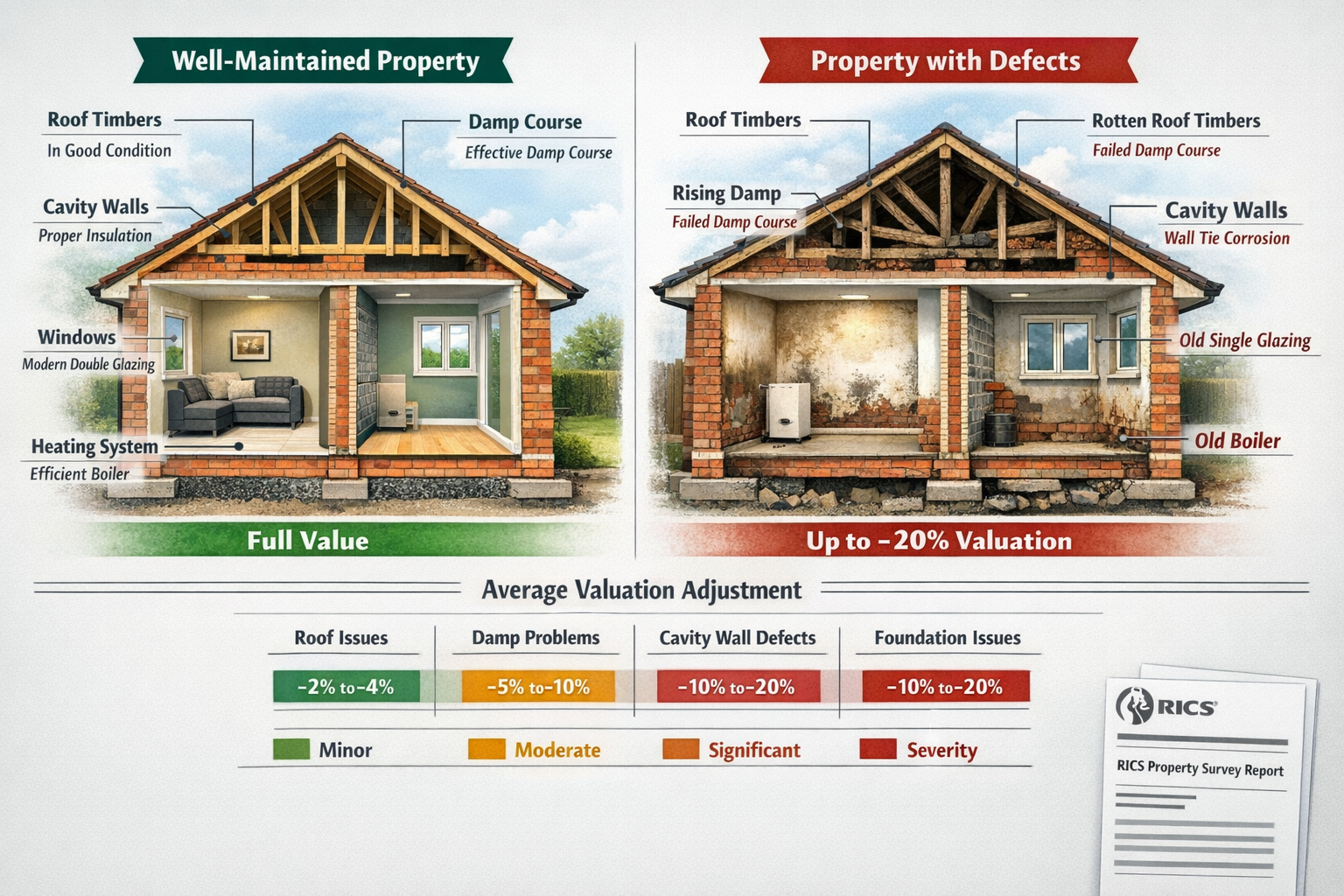
The relationship between building survey findings and valuation accuracy cannot be overstated. For Northern England bungalows, a thorough Level 3 survey provides the foundation for defensible valuations that reflect true market value rather than superficial appeal.
Structural Assessment Priorities
Foundation and substructure evaluation: Many post-war bungalows were constructed on shallow foundations with minimal reinforcement. Surveyors should look for:
- Stepped cracking in brickwork indicating differential settlement
- Gaps between walls and floors suggesting movement
- External ground level changes that may have compromised damp courses
- Evidence of previous underpinning or structural repairs
The presence of significant structural issues may necessitate valuation reductions of 10-30% depending on severity and remediation costs. In extreme cases, properties may be valued on a land-only basis.
Roof and Envelope Condition
Single-story construction means bungalow roofs are more accessible for inspection, but also more critical to overall condition:
Pitched roof considerations: Concrete tiles popular in 1960s-1980s construction are reaching end-of-life in many properties. Nail fatigue, tile delamination, and felt deterioration are common. A roof requiring complete re-covering represents a significant liability.
Flat roof elements: Many bungalows feature flat-roofed extensions or porches. Understanding common flat roof types and issues helps surveyors assess remaining lifespan and budget for replacement.
Insulation deficiencies: Older bungalows often have minimal loft insulation. While not a structural defect, poor energy performance impacts marketability and should factor into valuation, particularly with increasing focus on EPC ratings.
Damp, Timber, and Environmental Factors
Northern England's climate creates specific challenges for bungalow maintenance:
Penetrating damp: Single-story properties with large roof areas and limited eaves overhang are vulnerable to wind-driven rain penetration, particularly on exposed elevations.
Rising damp: Many properties have failed or bridged damp-proof courses. Surveyors should use moisture meters to verify suspected issues rather than relying on visual indicators alone.
Timber decay: Roof timbers, floor joists, and window frames in poorly ventilated properties may show wet rot or dry rot. Timber treatment and replacement costs can be substantial.
Asbestos presence: Properties built before 2000 frequently contain asbestos materials. While not necessarily requiring immediate removal, asbestos presence affects renovation costs and buyer perceptions.
Mechanical and Electrical Systems
Aging infrastructure in older bungalows often requires updating:
- Heating systems: Back boilers and storage heaters are inefficient and nearing obsolescence; replacement with modern gas central heating or heat pumps costs £4,000-£8,000
- Electrical installations: Properties with original 1960s-1980s wiring require complete rewiring (£3,000-£6,000)
- Plumbing: Lead pipes, outdated boilers, and poor water pressure are common issues
- Drainage: Older properties may have combined drainage or deteriorated clay pipes requiring replacement
"A comprehensive building survey isn't just about identifying defects—it's about quantifying their impact on value and providing clients with the information needed to negotiate effectively or budget for future works." — RICS Guidance
When your home valuation is less than an offer, understanding the specific defects driving that valuation provides leverage for renegotiation or informed decision-making.
Investment Potential: Valuation Strategies for Northern England Bungalows in the 2026 Housing Recovery
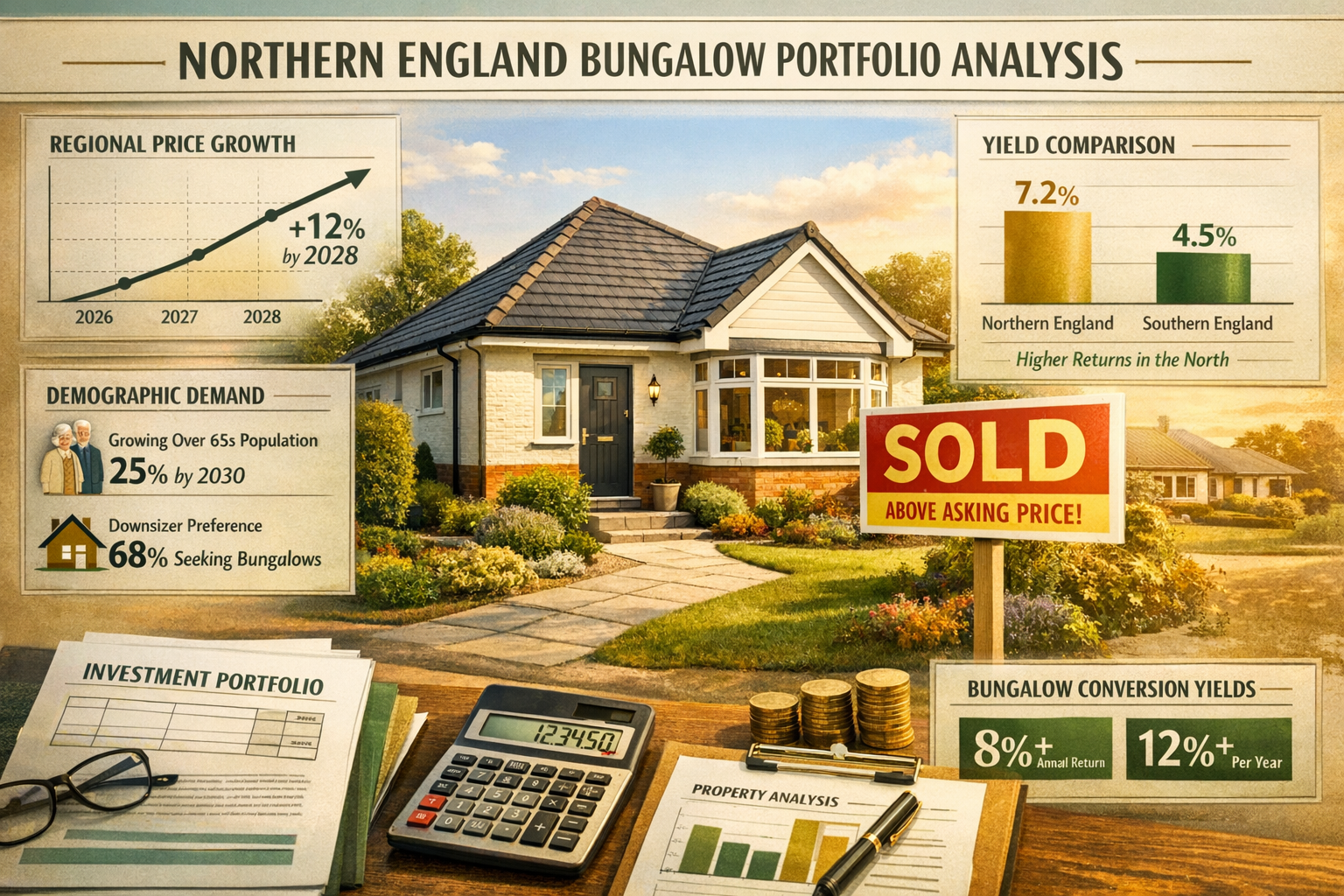
The convergence of demographic trends, regional price recovery, and supply constraints creates compelling investment opportunities for those applying sophisticated valuation strategies to Northern England bungalows.
Demographic Demand Drivers
The UK's aging population creates sustained structural demand for bungalow accommodation:
Downsizer market: Baby boomers seeking to release equity from larger family homes represent a substantial buyer pool. Many prioritize single-level living, manageable gardens, and locations near family or established communities.
Accessibility requirements: An increasing proportion of the population requires wheelchair-accessible or mobility-friendly accommodation. Bungalows naturally accommodate these needs better than multi-story properties.
Care-at-home trends: Government policy increasingly emphasizes aging in place rather than institutional care. Bungalows facilitate this approach, supporting long-term demand.
These demographic factors suggest that bungalow valuations should incorporate a demand resilience premium compared to other property types, particularly in locations with strong healthcare infrastructure and community amenities.
Rental Yield Analysis
For investment purposes, Northern England bungalows offer attractive yields compared to southern markets:
Typical Northern England bungalow investment metrics:
- Purchase price: £180,000-£280,000 (regional variation)
- Monthly rental income: £750-£1,100
- Gross yield: 5.0-7.5%
- Tenant profile: Professional couples, downsizers, families seeking quality accommodation
- Void periods: Generally low due to limited supply of bungalow rental stock
Compare these figures to London or South East yields of 3-4% and the investment case becomes compelling. For those exploring funding for land and development opportunities, bungalow conversion or new-build projects in Northern locations warrant serious consideration.
Value-Add Opportunities
Strategic investors can enhance returns through targeted improvements:
Extension and reconfiguration: Adding a conservatory, extending into loft space, or reconfiguring internal layout can add £30,000-£60,000 in value for investments of £20,000-£40,000.
Energy efficiency upgrades: Installing solar panels, improving insulation, and upgrading heating systems improves EPC ratings, reduces tenant costs, and supports premium rents.
Cosmetic modernization: Kitchen and bathroom updates, new flooring, and redecoration can transform dated properties into premium rentals or attractive sale prospects.
Garden and external improvements: Landscaping, new driveways, and external painting enhance curb appeal and support higher valuations.
Forward-Looking Valuation Scenarios
RICS data suggests sustained Northern England recovery through 2028. Applying scenario analysis to investment valuations provides realistic return projections:
Conservative scenario (House Price Balance reaches +5% by 2028):
- Current valuation: £220,000
- 2028 projected value: £242,000 (10% appreciation)
- Rental income (3 years): £31,500
- Total return: 24.3%
Base case scenario (House Price Balance reaches +12% by 2028):
- Current valuation: £220,000
- 2028 projected value: £264,000 (20% appreciation)
- Rental income (3 years): £31,500
- Total return: 34.3%
Optimistic scenario (Northern outperformance continues):
- Current valuation: £220,000
- 2028 projected value: £286,000 (30% appreciation)
- Rental income (3 years): £31,500
- Total return: 44.3%
These projections assume no leverage. With typical buy-to-let mortgages requiring 25% deposits, actual returns on invested capital would be substantially higher.
Professional Valuation Services and RICS Standards
Engaging qualified professionals ensures valuations meet industry standards and provide defensible figures for all purposes—whether residential purchase, commercial valuations, refinancing, or annual tax assessments.
RICS Red Book Compliance
The RICS Valuation – Global Standards (Red Book) establishes mandatory requirements for valuation practice. For Northern England bungalows, key compliance areas include:
Basis of value clarity: Valuations must specify whether they reflect Market Value, Market Rent, Investment Value, or another defined basis.
Assumptions and special assumptions: Any departures from standard assumptions (e.g., assuming completion of renovations, assuming planning permission) must be clearly stated.
Inspection requirements: The extent of inspection must be disclosed, with limitations clearly identified. Desktop valuations carry different weight than comprehensive building surveys.
Comparable evidence: Supporting comparable transactions should be documented with sufficient detail to allow verification.
When to Commission Professional Valuations
Several scenarios warrant professional RICS valuation services:
✅ Purchase decisions: Independent valuations protect buyers from overpaying, particularly in recovering markets where asking prices may lag or lead actual values.
✅ Refinancing: Lenders require professional valuations to support mortgage advances; understanding what a RICS HomeBuyer Report includes helps borrowers choose appropriate services.
✅ Estate planning and taxation: Accurate valuations ensure appropriate inheritance tax calculations and equitable estate distributions.
✅ Divorce settlements: Court proceedings require defensible, independent valuations from qualified professionals.
✅ Portfolio management: Investors should obtain periodic valuations to track performance and inform strategic decisions.
✅ Development appraisal: Assessing land value and development potential requires specialized expertise.
Selecting Qualified Surveyors
Not all surveyors possess equal expertise in bungalow valuation or Northern England markets. When selecting professionals, consider:
RICS membership status: Ensure surveyors hold MRICS or FRICS designations and maintain professional indemnity insurance.
Local market knowledge: Surveyors with established practices in Northern England bring invaluable understanding of regional nuances, comparable evidence, and market trends.
Specialist experience: Bungalow-specific experience ensures awareness of common defects, valuation adjustments, and buyer preferences.
Service scope: Clarify whether you require a basic valuation, HomeBuyer Report, or comprehensive Level 3 Building Survey based on your specific needs.
Conclusion
The Valuation Strategies for Northern England Bungalows in the 2026 Housing Recovery: RICS Insights reveal a market at an inflection point. While national headlines focus on continued housing market challenges, Northern England bungalows are experiencing a structural shift that demands fresh approaches to valuation and investment analysis.
The data is unequivocal: the RICS House Price Balance has improved for three consecutive months, reaching -10% in January 2026—the strongest reading since June 2025. Northern regions are outperforming national averages, with the North West and North of England reporting positive price trends. Bungalows continue to attract robust demand driven by demographic shifts, accessibility requirements, and downsizer preferences.
For property professionals, these trends require recalibration of baseline valuation assumptions, careful selection of comparables, and integration of forward-looking market intelligence. For investors, Northern England bungalows offer compelling yields, value-add opportunities, and appreciation potential that significantly exceeds southern markets.
The key to success lies in combining rigorous RICS-compliant valuation methodology with comprehensive building survey insights that identify defects and quantify their impact on value. Whether you're a homeowner seeking to understand your property's worth, an investor evaluating opportunities, or a professional advising clients, the strategies outlined in this article provide a framework for navigating the 2026 Northern England housing recovery.
Actionable Next Steps
🎯 Commission a professional valuation: Engage RICS-qualified surveyors with Northern England expertise to establish accurate baseline values for your property or investment targets.
🎯 Conduct comprehensive building surveys: Don't rely on superficial assessments—invest in Level 3 surveys that reveal the true condition of older bungalows and support accurate valuations.
🎯 Monitor regional market data: Track monthly RICS survey releases and local transaction evidence to stay ahead of market movements.
🎯 Evaluate investment opportunities: Apply scenario analysis to potential acquisitions, incorporating RICS projections for sustained Northern recovery through 2028.
🎯 Consider value-add strategies: Identify properties where targeted improvements can unlock significant equity gains or rental premium.
The Northern England bungalow market of 2026 offers opportunities that won't last indefinitely. As the recovery gains momentum and more investors recognize the regional divergence, competition for quality stock will intensify. Those who act now with professional guidance and sophisticated valuation strategies will be best positioned to benefit from this structural market shift.