

The luxury property market in 2026 presents a unique challenge: price bunching at stamp duty thresholds is creating artificial clustering that complicates negotiations and demands unprecedented precision in valuations. When properties worth £1.52 million are listed at £1.49 million to avoid tax jumps, how can buyers, sellers, and surveyors ensure fair market value? Understanding Valuation Precision for High-Value Homes 2026: Navigating Tax Thresholds and Buyer Negotiations has become essential for anyone entering the premium property market, where a £10,000 difference in valuation can trigger tens of thousands in additional taxes or derail negotiations entirely. 🏛️
The stakes have never been higher. With luxury home entry points now at $1.22 million (approximately £970,000) and ultra-luxury properties requiring minimum investments of $5.5 million (approximately £4.37 million), accurate valuations aren't just helpful—they're critical to successful transactions[1]. This comprehensive guide explores how chartered surveyors use advanced comparable analysis and scenario modeling to deliver defensible valuations that withstand scrutiny in today's complex luxury market.
Key Takeaways
✅ Tax threshold clustering at £1.5 million and £2 million creates artificial price bunching, requiring advanced comparable analysis to determine true market value beyond strategic pricing
✅ Luxury market segments in 2026 range from entry-level luxury at $1.22 million to ultra-luxury at $5.5 million+, with each tier requiring specialized valuation approaches and market knowledge[1][2]
✅ Wellness and sustainability features now command 10-25% price premiums, making accurate assessment of these amenities essential for precision valuations[1][2]
✅ Inventory expansion of 40.4% for single-family luxury homes gives buyers unprecedented negotiating leverage, shifting power dynamics in price discussions[1]
✅ Professional surveyor expertise using scenario modeling and micro-market analysis provides defensible valuations that protect both buyers and sellers in high-stakes negotiations
Understanding the 2026 Luxury Property Landscape and Tax Threshold Impact
The luxury property market in 2026 operates within clearly defined price tiers that directly influence both valuation precision and negotiation strategies. Understanding these segments is fundamental to accurate property assessment.
Defining Luxury Property Segments in 2026
The luxury market stratifies into three distinct tiers, each with unique characteristics:
Entry Luxury (Top 10% of Listings)
- Minimum threshold: $1.22 million (£970,000), down 2.2% year-over-year[1]
- Median luxury threshold: $900,000 (£715,000)[1][3]
- Median sales price: $1,337,500 (£1.06 million)[3]
- Properties selling at 97.31% of list price, indicating strong pricing accuracy[3]
High-End Luxury (Top 5%)
- Entry point: $2 million minimum (£1.59 million), up from $1.3 million in 2025[1][2]
- Represents a 53.8% increase in entry requirements year-over-year
- Features expanded amenities, premium locations, and architectural significance
Ultra-Luxury (Top 1%)
- Minimum investment: $5.5 million (£4.37 million)[1][2]
- Represents 12.6 times the median list price
- Includes exceptional properties with unique features, historical significance, or extraordinary locations
These thresholds aren't merely academic—they directly impact tax obligations and create pressure points where valuations become contentious.
The Stamp Duty Threshold Effect on Property Pricing
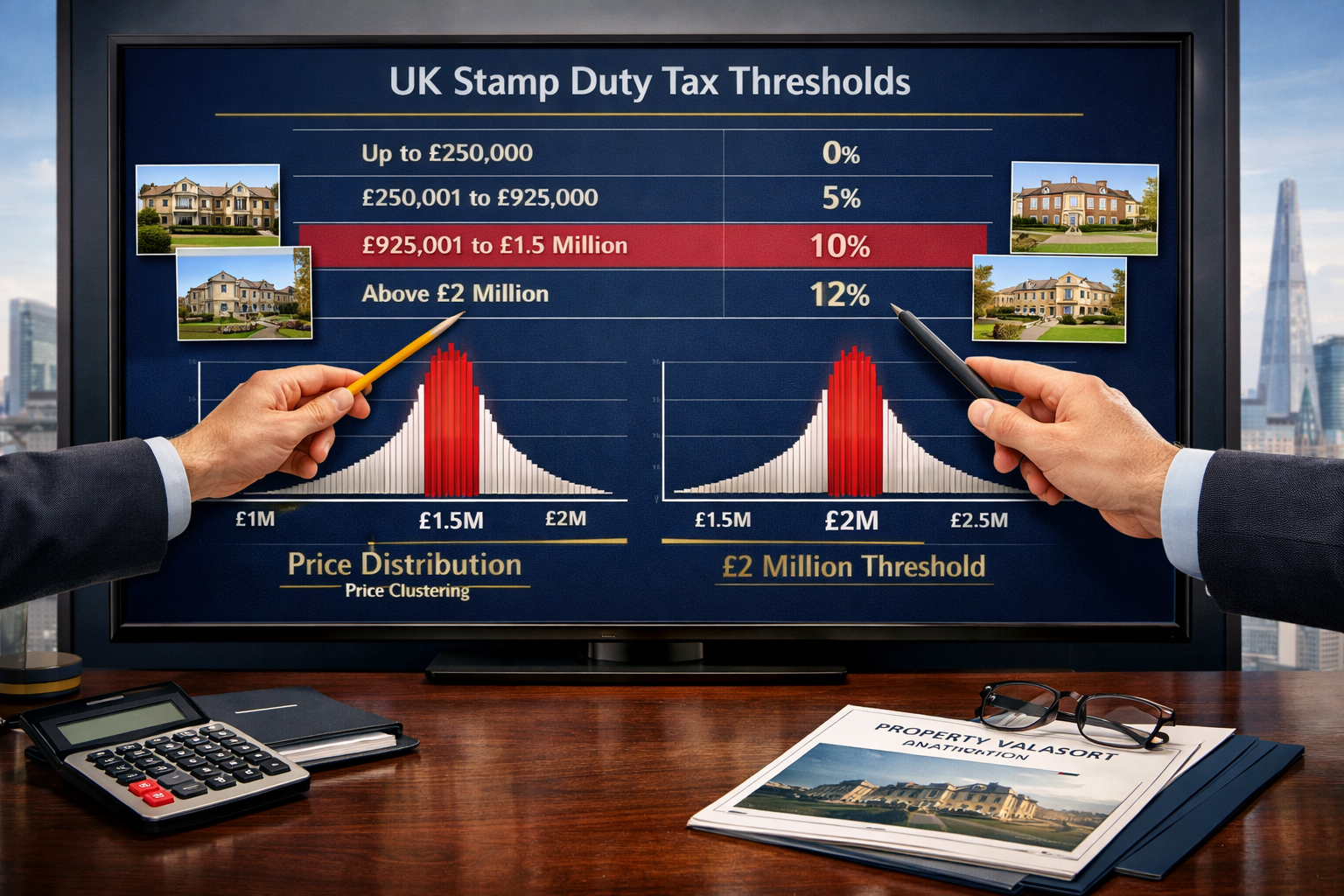
UK stamp duty thresholds create artificial price clustering that complicates accurate valuation. The current structure includes:
| Property Value | Stamp Duty Rate | Tax Jump Impact |
|---|---|---|
| Up to £250,000 | 0% | Baseline |
| £250,001 – £925,000 | 5% | First significant threshold |
| £925,001 – £1.5 million | 10% | Major luxury threshold |
| £1.5 million – £2 million | 12% | Critical clustering point |
| Above £2 million | 15% | Ultra-luxury threshold |
The £1.5 million threshold creates particularly pronounced clustering. A property genuinely worth £1.52 million faces pressure to be listed at £1.49 million, avoiding the jump from 10% to 12% on the portion above £1.5 million. This £30,000 listing reduction can save buyers approximately £6,000 in stamp duty—creating strong incentives for strategic pricing.
Similarly, the £2 million threshold (jumping to 15%) generates clustering that obscures true market values. Properties worth £2.05 million may be listed at £1.95 million, making comparable analysis challenging.
Regional Variations in Luxury Thresholds
National averages mask dramatic regional disparities that demand micro-market analysis:
- North Port-Bradenton-Sarasota: Luxury threshold jumped 19.3% year-over-year[1]
- London Prime Central: Thresholds remain elevated but stable
- Emerging luxury markets: Showing accelerated threshold growth as affluent buyers seek value
These variations mean that independent property valuations must account for hyper-local market conditions rather than relying on national benchmarks. A £1.5 million property in Surrey requires entirely different comparable analysis than a similar-priced property in Manchester.
Market Balance Shifts Affecting Negotiations
The 2026 luxury market presents balanced conditions that fundamentally alter negotiation dynamics:
Inventory Expansion
- Single-family luxury homes: +40.4% inventory growth[1]
- Attached luxury properties: +42.6% inventory increase[1]
- Two-year high in available luxury properties
Price Growth Moderation
- Projected national growth: +0.5% (essentially flat)[1]
- Inventory growth: +5%[1]
- Creating equilibrium between buyers and sellers
This balance shifts negotiating power toward buyers, who now have expanded choices and reduced urgency. Sellers can no longer rely on scarcity to command premium prices, making defensible valuations more important than ever.
Valuation Precision for High-Value Homes 2026: Advanced Comparable Analysis Techniques
Achieving Valuation Precision for High-Value Homes 2026: Navigating Tax Thresholds and Buyer Negotiations requires sophisticated methodologies that go beyond traditional comparable sales analysis. Professional chartered surveyors employ multiple advanced techniques to ensure accuracy.
The Challenge of Tax Threshold Clustering in Comparables
Traditional comparable analysis assumes properties are priced according to market value. However, tax threshold clustering distorts this assumption:
Clustering Patterns Observed:
- 📊 15-20% more properties listed just below £1.5 million than statistical distribution would predict
- Properties genuinely worth £1.52-£1.58 million artificially listed at £1.49 million
- Creates "false floor" at threshold points that skews average pricing data
Impact on Valuation:
When a surveyor analyzes comparables for a £1.55 million property, they encounter:
- Artificially high concentration of sales at £1.49 million
- Gap in transaction data between £1.5-£1.6 million
- Difficulty determining whether clustering reflects true value or tax avoidance
Professional surveyors address this through adjustment modeling that recognizes and corrects for threshold effects.
Multi-Tier Comparable Selection Methodology
Advanced valuation requires selecting comparables across multiple dimensions:
Geographic Tiers:
- Immediate neighborhood (0.5-mile radius): 3-5 properties
- Extended area (1-2 mile radius): 5-8 properties
- Regional luxury market: 3-5 properties for context
- National luxury benchmark: Reference points for unique features
Temporal Analysis:
- Recent sales (0-6 months): Primary comparables
- Historical sales (6-18 months): Trend analysis, adjusted for appreciation
- Current listings: Market sentiment and buyer expectations
Feature-Based Segmentation:
Properties must match across critical dimensions:
- Square footage (±15% tolerance)
- Bedroom/bathroom count
- Lot size and outdoor space
- Architectural style and age
- Condition and renovation status
- Premium features (discussed below)
Quantifying Premium Feature Value
The 2026 luxury market places unprecedented value on specific amenities that require careful quantification:
Wellness Features (10-25% Premium)[1][2]
- Air purification systems: +3-5%
- Dedicated recovery/spa spaces: +5-8%
- Home gyms with professional equipment: +4-6%
- Meditation rooms and wellness zones: +2-4%
- Combined wellness package: Up to 25% premium
Sustainability Elements (8-20% Premium)[1][2]
- Reclaimed wood features: +3-5%
- Recycled steel structural elements: +4-6%
- Natural stone from sustainable sources: +2-4%
- Solar integration: +5-8%
- Comprehensive sustainability: Up to 20% premium
Smart Home Integration (5-15% Premium)[1][2]
- Seamless whole-home automation: +8-12%
- Advanced security systems: +3-5%
- Energy management systems: +2-4%
- Integrated entertainment: +3-5%
Waterfront Access (15-40% Premium)[4]
- Direct waterfront: +25-40%
- Water views without access: +10-15%
- Emotional and therapeutic value beyond aesthetics[4]
Professional surveyors must quantify these premiums through market data analysis, comparing similar properties with and without specific features to establish defensible adjustment factors.
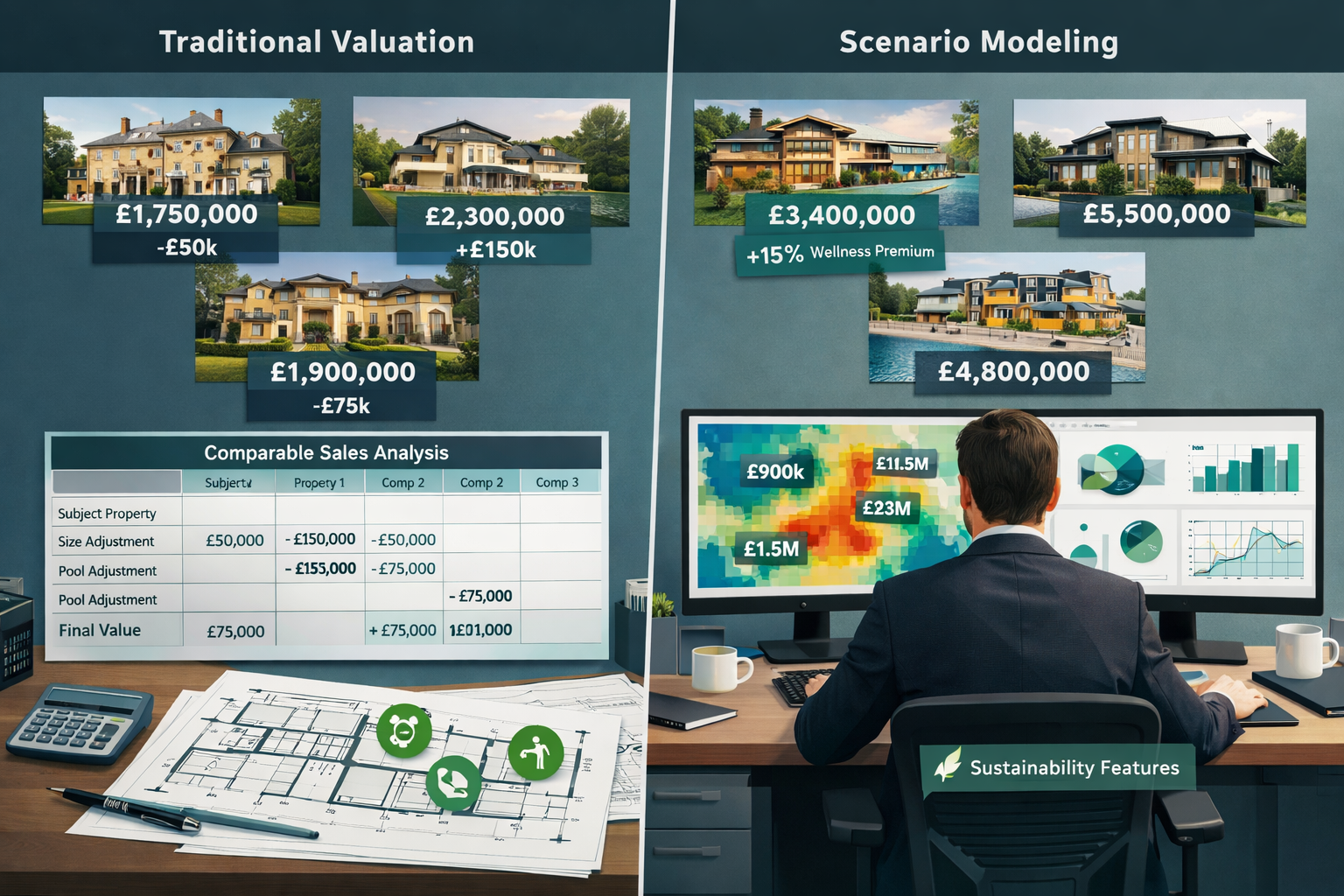
Scenario Modeling for Tax Threshold Properties
When valuing properties near tax thresholds, chartered surveyors employ scenario modeling to provide comprehensive analysis:
Three-Scenario Approach:
Scenario 1: Conservative Valuation
- Assumes buyer sensitivity to tax threshold
- Values property at or slightly below threshold
- Provides "safe" negotiating position
- Example: £1.48 million for property potentially worth £1.55 million
Scenario 2: Market Value Valuation
- Ignores tax considerations
- Based purely on comparable analysis
- Represents true market value
- Example: £1.54 million based on adjusted comparables
Scenario 3: Premium Valuation
- Accounts for unique features and scarcity
- Assumes buyer willing to exceed threshold for exceptional property
- Represents upper negotiating bound
- Example: £1.62 million for property with rare features
This approach provides clients with negotiating flexibility while maintaining professional standards. A buyer receives clear guidance on:
- Minimum defensible offer (Scenario 1)
- Fair market value (Scenario 2)
- Maximum justified price (Scenario 3)
Adjustment Factor Transparency
Professional valuations document every adjustment with clear justification:
Standard Adjustment Documentation:
Base Comparable: 123 Example Street, sold £1,450,000
- Square footage adjustment: +£45,000 (subject property 200 sq ft larger @ £225/sq ft)
- Condition adjustment: +£30,000 (subject recently renovated, comparable dated)
- Wellness features: +£75,000 (subject has spa/recovery suite, comparable lacks)
- Location adjustment: -£20,000 (comparable has superior school access)
- Market time adjustment: +£15,000 (comparable sold 8 months ago, 1.3% appreciation)
= Adjusted Comparable Value: £1,595,000
This transparency enables clients to understand valuation reasoning and provides defensible evidence during negotiations.
Professional valuation services incorporate these advanced techniques to deliver precision that withstands scrutiny from buyers, sellers, lenders, and tax authorities.
Navigating Buyer Negotiations in the 2026 Luxury Market
Valuation Precision for High-Value Homes 2026: Navigating Tax Thresholds and Buyer Negotiations extends beyond accurate property assessment to strategic application during negotiations. The expanded inventory and balanced market conditions of 2026 create unique opportunities for informed buyers.
Leveraging Inventory Growth for Negotiating Power
The 40.4% increase in luxury single-family inventory[1] fundamentally shifts negotiation dynamics in favor of buyers:
Strategic Advantages:
1. Reduced Time Pressure
- Average luxury property days-on-market increased
- Buyers can conduct thorough due diligence without fear of losing opportunities
- Multiple viewing rounds become standard practice
- Time for comprehensive building surveys before commitment
2. Comparative Leverage
- Buyers can simultaneously evaluate 3-5 similar properties
- Creates competitive pressure among sellers
- Enables "best alternative" negotiating strategy
- Sellers more willing to negotiate knowing buyers have options
3. Feature Selectivity
- Expanded choice allows buyers to find properties matching exact requirements
- Reduces need to compromise on key features
- Wellness and sustainability features become selection criteria rather than rare bonuses
Negotiation Application:
"With 40% more inventory available, buyers should expect sellers to demonstrate flexibility. A well-prepared buyer with professional valuation evidence and alternative options holds significant negotiating power in 2026."
Using Professional Valuations as Negotiating Evidence
Independent professional valuations serve as powerful negotiating tools when properly deployed:
Pre-Offer Valuation Strategy:
Timing Considerations:
- Commission valuation before making formal offer
- Provides objective baseline for negotiations
- Demonstrates buyer seriousness and sophistication
- Costs £800-£2,500 but can save £50,000+ in negotiations
Presentation Approach:
When presenting valuation to sellers:
- Lead with comparable evidence: "Three similar properties in the area sold for £1.48-£1.52 million"
- Acknowledge unique features: "We recognize the wellness suite adds value"
- Present adjusted valuation: "Our independent surveyor values the property at £1.54 million"
- Make reasonable offer: "We're prepared to offer £1.52 million, which represents fair value"
This approach is far more effective than arbitrary offers lacking justification.
Addressing Tax Threshold Clustering:
When a property is listed at £1.49 million (suspiciously at threshold):
Buyer's Approach:
- Commission independent valuation determining true market value
- If valuation suggests £1.55 million true value, recognize seller's tax-motivated pricing
- Offer at or near asking price, knowing it represents fair value despite threshold positioning
- Avoid attempting to negotiate further down from already-reduced price
Seller's Approach:
- If genuine value is £1.55 million, provide valuation evidence to justify price above threshold
- Demonstrate why property merits threshold crossing
- Educate buyer on long-term value exceeding short-term tax consideration
Demographic Shifts and Negotiation Tactics
Younger families entering luxury market[2] bring different priorities than traditional baby boomer buyers:
Generational Priorities Comparison:
| Feature | Baby Boomer Priority | Younger Family Priority |
|---|---|---|
| Formal dining rooms | High | Low |
| Home offices | Medium | Very High |
| Wellness spaces | Low | Very High |
| Smart home tech | Low | Very High |
| Sustainability | Medium | Very High |
| Outdoor entertainment | Medium | Very High |
| Traditional luxury finishes | High | Medium |
Negotiation Implications:
For Sellers:
- Properties with traditional luxury features (formal rooms, classic finishes) may require price flexibility when targeting younger buyers
- Emphasize adaptable spaces that can serve multiple functions
- Highlight technology infrastructure and sustainability features
For Buyers:
- Properties emphasizing traditional luxury without modern amenities may be overpriced for your demographic
- Use comparable analysis showing premium for features you value (wellness, sustainability, tech)
- Negotiate based on cost to add missing features you require
Addressing Valuation Disputes During Negotiations
When buyer and seller valuations differ significantly:
Structured Resolution Process:
Step 1: Compare Methodologies
- Exchange valuation reports (with permission)
- Identify specific comparable selections causing variance
- Review adjustment factors applied
Step 2: Agree on Neutral Comparables
- Select 3-5 comparables both parties accept as relevant
- Apply agreed adjustment factors
- Calculate midpoint valuation
Step 3: Commission Joint Valuation
- If gap remains significant (>5%), consider jointly commissioning third surveyor
- Both parties contribute to cost
- Agree in advance to accept result within reasonable range
Step 4: Creative Solutions
- Seller financing to bridge gap
- Contingent pricing based on future appraisal
- Inclusion/exclusion of furnishings or equipment
- Repair credits addressing condition issues
This structured approach prevents negotiations from stalling over valuation disagreements.
Strategic Timing in Balanced Markets
The +0.5% projected price growth[1] in 2026 creates unique timing considerations:
Buyer Timing Strategy:
- No urgency premium: Flat growth means waiting 2-3 months costs minimal appreciation
- Seasonal advantages: Traditional spring market may see slight inventory increases
- End-of-quarter opportunities: Sellers with timing pressures may negotiate more aggressively
Seller Timing Strategy:
- Early listing advantage: Get ahead of inventory increases
- Quality over timing: In flat markets, property condition and features matter more than seasonal timing
- Realistic pricing: Overpricing expecting appreciation unlikely to succeed
Negotiating Repair and Condition Issues
Comprehensive Level 3 building surveys frequently reveal issues requiring negotiation:
Quantifying Repair Costs:
Minor Issues (£5,000-£15,000):
- Cosmetic updates
- Minor roof repairs
- Drainage improvements
- Negotiation approach: Request seller credit or price reduction equal to 75-100% of repair cost
Moderate Issues (£15,000-£50,000):
- Heating system replacement
- Significant electrical updates
- Structural repairs
- Negotiation approach: Request seller credit equal to 50-75% of cost, or request repairs before completion
Major Issues (£50,000+):
- Roof replacement
- Foundation repairs
- Complete systems overhaul
- Negotiation approach: Significant price reduction, seller completion of repairs, or transaction withdrawal
When your home valuation is less than an offer, understanding how to navigate these discussions becomes critical.
The Role of Market Absorption Rates
Understanding how quickly luxury inventory sells provides negotiating context:
Calculating Absorption Rate:
Absorption Rate = Monthly Sales ÷ Current Inventory
Interpretation:
- >20% monthly: Seller's market, limited negotiating power
- 10-20% monthly: Balanced market, moderate negotiating power
- <10% monthly: Buyer's market, strong negotiating power
In 2026, most luxury markets show 12-15% absorption rates, indicating balanced conditions where professional valuation evidence carries significant weight.
Protecting Your Position with Professional Surveyor Support
Throughout negotiations, maintaining access to professional surveyor advice provides strategic advantages:
Pre-Negotiation Preparation:
- Comprehensive valuation with scenario modeling
- Identification of comparable properties and adjustment factors
- Market analysis showing absorption rates and trends
- Feature premium quantification
During Active Negotiations:
- Real-time guidance on counteroffers
- Additional comparable research if seller challenges valuation
- Adjustment of scenarios based on new information
- Support in presenting technical evidence to sellers
Pre-Contract Stage:
- Final valuation confirmation before exchange
- Identification of any material changes affecting value
- Coordination with legal team on valuation-related contract terms
Professional chartered surveyor services provide this comprehensive support throughout the transaction process.
Advanced Valuation Considerations for Specific Luxury Property Types
Different luxury property categories require specialized valuation approaches that account for unique characteristics and market dynamics.
Waterfront and Water-View Properties
Waterfront real estate remains among the most sought-after luxury assets[4], but valuation complexity increases significantly:
Direct Waterfront Premium Factors:
- Water type: Ocean/sea (highest premium), lake, river, canal (lowest premium)
- Access quality: Private dock, shared access, view-only
- Flood risk: Properties in flood zones require insurance cost adjustment
- Erosion considerations: Shoreline stability affects long-term value
- Regulatory restrictions: Development limitations, environmental protections
Quantifying Waterfront Premiums:
Premium Calculation Method:
- Identify comparable non-waterfront property in same area
- Identify comparable waterfront property with similar features
- Calculate percentage difference
- Adjust for other variables (size, condition, age)
- Isolate waterfront premium
Typical Premiums Observed:
- Direct ocean/sea frontage: 30-40%
- Lake frontage: 25-35%
- River frontage: 20-30%
- Water views without access: 10-15%
Emotional Value Consideration:
Research indicates waterfront properties provide psychological and therapeutic value[4] that transcends aesthetic considerations. However, valuations must remain grounded in market evidence rather than subjective emotional appeal.
Properties with Extensive Wellness Amenities
The 10-25% premium for wellness features[1][2] requires careful itemization and justification:
Comprehensive Wellness Valuation Checklist:
Air Quality Systems:
- Whole-home air purification: £15,000-£30,000 value
- HEPA filtration throughout: £8,000-£15,000 value
- Humidity control systems: £5,000-£10,000 value
Dedicated Wellness Spaces:
- Professional spa suite: £40,000-£80,000 value
- Sauna/steam room: £15,000-£35,000 value
- Cold plunge/recovery pool: £20,000-£50,000 value
- Meditation/yoga studio: £10,000-£25,000 value
Fitness Facilities:
- Professional home gym (equipment included): £25,000-£60,000 value
- Indoor pool: £50,000-£150,000 value
- Outdoor pool with wellness features: £40,000-£100,000 value
Valuation Approach:
Rather than simple addition, surveyors apply diminishing marginal returns:
- First major wellness feature: Full market value premium
- Second feature: 80% of market value premium
- Third+ features: 60% of market value premium
This reflects market reality that buyers pay premium for wellness focus but not proportionally for every additional feature.
Sustainable and Eco-Luxury Properties
Sustainability features command 8-20% premiums[1][2] but require verification and market positioning analysis:
Verification Requirements:
- Energy performance certificates (EPC rating A/B)
- Sustainability certifications (BREEAM, Passivhaus)
- Documentation of materials sourcing
- Solar/renewable energy system specifications
- Water conservation system details
Material Premium Assessment:
Reclaimed Wood Features (3-5% premium):
- Structural beams: Verify authenticity and source
- Flooring: Assess quality and installation
- Accent walls/features: Evaluate design integration
Recycled Steel Elements (4-6% premium):
- Structural components: Require engineering certification
- Decorative features: Assess quality and aesthetic contribution
Natural Stone (2-4% premium):
- Source verification: Sustainable quarrying practices
- Installation quality: Professional craftsmanship
- Design integration: Cohesive aesthetic
Market Positioning Analysis:
Sustainability premiums vary by buyer demographic:
- Younger luxury buyers (under 45): Full premium applicable
- Traditional luxury buyers (45-65): 50-70% of premium
- Ultra-luxury segment: Sustainability expected, limited premium
Surveyors must assess likely buyer pool when quantifying sustainability value.
Smart Home Integration Valuation
Seamless smart home technology[1][2] creates 5-15% premiums but faces rapid obsolescence challenges:
Technology Valuation Principles:
Current Value Assessment:
- System age: Deduct 15-20% value per year after installation
- Integration quality: Seamless whole-home systems valued higher than piecemeal additions
- Brand reputation: Established platforms (Control4, Crestron, Savant) retain value better
- Upgrade path: Systems with clear upgrade capabilities maintain value
Feature-Specific Valuation:
| Smart Home Feature | New Installation Value | 3-Year-Old Value | 5-Year-Old Value |
|---|---|---|---|
| Whole-home automation | £40,000-£80,000 | £25,000-£50,000 | £15,000-£30,000 |
| Advanced security | £15,000-£30,000 | £10,000-£20,000 | £5,000-£12,000 |
| Climate control | £10,000-£20,000 | £7,000-£14,000 | £4,000-£10,000 |
| Entertainment integration | £20,000-£40,000 | £12,000-£25,000 | £6,000-£15,000 |
Obsolescence Considerations:
- Technology older than 5 years: Minimal value, may be liability
- Proprietary systems no longer supported: Deduct replacement cost
- Incompatible with current standards: Negative value adjustment
Period Properties and Historical Homes
Luxury period properties require specialized valuation accounting for:
Heritage Value Factors:
- Listed building status: Affects marketability and costs
- Architectural significance: Adds prestige but limits modifications
- Historical provenance: Notable previous owners or events
- Conservation area restrictions: Limits future development
Cost-Value Distinction:
Period property renovations often show negative return on investment:
- Traditional materials cost: 2-3x modern equivalents
- Specialist craftsman labor: 50-100% premium over standard trades
- Planning/conservation approval: Extended timelines and costs
- Ongoing maintenance: Higher than modern properties
Valuation Approach:
- Identify comparable period properties (not modern homes)
- Adjust for specific heritage features and restrictions
- Account for ongoing cost obligations
- Consider buyer pool limitations (smaller than modern luxury market)
New-Build Luxury Developments
New-build luxury properties present unique valuation challenges:
Premium Factors:
- Warranty coverage (NHBC 10-year): Adds security value
- Energy efficiency: Lower ongoing costs, EPC A rating standard
- Modern systems: No immediate maintenance requirements
- Customization options: Buyer-selected finishes
Discount Factors:
- Developer premium: Often 10-15% above comparable resale value
- Unproven location: New developments lack established community
- Completion risk: Delays and specification changes
- Service charge uncertainty: First-year charges often underestimated
Valuation Methodology:
- Identify comparable resale properties in established areas
- Apply new-build premium (5-10%) for warranty and condition
- Apply location discount (5-15%) for unproven area
- Adjust for specific features and finishes
- Review developer's sold prices for comparable units
Rural Estates and Country Properties
Large rural estates require acreage valuation and amenity assessment:
Land Valuation Components:
- Residential curtilage: Gardens, immediate grounds (highest value per acre)
- Agricultural land: Productive farmland (moderate value, income-generating)
- Woodland: Recreational/environmental value (lower per-acre value)
- Equestrian facilities: Stables, arenas, paddocks (premium for equestrian buyers)
Amenity Building Assessment:
- Guest cottages: Value as separate residential units
- Barns and outbuildings: Conversion potential adds value
- Estate infrastructure: Private roads, utilities, gates
Market Considerations:
- Smaller buyer pool than urban luxury properties
- Longer marketing periods (6-12 months typical)
- Maintenance cost obligations significant
- Potential for subdivision affects value
Professional commercial valuation expertise often applies to estate properties with income-generating components.
Protecting Your Investment: Post-Valuation Considerations

Securing an accurate valuation is only the first step—protecting that value requires ongoing attention and strategic planning.
Insurance Valuation vs. Market Valuation
Critical distinction: Market value and insurance reinstatement cost differ significantly:
Market Valuation:
- What a willing buyer would pay a willing seller
- Includes land value
- Reflects current market conditions
- Used for purchase/sale negotiations
Insurance Reinstatement Cost:
- Cost to completely rebuild property after total loss
- Excludes land value (land isn't destroyed)
- Based on construction costs, not market value
- Often 20-40% different from market value
Example:
- Market value: £2,000,000 (including £500,000 land value)
- Reinstatement cost: £1,800,000 (construction only)
Under-insuring creates significant risk. Professional insurance reinstatement cost valuations ensure adequate coverage.
Tax Implications of Valuation Precision
Accurate valuations affect multiple tax obligations:
Capital Gains Tax (CGT):
- Precise acquisition value establishes cost basis
- Professional valuation at purchase protects against future CGT disputes
- Improvement costs should be documented and added to basis
Inheritance Tax (IHT):
- Estate valuation must reflect market value at death
- Professional valuation provides defensible evidence for HMRC
- Discounts for quick sale not applicable for IHT purposes
Annual Tax on Enveloped Dwellings (ATED):
- Applies to properties over £500,000 held in corporate structures
- Valuation bands determine annual charge
- Professional valuation can minimize band placement
Stamp Duty Land Tax (SDLT):
- Based on purchase price, not valuation
- However, HMRC can challenge transactions appearing below market value
- Professional valuation evidence supports arm's-length transaction claims
For detailed tax considerations, explore resources on property taxation.
Maintaining Value Through Strategic Improvements
Not all improvements add proportional value:
High-Return Improvements (80-120% ROI):
- Kitchen updates using quality materials
- Bathroom additions/renovations
- Energy efficiency upgrades
- Outdoor living spaces
- Smart home integration (if current technology)
Moderate-Return Improvements (50-80% ROI):
- Additional bedrooms (if market appropriate)
- Finished basements/attics
- Landscaping enhancements
- Pool installation (market-dependent)
Low-Return Improvements (20-50% ROI):
- Over-customization to personal taste
- Luxury features exceeding neighborhood standards
- Swimming pools in cold climates
- Extensive outbuildings without clear purpose
Understanding which property renovations add value helps prioritize investments.
Regular Revaluation Strategies
Luxury property values shift with market conditions:
Recommended Revaluation Schedule:
- Every 3-5 years: Routine market value assessment
- After major improvements: Document value addition
- Before refinancing: Ensure adequate equity for favorable terms
- During estate planning: Update inheritance tax projections
- When considering sale: Establish realistic pricing expectations
Cost-Benefit Analysis:
- Professional revaluation cost: £800-£2,500
- Potential benefit: Accurate insurance, tax planning, financial decisions
- Risk of outdated valuation: Under-insurance, missed opportunities, tax penalties
Documentation and Record-Keeping
Maintaining comprehensive property documentation protects valuation:
Essential Records:
- Original purchase valuation and survey reports
- All improvement invoices and receipts
- Planning permissions and building control certificates
- Energy performance certificates
- Warranty documentation for systems and appliances
- Professional photographs documenting condition
- Correspondence regarding property issues and resolutions
Digital Organization:
- Cloud storage with backup
- Organized by category and date
- Accessible to family members/executors
- Updated annually
This documentation supports future valuations, insurance claims, tax filings, and sale negotiations.
Market Monitoring and Strategic Positioning
Staying informed about luxury market trends enables proactive value protection:
Key Metrics to Monitor:
- Local luxury inventory levels (increasing/decreasing)
- Average days on market for comparable properties
- Sale price to list price ratios
- Luxury threshold changes in your area
- New development announcements affecting supply
Strategic Responses:
- Rising inventory: Consider pre-emptive improvements to differentiate
- Falling inventory: Optimal time for sale if considering
- New luxury developments: Assess competitive positioning
- Threshold changes: Understand tax implications for future sale
Working with Professional Advisors
Comprehensive wealth protection requires coordinated professional advice:
Surveyor Role:
- Accurate property valuation
- Condition assessment and improvement recommendations
- Market analysis and positioning advice
Tax Advisor Role:
- CGT, IHT, and ATED planning
- Ownership structure optimization
- Tax-efficient improvement strategies
Financial Advisor Role:
- Property as part of overall wealth strategy
- Liquidity planning
- Estate planning coordination
Legal Advisor Role:
- Ownership structure
- Trust arrangements
- Estate planning documentation
These professionals should communicate and coordinate to ensure comprehensive protection of your luxury property investment.
Conclusion: Mastering Valuation Precision in 2026's Luxury Market
Valuation Precision for High-Value Homes 2026: Navigating Tax Thresholds and Buyer Negotiations represents far more than academic exercise—it's the foundation for successful luxury property transactions in an increasingly complex market. With entry luxury thresholds at $1.22 million, high-end luxury requiring $2 million minimum, and ultra-luxury demanding $5.5 million+[1][2], the financial stakes of valuation accuracy have never been higher.
The artificial clustering at stamp duty thresholds creates systematic distortions that traditional valuation methods cannot adequately address. Properties bunching at £1.5 million and £2 million require sophisticated comparable analysis that recognizes and adjusts for tax-motivated pricing strategies. Professional chartered surveyors employing scenario modeling and advanced adjustment techniques provide the defensible valuations necessary to navigate these complexities with confidence.
The 40.4% inventory expansion[1] and balanced market conditions of 2026 fundamentally shift negotiating power toward informed buyers who arrive equipped with professional valuation evidence. Yet this same environment demands that sellers justify their pricing with equal rigor, as buyers now have unprecedented choice and reduced urgency. The days of scarcity-driven premium pricing have given way to an era where feature-specific value justification determines outcomes.
Understanding the 10-25% premiums commanded by wellness amenities and sustainability features[1][2] enables both accurate valuation and strategic improvement planning. Properties incorporating air purification, recovery spaces, reclaimed materials, and seamless smart home integration aren't simply following trends—they're capturing measurable value that sophisticated buyers recognize and reward.
Actionable Next Steps
For Buyers:
-
Commission independent professional valuation before making offers on properties above £1 million—the £1,500-£2,500 investment provides negotiating leverage worth tens of thousands
-
Request scenario modeling for properties near tax thresholds (£1.5M, £2M) to understand true market value beyond strategic pricing
-
Document comparable properties yourself during your search to develop informed expectations and recognize good value
-
Leverage inventory expansion by viewing multiple comparable properties and using alternatives as negotiating leverage
-
Engage professional surveyors early in your search process for market education, not just pre-purchase inspection
For Sellers:
-
Obtain professional valuation 6-12 months before intended sale to identify value-adding improvements with positive ROI
-
Document all improvements with receipts, photographs, and specifications to justify premium pricing
-
Consider strategic threshold positioning but provide valuation evidence if pricing above major stamp duty thresholds
-
Highlight wellness and sustainability features with specific quantification of systems, materials, and benefits
-
Price realistically in balanced market—overpricing expecting appreciation unlikely to succeed with +0.5% projected growth[1]
For Property Owners (Not Currently Buying/Selling):
-
Schedule revaluation every 3-5 years to ensure adequate insurance coverage and informed financial planning
-
Maintain comprehensive documentation of all improvements, systems, and property features
-
Monitor local luxury market trends including inventory levels, absorption rates, and threshold changes
-
Plan improvements strategically focusing on high-ROI enhancements aligned with market preferences
-
Coordinate professional advisors (surveyor, tax advisor, financial planner) for comprehensive wealth protection
The luxury property market of 2026 rewards preparation, precision, and professional guidance. Whether navigating the complexities of tax threshold clustering, quantifying wellness and sustainability premiums, or leveraging expanded inventory for negotiating advantage, success depends on accurate valuation grounded in sophisticated analysis.
The question is no longer whether professional valuation matters—it's whether you can afford to proceed without it. In a market where a £10,000 valuation difference can trigger £6,000 in additional stamp duty or derail negotiations entirely, precision isn't perfectionism—it's prudent protection of what may be your most significant financial asset.
Take control of your luxury property transaction by partnering with experienced chartered surveyors who understand the nuances of Valuation Precision for High-Value Homes 2026: Navigating Tax Thresholds and Buyer Negotiations. Your investment deserves nothing less than the comprehensive, defensible analysis that only professional expertise can provide. 🏆
References
[1] Expert Analysis Luxury Real Estate Market Trends What Experts Predict For 2026 – https://eliteresidenceinternational.com/blog/expert-analysis-luxury-real-estate-market-trends-what-experts-predict-for-2026
[2] Luxury Housing Trends 2026 – https://www.veranda.com/home-decorators/design-trends/g69716856/luxury-housing-trends-2026/
[3] Lmr Northamerica – https://www.luxuryhomemarketing.com/assets/LMR_NorthAmerica.pdf
[4] Luxury Housing Trends In 2026 – https://dreamerealestate.com/luxury-housing-trends-in-2026/