

When property prices stop climbing and markets plateau, the traditional rules of valuation face their toughest test. In 2026, London and the South East are experiencing precisely this challenge—a mature market where appreciation has slowed to a crawl, affordability ceilings have been reached, and buyers are increasingly cautious. For chartered surveyors, this environment demands a complete rethinking of valuation methodology for flat markets. Gone are the days when rising tides lifted all boats; today's valuers must justify every figure with surgical precision.
The stakes have never been higher. In February 2026, a staggering 83% of offers on homes priced within 10% of £2 million came in below the asking threshold, compared to just 64% a year earlier[4]. This dramatic shift signals that traditional valuation approaches—those that worked beautifully during growth periods—are no longer sufficient. Chartered surveyors must now master specialized techniques that account for stagnation, adjust for affordability constraints, and position properties competitively when appreciation grinds to a halt.

Key Takeaways
- Comparable sales methodology requires tighter parameters in flat markets, with surveyors selecting properties within a one-mile radius that sold less than six months ago to ensure accuracy[3]
- Income-based valuation techniques become critical for investment properties, with Gross Rent Multiplier analysis revealing overpriced assets in stagnant markets[3]
- Professional RICS assessments remain the cornerstone of effective valuation strategy, particularly when market uncertainty creates pricing challenges[1]
- Premium segment properties face intensified valuation pressure, with 83% of high-value offers coming below asking prices in early 2026[4]
- Strategic positioning requires surveyors to balance realistic market values against affordability ceilings while maintaining professional standards
Understanding the 2026 London and South East Market Plateau
The London and South East property markets have entered a distinctive phase in 2026—one characterized by stability rather than growth. This isn't a crash or correction; it's a mature market reaching equilibrium after years of sustained appreciation. Several factors converge to create this environment:
Affordability Ceilings Have Been Reached 🏠
Property prices in prime London and South East locations have climbed to levels where average buyers simply cannot stretch further. Even with historically low interest rates, the ratio of property prices to household incomes has reached unsustainable levels. This creates a natural ceiling that prevents further appreciation, regardless of demand.
Economic Uncertainty Dampens Buyer Confidence
Brexit's long-term effects, global economic headwinds, and domestic policy changes have created an environment where buyers hesitate before committing to major purchases. This caution translates directly into flat price growth, as buyers negotiate harder and sellers struggle to achieve premium prices.
Supply-Demand Balance Has Stabilized
Unlike previous years where demand significantly outstripped supply, 2026 sees a more balanced market. New construction has caught up in many areas, and existing homeowners are less inclined to move in uncertain conditions, creating a stalemate that prevents price escalation.
For chartered surveyors in London and surrounding regions, these conditions necessitate a fundamental shift in approach. Traditional valuation methods that relied on recent appreciation trends must be recalibrated for a market where yesterday's growth patterns no longer predict tomorrow's values.
Core Valuation Methodology for Flat Markets: The Comparable Sales Approach
When price growth stalls, the comparable sales method becomes both more critical and more challenging. This approach—the foundation of residential property valuation—requires meticulous attention to detail in flat markets where even small variations can significantly impact accuracy.
Selecting Appropriate Comparables in Stagnant Markets
The traditional rule of thumb suggests selecting three to five comparable properties within a reasonable radius. However, flat markets demand stricter parameters:
Geographic Proximity 📍
- Limit comparables to within one mile of the subject property[3]
- In highly localized markets, reduce this to half a mile
- Account for micro-market variations that become more pronounced in flat conditions
Temporal Relevance
- Use sales completed within the last six months maximum[3]
- In rapidly changing flat markets, prefer three-month comparables
- Avoid using older sales that reflect different market conditions
Property Characteristics
- Match property type precisely (terraced, semi-detached, detached, flat)
- Ensure comparable square footage (within 10-15%)
- Match bedroom and bathroom counts exactly
- Consider condition and specification levels
Adjusting Comparables for Market Stagnation
In growth markets, surveyors typically adjust comparables upward for time. In flat markets, this adjustment disappears or even reverses. Professional valuation services must account for:
| Adjustment Factor | Growth Market | Flat Market 2026 |
|---|---|---|
| Time adjustment | +0.5-1% monthly | 0% or negative |
| Condition premium | 5-10% | 3-5% |
| Location premium | 10-15% | 5-8% |
| Specification upgrade | 15-20% | 8-12% |
The Downward Pressure Reality
In flat markets, properties often sell for less than similar homes sold months earlier. Surveyors must acknowledge this trend rather than assuming stability. The data from February 2026 showing 83% of premium offers below asking prices reflects this reality[4].
Documentation and Evidence Standards
When markets plateau, every valuation decision requires robust justification. RICS-qualified surveyors conducting professional assessments must:
- Provide detailed comparable sales analysis with specific adjustment rationale
- Document market conditions affecting valuation conclusions
- Include recent listing data showing asking price trends
- Reference days-on-market statistics indicating buyer behavior
- Present multiple valuation scenarios reflecting market uncertainty
For chartered surveyors in East London and South West London, this documentation becomes essential when clients challenge valuations that come below expectations.

Income-Based Valuation Techniques for Investment Properties
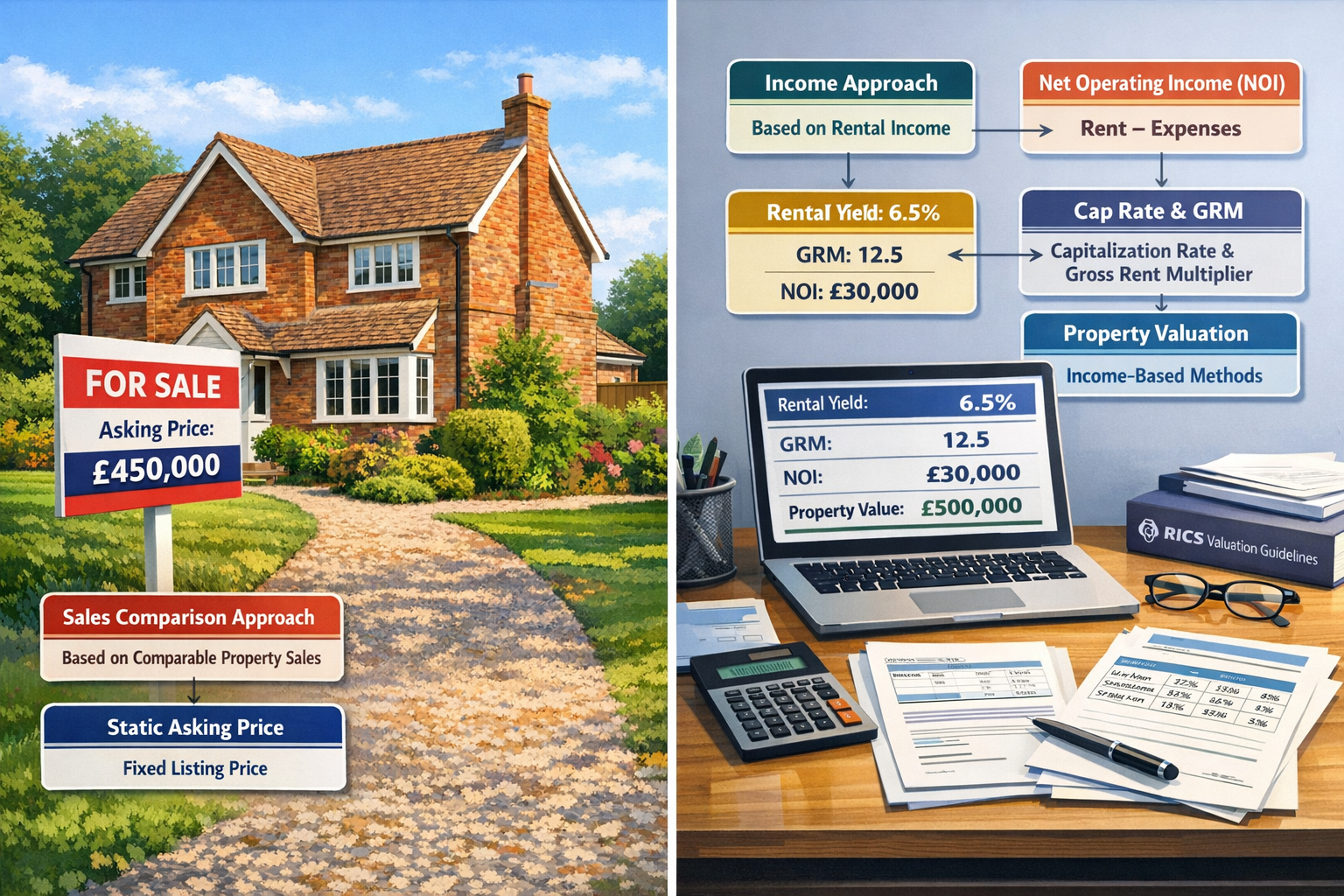
While owner-occupiers focus on comparable sales, investment property valuations in flat markets require income-based methodologies. When capital appreciation stalls, rental yields become the primary value driver.
The Gross Rent Multiplier (GRM) Method
The GRM approach provides a quick assessment of investment property value by dividing purchase price by annual rental income[3]. In flat markets, this metric reveals critical insights:
Calculating GRM:
GRM = Property Purchase Price ÷ Annual Gross Rental Income
Example:
- Property price: £500,000
- Annual rent: £30,000
- GRM = 16.67
Interpreting GRM in Flat Markets:
In growth markets, investors tolerate higher GRM ratios (18-22) because they anticipate capital appreciation. In flat markets, abnormally high GRMs indicate overpriced properties[3]. Surveyors should benchmark against:
- London prime areas: GRM 15-18 (reflecting higher rents)
- South East suburbs: GRM 12-16 (more balanced)
- Outer regions: GRM 10-14 (yield-focused)
Ratios exceeding these ranges suggest the property is priced for growth that won't materialize, making it a poor investment at current asking prices.
Income Capitalization Approach
For more sophisticated investment valuations, the income capitalization method provides deeper analysis:
Formula:
Property Value = Net Operating Income (NOI) ÷ Capitalization Rate
Calculating NOI:
- Start with annual gross rental income
- Subtract vacancy allowance (5-10% in flat markets)
- Deduct operating expenses (maintenance, insurance, management fees)
- Result = NOI
Determining Cap Rates in Flat Markets:
Capitalization rates must reflect the absence of growth expectations. In 2026's London and South East markets:
- Prime London locations: 3.5-4.5% cap rates
- Established South East areas: 4.5-5.5% cap rates
- Emerging locations: 5.5-6.5% cap rates
Higher cap rates (lower valuations) compensate investors for stagnant capital values. Surveyors conducting inheritance tax valuations or SIPP pension valuations must apply these adjusted rates to reflect current market realities.
Rental Market Analysis
Income-based valuations depend on accurate rental assessments. In flat sales markets, rental markets often remain more stable, providing a reliable value foundation:
Key Rental Metrics:
- Rental yield: Annual rent ÷ property value (aim for 4-6% in flat markets)
- Rent-to-price ratio: Monthly rent ÷ purchase price (0.4-0.5% indicates balanced market)
- Tenant demand indicators: Days to let, void periods, rental growth trends
Professional surveyors must research current rental comparables with the same rigor applied to sales comparables, ensuring income projections reflect achievable rents rather than optimistic assumptions.
Strategic Positioning and Competitive Valuation in Stagnant Markets
Beyond technical methodology, valuation methodology for flat markets requires strategic thinking about property positioning. Surveyors must help clients understand how to price properties competitively when appreciation has stalled.
Realistic Pricing Strategies
The gap between seller expectations and market reality widens in flat markets. Sellers remember recent peak prices and resist accepting current values. Chartered surveyors must:
Communicate Market Realities Clearly 💬
"In flat markets, the property is worth what buyers will pay today, not what similar properties sold for at market peak. Overpricing leads to extended marketing periods and eventual price reductions that signal desperation."
Provide Evidence-Based Pricing Guidance:
- Present asking price analysis showing how long overpriced properties remain unsold
- Demonstrate the correlation between realistic pricing and successful sales
- Show how properties priced at or slightly below market value generate multiple offers
- Explain the cost of extended marketing (mortgage payments, maintenance, opportunity cost)
Identifying Value-Add Opportunities
When markets plateau, property improvement becomes the only path to value creation. Surveyors should identify:
High-Impact Improvements:
- Kitchen and bathroom renovations (8-12% value increase)
- Additional bedrooms or bathrooms (10-15% increase)
- Energy efficiency upgrades (increasingly valued by buyers)
- Outdoor space enhancements (gardens, terraces, balconies)
Cost-Benefit Analysis:
Not all improvements deliver positive returns in flat markets. Surveyors must assess whether renovation costs can be recovered through higher sale prices or enhanced rental yields.
Leasehold Considerations in Flat Markets
For leasehold properties—particularly prevalent in London—flat markets intensify valuation challenges. Leasehold extension and enfranchisement valuations become critical:
Lease Length Impact:
- Properties with less than 80 years remaining face significant value penalties
- In flat markets, buyers are less willing to overlook short leases
- Marriage value calculations must reflect stagnant growth assumptions
Ground Rent Considerations:
- High ground rents deter buyers in cautious markets
- Capitalize ground rent at higher yields (reflecting increased risk)
- Factor in potential ground rent reform legislation
Regional Variations Within London and South East
Not all areas within London and the South East experience identical market conditions. Surveyors must recognize micro-market variations:
Prime Central London:
- More severely affected by flat conditions
- International buyer withdrawal impacts high-end properties
- Rental yields provide floor value support
Outer London Boroughs:
- More resilient due to better affordability
- First-time buyer activity maintains some momentum
- Transport links significantly impact relative values
South East Commuter Belt:
- Hybrid working patterns affect demand
- Properties near good schools maintain premium
- Market segmentation more pronounced
Professional surveyors operating across these regions—from Hertfordshire to Berkshire—must adjust methodology to reflect local conditions rather than applying blanket approaches.
Professional Standards and RICS Compliance in Challenging Markets
When markets become difficult, maintaining professional standards becomes paramount. The cornerstone of effective valuation strategy remains obtaining a professional assessment from a RICS-qualified surveyor[1].
The RICS Red Book Framework
The RICS Valuation – Global Standards (Red Book) provides the framework for professional valuations. In flat markets, several provisions become especially relevant:
Valuation Uncertainty Clauses:
When market conditions create significant uncertainty, surveyors must include appropriate caveats explaining limitations and assumptions. This protects both surveyor and client while ensuring transparency.
Market Value Definition:
RICS defines market value as "the estimated amount for which an asset should exchange on the valuation date between a willing buyer and a willing seller in an arm's length transaction after proper marketing." In flat markets, this definition requires careful interpretation of what constitutes "proper marketing" and "willing" parties.
Departure Provisions:
In exceptional circumstances, surveyors may depart from specific Red Book requirements, but must clearly disclose and justify such departures.
Valuation Report Components
Professional RICS valuations involve comprehensive processes. Surveyors conduct 45-90 minute property inspections and review extensive documentation[5]:
Inspection Elements:
- Detailed property measurement and condition assessment
- Identification of defects or issues affecting value
- Photographic documentation of key features
- Neighborhood and location analysis
Research Components:
- Land Registry records review
- Planning permissions and building regulations compliance
- Comparable sales and rental data analysis
- Local market trends and forecasts
Report Deliverables:
- Executive summary with valuation conclusion
- Detailed methodology explanation
- Comparable evidence presentation
- Market context and assumptions
- Recommendations for clients
Cost Considerations
Professional RICS valuations represent an investment in accuracy and credibility. For 2026, typical costs range from £200-£400 depending on property value and complexity[5]. This investment proves worthwhile when:
- Securing mortgage financing requiring lender-approved valuations
- Resolving estate planning issues requiring inheritance tax valuations
- Exercising Right to Buy options requiring independent assessment
- Managing tax liabilities through accurate capital gains valuations
Ethical Considerations in Flat Markets
Flat markets test professional ethics. Pressure from clients to inflate valuations intensifies when sellers struggle to achieve desired prices. RICS-qualified surveyors must:
Maintain Independence:
- Resist pressure to reach predetermined values
- Base conclusions solely on market evidence
- Clearly communicate when client expectations exceed market reality
Provide Honest Advice:
- Explain why flat markets require conservative valuations
- Help clients understand long-term implications of overpricing
- Offer strategic alternatives when values fall short of expectations
Document Thoroughly:
- Create audit trails justifying all valuation conclusions
- Retain comparable evidence and analysis
- Prepare defensible reports that withstand scrutiny
Conclusion: Mastering Valuation in the New Normal
The valuation methodology for flat markets represents a fundamental shift from the growth-oriented approaches that dominated previous decades. As London and South East property markets plateau in 2026, chartered surveyors must embrace techniques that prioritize accuracy over optimism, evidence over expectation, and strategic positioning over wishful thinking.
The key principles are clear: tighten comparable selection criteria, adjust for market stagnation rather than growth, employ income-based methods for investment properties, and maintain unwavering professional standards even when clients resist unfavorable conclusions. The 83% of premium property offers coming below asking prices signals that markets have fundamentally changed[4]—and valuation methodology must change with them.
Actionable Next Steps
For property owners, buyers, and investors navigating flat markets:
- Engage RICS-qualified surveyors early in any transaction to establish realistic value expectations before committing resources
- Request detailed comparable analysis that explains adjustments and reflects current market conditions rather than historical trends
- Consider income-based valuations for investment properties to ensure rental yields justify purchase prices in the absence of appreciation
- Be prepared for values below expectations and work with surveyors to develop strategic positioning approaches
- Invest in value-add improvements identified through professional assessment to create equity when markets won't deliver appreciation
The flat market environment of 2026 isn't temporary—it represents a mature market reaching equilibrium. Success requires adapting to this new reality rather than waiting for a return to growth conditions that may not materialize. Professional chartered surveyors employing rigorous methodology provide the foundation for sound decisions in this challenging environment.
Whether you're buying, selling, refinancing, or managing property portfolios across London and the South East, the expertise of qualified professionals following proven valuation methodology for flat markets ensures you navigate these conditions with confidence and clarity.
References
[1] Valuation Strategies For First Time Buyers In 2026 Leveraging Affordability Gains And Regional Price Variations – https://nottinghillsurveyors.com/blog/valuation-strategies-for-first-time-buyers-in-2026-leveraging-affordability-gains-and-regional-price-variations
[3] Understanding The Different Methods Of Property Valuation – https://landsterling.com/understanding-the-different-methods-of-property-valuation/
[4] Post Budget 2026 Valuation Challenges Surveyor Strategies For High Value Properties Over 2 Million – https://nottinghillsurveyors.com/blog/post-budget-2026-valuation-challenges-surveyor-strategies-for-high-value-properties-over-2-million
[5] Rics Help To Buy Valuation London Cost Process Timescales 2026 Guide – https://winfieldssurveyors.london/rics-help-to-buy-valuation-london-cost-process-timescales-2026-guide/