

The property market in 2026 faces an unprecedented challenge: AI-powered valuation tools are creating friction between buyers and sellers at an alarming rate. While artificial intelligence promises speed and efficiency, the reality is more complex. When an AI algorithm values a property £50,000 below the seller's expectation or £30,000 above what a buyer considers reasonable, disputes escalate quickly. Understanding Valuation Challenges from AI Tools in 2026: Chartered Surveyor Strategies for Buyer-Seller Disputes has become essential for anyone navigating today's property transactions.
The surge in proptech adoption has transformed how properties are valued, but it hasn't eliminated the need for human expertise. In fact, chartered surveyors now play a more critical role than ever—serving as the bridge between algorithmic outputs and real-world property complexities. This article explores the specific challenges AI valuations present and reveals the proven strategies RICS-qualified professionals use to resolve disputes and ensure accurate property pricing.
Key Takeaways
- AI valuation accuracy varies dramatically by property type, with multifamily properties achieving 93-97% accuracy while specialty assets and unique properties struggle at 85-90%, creating significant dispute potential
- Data quality limitations, not algorithmic capability, represent the primary source of AI valuation errors, particularly in markets with limited comparables or properties with unique characteristics
- Chartered surveyors employ RICS-guided manual overrides and transparency protocols to reconcile AI-generated valuations with qualitative factors like neighborhood trajectory, deferred maintenance, and unrealized potential
- Combined human-AI approaches produce the most reliable results, with professional surveyors using AI as a screening tool while applying expert judgment to assess factors algorithms cannot capture
- Effective dispute resolution requires transparent documentation showing both AI-generated data and professional adjustments, helping buyers and sellers understand valuation rationale
Understanding AI Valuation Accuracy Across Property Types in 2026
The accuracy of AI-powered property valuations in 2026 depends heavily on property type and market characteristics. Research shows that multifamily properties demonstrate the highest AI accuracy at 93-97%, with median accuracy of 95-97% for conventional multifamily in major metros, meaning estimates fall within 3-5% of actual transaction prices [1]. This exceptional performance stems from abundant comparable sales data and standardized property characteristics.
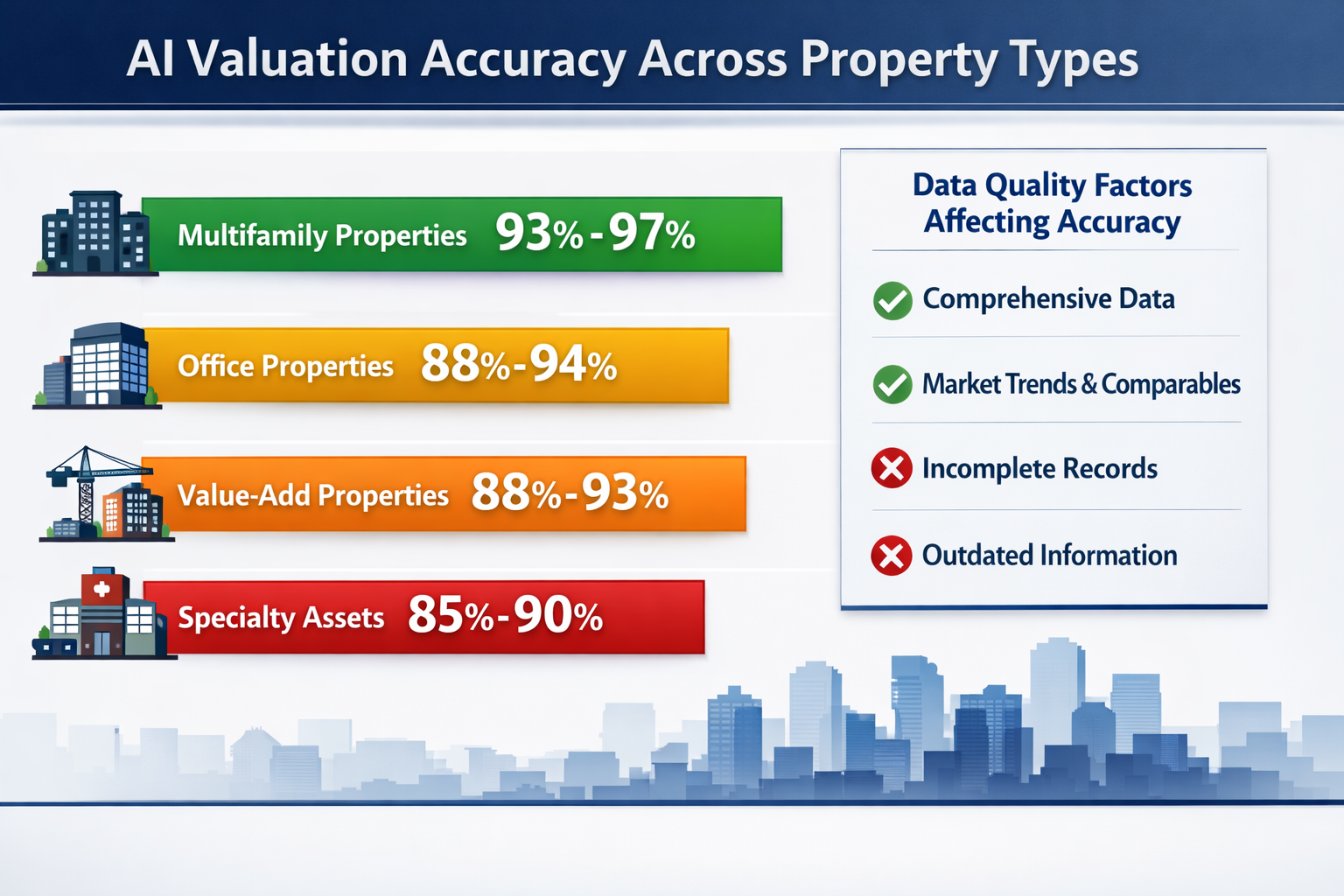
However, other property categories present greater challenges:
Property Type Accuracy Breakdown
| Property Type | AI Accuracy Range | Key Challenges |
|---|---|---|
| Multifamily (Conventional) | 93-97% | Minimal—abundant comparables |
| Office Properties | 88-94% | Post-pandemic demand disruption |
| Value-Add Properties | 88-93% | Future value depends on execution |
| Specialty Assets | 85-90% | Limited comparables, unique features |
| Mixed-Use Developments | 80-88% | Multiple component types, thin markets |
Office properties present particularly significant valuation challenges in 2026, with accuracy ranging from 88-94%. Post-pandemic disruption to office demand created structural breaks in historical data relationships, with models trained on pre-2020 data potentially misreflecting current valuations [1]. This creates frequent disputes when AI tools value office space based on outdated demand patterns.
Why Data Quality Matters More Than Algorithms
Data quality is the limiting factor, not algorithms—properties with limited comparables, unique characteristics, or thin markets produce less reliable estimates [1]. High transaction volume markets like Dallas, Phoenix, and Atlanta provide more accurate results than smaller MSAs and tertiary markets. This explains why a professional chartered surveyor valuation remains essential, particularly for properties in less active markets.
Value-add properties show reduced accuracy at 88-93%, with properties having significant renovation components, lease-up stage developments, and affordable housing with regulatory constraints showing lower reliability [1]. This occurs because future value depends on business plan execution rather than current market conditions—something AI struggles to assess.
"A standardized 200-unit garden-style apartment has hundreds of direct comparables for accurate modeling, while mixed-use developments with retail, office, and residential components in transitional neighborhoods have very few true comparables, significantly reducing model accuracy." [1]
For chartered surveyors working in areas like Surrey or West London, understanding these accuracy variations helps set realistic expectations when clients question AI-generated valuations.
What AI Valuation Tools Cannot Assess: The Human Expertise Gap
Despite impressive technological advances, AI cannot assess qualitative factors including curb appeal, neighborhood trajectory, management quality, deferred maintenance severity, or regulatory risk with the nuance that experienced professionals bring [1]. This limitation creates the most significant source of buyer-seller disputes in 2026.
Critical Factors AI Tools Miss
🏘️ Local Market Nuances
AI tools can analyze comparable sales but cannot determine that homes near specific parks move quickly, that buyers stretch budgets for certain school districts, or that different neighborhoods attract different buyer profiles [3]. A chartered surveyor in Weybridge, for example, understands the premium buyers place on properties within walking distance of the town center—knowledge that algorithms struggle to quantify accurately.
🔧 Deferred Maintenance and Property Condition
While computer vision technology is identifying new valuation factors by analyzing property images to detect renovation potential, design quality, and curb appeal [4], AI still cannot assess the severity of deferred maintenance with professional accuracy. A surveyor conducting a Level 3 building survey can identify structural issues, dampness patterns, and maintenance backlogs that significantly impact value but may not be visible in photographs or data points.
📈 Unrealized Potential and Repositioning Opportunities
AI valuations cannot effectively estimate unrealized potential such as renovation upside in dated properties, densification potential on underutilized sites, or repositioning opportunities [1]. These assessments require human judgment informed by construction cost analysis and execution capability assessment—expertise that chartered surveyors bring to every independent property valuation.
Algorithmic Bias and Privacy Concerns
Algorithmic bias and data privacy remain significant concerns, with AI models potentially perpetuating biases in training data and raising regulatory compliance issues as the legal landscape around AI continues evolving [2]. When AI tools consistently undervalue properties in certain postcodes or overvalue others based on historical patterns that reflect past discrimination, chartered surveyors must identify and correct these biases.
The transparency issue compounds these challenges. Many AI valuation platforms operate as "black boxes," providing outputs without explaining the weighting of various factors. This lack of transparency makes it difficult for buyers and sellers to understand why a valuation differs from their expectations, escalating disputes that could be resolved through clear explanation.
Chartered Surveyor Strategies for Resolving Valuation Challenges from AI Tools in 2026
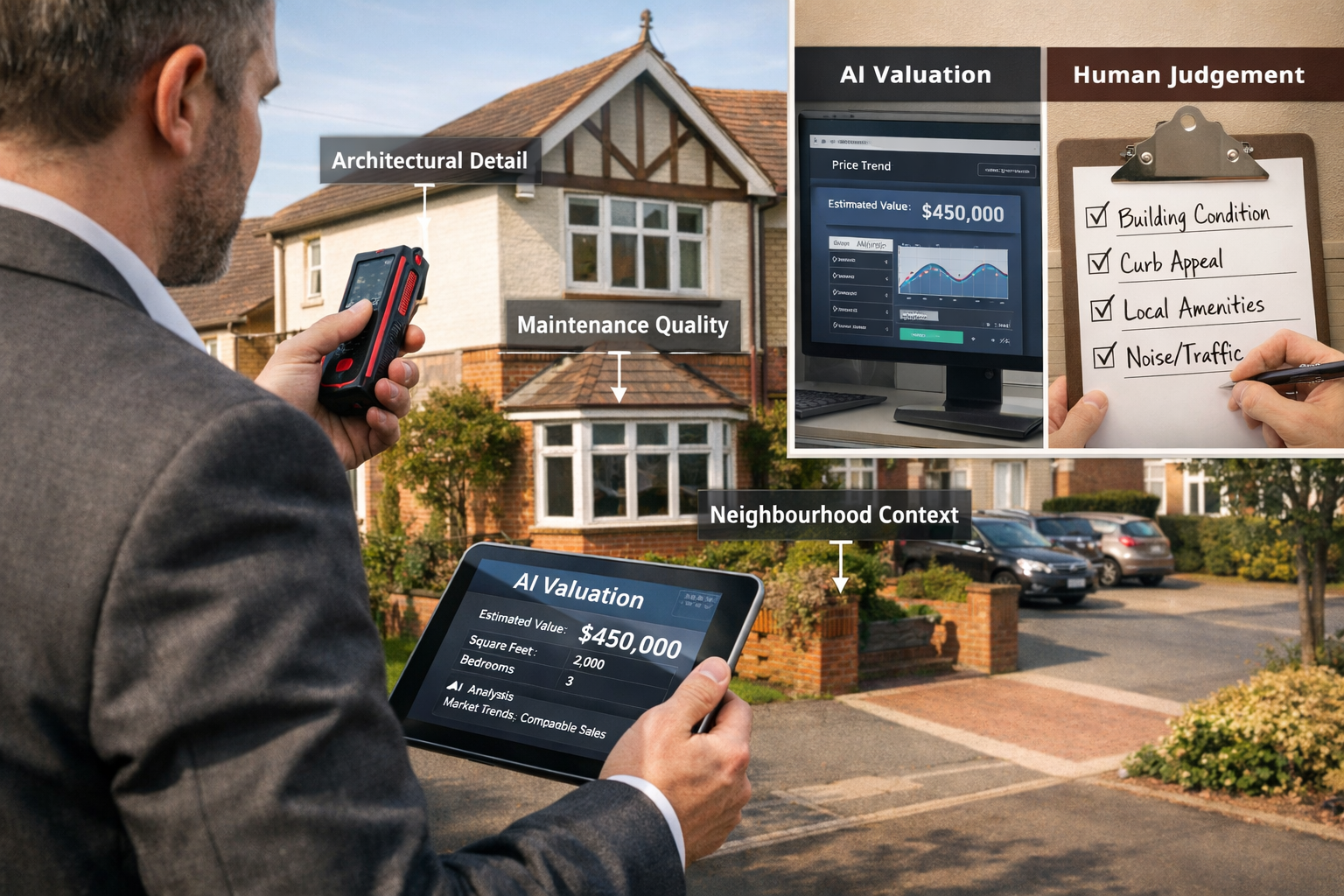
RICS-qualified chartered surveyors have developed systematic approaches to address AI valuation discrepancies and resolve buyer-seller disputes effectively. These strategies combine technological efficiency with professional expertise to deliver accurate, defensible valuations.
The Combined Human-AI Approach
Combined human-AI approach produces most accurate results, with AI handling data processing and pattern identification while humans assess qualitative factors like location nuances and property condition [1]. AI valuations perform best as screening tools rather than replacements for certified appraisals required by lenders.
The workflow typically follows this structure:
- Initial AI Screening: Generate preliminary valuation using multiple AI platforms to identify range and outliers
- Physical Inspection: Conduct thorough on-site assessment focusing on factors AI cannot capture
- Comparative Analysis: Review AI-identified comparables and add relevant transactions the algorithm missed
- Manual Adjustments: Apply professional judgment to adjust for qualitative factors
- Documentation: Create transparent report showing both AI data and professional modifications
RICS-Guided Manual Override Protocols
When AI valuations diverge significantly from professional assessment, chartered surveyors follow RICS Red Book standards to document override rationale. This includes:
📋 Detailed Comparable Justification
Rather than simply accepting AI-selected comparables, surveyors verify each transaction's relevance, adjusting for factors like:
- Sale timing and market conditions
- Property condition differences
- Location micro-variations
- Transaction circumstances (distressed sales, family transfers)
🔍 Qualitative Factor Quantification
Professional surveyors translate subjective assessments into defendable adjustments:
- Excellent condition vs. average: +5-8% value adjustment
- Superior location within neighborhood: +3-7% adjustment
- Deferred maintenance requiring immediate attention: -10-15% adjustment
- Unrealized development potential: +15-25% adjustment (with planning probability assessment)
These specific adjustments help buyers and sellers understand the rationale behind valuations that differ from AI outputs. When disputes arise over average price reductions after survey, this documentation becomes invaluable.
Transparency Tactics for Dispute Resolution
The most effective strategy for resolving valuation challenges from AI tools involves radical transparency. Chartered surveyors now provide:
Two-Tier Reporting
- Tier 1: AI-generated baseline valuation with data sources disclosed
- Tier 2: Professional assessment with itemized adjustments and photographic evidence
This approach allows buyers and sellers to see exactly where human expertise modified algorithmic outputs and why. For capital gains tax valuations or right-to-buy valuations, this transparency proves essential for HMRC compliance.
Leveraging Technology for Better Outcomes
AI valuations significantly reduce traditional appraisal timelines, with AI-powered assessments taking minutes to hours versus days to weeks for traditional appraisals, while also reducing human bias through algorithmic analysis with approximately 8% improvement in overall AVM accuracy metrics [2].
Chartered surveyors leverage this efficiency by:
- Using AI tools for initial market analysis and comparable identification
- Deploying computer vision technology to pre-screen property conditions
- Applying predictive analytics to identify properties requiring detailed inspection
- Utilizing digital platforms to provide clients with real-time valuation updates
This technology integration doesn't replace professional judgment—it enhances it, allowing surveyors to focus expertise where it matters most while maintaining efficiency that clients demand in 2026's fast-paced property market.
Mediating Buyer-Seller Disputes
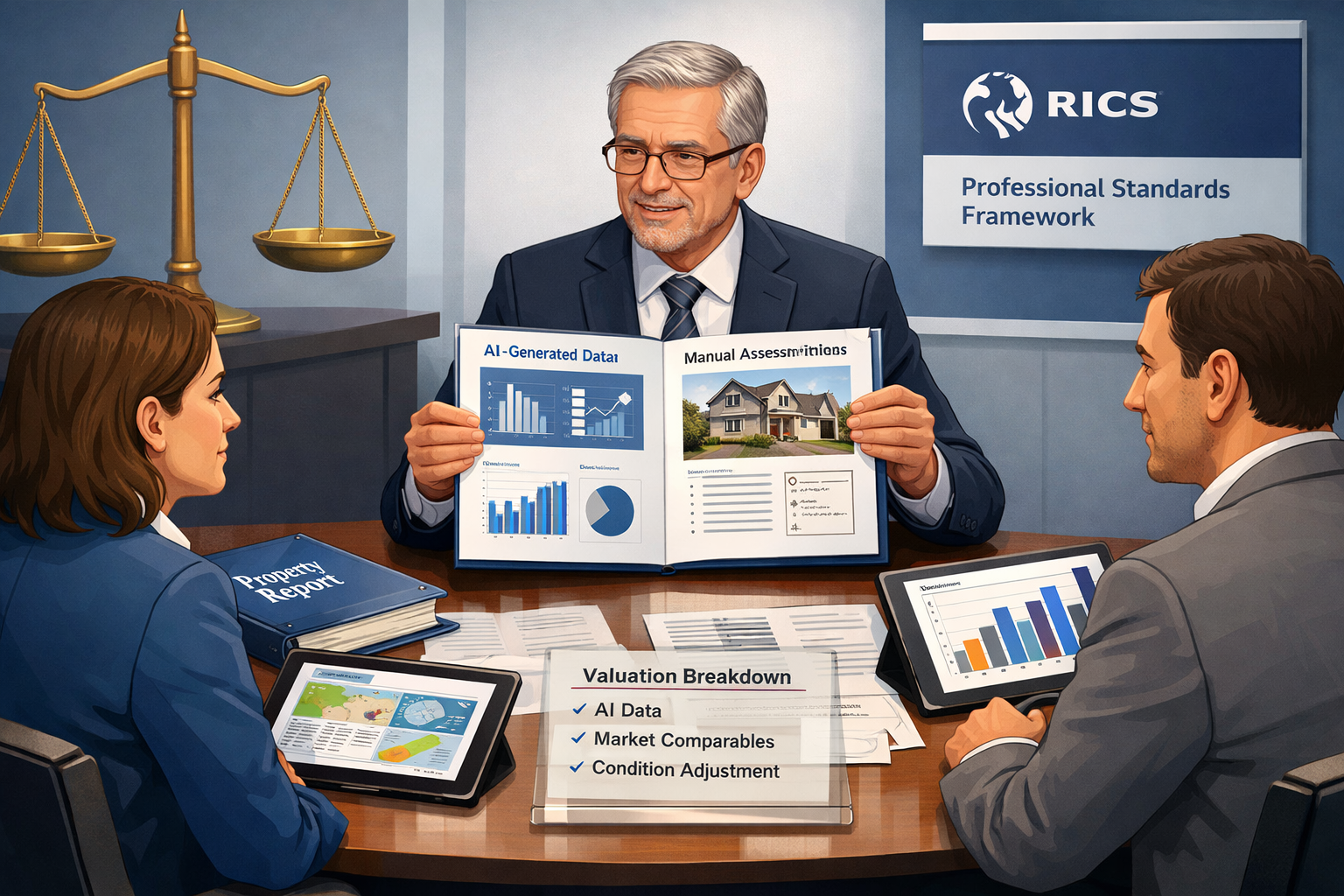
When AI valuations create friction between parties, chartered surveyors act as independent arbiters using these proven techniques:
🤝 Pre-Transaction Alignment Sessions
Before disputes escalate, surveyors facilitate discussions where both parties review:
- The AI valuation methodology and limitations
- Specific property characteristics affecting value
- Comparable properties and adjustment rationale
- Market trends impacting current pricing
📊 Dual-Scenario Modeling
For disputed valuations, surveyors present multiple scenarios:
- Conservative valuation: Based on current condition with no adjustments for potential
- Optimistic valuation: Reflecting realized improvements or development potential
- Most likely valuation: Professional judgment balancing all factors
This range helps buyers and sellers find common ground while understanding the uncertainty inherent in any valuation.
⚖️ Independent Expert Determination
For high-value disputes, chartered surveyors provide expert witness reports that courts and tribunals accept as authoritative. These reports specifically address AI valuation discrepancies, explaining why algorithmic outputs may not reflect true market value.
Continuous Professional Development
The rapidly evolving AI landscape requires chartered surveyors to maintain current knowledge of:
- New AI valuation platforms and their specific strengths/weaknesses
- Emerging case law around AI-generated valuations in disputes
- Updated RICS guidance on technology integration
- Data privacy regulations affecting valuation practices
Professional surveyors regularly test AI platforms against actual transaction outcomes, building institutional knowledge about which tools perform best for specific property types and markets. This empirical approach ensures recommendations remain grounded in evidence rather than technology hype.
Conclusion
The valuation challenges from AI tools in 2026 represent both an obstacle and an opportunity for the property industry. While artificial intelligence delivers unprecedented speed and data processing capability, it cannot replace the nuanced judgment that RICS-qualified chartered surveyors bring to property valuation. The most accurate and defensible valuations emerge from a combined approach—leveraging AI's computational power while applying professional expertise to assess the qualitative factors that truly determine market value.
For buyers and sellers navigating disputes arising from AI-generated valuations, the path forward is clear: engage chartered surveyors who understand both technology and traditional valuation principles. These professionals can reconcile algorithmic outputs with real-world property characteristics, providing transparent documentation that helps all parties understand valuation rationale.
Actionable Next Steps
✅ For Property Buyers: Don't accept AI valuations at face value—commission an independent professional valuation that accounts for factors algorithms miss, particularly for unique properties or those requiring renovation.
✅ For Property Sellers: When AI tools undervalue your property, work with chartered surveyors to document the specific characteristics and potential that justify higher pricing, creating evidence-based support for your position.
✅ For Lenders and Investors: Implement dual-validation protocols requiring both AI screening and professional verification for transactions above threshold values, reducing dispute risk while maintaining efficiency.
✅ For Property Professionals: Invest in understanding AI valuation tools' capabilities and limitations, positioning yourself as the expert who can bridge the gap between algorithmic outputs and market reality.
The property market's future lies not in choosing between AI and human expertise, but in strategically combining both to deliver valuations that are simultaneously efficient, accurate, and defensible. Chartered surveyors who master this integration will lead the industry through 2026 and beyond, resolving disputes and ensuring that property transactions proceed on the foundation of reliable, transparent valuations.
References
[1] Ai Property Valuation Accuracy 2026 Benchmarks – https://www.theaiconsultingnetwork.com/blog/ai-property-valuation-accuracy-2026-benchmarks
[2] Ai Property Analysis – https://www.growthfactor.ai/blog-posts/ai-property-analysis
[3] How Ai Is Changing Buying And Selling Real Estate In 2026 – https://www.vittorialogli.com/blog/how-ai-is-changing-buying-and-selling-real-estate-in-2026
[4] 5 Ai For Real Estate Trends Every Team Should Watch Heading Into 2026 – https://fello.ai/academy/5-ai-for-real-estate-trends-every-team-should-watch-heading-into-2026