

The property valuation landscape in 2026 reveals a striking geographic divide that surveyors can no longer ignore. While northern regions experience robust residential growth of 3-7%, southern markets struggle with stagnation and commercial property flatlines of just 0.03%[1][4]. This divergence isn't random—it's driven by affordability migration, limited housing inventory, and fundamental shifts in where buyers can actually afford to live. For chartered surveyors, understanding these Valuation Adjustments for 2026 Affordability-Driven Markets: How Surveyors Must Recalibrate in High-Growth Northern Regions is essential to providing accurate, defensible valuations that reflect true market conditions.
The data tells a compelling story: Sedgwick County residential properties jumped 9.3% in median valuation, while Pottawatomie County saw sustained demand with 428 residential sales driving 3-7% countywide increases[1][2]. Meanwhile, commercial properties barely moved. This isn't just a statistical anomaly—it represents a fundamental market recalibration that demands new surveying approaches.
Key Takeaways
- Northern regions are experiencing 3-9.3% residential valuation growth while southern markets and commercial properties remain largely flat, creating a geographic valuation divide[1][4]
- Limited housing inventory and affordability-driven migration are the primary factors elevating northern residential values, requiring surveyors to adjust traditional comparable selection methods[1][2]
- Commercial properties show 0.03-5% growth ranges, contrasting sharply with residential markets and demanding sector-specific valuation approaches[2][4]
- March 1, 2026 marks official valuation notice dates across multiple counties, with property owners having 30 days to file appeals based on accurate market analysis[1][2]
- Surveyors must recalibrate valuation models to account for supply-demand imbalances, neighborhood-specific trends ranging from 2-16%, and affordability factors driving regional growth[5]
Understanding the 2026 Market Divergence: Northern Growth vs. Southern Stagnation
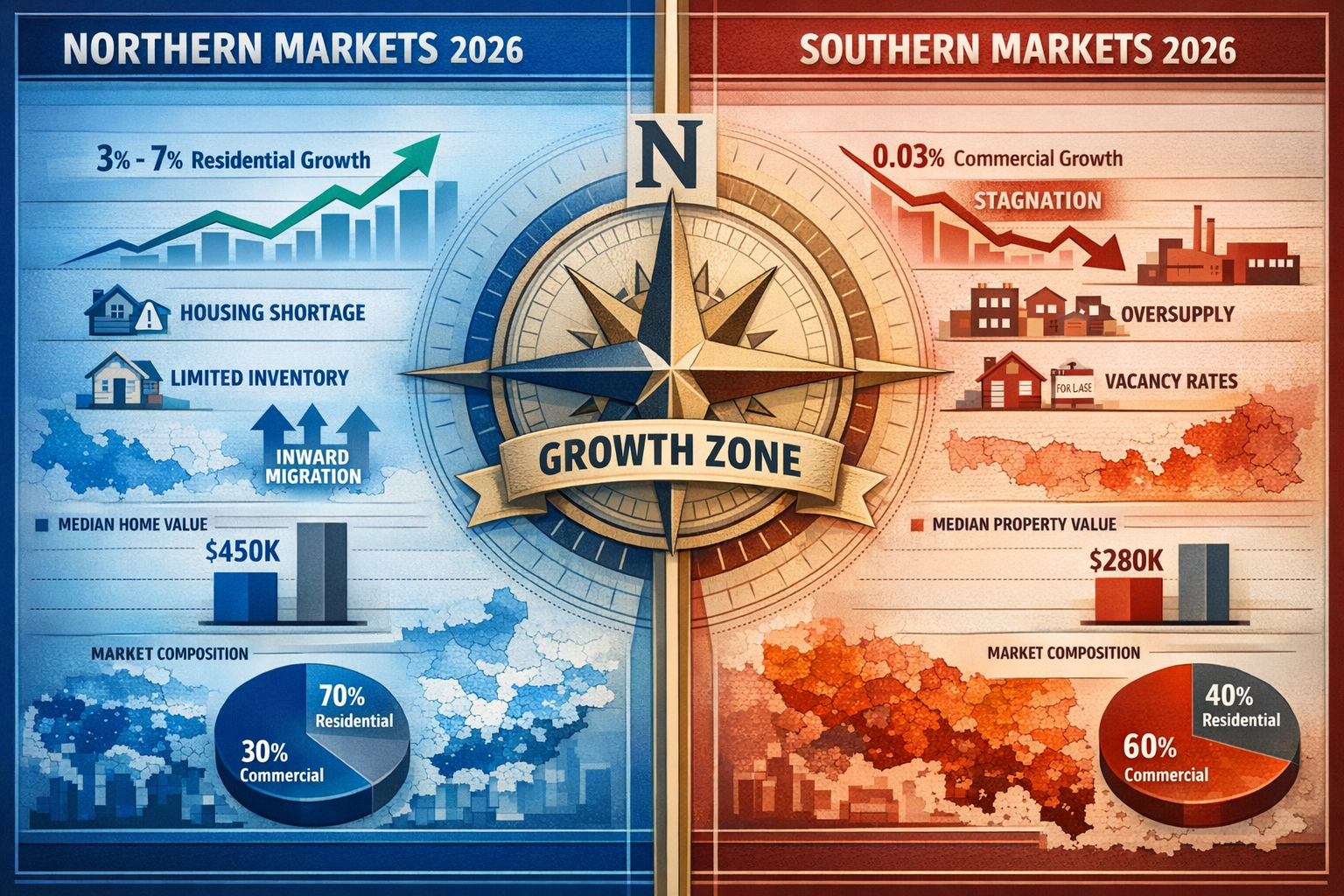
The geographic split in property valuations across 2026 markets represents more than a temporary fluctuation—it signals a structural shift in how affordability shapes regional real estate dynamics.
The Northern Residential Boom 📈
Northern regions are experiencing unprecedented residential valuation increases. Sedgwick County's 9.3% median residential increase reflects strong real estate markets fueled by elevated 2025 sale prices that continue influencing 2026 assessments[1][4]. Pottawatomie County demonstrates similar patterns, with approximately 428 residential dwelling sales in 2025 creating sustained demand that pushed countywide increases to the 3-7% range[2].
Graham County identified an even wider variation, with 2-16% upward trends across different residential neighborhoods for 2026 tax assessments[5]. This variation highlights a critical point for surveyors: blanket regional adjustments no longer suffice. Neighborhood-level analysis has become essential.
The primary driver? Limited housing inventory[1]. When supply constraints meet sustained buyer demand, prices inevitably rise. For surveyors conducting commercial valuations or residential assessments, this inventory shortage must factor into comparable selection and adjustment calculations.
Commercial Property Stagnation
The contrast with commercial markets couldn't be starker. Sedgwick County commercial properties posted a mere 0.03% median increase—essentially flat[4]. Pottawatomie County commercial parcels showed slightly better performance with projected 1-5% increases, but individual property variation remained significant[2].
This commercial stagnation reflects different market fundamentals:
- Oversupply in certain commercial sectors
- Changing work patterns reducing office space demand
- Retail transformation affecting traditional commercial valuations
- Investment capital flowing toward residential opportunities
For surveyors, this means sector-specific methodologies are no longer optional—they're essential. A professional valuation service must differentiate between residential and commercial approaches in 2026 markets.
Agricultural Land Value Trends
Adding another layer of complexity, agricultural land values in Pottawatomie County favor slight decreases for 2026[2]. This decline stems from:
- Commodity price fluctuations
- Rising production costs
- Changes in landlord net income
- Competing land use pressures
Surveyors working across property types must understand these divergent trajectories to provide accurate valuations for inheritance tax valuations or capital gains purposes.
Valuation Adjustments for 2026 Affordability-Driven Markets: Key Factors Surveyors Must Consider
Understanding market divergence is only the first step. Surveyors must now recalibrate their methodologies to capture the nuanced factors driving 2026 valuations.
Supply and Demand Dynamics Favoring Sellers
The fundamental economic principle of supply and demand dominates 2026 residential markets. Despite rising property values, supply and demand dynamics continue favoring sellers[2]. This creates a unique valuation challenge: traditional depreciation models may underestimate value in high-demand, low-inventory markets.
Surveyors must ask:
- What is the current inventory-to-sales ratio in the subject property's market?
- How quickly are comparable properties selling?
- Are there bidding wars or above-asking-price sales?
- What percentage of listings receive multiple offers?
These questions inform adjustment factors that reflect true market conditions rather than historical patterns.
Location-Specific Valuation Factors
County appraisers consistently consider location, age, square footage, and repairs/remodeling as standard valuation factors[1]. However, in 2026's affordability-driven markets, location carries amplified weight.
Location considerations now include:
| Factor | Traditional Weight | 2026 Adjusted Weight | Rationale |
|---|---|---|---|
| Proximity to employment centers | Medium | High | Remote work flexibility increases range |
| School district quality | High | Very High | Families prioritize education in relocation |
| Affordability relative to metro areas | Low | Very High | Primary migration driver |
| Infrastructure development | Medium | High | New construction signals growth |
| Neighborhood renovation trends | Medium | High | Indicates sustained investment |
For surveyors operating in North West London or other high-growth areas, these weighted factors must inform comparable selection and adjustment calculations.
New Construction and Neighborhood Renovation Impact
New construction and neighborhood renovations directly influence increased valuations in affected areas[1]. Surveyors must quantify this impact through:
- Construction activity analysis: Number of building permits issued in the past 12-24 months
- Renovation investment tracking: Average spending on home improvements in the neighborhood
- Infrastructure upgrades: Public investment in roads, utilities, parks, and amenities
- Commercial development: New retail, dining, and service establishments
When conducting an independent property valuation, these factors provide objective support for upward adjustments that might otherwise seem aggressive.
Affordability Migration Patterns
The 2026 market is fundamentally shaped by affordability-driven migration. Buyers priced out of traditional high-cost areas are relocating to northern regions where housing remains accessible. This creates:
- Increased competition for available properties
- Upward price pressure even on properties requiring renovation
- Compressed time-on-market statistics
- Reduced negotiation leverage for buyers
Surveyors must recognize that comparable sales from 12-18 months ago may not accurately reflect current market conditions in rapidly appreciating areas. Time adjustments become critical—potentially 0.5-1.0% per month in the fastest-growing markets.
How Surveyors Must Recalibrate in High-Growth Northern Regions

Theoretical understanding means little without practical recalibration. Surveyors working in high-growth northern regions must implement specific methodological changes to maintain valuation accuracy.
Comparable Selection in Low-Inventory Markets
Traditional comparable selection criteria—three to six sales within the past six months, within a half-mile radius—often prove impossible in constrained inventory markets. Surveyors must adapt:
Expanded Geographic Radius: When local comparables are scarce, expand the search radius but apply location adjustments based on:
- Commute time differentials
- School district variations
- Neighborhood amenity differences
- Market perception factors
Extended Time Frame with Adjustments: Using sales from 9-12 months ago becomes necessary, but requires robust time adjustments. In markets showing 7% annual appreciation, this means approximately 0.58% monthly adjustment—compounded, not simple.
Cross-Property Type Analysis: In extreme inventory constraints, adjusted comparables from different property types (detached vs. semi-detached) may provide supporting evidence when properly adjusted for:
- Privacy and land use differences
- Structural variations
- Market segment preferences
- Financing availability differences
Neighborhood-Level Granularity
Graham County's 2-16% variation across neighborhoods[5] demonstrates why regional averages fail. Surveyors must develop neighborhood-specific adjustment factors through:
- Micro-market segmentation: Divide larger regions into distinct neighborhoods based on school catchments, infrastructure, and development patterns
- Neighborhood-specific sales analysis: Calculate appreciation rates for each micro-market separately
- Development pipeline tracking: Monitor planning applications and construction activity by neighborhood
- Demographic shift analysis: Understand which neighborhoods attract affordability-driven migrants
This granular approach supports defensible valuations when property owners question assessments or when conducting SIPP pension valuations requiring precision.
Adjustment Factor Recalibration
Standard adjustment factors developed in balanced markets require recalibration for 2026's affordability-driven dynamics:
Condition Adjustments: In seller-favoring markets, properties in average condition command premiums that exceed historical norms. Buyers accept deferred maintenance when inventory is limited.
Size Adjustments: Per-square-foot values often compress in high-growth markets as buyers prioritize location over space. The adjustment per square foot may decrease as total size increases.
Age Adjustments: New construction premiums expand in markets with limited inventory. The gap between new and 10-year-old properties widens beyond historical patterns.
Lot Size Adjustments: In affordability-driven markets, lot size premiums may decrease as buyers prioritize home size and location over land.
Documentation and Defense Strategies
With March 1, 2026 as the official notification date for change-of-value notices and property owners having 30 days to file appeals[1][2], surveyors must prepare robust documentation:
Market Condition Reports: Develop comprehensive reports showing:
- Inventory levels over 12-24 months
- Average days-on-market trends
- List-price-to-sale-price ratios
- Sales volume and velocity statistics
Neighborhood Analysis: Provide specific data for the subject property's micro-market, not just regional averages.
Adjustment Justification: Document the methodology behind every adjustment factor, particularly those that deviate from historical norms.
Comparable Selection Rationale: Explain why specific comparables were chosen and others rejected, especially when using expanded search criteria.
This documentation proves essential when valuations face scrutiny during the appeals process, with decisions mailed by May 20[1].
Technology Integration for Real-Time Market Tracking
2026's rapid market changes demand real-time data integration. Surveyors should leverage:
- Automated valuation models (AVMs) for initial screening and trend identification
- Geographic information systems (GIS) for spatial analysis of market patterns
- Multiple listing service (MLS) data feeds for immediate comparable identification
- Public records integration for comprehensive transaction history
- Market dashboard tools tracking inventory, absorption rates, and price trends
These technologies don't replace professional judgment—they enhance it by providing current data that manual research can't match.
Professional Development and Market Intelligence
Surveyors must invest in continuous education focused on:
- Economic migration patterns driving regional growth
- Demographic analysis revealing buyer composition changes
- Affordability index interpretation understanding threshold effects
- Regulatory changes affecting housing supply and demand
- Financing trends influencing buyer capacity and market access
Professional organizations and continuing education programs increasingly address these 2026-specific challenges, recognizing that traditional surveying education may not cover affordability-driven market dynamics.
Practical Implementation: A Framework for 2026 Valuations
Implementing these recalibrations requires a systematic framework that surveyors can apply consistently across assignments.
Step 1: Market Context Analysis
Before analyzing any individual property, establish the market context:
- Identify the micro-market: Define the specific neighborhood or sub-region
- Quantify inventory levels: Calculate months of supply based on current listings and sales velocity
- Measure price trends: Determine appreciation rates over 3, 6, and 12 months
- Assess supply pipeline: Review construction permits and planned developments
- Evaluate migration patterns: Understand demographic shifts affecting demand
This context informs every subsequent valuation decision.
Step 2: Comparable Selection with Expanded Criteria
Apply flexible comparable selection criteria appropriate for constrained markets:
- Primary comparables: Ideal matches within 6 months and 0.5 miles
- Secondary comparables: Acceptable matches within 12 months and 1 mile, with time and location adjustments
- Supporting comparables: Broader matches providing market context and trend validation
Document why each comparable was selected and how it supports the valuation conclusion.
Step 3: Adjustment Factor Application
Apply recalibrated adjustment factors reflecting 2026 market conditions:
- Time adjustments: Use market-specific appreciation rates, not generic assumptions
- Location adjustments: Reflect actual buyer preferences and migration patterns
- Condition adjustments: Account for seller-favoring market dynamics
- Size/age/quality adjustments: Calibrate to current market behavior
Test adjustment sensitivity—small changes in key factors should produce reasonable value ranges.
Step 4: Reconciliation and Reasonableness Testing
Reconcile multiple value indications through:
- Comparable sales approach: Primary method in residential markets
- Cost approach: Supporting method for newer properties
- Income approach: Applicable for investment properties
- Market extraction: Deriving adjustments from paired sales analysis
Test reasonableness by comparing the concluded value to:
- Recent list prices for similar properties
- Current market absorption rates
- Affordability metrics for target buyer demographics
- Historical value trends adjusted for current conditions
Step 5: Documentation and Reporting
Prepare comprehensive reports that:
- Explain market context: Describe the affordability-driven dynamics affecting the subject property
- Justify methodology: Defend comparable selection and adjustment factors
- Provide transparency: Show calculations and reasoning clearly
- Address potential objections: Anticipate questions about aggressive valuations
- Include supporting data: Attach market statistics, charts, and trend analysis
This documentation proves essential during appeals and when clients question valuations that exceed expectations.
Regional Considerations: Applying Principles to Specific Markets
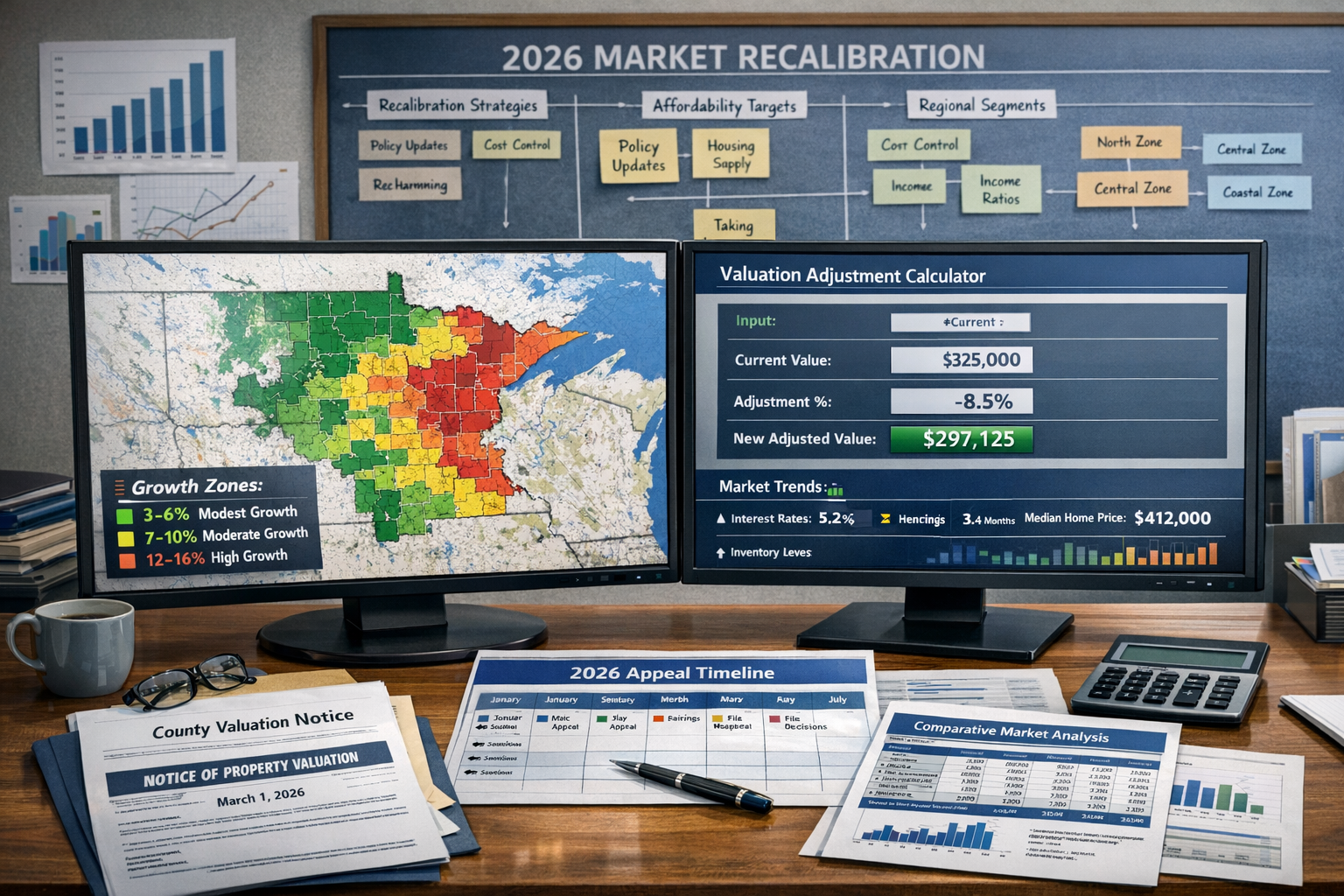
While this framework applies broadly, regional variations require specific adaptations.
High-Growth Northern Regions
In areas showing 7-9% residential appreciation:
- Prioritize recent comparables: Even 6-month-old sales may require significant time adjustments
- Monitor new construction: Development activity signals sustained growth
- Track infrastructure investment: Public spending indicates long-term value support
- Analyze migration sources: Understanding where buyers relocate from reveals price tolerance
Moderate-Growth Transitional Areas
In regions showing 3-5% appreciation:
- Identify growth catalysts: What's driving appreciation—schools, employment, affordability?
- Assess sustainability: Is growth likely to continue or plateau?
- Compare to adjacent markets: How does this area's affordability compare to alternatives?
- Monitor inventory trends: Is supply increasing or remaining constrained?
Stagnant Southern Markets
In areas showing flat or declining values:
- Understand oversupply: Why is inventory elevated relative to demand?
- Identify value segments: Are certain price points or property types performing better?
- Assess competitive positioning: How does this market compare to growing alternatives?
- Consider contrarian opportunities: Stagnation may present value for long-term investors
For surveyors working across multiple regions, maintaining separate market intelligence files for each area ensures appropriate methodology application.
Conclusion
Valuation Adjustments for 2026 Affordability-Driven Markets: How Surveyors Must Recalibrate in High-Growth Northern Regions represents more than a technical challenge—it's a fundamental shift in how property valuation must account for economic migration, supply constraints, and geographic divergence. The data is clear: northern residential markets are experiencing 3-9.3% growth while commercial properties and southern regions stagnate[1][4]. This isn't temporary volatility; it's a structural realignment driven by affordability.
Surveyors who maintain traditional methodologies risk producing inaccurate valuations that fail to reflect market reality. Those who recalibrate—expanding comparable selection criteria, applying market-specific adjustment factors, and documenting affordability-driven dynamics—will provide defensible valuations that serve clients and withstand scrutiny.
Actionable Next Steps
For Surveyors:
- Audit current methodology: Review recent valuations to identify where traditional approaches may undervalue high-growth properties
- Develop market intelligence systems: Implement tools for tracking inventory, sales velocity, and appreciation rates by micro-market
- Recalibrate adjustment factors: Update standard adjustments to reflect 2026 market conditions
- Enhance documentation practices: Prepare for increased appeals by strengthening market context reporting
- Invest in professional development: Attend training focused on affordability-driven market analysis
For Property Owners:
- Review March 1, 2026 valuation notices carefully: Understand the methodology and comparables used
- File appeals within 30 days if warranted: Don't miss the deadline for challenging inaccurate assessments[1]
- Obtain independent valuations: Consider professional valuation services for significant properties
- Understand market context: Recognize that rising valuations reflect genuine market appreciation in high-growth areas
- Plan for tax implications: Increased valuations affect property taxes, requiring financial planning
For Market Participants:
- Monitor regional divergence: Track which areas show sustained growth versus stagnation
- Analyze affordability metrics: Understand price-to-income ratios driving migration
- Assess investment opportunities: Stagnant markets may offer value; growth markets may offer appreciation
- Consider timing: In rapidly appreciating markets, delays can mean significantly higher prices
- Engage qualified professionals: Work with surveyors who understand 2026's unique market dynamics
The 2026 property market demands sophisticated analysis that goes beyond historical patterns. Surveyors who embrace this complexity, recalibrate their methodologies, and provide transparent, well-documented valuations will deliver the accuracy that clients deserve and the market demands. The geographic divide between northern growth and southern stagnation isn't disappearing—it's intensifying. Success requires recognition of this reality and adaptation to it.
References
[1] Sedgwick County Appraiser Explains Increase In 2026 Property Valuations – https://www.sedgwickcounty.org/communications/news-releases/sedgwick-county-appraiser-explains-increase-in-2026-property-valuations/
[2] Civicalerts – https://www.pottcounty.org/CivicAlerts.asp?AID=576
[3] Fisc Note Hb2457 00 0000 – https://www.kslegislature.gov/li/b2025_26/measures/documents/fisc_note_hb2457_00_0000.pdf
[4] Sedgwick County Home Values Property Increase – https://www.bizjournals.com/wichita/news/2026/02/18/sedgwick-county-home-values-property-increase.html
[5] Market Study Analysis 2026 – https://www.grahamcountyks.com/appraiser/pages/market-study-analysis-2026
[6] 2026 Sedgwick County Rp Cvn Cover Letter – https://www.sedgwickcounty.org/media/71114/2026-sedgwick-county-rp-cvn-cover-letter.pdf
[7] February 9 2026 Legislative Update – https://kansascounties.org/news/719883/February-9-2026-Legislative-Update.htm