

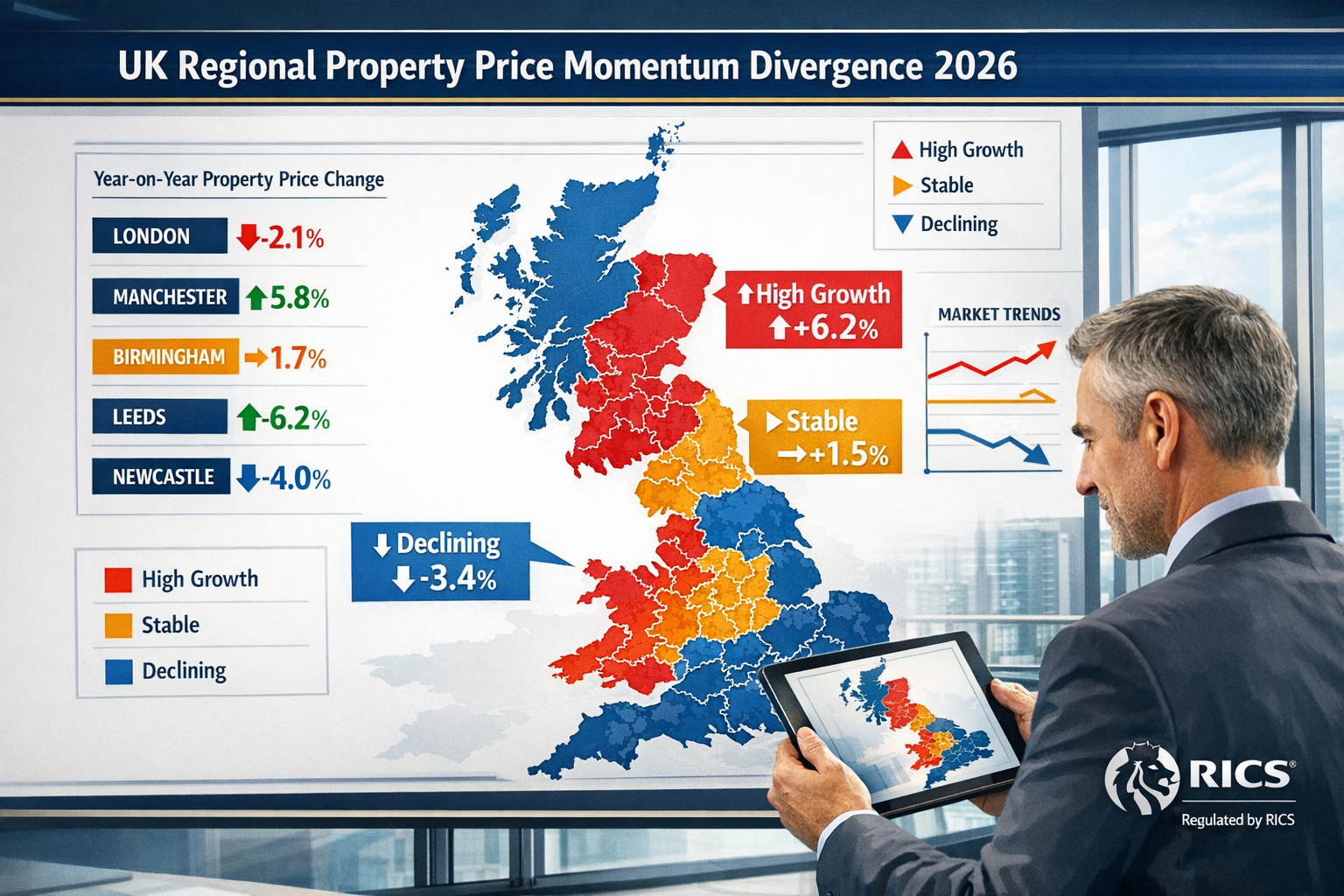
Property valuations across the UK in 2026 reveal a stark reality: while national house price indices suggest modest growth of 2.3%, individual regional markets are experiencing price movements ranging from -4% to +8% year-on-year. This unprecedented divergence creates a complex challenge for chartered surveyors who must deliver accurate valuations that reflect localized market conditions rather than relying on outdated national benchmarks. Valuation Accuracy in Diverging Market Conditions: Chartered Surveyor Techniques for Assessing Properties as Regional Price Momentum Varies has become a critical competency as the traditional north-south divide expands into a more nuanced patchwork of micro-markets, each responding differently to economic pressures, employment trends, and infrastructure investment.[1]
The widening gap between regional property markets demands that chartered surveyors adopt sophisticated analytical frameworks that account for local momentum while maintaining professional standards. As market conditions become increasingly fragmented, the techniques employed by RICS-accredited professionals must evolve beyond simple comparable analysis to incorporate multiple data sources, enhanced due diligence, and transparent uncertainty disclosure.
Key Takeaways
- Regional divergence is accelerating: UK property markets now exhibit price momentum variations exceeding 12 percentage points between highest and lowest performing regions, requiring location-specific valuation methodologies.[1][3]
- Material uncertainty clauses are mandatory: RICS Red Book Global Standards now require explicit uncertainty disclosure when market conditions create valuation challenges, protecting both surveyors and clients.[2]
- Multiple valuation approaches strengthen accuracy: Chartered surveyors increasingly employ cross-referencing techniques combining comparable evidence, income capitalization, and residual methods to validate findings in uncertain markets.[2]
- Enhanced regional expertise delivers superior outcomes: Surveyors with specialized knowledge of local market dynamics produce demonstrably more reliable valuations than those applying standardized national approaches.[2][3]
- ESG factors and climate risks now influence valuations: Environmental considerations, building safety regulations, and future-proofing requirements have become integral to accurate property assessment in 2026.[2]
Understanding Regional Price Momentum Divergence in 2026
The UK property market landscape in 2026 presents chartered surveyors with unprecedented complexity. Regional price momentum varies dramatically across the country, with some areas experiencing robust growth while others face declining values. This divergence stems from multiple factors including employment patterns, infrastructure investment, demographic shifts, and varying local economic resilience.
The Expanding North-South Divide
The traditional north-south property price divide has evolved into a more sophisticated pattern of regional variation. While London and the Southeast historically commanded premium valuations, 2026 data reveals significant internal variation within these regions.[1]
Key regional trends include:
- 🏙️ Urban core fluctuations: Major city centers show mixed performance based on post-pandemic work patterns
- 🏡 Suburban resilience: Commuter towns with strong transport links maintain stable or growing values
- 🌾 Rural market divergence: Countryside properties show highly localized performance tied to amenity value
- 🏭 Industrial regeneration zones: Areas benefiting from levelling-up investment demonstrate accelerated growth
For chartered surveyors working in areas like Richmond, Islington, or Weybridge, understanding these micro-market dynamics becomes essential for accurate valuation work.
Factors Driving Regional Divergence
Several interconnected factors contribute to the widening gap between regional property markets:
| Factor | Impact on Valuation | Regional Variation |
|---|---|---|
| Employment Growth | Direct correlation with housing demand | High in tech hubs, lower in traditional industrial areas |
| Infrastructure Investment | Significant uplift in transport corridor zones | Concentrated in government priority regions |
| Demographic Shifts | Age profile affects property type demand | Retirement destinations vs. young professional areas |
| Planning Policy | Supply constraints create price pressure | Highly localized based on council policies |
| Climate Risk | Flood zones and coastal erosion impact values | Coastal and riverside properties most affected |
The challenge for chartered surveyors lies in quantifying these factors within individual property valuations while maintaining consistency with professional standards.[3]
Chartered Surveyor Techniques for Valuation Accuracy in Diverging Market Conditions
Professional chartered surveyors employ multiple sophisticated techniques to maintain valuation accuracy when regional markets behave differently from national trends. These methodologies align with RICS standards while adapting to contemporary market complexity.
Enhanced Comparable Evidence Analysis
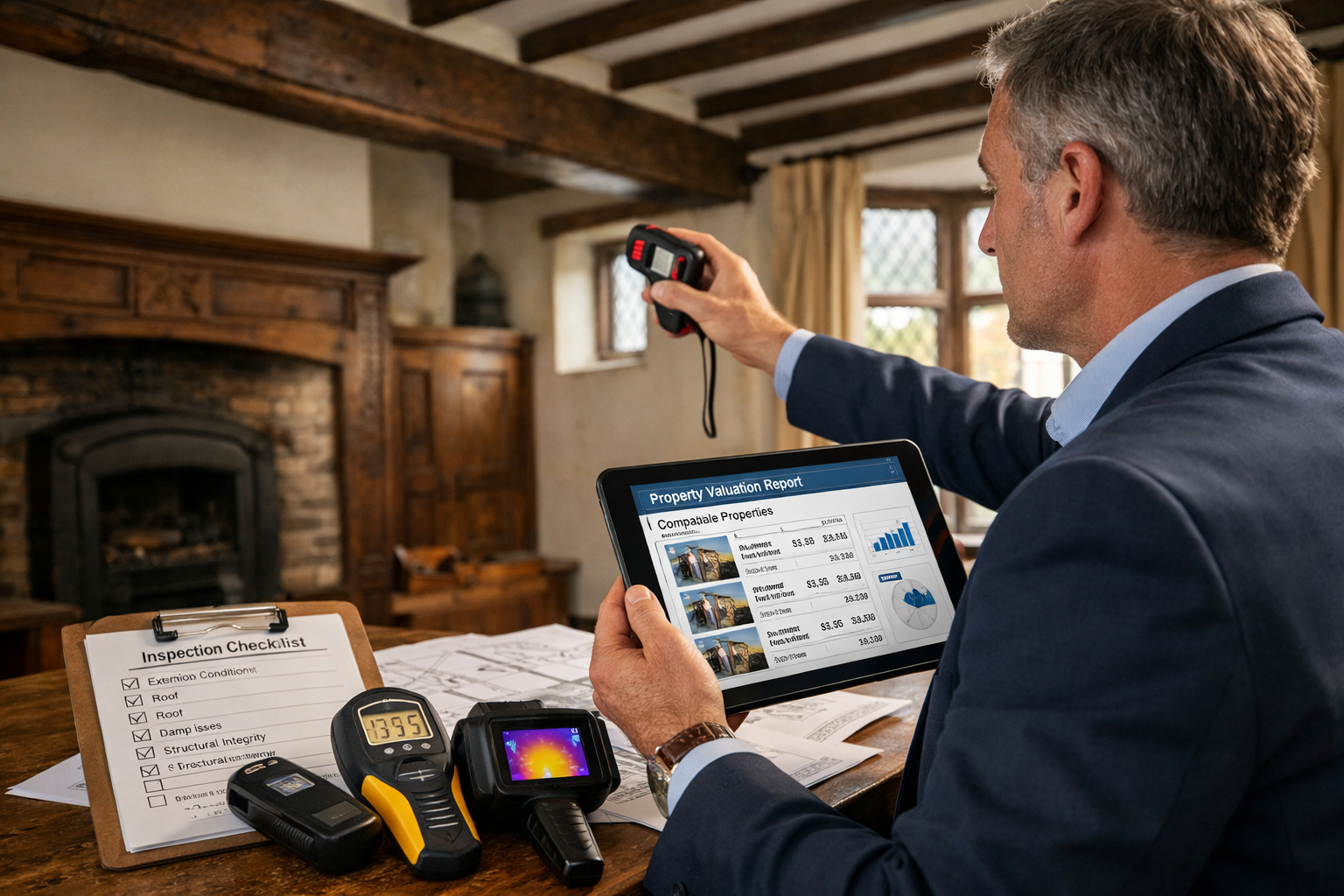
The foundation of property valuation remains the comparable evidence method, but in diverging markets, this approach requires significant refinement. Chartered surveyors must:
Expand geographical search parameters while maintaining relevance. When local comparables are limited or outdated, surveyors look to similar property types in demographically comparable areas, making careful adjustments for location differences.
Apply temporal adjustments to account for rapid market changes. A comparable sale from six months ago may require significant adjustment in fast-moving markets. Surveyors track monthly price indices at postcode level to apply appropriate time-based corrections.
Weight evidence quality based on transaction circumstances. Distressed sales, family transactions, or properties sold with unusual conditions receive lower weighting in the analysis.
Cross-reference multiple data sources including Land Registry data, local agent intelligence, auction results, and proprietary databases to build comprehensive market pictures.[2]
For complex properties requiring detailed assessment, chartered surveyors often combine valuation work with comprehensive building surveys to ensure all factors affecting value are properly understood.
Alternative Valuation Methodologies
When comparable evidence proves insufficient or unreliable, chartered surveyors employ alternative methodologies to cross-validate their assessments:
Income Capitalization Approach
For investment properties, the income method provides an independent valuation check. Surveyors analyze:
- Current and potential rental income streams
- Appropriate capitalization rates for the specific location and property type
- Void periods and management costs
- Comparable yields in similar markets
This approach proves particularly valuable in areas where transaction volumes are low but rental markets remain active.
Residual Valuation Method
For development properties or those with significant improvement potential, the residual method calculates value by working backward from completed development value:
Completed Development Value – (Development Costs + Profit Margin) = Site Value
This technique requires detailed knowledge of local construction costs, planning constraints, and end-value expectations, making regional expertise critical.[2]
Cost Approach for Specialized Properties
Unique properties lacking comparables may require cost-based valuation, calculating replacement cost adjusted for depreciation and obsolescence. While less commonly used for standard residential properties, this method provides useful validation for unusual assets.
Regional Market Intelligence Integration
Valuation Accuracy in Diverging Market Conditions: Chartered Surveyor Techniques for Assessing Properties as Regional Price Momentum Varies fundamentally depends on deep regional market knowledge. Leading chartered surveyors maintain this intelligence through:
✅ Regular market monitoring: Tracking local transaction volumes, time on market, and price achievement rates
✅ Agent relationship networks: Maintaining dialogue with local estate agents who provide real-time market sentiment
✅ Economic indicator analysis: Monitoring local employment data, infrastructure projects, and demographic trends
✅ Planning authority engagement: Understanding upcoming developments and policy changes affecting supply
✅ Historical performance analysis: Building databases of local market cycles and recovery patterns
This granular intelligence enables surveyors to identify whether a specific property sits within a growing, stable, or declining micro-market, even when broader regional trends suggest different conditions.[3]
Advanced Data Analytics and Technology
Modern chartered surveyors increasingly leverage technology to enhance valuation accuracy:
- Automated Valuation Models (AVMs) provide initial estimates and validation checks, though professional judgment remains essential
- Geographic Information Systems (GIS) map price gradients and identify location-specific value drivers
- Predictive analytics identify emerging trends before they appear in transaction data
- Drone surveys provide detailed property condition assessment for premium valuation services
However, technology serves as a tool to enhance rather than replace professional expertise. The interpretation of data within local context remains a distinctly human skill.
Professional Standards and Uncertainty Disclosure in Challenging Markets
As market conditions become more complex, professional standards governing valuation practice have evolved to ensure transparency and protect all parties involved in property transactions.

RICS Red Book Requirements for Diverging Markets
The RICS Valuation – Global Standards (commonly known as the Red Book) provides the framework within which chartered surveyors must operate. In 2026, these standards place particular emphasis on appropriate uncertainty disclosure when market conditions create valuation challenges.[2]
Material Uncertainty Clauses
When market volatility, limited transaction evidence, or other factors reduce valuation confidence, chartered surveyors must include material uncertainty clauses in their reports. These clauses:
- Clearly state the specific factors creating uncertainty
- Explain the potential impact on valuation accuracy
- Provide context without undermining the professional opinion
- Protect clients by ensuring informed decision-making
Simple caveat wording proves insufficient. Material uncertainty clauses must be substantive, specific, and appropriately prominent within the valuation report.[2]
Enhanced Due Diligence Protocols
Valuation Accuracy in Diverging Market Conditions: Chartered Surveyor Techniques for Assessing Properties as Regional Price Momentum Varies requires enhanced diligence beyond standard inspection and analysis:
Peer review processes involve senior surveyors reviewing valuations in challenging markets before finalization, providing quality assurance and identifying potential oversights.
Contamination and hazard flagging ensures environmental risks, structural concerns, or legal issues affecting value receive appropriate attention and investigation.
Planning and zoning verification confirms current use rights and identifies potential constraints or opportunities affecting future value.
Building safety compliance has become increasingly critical following regulatory changes, with surveyors assessing fire safety, cladding issues, and compliance with updated building regulations.[2]
For properties requiring detailed structural assessment, chartered surveyors often recommend comprehensive Level 3 building surveys to identify all factors potentially affecting value.
ESG Integration in Valuation Practice
Environmental, Social, and Governance (ESG) factors have moved from peripheral considerations to core elements of property valuation in 2026. Chartered surveyors now routinely assess:
🌱 Energy Performance: EPC ratings significantly impact value, with poor-performing properties facing increasing buyer resistance and potential future regulatory constraints
🌊 Climate Risk: Flood risk, coastal erosion, and extreme weather vulnerability require explicit consideration and may trigger material uncertainty clauses
🏗️ Future-Proofing: Adaptability to changing building regulations, retrofit potential, and long-term sustainability affect investment value
♿ Social Factors: Accessibility, community amenities, and social infrastructure influence desirability and value
These considerations particularly affect valuations in areas vulnerable to climate change or facing significant regulatory change.[2]
Transparent Assumptions and Limitations
Professional valuation reports must clearly state all assumptions underlying the valuation opinion. In diverging markets, this transparency becomes even more critical:
- Market condition assumptions: Stating whether the valuation assumes current conditions continue, improve, or deteriorate
- Comparable evidence limitations: Acknowledging when comparable data is limited, dated, or requires significant adjustment
- Inspection limitations: Noting any areas not inspected or conditions preventing full assessment
- Special assumptions: Clearly stating any hypothetical conditions assumed for the valuation purpose
This transparency ensures clients understand the basis of the valuation and can make informed decisions accordingly.
Practical Application: Case Studies in Regional Valuation
Understanding how chartered surveyors apply these techniques in practice demonstrates their value in maintaining accuracy across diverging markets.
Case Study 1: Urban Core Property in Declining Market
A three-bedroom Victorian terrace in a northern city center required valuation for mortgage purposes. The local market showed 3% year-on-year decline while the broader region remained stable.
Surveyor approach:
- Identified five comparable sales within 0.5 miles, adjusting for time using monthly local indices
- Cross-referenced with rental yields to validate capital values
- Consulted local agents regarding market sentiment and buyer demand
- Applied material uncertainty clause noting limited buyer activity and price negotiation trends
- Delivered valuation 8% below automated valuation model estimate, subsequently validated by agreed sale price
This case demonstrates how local expertise and multiple validation methods produce accurate valuations even when broader market data suggests different values.
Case Study 2: Suburban Property in High-Growth Corridor
A four-bedroom detached house in a commuter town benefiting from new rail infrastructure required valuation despite limited recent comparable sales.
Surveyor approach:
- Analyzed comparable evidence from neighboring towns with similar demographics
- Applied location premium based on transport link improvements
- Employed residual method to validate land value component
- Incorporated independent property valuation techniques to ensure objectivity
- Provided detailed commentary on infrastructure impact and future market expectations
The resulting valuation reflected the property's position in a high-momentum micro-market, delivering accuracy that generic valuation models could not achieve.
Case Study 3: Coastal Property with Climate Risk
A seafront apartment required valuation in an area facing increasing flood risk and insurance challenges.
Surveyor approach:
- Assessed comparable evidence while noting declining transaction volumes
- Evaluated flood risk reports and insurance availability
- Applied material uncertainty clause regarding future climate impact
- Reduced valuation by 12% compared to pre-climate-awareness comparable evidence
- Recommended specialist building defects survey to assess structural resilience
This case illustrates how chartered surveyors integrate emerging risk factors into valuations, protecting clients from purchasing overvalued assets in vulnerable locations.
Quality Assurance and Continuous Professional Development
Maintaining Valuation Accuracy in Diverging Market Conditions: Chartered Surveyor Techniques for Assessing Properties as Regional Price Momentum Varies requires ongoing professional development and quality assurance mechanisms.
Continuous Market Education
Leading chartered surveyors invest in continuous learning:
- Attending regional market briefings and economic forecasts
- Participating in RICS professional development programs
- Engaging with local authority planning departments
- Monitoring regulatory changes affecting property values
- Analyzing post-valuation feedback to refine methodologies
This commitment to learning ensures surveyors remain current with evolving market conditions and regulatory requirements.
Internal Quality Controls
Professional surveying practices implement robust quality assurance:
- Standardized reporting templates ensuring consistency and completeness
- Peer review requirements for complex or high-value properties
- Regular calibration meetings where surveyors discuss challenging valuations and share insights
- Post-transaction analysis comparing valuations to achieved prices to identify systematic biases
- Client feedback mechanisms capturing concerns and improving service delivery
These controls maintain high standards even as individual surveyors handle diverse property types across varying market conditions.
Professional Indemnity and Risk Management
Chartered surveyors carry professional indemnity insurance protecting clients if valuations prove materially inaccurate. However, risk management extends beyond insurance:
- Clear engagement letters defining scope and limitations
- Appropriate fee structures ensuring adequate time for thorough analysis
- Declining inappropriate instructions when conflicts of interest or unrealistic expectations arise
- Maintaining independence from parties with vested interests in specific valuation outcomes
These practices protect both surveyors and clients while maintaining professional integrity.
Future Trends in Property Valuation Practice
As regional market divergence continues through 2026 and beyond, several trends will shape how chartered surveyors maintain valuation accuracy.
Increasing Data Granularity
Valuation practice will increasingly operate at micro-market level, with data analyzed by postcode sector or even individual streets rather than broad regional averages. This granularity enables more precise comparable selection and adjustment.
Integration of Predictive Analytics
While professional judgment remains essential, predictive analytics will increasingly help surveyors identify emerging trends before they appear in transaction data, enabling forward-looking valuations that account for momentum shifts.
Enhanced Climate Risk Modeling
As climate change impacts become more evident, valuation methodologies will incorporate sophisticated climate risk modeling, potentially creating significant value divergence between vulnerable and resilient properties within the same neighborhood.
Regulatory Evolution
Building safety regulations, energy performance requirements, and planning policies will continue evolving, requiring surveyors to maintain current knowledge and assess compliance impact on property values.
Technology-Enhanced Inspection
Drone surveys, thermal imaging, and other inspection technologies will become standard practice, providing more comprehensive property assessment and supporting more accurate valuations. Services like premium drone surveys will become increasingly common for complex properties.
Selecting the Right Chartered Surveyor for Accurate Valuations
For property buyers, sellers, and investors requiring valuations in diverging market conditions, selecting an appropriately qualified surveyor proves critical.
Key Selection Criteria
✅ RICS Accreditation: Ensure the surveyor holds current RICS membership and operates under Red Book standards
✅ Regional Expertise: Prioritize surveyors with demonstrated experience in the specific local market
✅ Appropriate Specialization: Match surveyor expertise to property type (residential, commercial, rural, etc.)
✅ Professional Indemnity Coverage: Verify adequate insurance protection
✅ Transparent Methodology: Select surveyors who clearly explain their approach and limitations
✅ Quality Assurance Processes: Choose practices with robust internal review mechanisms
Questions to Ask Potential Surveyors
When engaging a chartered surveyor for valuation work, consider asking:
- How many valuations have you completed in this specific area in the past 12 months?
- What data sources do you use for comparable evidence?
- How do you account for current market momentum in your valuations?
- Will the valuation include material uncertainty clauses if appropriate?
- What quality assurance processes does your practice employ?
- Can you provide references from recent similar valuation assignments?
These questions help identify surveyors with the expertise and methodology to deliver accurate valuations in challenging market conditions.
Conclusion
Valuation Accuracy in Diverging Market Conditions: Chartered Surveyor Techniques for Assessing Properties as Regional Price Momentum Varies represents one of the most significant professional challenges facing the property industry in 2026. As UK property markets fragment into increasingly distinct regional and micro-market patterns, the techniques employed by chartered surveyors must evolve beyond traditional comparable analysis to incorporate multiple validation methods, enhanced regional intelligence, and transparent uncertainty disclosure.
The widening gap between regional markets—with some areas experiencing robust growth while others face declining values—demands that surveyors develop deep local expertise while maintaining adherence to professional standards. The integration of alternative valuation methodologies, advanced data analytics, and comprehensive ESG assessment enables chartered surveyors to deliver reliable valuations even when market conditions create significant uncertainty.[1][2][3]
For property stakeholders navigating these complex markets, engaging qualified chartered surveyors with demonstrated regional expertise and robust methodologies proves essential. The investment in professional valuation services protects against overpaying in declining markets while ensuring properties in high-momentum areas receive appropriate recognition of their value potential.
Actionable Next Steps
If you require accurate property valuation in today's diverging market conditions:
- Engage a RICS-accredited chartered surveyor with specific experience in your target location
- Request detailed methodology explanation including how regional market conditions will be addressed
- Ensure comprehensive inspection combining valuation with appropriate building survey services where needed
- Review valuation reports carefully for material uncertainty clauses and underlying assumptions
- Consider multiple valuation opinions for high-value or complex properties in rapidly changing markets
- Monitor local market conditions independently to understand the context of your valuation
- Maintain dialogue with your surveyor regarding any market changes between valuation and transaction completion
The complexity of diverging regional markets in 2026 makes professional chartered surveyor expertise more valuable than ever. By understanding the sophisticated techniques employed by qualified professionals and selecting surveyors with appropriate regional knowledge, property stakeholders can navigate these challenging conditions with confidence, ensuring transactions proceed on the basis of accurate, defensible valuations that reflect true market conditions rather than outdated national assumptions.
For expert valuation services delivered by experienced chartered surveyors who understand regional market dynamics, explore professional valuation options that combine technical expertise with local market intelligence.
References
[1] Navigating Widening North South Valuation Divides In 2026 Rics Techniques For Accurate Property Appraisals – nottinghillsurveyors.com
[2] Real Estate Valuation Extreme Conditions – ww3.rics.org
[3] Building Survey Market Sentiment In Early 2026 Navigating Regional Price Divergence And Buyer Uncertainty – nottinghillsurveyors.com