

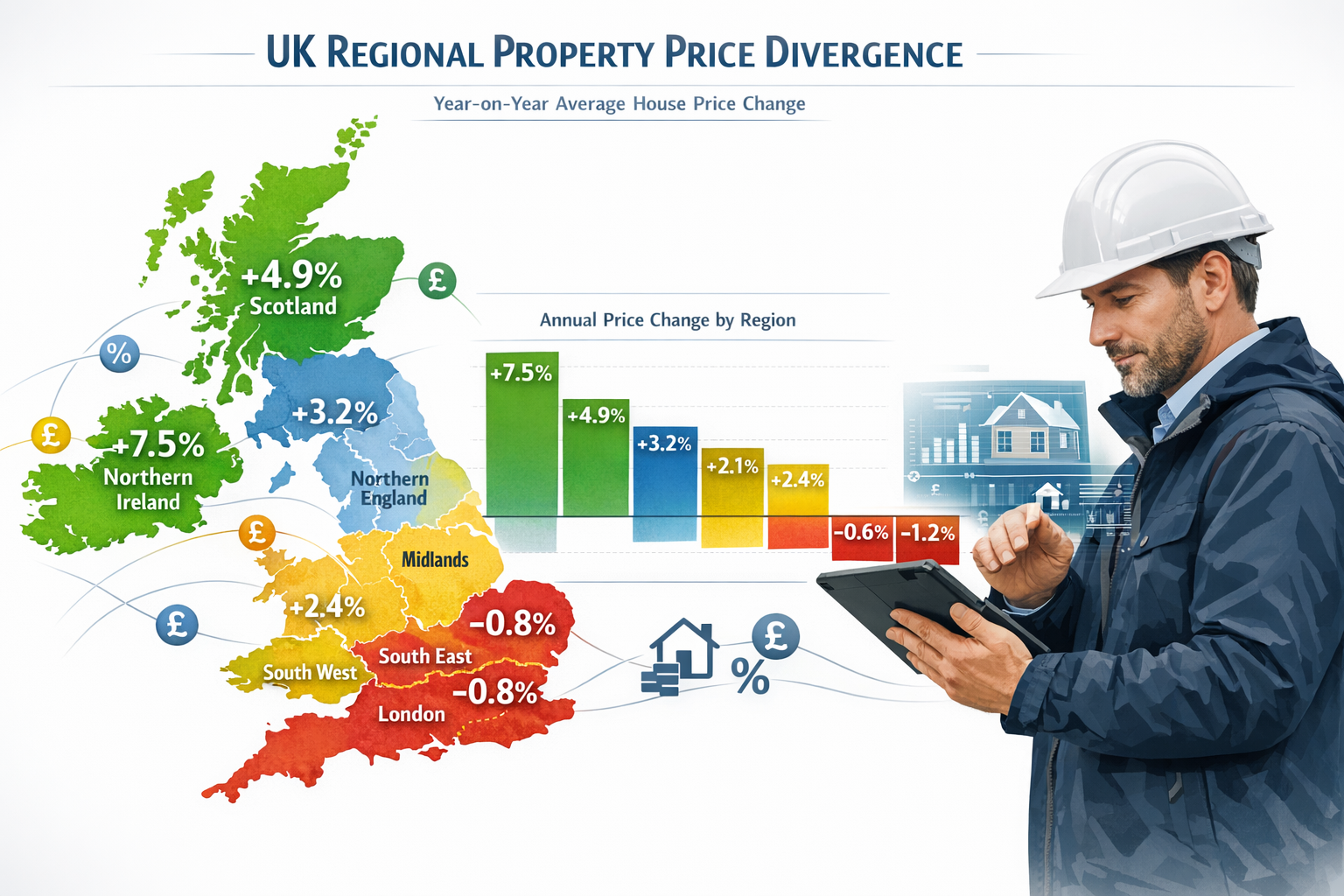
The UK property market in 2026 presents a fascinating paradox: while headlines speak of national recovery, the reality beneath reveals a stark regional divide that challenges traditional valuation approaches. Scotland's property prices surged 4.9% year-on-year, Northern Ireland posted an impressive 7.5% growth, yet London and southern markets languish with minimal gains or outright declines[1][4]. For property surveyors, this divergence demands more than standard methodologies—it requires region-specific valuation strategies that account for dramatically different affordability dynamics, buyer psychology, and market momentum.
Understanding Valuation Accuracy in 2026's Regional Price Divergence: Surveyor Strategies for Scotland, Northern Ireland, and Southern Markets has become essential for professionals seeking to deliver credible, defensible valuations in an increasingly fragmented landscape. The days of applying uniform national assumptions are over; today's surveyors must master the nuances of each regional market to serve clients effectively.
Key Takeaways
- 📊 Scotland leads UK growth with 4.9% year-on-year price increases and 42% of RICS respondents reporting rising prices—the strongest reading in nearly a year
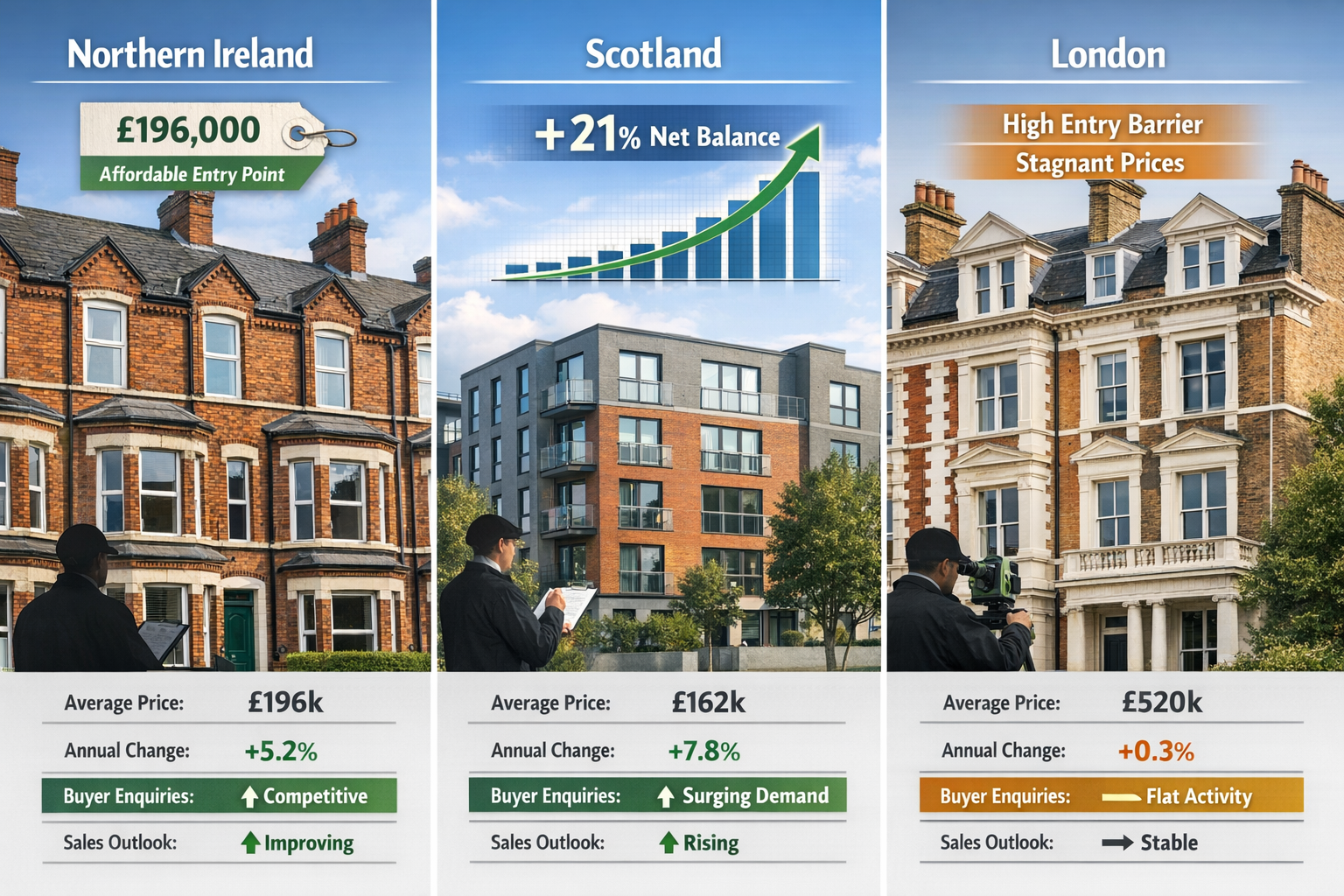
- 🏠 Northern Ireland outperforms all regions with 7.5% annual growth reaching £196,000, driven by competitive affordability and sustained buyer demand
- 📉 Southern England underperforms significantly, with London experiencing price falls while Prime Central London prices merely hold steady rather than appreciate
- 🔄 Regional arbitrage intensifies as eight of the top ten growth areas are located in northern or central England and Scotland, reflecting fundamental shifts in buyer priorities
- 🎯 Surveyor strategies must adapt with region-specific comparable selection, localized market sentiment analysis, and differentiated risk assessment frameworks
Understanding the 2026 Regional Price Divergence Landscape
The North-South Divide Reaches Historic Proportions
The regional price divergence characterizing 2026's UK property market represents more than cyclical variation—it reflects fundamental structural shifts in how buyers value location, affordability, and lifestyle. RICS data from January 2026 reveals that Scotland recorded a net balance of 42% of respondents reporting rising prices over the previous three months, marking the strongest reading in nearly twelve months[1]. This performance stands in sharp contrast to London and the South East, where surveyors continue reporting price pressures and stagnant valuations[2][3].
Northern Ireland's 7.5% year-on-year growth to £196,000 positions it as the UK's strongest performing region[4]. Meanwhile, England's average price increase of just 1.7% to £292,000 masks enormous internal variation, with southern regions dragging down the national average[4]. Wales demonstrates resilience with 5% growth to £215,000, positioning itself between the outperforming northern markets and struggling southern regions[4].
This divergence creates valuation challenges unprecedented in recent memory. Surveyors working across multiple regions cannot rely on standardized approaches; instead, they must develop sophisticated frameworks that account for:
- Regional affordability thresholds and purchasing power parity
- Localized supply-demand dynamics
- Area-specific buyer sentiment and forward expectations
- Differential interest rate sensitivity across price bands
- Migration patterns and regional economic fundamentals
Macroeconomic Tailwinds Supporting Northern Valuations
The broader economic context of 2026 provides important backdrop for understanding regional performance. UK inflation fell to 3%, creating conditions for further interest rate cuts throughout the year[4]. This monetary easing disproportionately benefits regions where affordability remains competitive, as lower borrowing costs translate more directly into increased purchasing power for buyers in Scotland and Northern Ireland compared to already-stretched southern markets.
Survey data reveals that 65% of Real Estate 360 respondents express optimism about the housing industry over the next 12-36 months[4], yet this optimism concentrates in regions where valuations haven't reached affordability ceilings. The UK house price balance climbed to -10% in January 2026, representing the strongest position since mid-2025[1][3], but this aggregate figure obscures the reality that northern markets are experiencing genuine price appreciation while southern markets merely stabilize.
For surveyors conducting professional valuations, these macroeconomic factors must be weighted differently depending on regional context. Interest rate sensitivity varies dramatically between a £500,000 London flat and a £200,000 Northern Ireland terrace, requiring nuanced analysis of how monetary policy impacts local market dynamics.
Valuation Accuracy in 2026's Regional Price Divergence: Scottish Market Strategies
Capturing Scotland's Demand-Supply Renaissance
Scotland's property market in 2026 exhibits a rare and valuable characteristic: simultaneous growth in both buyer demand and seller supply. A net balance of 21% of Scottish survey respondents reported rising buyer enquiries in January 2026, signaling renewed purchaser interest[1]. Critically, this demand surge coincides with a net balance of 27% of respondents indicating increased instructions to sell[1], creating a healthy market dynamic that sustains transactional activity without stalling.
This dual expansion contrasts sharply with the UK-wide picture, where the new buyer enquiry net balance registered only -15% in January (improving from -21% in December and -29% in November)[3]. For surveyors valuing Scottish properties, this divergence carries profound implications:
Comparable Selection Must Reflect Accelerating Market Momentum
Traditional three-month comparable windows may undervalue properties in rapidly appreciating markets. Scottish surveyors should consider:
- Weighting recent transactions more heavily than standard practice
- Applying time adjustments that reflect the 4.9% annual growth trajectory[1]
- Incorporating pending sales data where available to capture current market clearing prices
- Adjusting for seasonal factors given Scotland's pronounced spring market surge
Forward-Looking Valuation Adjustments
With a net balance of 34% of Scottish surveyors anticipating higher sales volumes over the next three months[1], and 55% expecting higher prices over the coming year[1], valuation approaches must balance current market evidence with near-term momentum. This doesn't mean speculative valuations, but rather recognizing that market sentiment itself influences buyer behavior and willingness to pay.
Regional Micro-Market Differentiation Within Scotland
Scotland's overall strong performance masks significant internal variation. Edinburgh's established prestige market behaves differently from Glasgow's value-driven segments, while rural Highland properties attract different buyer profiles than Aberdeen's energy-sector-influenced market. Surveyors must develop micro-market expertise that recognizes:
- Urban regeneration zones experiencing above-average appreciation
- Commuter belt expansion driven by hybrid working patterns
- Tourism-dependent areas with seasonal valuation considerations
- Energy transition impacts on specific localities
When conducting building surveys in Scotland, surveyors should integrate market commentary that explains regional context, helping clients understand how local dynamics influence valuation conclusions. This transparency builds confidence in valuations that may appear aggressive compared to historical norms but accurately reflect current market realities.
Affordability Analysis as Valuation Foundation
Scotland's competitive affordability relative to southern markets underpins its strong performance[1]. Surveyors should quantify this advantage through:
| Metric | Scotland | London | Implication |
|---|---|---|---|
| Median Price | £185,000 | £535,000 | 2.9x affordability advantage |
| Price-to-Income Ratio | 4.2x | 12.5x | Sustainable borrowing capacity |
| First-Time Buyer Accessibility | High | Severely constrained | Broader buyer pool |
| Interest Rate Sensitivity | Moderate | Extreme | Resilience to rate changes |
This affordability foundation means Scottish valuations rest on fundamentally sounder footing than southern equivalents. Surveyors can express greater confidence in sustainable value appreciation when affordability metrics remain within historical norms, as they do across most Scottish markets.
Northern Ireland Valuation Techniques for Outperformance Markets
Contextualizing 7.5% Growth in Valuation Frameworks
Northern Ireland's position as the UK's strongest performing region with 7.5% year-on-year growth[4] creates both opportunities and challenges for surveyors. The £196,000 average price point represents exceptional value compared to mainland UK equivalents, yet this very affordability drives rapid appreciation that can quickly render comparables obsolete.
Valuation Accuracy in 2026's Regional Price Divergence: Surveyor Strategies for Scotland, Northern Ireland, and Southern Markets requires Northern Ireland specialists to adopt particularly rigorous approaches:
Compressed Comparable Timeframes
In markets appreciating 7.5% annually, six-month-old comparables may understate current values by nearly 4%. Northern Ireland surveyors should:
- Prioritize comparables from the most recent 60-90 days
- Apply explicit time adjustments for older comparables based on local price indices
- Weight pending sales and under-offer properties more heavily than typical practice
- Maintain detailed transaction databases enabling precise time-series analysis
Supply Constraint Recognition
Unlike Scotland's balanced supply-demand dynamic, Northern Ireland's growth occurs against a backdrop of constrained new supply. Surveyors must assess whether specific properties benefit from scarcity premiums in desirable locations where alternatives are limited. This requires:
- Detailed inventory analysis of competing properties
- Days-on-market trending for comparable properties
- Multiple offer incidence tracking
- New construction pipeline assessment
Cross-Border Comparison Complications
Northern Ireland's unique position creates valuation complexities absent in other UK regions. Proximity to the Republic of Ireland, currency considerations, and distinct regulatory frameworks all influence buyer decision-making. Surveyors must address:
Currency Arbitrage Effects
Euro-sterling exchange rate fluctuations influence buyer purchasing power, particularly in border regions. Valuations should acknowledge this dynamic without over-weighting short-term currency movements.
Regulatory Divergence
Northern Ireland's planning system, building regulations, and property law differ from the rest of the UK. These distinctions can create value differentials that surveyors must understand and explain, particularly when clients compare Northern Ireland properties to mainland equivalents.
Migration Pattern Impacts
Return migration from Great Britain, particularly among professionals priced out of southern markets, creates demand dynamics that traditional demographic analysis may miss. Understanding these buyer motivation shifts informs realistic assessment of sustainable demand.
Balancing Growth Evidence with Prudent Valuation
The temptation in rapidly appreciating markets is to extrapolate recent growth indefinitely. Professional surveyors must resist this impulse while still acknowledging genuine market strength. Strategies include:
- Scenario analysis presenting base, optimistic, and conservative valuation ranges
- Sensitivity testing showing how valuations respond to interest rate changes or supply increases
- Comparable bracketing using both recent high-value transactions and more conservative older sales
- Explicit assumption documentation making transparent the market conditions underpinning valuations
When preparing commercial valuations in Northern Ireland, these principles apply with even greater force, as commercial property cycles can amplify residential trends or diverge based on sector-specific factors.
Southern Market Valuation Strategies Amid Underperformance

Navigating London and South East Stagnation
The stark reality of southern England's property markets in 2026 is underperformance relative to national trends. London experiences reported price falls while Prime Central London prices merely hold steady rather than appreciate[2][3]. The South East, South West, and East Anglia all lag behind the national average, creating valuation challenges distinct from those facing northern counterparts.
For surveyors operating in these markets, Valuation Accuracy in 2026's Regional Price Divergence: Surveyor Strategies for Scotland, Northern Ireland, and Southern Markets demands recognition that traditional valuation approaches may overstate current market realities. Key considerations include:
Downward Price Pressure Recognition
Unlike northern markets where the challenge is capturing appreciation, southern surveyors must accurately reflect price softening without creating undue alarm. This requires:
- Careful comparable selection emphasizing recent actual sales over asking prices
- Adjustment for properties that sold below asking, indicating buyer leverage
- Recognition of extended marketing periods as evidence of price resistance
- Incorporation of price reduction data from average price reduction after survey analysis
Affordability Ceiling Analysis
Southern markets have reached or exceeded affordability limits for many buyer segments. Valuations must acknowledge that further appreciation requires income growth or interest rate falls rather than simply continuing historical trends. Surveyors should:
- Calculate price-to-income ratios and compare to historical sustainability thresholds
- Assess mortgage affordability at current interest rates for target buyer profiles
- Identify price points where demand demonstrably weakens
- Recognize that properties priced beyond affordability ceilings face extended marketing periods
Micro-Market Identification in Underperforming Regions
Even within struggling southern markets, pockets of strength exist. Surveyors who can identify and validate these micro-market exceptions provide exceptional value to clients. Areas showing relative resilience include:
- Transport infrastructure beneficiaries where new rail links or improved commuter access expand buyer pools
- School catchment premiums that persist even when broader markets soften
- Regeneration zones where public investment creates genuine value enhancement
- Lifestyle amenity clusters offering compelling value propositions that transcend pure financial calculations
When conducting valuations in these micro-markets, surveyors must substantiate premium pricing with robust comparable evidence and clear explanation of the factors driving local outperformance. Clients and lenders increasingly scrutinize valuations that deviate significantly from broader market trends, requiring thorough documentation.
Professionals working across South West London, North West London, South East London, and North London encounter dramatically different micro-market dynamics despite geographic proximity, reinforcing the need for granular local expertise.
Valuation Defensibility in Challenging Markets
Southern market valuations face heightened scrutiny from lenders, buyers, and sellers alike. Establishing defensible valuation conclusions requires:
Comprehensive Comparable Analysis
- Minimum five comparable transactions within 0.5 miles and three months
- Explicit adjustment matrices documenting size, condition, location, and timing differences
- Explanation of why specific comparables were selected or rejected
- Market evidence supporting adjustment percentages applied
Market Context Commentary
- Clear explanation of regional underperformance relative to national trends
- Discussion of factors constraining local appreciation (affordability, economic headwinds, supply levels)
- Forward-looking assessment based on surveyor sentiment and leading indicators
- Acknowledgment of uncertainty and potential valuation ranges
Risk Factor Disclosure
Professional valuations should identify factors that could cause values to decline further:
- Interest rate sensitivity given high absolute price levels
- Economic recession impacts on high-value discretionary purchases
- Supply increases from new development pipelines
- Demographic shifts reducing buyer pool size
This transparency doesn't undermine valuation credibility—it enhances it by demonstrating thorough analysis and professional judgment. Clients appreciate candor about market challenges, particularly when considering whether to negotiate house price down after survey.
Cross-Regional Valuation Methodology Adaptations
Tailoring RICS Red Book Compliance to Regional Realities
The RICS Valuation – Global Standards (Red Book) provides the professional framework for all UK valuations, yet its application must flex to accommodate regional divergence. Surveyors working across multiple regions should develop systematic approaches that maintain Red Book compliance while recognizing distinct market characteristics.
Comparable Evidence Weighting Adjustments
| Region | Recent Transaction Weight | Time Adjustment Factor | Supply-Demand Consideration |
|---|---|---|---|
| Scotland | 70% (last 90 days) | +0.4% monthly | Balanced market, moderate adjustments |
| Northern Ireland | 75% (last 60 days) | +0.6% monthly | Supply-constrained, aggressive adjustments |
| Southern England | 60% (last 120 days) | -0.1% monthly | Oversupplied segments, conservative approach |
These differential approaches reflect the reality that market velocity varies dramatically across regions. A three-month comparable in Northern Ireland may be significantly less relevant than a six-month comparable in stagnant southern markets.
Regional Risk Assessment Frameworks
Valuation Accuracy in 2026's Regional Price Divergence: Surveyor Strategies for Scotland, Northern Ireland, and Southern Markets requires explicit recognition that risk profiles differ fundamentally across regions. Surveyors should incorporate regional risk factors into valuation commentary:
Northern Market Risks (Scotland, Northern Ireland)
- Rapid appreciation sustainability concerns
- Potential supply response to price signals
- Economic concentration in specific sectors
- Limited high-value market depth
Southern Market Risks (London, South East)
- Affordability constraint binding
- Interest rate sensitivity at high price points
- Economic uncertainty impacts on discretionary purchases
- Oversupply in specific segments (new-build flats)
Universal Risks Requiring Regional Calibration
- Climate change and flood risk (coastal property exposure)
- Building safety and cladding issues (high-rise concentration)
- Leasehold reform impacts (regional tenure mix variations)
- Planning policy changes (green belt, development restrictions)
Technology-Enhanced Regional Valuation Approaches
Modern surveying practice increasingly leverages technology to enhance valuation accuracy across diverse regional markets. Tools and approaches include:
Automated Valuation Models (AVMs) as Cross-Checks
While AVMs cannot replace professional judgment, they provide useful sanity checks for valuations, particularly when working across unfamiliar regions. Surveyors should:
- Run AVM estimates for subject properties and comparables
- Investigate significant variances between professional valuations and AVM outputs
- Use AVM confidence scores to assess data quality and market transparency
- Recognize AVM limitations in rapidly changing markets (both appreciating and declining)
Geographic Information Systems (GIS) for Micro-Market Analysis
GIS tools enable sophisticated analysis of location-specific value drivers:
- Transport accessibility mapping and commute time analysis
- School catchment boundary overlays and performance correlation
- Amenity proximity scoring (parks, retail, leisure facilities)
- Environmental risk mapping (flooding, contamination, noise)
Transaction Database Maintenance
Surveyors operating across multiple regions should maintain proprietary transaction databases that capture:
- Actual sale prices and transaction dates
- Days on market and price reduction history
- Property characteristics and condition notes
- Buyer profiles and financing arrangements
- Post-transaction feedback and resale data
This investment in data infrastructure pays dividends through enhanced comparable analysis and market intelligence that generic databases cannot provide. When assessing land value, regional transaction histories become particularly valuable for identifying development potential and site-specific premiums.
Forward-Looking Valuation Considerations for 2026 and Beyond
Incorporating Market Sentiment and Future Expectations
Professional valuations reflect current market conditions, yet buyer and seller behavior responds to expectations about the future. The challenge for surveyors is incorporating forward-looking market sentiment without speculating beyond available evidence.
RICS survey data provides valuable insight into professional sentiment across regions:
- Scotland: 55% of surveyors expect higher prices over the coming year, with 23% anticipating rises over the next three months[1]
- Northern Ireland: Positioned alongside Scotland as expecting strongest price growth trends[3]
- UK Overall: Consensus forecasts predict 2% to 4% growth for 2026, with Savills forecasting 2% and Knight Frank approximately 3%[2][6]
Surveyors should reference these forward expectations in valuation commentary, explaining how current pricing reflects or deviates from anticipated trends. This contextualizes valuations within the broader market narrative without compromising professional objectivity.
Interest Rate Scenario Planning
With UK inflation at 3% and further interest rate cuts anticipated throughout 2026[4], monetary policy remains a critical valuation variable. Surveyors should consider how different interest rate scenarios impact regional markets:
Rate Cut Scenario (Base Case)
- Northern markets benefit through enhanced affordability and buyer confidence
- Southern markets experience modest relief but remain affordability-constrained
- Transaction volumes increase across all regions
- Valuation confidence strengthens as market uncertainty reduces
Rate Hold Scenario
- Northern appreciation moderates but continues
- Southern markets remain stagnant or decline modestly
- Buyer-seller expectation gaps widen
- Valuation ranges expand to reflect increased uncertainty
Rate Increase Scenario (Tail Risk)
- Northern markets experience sharp correction from recent highs
- Southern markets face severe pressure with potential significant declines
- Transaction volumes collapse
- Valuation accuracy becomes extremely challenging
While surveyors cannot predict monetary policy, acknowledging these scenarios demonstrates sophisticated risk awareness and helps clients understand the assumptions underpinning valuations.
Sustainability and Energy Efficiency Valuation Impacts
The 2026 property market increasingly prices energy efficiency and sustainability features, yet this premium varies significantly by region. Surveyors must calibrate green premium assessments to local market realities:
Northern Markets
- Energy efficiency valued primarily through running cost savings
- EPC ratings influence marketability more than premium pricing
- Renewable energy installations (solar, heat pumps) recovering 50-70% of installation costs
- Sustainability features becoming differentiators in competitive markets
Southern Markets
- Affluent buyer segments paying meaningful premiums for sustainability credentials
- EPC ratings increasingly influencing mortgage availability and terms
- Period property retrofitting creating complex valuation scenarios
- Green features mitigating value decline in otherwise challenged markets
When conducting valuations, surveyors should explicitly address energy efficiency and document how EPC ratings and sustainability features influenced comparable selection and adjustment. This transparency becomes increasingly important as regulatory requirements tighten and buyer preferences evolve.
Understanding capital gains implications of energy efficiency improvements helps clients make informed investment decisions about property enhancement.
Professional Development and Regional Expertise Building
Continuous Learning in Fragmented Markets
The regional divergence characterizing 2026's property market demands that surveyors commit to continuous professional development focused on regional specialization. Strategies for building and maintaining expertise include:
Regional Market Immersion
- Regular attendance at local property auctions
- Relationship building with regional estate agents and developers
- Participation in regional RICS branches and professional networks
- Site visits and property inspections beyond formal instruction
Data-Driven Market Intelligence
- Subscription to regional property indices and market reports
- Analysis of Land Registry data for granular transaction insights
- Monitoring of regional economic indicators and employment trends
- Tracking of planning applications and development pipelines
Peer Collaboration and Knowledge Sharing
- Case study discussions with colleagues specializing in different regions
- Participation in valuation review panels examining cross-regional instructions
- Contribution to professional publications documenting regional practices
- Mentoring relationships connecting surveyors across geographic areas
Specialization Versus Generalization Trade-offs
Surveyors face strategic decisions about whether to specialize deeply in specific regions or maintain broader geographic coverage. Each approach offers distinct advantages:
Regional Specialization Benefits
- ✅ Deep micro-market knowledge and relationship networks
- ✅ Enhanced credibility with local clients and referral sources
- ✅ Efficiency through focused comparable databases and market intelligence
- ✅ Ability to command premium fees for specialized expertise
Multi-Regional Generalization Benefits
- ✅ Diversified revenue streams across varying market cycles
- ✅ Ability to serve clients with multi-regional portfolios
- ✅ Broader market perspective informing individual valuations
- ✅ Reduced vulnerability to regional economic downturns
Many successful surveying practices adopt hybrid models, developing core regional expertise while maintaining capacity to serve clients across broader geographies through collaboration and referral networks.
Quality Assurance in Regional Valuation Practice
Maintaining Valuation Accuracy in 2026's Regional Price Divergence: Surveyor Strategies for Scotland, Northern Ireland, and Southern Markets requires robust quality assurance processes:
Internal Review Protocols
- Peer review of valuations outside surveyor's primary region
- Standardized checklists ensuring regional factors are addressed
- Regular calibration exercises comparing valuations to subsequent sale prices
- Documentation standards requiring explicit regional context explanation
External Validation Mechanisms
- Engagement with regional valuation panels for complex instructions
- Participation in RICS quality assurance schemes
- Client feedback systems capturing satisfaction and accuracy perceptions
- Professional indemnity insurer consultation on high-value or unusual instructions
Continuous Improvement Cycles
- Post-transaction analysis comparing valuations to actual outcomes
- Root cause analysis of significant valuation variances
- Integration of lessons learned into methodology refinement
- Regular methodology review and update to reflect market evolution
These quality assurance investments protect both clients and surveyors, ensuring that valuations remain credible, defensible, and accurate across diverse regional contexts.
Practical Implementation Guide for Surveyors
Regional Valuation Checklist
Surveyors can enhance consistency and accuracy by adopting systematic regional valuation checklists:
Pre-Inspection Regional Research
- Review latest regional RICS survey data and sentiment indicators
- Analyze recent comparable transactions (last 60-120 days depending on region)
- Assess regional price trends and momentum (appreciating/stable/declining)
- Identify relevant micro-market factors (transport, schools, regeneration)
- Determine appropriate comparable timeframe and weighting approach
During Inspection Regional Considerations
- Document property features particularly valued in regional market
- Assess condition relative to regional stock characteristics
- Note location factors influencing regional premium/discount
- Identify energy efficiency features and regional green premium potential
- Photograph elements supporting regional comparable adjustments
Post-Inspection Regional Analysis
- Select comparables reflecting regional market dynamics
- Apply region-appropriate time adjustments and weighting
- Calculate and justify regional-specific comparable adjustments
- Assess valuation against regional affordability metrics
- Prepare market commentary explaining regional context
Regional Valuation Report Elements
- Executive summary highlighting regional market position
- Regional market overview with RICS survey data and trends
- Comparable analysis with explicit regional adjustment justification
- Forward-looking commentary incorporating regional sentiment
- Risk factor disclosure addressing region-specific concerns
Case Study Applications
Case Study 1: Edinburgh New Town Flat
Property: Two-bedroom Georgian flat, £425,000 asking price
Regional Context: Scotland's 4.9% growth and strong buyer demand[1]
Valuation Approach:
- Prioritized comparables from last 60 days given market momentum
- Applied +0.4% monthly time adjustment to older comparables
- Weighted recent sales at 70% versus 30% for 3-6 month comparables
- Incorporated RICS sentiment data showing 55% expecting higher prices
- Concluded valuation at £420,000 (1.2% below asking) reflecting strong but not overheated market
Key Learning: Even in appreciating markets, rigorous comparable analysis prevents over-valuation while acknowledging genuine strength.
Case Study 2: Belfast Suburban Semi-Detached
Property: Three-bedroom 1930s semi, £215,000 asking price
Regional Context: Northern Ireland's 7.5% growth and supply constraints[4]
Valuation Approach:
- Identified only three comparables within 90 days due to limited supply
- Expanded geographic search radius to capture sufficient evidence
- Applied +0.6% monthly time adjustment reflecting rapid appreciation
- Documented supply constraint premium through days-on-market analysis
- Concluded valuation at £218,000 (1.4% above asking) reflecting competitive market
Key Learning: Supply-constrained markets may justify valuations above asking when supported by robust market evidence and transparent methodology.
Case Study 3: South East London Victorian Terrace
Property: Four-bedroom Victorian terrace, £875,000 asking price
Regional Context: London price falls and southern underperformance[2][3]
Valuation Approach:
- Extended comparable timeframe to 120 days to capture sufficient evidence
- Weighted older comparables equally with recent sales given stable/declining market
- Applied -0.1% monthly time adjustment reflecting modest price softening
- Documented extended marketing periods for properties above £800,000
- Concluded valuation at £835,000 (4.6% below asking) reflecting buyer leverage
Key Learning: Underperforming markets require conservative approaches and clear documentation of downward price pressure to protect clients and maintain professional credibility.
Conclusion: Mastering Regional Valuation Excellence in 2026
The unprecedented regional divergence characterizing the UK property market in 2026 fundamentally transforms surveying practice. Valuation Accuracy in 2026's Regional Price Divergence: Surveyor Strategies for Scotland, Northern Ireland, and Southern Markets is not merely a technical challenge—it represents a professional imperative for surveyors committed to delivering credible, defensible valuations that serve client interests and maintain market confidence.
Scotland's 4.9% growth and Northern Ireland's 7.5% appreciation stand in stark contrast to southern England's stagnation, creating valuation contexts so different they might as well represent separate national markets[1][4]. Surveyors who recognize this reality and adapt their methodologies accordingly will thrive; those who cling to outdated uniform approaches risk delivering valuations that mislead clients and undermine professional credibility.
Key Success Factors for Regional Valuation Excellence
🎯 Regional Specialization: Develop deep expertise in specific markets while maintaining awareness of broader national trends
📊 Data-Driven Methodology: Leverage comprehensive transaction databases, RICS survey data, and regional indices to inform comparable selection and adjustments
🔄 Adaptive Frameworks: Tailor comparable timeframes, weighting approaches, and time adjustments to regional market velocity
💡 Transparent Communication: Provide clients with clear explanations of regional context, methodology choices, and risk factors
🛡️ Quality Assurance: Implement robust review processes ensuring regional factors receive appropriate consideration
Actionable Next Steps for Surveyors
-
Audit Current Regional Capabilities: Assess your firm's regional expertise distribution and identify knowledge gaps requiring development investment
-
Enhance Regional Data Infrastructure: Build or acquire comprehensive transaction databases covering your primary operating regions, ensuring data quality and currency
-
Develop Regional Methodology Protocols: Document region-specific valuation approaches, including comparable selection criteria, adjustment frameworks, and risk assessment protocols
-
Invest in Continuous Learning: Commit to regular regional market immersion through site visits, networking, and professional development activities
-
Strengthen Quality Assurance: Implement peer review processes for cross-regional valuations and establish calibration mechanisms validating accuracy
-
Communicate Regional Expertise: Market your regional specialization to clients and referral sources, positioning your practice as the go-to resource for specific markets
The regional price divergence of 2026 creates both challenges and opportunities. Surveyors who embrace regional specialization, invest in data and methodology development, and commit to continuous learning will find themselves ideally positioned to serve clients navigating this fragmented landscape. Those who adapt will not only survive but thrive in an environment where regional expertise commands premium value.
The future of surveying practice lies in sophisticated regional differentiation—understanding not just properties, but the distinct market ecosystems in which they exist. By mastering Valuation Accuracy in 2026's Regional Price Divergence: Surveyor Strategies for Scotland, Northern Ireland, and Southern Markets, surveyors elevate their professional practice while delivering the accurate, credible valuations that clients, lenders, and markets demand.
References
[1] Scottish Housing Market 2026 Rics Survey – https://www.simpsonmarwick.com/journal/scottish-housing-market-2026-rics-survey
[2] The 2026 Uk Property Market Outlook – https://nedbankprivatewealth.com/insights/the-2026-uk-property-market-outlook/
[3] Uk Resi Survey Jan 2026 Report Shows Early Signs Market Recovery Despite Caution – https://www.rics.org/news-insights/uk-resi-survey-jan-2026-report-shows-early-signs-market-recovery-despite-caution
[4] Industry Reacts To Latest House Price Data 2 – https://bebeez.eu/2026/02/19/industry-reacts-to-latest-house-price-data-2/
[5] Valuing Northern England Properties In 2026 Surveyor Tactics For Outpacing Southern Affordability Pressures – https://nottinghillsurveyors.com/blog/valuing-northern-england-properties-in-2026-surveyor-tactics-for-outpacing-southern-affordability-pressures
[6] Hpi Review Outlook 2026 – https://www.nationwide-intermediary.co.uk/news/hpi-review-outlook-2026