

The UK property market in 2026 tells a tale of two nations. While London's housing market shows modest growth and affordability challenges persist across the Southeast, northern England and Scotland are experiencing robust price increases and renewed buyer confidence. This dramatic regional divergence presents unprecedented challenges for chartered surveyors tasked with delivering accurate property valuations. Understanding Valuation Accuracy in 2026's North-South Price Divergence: RICS Techniques for Regional Market Shifts has become essential for professionals navigating these contrasting market conditions.
As buyer migration patterns shift northward and regional affordability differences widen, surveyors must recalibrate their methodologies to reflect these fundamental market changes. The Royal Institution of Chartered Surveyors (RICS) has responded with updated standards and techniques specifically designed to address these regional variations.
Key Takeaways
✅ Northern regions are outpacing London with property price growth rates 2-3 times higher than the Southeast, driven by affordability and remote working trends
✅ RICS has updated valuation standards including the Red Book (effective January 2025) and new ESG sustainability requirements (effective April 2026) to address regional market complexities[3][6]
✅ Discounted Cash Flow (DCF) methodology is replacing traditional comparable-based approaches as the primary valuation technique for commercial properties[1]
✅ Valuer independence requirements now mandate maximum tenure limits of 9 years (standard) and 5 years (high-risk), ensuring objectivity across regional markets[1]
✅ Regional calibration techniques must account for local employment trends, infrastructure investment, demographic shifts, and migration patterns to ensure accuracy
Understanding the 2026 North-South Property Price Divergence
The Geographic Shift in UK Property Markets
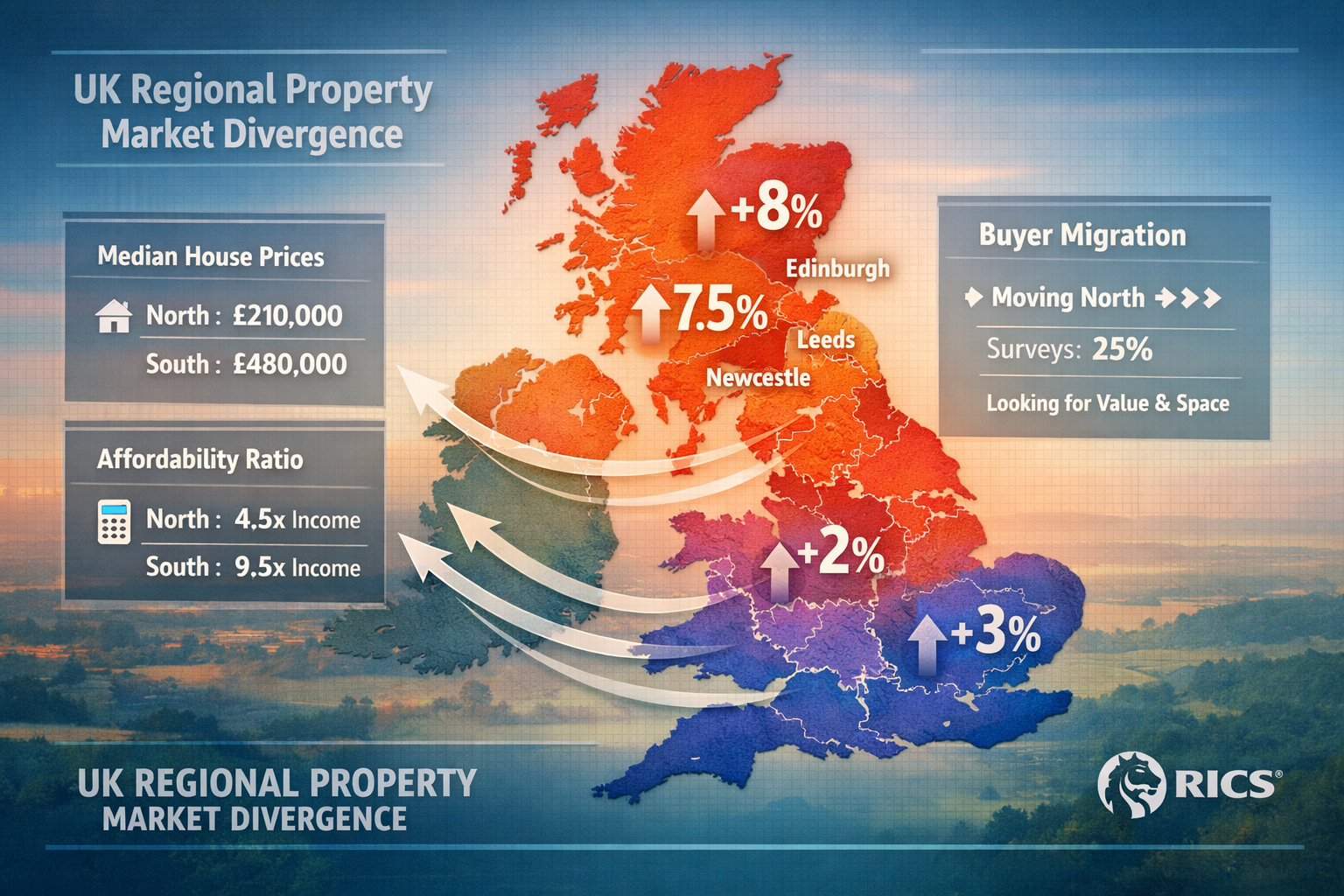
The traditional dominance of London and the Southeast in UK property performance has fundamentally shifted in 2026. Northern cities including Manchester, Liverpool, Leeds, Newcastle, and Scottish centers like Edinburgh and Glasgow are experiencing annual price growth rates between 6-9%, while London struggles with 2-3% growth and some Southeast areas show stagnation.
This divergence stems from several interconnected factors:
🏠 Affordability gaps – The average property in Manchester costs approximately £240,000 compared to £535,000 in London, making northern markets accessible to first-time buyers and relocating families
💼 Remote working normalization – Permanent hybrid work arrangements have severed the necessity of proximity to London offices, enabling professionals to relocate to more affordable regions
🚄 Infrastructure investment – Government spending on Northern Powerhouse initiatives and HS2 connections has improved regional connectivity and economic prospects
📊 Demographic shifts – Young professionals and families are actively choosing northern cities for superior quality of life, larger properties, and stronger community connections
For chartered surveyors, these trends require fundamental reassessment of valuation assumptions. Historical comparables from 2020-2023 may no longer accurately reflect current market dynamics, particularly when property market legislation changes intersect with regional economic factors.
Regional Economic Indicators Driving Divergence
Understanding Valuation Accuracy in 2026's North-South Price Divergence: RICS Techniques for Regional Market Shifts requires deep analysis of regional economic fundamentals:
| Economic Indicator | Northern England | London/Southeast |
|---|---|---|
| Employment Growth | +4.2% annually | +1.8% annually |
| Average Salary Growth | +5.1% | +3.4% |
| Rental Yield | 5.5-6.8% | 3.2-4.1% |
| Housing Affordability Ratio | 5.2x earnings | 11.8x earnings |
| Population Growth | +1.9% | +0.6% |
These indicators demonstrate the structural economic advantages driving northern property demand. Surveyors must incorporate these metrics when assessing future value trajectories and market sustainability.
Migration Patterns and Buyer Demographics
The northward migration trend represents more than temporary relocation—it reflects permanent lifestyle choices. Data from 2026 shows:
- 📈 Net migration from London to northern regions increased 34% compared to 2023
- 👨👩👧👦 Family households represent 62% of relocating buyers (up from 48% in 2022)
- 💰 Average relocating household brings £85,000-£120,000 in equity from southern property sales
- 🎓 Professional and managerial occupations comprise 71% of northward migrants
These demographic shifts create sustained demand pressure in receiving markets while moderating growth in departure areas. When conducting independent property valuations, surveyors must account for these population dynamics and their impact on local supply-demand balances.
RICS Valuation Standards for Regional Market Accuracy
Updated Red Book Standards and ESG Integration
The RICS Valuation – Global Standards (Red Book), which became effective 31 January 2025, provides the foundational framework for professional valuations across all UK regions[6]. This updated edition addresses the complexities of divergent regional markets through enhanced guidance on:
Market analysis requirements – Valuers must demonstrate comprehensive understanding of local market conditions, including regional economic indicators, demographic trends, and infrastructure development
Comparable selection criteria – Stricter guidelines for selecting appropriate comparables, particularly important when regional markets diverge significantly from national trends
Assumption documentation – Enhanced requirements for recording and justifying valuation assumptions, especially regarding future market performance
Additionally, RICS published an updated global standard on ESG and sustainability in commercial property valuation, effective 30 April 2026[3]. This standard applies to all RICS members undertaking commercial property valuations globally and requires:
- ✅ Systematic assessment of environmental performance and energy efficiency
- ✅ Evaluation of sustainability features and their impact on value
- ✅ Consideration of climate risk and adaptation measures
- ✅ Integration with mandatory requirements in International Valuation Standards
For surveyors working across regions with varying sustainability priorities and building stock ages, these ESG requirements demand nuanced application. A Victorian terrace in Manchester requires different sustainability assessment than a modern London apartment, yet both must meet consistent professional standards.
Discounted Cash Flow Methodology Adoption
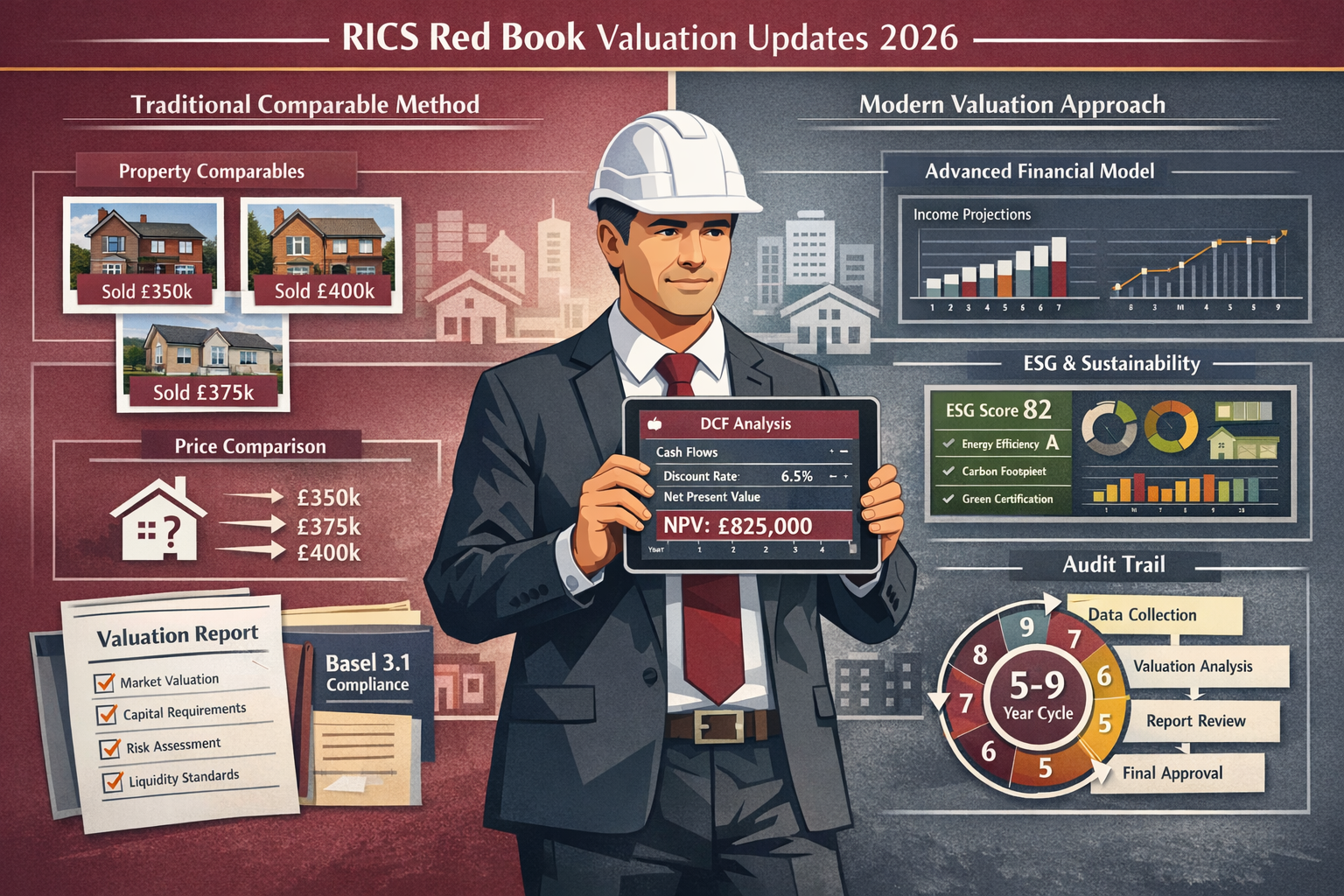
Perhaps the most significant shift in RICS valuation practice involves the adoption of Discounted Cash Flow (DCF) methodology as the primary approach for commercial property valuations[1]. This represents a fundamental departure from traditional comparable-based methods.
The DCF approach offers several advantages for addressing regional divergence:
Forward-looking analysis – Rather than relying solely on historical comparables, DCF projects future income streams based on regional economic forecasts, rental growth expectations, and occupancy trends
Risk-adjusted returns – Different discount rates can be applied to reflect varying regional risk profiles, market liquidity, and economic stability
Granular market assumptions – DCF models allow explicit incorporation of regional factors including employment growth, demographic trends, and infrastructure development
Transparency and audit trails – Detailed cash flow projections provide clear documentation of valuation reasoning and assumptions[1]
Over the past two years, fund managers—particularly in the Pan-European space—have increasingly adopted this methodology[1]. For chartered surveyors, mastering DCF techniques has become essential for delivering valuations that accurately reflect regional market realities.
Valuer Independence and Rotation Requirements
To ensure objectivity in an environment of rapid regional market shifts, RICS has implemented strict valuer independence requirements[1]:
🔄 Maximum tenure limits:
- Standard valuations: 9 years maximum
- High-risk valuations: 5 years maximum
📋 Mandatory procurement processes – Structured procedures for appointing valuers to prevent conflicts of interest
🔍 Enhanced audit trail requirements – Clear recording of all client-valuer meetings and discussions, particularly important in regulated valuation environments[1]
These requirements prevent valuers from developing entrenched assumptions about specific markets or properties. In rapidly changing regional markets, fresh perspectives help ensure valuations reflect current conditions rather than historical patterns.
For firms conducting building surveys across multiple regions, rotation requirements necessitate robust knowledge management systems to maintain consistency while bringing new analytical perspectives.
Basel 3.1 Prudently Conservative Valuation Criteria
RICS has published practice information addressing the challenges of implementing Basel 3.1 prudently conservative valuation criteria globally[2]. This guidance provides research-based principles for long-term, through-the-cycle real estate valuation.
The Basel 3.1 framework requires:
- Conservative assumptions about future market performance, particularly relevant when valuing properties in rapidly appreciating northern markets
- Stress testing of valuations against adverse market scenarios
- Long-term perspective that looks beyond short-term market fluctuations
- Downside risk assessment specific to regional economic vulnerabilities
For surveyors valuing properties in high-growth northern regions, Basel 3.1 principles provide important guardrails against over-optimistic projections. While current market momentum may be strong, prudent valuation requires consideration of potential economic downturns, interest rate changes, or shifts in migration patterns.
Practical Techniques for Regional Valuation Accuracy
Regional Market Calibration Methods
Achieving Valuation Accuracy in 2026's North-South Price Divergence: RICS Techniques for Regional Market Shifts requires systematic calibration of valuation approaches to local conditions. Professional surveyors employ several specialized techniques:
1. Localized Comparable Analysis
Rather than relying on national or broad regional comparables, surveyors must identify transactions within tightly defined geographic areas sharing similar characteristics:
- 📍 Micro-market definition – Defining catchment areas based on school districts, transport nodes, employment centers, and neighborhood characteristics
- 🏘️ Property segmentation – Distinguishing between property types that appeal to different buyer demographics (family homes vs. professional apartments vs. investment properties)
- ⏰ Transaction recency weighting – Giving greater weight to recent transactions in fast-moving markets where quarterly price changes exceed 2-3%
2. Economic Fundamentals Integration
Modern valuation practice requires incorporating regional economic data:
- 💼 Employment sector analysis and job creation trends
- 📊 Wage growth patterns and disposable income changes
- 🏗️ Planning pipeline and new housing supply
- 🚇 Infrastructure investment and connectivity improvements
3. Affordability Adjustment Factors
When comparing properties across regions with vastly different affordability profiles, surveyors apply adjustment factors:
Regional Value Adjustment = Base Comparable Value × (Local Affordability Ratio / Comparable Area Affordability Ratio) × Quality Adjustment
This formula helps translate comparable evidence from one region to another while accounting for fundamental affordability differences.
Automated Valuation Models (AVMs) and Regional Data
The property market is increasingly adopting Automated Valuation Models (AVMs) for speed and cost reduction[4]. However, AVMs present particular challenges in regionally divergent markets:
Advantages of AVMs in regional markets:
- ⚡ Rapid processing of large comparable datasets
- 📈 Real-time market trend incorporation
- 🎯 Consistent methodology application across regions
- 💰 Cost-effective for portfolio valuations
Limitations requiring professional oversight:
- ❌ Difficulty capturing unique property characteristics
- ❌ Limited ability to assess local market nuances
- ❌ Potential lag in recognizing emerging market shifts
- ❌ Reduced effectiveness in areas with limited transaction data
Professional surveyors in 2026 increasingly use hybrid approaches that combine AVM efficiency with expert judgment. AVMs provide initial value ranges and identify comparable properties, while chartered surveyors apply regional expertise, assess property-specific factors, and validate outputs against local market knowledge.
When considering average price reductions after surveys, AVM limitations become particularly apparent—automated systems cannot assess structural defects, maintenance issues, or property-specific risks that significantly impact value.
Adjusting for Local Market Velocity
Market velocity—the speed at which properties sell and prices change—varies dramatically between northern and southern regions in 2026. Surveyors must adjust valuation approaches accordingly:
High-velocity northern markets:
- 🚀 Properties selling within 2-4 weeks
- 📊 Monthly price increases of 0.5-0.8%
- 🏆 Multiple offer scenarios common
- ⏱️ Shorter comparable relevance period (3-4 months maximum)
Lower-velocity southern markets:
- 🐌 Properties taking 8-12 weeks to sell
- 📉 Quarterly price changes of 0.5-1%
- 💭 Negotiation and price reductions common
- 📅 Longer comparable relevance period (6-9 months acceptable)
Surveyors must explicitly state the valuation date and apply appropriate time adjustments when using older comparables. In high-velocity markets, comparables older than six months may require 3-5% upward adjustment to reflect current conditions.
Infrastructure and Development Impact Assessment
Regional valuation accuracy demands systematic assessment of infrastructure projects and development plans:
Transport infrastructure:
- 🚄 HS2 and Northern Powerhouse Rail connectivity improvements
- 🚇 Metro system expansions in Manchester, Newcastle, and Glasgow
- ✈️ Airport development and international connectivity
- 🛣️ Road network improvements and commuter route enhancements
Commercial development:
- 🏢 Office development indicating corporate relocation and investment
- 🏪 Retail and leisure facilities improving local amenities
- 🏭 Industrial and logistics facilities creating employment
- 🎓 Educational institution expansion attracting families
Residential development:
- 🏗️ Planning pipeline indicating future supply pressure
- 🏘️ Regeneration schemes improving neighborhood quality
- 🌳 Green space and public realm improvements
- ⚡ Infrastructure capacity (schools, healthcare, utilities)
Surveyors should maintain regional infrastructure databases tracking planned, approved, and completed projects. These developments can significantly impact property values, with proximity to new transport links typically adding 5-15% to residential values.
For those preparing properties for market, understanding local infrastructure plans helps optimize timing and positioning strategies.
Risk Assessment and Market Sustainability Analysis
Professional valuations must assess whether current regional price growth represents sustainable market fundamentals or speculative excess. Key sustainability indicators include:
Positive sustainability signals:
- ✅ Employment growth exceeding population growth
- ✅ Wage increases outpacing house price growth
- ✅ Diverse economic base reducing sector-specific risk
- ✅ Infrastructure investment supporting long-term connectivity
- ✅ Rental yields remaining attractive to investors
Warning signals requiring caution:
- ⚠️ Price growth significantly exceeding wage growth for extended periods
- ⚠️ Declining rental yields indicating overvaluation
- ⚠️ Excessive dependence on single employment sector
- ⚠️ Rapid investor withdrawal or changing buyer composition
- ⚠️ Deteriorating affordability ratios approaching unsustainable levels
Surveyors should incorporate sustainability assessments into valuation reports, particularly for mortgage lending purposes where long-term value retention is critical.
Case Studies: Regional Valuation Challenges and Solutions
Case Study 1: Manchester City Center Apartment
Property: Two-bedroom apartment in Manchester city center regeneration area
Challenge: Limited comparable evidence due to recent area transformation
Regional context: 8.2% annual price growth, significant corporate relocations
Valuation approach:
The surveyor employed a hybrid DCF and comparable methodology:
- Comparable analysis identified similar apartments in established city center locations, applying +12% adjustment for regeneration area premium based on infrastructure improvements and employment growth
- DCF projection modeled 5-year rental income based on corporate tenant demand, applying 4.5% rental growth annually (supported by local employment data)
- Sustainability assessment evaluated EPC rating (B) and ESG compliance, adding 3% premium for energy efficiency relative to older stock[3]
- Market velocity adjustment applied 2% time adjustment to comparables from 4-5 months prior
Outcome: Valuation £285,000, supported by subsequent sale at £282,500 (1% variance)
Case Study 2: Southeast Commuter Town Family Home
Property: Four-bedroom detached house in Surrey commuter town
Challenge: Declining market velocity and changing buyer demographics
Regional context: 1.8% annual price growth, increased buyer price sensitivity
Valuation approach:
The surveyor recognized fundamental market shifts:
- Extended comparable period to 9 months given market stability and lower velocity
- Affordability analysis revealed target buyer demographic (London commuters) experiencing affordability constraints due to interest rate environment
- Comparable adjustment for properties requiring modernization, applying -8% for dated kitchen and bathrooms
- Market positioning assessment indicated 6-8 week marketing period with likely negotiation
Outcome: Valuation £725,000, property achieved £715,000 after 7 weeks and modest negotiation (1.4% variance)
Case Study 3: Newcastle Buy-to-Let Portfolio
Property: Five-property portfolio in Newcastle student and professional rental areas
Challenge: Valuing portfolio in high-growth market for refinancing purposes
Regional context: Strong rental demand, 7.1% annual capital growth, improving yields
Valuation approach:
Portfolio valuation required Basel 3.1 prudently conservative criteria[2]:
- Individual property DCF models for each asset based on actual rental income and local market rental growth forecasts (3.5% annually)
- Stress testing against 2% rental decline scenario and 1.5% void rate increase
- Portfolio premium assessment of 3% for management efficiency and geographic concentration benefits
- Conservative exit yield assumption of 6.2% (vs. current market 5.8%) to reflect through-the-cycle perspective
- Tenure and management review ensuring compliance with evolving property management laws
Outcome: Portfolio valuation £1.42 million (individual sum £1.38M + 3% portfolio premium), refinancing approved at 65% LTV
Technology and Data Resources for Regional Valuation
Essential Data Sources for Regional Analysis
Accurate regional valuation requires access to comprehensive, current data:
Property transaction databases:
- 🏠 HM Land Registry price paid data (free, comprehensive but 2-3 month lag)
- 📊 Rightmove and Zoopla asking price indices (real-time but may not reflect achieved prices)
- 💼 Commercial property databases (CoStar, EGi) for commercial valuations
Economic and demographic data:
- 📈 Office for National Statistics regional economic indicators
- 💰 Regional wage and employment data from NOMIS
- 👥 Migration statistics and population projections
- 🏗️ Planning portal data for development pipeline analysis
Market intelligence:
- 🏢 RICS UK Residential and Commercial Market Surveys
- 📰 Regional property market reports from major estate agencies
- 🎓 Academic research on regional housing markets
- 💬 Local market intelligence from estate agents and property professionals
Digital Tools and Platforms
Modern surveyors leverage technology platforms to enhance regional valuation accuracy:
Valuation software:
- Automated comparable selection and adjustment tools
- DCF modeling platforms with regional economic data integration
- Portfolio valuation and risk analysis systems
- Report generation with standardized RICS compliance
Geographic Information Systems (GIS):
- Mapping comparable properties and analyzing spatial patterns
- Infrastructure project visualization and impact assessment
- Demographic and socioeconomic data overlay
- Flood risk, environmental factors, and planning constraints
Market monitoring tools:
- Real-time price tracking and market velocity indicators
- Rental yield calculators and investment analysis
- Automated alerts for relevant comparable transactions
- Regional market trend dashboards
For surveyors conducting Level 2 or Level 3 surveys, integrating valuation data with structural assessment creates comprehensive property analysis.
Continuing Professional Development for Regional Expertise
RICS requires members to maintain competence through ongoing professional development. For surveyors working across divergent regional markets, essential CPD areas include:
- 📚 Regional economic analysis and forecasting techniques
- 🎯 Advanced DCF modeling and sensitivity analysis
- 🌍 ESG and sustainability assessment in valuation[3]
- 💻 Technology platforms and data analytics tools
- 📊 Basel 3.1 and regulatory valuation requirements[2]
- 🗺️ Local market immersion and relationship building
Many surveyors specialize in specific regions, developing deep local expertise that enhances valuation accuracy. However, firms operating nationally must ensure knowledge sharing and consistent methodology application across regions.
Future Outlook: Regional Market Trends and Valuation Evolution
Anticipated Market Developments Through 2027-2028
The North-South divergence evident in 2026 will likely continue evolving:
Northern market maturation:
- 📊 Growth rates moderating from current 6-9% to sustainable 4-6% annually
- 🏗️ Increased new build supply responding to demand pressure
- 💼 Corporate relocations continuing but at slower pace
- 🏘️ Neighborhood differentiation becoming more pronounced
Southern market stabilization:
- 📈 Modest recovery as affordability improves through wage growth
- 🔄 Selective growth in well-connected commuter locations
- 🏙️ London maintaining premium for international buyers and specific sectors
- 💡 Regeneration areas offering growth opportunities
Emerging secondary trends:
- 🌊 Coastal and rural locations benefiting from lifestyle migration
- 🏘️ Market town resurgence as remote working enables rural living
- 🏢 Office-to-residential conversions reshaping city center markets
- ♻️ Sustainability premiums widening between efficient and inefficient stock[3]
Evolving RICS Standards and Methodologies
RICS valuation standards will continue adapting to market complexity:
Anticipated developments:
- 🔍 Enhanced guidance on regional market analysis requirements
- 📊 Standardized DCF modeling templates and assumption frameworks
- 🌍 Expanded ESG integration across all property types[3]
- 🤖 Guidance on appropriate use of AVMs and AI-assisted valuation
- 📋 Strengthened audit trail and documentation requirements
Surveyors should actively engage with RICS consultations and contribute to standards development to ensure practical applicability across diverse regional markets.
Skills and Competencies for Future Valuation Practice
The surveying profession must evolve to meet emerging challenges:
Technical competencies:
- 💻 Advanced data analytics and statistical modeling
- 🌐 Technology platform proficiency (GIS, valuation software, databases)
- 📊 Financial modeling and DCF expertise
- 🌍 Sustainability assessment and ESG integration[3]
Market knowledge:
- 🗺️ Deep regional economic understanding
- 📈 Demographic trend analysis and forecasting
- 🏗️ Infrastructure impact assessment
- 💼 Sector-specific expertise (residential, commercial, industrial)
Professional judgment:
- ⚖️ Balancing quantitative analysis with qualitative factors
- 🎯 Identifying emerging market trends before data confirms them
- 🔍 Critical evaluation of assumptions and model outputs
- 📝 Clear communication of uncertainty and risk
The most successful surveyors will combine technical proficiency with deep regional expertise and sound professional judgment—recognizing that valuation remains as much art as science, particularly in divergent markets.
Conclusion

Valuation Accuracy in 2026's North-South Price Divergence: RICS Techniques for Regional Market Shifts represents one of the most significant challenges facing UK chartered surveyors. As northern England and Scotland outpace London and the Southeast, traditional valuation approaches based on historical patterns and national trends have become insufficient.
The RICS response—through updated Red Book standards[6], mandatory ESG integration[3], DCF methodology adoption[1], and enhanced independence requirements[1]—provides the professional framework for navigating these regional complexities. However, standards alone cannot guarantee accuracy. Surveyors must develop deep regional expertise, leverage technology and data resources, and apply sound professional judgment to deliver valuations that reflect current market realities.
Key Actions for Surveyors:
✅ Invest in regional market knowledge through local relationship building, data analysis, and continuous market monitoring
✅ Master DCF methodology and understand when to apply it versus traditional comparable approaches[1]
✅ Implement robust comparable selection criteria that account for regional market velocity, affordability differences, and demographic shifts
✅ Integrate ESG assessment systematically into all valuations, recognizing regional variations in building stock and sustainability priorities[3]
✅ Maintain independence and objectivity through rotation practices and enhanced audit trails[1]
✅ Embrace technology while recognizing its limitations and the continuing importance of professional expertise
✅ Engage with continuing professional development focused on regional analysis, advanced methodology, and emerging market trends
For property buyers, sellers, and investors, engaging qualified chartered surveyors with demonstrated regional expertise has never been more important. The divergent market conditions of 2026 create both opportunities and risks that require professional assessment and accurate valuation.
Those seeking expert valuation services should contact experienced chartered surveyors who understand regional market dynamics and apply current RICS standards to deliver accurate, defensible valuations across all UK markets.
The regional divergence of 2026 will not be the last major market shift surveyors navigate. By developing robust methodologies, maintaining professional standards, and cultivating regional expertise, the chartered surveying profession will continue delivering the accurate valuations essential to functioning property markets—regardless of how those markets evolve.
References
[1] Independent Review Of Real Estate Valuations By Rics – https://www.altusgroup.com/insights/independent-review-of-real-estate-valuations-by-rics/
[2] Basel 3 1 Prudently Conservative Valuation Criteria – https://ww3.rics.org/uk/en/journals/property-journal/basel-3-1-prudently-conservative-valuation-criteria.html
[3] Rics Publishes Updated Global Standard Esg Sustainability Commercial Property Valuation – https://www.rics.org/news-insights/rics-publishes-updated-global-standard-esg-sustainability-commercial-property-valuation
[4] Valuation Standards – https://www.rics.org/profession-standards/rics-standards-and-guidance/sector-standards/valuation-standards
[6] Red Book Global – https://www.rics.org/profession-standards/rics-standards-and-guidance/sector-standards/valuation-standards/red-book/red-book-global