

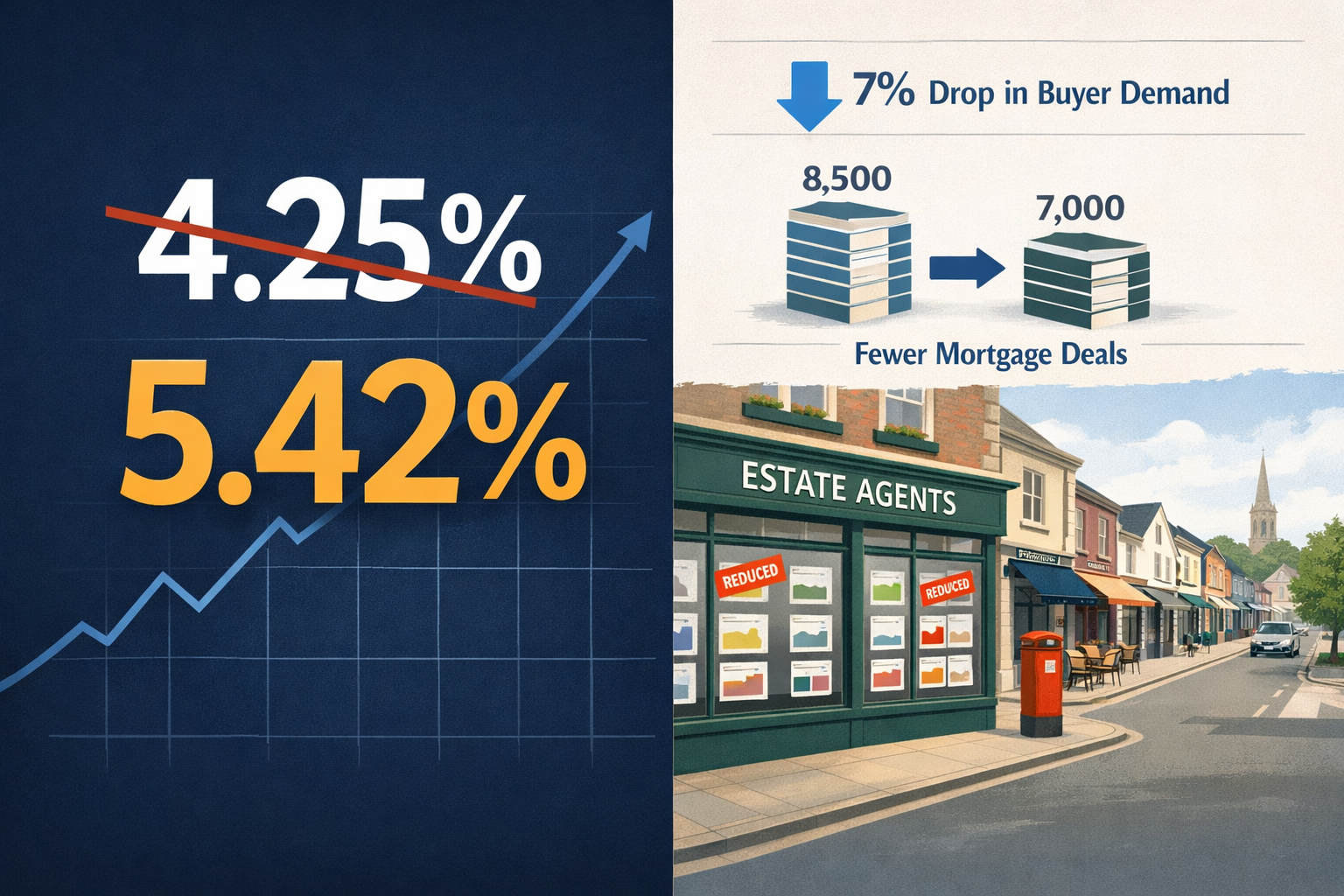
The average two-year fixed mortgage rate has jumped from 4.25% to 5.42% since geopolitical tensions escalated earlier this year — and buyer demand has already fallen 7% compared to the same period in 2025. If you are buying or selling a home right now, this is not background noise. It is the single most important factor shaping every offer, negotiation, and survey decision you will make in 2026.
The UK mortgage rate volatility 2026 buyer demand impact is reshaping the property market in ways that demand a sharper, more evidence-based approach from everyone involved in a transaction. This guide explains exactly what is happening, why it matters, and how commissioning the right building survey can give you a decisive edge.
Key Takeaways 📋
- Two-year fixed rates have risen from 4.25% to 5.42% following geopolitical shocks, adding hundreds of pounds to monthly mortgage costs.
- Buyer demand has dropped 7% year-on-year, and the number of available mortgage products has fallen from 8,500 to 7,000.
- Standard variable rates now average 7.13%, making the cost of inaction extremely high for remortgagers.
- Price-sensitive buyers have more negotiation leverage — but only if they have solid survey evidence to back their position.
- A RICS Level 2 or Level 3 building survey from a trusted practice like Prince Surveyors is one of the most cost-effective tools in a volatile market.
Understanding the UK Mortgage Rate Volatility 2026 Buyer Demand Impact
What Has Driven Rates Higher?
The Iran war and wider Middle East tensions have sent oil and gas prices sharply upward, injecting fresh uncertainty into financial markets. Fixed mortgage rates are driven primarily by swap rates — market expectations about future interest rates — rather than the Bank of England base rate alone. When geopolitical risk rises, swap rates follow, and lenders reprice their products almost immediately.
The numbers tell a stark story:
| Metric | Before Tensions | April 2026 |
|---|---|---|
| Average 2-year fixed rate | 4.25% | 5.42% |
| Average 5-year fixed rate | ~4.8% | 5.54% |
| Standard variable rate (SVR) | ~6.5% | 7.13% |
| Available mortgage products | 8,500 | 7,000 |
| Year-on-year buyer demand | Baseline | -7% |
On a £200,000 mortgage over 25 years, the difference between a competitive fixed rate and the current SVR of 7.13% is approximately £207 more per month. That is not a rounding error — it is a holiday, a car payment, or a month’s groceries.
Global factors — including US monetary policy, energy prices, and concerns about stagflation — are now the primary drivers of UK mortgage rate movements. This makes precise forecasting for 2026–2027 genuinely difficult, even for professional analysts.
The Product Drought: From 8,500 to 7,000
The fall in available mortgage products from 8,500 to 7,000 is significant. Fewer products mean less competition among lenders, which in turn means less downward pressure on rates. For buyers with smaller deposits or complex income situations, the shrinking product range creates real barriers.
💬 “When lenders pull products, they are not just reducing choice — they are signalling caution about where the market is heading. Buyers need to respond with equal caution.”
First-time buyers are particularly exposed. Despite high loan-to-value lending reaching its highest level in over a decade during 2025, the tightening product range in 2026 is reversing some of that progress.
How UK Mortgage Rate Volatility 2026 Buyer Demand Impact Changes the Survey Decision
Price-Sensitive Buyers Need Evidence, Not Optimism
When buyer demand falls by 7%, the balance of power shifts — but only for buyers who are prepared. A lower-demand market means sellers are more open to negotiation, but they will not reduce their asking price without a compelling reason. That reason almost always comes from a professional survey report.
A RICS building survey does far more than confirm a property exists. It identifies:
- 🏚️ Structural defects — subsidence, roof failures, wall movement
- 💧 Damp and drainage issues — often hidden behind fresh decoration
- 🪵 Timber defects — rot, woodworm, compromised joists
- ⚡ Electrical and heating concerns — outdated systems requiring urgent spend
- 🔧 Deferred maintenance — costs that will land on the buyer post-completion
Each of these findings is a quantified negotiation point. In a market where every pound of mortgage repayment is under scrutiny, a £4,000 roof repair identified in a survey can justify a price reduction that saves the buyer far more than the survey cost.
Level 2 vs Level 3: Choosing the Right Survey
Understanding the difference between a full building survey and a homebuyer survey is essential in 2026’s market conditions.
RICS Level 2 (HomeBuyer Report) is suitable for:
- Conventionally built properties in reasonable condition
- Newer homes (post-1950s)
- Buyers wanting a clear, structured overview with a market valuation
RICS Level 3 (Full Building Survey) is recommended for:
- Older properties (pre-1900s Victorian and Edwardian stock)
- Properties that have been extended or significantly altered
- Any home where you suspect hidden defects
- Buyers who want maximum negotiation leverage
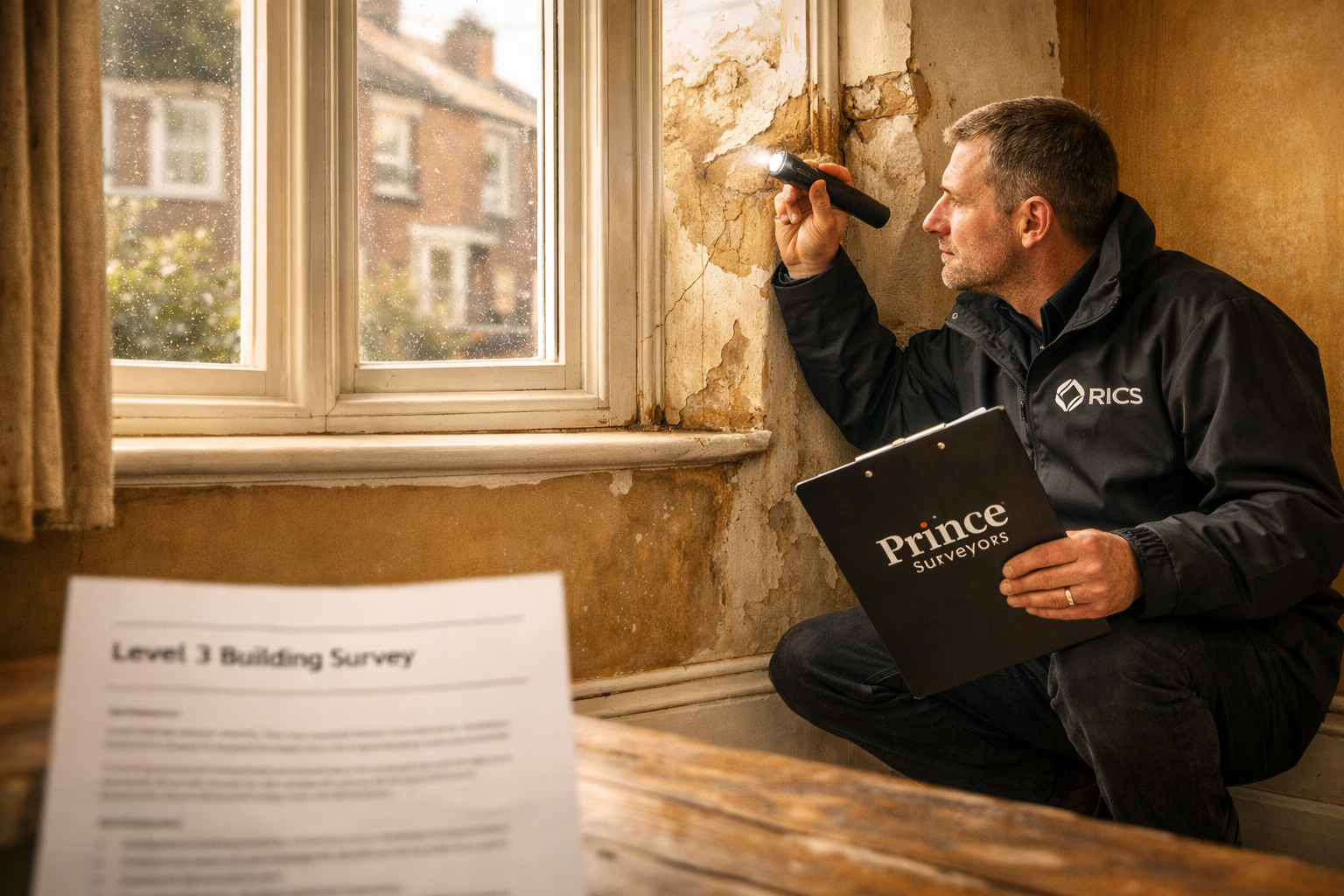
If you are unsure what a RICS HomeBuyer Report actually covers, the key point is this: it is a snapshot. A Level 3 survey is a forensic examination. In a volatile market, forensic wins.
The Consequences of Skipping a Survey
The consequences of failing to act on survey findings are well documented. Buyers who waive surveys to speed up transactions — a temptation in competitive markets — often face repair bills that dwarf the survey fee within the first two years of ownership.
In a high-rate environment, unexpected repair costs are doubly damaging. Not only do they deplete cash reserves, but they arrive at a time when refinancing or borrowing more is expensive. The survey is not a luxury — it is financial protection.
How Prince Surveyors Supports Buyers in a Volatile Market
RICS Expertise Across the UK
Prince Surveyors is a RICS-regulated chartered surveyor practice with a strong track record of supporting buyers, sellers, and property owners through exactly the kind of market uncertainty we are experiencing in 2026. Whether you are buying in Surrey, Central London, Buckinghamshire, or Ealing, our surveyors bring local market knowledge alongside professional rigour.
Our services include:
- ✅ RICS Level 2 HomeBuyer Reports — clear, structured, with market valuation
- ✅ RICS Level 3 Full Building Surveys — comprehensive, forensic, negotiation-ready
- ✅ Valuation services — including capital gains valuations for sellers
- ✅ Expert guidance on what to do if your home valuation is less than your offer
Why Valuation Evidence Matters More Than Ever
When mortgage rates are high and products are scarce, lenders scrutinise valuations more carefully. A property that is overpriced relative to its condition will face down-valuations from lenders — which can collapse a transaction at the last moment. Having an independent RICS survey that accurately reflects the property’s condition and market value protects both buyer and lender.
For sellers, understanding your property’s true market position in 2026 — accounting for the 7% drop in demand and tighter buyer budgets — is equally critical. Overpricing in this environment does not attract higher offers; it attracts no offers at all.
What Buyers and Sellers Should Do Right Now
The UK mortgage rate volatility 2026 buyer demand impact is not a temporary blip. With the Bank of England’s rate decisions closely watched, global energy markets still unsettled, and lender product ranges constrained, the smart move is to act on evidence rather than hope.
For buyers:
- Secure a mortgage agreement in principle before making offers — product availability is shrinking
- Commission a Level 2 or Level 3 survey before exchange, not after
- Use survey findings as structured negotiation evidence, not just reassurance
- Factor in the full cost of ownership, including any repairs identified in the survey
For sellers:
- Price realistically — demand is 7% lower than 2025 and buyers have less borrowing power
- Consider a pre-sale survey to identify and address issues before they derail a buyer’s survey
- Work with an agent who understands the current mortgage environment
Conclusion: Solid Evidence Is Your Best Asset in 2026
The combination of rising mortgage rates, shrinking product choice, and falling buyer demand has created a market where every decision carries more weight. A 5.42% two-year fixed rate versus the 7.13% SVR is not an abstract statistic — it is a monthly cost that shapes what buyers can afford and what sellers can realistically expect.
In this environment, a professional RICS building survey is not an optional extra. It is the foundation of a sound property transaction. It protects buyers from costly surprises, gives sellers realistic expectations, and provides the hard evidence that lenders, solicitors, and negotiating parties all need.
Prince Surveyors is ready to help. Whether you need a Level 2 HomeBuyer Report for a modern flat or a detailed Level 3 Full Building Survey for a Victorian terrace, our RICS-chartered team delivers the clarity and confidence you need to move forward — whatever the market throws at you.
👉 Contact Prince Surveyors today for free advice and take the uncertainty out of your next property decision.