

Fewer than 30% of UK mortgage lenders will offer standard terms on non-standard construction properties without specialist survey evidence — yet adapted homes, prefabricated systems, and high-rise mixed-use developments now represent one of the fastest-growing segments of the housing stock. For surveyors navigating this landscape, Technology-Driven Property Understanding in 2026: Surveyor Best Practices for Non-Standard Construction Risks has moved from a niche specialism to a core professional competency. The convergence of AI-powered valuation models, drone-enabled inspection, LiDAR scanning, and digital twins is fundamentally changing how risk is identified, quantified, and communicated — particularly where traditional comparables fall short and physical access is constrained.
Key Takeaways
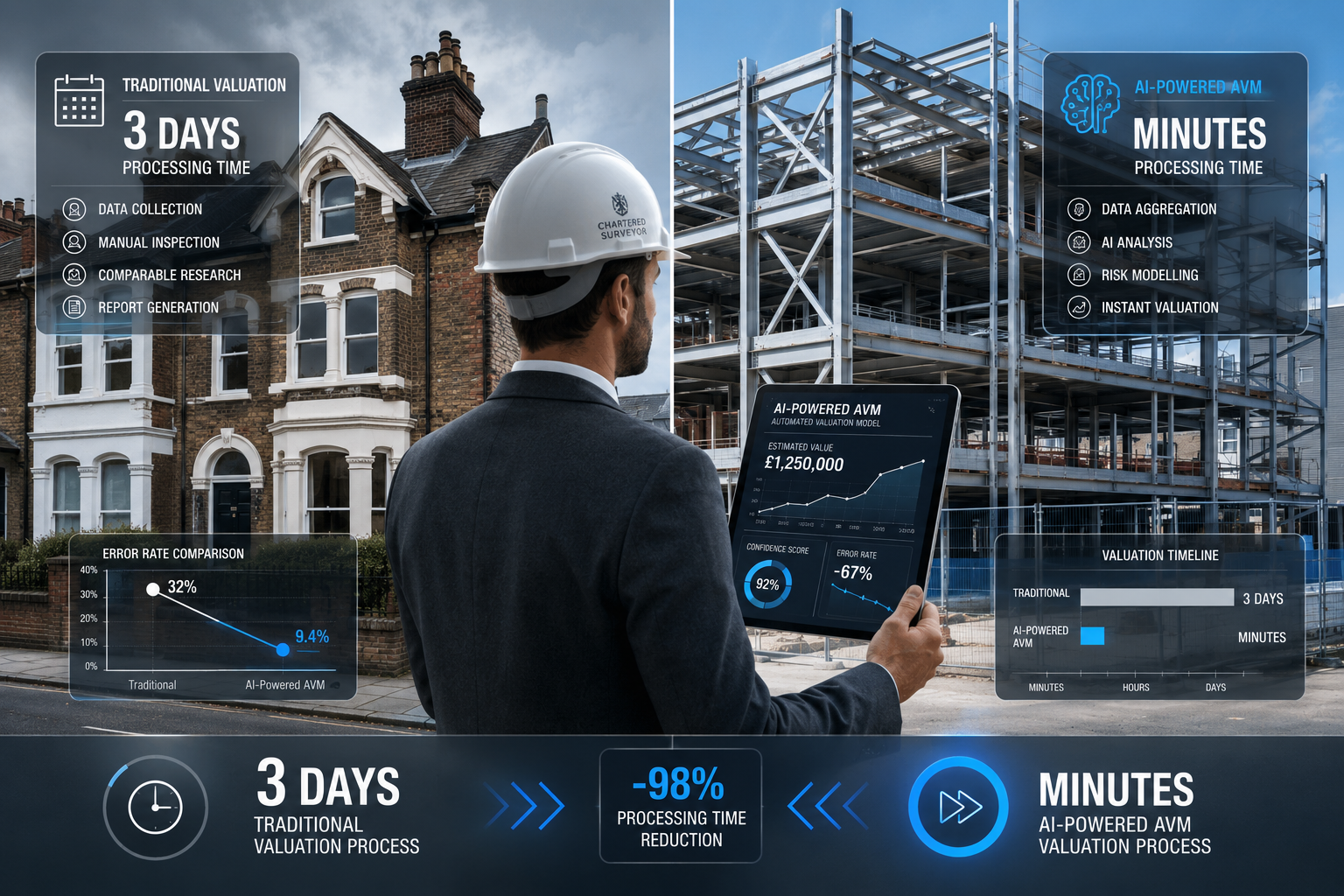
- AI-powered Automated Valuation Models have cut complex property valuation times from days to minutes, achieving a median error rate of just 2.8%, but human expert oversight remains essential for non-standard construction types.
- The 2026 ALTA/NSPS Land Title Survey Standards formally recognise drones, LiDAR, and AI as acceptable survey methodologies, signalling a profession-wide shift in acceptable practice.
- Building Information Modelling (BIM) Level 2 is now the baseline expectation for UK public sector projects, with digital twins enabling real-time structural and energy performance monitoring.
- RICS introduced a professional standard on responsible AI use effective March 2026, placing ethical obligations on surveyors integrating automated tools into risk-based assessments.
- Early, technology-led property insight reduces valuation delays, supports accurate repair budgeting, and strengthens lender confidence in complex or adapted properties.
Why Non-Standard Construction Demands a Different Approach
Non-standard construction covers a broad spectrum: Airey, Wimpey No-Fines, and BISF steel-frame homes from the post-war era; modern methods of construction (MMC) including cross-laminated timber (CLT) and structural insulated panels (SIPs); high-rise reinforced concrete frames; and increasingly, properties that have been significantly adapted — basement conversions, large-scale extensions, or retrofitted heritage buildings.
Each of these property types presents risks that a standard visual inspection, relying on conventional comparables, struggles to capture fully. Structural behaviour under load, thermal bridging, interstitial condensation risk, and the long-term durability of proprietary systems all require a deeper evidence base than a traditional survey can provide within conventional timescales.
The consequences of underestimating these risks are significant. Lenders may withdraw offers, insurers may apply exclusions, and buyers may inherit repair liabilities that were never disclosed. Understanding the consequences of failing to act on identified building defects is critical context for any surveyor advising clients on non-standard stock.
The Valuation Gap in Complex Properties
Traditional Automated Valuation Models (AVMs) were built on comparable sales data. For standard residential stock in high-transaction areas, this works reasonably well. For a converted warehouse, a steel-frame bungalow, or a mixed-use high-rise, the comparable evidence base is thin or absent.
Modern AI-powered AVMs have addressed part of this problem. Research indicates these systems have reduced valuation turnaround from two to three days to mere minutes, with a median error rate of approximately 2.8% [1]. That level of accuracy is impressive for standard stock. For non-standard construction, however, the error margin widens unless the model is fed with richer, property-specific data — precisely the kind of data that technology-led surveys are now able to generate.
Core Technologies Reshaping Surveyor Practice in 2026
Effective technology-driven property understanding in 2026 rests on a suite of integrated tools. No single technology solves the non-standard construction challenge in isolation. The most effective surveyor practices combine several of these approaches within a structured, risk-based framework.

Drones and LiDAR: Access Without Risk
Drone-mounted cameras and LiDAR (Light Detection and Ranging) sensors have transformed the inspection of elements that were previously inaccessible without expensive scaffolding or specialist access equipment. High-rise facades, complex roof geometries, and areas affected by structural movement can now be captured in high resolution, producing point-cloud data that supports precise measurement and defect mapping.
The 2026 ALTA/NSPS Land Title Survey Standards, effective from February 23, 2026, explicitly recognise these technologies as part of "practices generally recognised as acceptable," moving away from the earlier requirement for purely ground-based methods [2]. This is a significant professional endorsement. Surveyors evaluating new technology tools are advised to assess them against criteria including accuracy, industry acceptance, peer review, quality control, and client understanding [6].
For non-standard construction, drone-captured thermal imaging is particularly valuable. It can reveal hidden moisture ingress, insulation failures, and thermal bridging in prefabricated panel systems — defects that are invisible to the naked eye and that have a direct bearing on both structural integrity and energy performance.
A thorough Level 3 Full Building Survey now increasingly incorporates drone-assisted inspection as standard for complex or multi-storey properties, providing clients with a far more complete picture of condition than was achievable even five years ago.
Building Information Modelling and Digital Twins
Building Information Modelling (BIM) has moved from aspiration to baseline expectation. By 2026, BIM Level 2 is the standard for UK public sector projects, with private clients increasingly requiring the same [3]. For surveyors assessing non-standard construction, access to a property's BIM data — where it exists — provides an invaluable reference against which current condition can be compared.
Digital twins take this further. A digital twin is a live, data-rich virtual replica of a physical asset, updated in real time through sensor networks embedded in the building. For high-rise developments and complex mixed-use assets, digital twins enable continuous monitoring of structural performance, energy consumption, moisture levels, and maintenance status [3]. A surveyor with access to a building's digital twin can identify developing defects before they become visible, assess repair urgency with far greater precision, and provide clients with evidence-based cost projections.
This capability is directly relevant to building defects surveys and to the areas of further investigation that a Level 3 survey may recommend. Where a digital twin flags anomalous structural movement or elevated moisture readings, the surveyor has a specific, data-supported basis for recommending specialist investigation rather than relying on visual inference alone.
AI-Powered Risk Assessment and Predictive Analytics
Beyond AVMs, AI is being applied to risk stratification in building surveys. Machine learning models trained on large datasets of building defects, repair costs, and construction typologies can flag elevated risk profiles for specific non-standard construction types, cross-referencing age, location, environmental exposure, and known systemic failure modes.
AI adoption across real estate is projected to unlock $34 billion in efficiency gains by 2030, with early property insight identified as a primary driver of that value [8]. For surveyors, the practical implication is that AI tools can support more consistent, evidence-based risk categorisation — reducing the variability that has historically made non-standard construction assessments difficult to benchmark.
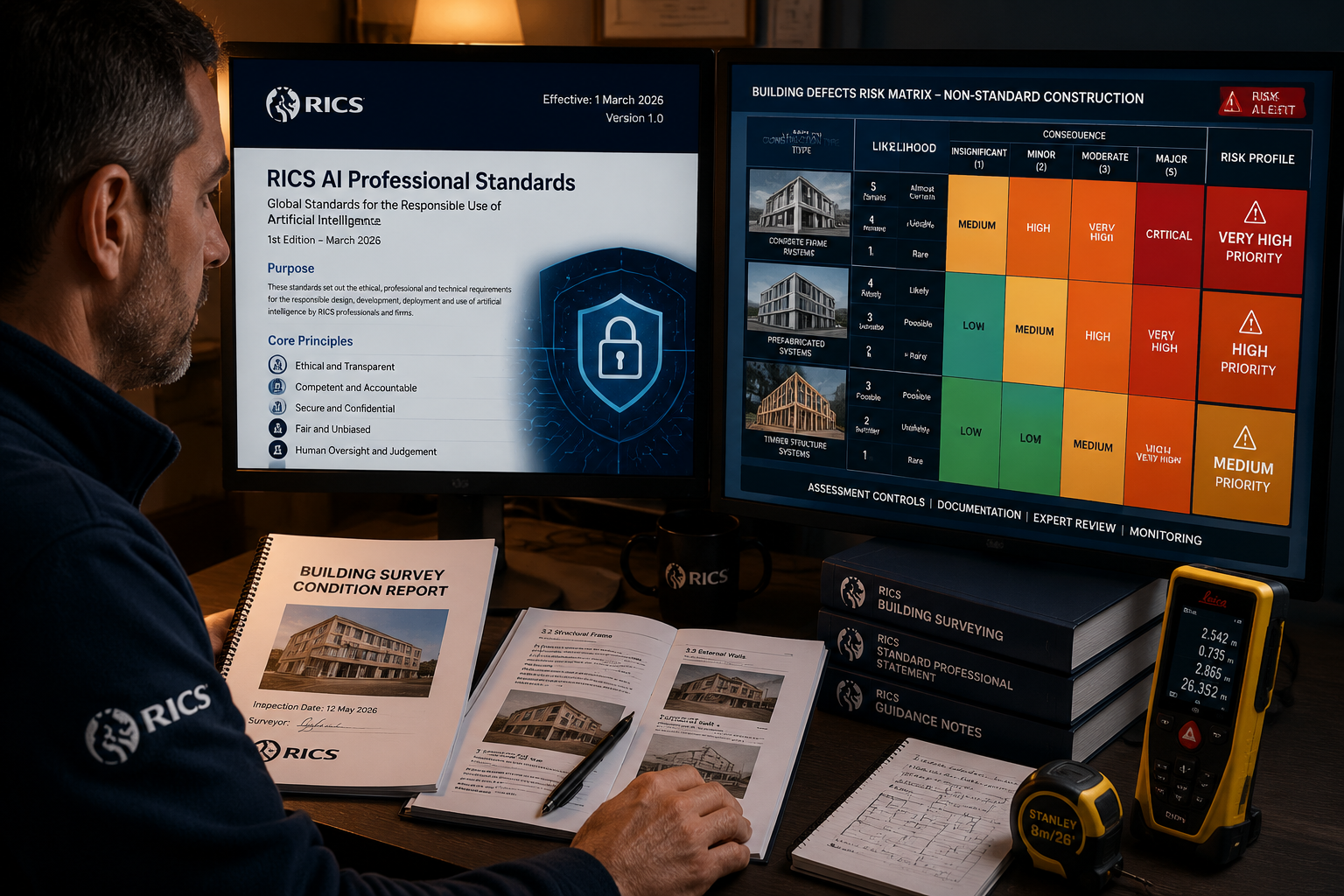
RICS introduced its professional standard on the responsible use of AI, effective March 9, 2026, providing clear guidelines on transparency, accountability, and the limits of automated decision-making in surveying practice [4]. The standard makes clear that AI tools are aids to professional judgement, not replacements for it. Surveyors remain responsible for the conclusions they draw and the advice they give.
A Framework for Technology-Driven Risk-Based Valuations
Integrating these technologies into a coherent, risk-based valuation framework requires a structured approach. The following model reflects best practice for non-standard construction assessments in 2026.
| Stage | Activity | Technology Applied |
|---|---|---|
| Pre-inspection | Data gathering, AVM baseline, planning history review | AI-powered AVMs, GIS mapping, historic records |
| Access and capture | Site inspection, drone survey, thermal imaging | UAV/drone, LiDAR, infrared camera |
| Structural analysis | Defect mapping, movement assessment, material testing | Point cloud processing, BIM comparison, moisture meters |
| Risk stratification | Defect severity scoring, repair cost modelling | AI risk models, digital twin data |
| Reporting | Evidence-based condition report, valuation narrative | Integrated survey platform, structured data output |
Stage 1: Upfront Data Intelligence
The most significant shift in surveyor practice is the move toward upfront data gathering before the physical inspection takes place. This mirrors the approach described in technology-for-early-property-insight research, which demonstrates that pre-inspection data analysis reduces valuation delays and improves the quality of on-site decision-making [8].
For non-standard construction, upfront intelligence should include: planning portal records identifying any material changes of use or structural alterations; building regulation compliance history; known systemic defects associated with the specific construction type (for example, carbonation in reinforced concrete frames or corrosion in steel-frame systems); and environmental risk data covering flood, subsidence, and contamination.
Surveyors working in areas with significant non-standard stock — including many parts of outer London, the South East, and post-war new towns — will find that this pre-inspection phase significantly sharpens the focus of the physical survey.
Stage 2: Physical Inspection Enhanced by Remote Sensing
The physical inspection remains the cornerstone of the survey. Technology enhances it rather than replacing it. Drone surveys of roof planes, facades, and high-level elements should be conducted before the surveyor enters the building, so that aerial observations can inform ground-level investigation priorities.
For properties with suspected asbestos-containing materials — common in non-standard construction built between 1945 and 1985 — the inspection protocol must include specific identification procedures. Detailed guidance on asbestos building surveys is an essential reference for surveyors working with this stock. Similarly, roofing conditions in non-standard construction often require specialist assessment; understanding when a roofing surveyor is needed is part of the risk escalation protocol.
Stage 3: Reporting, Repair Budgeting, and Client Communication
Technology-driven surveys generate richer data, but that data must be translated into clear, actionable advice for clients. Building surveys now routinely include assessments of thermal performance and potential energy upgrade costs, giving buyers a clearer picture of long-term running costs alongside immediate repair liabilities [9].
Effective budgeting for repairs and restoration is one of the most valued outputs of a Level 3 survey on non-standard construction. Clients need to understand not just what is wrong, but what it will cost to put right — and technology-assisted cost modelling, drawing on current contractor data and material cost indices, makes those estimates more reliable.
Managing Digital Risks in Technology-Enhanced Surveys
The integration of connected technologies into building surveys introduces a category of risk that was not present in traditional practice: digital risk. Buildings equipped with IoT sensors, smart energy management systems, and connected access controls are exposed to cybersecurity threats and data privacy vulnerabilities that can affect both building operations and property value [5].
RICS has identified digital risk management as an emerging professional responsibility for property practitioners [5]. For surveyors assessing high-rise or mixed-use developments with significant smart building infrastructure, the survey scope should now include a review of digital system resilience, data governance arrangements, and cybersecurity protocols.
This is not a peripheral concern. A building whose smart systems are compromised — or whose sensor data is unreliable — cannot support the kind of digital-twin-based monitoring that underpins modern asset management. Identifying these vulnerabilities early protects both the client's investment and the surveyor's professional reputation.
Contractors and construction professionals have similarly identified technology integration and data sharing as top priorities, with breaking down information silos cited as a key driver of reduced errors and improved project outcomes [7]. The same principle applies to post-construction surveying: integrated, well-governed data produces better risk assessments.
Choosing the Right Survey Level for Non-Standard Construction
Not every property requires the full suite of technology-driven investigation. The choice of survey level should be proportionate to the complexity and risk profile of the property. A useful starting point is understanding the difference between a Level 2 and Level 3 survey and how construction type influences that decision.
For non-standard construction of any kind, a Level 3 Full Building Survey is almost always the appropriate choice. The complete guide to choosing the right property survey sets out the criteria clearly. The additional cost of a Level 3 survey is consistently justified by the depth of risk identification it provides — and by the negotiating leverage it gives buyers when defects are uncovered.
"The value of a technology-enhanced Level 3 survey on non-standard construction is not just in what it finds — it is in the confidence it gives lenders, insurers, and buyers that the risks have been properly understood."
Regulatory Compliance and Professional Standards in 2026
Surveyors integrating advanced technologies into their practice must maintain compliance with evolving professional standards. The RICS AI standard effective March 2026 is the most significant recent development, establishing requirements for transparency in how AI tools are used, how their outputs are validated, and how limitations are communicated to clients [4].
Building regulation compliance testing is a parallel obligation. For non-standard construction, compliance with the Building Regulations — particularly Part A (Structure), Part B (Fire Safety), and Part L (Conservation of Fuel and Power) — must be assessed as part of the survey process. Technology tools can support this assessment, but the professional responsibility for compliance conclusions rests with the chartered surveyor.
Statutory considerations, including listed building consent, permitted development rights, and planning conditions, also bear on non-standard construction assessments. A thorough understanding of statutory considerations in building surveys is essential for surveyors advising on adapted or converted properties.
Conclusion: Actionable Next Steps for Surveyors and Property Professionals
Technology-Driven Property Understanding in 2026: Surveyor Best Practices for Non-Standard Construction Risks is not a future aspiration — it is the current standard of care for any surveyor working with complex or non-standard property. The tools are available, the professional standards are in place, and the market demand for evidence-based risk assessment has never been stronger.
For surveyors, the priority actions are clear:
- Invest in drone and LiDAR capability, or establish reliable specialist partnerships for high-level and facade inspection.
- Integrate AI risk stratification tools into pre-inspection data gathering, while maintaining full professional accountability for all conclusions.
- Familiarise with the RICS responsible AI standard and apply its transparency requirements to all technology-assisted assessments.
- Expand survey scope to include digital risk assessment for properties with significant smart building infrastructure.
- Ensure repair cost modelling is supported by current data, giving clients actionable financial intelligence alongside condition findings.
For buyers and property investors, the message is equally direct: insist on a Level 3 survey for any non-standard construction purchase, and ask specifically whether the surveyor will be using drone, thermal imaging, or LiDAR inspection. The upfront cost is modest relative to the risk exposure of an inadequate assessment.
The integration of technology into surveying practice is accelerating. Surveyors who build these capabilities now — and who apply them within a rigorous, ethics-led professional framework — will be best placed to serve clients, satisfy lenders, and maintain professional standing as the complexity of the built environment continues to grow.
References
[1] Technology For Upfront Property Insight In Complex 2026 Valuations Beyond Data Volume To Risk Insight – kingstonsurveyors.com
[2] 2026alta – nsps.us.com
[3] Six Key Surveying Trends For 2026 Accelerating Digital Transformation – canterburysurveyors.com
[4] What Surveyors Think Ai – ww3.rics.org
[5] Digital Risks In Buildings – ww3.rics.org
[6] 2026 Alta Nsps Land Title Survey Standards Key Updates And Compliance Guide For Surveyors – canterburysurveyors.com
[7] Future Construction Technology Trends Contractor Survey – trimble.com
[8] Technology For Early Property Insight In 2026 Building Surveys Reducing Delays In Complex Valuations – nottinghillsurveyors.com
[9] Current Trends In Building Surveying Whats Changing In 2026 – asg-consulting.co.uk