

Only 56% of building survey firms currently have formal sustainability policies in place — meaning nearly half operate without the structured frameworks now demanded by updated RICS standards [5]. For firms handling valuations and compliance audits in 2026, that gap is no longer a minor oversight. It is a professional liability.
Sustainability Policies in Building Survey Firms: RICS Guidance for 2026 Valuations and Compliance Audits has moved from aspirational best practice to a mandatory operational requirement. The Royal Institution of Chartered Surveyors (RICS) activated its 4th edition ESG and sustainability standard for commercial property valuation on 30 April 2026, aligning it with both the Red Book and International Valuation Standards (IVS) [1]. Firms that have not yet built robust internal policies, audit checklists, and compliance templates are already behind.
This article breaks down exactly what RICS now requires, provides practical policy templates and audit frameworks, and shows how surveyors can embed sustainability compliance into everyday valuation and building survey practice.
Key Takeaways 📋
- RICS activated its 4th edition ESG sustainability standard for commercial valuations on 30 April 2026, making ESG integration mandatory — not optional [1].
- 56% of firms have sustainability policies in place; the remaining 44% face compliance risk under current RICS requirements [5].
- Whole Life Carbon Assessment (2nd Edition) and PAS 2080:2023 adoption mean carbon must now be tracked across the full building lifecycle [2].
- AI governance is now a formal RICS requirement, with written due diligence, risk registers, and updated terms of engagement mandatory for firms using AI tools [2].
- Practical policy templates and audit checklists are the fastest route to compliance for firms still building their sustainability frameworks.
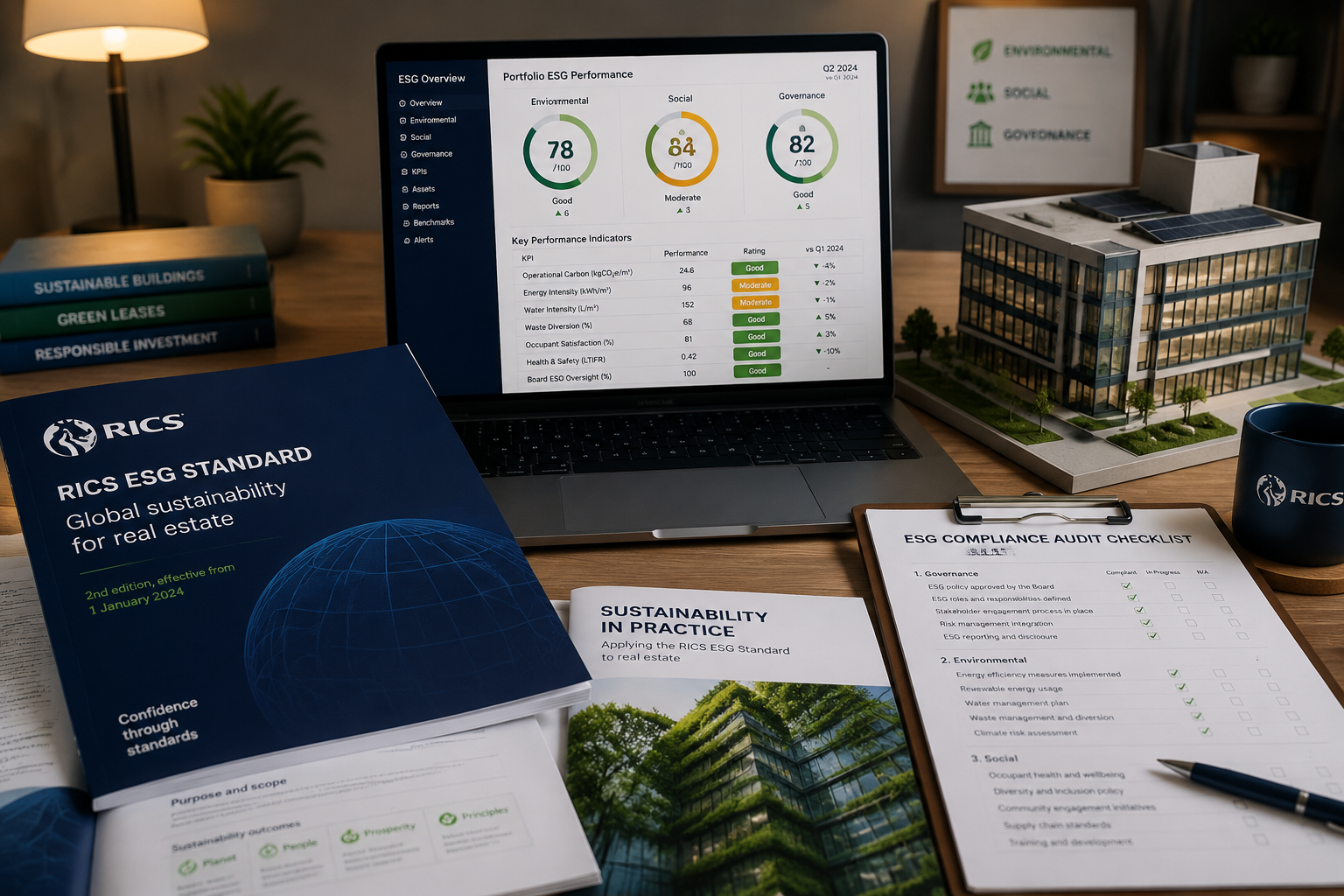
Understanding the 2026 RICS ESG Framework: What Has Changed
The 4th Edition ESG Standard: Core Requirements
The RICS 4th edition global standard on ESG and sustainability in commercial property valuation became effective 30 April 2026 [1]. It is the primary authoritative document for all RICS members and regulated firms undertaking commercial property valuations globally. Three changes stand out above all others.
1. Mandatory ESG KPI Integration
The standard provides a consolidated global list of typical ESG-related Key Performance Indicators (KPIs) that firms must use when assessing environmental, social, and governance factors [1]. These KPIs are not suggestions — they form the baseline against which valuation advice is measured and audited.
2. Capital and Operational Expenditure Clarity
The updated standard includes practical guidance on cost assumptions in valuations, specifically clarifying when and how capital expenditure (CapEx) and operational expenditure (OpEx) linked to ESG factors may be reflected in valuation advice [1]. This resolves a long-standing grey area where valuers were uncertain whether retrofit costs, energy upgrade expenses, or carbon compliance costs should influence assessed market value.
3. Dual Regulatory Alignment
The standard now aligns with mandatory requirements in both RICS Valuation Global Standards (the Red Book) and International Valuation Standards (IVS) [1]. This means firms operating across multiple jurisdictions no longer need to reconcile conflicting frameworks — one set of ESG policies can satisfy both.
💬 "Firms that treat ESG compliance as a box-ticking exercise will find the 2026 standards expose the gaps quickly. The KPI framework demands evidence, not intention."
Whole Life Carbon Assessment and PAS 2080:2023
Beyond the ESG valuation standard, RICS has introduced two further frameworks that directly affect building survey practice in 2026 [2]:
- RICS Professional Standard: Whole Life Carbon Assessment for the Built Environment (2nd Edition) — provides guidance from design through end of life, enabling property owners and investors to make data-driven decarbonisation decisions.
- PAS 2080:2023 Carbon Management in Buildings and Infrastructure — adopted by RICS, this standard provides governance processes, roles, and requirements to manage carbon throughout the building lifecycle, with emphasis on leadership, decision-making, and collaborative working.
Both standards align with the International Cost Management Standards (ICMS) 3rd Edition, making them globally applicable across different jurisdictions and building types [2].
Surveyors conducting a Level 3 Full Building Survey must now consider where whole-life carbon data intersects with structural condition assessments, particularly for older or energy-inefficient stock.
The CLEAR Initiative
RICS also announced the launch of the Coalition for Life Cycle Emissions Alignment and Reporting (CLEAR) — a global initiative designed to harmonise the measurement and reporting of whole-life carbon emissions across the built environment [4]. CLEAR became effective as part of the April 2026 updates and provides the international reporting backbone for the Whole Life Carbon Assessment standard.
Sustainability Policy Templates and Audit Checklists for Building Survey Firms
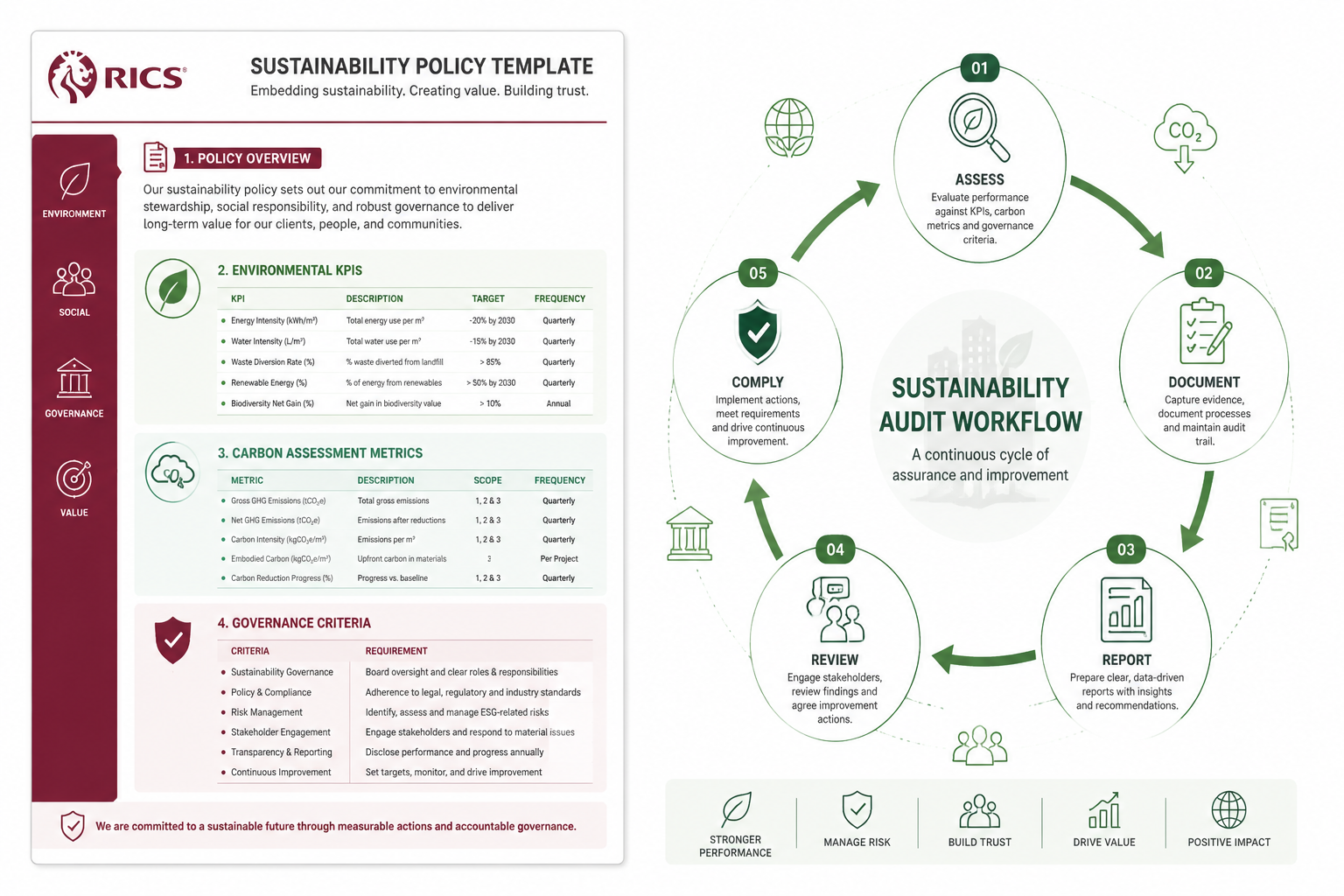
Why 44% of Firms Are Still Exposed
The fact that only 56% of firms have formal sustainability policies [5] suggests that many practices have absorbed RICS guidance in principle but have not translated it into documented, auditable operational procedures. In 2026, that distinction matters enormously. RICS compliance audits assess not just what a firm does, but what it can demonstrate it does — through written policies, signed-off checklists, and documented decision trails.
The sections below provide structured templates and checklists that firms can adapt immediately.
🗂️ Template 1: Firm-Level Sustainability Policy Statement
A sustainability policy statement should be a living document, reviewed annually and signed by a senior partner or director. The core sections are:
| Section | Required Content |
|---|---|
| Policy Purpose | Commitment to RICS ESG standard compliance and net-zero targets |
| Scope | All valuation, building survey, and compliance audit services |
| ESG KPI Framework | Reference to RICS consolidated KPI list (4th Edition, 2026) |
| Carbon Management | Alignment with PAS 2080:2023 and Whole Life Carbon Assessment |
| Review Cycle | Annual review, with interim updates triggered by RICS standard changes |
| Responsible Person | Named sustainability lead or partner |
| Client Communication | How ESG findings are reported in survey outputs |
Key policy commitments to include:
- Embed ESG KPIs into all commercial valuation reports as standard
- Reflect CapEx/OpEx linked to ESG factors where market evidence supports it
- Report whole-life carbon data for relevant building types
- Maintain a sustainability training log for all fee earners
- Review AI tool usage against RICS AI governance requirements (see below)
🗂️ Template 2: ESG Valuation Checklist (Commercial Properties)
This checklist should accompany every commercial valuation instruction. It maps directly to the RICS 4th Edition ESG standard [1].
Environmental KPIs to assess:
- Energy Performance Certificate (EPC) rating — current and projected post-retrofit
- Operational carbon emissions (kgCO₂e/m²/year)
- Embodied carbon data available (yes/no; source documented)
- Flood risk zone classification and resilience measures
- Water consumption metrics where available
- Biodiversity net gain status (where applicable)
- Renewable energy installations (type, capacity, age)
Social KPIs to assess:
- Accessibility compliance (Part M / Equality Act)
- Health and wellbeing certifications (WELL, BREEAM Health credits)
- Proximity to public transport and active travel infrastructure
- Community impact or social value assessments on file
Governance KPIs to assess:
- ESG reporting framework used by occupier/owner (GRI, TCFD, GRESB)
- Lease terms with green clauses (landlord/tenant cooperation on ESG)
- Supply chain sustainability disclosures available
- Board-level ESG accountability documented
Valuation adjustment section:
- CapEx requirements for ESG compliance identified and quantified
- OpEx adjustments for energy efficiency reflected in yield/capitalisation rate
- Valuer's ESG assumptions explicitly stated in report
- Limitations on valuer's role in ESG assessment clearly disclosed [1]
For firms handling specialist property types, the insurance reinstatement cost valuations process should also incorporate ESG-linked rebuild cost considerations, particularly where green materials or energy-efficient systems form part of the reinstatement specification.
🗂️ Template 3: Building Survey Sustainability Audit Checklist
For residential and commercial building surveys, sustainability compliance audits require a separate layer of assessment beyond standard condition reporting. The top things looked at during a property valuation now routinely include energy performance and sustainability credentials alongside structural condition.
Pre-inspection sustainability checks:
- EPC obtained and reviewed prior to inspection
- Planning history checked for permitted development or energy upgrade works
- Flood risk, subsidence risk, and climate vulnerability data reviewed
- Any heritage or conservation constraints noted (affects retrofit options)
On-site sustainability assessment:
- Roof condition assessed for solar PV suitability or existing installation integrity — see RICS roof surveyor guidance for inspection standards
- Wall insulation type identified (cavity, solid, external, internal)
- Window glazing specification recorded (single, double, triple)
- Heating system type, age, and efficiency rating documented
- Ventilation adequacy assessed (risk of damp/mould in airtight retrofits)
- Evidence of damp or mould assessed in context of energy upgrade history
- EV charging provision or infrastructure readiness noted
Report output requirements:
- Sustainability findings reported in a dedicated section
- Whole-life carbon implications noted where relevant
- Recommended further specialist advice identified — see sourcing extra advice for building surveys
- Client advised of potential ESG-related costs in plain language
🗂️ Template 4: Annual Sustainability Compliance Audit (Firm-Level)
Firms should conduct an internal sustainability compliance audit annually. This audit reviews whether the firm's policies, processes, and outputs meet current RICS requirements.
Audit structure:
| Audit Area | Evidence Required | Pass/Fail |
|---|---|---|
| ESG Policy Document | Signed, dated, current version on file | ☐ |
| Staff Training Records | CPD log showing ESG/sustainability training | ☐ |
| Valuation Report Sample | 10% sample reviewed for ESG KPI inclusion | ☐ |
| Building Survey Sample | 10% sample reviewed for sustainability section | ☐ |
| AI Tool Governance | Written due diligence and risk register in place | ☐ |
| Terms of Engagement | Updated to reflect AI use and ESG scope | ☐ |
| Carbon Assessment | WLCA applied where required | ☐ |
| Client Complaints Log | Any ESG-related complaints documented and resolved | ☐ |
AI Governance, Carbon Reporting, and Emerging Compliance Obligations

The RICS AI Governance Standard: What Firms Must Do Now
One of the most significant — and least anticipated — compliance requirements emerging from the 2026 RICS updates is the Professional Standard: Responsible Use of AI in Surveying Practice [2]. This is not a technology guideline. It is a mandatory professional standard with direct implications for how firms conduct valuations and building surveys.
Core requirements for RICS-regulated firms using AI tools:
-
Written due diligence — Firms must document AI reliability assessments in writing, with explicit assumptions and concerns stated before any AI system is relied upon in surveying practice [2].
-
Updated terms of engagement — If a firm adopts AI systems, its terms of engagement must be updated to specify:
- When AI will be used in the instruction
- Professional Indemnity Insurance (PII) cover provisions
- Internal quality assurance processes
- Redress mechanisms for client concerns
- Client opt-out options [2]
-
Governance framework — Firms must maintain:
- Data governance policies
- System governance policies
- Risk management policies
- Written risk assessments
- Regular review schedules
- A maintained risk register [2]
-
Professional scepticism — RICS members must apply professional judgment and scepticism (aligned with the latest Red Book edition) to evaluate AI system outputs before reliance [2].
Technology tools such as premium drone surveys increasingly incorporate AI-assisted analysis. Firms using these services must ensure their AI governance documentation covers drone-derived data outputs alongside any other AI-processed information.
Integrating Sustainability Policies in Building Survey Firms: RICS Guidance for 2026 Valuations and Compliance Audits into Day-to-Day Practice
The gap between having a sustainability policy and operationalising it is where most firms fall short. The following practical steps bridge that gap:
Step 1: Appoint a Sustainability Lead
Designate a named individual — partner, associate, or senior surveyor — as the firm's sustainability compliance lead. This person owns the policy document, coordinates annual audits, and acts as the first point of contact for client ESG queries.
Step 2: Embed Checklists into Workflow Systems
Sustainability and AI governance checklists should be built into case management software or job management systems — not stored as standalone documents. Every instruction should trigger the relevant checklist automatically.
Step 3: Train All Fee Earners
RICS CPD requirements already mandate ongoing professional development. Firms should ensure that ESG, carbon assessment, and AI governance topics feature in annual CPD plans for all surveyors, not just senior staff.
Step 4: Review Terms of Engagement
Standard terms of engagement need updating to reflect ESG scope, AI usage, and the limitations of the surveyor's role in ESG assessment — as clarified by the 4th Edition standard [1]. Legal review of updated terms is recommended.
Step 5: Build the Evidence Trail
Compliance audits succeed or fail on documentation. Firms should maintain:
- Signed policy documents with version history
- Training logs with dates and topics
- Completed checklists archived against each instruction
- AI risk registers with review dates
- Sample report reviews with sign-off records
For firms working across capital gains valuations or inheritance tax valuations, sustainability credentials are increasingly relevant to assessed market value — particularly where EPC ratings, retrofit costs, or climate risk exposure materially affect a property's worth.
The Financial Case for Sustainability Compliance
Beyond regulatory obligation, there is a clear commercial rationale for robust sustainability policies. Properties with strong ESG credentials are increasingly attracting valuation premiums, while those with poor EPC ratings or high carbon liability face discounts — a trend the 4th Edition standard formally acknowledges by clarifying how ESG CapEx and OpEx should be reflected in valuations [1].
Clients — particularly institutional investors, housing associations, and commercial landlords — are beginning to request evidence of a firm's own sustainability credentials before appointing surveyors. A documented, auditable sustainability policy is a competitive differentiator, not just a compliance requirement.
Conclusion: Turning Policy into Practice in 2026
Sustainability Policies in Building Survey Firms: RICS Guidance for 2026 Valuations and Compliance Audits represents the most comprehensive regulatory update the surveying profession has faced in a generation. The 4th Edition ESG standard, Whole Life Carbon Assessment requirements, PAS 2080:2023 adoption, the CLEAR initiative, and the new AI governance standard have collectively raised the bar for what professional compliance looks like [1][2][4].
The 44% of firms without formal sustainability policies face immediate exposure. But the solution is not complicated — it requires structured action, not wholesale reinvention.
Actionable next steps for building survey firms:
✅ This week: Download and read the RICS 4th Edition ESG standard (effective 30 April 2026) and identify gaps against current practice.
✅ This month: Draft or update your firm-level sustainability policy statement using the template above. Appoint a named sustainability lead.
✅ This quarter: Embed the ESG valuation checklist and building survey sustainability audit checklist into your workflow systems. Update terms of engagement to cover AI usage.
✅ This year: Conduct your first formal annual sustainability compliance audit using the firm-level audit template. Document everything. Build the evidence trail.
The firms that act now will be positioned to win more instructions, satisfy more demanding clients, and meet RICS audit requirements with confidence. The firms that wait will find the gap between policy and practice increasingly difficult — and costly — to close.
References
[1] RICS Publishes Updated Global Standard ESG Sustainability Commercial Property Valuation – rics.org
[2] Five Hot Topics for Surveyors Spring 2026 – pbctoday.co.uk
[3] ESG Sustainability Commercial Valuation 4th Edition – rics.org
[4] Home Survey Standard 2nd Edition April 2026 Update – rics.org
[5] Building Survey Quality Standards 2026: Navigating RICS Updates and Enhanced Home Inspection Requirements – nottinghillsurveyors.com
[6] Sustainability – rics.org