

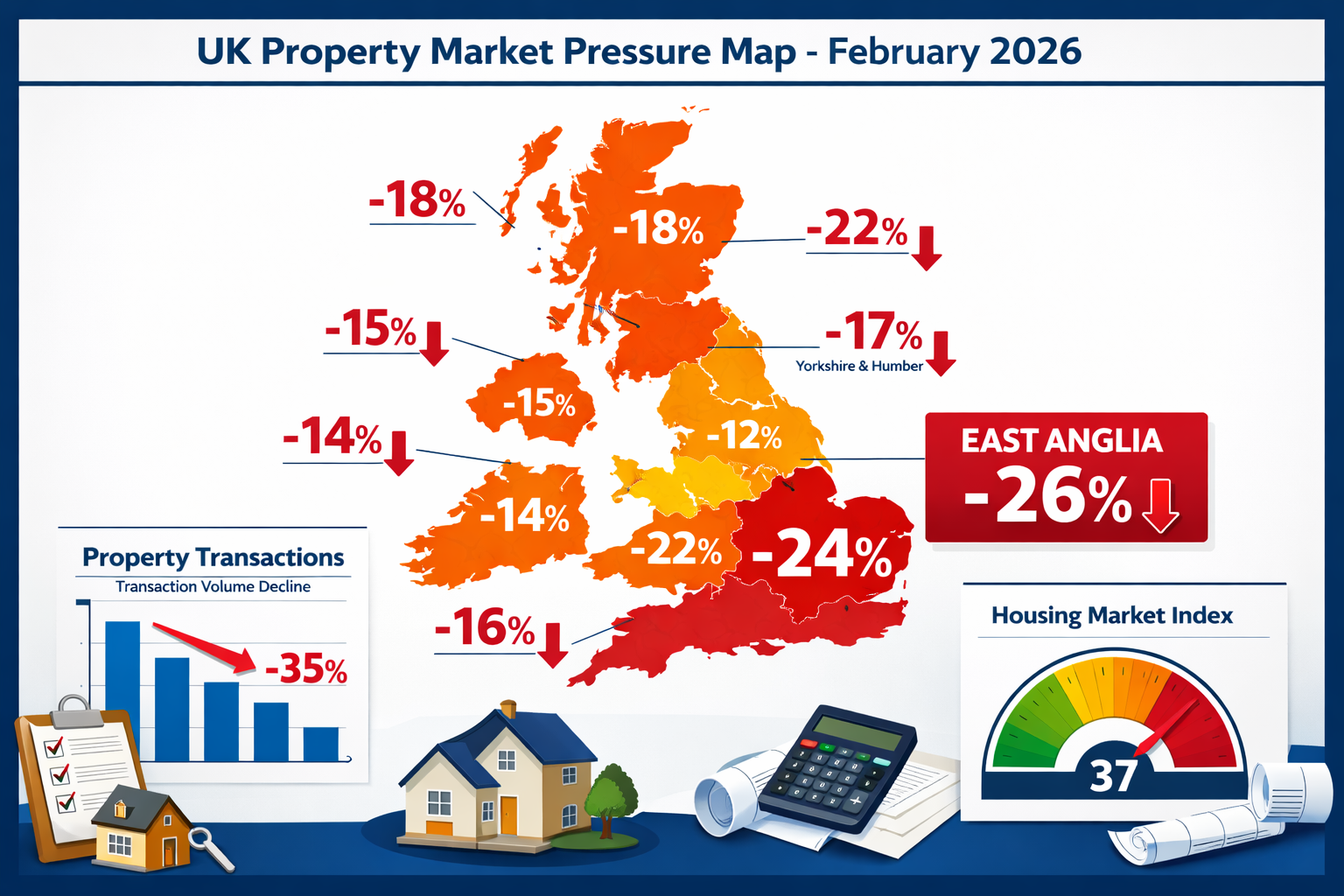
The UK property market entered February 2026 facing unprecedented regional pressures: the South East experienced -24% downward price pressure while East Anglia saw -26% declines, creating a perfect storm of valuation challenges and buyer hesitation.[5] Against this backdrop, the surveying profession stands at a critical juncture where upfront condition assessments have transformed from optional due diligence into essential transaction safeguards. As the UK government consults on making property condition assessments a mandatory upfront requirement in the homebuying process,[1] surveyors must adapt their strategies to deliver certainty in an uncertain market while preparing for potentially transformative regulatory changes.
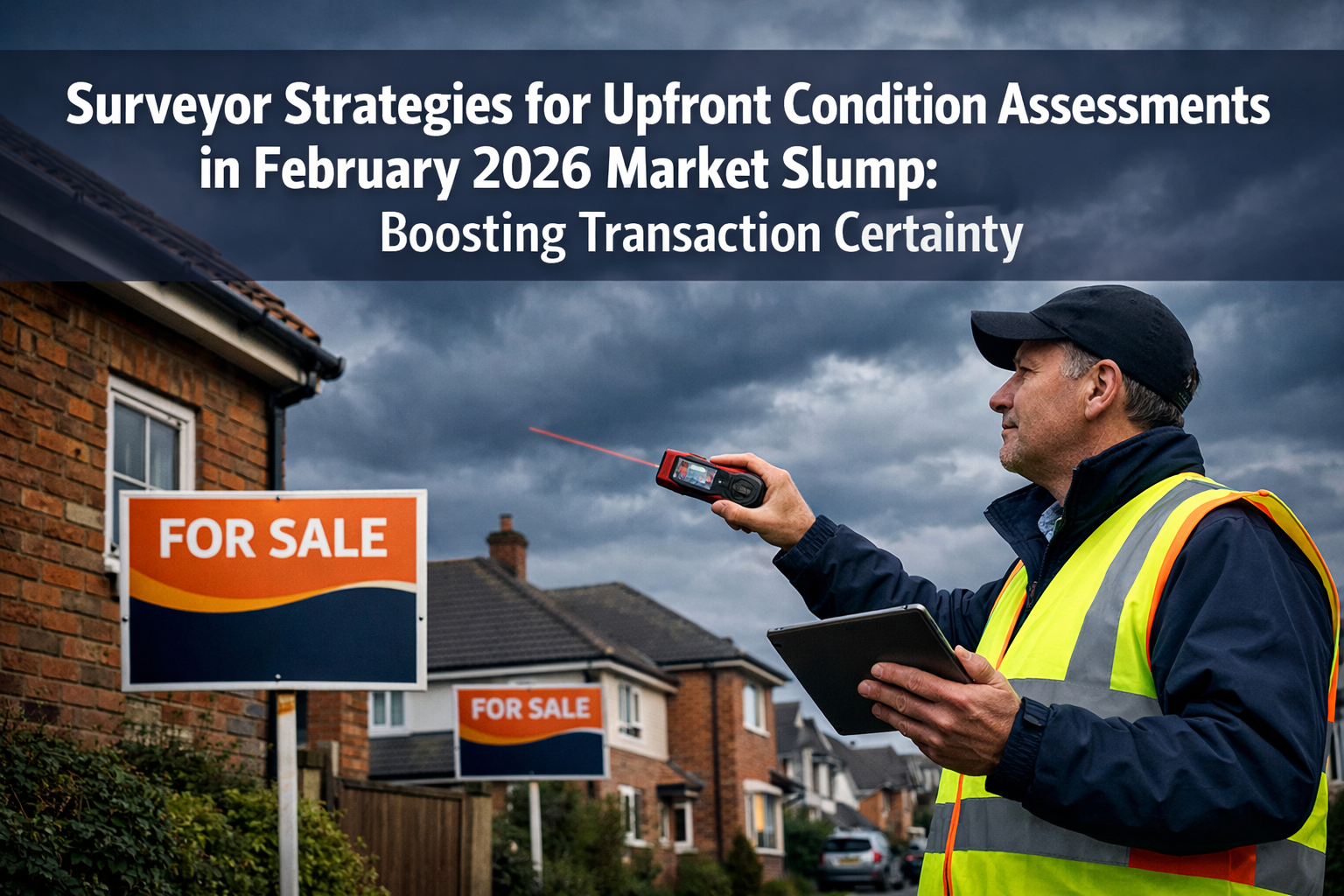
The February 2026 market slump has fundamentally altered buyer behavior and transaction dynamics. With the NAHB/Wells Fargo Housing Market Index falling to 37 in January 2026 and prospective buyer traffic dropping to just 23,[4] transaction certainty has become the currency of successful property deals. Surveyor Strategies for Upfront Condition Assessments in February 2026 Market Slump: Boosting Transaction Certainty must address both immediate market pressures and prepare for structural reforms that could reshape the profession's role in property transactions.
Key Takeaways
- 🏘️ Regional price pressures in February 2026 demand sophisticated valuation methodologies that account for declining market conditions and local variations
- 📋 Upfront condition assessments are transitioning from optional to potentially mandatory, requiring surveyors to adapt workflows and client communication strategies
- 🔍 Comprehensive building pathology investigations provide transaction certainty by identifying defects early, preventing deal collapse and renegotiation delays
- 💼 Enhanced reporting protocols with clear risk categorization help buyers and lenders make confident decisions despite market volatility
- ⚖️ Professional standards and liability management become critical as surveyors take on greater responsibility in front-loaded transaction processes
Understanding the February 2026 Market Context and Its Impact on Survey Demand
The property market landscape in early 2026 presents unique challenges that directly influence surveying strategies. Regional variations have created a patchwork of market conditions requiring localized expertise and nuanced assessment approaches.
Regional Price Pressure Analysis
The dramatic downward pressures observed in February 2026 aren't uniform across the UK. The South East's -24% pressure and East Anglia's -26% decline[5] represent the most severe regional corrections, but other areas show different patterns. These variations create valuation complexity that demands surveyors employ sophisticated comparable analysis and adjustment methodologies.
Surveyors operating in declining markets must consider:
- Time-adjusted comparables: Recent sales may not reflect current market reality
- Days on market trends: Extended listing periods indicate weakening demand
- Renegotiation frequency: High rates suggest initial valuations exceeded market appetite
- Mortgage lending criteria: Tightening standards affect achievable prices
Understanding valuation methodology for flat and declining markets becomes essential for delivering accurate assessments that withstand lender scrutiny and support confident buyer decisions.
Builder Confidence and New Construction Implications
The decline in builder sentiment to 37 in January 2026[4] has significant implications for surveyors working with new-build properties. With prospective buyer traffic at historic lows of 23, developers face mounting pressure to complete transactions quickly, potentially compromising construction quality oversight.
This environment increases the importance of snagging surveys for new builds, as rushed completion schedules may result in overlooked defects. Surveyors must apply heightened scrutiny to new construction, particularly in developments where builders face financial pressure.
Core Surveyor Strategies for Upfront Condition Assessments in February 2026 Market Slump
Implementing effective upfront assessment strategies requires fundamental shifts in how surveyors approach property evaluation, client communication, and report delivery. The goal is transforming surveys from reactive due diligence into proactive transaction enablers.
Enhanced Pre-Inspection Research Protocols
Thorough pre-inspection research forms the foundation of effective upfront assessments. In declining markets where properties may have extended listing histories, surveyors can leverage additional data sources:
- Historical listing analysis: Review price reductions, previous survey findings, and marketing duration
- Planning and building control records: Identify undisclosed alterations or enforcement actions
- Environmental data screening: Assess flood risk, contamination, and subsidence history
- Energy performance considerations: Review EPC ratings and MEES compliance implications
This enhanced research enables surveyors to arrive at properties with informed hypotheses about potential defects, optimizing inspection efficiency and thoroughness.
Comprehensive Building Pathology Investigation
The market slump demands that surveyors conduct more thorough building pathology investigations than standard practice might require. Buyers facing uncertain market conditions need complete confidence in property condition before committing.
Advanced inspection techniques for February 2026 market conditions include:
- Moisture mapping: Thermal imaging and moisture meters to identify hidden damp issues
- Structural movement monitoring: Detailed crack analysis with width measurements and monitoring recommendations
- Roof void inspection: Comprehensive assessment of roof structure, insulation, and ventilation
- Service installation review: Evaluation of heating, electrical, and plumbing system condition and remaining lifespan
- Drainage investigation: CCTV surveys where concerns exist about underground drainage integrity
For period properties, understanding common defects in older homes enables targeted investigation of age-related deterioration patterns.
Risk-Categorized Reporting Frameworks
Traditional survey reports often bury critical findings in lengthy narratives. Upfront assessments in declining markets require immediate clarity about property condition and associated risks.
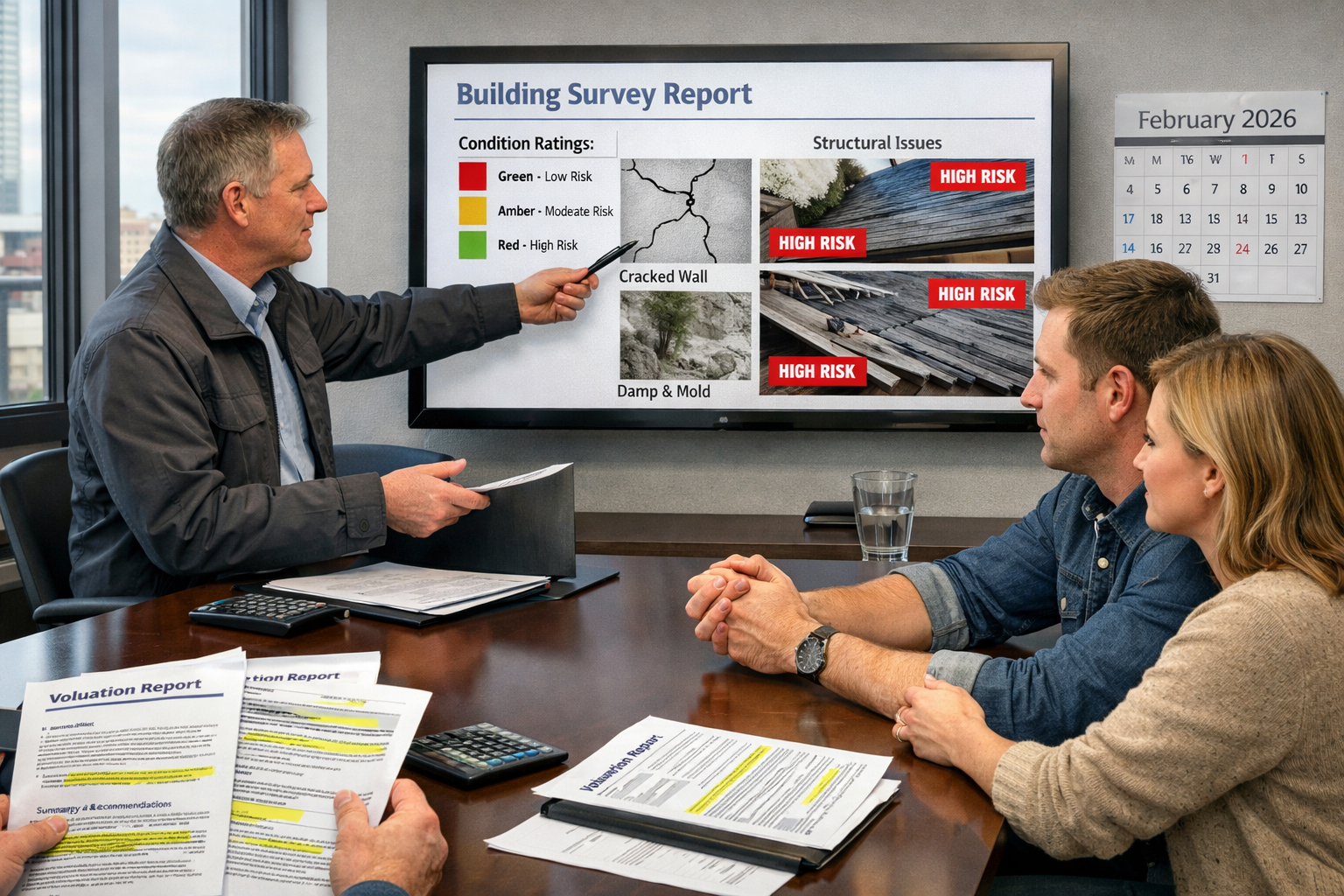
Effective risk categorization employs a traffic light system:
| Risk Category | Description | Buyer Action Required |
|---|---|---|
| 🟢 Green | Minor defects requiring routine maintenance | Proceed with confidence |
| 🟡 Amber | Moderate issues requiring further investigation or budgeting | Obtain specialist reports; adjust offer |
| 🔴 Red | Serious defects affecting value, safety, or insurability | Significant price renegotiation or withdrawal |
This framework enables buyers, sellers, and lenders to quickly assess transaction viability and make informed decisions without parsing complex technical language.
Accelerated Turnaround Protocols
One barrier to upfront assessments has been timing—sellers traditionally resist commissioning surveys before securing buyers. However, building survey timeframes can be optimized for upfront deployment:
- Rapid scheduling: Priority booking for upfront assessments within 48 hours
- Streamlined reporting: Preliminary findings within 24 hours for time-sensitive decisions
- Digital delivery: Cloud-based reports accessible to all transaction parties simultaneously
- Modular reporting: Phased delivery with critical findings first, detailed analysis following
These protocols reduce the perception that upfront surveys delay marketing or transaction momentum.

Preparing for Mandatory Upfront Assessment Reforms
The UK government's consultation on making property condition assessments a standard upfront requirement[1] represents potentially the most significant structural change to the homebuying process in decades. Surveyors must prepare operationally, professionally, and commercially for this transformation.
Understanding the Proposed Reform Framework
The proposed reforms aim to reduce transaction fall-through rates and accelerate completion timelines by front-loading information provision. Under consideration:
- Seller-commissioned surveys: Property condition reports completed before marketing
- Standardized reporting formats: Consistent presentation enabling easy comparison
- Digital information packs: Centralized platforms containing all property documentation
- Reduced renegotiation: Upfront disclosure limiting post-offer price adjustments
These changes would fundamentally alter how building surveyors structure their workloads, shifting from buyer-instructed reactive surveys to seller-instructed proactive assessments.[2]
Operational Capacity Planning
If mandatory upfront assessments become reality, surveying firms face significant capacity challenges. The reform would effectively double immediate survey demand as every marketed property requires assessment rather than only those under offer.
Capacity planning strategies include:
- Workforce expansion: Recruiting additional RICS-qualified surveyors and training graduate surveyors
- Technology investment: Deploying drone surveys and digital inspection tools to improve efficiency
- Workflow optimization: Standardizing inspection protocols and report templates
- Geographic specialization: Developing deep expertise in specific areas to improve efficiency
- Partnership networks: Collaborating with specialist consultants for complex investigations
Firms that proactively build capacity will capture market share when reforms take effect.
Professional Liability Considerations
Mandatory upfront assessments shift liability dynamics significantly. When buyers commission surveys, the surveyor-client relationship is clear. When sellers commission surveys that multiple potential buyers rely upon, liability exposure expands.
Critical professional considerations include:
- Duty of care scope: Clarifying responsibilities to sellers, buyers, and lenders
- Professional indemnity insurance: Ensuring adequate coverage for expanded liability
- Report disclaimers: Clearly defining inspection limitations and assumptions
- Update protocols: Establishing procedures for report validity periods and property changes
- Negligence standards: Understanding how courts may interpret surveyor obligations under new frameworks
Surveyors should engage professional indemnity insurers early to ensure coverage adequately reflects the reformed market structure.
Client Communication and Expectation Management
The transition to mandatory upfront assessments requires educating both sellers and buyers about the new process and its implications.
For sellers, surveyors must communicate:
- The strategic advantage of commissioning surveys before marketing
- How transparent disclosure can actually support asking prices by eliminating buyer uncertainty
- The importance of addressing identified defects or adjusting pricing expectations
- How quality surveys differentiate properties in competitive markets
For buyers, the message shifts to:
- Understanding that seller-commissioned surveys provide valuable information but may benefit from independent verification
- Recognizing that upfront transparency reduces transaction risk and speeds completion
- Knowing when to commission additional specialist investigations beyond the standard assessment
- Appreciating that comprehensive surveys justify confident offers with reduced renegotiation
Determining which building survey level is appropriate becomes even more critical when assessments occur upfront.
Valuation Methodology Adaptations for Declining Market Conditions
Accurate property valuation in the February 2026 market slump demands sophisticated methodologies that account for downward price pressures, limited comparable data, and buyer hesitation. Traditional approaches may not adequately reflect current market reality.
Comparable Analysis in Thin Markets
Regional price declines of -24% to -26%[5] create challenges in identifying truly comparable sales. Properties that sold six months ago may have transacted in fundamentally different market conditions.
Enhanced comparable selection criteria for declining markets:
- Recency weighting: Prioritizing sales within the past 60-90 days over older transactions
- Market condition adjustments: Applying percentage adjustments to older comparables based on regional indices
- Transaction type filtering: Distinguishing between motivated sales, distressed sales, and normal market transactions
- Days on market analysis: Adjusting for properties with extended marketing periods
- Offer-to-asking ratios: Understanding typical negotiation patterns in current conditions
Surveyors must document adjustment rationale thoroughly to withstand lender scrutiny and support defendable valuations.
Reinstatement Cost vs. Market Value Divergence
In declining markets, reinstatement cost (the cost to rebuild a property) and market value (what buyers will pay) can diverge significantly. This creates particular challenges for insurance valuations and lending decisions.
Surveyors should clearly distinguish:
- Market value: Current achievable sale price in prevailing conditions
- Reinstatement cost: Full rebuilding cost for insurance purposes
- Mortgage lending value: Conservative valuation for lending security
- Investment value: Potential value to specific buyer types with particular uses
Each valuation basis serves different purposes, and clarity prevents misunderstanding and disputes.
Forward-Looking Market Indicators
While surveyors cannot predict future market movements, incorporating forward-looking indicators provides context for current valuations:
- Local employment trends and major employer announcements
- Infrastructure investment and transport improvements
- Planning pipeline and development activity
- Demographic shifts and migration patterns
- Interest rate expectations and lending availability
Despite near-term challenges, the surveying sector anticipated recovery and growth in 2026 with improved market conditions,[1] suggesting current pressures may be transitional rather than structural.
Technology Integration for Enhanced Assessment Efficiency
Technology adoption has accelerated across the surveying profession, driven by capacity constraints, client expectations, and the need for more comprehensive data collection. The February 2026 market environment intensifies these drivers.
Digital Inspection Tools and Data Capture
Modern surveyors increasingly deploy digital tools that improve inspection thoroughness and efficiency:
- Thermal imaging cameras: Identifying insulation defects, moisture ingress, and heating system issues
- Moisture meters: Quantifying dampness levels for objective assessment
- Laser measuring devices: Accurate dimensional surveys for floor plans and room measurements
- Digital voice recording: Capturing observations in real-time for later report writing
- Tablet-based inspection software: Structured data collection ensuring consistent coverage
These tools enable more comprehensive assessments within similar timeframes to traditional inspection methods.
Drone Technology for Roof and Elevation Assessment
Premium drone surveys have transformed how surveyors assess roofs, chimneys, and upper elevations, particularly for properties where physical access is difficult or dangerous.
Benefits of drone integration include:
- Safety improvements: Eliminating dangerous ladder work and roof access
- Visual documentation: High-resolution photography of roof condition and defects
- Client communication: Compelling visual evidence supporting survey findings
- Efficiency gains: Rapid assessment of large or complex roof structures
- Repeat monitoring: Easy comparison of condition changes over time
Drone technology particularly benefits Level 3 full building surveys where comprehensive assessment of all building elements is required.
Cloud-Based Reporting and Collaboration Platforms
Traditional paper-based or PDF survey reports create communication bottlenecks. Cloud-based platforms enable real-time collaboration between surveyors, clients, lenders, and other transaction parties.
Modern reporting platforms offer:
- Instant delivery: Reports available immediately upon completion
- Multi-party access: Controlled sharing with buyers, sellers, lenders, and solicitors
- Interactive elements: Clickable floor plans linking to specific defect descriptions
- Update capability: Easy amendments and clarifications without full report reissue
- Mobile optimization: Full functionality on smartphones and tablets
This technology infrastructure supports the rapid information sharing essential for upfront assessment models.
Building Surveyor Specializations for Complex Properties
Certain property types demand specialized knowledge beyond general surveying competence. In the February 2026 market, where buyers exercise heightened caution, specialist expertise provides competitive advantage.
Period Property Assessment Expertise
Victorian, Edwardian, and Georgian properties constitute significant portions of UK housing stock, particularly in urban areas. These properties present unique assessment challenges requiring specialized knowledge.
Surveyors specializing in Edwardian cottage assessments understand:
- Traditional construction methods: Lime mortar, solid wall construction, and timber frame techniques
- Age-related deterioration patterns: Expected defects vs. concerning structural issues
- Appropriate repair methodologies: Sympathetic repairs using compatible materials
- Conservation considerations: Listed building implications and planning restrictions
- Character vs. defect distinction: Separating period features from genuine problems
This expertise enables accurate assessment of whether observed issues represent normal age-related wear or require significant remedial investment.
Basement and Subterranean Structure Assessment
Properties with basements, cellars, or subterranean extensions require specialized assessment skills, particularly regarding dampness, structural stability, and compliance with building regulations.
Understanding basement and party wall considerations enables surveyors to evaluate:
- Tanking and waterproofing systems: Effectiveness and remaining lifespan
- Structural underpinning: Quality of basement excavation and support works
- Ventilation and condensation: Moisture management in below-ground spaces
- Compliance with building regulations: Whether conversions meet current standards
- Party wall implications: Impact on adjacent properties and potential disputes
Basement assessments often require sourcing additional specialist advice from structural engineers or waterproofing specialists.
New Build and Modern Construction Methods
Despite builder confidence challenges,[4] new construction continues, increasingly employing modern methods of construction (MMC) and innovative building systems.
Surveyors assessing new builds must understand:
- Timber frame construction: Inspection protocols for factory-built systems
- Insulated concrete formwork: Performance characteristics and potential issues
- NHBC warranty coverage: What's included and excluded from builder warranties
- Building regulation compliance: Verifying compliance with current standards
- Snagging identification: Distinguishing cosmetic issues from structural defects
The question "do you need a survey on a new build" increasingly receives affirmative answers as buyers recognize that NHBC warranties don't eliminate the value of independent professional assessment.
Regional Market Strategies and Local Expertise
The divergent regional performance in February 2026 demonstrates that property markets are fundamentally local. Surveyors with deep regional expertise provide superior service by understanding local market dynamics, construction traditions, and area-specific issues.
Developing Geographic Specialization
Firms benefit from developing concentrated expertise in specific geographic areas rather than attempting to serve all regions equally. Geographic specialization enables:
- Local comparable knowledge: Intimate familiarity with recent sales and market trends
- Construction tradition understanding: Recognition of regional building methods and materials
- Known issue awareness: Knowledge of area-specific problems (mining subsidence, flood risk, etc.)
- Professional network development: Relationships with local specialists for referrals
- Marketing efficiency: Concentrated reputation building in defined areas
Firms like chartered surveyors in St Albans, Godalming, and Weybridge exemplify this geographic focus strategy.
Urban vs. Suburban vs. Rural Assessment Differences
Different property locations present distinct assessment challenges requiring adapted approaches:
Urban properties (e.g., Hammersmith, Chelsea, Battersea):
- Higher density construction with shared walls and party wall considerations
- Conversion properties with complex ownership and maintenance arrangements
- Limited external space requiring detailed assessment of shared facilities
- Transport links as significant value drivers
Suburban properties (e.g., Chiswick, Putney, Twickenham):
- Mix of period and modern construction requiring diverse expertise
- Gardens and external spaces needing boundary and drainage assessment
- Parking and garage structures requiring evaluation
- School catchment areas influencing value
Rural properties (e.g., Hampshire):
- Non-mains drainage systems requiring specialist assessment
- Agricultural buildings and outbuildings with different construction standards
- Access rights and private road maintenance obligations
- Environmental considerations including protected species and flood zones
Understanding these distinctions enables surveyors to focus inspection efforts appropriately and provide relevant advice.
Professional Development and Continuous Learning
The rapidly evolving market conditions of 2026 and potential regulatory reforms demand that surveyors commit to continuous professional development to maintain competence and competitive advantage.
Staying Current with Building Regulations and Standards
Building regulations, energy efficiency standards, and construction best practices evolve continuously. Surveyors must remain current with:
- Building Regulation amendments: Changes affecting existing properties and renovations
- Energy performance requirements: Evolving EPC standards and MEES compliance
- Fire safety regulations: Post-Grenfell reforms affecting residential buildings
- Accessibility standards: Requirements for adaptations and conversions
- Sustainability initiatives: Green building standards and retrofit expectations
Professional bodies like RICS provide structured CPD programs ensuring members maintain current knowledge.
Market Analysis and Economic Awareness
Understanding broader economic trends enables surveyors to provide contextual advice beyond pure technical assessment. Relevant knowledge areas include:
- Interest rate trends: Impact on buyer affordability and market activity
- Regional economic development: Employment, infrastructure, and demographic shifts
- Government policy: Housing initiatives, tax changes, and regulatory reforms
- Lending market conditions: Mortgage availability and lending criteria evolution
- Construction cost trends: Material and labor cost movements affecting renovation viability
This economic literacy enables surveyors to position technical findings within broader market context.
Technology and Innovation Adoption
As technology transforms surveying practice, continuous learning about new tools becomes essential:
- Digital inspection equipment: Thermal imaging, moisture detection, and laser scanning
- Software platforms: Report writing, project management, and client communication tools
- Data analytics: Using market data and comparable analysis software
- Remote assessment technologies: Virtual inspections and video conferencing
- Artificial intelligence applications: Emerging AI tools for defect identification and risk assessment
Early adopters of effective technologies gain efficiency advantages and enhanced service quality.
Conclusion: Navigating Uncertainty with Professional Excellence
The February 2026 market slump presents significant challenges for property transactions, with regional price pressures, declining builder confidence, and widespread buyer hesitation creating an environment where transaction certainty has become the most valuable commodity. Surveyor Strategies for Upfront Condition Assessments in February 2026 Market Slump: Boosting Transaction Certainty must address both immediate market pressures and prepare for potentially transformative regulatory reforms.
The path forward requires surveyors to:
✅ Enhance technical capabilities through comprehensive building pathology investigation, advanced inspection technologies, and specialized property type expertise
✅ Adapt reporting frameworks to provide clear risk categorization and actionable intelligence that supports confident decision-making
✅ Prepare operationally for potential mandatory upfront assessment requirements through capacity planning and workflow optimization
✅ Develop geographic specialization that enables deep local market understanding and superior comparable analysis
✅ Commit to continuous professional development ensuring current knowledge of regulations, market conditions, and technological innovations
The surveying profession stands at a pivotal moment. While the February 2026 market presents near-term challenges, the anticipated recovery and potential regulatory reforms[1] position well-prepared surveyors for significant growth opportunities. Those who invest in enhanced capabilities, embrace upfront assessment models, and deliver exceptional client value will emerge as market leaders.
Actionable Next Steps
For surveying professionals navigating the current market:
- Review and enhance inspection protocols to ensure comprehensive coverage of building pathology issues
- Invest in digital inspection tools that improve efficiency and documentation quality
- Develop clear risk-categorized reporting templates that provide immediate clarity to clients
- Build specialist expertise in period properties, new construction, or other property types aligned with your market
- Engage with professional indemnity insurers to ensure adequate coverage for evolving liability exposures
- Establish partnerships with specialist consultants for seamless referral of complex investigations
- Monitor regulatory reform developments and participate in industry consultations shaping future requirements
For property buyers and sellers:
- Commission comprehensive Level 3 building surveys early in the transaction process
- Engage RICS-qualified surveyors with relevant property type and local market expertise
- Use survey findings proactively to inform pricing decisions and negotiation strategies
- Address identified defects or adjust expectations before marketing to reduce transaction fall-through risk
- Recognize that transparent disclosure actually enhances transaction certainty and speeds completion
The February 2026 market slump will eventually pass, but the shift toward upfront condition assessments represents a permanent evolution in how property transactions occur. Surveyors who embrace this transformation and deliver exceptional value through comprehensive, clearly communicated assessments will thrive regardless of market conditions.
References
[1] Surveying In 2026 Reform Recovery And Renewed Demand – lrg.co.uk
[2] Homebuying Process Reforms 2026 How Mandatory Upfront Surveys Will Transform Building Surveyor Workloads – nottinghillsurveyors.com
[3] Survey Reveals Demand Uncertainty Is Changing 2026 Homebuilding Strategy – housingwire.com
[4] Builder Sentiment Loses Ground At Start Of 2026 – nahb.org
[5] Valuation Methodology For Flat And Declining Markets Surveyor Techniques When Regional Price Pressures Mount – nottinghillsurveyors.com