

Cold storage real estate grew by over 45% in transaction volume between 2020 and 2025, yet fewer than 12% of buyers commission a specialist survey before acquisition — a gap that costs the industry hundreds of millions in unforeseen remediation each year. As the Urban Land Institute (ULI) formally repositions temperature-controlled warehouses and biotech laboratories as essential real estate, the demand for precision assessments has never been more urgent. Surveying Niche Essentials: Precision Assessments for Cold Storage and Life Sciences Facilities in 2026 is no longer a niche conversation — it is a core competency for every investor, developer, and occupier in this sector.
Key Takeaways 📋
- Cold storage and life sciences facilities carry unique structural, mechanical, and compliance risks that standard surveys routinely miss.
- ULI's reclassification of these asset types as essential real estate has accelerated demand for specialist precision assessments in 2026.
- A Level 3 Full Building Survey adapted for temperature-controlled environments is the minimum recommended standard for buyers and lenders.
- Thermal imaging, drone inspection, and environmental screening are no longer optional extras — they are baseline tools for accurate assessment.
- Failing to commission a specialist survey can expose owners to significant price renegotiation, regulatory penalties, and costly retrofits.
Why ULI's Shift to Essential Real Estate Changes Everything
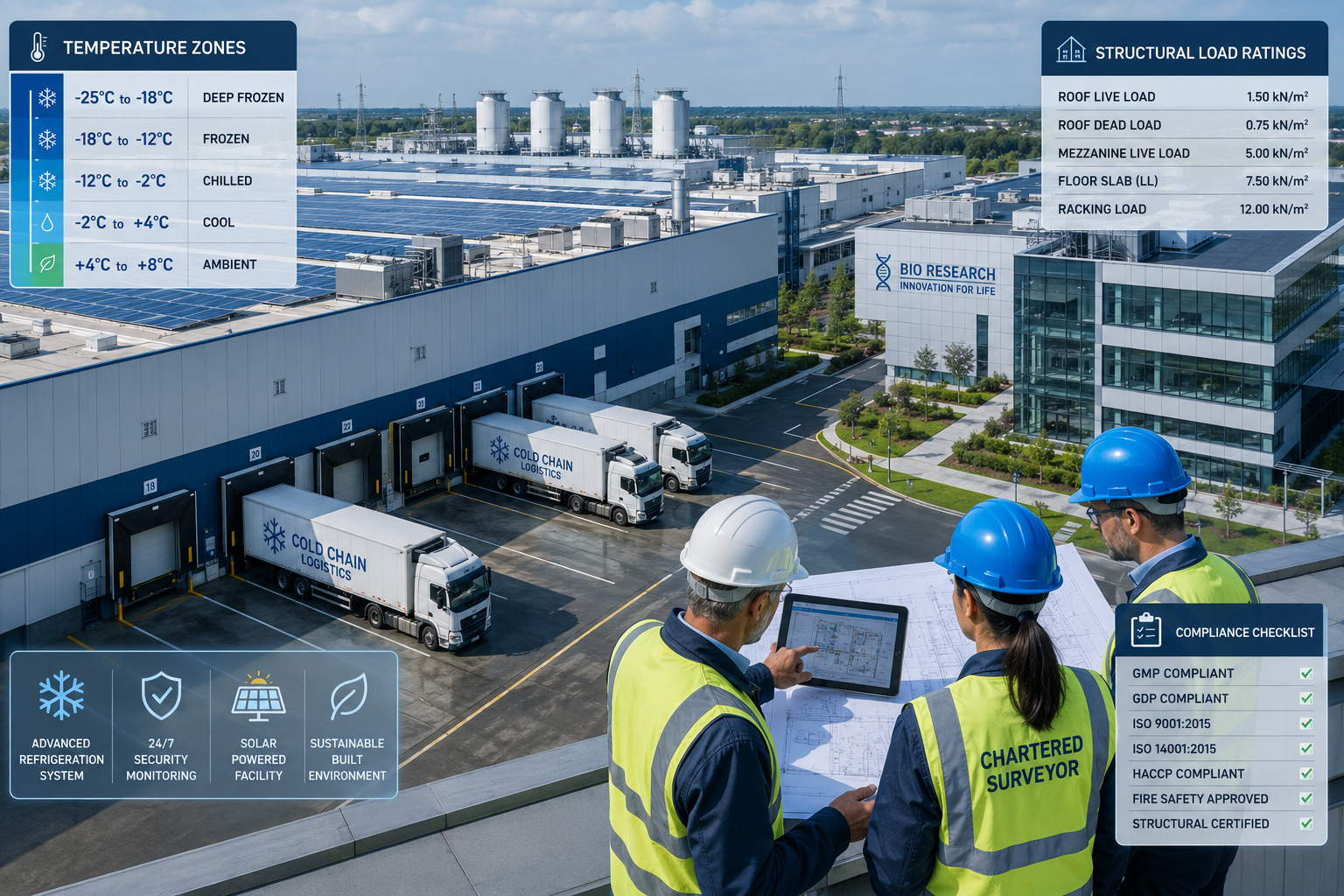
The Urban Land Institute's evolving framework treats cold chain logistics and life sciences campuses with the same strategic weight previously reserved for hospitals and data centres. This reclassification reflects a hard market reality: global pharmaceutical supply chains, vaccine distribution networks, and biotech manufacturing have made temperature-controlled space mission-critical infrastructure.
For surveyors and property professionals, this shift carries a clear message. Generic assessments designed for standard commercial buildings are inadequate for facilities where a 2°C temperature variance can render an entire inventory worthless, or where a structural defect in a clean-room floor can trigger a regulatory shutdown.
💬 "The risk profile of a -25°C blast freezer facility is categorically different from a standard warehouse. Treating them the same in a survey is like using a tape measure to check a heartbeat." — Senior Chartered Surveyor perspective, 2026
The supply chain booms of the mid-2020s have pushed cold storage yields to historically attractive levels, drawing institutional capital from pension funds, REITs, and private equity. But capital flowing in without specialist due diligence creates systemic risk. Precision assessments are the firewall between profitable acquisition and catastrophic loss.
Core Components of a Specialist Cold Storage Survey
Structural Assessment Under Extreme Thermal Conditions
Cold storage buildings are subject to stresses that standard commercial structures never face. Repeated freeze-thaw cycles, condensation accumulation, and the weight of refrigeration plant on rooftops create unique building pathology challenges that demand expert interpretation.
Key structural elements to assess include:
| Element | Specific Risk | Assessment Method |
|---|---|---|
| Insulated floor slabs | Heave from ground frost | Ground-penetrating radar, core sampling |
| Sandwich panel walls | Delamination, moisture ingress | Thermal imaging, percussion testing |
| Roof structure | Overloading from HVAC plant | Load calculation, drone visual inspection |
| Column bases | Settlement from refrigerant leaks | Level survey, soil investigation |
| Dock levellers | Fatigue cracking, seal failure | Physical inspection, operational testing |
A Level 3 Full Building Survey provides the most comprehensive structural baseline, but it must be adapted by a surveyor with cold chain experience. Standard RICS methodology covers the fabric — specialist knowledge covers the thermal mechanics.
Mechanical, Electrical, and Refrigeration Plant (MEP+R)
The refrigeration plant in a cold storage facility is often worth more than the building shell itself. A specialist survey must include:
- Refrigerant type and compliance — HFC phase-out regulations under F-Gas rules affect asset value directly
- Compressor age and service history — plant over 15 years old carries significant replacement liability
- Electrical capacity and resilience — cold storage is an energy-intensive use; incoming supply adequacy is critical
- Backup power provision — generator capacity, fuel storage, and automatic transfer switch testing
- BMS (Building Management System) integration — data logging, alarm systems, and remote monitoring capability
🔑 Key point: Refrigeration plant defects are the single largest source of post-acquisition cost surprises in cold storage transactions. A surveyor without MEP+R competence cannot adequately protect a buyer.
Environmental and Contamination Screening
Life sciences facilities present a distinct environmental risk profile. Biotech labs, pharmaceutical manufacturing units, and research campuses may have histories involving:
- Hazardous chemical storage and disposal
- Radioactive material use
- Biological containment failures
- Legacy asbestos in older laboratory fit-outs
Thorough environmental issues assessment is essential before any acquisition. This includes Phase 1 desktop studies, Phase 2 intrusive investigation where warranted, and specific screening for asbestos in building surveys — particularly relevant in laboratory buildings constructed before 2000.
Surveying Niche Essentials: Precision Assessments for Cold Storage and Life Sciences Facilities in 2026 — The Technical Toolkit
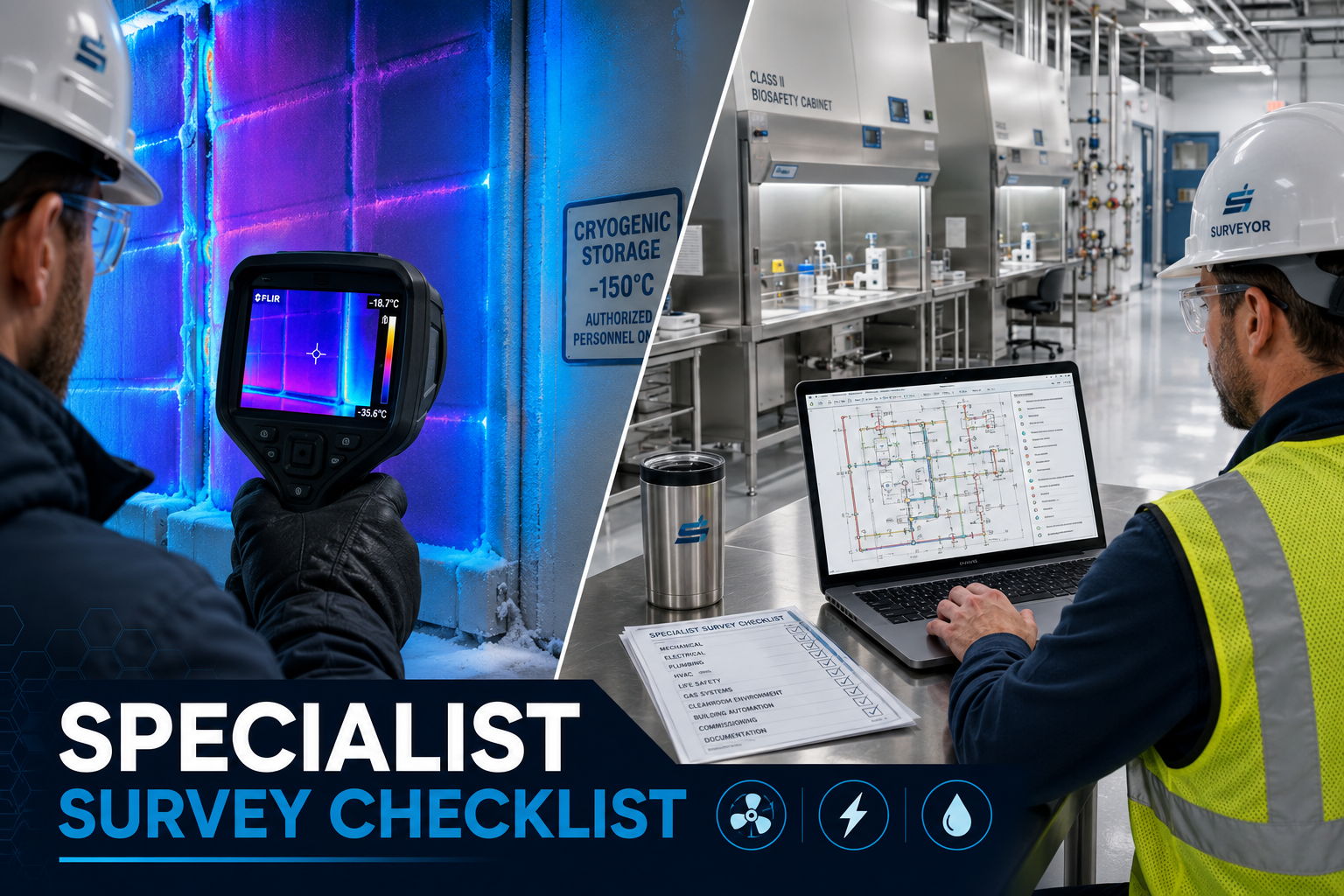
Modern precision assessment for these specialist asset types relies on a suite of technologies that have matured significantly by 2026. Understanding the toolkit helps buyers ask the right questions when commissioning a survey.
🛸 Drone-Assisted Roof and Facade Inspection
Large cold storage facilities often cover 50,000 sq ft or more, with roofs carrying substantial refrigeration plant. Physical access is hazardous and time-consuming. Premium drone survey services now deliver:
- High-resolution photogrammetry of roof membranes and panel joints
- Thermal imaging to detect moisture ingress beneath waterproofing layers
- Detailed 3D point cloud models for structural analysis
- Safe inspection of elevated facades and loading canopies
Drone data, when combined with ground-level thermal imaging, provides a complete picture of the building envelope — the most critical element in maintaining thermal performance.
🌡️ Thermal Imaging Surveys
Thermal cameras detect temperature differentials invisible to the naked eye. In cold storage contexts, they reveal:
- Cold bridges — points where insulation is compromised, driving energy costs up
- Panel joint failures — gaps in the building envelope allowing warm air infiltration
- Moisture pockets — trapped water within insulated panels that will eventually cause structural failure
- Refrigerant leak paths — temperature anomalies around pipework and fittings
In life sciences buildings, thermal imaging identifies HVAC distribution inefficiencies that compromise clean-room environmental control.
📊 Compliance and Regulatory Audit
Both asset types operate within dense regulatory frameworks. A precision assessment must map compliance status across:
Cold Storage:
- Food Safety Act / BRC Global Standard for Storage and Distribution
- F-Gas Regulation (refrigerant compliance)
- Fire suppression system certification
- Planning use class and permitted development limitations
Life Sciences:
- MHRA Good Manufacturing Practice (GMP) guidelines
- HSE COSHH regulations
- Containment Level (CL1–CL4) certification
- Clean-room classification (ISO 14644)
Surveyors working in these sectors should understand planning considerations that affect future use, expansion potential, and change-of-use risk — all of which directly affect asset value.
Life Sciences Facilities: Unique Survey Considerations
Life sciences real estate is the fastest-growing commercial property sector in the UK in 2026, driven by post-pandemic investment in pharmaceutical and genomics research. But the buildings that house this activity are extraordinarily complex.
Clean-Room Integrity Assessment
Clean rooms are classified by airborne particulate levels. Maintaining classification requires:
- Positive pressure differentials between zones
- HEPA filtration systems in verified condition
- Seamless, chemically resistant floor and wall finishes
- Specialist HVAC with validated air change rates
A surveyor assessing a life sciences facility must verify that the physical fabric supports these requirements. Cracks in partition walls, degraded sealants around service penetrations, or failed pressure differentials all represent material defects with significant remediation costs.
Vibration and Acoustic Sensitivity
Many laboratory instruments — electron microscopes, mass spectrometers, precision balances — are highly sensitive to vibration. Buildings housing this equipment require:
- Anti-vibration floor mounts or isolated structural bays
- Assessment of external vibration sources (road traffic, rail, nearby plant)
- Acoustic separation between mechanical plant and laboratory space
Standard building survey methodology does not address vibration risk. A specialist life sciences surveyor will include vibration monitoring as part of the assessment protocol.
Utility Resilience and Redundancy
Life sciences operations cannot tolerate utility interruption. Survey assessment must cover:
- N+1 power redundancy — dual incoming supplies, UPS systems, generator capacity
- Pure water systems — RO/DI water generation plant condition and capacity
- Medical gas pipework — condition, certification, and pressure testing records
- Drainage — acid-resistant drainage systems and trade effluent consent status
Surveying Niche Essentials: Precision Assessments for Cold Storage and Life Sciences Facilities in 2026 — Common Defects and Their Cost Implications
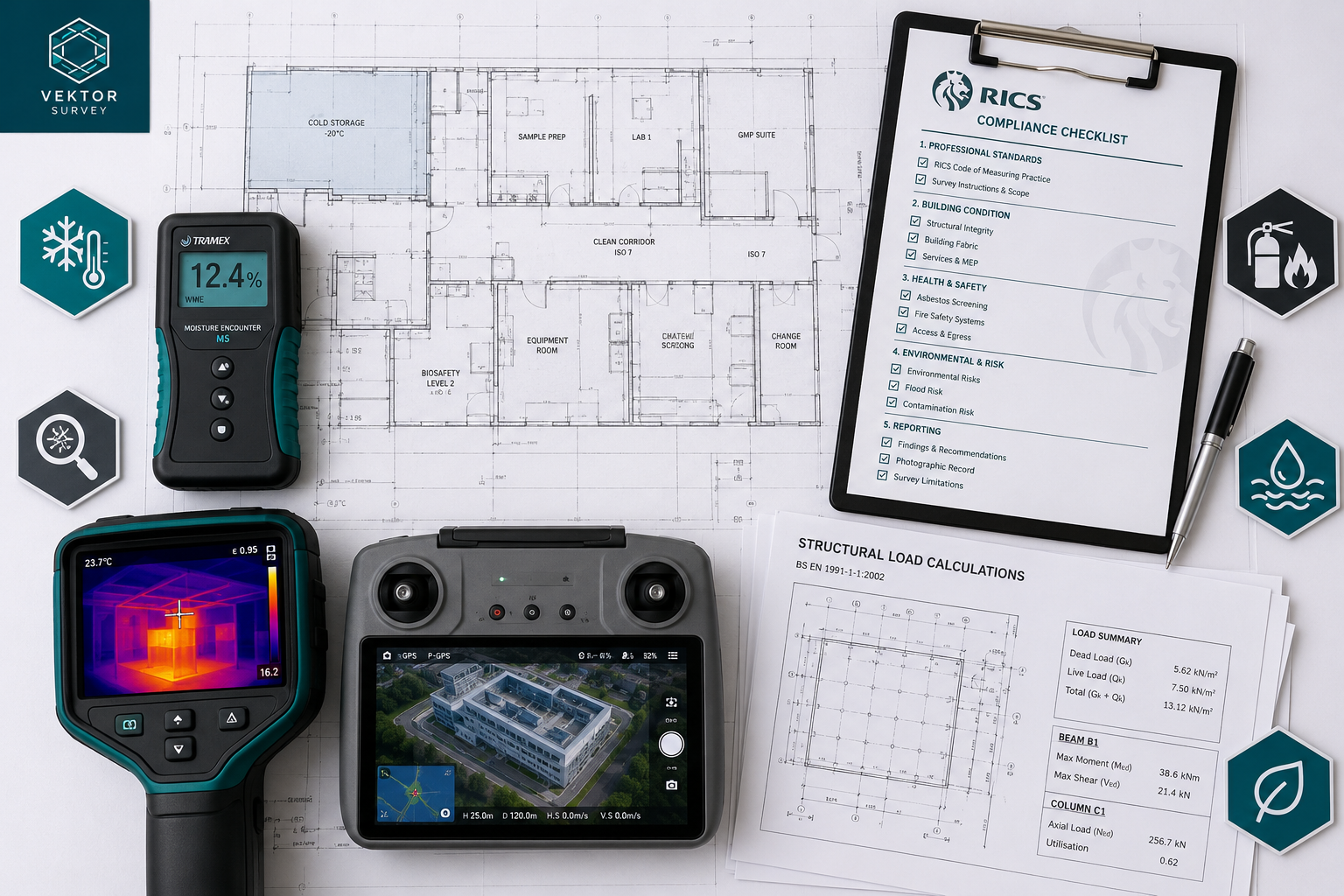
Understanding the most frequently identified defects helps buyers budget realistically and negotiate effectively. The table below summarises common findings and indicative remediation costs in 2026.
| Defect Type | Frequency | Typical Remediation Cost |
|---|---|---|
| Insulated panel delamination | Very common | £15,000–£150,000+ |
| Refrigeration plant end-of-life | Common | £200,000–£800,000+ |
| Floor slab heave/cracking | Moderate | £50,000–£300,000 |
| Asbestos in laboratory fit-out | Moderate (pre-2000 buildings) | £20,000–£100,000 |
| Clean-room HVAC failure | Common | £80,000–£400,000 |
| Refrigerant non-compliance | Increasing | £30,000–£200,000 |
| Drainage system failure | Common | £25,000–£150,000 |
💡 Understanding the average price reduction after a survey is important context here. In specialist facilities, survey findings routinely justify price reductions of 5–15% of acquisition value — often far exceeding the cost of the survey itself.
Buyers who skip specialist assessment often discover these defects post-completion, at which point the full remediation cost falls entirely on them. The survey fee — typically £3,000–£8,000 for a specialist cold storage or life sciences assessment — is one of the highest-return investments in any transaction.
Choosing the Right Surveyor for Specialist Facilities
Not every chartered surveyor has the competence to assess cold storage or life sciences buildings. When selecting a professional, look for:
✅ RICS membership with relevant commercial building survey experience
✅ Demonstrable sector experience — ask for examples of similar assessments
✅ Access to specialist subcontractors — refrigeration engineers, environmental consultants, clean-room specialists
✅ Technology capability — thermal imaging, drone survey, BMS data analysis
✅ Understanding of regulatory frameworks — F-Gas, GMP, BRC, MHRA
It is also worth considering whether the surveyor can support ongoing maintenance planning post-acquisition. The complexity of these buildings means that a well-structured planned preventive maintenance (PPM) schedule, informed by survey findings, can significantly reduce lifecycle costs.
For those uncertain about which level of assessment is appropriate, a useful starting point is understanding which building survey you need before engaging a specialist.
The Investment Case for Precision Assessment
The ULI's repositioning of cold storage and life sciences as essential real estate reflects a structural shift in how institutional capital views these assets. Long income, government-backed tenants (NHS, university research bodies, defence contractors), and supply-constrained markets make them compelling investments.
But the same characteristics that make them attractive — complexity, specialisation, regulatory intensity — make them high-risk without proper due diligence.
The investment case for precision assessment is straightforward:
- Risk quantification — know exactly what you are buying before funds are committed
- Negotiation leverage — survey findings create evidence-based grounds for price adjustment
- Lender confidence — specialist survey reports satisfy lender due diligence requirements
- Asset management — survey data informs capex planning and lease negotiations
- Exit strategy — a well-documented building with a clean survey history commands premium pricing at disposal
In 2026, as competition for quality cold storage and life sciences stock intensifies, the buyers who commission thorough precision assessments will consistently outperform those who rely on desktop analysis alone.
Conclusion: Actionable Next Steps for 2026
Surveying Niche Essentials: Precision Assessments for Cold Storage and Life Sciences Facilities in 2026 demands a fundamentally different approach from standard commercial property due diligence. The structural complexity, regulatory density, and mechanical sophistication of these buildings require specialist expertise, advanced technology, and a thorough understanding of sector-specific risk.
Here are the actionable next steps for buyers, investors, and occupiers:
- Commission early — instruct a specialist surveyor at Heads of Terms stage, not after exchange
- Define scope precisely — ensure the brief covers structural, MEP+R, environmental, and compliance dimensions
- Verify credentials — confirm RICS membership and specific sector experience before appointment
- Budget for findings — build a 10–15% contingency into acquisition models to absorb survey-identified defects
- Use findings strategically — leverage the survey report in price negotiations and lease discussions
- Plan for the long term — request a PPM schedule as part of the survey deliverables
The cold chain and life sciences sectors will continue to attract significant capital in 2026 and beyond. Those who invest in precision assessment will be best positioned to protect that capital — and to unlock the full value of these essential assets.