

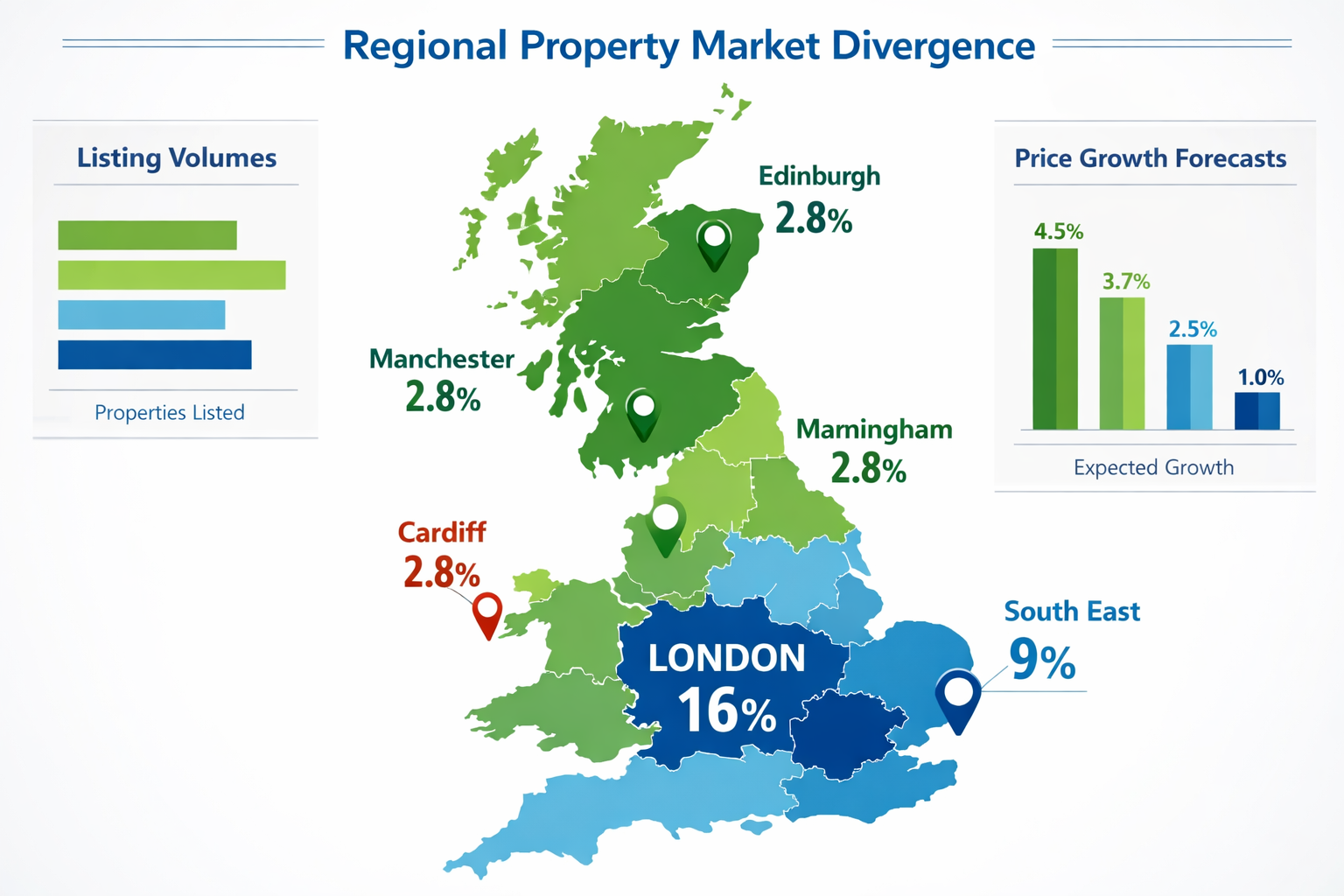
The London property market has entered 2026 with a dramatic transformation. Listing volumes have surged by approximately 80% year-on-year, marking the highest level of buyer choice since 2014[4]. For chartered surveyors and valuation professionals, this represents an unprecedented opportunity to capture increased instruction volume by understanding Supply-Side Opportunities: Building Surveys and Valuations for the 16% Surge in London Listings and Regional Market Divergence. As southern England experiences sharp supply increases—London up 16% and the South East up 9%—the market dynamics are shifting in ways that demand strategic adaptation from surveying professionals.
This supply-side surge isn't happening in isolation. Buyer enquiries have jumped by 57-60% compared to the final quarter of 2025, while total stock on sale has increased by 8.3% nationally[4][6]. Yet beneath these headline figures lies a complex story of regional divergence, with London and the South East following distinctly different trajectories than the Midlands, North, Scotland, and Wales.

Key Takeaways
- London listing volumes have increased 80% year-on-year, creating the largest supply-side opportunity for surveyors since 2014, with buyer enquiries up 57-60% driving instruction demand
- Regional market divergence is accelerating, with London forecast for 1% growth while the Midlands, North, Scotland and Wales outperform with stronger affordability-driven appreciation
- First-time buyers now represent 48.3% of London sales (up from 22.4% a decade ago), shifting survey demand toward flats in Zones 2-4 and smaller properties in affordable boroughs
- Prime Central London presents a buyer's market, with the best conditions in ten years for purchasers in the £5m+ segment where new instructions are up 12.5%
- Surveyors must adapt service offerings to capture supply-side opportunities by understanding listing trends, seasonal timing, and regional variations in property types and buyer profiles
Understanding the 2026 Supply-Side Surge: Market Fundamentals Behind London's Listing Boom
The dramatic increase in London property listings didn't emerge overnight. The surge began immediately after Christmas 2025, with new listings jumping over 80% post-holiday and Boxing Day seeing record levels of property search activity nationally[2]. This timing reflects renewed confidence following economic stabilization and clearer mortgage market conditions.
The Numbers Behind the Surge
The scale of supply-side growth varies significantly by market segment and geography:
| Market Segment | Supply Increase | Key Driver |
|---|---|---|
| Overall London Market | 80% year-on-year | Renewed seller confidence |
| Total UK Stock | 8.3% vs. start 2025 | Post-Christmas activity |
| £5m+ Prime Market | 12.5% new instructions | Buyer's market conditions |
| South East Region | 9% listing growth | Regional spillover effect |
These figures represent more than statistical anomalies—they signal fundamental shifts in seller behavior and market psychology. The week of February 3-7 saw property launches reach their highest visibility before the traditional March surge, with peak competition beginning the week of February 24-28[1].
Why Sellers Are Returning to Market
Several converging factors explain the supply-side expansion:
- 🏦 Mortgage market stabilization following 2024-2025 rate volatility
- 📈 Improved economic sentiment and employment confidence
- 💷 Realistic pricing expectations after market corrections
- 🔄 Pent-up transaction demand from delayed moves during uncertainty
- 📊 Strategic timing to capture spring market momentum
For surveying professionals, understanding these motivations helps position services effectively. Sellers returning to market after delays may require comprehensive building surveys to establish accurate valuations, particularly for properties that have been held off-market during maintenance or renovation periods.
Regional Context: London Within the Broader UK Market
While London experiences significant supply growth, the capital's price appreciation forecast remains modest at around 1% for 2026, compared to the UK average of 2.8% recorded in January—the largest January increase on record[3]. This divergence reflects:
- Affordability constraints limiting London price growth
- Regional rebalancing as buyers seek value outside the capital
- First-time buyer dominance (48.3% of London sales) focusing on entry-level properties[6]
- Prime market softening creating buyer advantages in higher brackets
Understanding these dynamics allows surveyors to tailor their valuation services to reflect realistic market conditions rather than outdated appreciation assumptions.
Capturing Supply-Side Opportunities: Building Surveys and Valuations for the 16% Surge in London Listings
The surge in London listings creates direct opportunities for chartered surveyors to expand instruction volumes across multiple service lines. However, capturing this opportunity requires strategic positioning and service adaptation.

Positioning for Increased Survey Instructions
With 80% more properties entering the market, the demand for pre-listing surveys, purchase surveys, and valuation services has expanded proportionally. Surveyors can capture this opportunity through several approaches:
Pre-Listing Survey Services
Sellers increasingly recognize the value of obtaining surveys before listing to:
- Establish realistic asking prices based on condition assessments
- Identify maintenance issues that could derail transactions
- Demonstrate transparency to attract serious buyers
- Accelerate transaction timelines by addressing concerns proactively
Offering Level 3 full building surveys as pre-listing services positions surveyors as strategic advisors rather than transaction gatekeepers. This approach is particularly effective in the current market where buyers have increased choice and can afford to be selective.
Purchase Survey Demand
The 57-60% increase in buyer enquiries translates directly to purchase survey demand[4]. However, the composition of buyers has shifted dramatically:
- First-time buyers at 48.3% of London sales require education about which building survey they need
- Younger buyers expect digital delivery and clear, accessible reporting
- Value-conscious purchasers seek comprehensive assessments to avoid costly surprises
- Investment buyers require detailed condition analysis for portfolio decisions
Adapting communication styles and service packages to these buyer profiles increases conversion rates. For instance, first-time buyers benefit from educational content explaining the different types of building surveys available and their respective value propositions.
Valuation Services in a High-Supply Environment
The supply surge affects valuation methodology and service delivery:
Market Value Considerations:
- Increased supply creates downward pressure on valuations in some segments
- Comparable evidence becomes more current with active transaction volumes
- Days on market become critical indicators of realistic pricing
- Condition premiums narrow as buyers have more choice
Professional valuers must adjust their approaches to reflect these realities. Commercial valuations and matrimonial valuations require particular attention to current market conditions rather than historical precedents.
Seasonal Timing and Instruction Flow
Understanding the seasonal patterns of the 2026 market allows surveyors to optimize resource allocation:
The February visibility peak (week of February 3-7) followed by the March competition surge (week of February 24-28) creates predictable instruction waves[1]. Surveyors should:
- 📅 Pre-book capacity during January for February-March peak demand
- 🤝 Strengthen estate agent relationships before seasonal surges
- 💻 Enhance digital booking systems to capture online enquiries
- 📞 Increase communication bandwidth during high-volume periods
- ⚡ Streamline report delivery to maintain quality during peaks
The post-Christmas surge pattern that characterized early 2026 suggests similar patterns may emerge in future years, allowing strategic planning around these cycles.
Regional Market Divergence: Adapting Survey Services for Geographic Variations
Perhaps the most significant aspect of Supply-Side Opportunities: Building Surveys and Valuations for the 16% Surge in London Listings and Regional Market Divergence is the growing gap between London's performance and other UK regions. This divergence requires surveyors to adapt their service offerings based on geographic focus.
London and South East: High Supply, Moderate Growth
The London and South East markets share common characteristics in 2026:
- High listing volumes (London +80%, South East +9% in supply growth)
- Moderate price appreciation (London ~1%, below national average)
- Buyer's market conditions particularly in prime segments
- First-time buyer dominance reshaping demand profiles
For surveyors operating in these regions, service adaptation should focus on:
Volume Efficiency: With higher instruction volumes, surveyors must balance thoroughness with efficiency. Understanding how long a building survey takes and optimizing scheduling becomes critical to capturing market share without compromising quality.
Price-Sensitive Positioning: Buyers in high-supply markets have negotiating power. Survey findings that identify defects provide leverage for price reductions, making comprehensive assessments more valuable. Highlighting this benefit in marketing materials increases instruction rates.
Property Type Focus: The dominance of first-time buyers shifts demand toward:
- Flats in Zones 2-4 requiring leasehold-specific considerations
- Smaller houses in affordable boroughs like Bromley, Croydon, and Bexley
- Conversion properties needing detailed construction and condition surveys
- Period properties requiring specialist knowledge of common defects in older homes
Surveyors serving South East London, Surrey, or Guildford should emphasize these property-type specializations in their positioning.
The Midlands, North, Scotland, and Wales: Outperformance Regions
Forecasts point toward particularly strong performance across regions outside the South East, where affordability remains most attractive[2]. These markets present different opportunities:
Characteristics of Outperforming Regions:
- 💪 Stronger price appreciation exceeding London's growth
- 🏠 Improved affordability ratios attracting relocating buyers
- 📈 Investment appeal for portfolio buyers seeking yield
- 🔄 Supply-demand balance favoring sellers more than London
Survey Service Implications:
For surveyors operating nationally or considering geographic expansion, these regions offer:
- Higher valuation growth rates supporting premium service pricing
- Investment buyer focus requiring detailed property development valuations
- Relocation buyers needing comprehensive assessments of unfamiliar property types
- Buy-to-let focus demanding rental valuation expertise
The divergence also creates opportunities for surveyors to provide comparative market analysis services, helping clients understand regional value propositions when considering investment or relocation decisions.
Prime Central London: The Buyer's Market Opportunity
Prime Central London deserves special attention as it presents "the best buyers' market we have seen in ten years" according to industry analysis[6]. The £5m+ market has seen new instructions increase by 12.5%, while values have softened year-on-year.
Surveyor Opportunities in Prime Markets:
- 🔍 Enhanced due diligence demand from buyers with negotiating power
- 💼 High-value instruction fees reflecting property values
- 🏛️ Complex property types requiring specialist expertise
- 🌍 International buyer services needing comprehensive documentation
- ⚖️ Negotiation support through detailed defect identification
Prime market buyers typically require Level 3 full building surveys with extensive sourcing of extra specialist advice on matters like asbestos, structural integrity, and maintenance requirements.
Surveyors serving areas like Clapham, Hammersmith, Ealing, and Twickenham should position themselves to capture both the prime market and the substantial mid-market segments in these locations.
Strategic Service Adaptations for Surveyors in 2026
To fully capitalize on supply-side opportunities, chartered surveyors should consider several strategic adaptations:
1. Digital Service Delivery Enhancement
The 57% increase in buyer enquiries includes significant online research activity[4]. Surveyors must:
- ✅ Optimize website booking systems for mobile users
- ✅ Provide instant quote generation tools
- ✅ Deliver digital reports with interactive elements
- ✅ Offer video walkthroughs of survey findings
- ✅ Enable secure document sharing platforms
2. Tiered Service Offerings
Market segmentation requires differentiated service levels:
| Service Tier | Target Market | Key Features |
|---|---|---|
| Essential | First-time buyers, flats | Streamlined reporting, competitive pricing |
| Comprehensive | Family homes, period properties | Full Level 3 survey, detailed analysis |
| Premium | Prime market, complex properties | Specialist consultations, extensive reporting |
This tiered approach allows surveyors to capture volume at entry levels while maintaining premium positioning for complex instructions.
3. Partnership Development
Strategic partnerships amplify market reach:
- 🤝 Estate agent relationships for pre-listing survey referrals
- 🏦 Mortgage broker connections for purchase survey instructions
- 👷 Contractor networks for post-survey remediation referrals
- 💼 Legal firm partnerships for valuation services in matrimonial and probate matters
Building these relationships before peak seasons ensures consistent instruction flow during high-volume periods.
4. Specialist Niche Development
Regional divergence creates opportunities for specialization:
- Period property expertise for Victorian and Edwardian stock
- New build snagging as development completions increase
- Leasehold specialists for the flat-dominated first-time buyer market
- Investment property analysis for portfolio buyers
- Energy efficiency assessment as EPC and MEES considerations gain importance
Developing recognized expertise in specific niches allows premium pricing and reduces direct competition.
5. Educational Content Marketing
With first-time buyers representing 48.3% of London sales[6], educational content provides significant value:
- 📝 Blog posts explaining Level 2 vs Level 3 surveys
- 🎥 Video content on what to expect during a building survey
- 📊 Market updates on regional trends and pricing
- 🏠 Property type guides for different London zones
- 💡 Buyer checklists and decision frameworks
This content establishes authority while capturing early-stage enquiries that convert to instructions as buyers progress their property search.
Practical Implementation: Capturing the Supply Surge
Translating strategy into action requires concrete implementation steps:
Immediate Actions (Next 30 Days)
- Audit current capacity to identify maximum instruction volumes
- Review pricing strategy to ensure competitiveness in high-supply market
- Strengthen digital presence with website optimization and booking systems
- Reach out to estate agents in target areas to establish referral relationships
- Prepare marketing materials highlighting relevant specializations
Medium-Term Development (Next 90 Days)
- Develop tiered service packages with clear differentiation
- Create educational content targeting first-time buyers
- Implement CRM systems to manage increased enquiry volumes
- Train team members on market trends and buyer profiles
- Establish quality control processes to maintain standards during volume increases
Long-Term Strategic Positioning (Next 12 Months)
- Build specialist expertise in chosen niche areas
- Expand geographic coverage into outperforming regions if appropriate
- Develop partnership ecosystem for comprehensive service delivery
- Invest in technology for efficiency and enhanced client experience
- Monitor market evolution and adapt services as conditions change
Conclusion
The Supply-Side Opportunities: Building Surveys and Valuations for the 16% Surge in London Listings and Regional Market Divergence represent a defining moment for chartered surveyors in 2026. With London listing volumes up 80% year-on-year and buyer enquiries increasing 57-60%, the instruction pipeline has expanded dramatically[4]. However, capturing this opportunity requires more than simply processing increased volumes—it demands strategic adaptation to shifting buyer profiles, regional divergence, and evolving market dynamics.
The dominance of first-time buyers at 48.3% of London sales, combined with the buyer's market conditions in prime segments and the outperformance of regions outside the South East, creates a complex landscape requiring nuanced service positioning[6]. Surveyors who understand these dynamics and adapt their offerings accordingly will capture disproportionate market share during this supply surge.
Next Steps for Surveying Professionals
To capitalize on these supply-side opportunities:
- Assess your current positioning against the market trends outlined in this analysis
- Identify your target segments based on geographic focus and property specialization
- Adapt service offerings to match buyer profiles and market conditions
- Strengthen digital capabilities to capture online enquiries effectively
- Build strategic partnerships to ensure consistent instruction flow
- Monitor market evolution as 2026 progresses and adjust strategies accordingly
The surge in London listings creates a rising tide, but only surveyors who adapt their vessels to navigate these specific waters will fully benefit from the opportunity. By understanding both the supply-side dynamics and the regional divergence shaping the 2026 market, chartered surveyors can position themselves for sustained growth throughout this market cycle and beyond.
For surveyors ready to capture these opportunities, the time to act is now—before the spring surge reaches its peak and competition for instructions intensifies. The market has provided the opportunity; strategic execution will determine who benefits most from it.
References
[1] London Spring Property Market 2026 – featheringtoninteriors.com
[2] The Uk Property Market Enters 2026 With Renewed Confidence And Strong Momentum – aucklandestates.com
[3] London Property Market Update 2026 A Market Reset Or Opportunity – lysshomes.co.uk
[4] Londons Property Market Outlook 2026 The Spring Surge Arrives Early – reimcapital.com
[5] What To Expect From The London Property Market In 2026 – winkworth.co.uk
[6] March 2026 – black-brick.com