

The construction industry faces a stark reality: while green building demand shows positive growth globally, momentum is stalling precisely when climate urgency demands acceleration. The RICS Sustainability Report 2025 reveals that despite increased awareness, a significant percentage of construction professionals still do not measure carbon across projects—a figure that has risen dramatically from 34% in 2024[2][3]. This gap between ambition and action creates critical implications for party wall agreements in 2026, where sustainability clauses are no longer optional but essential for future-proofing property development.
Understanding the RICS Sustainability Report 2025 Implications for Party Wall Awards: Embedding Net Zero Clauses in 2026 becomes crucial as neighboring property owners navigate increasingly complex construction projects that must balance legal obligations with environmental responsibilities. The traditional party wall framework now requires integration with carbon impact assessments, sustainable material specifications, and net zero compliance measures.
Key Takeaways
- 🌍 Regional sustainability growth varies significantly, with the Middle East & Africa leading at +52% compared to the UK's +43%, requiring location-specific party wall approaches
- 📊 Carbon measurement gaps persist, with many professionals lacking knowledge and skills to reduce embodied carbon emissions in construction projects
- ⚖️ Party wall awards must now incorporate net zero clauses to prevent future disputes over sustainable construction methods and material choices
- 💰 Initial costs, ROI evidence gaps, and investor awareness remain the three primary obstacles blocking sustainable building investment
- 🏗️ Proactive sustainability integration in party wall agreements reduces dispute risks and ensures compliance with evolving environmental regulations
Understanding the RICS Sustainability Report 2025 Context
The RICS Sustainability Report 2025 provides essential benchmarking data that directly impacts how party wall surveyors approach their work in 2026. The report's findings reveal a construction industry at a crossroads, where green building certification is recognized as important by a significant percentage of investors, yet practical implementation faces substantial barriers[3].
Key Findings from the RICS Sustainability Report 2025
The 2025 RICS Sustainable Building Index remains in positive territory, indicating continued growth in sustainable construction practices. However, the data reveals concerning trends:
| Region | Growth Rate | Key Characteristics |
|---|---|---|
| Middle East & Africa | +52% | Strongest performer, new regulatory frameworks |
| United Kingdom | +43% | Moderate growth, established standards |
| Europe | +39% | Steady progress, stringent regulations |
| Asia Pacific | +27% | Emerging markets, varied adoption |
| Americas | +11% | Slowest growth, fragmented approaches |
These regional variations matter significantly for party wall practitioners working on international projects or in diverse UK communities with different sustainability expectations[2][3].
Critical Barriers to Sustainable Building Investment
The RICS report identifies three primary obstacles that party wall surveyors must address when drafting awards:
- Initial Costs – Sustainable materials and construction methods often carry higher upfront expenses
- Lack of ROI Evidence – Insufficient long-term data demonstrating financial returns on green investments
- Investor Awareness Gaps – Limited understanding among property owners about sustainability benefits
These barriers directly influence party wall disputes when neighboring owners disagree about the necessity or cost allocation of sustainable construction methods.
RICS Sustainability Report 2025 Implications for Party Wall Awards: Practical Applications
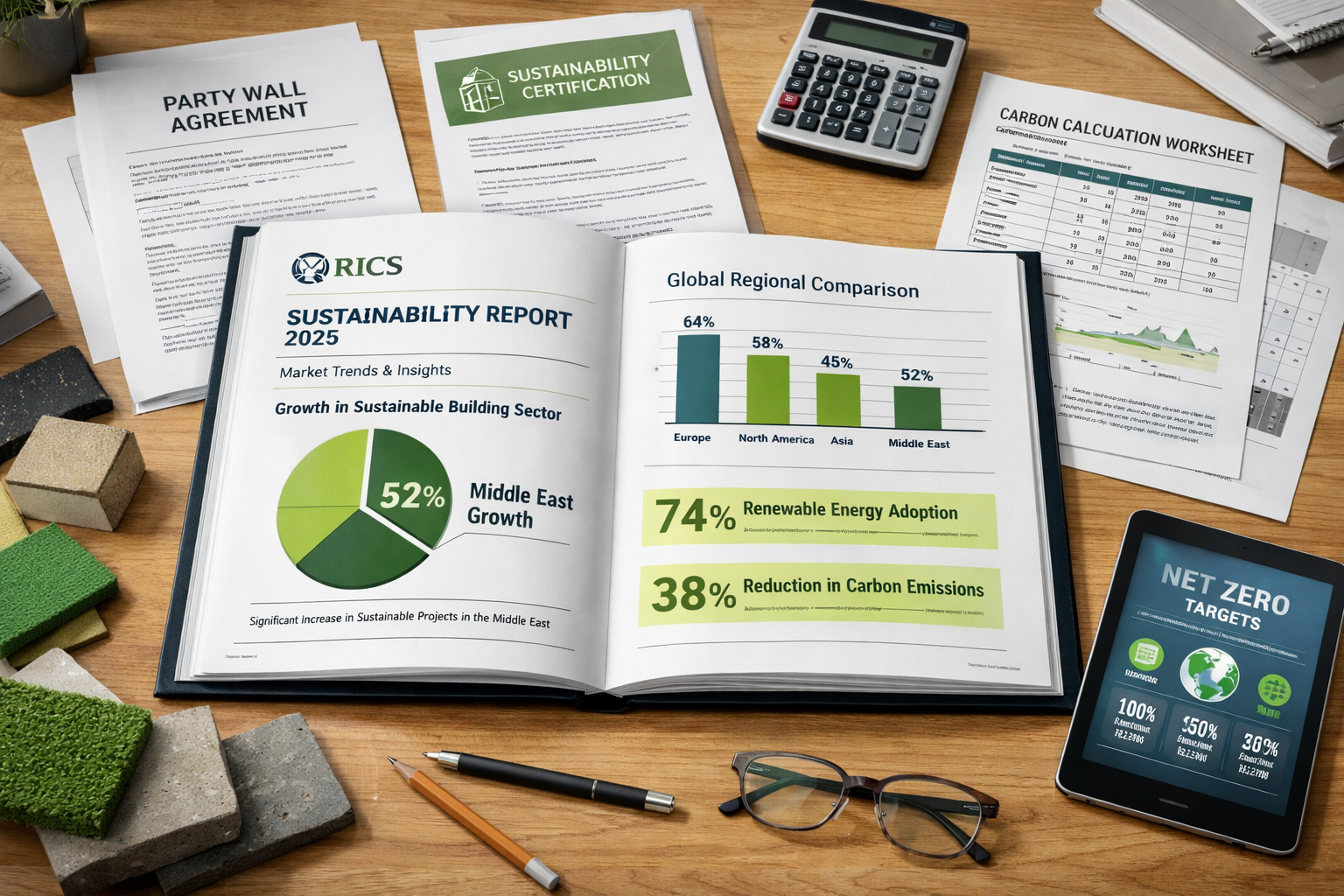
The integration of sustainability metrics into party wall awards represents a fundamental shift in how surveyors document and approve construction work. Traditional party wall agreements focused primarily on structural integrity, noise mitigation, and damage prevention. In 2026, these documents must expand to address environmental impact.
Carbon Impact Assessments in Party Wall Procedures
A concerning finding from the RICS report shows that many professionals report carbon calculations and climate resilience assessments in fewer than half of projects or not at all[2][3]. This gap creates significant risks for party wall awards:
Building owners undertaking notifiable work must now consider:
- Embodied carbon in proposed materials and construction methods
- Operational carbon impacts from new extensions or alterations
- Whole-life carbon assessments for major structural works
- Climate resilience measures protecting both properties
When drafting party wall awards, surveyors should include specific clauses requiring:
✅ Pre-construction carbon baseline assessments
✅ Material specifications with embodied carbon data
✅ Construction method statements prioritizing low-carbon approaches
✅ Post-completion verification of sustainability targets
Addressing the Knowledge Gap
The RICS report reveals that a significant percentage of professionals cite insufficient knowledge and skills to reduce embodied carbon emissions[2][3]. This knowledge deficit has direct implications for party wall surveyors' responsibilities and the quality of awards they produce.
Professional development priorities for 2026:
- Understanding embodied carbon calculation methodologies
- Familiarity with sustainable construction materials and techniques
- Knowledge of green building certification systems (BREEAM, LEED, Passivhaus)
- Awareness of climate resilience design principles
- Competence in balancing sustainability goals with cost considerations
Embedding Net Zero Clauses in 2026 Party Wall Awards
The practical implementation of net zero clauses requires careful drafting to ensure enforceability while maintaining flexibility for evolving best practices. Party wall awards must balance legal precision with environmental ambition.
Essential Components of Net Zero Party Wall Clauses
1. Material Specification Requirements
Modern party wall awards should specify:
- Minimum recycled content percentages for concrete, steel, and timber
- Banned materials with high embodied carbon (where alternatives exist)
- Locally sourced materials to reduce transportation emissions
- Certification requirements (FSC timber, EPD-certified products)
Example clause: "The Building Owner shall ensure that all structural timber used in the proposed works carries FSC certification, and that concrete mixes incorporate a minimum of 30% ground granulated blast-furnace slag (GGBS) or equivalent low-carbon cement replacement, unless technical requirements demonstrably preclude such substitution."
2. Construction Method Protocols
Party wall awards must address how work is executed:
- Waste management plans with minimum recycling targets
- Energy-efficient equipment requirements for contractors
- Water conservation measures during construction
- Air quality protection for both properties
3. Performance Monitoring and Verification
Unlike traditional awards that focus solely on structural outcomes, net zero clauses require ongoing monitoring:
- Carbon accounting documentation at project milestones
- Third-party verification of sustainability claims
- Photographic evidence of specified materials being used
- Completion certificates confirming net zero compliance
Understanding what party wall rights include in the context of sustainability helps both building and adjoining owners navigate these new requirements.
Avoiding Disputes in Eco-Focused Builds
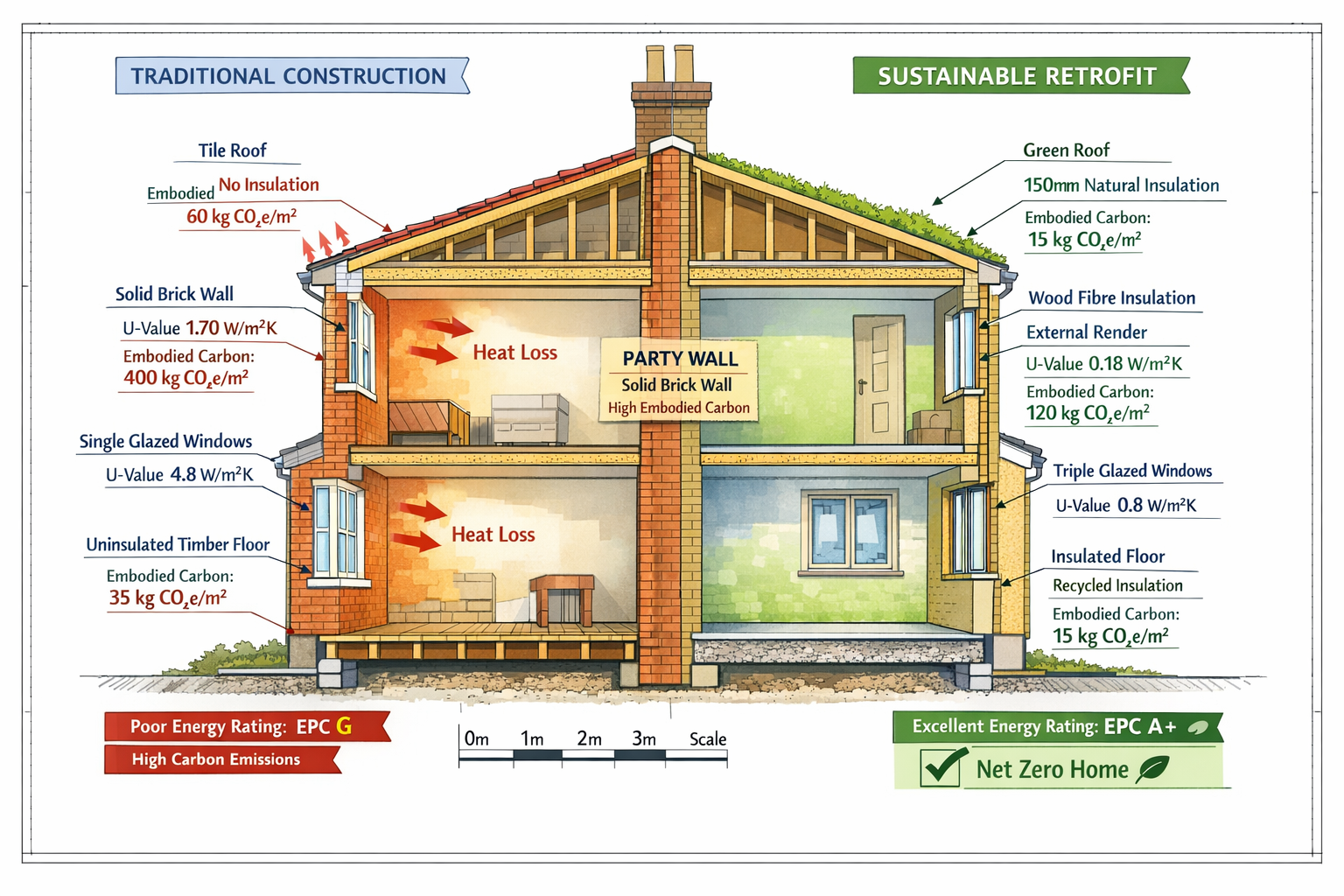
The RICS Sustainability Report 2025 data suggests that occupiers increasingly prioritize indoor environmental quality[3], creating new potential conflict areas in party wall scenarios. Proactive measures prevent disputes:
Common sustainability-related party wall disputes in 2026:
🔴 Disagreement over sustainable material costs – Adjoining owners questioning premium pricing for eco-materials
🔴 Thermal bridging concerns – Insulation work affecting party wall thermal performance
🔴 Ventilation system conflicts – MVHR systems requiring party wall penetrations
🔴 Renewable energy installations – Solar panels, heat pumps affecting shared structures
🔴 Embodied carbon allocation – Determining responsibility for carbon footprint of shared works
Best practices for dispute prevention:
- Early engagement with sustainability consultants before serving party wall notices
- Transparent cost breakdowns separating standard and enhanced sustainability measures
- Alternative material options presented with carbon and cost comparisons
- Independent sustainability assessments by RICS-qualified professionals
- Clear documentation of net zero benefits to both properties
The building surveyor's role expands significantly when sustainability considerations enter party wall negotiations.
Regional Variations and RICS Sustainability Report 2025 Implications
The dramatic regional differences in sustainable building growth rates identified in the RICS report (+52% in Middle East & Africa versus +11% in the Americas) create complexity for party wall practitioners working across diverse markets[2][3].
UK-Specific Considerations for 2026
The UK's +43% growth rate in sustainable building positions it as a moderate performer with established regulatory frameworks. Party wall awards in England and Wales must align with:
- Building Regulations Part L (Conservation of fuel and power) – Updated 2025 requirements
- Future Homes Standard – Preparing for 2025 implementation
- UK Green Building Council guidance – Industry best practices
- Local authority climate emergency declarations – Varying regional requirements
London-specific factors:
Property owners in London face additional considerations:
- Greater London Authority's net zero carbon targets
- Higher density development increasing party wall work volume
- Historic building constraints in conservation areas
- Premium property market driving sustainability demand
For properties in conservation areas or listed buildings, balancing heritage protection with sustainability goals requires specialist expertise.
International Project Implications
For surveyors working on international developments or advising multinational clients, understanding regional sustainability priorities becomes essential:
Middle East & Africa (+52% growth):
- Rapid regulatory development
- Focus on cooling efficiency and water conservation
- High solar potential integration
- Cultural considerations in sustainable design
Europe (+39% growth):
- Stringent EU taxonomy requirements
- Established certification systems
- Emphasis on circular economy principles
- Cross-border standardization efforts
Cost Implications and ROI Considerations
The RICS report identifies lack of ROI evidence as a primary barrier to sustainable building investment[2][3]. This directly impacts party wall negotiations where adjoining owners may resist contributing to enhanced sustainability measures.
Financial Framework for Sustainable Party Wall Works
Cost allocation principles for net zero clauses:
| Cost Category | Typical Allocation | Justification |
|---|---|---|
| Standard structural work | Shared per Party Wall Act | Legal requirement |
| Enhanced insulation (mutual benefit) | Negotiated split | Thermal performance improvement for both properties |
| Premium sustainable materials | Building Owner | Discretionary upgrade |
| Carbon assessment fees | Building Owner | Initiating owner's obligation |
| Monitoring and verification | Shared | Protects both parties |
ROI arguments for sustainable party wall works:
💰 Increased property values – Green buildings command premium prices
💰 Reduced operating costs – Lower energy bills benefit both properties
💰 Future-proofing – Compliance with anticipated stricter regulations
💰 Insurance benefits – Some insurers offer discounts for sustainable buildings
💰 Tenant demand – Higher occupancy rates for eco-certified properties
When determining the cost of party wall surveyor services, additional sustainability assessment work should be transparently itemized.
Practical Checklist for Party Wall Surveyors in 2026
Based on the RICS Sustainability Report 2025 implications, party wall surveyors should adopt this systematic approach:
Pre-Notice Stage
- Conduct preliminary carbon impact screening for proposed works
- Identify sustainability opportunities that benefit both properties
- Research applicable green building standards for the location
- Assess building owner's net zero commitments and legal obligations
- Review adjoining owner's sustainability preferences (if known)
Notice and Response Stage
- Include sustainability summary in explanatory documents
- Provide carbon impact estimates alongside structural information
- Offer sustainable material alternatives with cost comparisons
- Explain net zero clause benefits to both parties
- Address potential sustainability objections proactively
Award Drafting Stage
- Incorporate specific net zero clauses with measurable targets
- Define sustainable material specifications clearly
- Establish carbon monitoring protocols and reporting requirements
- Include verification and enforcement mechanisms
- Address dispute resolution procedures for sustainability disagreements
- Set realistic timelines accounting for sustainable material procurement
Construction Monitoring Stage
- Verify sustainable material deliveries against specifications
- Document construction methods for carbon accounting
- Monitor waste management and recycling compliance
- Conduct interim sustainability assessments at key milestones
- Photograph evidence of net zero clause compliance
Completion Stage
- Obtain sustainability verification certificates
- Calculate actual carbon footprint versus projections
- Document lessons learned for future projects
- Update professional knowledge based on project experience
- Provide completion report including sustainability outcomes
Emerging Technologies and Future Trends
The RICS Sustainability Report 2025 data indicates that while challenges persist, innovation continues advancing sustainable construction practices. Party wall surveyors must stay informed about emerging technologies that will shape awards in coming years:
Digital tools transforming party wall sustainability:
🔧 Building Information Modeling (BIM) – 3D modeling with embedded carbon data
🔧 Carbon calculation software – Automated embodied carbon assessments
🔧 Material passport systems – Digital tracking of material sustainability credentials
🔧 IoT sensors – Real-time monitoring of construction environmental impact
🔧 Blockchain verification – Immutable records of sustainable material sourcing
Material innovations affecting party wall works:
- Low-carbon concrete alternatives – Geopolymer, hempcrete, recycled aggregate
- Engineered timber products – Cross-laminated timber (CLT) for party wall structures
- Bio-based insulation – Sheep's wool, wood fiber, mycelium alternatives
- Recycled steel – Higher recycled content in structural elements
- Phase-change materials – Advanced thermal performance in party walls
For properties requiring structural engineering input, collaboration with sustainability specialists ensures comprehensive solutions.
Legal and Regulatory Landscape
The Party Wall etc. Act 1996 does not explicitly address sustainability considerations, creating a regulatory gap that party wall awards must bridge through careful drafting. However, adjacent legislation increasingly mandates environmental performance:
Relevant UK regulations affecting party wall works in 2026:
- Building Safety Act 2022 – Enhanced oversight of construction quality
- Environment Act 2021 – Biodiversity net gain requirements
- Climate Change Act 2008 (2050 Target Amendment) – Net zero legal obligation
- Energy Performance of Buildings Regulations – EPC requirements for alterations
Potential regulatory developments:
Anticipated changes that may impact party wall practice include:
- Mandatory embodied carbon declarations for building works
- Stricter waste reduction targets for construction projects
- Enhanced penalties for non-compliance with sustainability standards
- Extension of EPC requirements to smaller alterations
- Introduction of whole-life carbon assessments for planning permission
Staying informed about property market legislation changes helps surveyors anticipate regulatory impacts on party wall procedures.
Case Study Examples: Sustainability in Party Wall Awards
Case Study 1: Victorian Terrace Rear Extension
Scenario: Building owner proposes two-story rear extension in London terraced house, sharing party walls with both neighbors.
Sustainability challenges:
- Historic brick party walls with poor thermal performance
- Adjoining owner concerned about thermal bridging
- Building owner committed to Passivhaus standards
Solution:
Party wall award included:
- Detailed thermal modeling of party wall junction
- Specification of high-performance insulation with minimal thickness
- Agreement for thermal imaging verification post-completion
- Cost-sharing arrangement for mutual insulation benefits
- Carbon offset contribution for unavoidable thermal bridging
Outcome: Both properties achieved improved thermal performance, no disputes arose, and the building owner achieved Passivhaus certification.
Case Study 2: Commercial Property Sustainable Retrofit
Scenario: Office building owner undertaking deep retrofit to achieve BREEAM Excellent rating, affecting shared party wall with adjacent commercial property.
Sustainability challenges:
- Significant party wall structural alterations required
- High embodied carbon in proposed steel reinforcement
- Adjoining owner initially resistant to disruption
Solution:
Party wall award incorporated:
- Substitution of recycled steel with 95% recycled content
- Phased construction schedule minimizing adjoining owner disruption
- Shared benefit clause for improved fire resistance
- Independent sustainability verification by RICS professional
- Detailed carbon accounting demonstrating 40% embodied carbon reduction
Outcome: Project achieved BREEAM Excellent, adjoining owner benefited from improved party wall fire performance, and the approach set precedent for future commercial party wall works.
Integration with Broader Building Survey Practices
Party wall awards do not exist in isolation. Sustainable construction principles should align with comprehensive building survey practices. When conducting Level 3 full building surveys, surveyors should identify:
- Existing sustainability features that party wall works might affect
- Opportunities for sustainable improvements during party wall works
- Potential conflicts between heritage conservation and sustainability
- Hidden defects that sustainable construction methods could address
- Long-term maintenance implications of sustainable materials
The integration of sustainability considerations across all surveying disciplines creates consistency and reduces conflicting advice to property owners.
Conclusion
The RICS Sustainability Report 2025 Implications for Party Wall Awards: Embedding Net Zero Clauses in 2026 represent a fundamental evolution in party wall practice. As the report demonstrates, while sustainable building momentum faces challenges—including knowledge gaps, cost concerns, and inconsistent carbon measurement—the trajectory toward net zero construction is irreversible[2][3].
Party wall surveyors must adapt their practice to incorporate sustainability metrics, carbon impact assessments, and net zero clauses as standard components of awards. This transformation requires:
✅ Enhanced professional knowledge of sustainable construction methods and materials
✅ Proactive engagement with sustainability specialists during party wall procedures
✅ Clear communication of environmental benefits and costs to all parties
✅ Robust drafting of enforceable net zero clauses in awards
✅ Ongoing monitoring of sustainability compliance during construction
The regional variations identified in the RICS report—from the Middle East & Africa's +52% growth to the Americas' +11%—remind practitioners that sustainability approaches must be context-sensitive while maintaining core principles[2][3].
Actionable Next Steps for 2026
For party wall surveyors:
- Complete CPD training in embodied carbon assessment and sustainable construction
- Update standard party wall award templates to include net zero clause options
- Develop relationships with sustainability consultants for complex projects
- Create client guidance documents explaining sustainability integration in party wall procedures
- Join RICS sustainability networks to stay informed of evolving best practices
For building owners:
- Engage sustainability consultants early before serving party wall notices
- Budget appropriately for enhanced sustainable materials and verification costs
- Communicate proactively with adjoining owners about environmental benefits
- Document sustainability commitments clearly in party wall correspondence
- Plan realistic timelines accounting for sustainable material procurement
For adjoining owners:
- Understand your rights regarding sustainability requirements in party wall works
- Consider mutual benefits of enhanced sustainable construction methods
- Seek independent advice when sustainability claims seem excessive
- Negotiate fairly on cost allocation for shared environmental benefits
- Document agreements clearly in party wall awards
The construction industry's transition to net zero creates both challenges and opportunities for party wall practice. By embracing the implications of the RICS Sustainability Report 2025 and embedding robust net zero clauses in 2026 awards, surveyors can prevent disputes, future-proof agreements, and contribute meaningfully to the built environment's climate response.
The data is clear: sustainable building growth continues despite obstacles, occupiers increasingly prioritize environmental quality, and investors recognize green certification value[2][3]. Party wall awards that ignore these trends risk becoming obsolete, while those that thoughtfully integrate sustainability principles will serve property owners effectively for decades to come.
References
[2] Sustainability Report 2025 – rics.org
[3] Sustainability Report 2025 Infographic – rics.org
How Prince Surveyors can help: explore our party wall surveyors or learn about our party wall surveyor costs.