

{"cover":"Professional landscape format (1536×1024) editorial hero image featuring bold text overlay 'RICS Sustainability Report 2025: Net Zero Compliance in 2026 Valuations' in extra large 72pt white sans-serif font with dark shadow and semi-transparent navy overlay box, positioned in upper third center. Background shows modern glass commercial building facade with visible energy efficiency ratings, green certification badges, and digital carbon footprint data overlays. Foreground includes chartered surveyor with tablet conducting property assessment. Color palette: deep green, navy blue, white, gold accents. High contrast, magazine cover quality, professional real estate editorial style with sustainability focus.","content":["Detailed landscape format (1536×1024) infographic showing the RICS ESG valuation framework timeline with April 30 2026 implementation date prominently displayed. Visual includes three-tier diagram: top tier shows old voluntary ESG guidance in faded grey, middle tier displays transition period with amber warning indicators, bottom tier highlights new mandatory requirements in bold green with checkmarks. Side panels feature jurisdiction-specific requirements for UK, EU, and Australia with flag icons. Professional color scheme of forest green, charcoal grey, and white with clean corporate typography and directional arrows showing the regulatory shift from advisory to mandatory compliance.","Detailed landscape format (1536×1024) split-screen comparison image showing two identical residential properties side by side. Left property labeled 'Non-Compliant' displays red warning indicators, poor EPC rating (F-G), high carbon emissions data, and downward trending value arrow with percentage decrease. Right property labeled 'Net Zero Compliant' shows green certification badges, A-rated EPC, solar panels on roof, heat pump installation, whole life carbon assessment certificate, and upward trending value arrow with premium percentage increase. Central dividing line includes calculator and valuation adjustment metrics. Clean architectural photography style with data overlay graphics and professional surveying aesthetic.","Detailed landscape format (1536×1024) professional scene showing chartered surveyor conducting comprehensive sustainability audit inside modern residential property. Surveyor uses advanced thermal imaging camera pointed at wall, with tablet displaying carbon calculation software and building performance metrics. Background shows exposed building fabric with insulation layers visible, energy-efficient windows, and mechanical ventilation system. Foreground includes clipboard with RICS audit checklist, sustainability credentials documentation, and whole life carbon assessment forms. Technical equipment includes moisture meter and air quality monitor. Lighting emphasizes professional inspection environment with natural daylight and focused task lighting on assessment areas."]
Over 60% of property professionals currently conduct carbon calculations and climate resilience assessments in less than half of their projects—or not at all[3]. This alarming gap between regulatory expectations and industry practice will become unsustainable from April 30, 2026, when RICS's fourth edition global standard on ESG and sustainability in commercial property valuation takes mandatory effect[2]. The RICS Sustainability Report 2025 Applications: Chartered Surveyor Audits for Net Zero Compliance in 2026 Valuations represents a fundamental shift in how property professionals must approach their work, transforming ESG considerations from optional guidance into hard valuation metrics that directly impact property values.
The transition from voluntary sustainability considerations to mandatory compliance requirements creates both challenges and opportunities for property owners, investors, and chartered surveyors. As the 2026 deadline approaches, understanding how to apply the RICS Sustainability Report 2025 findings to practical valuation work becomes critical for maintaining professional standards and protecting asset values.
Key Takeaways
- Mandatory ESG valuations begin April 30, 2026, requiring all RICS members conducting commercial property valuations to integrate sustainability metrics as hard valuation factors[2]
- Carbon assessment implementation lags severely, with over 60% of professionals failing to conduct regular climate resilience assessments despite upcoming compliance requirements[3]
- Regional demand for green buildings varies dramatically, from +52 in MEA to just +11 in the Americas, creating different market pressures for Net Zero compliance[3]
- Whole life carbon assessments will become standard components of residential valuations, requiring new skills and methodologies from chartered surveyors
- Valuation adjustments for sustainability credentials can significantly impact property values, with compliant properties commanding premiums while non-compliant assets face discounts
Understanding the RICS Sustainability Report 2025 and Its Impact on 2026 Valuations
The RICS Sustainability Report 2025 examined sentiments from over 3,500 global professionals in commercial real estate and construction sectors to understand how the climate agenda shapes industry trends and practices[3]. The findings reveal a sector at a critical inflection point: while the 2025 Sustainable Building Index (SBI) remains in positive territory, demand growth for green buildings has slowed considerably, and the sector remains largely stagnant in adopting sustainable practices[3].
This stagnation occurs precisely when regulatory frameworks are tightening. The fourth edition of RICS's global professional standard on ESG and sustainability in commercial property valuation, effective from April 30, 2026, establishes mandatory requirements for all RICS members and firms undertaking commercial property valuations globally[2]. This represents a seismic shift from advisory guidance to enforceable standards.
The Regulatory Framework Driving Change
The updated RICS standard includes several critical components that directly affect how chartered surveyors must conduct valuations in 2026:
New jurisdiction-specific guidance for the UK, EU, and Australia reflects established regulatory and disclosure frameworks in those regions[2]. This means surveyors operating across different markets must understand and apply varying compliance requirements based on local regulations.
Clear distinction between valuation and strategic ESG advice confirms that strategic ESG advice is typically a separate, additional service and should not be confused with valuation itself[2]. This clarification protects both surveyors and clients by establishing clear service boundaries.
Practical guidance on ESG cost assumptions provides clarification on when and how capital and operational expenditure linked to ESG factors may be reflected in valuations, establishing clear limits on a valuer's role in ESG cost assumptions[2]. This framework helps surveyors navigate the complex relationship between sustainability improvements and property values.
For property owners considering inheritance tax valuations or annual tax assessments, understanding how ESG factors now affect property values becomes essential for accurate tax planning.
Regional Variations in Green Building Demand
The RICS Sustainability Report 2025 reveals stark regional differences in demand for green buildings[3]:
| Region | Green Building Demand Index |
|---|---|
| MEA (Middle East & Africa) | +52 |
| United Kingdom | +43 |
| Europe | +39 |
| Asia Pacific | +27 |
| Americas | +11 |
These variations create different market dynamics for Net Zero compliance. Properties in regions with higher green building demand may see more immediate valuation premiums for sustainability credentials, while those in slower-adoption regions may initially experience less market differentiation. However, as regulatory requirements become universal from April 2026, even markets with lower current demand will need to comply with the same valuation standards.
How RICS Sustainability Report 2025 Applications Transform Chartered Surveyor Audits
The practical application of RICS Sustainability Report 2025 findings to chartered surveyor audits requires fundamental changes in methodology, skills, and service delivery. The report identifies critical implementation gaps that must be addressed before the April 2026 deadline.
Critical Implementation Gaps
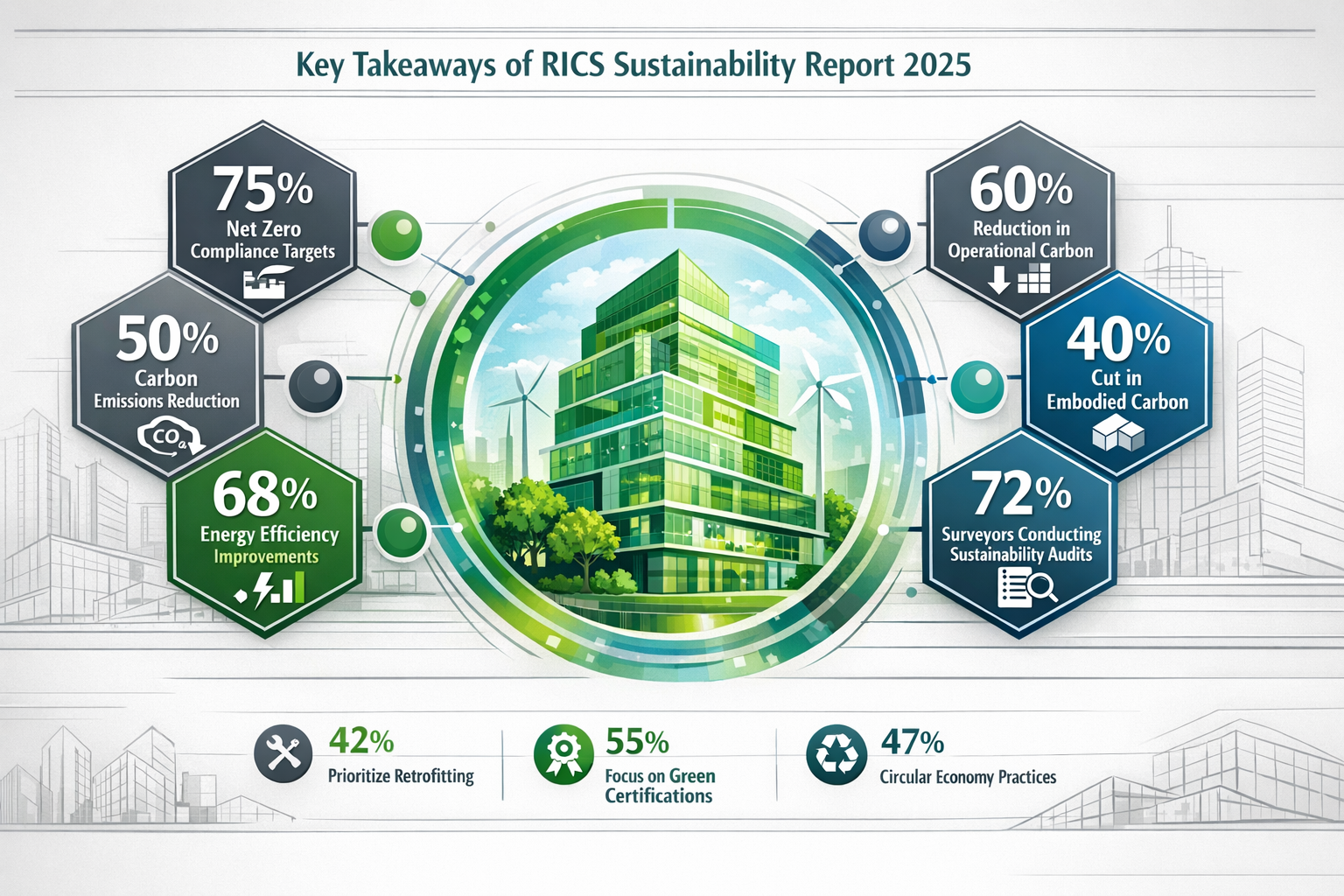
Carbon calculation adoption remains insufficient. Over 60% of professionals report that carbon calculations and climate resilience assessments are conducted in less than half of projects or not at all[3]. This represents a significant compliance risk as these assessments transition from optional to mandatory components of property valuations.
Waste tracking and environmental monitoring show inconsistent adoption. Only 40% of professionals track waste reduction and data-sharing regularly[3], suggesting that comprehensive environmental monitoring practices remain underdeveloped across the sector.
Skills development emerges as a critical need. The report emphasizes that professional skills and knowledge must be developed to make meaningful progress in adopting sustainable practices[3], highlighting a workforce capability gap for implementing the new 2026 standards.
Enhanced Audit Methodologies for Net Zero Compliance
Chartered surveyors conducting property audits in 2026 must integrate several new assessment components:
🏗️ Whole Life Carbon Assessment
Whole life carbon assessment examines the total carbon impact of a property across its entire lifecycle, including:
- Embodied carbon from construction materials and building processes
- Operational carbon from ongoing energy use and maintenance
- End-of-life carbon from demolition and material disposal
This comprehensive approach requires surveyors to evaluate not just current energy performance but the carbon implications of future improvements, maintenance cycles, and eventual property disposal.
📊 Climate Resilience Evaluation
Climate resilience assessments examine a property's vulnerability to climate-related risks:
- Flood risk from changing precipitation patterns
- Heat stress from rising temperatures
- Storm damage susceptibility
- Water scarcity impacts on property functionality
These factors directly affect long-term property value and must be incorporated into valuation models under the new RICS standards.
💡 Energy Performance Documentation
Enhanced energy performance documentation goes beyond basic EPC ratings to include:
- Detailed analysis of heating, cooling, and ventilation systems
- Renewable energy generation capacity
- Smart building technology integration
- Energy storage capabilities
For comprehensive property assessments, Level 3 full building surveys now incorporate these sustainability metrics as standard components rather than optional add-ons.
Technology Integration in Sustainability Audits
Modern sustainability audits leverage advanced technology to improve accuracy and efficiency:
Thermal imaging identifies heat loss and insulation deficiencies that affect both energy performance and carbon footprint. Premium drone surveys provide comprehensive building envelope assessments without requiring extensive access equipment.
Building Information Modeling (BIM) enables detailed analysis of building systems and materials, supporting accurate whole life carbon calculations.
IoT sensors and smart building systems provide real-time data on energy consumption, indoor air quality, and building performance metrics that inform sustainability assessments.
Net Zero Compliance Requirements in 2026 Valuations: Practical Applications
As ESG transitions from an advisory consideration to a mandatory, hard valuation metric from April 2026[5], chartered surveyors must understand how sustainability credentials directly impact property values. This fundamental change affects both commercial and residential property valuations.
Valuation Adjustments for Sustainability Credentials
The new RICS framework establishes that ESG factors must be reflected in property valuations where they materially affect value. This creates several practical valuation scenarios:
✅ Premium Valuations for Compliant Properties
Properties demonstrating strong Net Zero credentials typically command valuation premiums through:
Lower operational costs from energy-efficient systems reduce ongoing expenses and increase net operating income for commercial properties or reduce total cost of ownership for residential properties.
Enhanced marketability as regulatory requirements tighten and buyer preferences shift toward sustainable properties. Properties in high-demand areas like Central London or Chelsea with strong sustainability credentials often achieve faster sales and higher prices.
Reduced obsolescence risk protects long-term value as properties meeting current and anticipated future regulations avoid costly retrofit requirements.
Access to green financing at favorable rates improves investment returns and property affordability.
⚠️ Valuation Discounts for Non-Compliant Properties
Conversely, properties lacking sustainability credentials face several value-reducing factors:
Retrofit cost deductions reflect the capital expenditure required to bring properties up to compliance standards. Surveyors must carefully assess these costs and their impact on net property value.
Increased obsolescence risk as regulatory requirements tighten and market preferences shift, potentially stranding non-compliant assets.
Higher operational costs from inefficient systems reduce net income and total returns.
Restricted buyer pool as institutional investors and environmentally conscious buyers exclude non-compliant properties from consideration.
For properties requiring significant upgrades, understanding urgent or dangerous building issues becomes critical in assessing both immediate safety concerns and longer-term sustainability compliance requirements.
Residential Property Valuation Considerations
While the April 2026 RICS standard primarily addresses commercial property valuation, its principles increasingly influence residential valuations as well. Chartered surveyors conducting residential assessments must consider:
EPC rating impact on value has become more pronounced as minimum energy efficiency standards tighten. Properties with poor EPC ratings face both immediate valuation discounts and future improvement costs.
Heating system type significantly affects value, with properties relying on fossil fuel heating systems facing potential obsolescence as heat pump and renewable heating mandates expand.
Insulation quality and thermal performance directly impact both energy costs and comfort, affecting buyer willingness to pay.
Renewable energy generation through solar panels, ground source heat pumps, or other systems adds value through reduced operational costs and enhanced sustainability credentials.
For residential transactions including Right to Buy valuations, these sustainability factors must be carefully assessed and documented.
Documentation Requirements for Compliance
Chartered surveyors must maintain comprehensive documentation supporting their sustainability assessments and valuation adjustments:
| Documentation Type | Purpose | Retention Period |
|---|---|---|
| Carbon calculation worksheets | Support whole life carbon assessments | Minimum 6 years |
| Climate resilience reports | Document vulnerability analysis | Minimum 6 years |
| Energy performance data | Justify operational cost assumptions | Minimum 6 years |
| Retrofit cost estimates | Support valuation adjustments | Minimum 6 years |
| Comparable transaction analysis | Demonstrate market evidence for sustainability premiums/discounts | Minimum 6 years |
This documentation protects surveyors from professional liability claims and provides transparency for clients and regulatory bodies reviewing valuation decisions.
Developing Chartered Surveyor Capabilities for RICS Sustainability Report 2025 Applications
The skills development gap identified in the RICS Sustainability Report 2025[3] requires immediate attention as the April 2026 implementation deadline approaches. Chartered surveyors must develop new competencies across technical, analytical, and advisory domains.
Essential Technical Skills for Net Zero Audits
Building physics understanding enables surveyors to assess thermal performance, moisture management, and energy efficiency with greater accuracy. This includes understanding heat transfer mechanisms, thermal bridging, air tightness, and ventilation requirements.
Carbon calculation methodologies require familiarity with lifecycle assessment principles, embodied carbon databases, and operational carbon modeling. Surveyors must understand how to apply tools like RICS Whole Life Carbon Assessment guidance to practical property assessments.
Renewable energy technology knowledge helps surveyors evaluate the performance, costs, and benefits of solar PV, heat pumps, biomass systems, and other renewable technologies integrated into properties.
Climate risk assessment frameworks enable surveyors to evaluate property vulnerability to climate-related hazards using standardized methodologies and risk rating systems.
Analytical Capabilities for Valuation Adjustments
Comparative market analysis with sustainability factors requires surveyors to identify and analyze comparable transactions while controlling for ESG differences. This involves building databases of sustainable property transactions and developing adjustment factors for various sustainability features.
Financial modeling of retrofit scenarios helps surveyors assess the cost-benefit relationship of sustainability improvements. This includes understanding payback periods, net present value calculations, and the impact of green financing on investment returns.
Regulatory compliance tracking across multiple jurisdictions requires surveyors to maintain current knowledge of evolving requirements in different markets. For surveyors operating across regions like Hampshire, Sussex, and Oxfordshire, understanding local regulatory variations becomes essential.
Advisory Service Development
The RICS standard's clarification that strategic ESG advice is typically a separate service[2] creates opportunities for chartered surveyors to develop enhanced advisory offerings:
Sustainability improvement roadmaps help property owners plan phased approaches to Net Zero compliance, prioritizing improvements based on cost-effectiveness and regulatory timelines.
Green financing guidance assists clients in accessing favorable financing for sustainability improvements through green mortgages, energy efficiency loans, and other specialized products.
Portfolio-level sustainability strategy helps institutional clients develop coordinated approaches to improving ESG performance across multiple properties.
These advisory services complement traditional valuation work while respecting the boundary between valuation and strategic advice established by the RICS standards.

Strategic Implementation: Preparing for April 2026 Compliance
With the mandatory implementation date approaching, property owners, investors, and chartered surveyors must take strategic action to ensure compliance and protect property values.
For Property Owners
Conduct baseline sustainability assessments of all properties to understand current performance levels and compliance gaps. This establishes a starting point for improvement planning and helps prioritize properties requiring immediate attention.
Develop phased improvement plans that address the most critical compliance gaps first while spreading capital expenditure over manageable timeframes. Properties with poor EPC ratings or fossil fuel heating systems should be prioritized.
Engage qualified chartered surveyors with demonstrated sustainability expertise to ensure assessments meet the new RICS standards. Look for surveyors who have completed relevant continuing professional development in ESG valuation and Net Zero compliance.
Document all improvements with proper certification and performance data to support future valuations and demonstrate compliance with regulatory requirements.
For Chartered Surveyors
Invest in professional development through RICS-approved training programs focused on ESG valuation, whole life carbon assessment, and climate resilience evaluation. The skills gap identified in the 2025 report[3] requires immediate attention.
Upgrade technology and tools to support enhanced sustainability assessments. This includes thermal imaging equipment, carbon calculation software, and building performance modeling tools.
Build comparable transaction databases that include sustainability features and performance metrics to support evidence-based valuation adjustments.
Develop clear service definitions that distinguish between valuation services and strategic ESG advice, ensuring clients understand what is included in different service offerings.
Establish quality assurance processes for sustainability assessments to ensure consistency and accuracy across different surveyors and property types.
For Investors and Lenders
Integrate sustainability criteria into investment and lending decisions, recognizing that ESG factors now directly affect property values and risk profiles.
Require comprehensive sustainability documentation as part of due diligence processes, including whole life carbon assessments, climate resilience evaluations, and retrofit cost estimates.
Adjust underwriting standards to reflect the value impact of sustainability credentials, offering favorable terms for properties meeting high ESG standards while applying appropriate risk adjustments for non-compliant properties.
Support property improvement initiatives through green financing products and flexible terms that enable borrowers to invest in Net Zero compliance improvements.
Sector-Specific Applications Across Property Types
The RICS Sustainability Report 2025 applications vary across different property sectors, requiring tailored approaches to Net Zero compliance audits and valuations.
Commercial Office Properties
Office properties face particular scrutiny under the new standards due to:
- Higher energy consumption profiles compared to residential properties
- Greater regulatory oversight through commercial EPC requirements
- Institutional ownership patterns that prioritize ESG compliance
- Tenant expectations for sustainable workplace environments
Surveyors assessing commercial offices must evaluate building management systems, smart building technology integration, and workplace flexibility features that support sustainable operations.
Residential Properties
Residential property valuations increasingly incorporate sustainability factors as:
- Minimum EPC standards tighten for rental properties
- Mortgage lenders offer preferential rates for energy-efficient homes
- Buyer preferences shift toward properties with lower operational costs
- Heat pump and renewable heating mandates expand
For residential assessments in areas like East London, Hampstead, or Clapham, understanding local market dynamics around sustainability features helps surveyors make accurate valuation adjustments.
Industrial and Logistics Properties
Industrial properties present unique sustainability challenges and opportunities:
- Large roof areas suitable for solar PV installations
- High energy consumption from industrial processes
- Potential for waste heat recovery and energy efficiency improvements
- Growing demand for sustainable logistics facilities from e-commerce operators
Retail Properties
Retail properties must address:
- Customer expectations for sustainable shopping environments
- Energy-intensive lighting and HVAC requirements
- Potential for renewable energy integration
- Adaptation challenges as retail formats evolve
Mixed-Use Developments
Mixed-use properties require integrated approaches that address:
- Multiple use types with different sustainability requirements
- Shared building systems and energy management
- Complex ownership and occupancy structures
- Coordinated improvement planning across different stakeholders
The Role of Technology in RICS Sustainability Report 2025 Applications
Technology plays an increasingly critical role in enabling chartered surveyors to conduct comprehensive sustainability audits and accurate Net Zero compliance valuations.
Digital Assessment Tools
Building performance modeling software enables surveyors to simulate energy consumption, carbon emissions, and the impact of various improvement scenarios. These tools support evidence-based recommendations and accurate retrofit cost estimates.
Carbon calculation platforms automate complex lifecycle assessments, reducing the time required for whole life carbon analysis while improving accuracy and consistency.
Climate risk mapping tools provide property-specific vulnerability assessments based on location, building characteristics, and projected climate scenarios.
Data Collection and Analysis
IoT sensors and smart building systems provide real-time performance data that supports more accurate assessments than traditional point-in-time inspections. This continuous monitoring reveals actual building performance rather than theoretical design specifications.
Drone technology enables comprehensive building envelope assessments, identifying thermal performance issues, structural concerns, and maintenance requirements without extensive access equipment.
Satellite imagery and remote sensing support climate risk assessments by providing detailed topographic data, flood risk mapping, and environmental context analysis.
Documentation and Reporting
Cloud-based reporting platforms enable surveyors to produce comprehensive, standardized reports that include all required sustainability documentation while maintaining secure client data management.
Blockchain verification may increasingly support certification and documentation of sustainability credentials, providing tamper-proof records of building performance and improvement history.
AI-assisted analysis helps surveyors identify comparable transactions, analyze market trends, and develop valuation adjustments based on large datasets of property performance and transaction information.
Conclusion
The RICS Sustainability Report 2025 Applications: Chartered Surveyor Audits for Net Zero Compliance in 2026 Valuations represents a fundamental transformation in property valuation practice. From April 30, 2026, ESG factors transition from optional considerations to mandatory valuation metrics[2], requiring all chartered surveyors to integrate sustainability assessments into their standard practice.
The implementation gaps identified in the RICS Sustainability Report 2025—including the fact that over 60% of professionals currently fail to conduct regular carbon calculations and climate resilience assessments[3]—highlight the urgent need for skills development, methodology enhancement, and technology adoption across the profession.
Property owners face a critical window to assess their portfolios, identify compliance gaps, and implement improvement plans before sustainability credentials significantly impact property values. Properties demonstrating strong Net Zero compliance will command valuation premiums through lower operational costs, enhanced marketability, and reduced obsolescence risk. Conversely, non-compliant properties will face valuation discounts reflecting retrofit costs, increased operational expenses, and restricted buyer pools.
Chartered surveyors must invest immediately in professional development, technology upgrades, and methodology enhancement to meet the new standards. The distinction between valuation services and strategic ESG advice[2] creates opportunities for enhanced advisory offerings while maintaining professional boundaries.
Actionable Next Steps
For Property Owners:
- Commission baseline sustainability assessments of all properties before April 2026
- Develop phased improvement plans prioritizing properties with the greatest compliance gaps
- Engage qualified chartered surveyors with demonstrated ESG valuation expertise
- Document all improvements with proper certification to support future valuations
For Chartered Surveyors:
- Complete RICS-approved training in ESG valuation and Net Zero compliance before April 2026
- Invest in technology tools supporting whole life carbon assessment and climate resilience evaluation
- Build comparable transaction databases including sustainability features and performance metrics
- Develop clear service definitions distinguishing valuation from strategic ESG advice
For Investors and Lenders:
- Integrate sustainability criteria into investment and lending decisions
- Require comprehensive sustainability documentation in due diligence processes
- Adjust underwriting standards to reflect ESG value impacts
- Develop green financing products supporting Net Zero compliance improvements
The transition to mandatory ESG valuation standards represents both challenge and opportunity. Organizations that act decisively to develop capabilities, improve property performance, and integrate sustainability into valuation practice will be well-positioned to protect and enhance property values in the Net Zero economy. Those that delay face increasing compliance costs, valuation discounts, and competitive disadvantages as the April 2026 deadline approaches.
For professional guidance on sustainability-focused property assessments and valuations, consult with chartered surveyors who have developed specialized expertise in RICS Sustainability Report 2025 applications and Net Zero compliance requirements.
References
[2] Rics Publishes Updated Global Standard Esg Sustainability Commercial Property Valuation – rics.org
[3] Sustainability Report 2025 – rics.org
[5] Rics Verschaerft Immobilienbewertung Esg Wird Ab 2026 Wertrelevant – purpose-green.com