

By 9 March 2026, every RICS member and regulated firm worldwide — including sole-practitioner building surveyors and multi-office valuation practices across the UK — became legally obligated to comply with a brand-new mandatory professional standard. Yet a significant share of small and medium-sized practices had still not audited the AI tools already embedded in their workflows. That gap represents real professional and commercial risk.
This guide on Responsible AI in Surveying: How UK Building and Valuation Surveyors Can Meet the New RICS Professional Standard Day‑to‑Day cuts through the theory and gives practices a concrete, step-by-step path to compliance — from auditing existing tools to writing a policy and training staff. [1][3]
Key Takeaways 📌
- The RICS Responsible Use of Artificial Intelligence in Surveying Practice standard became mandatory on 9 March 2026 for all RICS members and regulated firms. [1]
- The standard applies only where AI has a "material impact" on the delivery of surveying services. [5]
- Surveyors remain fully accountable for all professional advice, regardless of AI involvement — AI assists, it does not decide. [3]
- Regulated firms must maintain a written AI use policy, an AI systems register, and a risk register reviewed at least quarterly. [6]
- Non-compliance carries the same disciplinary weight as any other breach of a mandatory RICS professional standard. [8]
Understanding the Standard: What Has Actually Changed in 2026?
The "Material Impact" Threshold
The RICS professional standard Responsible Use of Artificial Intelligence in Surveying Practice, published in September 2025, did not arrive without warning. RICS consulted widely before mandating it from 9 March 2026. [1][5]
The critical concept is "material impact." The standard is not triggered every time a surveyor uses a spell-checker or a basic search engine. It applies when an AI system meaningfully influences the professional advice or output delivered to a client. [3][5]
Practical examples of "material impact" AI use in surveying:
| AI Application | Material Impact? |
|---|---|
| Automated valuation model (AVM) informing a Red Book valuation | ✅ Yes |
| AI-assisted defect detection during a Level 3 building survey | ✅ Yes |
| Generative AI drafting a condition report narrative | ✅ Yes |
| Grammar-checking a client email | ❌ No |
| Basic postcode lookup tool | ❌ No |
The distinction matters because it determines which obligations are triggered. Where material impact exists, the full suite of governance requirements applies. [5][6]
Why This Standard Exists Now
The timing is not arbitrary. AI adoption in the built environment accelerated sharply between 2023 and 2026. Automated valuation models, drone-based photogrammetry, large language model report drafting, and computer-vision defect detection have all moved from pilot projects to everyday practice tools. RICS identified a governance vacuum and moved to fill it. [2][7]
"AI can provide a second perspective to sense-check thinking — but it cannot replace the surveyor's professional judgment, scepticism, or accountability."
— RICS member commentary at the March 2026 standard launch [1]
The standard sits alongside existing RICS conduct rules and does not replace sector-specific standards such as the Red Book (RICS Valuation — Global Standards) or the Home Survey Standard. It adds a governance layer on top. [3][8]
Step 1 — Audit Your Existing AI Tools Before Anything Else
Building an AI Systems Register
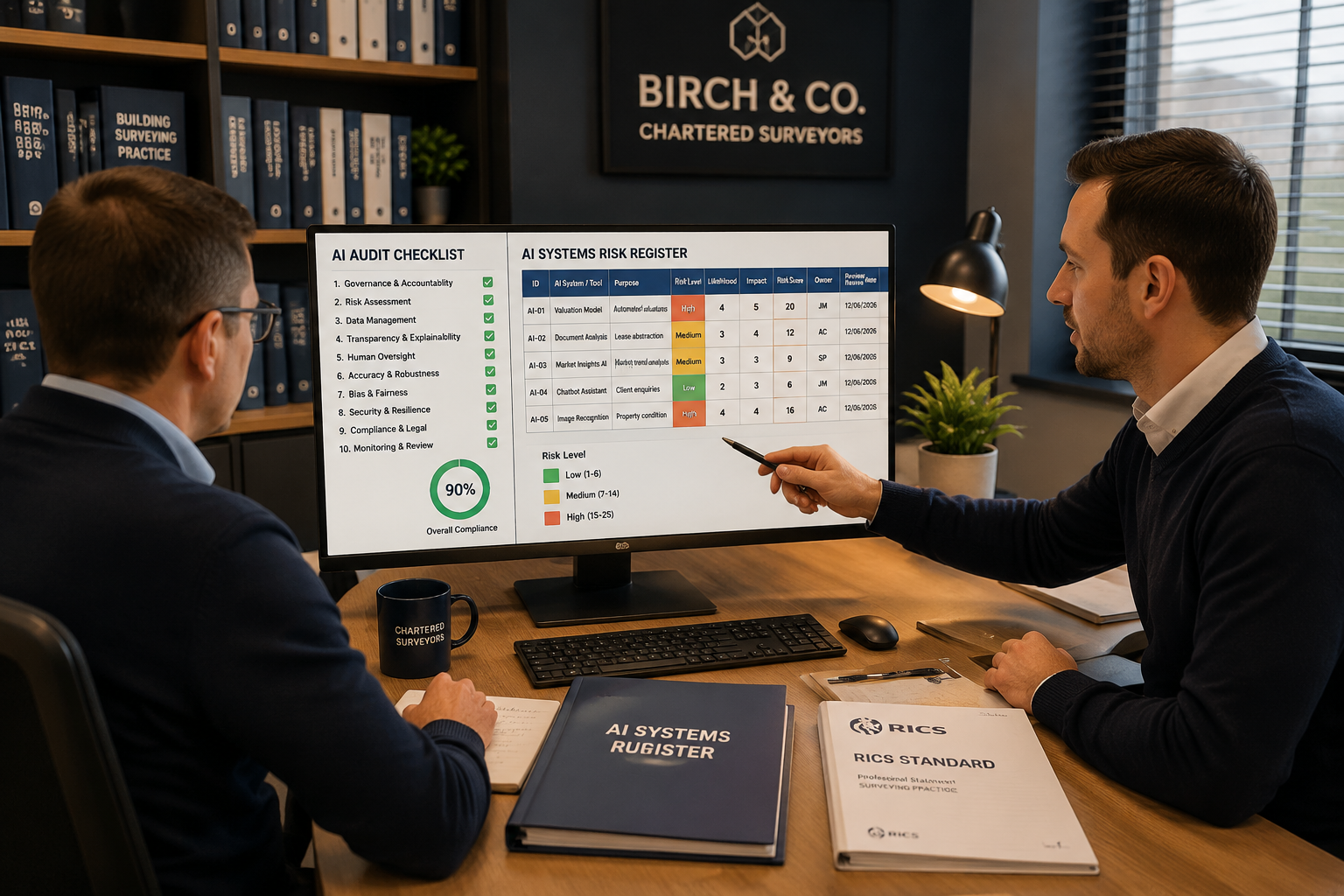
The first practical task for any practice is to identify every AI tool currently in use and record it formally. RICS requires regulated firms to maintain an AI systems register. [6]
How to build your register in five columns:
- Tool name and vendor (e.g., "PropTech AVM Platform v3.2 — XYZ Ltd")
- Purpose (e.g., "Generates indicative market value range for residential properties")
- Material impact assessment (Yes / No / Uncertain — escalate Uncertain items)
- Data inputs (What client or property data does it process?)
- Date last reviewed
This register does not need to be elaborate. A shared spreadsheet with version control is sufficient for most small practices. What matters is that it exists, is kept current, and is reviewed at least quarterly. [6][8]
Red Flags to Look for During the Audit 🚩
When assessing each tool, ask:
- Does the vendor provide documentation explaining how the model works?
- Can the output be independently verified against primary data sources?
- Has the tool been trained on UK-specific property data, or is it a US/global model applied to UK contexts?
- Does the vendor's contract clarify who owns liability for erroneous outputs?
For building survey services that involve AI-assisted defect identification, surveyors should also consider whether the tool has been validated against the specific property types in their portfolio — Victorian terraces behave very differently from 1970s system-built housing. [9]
⚠️ Key point: Discovering that a tool lacks explainability documentation does not mean it must be abandoned immediately. It means the surveyor must apply heightened professional scepticism and document that scepticism in the file.
Step 2 — Writing Your AI Use Policy: A Practical Framework for Responsible AI in Surveying
What the Policy Must Cover
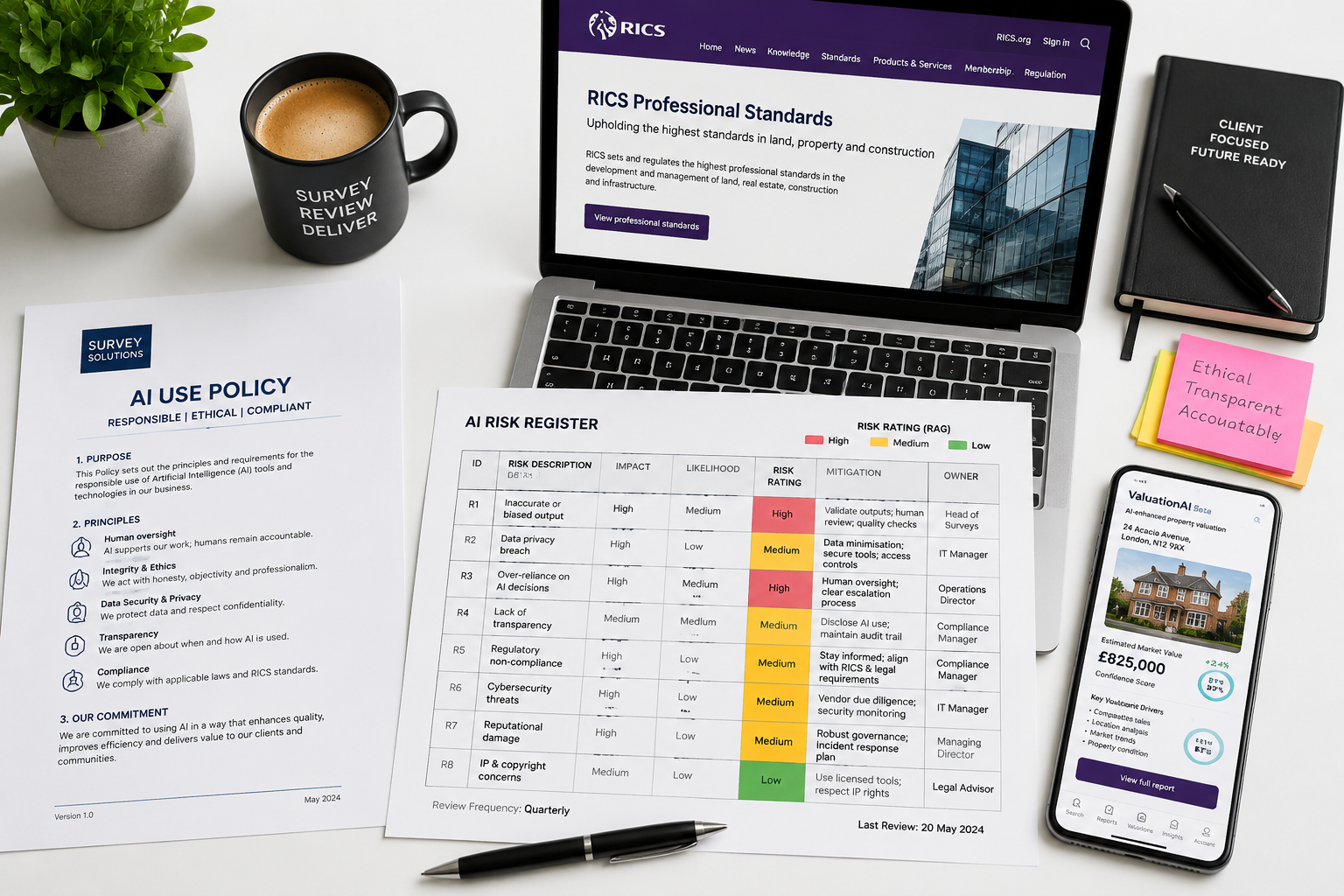
A written AI use policy is not optional under the RICS standard — it is a mandatory governance document for regulated firms. [6][8] The good news is that it does not need to be a 40-page legal treatise. For a small or medium practice, a clear, well-structured document of four to six pages will satisfy the requirement.
The seven sections every policy should include:
- Scope — Which tools and workflows does the policy cover? Reference the AI systems register.
- Approved AI systems — List tools that have passed the firm's internal assessment.
- Prohibited uses — Explicitly state what AI must not do (e.g., generate final valuations without human review, process client data through non-approved consumer AI chatbots).
- Human oversight requirements — Describe how surveyors must verify, sense-check, and document AI outputs before including them in client advice.
- Data protection and confidentiality — Address GDPR obligations when client or property data is processed by third-party AI systems.
- Incident reporting — Set out what happens when an AI tool produces a clearly erroneous output.
- Review cycle — Commit to a minimum quarterly review of the risk register and an annual full policy review.
The Risk Register: RAG Rating Your AI Exposure
Alongside the policy, the standard calls for a risk register that is reviewed at least quarterly. [6] A simple RAG (Red-Amber-Green) rating system works well:
| Risk | Likelihood | Impact | RAG | Mitigation |
|---|---|---|---|---|
| AVM produces outlier valuation adopted without challenge | Medium | High | 🔴 Red | Mandatory comparables cross-check before sign-off |
| AI report draft contains factual error | High | Medium | 🟡 Amber | Two-stage human review before issue |
| Vendor changes model without notice | Low | High | 🟡 Amber | Contractual change-notification clause |
| Staff use unapproved consumer AI for report drafting | Medium | High | 🔴 Red | Policy training + IT controls |
Practices offering commercial property valuations or SIPP pension valuations face particularly elevated risk ratings because errors in those outputs carry significant financial and regulatory consequences. The risk register should reflect that elevated exposure explicitly.
Disclosure to Clients: Transparency as a Compliance Tool
The RICS standard emphasises transparency. Where AI has a material impact on advice, clients should be informed in a proportionate way. [3][5] This does not require a lengthy disclaimer on every report. A single, clearly worded paragraph in the firm's terms of engagement — explaining that AI tools may be used to support (but not replace) professional judgment — is generally sufficient.
For matrimonial valuations or expert witness reports, where the surveyor's professional independence is under particular scrutiny, disclosure should be more explicit and recorded in the report itself.
Step 3 — Training Staff to Comply With Responsible AI in Surveying Day‑to‑Day
Why Training Is the Hardest Part
Governance documents only work if the people expected to follow them understand why they exist. The most common compliance failure RICS anticipates is not deliberate misuse — it is unreflective reliance: a surveyor accepting an AI-generated output without applying the professional scepticism the standard demands. [4][7]
A Three-Tier Training Model
Tier 1 — Awareness (all staff, including support staff):
- What is the firm's AI use policy?
- Which tools are approved and which are prohibited?
- How to report a suspected AI error or incident
Format: 45-minute induction session + one-page quick-reference card. Delivered at onboarding and refreshed annually.
Tier 2 — Application (all fee-earning surveyors):
- How to critically evaluate AI outputs in the context of specific service lines
- Documentation requirements: what to record in the file when AI has materially influenced advice
- Case studies: what went wrong when surveyors over-relied on automated tools
Format: Half-day CPD workshop, ideally with worked examples from the practice's own service lines. Counts toward mandatory RICS CPD hours.
Tier 3 — Governance (directors, partners, compliance leads):
- Maintaining and reviewing the AI systems register and risk register
- Vendor due diligence: what to look for in AI supplier contracts
- Responding to an AI-related complaint or professional indemnity claim
Format: Annual governance review meeting + external legal/insurance briefing where budget allows.
Documenting AI Involvement in the File 📁
One of the most practical day-to-day habits surveyors need to build is file noting. When AI has materially influenced a piece of advice, the file should record:
- Which tool was used
- What output it produced
- What independent checks the surveyor carried out
- The surveyor's professional conclusion (which may agree with, modify, or reject the AI output)
This is not bureaucratic box-ticking. In the event of a complaint or professional indemnity claim, this documentation demonstrates that the surveyor exercised professional judgment — the single most important defence available under the standard. [8][9]
Sector-Specific Considerations for Building and Valuation Surveyors
Building Surveyors: AI in Defect Detection and Reporting
For building surveyors, the most common AI touchpoints are:
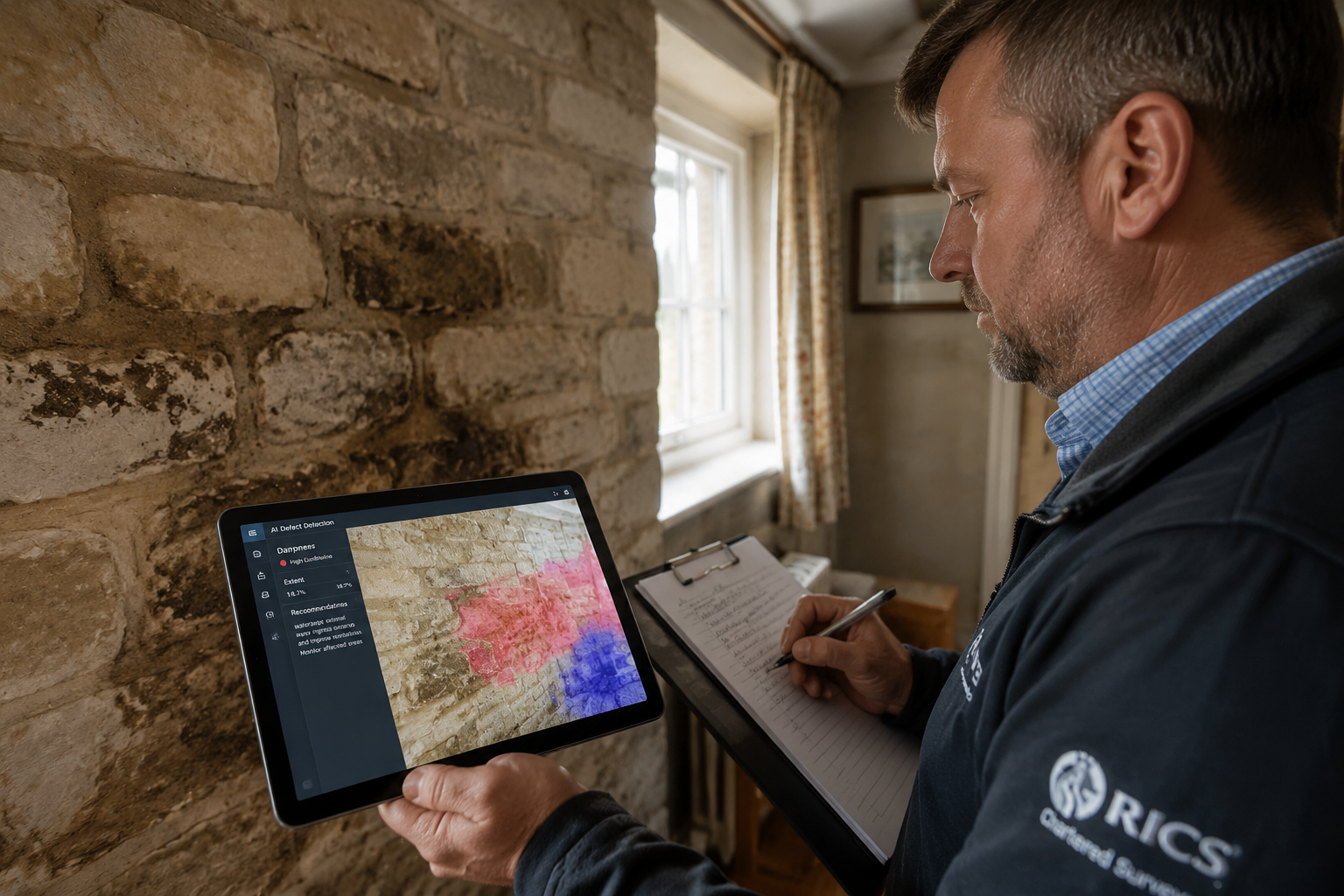
- Computer vision tools that flag potential defects in drone or camera imagery
- Generative AI that drafts condition narratives from structured inspection data
- Predictive maintenance tools used in planned maintenance programmes
When using AI-assisted defect detection during a full Level 3 building survey, the surveyor must still physically inspect the property and apply independent judgment. The AI output is a prompt for investigation, not a conclusion. [5][9]
Surveyors should also be alert to AI tools that have not been trained on UK-specific conditions — particularly regarding asbestos-containing materials in pre-2000 properties, where misidentification carries serious health and legal consequences.
Valuation Surveyors: AVMs and the Red Book
Automated Valuation Models present the sharpest tension between efficiency and compliance. AVMs can process comparable evidence at scale and speed that no human surveyor can match. But they are also prone to systematic errors in thin markets, unusual property types, and rapidly changing local conditions.
The RICS standard does not prohibit AVM use. It requires that where an AVM materially influences a Red Book valuation, the surveyor:
- Understands the model's methodology and limitations
- Cross-checks outputs against primary comparable evidence
- Documents the cross-check in the file
- Takes personal responsibility for the final figure [3][5][8]
Practices offering property valuations across diverse asset classes should ensure their AI use policy addresses each service line individually, since the risk profile of an AVM used for a residential mortgage valuation differs materially from one used for a commercial property valuation.
Professional Indemnity Insurance: What Insurers Are Watching
The insurance implications of the RICS AI standard deserve specific attention. CMS Law's analysis of the standard notes that insurers are beginning to ask about AI governance as part of professional indemnity renewal processes. [8] Practices that cannot demonstrate a written policy, a current systems register, and documented staff training may face:
- Higher premiums
- Broader exclusion clauses for AI-related claims
- Increased scrutiny on claims where AI was involved in the advice
The proactive response is straightforward: document everything. A well-maintained AI governance framework is not just a compliance exercise — it is a risk management asset that demonstrates professional competence to insurers, clients, and RICS alike.
Conclusion: Practical Next Steps for Your Practice in 2026
Responsible AI in Surveying: How UK Building and Valuation Surveyors Can Meet the New RICS Professional Standard Day‑to‑Day is ultimately about embedding a culture of informed, documented, human-led AI use — not about avoiding AI altogether.
The standard is clear: AI is permitted, even encouraged, as a tool that enhances professional capability. What it cannot do is replace the surveyor's judgment, scepticism, or accountability. [1][3]
Your action checklist for the next 30 days:
- 🗂️ Complete your AI systems register — list every tool currently in use and assess material impact
- 📝 Draft your AI use policy using the seven-section framework above
- 🟥 Build a RAG-rated risk register and schedule your first quarterly review
- 🎓 Deliver Tier 1 awareness training to all staff
- 📋 Update your terms of engagement to include proportionate AI disclosure language
- 🔒 Review vendor contracts for data protection, liability, and change-notification clauses
- 📁 Establish a file-noting habit for all AI-influenced professional outputs
Practices that treat compliance as a one-off exercise will find themselves revisiting these issues after a complaint. Practices that build it into their operating rhythm — quarterly register reviews, annual policy updates, ongoing CPD — will find that responsible AI governance becomes a genuine competitive differentiator, signalling professionalism and trustworthiness to clients in an increasingly AI-saturated market.
References
[1] RICS First Ever Standard On Responsible AI Use Now In Effect – rics.org
[2] RICS Issues First Mandatory Global Standard Responsible AI – linkedin.com
[3] Responsible Use Of AI – rics.org
[4] New RICS Standard On The Responsible Use Of AI – reddit.com
[5] Responsible Use Of Artificial Intelligence In Surveying Practice September 2025 – rics.org
[6] RICS Responsible Use Of AI Explained For APC Candidates – resources.apcguide.com
[7] RICS AI Guidance Article – 4newsquare.com
[8] RICS Introduces Mandatory AI Standard For Surveyors: What Insurers And Their Clients Need To Know – cms.law
[9] RICS AI Responsible Use Standard: What Surveyors Need To Know About Complying With March 2026 Guidelines – Rics ai responsible use standard what surveyors need to know about complying with march 2026 guidelines