

When the Royal Institution of Chartered Surveyors (RICS) made its first-ever global AI standard mandatory on March 9, 2026, it fundamentally changed how chartered surveyors must approach property valuations in an era of unprecedented geopolitical volatility and market uncertainty. This isn't merely guidance—it's a binding professional requirement that applies to every RICS member and regulated firm worldwide, regardless of size or specialization.[1]
The introduction of Responsible AI in Chartered Surveyor Valuations: RICS 2026 Standards for Geopolitical Risk and Market Uncertainty represents a watershed moment for the profession. As artificial intelligence increasingly influences property valuations across residential, commercial, and specialized sectors, the new standard establishes clear boundaries between technological assistance and professional accountability. For surveyors navigating volatile markets shaped by international conflicts, trade disputes, and economic instability, these requirements provide essential frameworks for maintaining valuation integrity while leveraging AI capabilities.
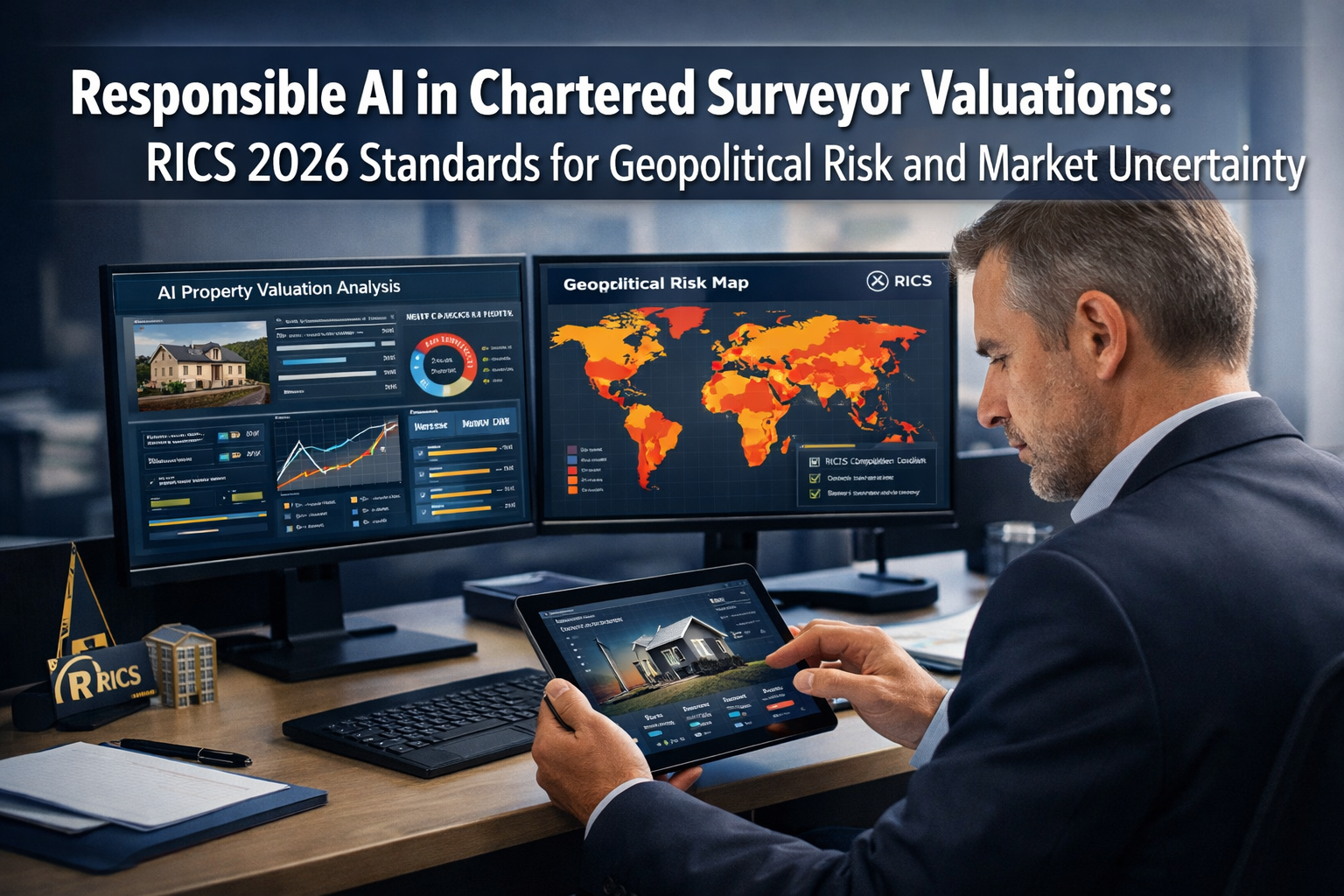
Key Takeaways
- Mandatory compliance: The RICS AI standard became globally mandatory on March 9, 2026, requiring all members and regulated firms to implement comprehensive governance frameworks with no exceptions for firm size.[3]
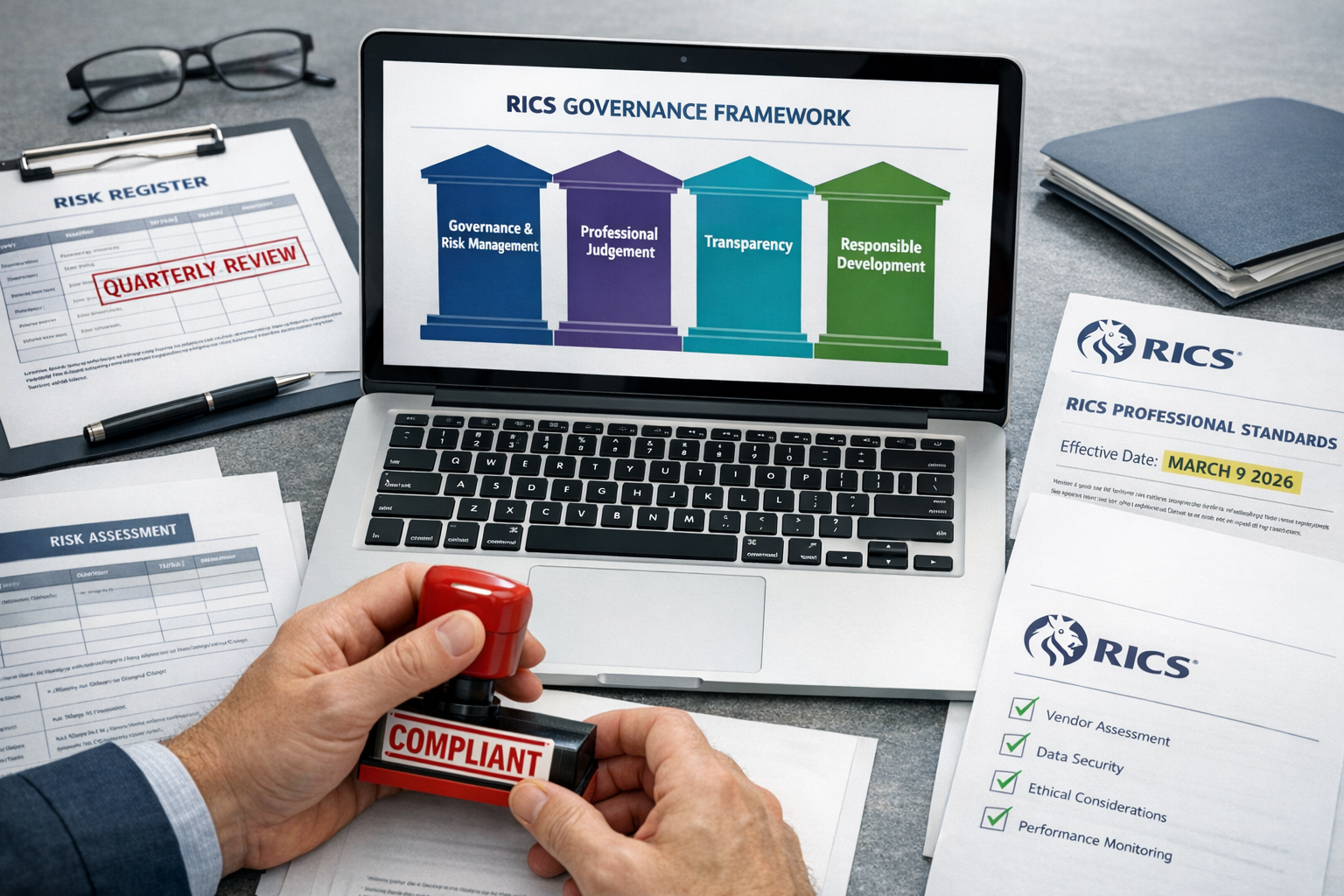
- Four-pillar framework: Compliance centers on governance and risk management, professional judgement and oversight, transparency and client communication, and responsible AI development.[3]
- Quarterly risk reviews: Firms using AI with material impact on service delivery must maintain written risk registers reviewed at least every three months.[5]
- Human accountability remains: AI assists professional practice but does not replace it—chartered surveyors remain fully accountable for every valuation regardless of technological tools used.[3]
- Professional scepticism required: The standard mandates that surveyors actively validate AI outputs rather than accepting algorithmic conclusions uncritically, addressing automation bias concerns.[3]
Understanding the RICS 2026 AI Standard Framework
The Global Scope and Mandatory Nature
The RICS Professional Standard on the Responsible Use of Artificial Intelligence in Surveying Practice marks a historic shift in professional regulation. As RICS's first-ever global professional standard specifically addressing responsible AI use, it covers all surveying disciplines including valuation, construction, infrastructure, and land services.[1]
What makes this standard unique:
- ✅ Universal application across all RICS members worldwide
- ✅ No size exemptions for smaller firms or sole practitioners
- ✅ Jurisdiction-specific compliance requirements alongside RICS mandates
- ✅ Immediate effect from March 9, 2026, with no grace period[3]
The standard recognizes that AI tools have become deeply embedded in valuation practice, from automated valuation models (AVMs) to predictive analytics for market trends. However, it firmly establishes that technology serves as an aid to—not a replacement for—professional expertise, particularly when assessing properties in geopolitically sensitive regions or markets experiencing significant uncertainty.
The Four Pillars of Responsible AI in Chartered Surveyor Valuations
The RICS 2026 Standards for Geopolitical Risk and Market Uncertainty rest on four fundamental requirements that govern how chartered surveyors must integrate AI into their professional practice:[3]
1. Governance and Risk Management
Firms must establish comprehensive governance structures that include:
- Written AI risk registers reviewed quarterly
- Documented materiality assessments determining whether AI use significantly impacts service delivery
- Clear policies for AI procurement and deployment
- Regular governance reviews tied to business planning cycles
2. Professional Judgement and Oversight
This pillar addresses the critical balance between technological efficiency and professional responsibility:
- Surveyors must apply professional scepticism when validating AI outputs
- Human oversight required for all material valuation decisions
- Mandatory sense-checking of AI recommendations against market knowledge
- Documentation of professional judgement applied to AI-generated data
3. Transparency and Client Communication
Clients must understand how AI influences their valuations:
- Clear disclosure when AI tools materially affect valuation outcomes
- Explanation of AI's role in the valuation process
- Documentation of AI systems used and their limitations
- Transparent communication about data sources and algorithmic approaches
4. Responsible Development and Deployment
For firms developing proprietary AI tools or customizing third-party systems:
- Ethical considerations in AI design and training
- Bias detection and mitigation protocols
- Ongoing monitoring of AI system performance
- Continuous improvement based on real-world outcomes
These pillars are particularly crucial when conducting inheritance tax valuations or capital gains valuations, where accuracy and defensibility are paramount.
Implementing Responsible AI in Chartered Surveyor Valuations: RICS 2026 Standards for Geopolitical Risk and Market Uncertainty
Risk Register Requirements and Quarterly Reviews
One of the most significant practical requirements under the RICS 2026 standards is the mandatory risk register for firms whose AI use has material impact on service delivery. This isn't a one-time exercise but an ongoing commitment to risk management.[5]
Key risk register components:
| Element | Requirement | Review Frequency |
|---|---|---|
| Material Impact Assessment | Written determination of whether AI materially affects services | Initial + when systems change |
| Risk Identification | Documented risks specific to AI tools used | Quarterly minimum |
| Mitigation Strategies | Specific controls for each identified risk | Quarterly minimum |
| Incident Logging | Record of AI-related errors or concerns | Ongoing |
| Review Documentation | Evidence of quarterly management review | Quarterly |
For surveyors conducting commercial valuations in volatile markets, the risk register must specifically address how AI handles geopolitical factors such as:
- 🌍 International sanctions affecting property values
- 🌍 Currency fluctuations in cross-border transactions
- 🌍 Political instability impacting market liquidity
- 🌍 Trade policy changes affecting commercial property demand
- 🌍 Regional conflict zones and property risk assessment
Due Diligence and Third-Party AI Procurement
Before implementing any third-party AI system, the RICS standard mandates written due diligence assessments.[5] This requirement recognizes that many surveying firms don't develop AI internally but rely on specialized proptech platforms and valuation software.
Due diligence assessment must cover:
-
System capabilities and limitations
- What the AI can and cannot reliably assess
- Known biases or data gaps
- Geographic or property-type restrictions
-
Data governance
- Where training data originates
- How the system handles confidential client information
- Data retention and deletion policies
- Compliance with GDPR and other data protection regulations
-
Vendor accountability
- Provider's track record and reputation
- Support and maintenance commitments
- Liability provisions for system errors
- Update and improvement schedules
-
Integration requirements
- Compatibility with existing workflows
- Staff training needs
- Quality assurance protocols
- Validation procedures
This due diligence becomes particularly critical when selecting AI tools for SIPP pension valuations, where regulatory scrutiny demands exceptional accuracy and defensibility.
Professional Scepticism and Automation Bias
Perhaps the most philosophically significant aspect of Responsible AI in Chartered Surveyor Valuations: RICS 2026 Standards for Geopolitical Risk and Market Uncertainty is the explicit requirement for professional scepticism. The standard directly addresses "automation bias"—the human tendency to over-rely on automated systems and accept their outputs uncritically.[3]
Practical applications of professional scepticism:
- Input curation: Surveyors must critically evaluate data fed into AI systems, recognizing that algorithmic outputs are only as reliable as their inputs
- Output validation: AI-generated valuations require sense-checking against local market knowledge, recent comparable transactions, and professional experience
- Contextual assessment: Algorithms may struggle with unique property features, local planning considerations, or emerging market trends that experienced surveyors recognize
- Geopolitical overlay: AI models trained on historical data may inadequately account for unprecedented geopolitical events affecting current valuations
This requirement ensures that chartered surveyors working across regions like South West London or Hertfordshire maintain their professional edge by combining technological efficiency with irreplaceable local expertise and market intuition.
Addressing Geopolitical Risk and Market Uncertainty Under RICS 2026 Standards
How AI Handles (and Struggles With) Geopolitical Factors
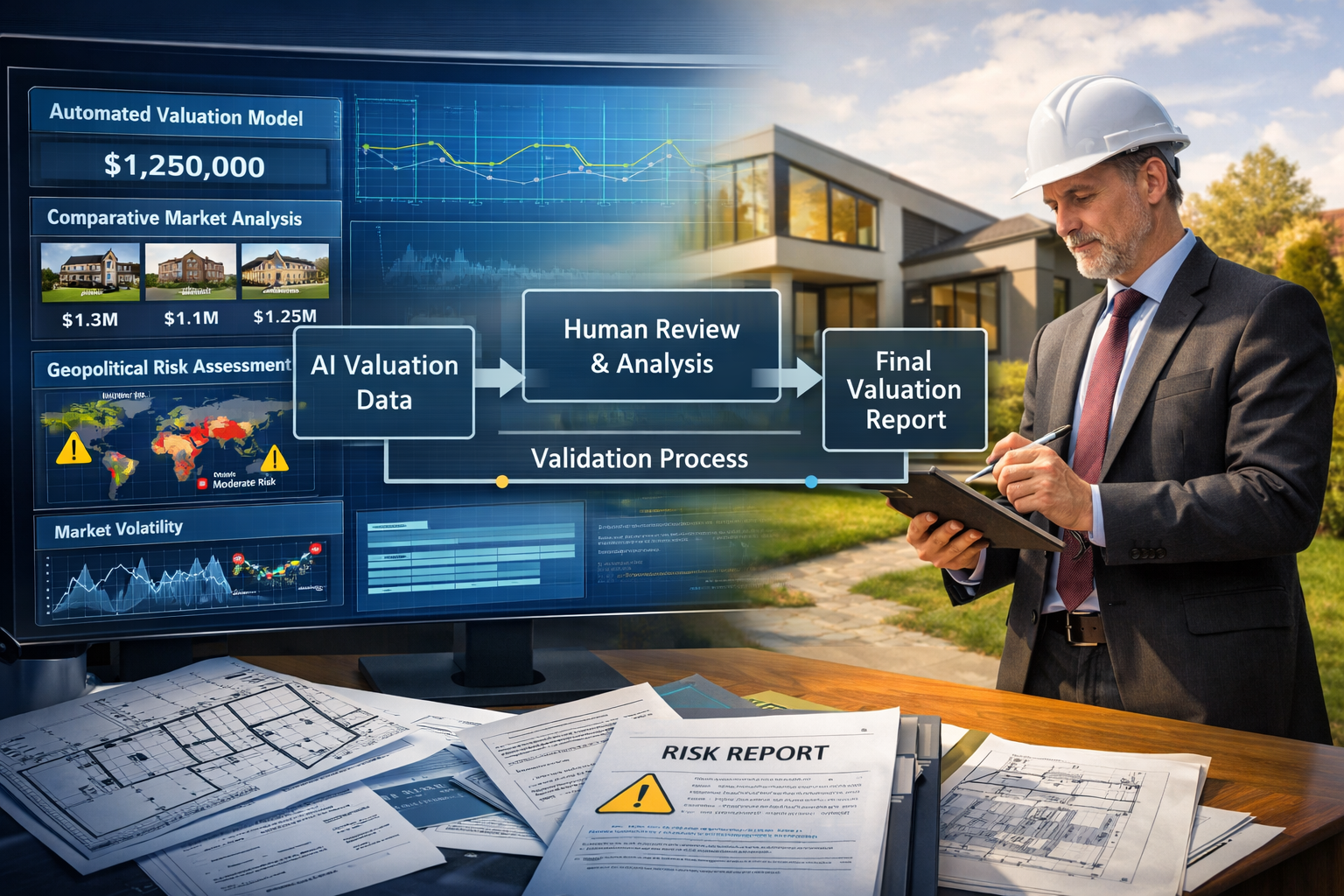
Artificial intelligence excels at processing vast datasets and identifying patterns, but geopolitical events often represent unprecedented disruptions that historical data cannot fully predict. The RICS 2026 standards acknowledge this limitation by requiring human oversight specifically for valuations in uncertain markets.[4]
AI strengths in geopolitical risk assessment:
- 📊 Rapid analysis of multiple economic indicators simultaneously
- 📊 Pattern recognition across international market correlations
- 📊 Real-time monitoring of news sentiment and market reactions
- 📊 Quantification of historical impacts from similar events
AI limitations requiring human intervention:
- ⚠️ Novel geopolitical scenarios without historical precedent
- ⚠️ Nuanced local impacts of international events
- ⚠️ Qualitative factors like investor sentiment and confidence
- ⚠️ Regulatory responses and policy interventions
- ⚠️ Second-order effects and cascading market impacts
For example, when valuing commercial property in areas affected by new trade policies, AI might accurately process economic data but miss crucial qualitative factors such as business owner confidence, supply chain adaptability, or local government support measures. The RICS standard requires surveyors to recognize these gaps and apply professional judgement accordingly.[6]
Case Study Applications: Market Uncertainty Scenarios
The RICS has published case studies demonstrating how the standard applies in real-world scenarios involving market uncertainty.[6] These examples illustrate the practical balance between AI assistance and professional oversight:
Scenario 1: Cross-Border Commercial Valuation
A surveyor valuing a commercial property portfolio with international tenants uses AI to analyze:
- Rental yield trends across multiple jurisdictions
- Currency exchange rate impacts on rental income
- Comparable transaction data from similar markets
However, the surveyor must personally assess:
- Geopolitical risks affecting specific tenant industries
- Regulatory changes in tenant home countries
- Lease covenant strength given international uncertainty
- Exit strategy viability in current market conditions
Scenario 2: Residential Market During Economic Volatility
AI tools provide valuable data on:
- Recent transaction volumes and price movements
- Mortgage availability and interest rate trends
- Demographic demand patterns
The surveyor's professional judgement remains essential for:
- Interpreting unprecedented market conditions
- Assessing local supply constraints
- Evaluating government intervention impacts (stamp duty changes, first-time buyer schemes)
- Forecasting near-term market direction
These scenarios demonstrate why the standard insists that AI assists professional practice; it does not replace it—a principle that protects both client interests and professional standards.[3]
Data Protection and Confidentiality in AI-Enhanced Valuations
The RICS 2026 standards include robust requirements for data governance, recognizing that AI systems often require access to sensitive client information and confidential market data.[5]
Mandatory data protection measures:
- Information classification: Clear policies defining what data can be processed through AI systems
- Confidentiality safeguards: Technical and procedural controls preventing unauthorized data access
- Third-party agreements: Contractual protections when using external AI platforms
- Data minimization: Using only necessary information for AI processing
- Retention limits: Clear policies on how long AI systems store client data
- Breach protocols: Documented procedures for responding to data security incidents
These requirements align with broader data protection legislation but provide surveying-specific guidance on AI applications. For firms conducting sensitive valuations such as inheritance tax assessments, these protections are particularly critical given the personal and financial sensitivity of the information involved.
Quality Assurance and Ongoing Compliance
Randomized Dip-Sampling and Output Validation
To ensure AI systems consistently perform as expected, the RICS standard mandates quality assurance protocols including randomized dip-sampling of AI outputs.[5] This requirement prevents firms from becoming complacent about AI accuracy and ensures ongoing validation.
Effective dip-sampling programs include:
- Random selection: Unbiased sampling across different property types, values, and geographic areas
- Independent review: Validation by surveyors not involved in the original valuation
- Documented findings: Written records of any discrepancies or concerns
- Corrective actions: Clear processes for addressing identified issues
- Trend analysis: Monitoring patterns in AI performance over time
For example, a firm might randomly select 5% of AI-assisted valuations each month for detailed human review, comparing AI recommendations against surveyors' independent assessments and documenting any significant variances.
Staff Training and Competency Requirements
The standard recognizes that effective AI use requires specific competencies beyond traditional surveying skills.[5] Firms must ensure their staff understand:
- AI fundamentals: Basic understanding of how AI systems process data and generate outputs
- System-specific training: Detailed knowledge of particular AI tools used in practice
- Limitation awareness: Clear understanding of what AI can and cannot reliably assess
- Validation techniques: Methods for sense-checking and verifying AI outputs
- Ethical considerations: Awareness of bias, fairness, and transparency issues
- Compliance requirements: Understanding of RICS standard obligations
Training programs should be documented, regularly updated, and tailored to different roles within the firm. Senior valuers conducting commercial valuations may require more sophisticated AI literacy than administrative staff, but all team members handling AI-generated data need appropriate competency levels.
Documentation and Audit Trail Requirements
Comprehensive documentation forms the backbone of RICS 2026 compliance. The standard requires written records across multiple areas:[4]
Essential documentation includes:
| Document Type | Purpose | Update Frequency |
|---|---|---|
| AI Use Policy | Overarching approach to AI in practice | Annual review |
| Risk Register | Identified risks and mitigation strategies | Quarterly |
| Due Diligence Assessments | Third-party AI system evaluations | Pre-procurement + major updates |
| Material Impact Determinations | Whether AI materially affects services | Initial + when systems change |
| Training Records | Staff competency in AI use | Ongoing |
| Quality Assurance Reports | Dip-sampling findings and corrective actions | Monthly/quarterly |
| Client Communications | Disclosure of AI use in valuations | Per engagement |
| Incident Logs | AI-related errors or concerns | Ongoing |
This documentation serves multiple purposes: demonstrating compliance during regulatory reviews, supporting professional indemnity insurance claims, providing evidence in disputes, and facilitating continuous improvement in AI governance.
Practical Implementation Roadmap for Surveying Firms
Immediate Action Steps for RICS 2026 Compliance
For firms still developing their compliance approach to Responsible AI in Chartered Surveyor Valuations: RICS 2026 Standards for Geopolitical Risk and Market Uncertainty, the following roadmap provides practical guidance:[7]
Phase 1: Assessment (Weeks 1-2)
- Inventory AI use: Document all AI tools currently used in practice
- Determine materiality: Assess whether AI materially impacts service delivery
- Identify gaps: Compare current practices against RICS requirements
- Assign responsibilities: Designate compliance lead and implementation team
Phase 2: Policy Development (Weeks 3-4)
- Draft AI use policy: Create overarching framework document
- Develop risk register: Identify and document AI-related risks
- Create procurement guidelines: Establish due diligence procedures
- Design quality assurance protocols: Define dip-sampling and validation processes
Phase 3: Implementation (Weeks 5-8)
- Conduct staff training: Ensure team understands requirements and procedures
- Update client communications: Revise engagement letters and disclosure templates
- Implement documentation systems: Establish record-keeping processes
- Begin quarterly reviews: Schedule first risk register review
Phase 4: Monitoring (Ongoing)
- Conduct dip-sampling: Regularly validate AI outputs
- Review risk register: Quarterly management review
- Update training: Ongoing competency development
- Refine processes: Continuous improvement based on experience
Integration with Existing Professional Standards
The RICS AI standard doesn't exist in isolation but complements existing professional requirements including the Red Book (valuation standards) and other RICS guidance. Firms must ensure their AI governance integrates seamlessly with:[4]
- Valuation methodology requirements: AI tools must support, not compromise, Red Book compliance
- Professional indemnity insurance: Insurers may have specific requirements for AI use
- Client care obligations: Existing duties of transparency and communication extend to AI disclosure
- Continuing professional development: AI competency becomes part of ongoing learning requirements
This integration ensures that embracing technological innovation doesn't create conflicts with established professional obligations but rather enhances overall service quality and risk management.
Sector-Specific Considerations
Different surveying specializations face unique challenges in implementing the RICS 2026 standards:
Residential Valuations:
- High volume makes AI particularly attractive for efficiency
- Standardized property types suit algorithmic approaches
- Local market nuances still require human expertise
- Regulatory valuations (mortgage lending) demand exceptional accuracy
Commercial Property:
- Complex lease structures challenge AI interpretation
- Unique property characteristics require professional judgement
- Geopolitical factors significantly impact valuations
- Tenant covenant assessment remains largely qualitative
Specialized Valuations:
- SIPP pension valuations require regulatory defensibility
- Inheritance tax valuations face HMRC scrutiny
- Development land valuations involve numerous assumptions
- Rural and agricultural properties often lack comparable data
Each specialization requires tailored approaches to AI governance while maintaining compliance with the overarching RICS framework.
The Future of AI in Surveying Practice
Emerging Technologies and Evolving Standards
The RICS 2026 standards represent a starting point rather than a final destination. As AI technology continues advancing, the standards will likely evolve to address new capabilities and challenges:[1]
Emerging AI applications in surveying:
- 🚀 Computer vision for automated property condition assessment
- 🚀 Natural language processing for lease analysis and risk identification
- 🚀 Predictive analytics for long-term market forecasting
- 🚀 Blockchain integration for transparent valuation audit trails
- 🚀 Augmented reality for remote property inspection and valuation
Each advancement will require careful consideration of how existing governance frameworks apply and where new guidance may be needed. The principle of responsible AI use—balancing technological capability with professional accountability—will remain constant even as specific applications evolve.
Competitive Advantage Through Responsible AI
Firms that embrace the RICS 2026 standards not merely as compliance obligations but as competitive differentiators will likely gain market advantages:[7]
Benefits of robust AI governance:
- ✨ Enhanced client confidence: Transparent AI use builds trust
- ✨ Risk mitigation: Comprehensive governance reduces errors and liability
- ✨ Operational efficiency: Well-implemented AI improves productivity
- ✨ Professional reputation: Demonstrable compliance enhances credibility
- ✨ Insurance benefits: Robust governance may reduce PI insurance premiums
- ✨ Talent attraction: Forward-thinking practices attract skilled professionals
Rather than viewing the standards as burdensome regulation, progressive firms recognize them as frameworks enabling safe innovation and differentiation in an increasingly competitive market.
Conclusion
The introduction of Responsible AI in Chartered Surveyor Valuations: RICS 2026 Standards for Geopolitical Risk and Market Uncertainty marks a defining moment for the surveying profession. As the first global professional standard specifically addressing AI use, it establishes clear expectations for how chartered surveyors must balance technological innovation with professional accountability, particularly when navigating volatile markets shaped by geopolitical uncertainty.
The standard's four-pillar framework—governance and risk management, professional judgement and oversight, transparency and client communication, and responsible AI development—provides comprehensive guidance while maintaining flexibility for different firm sizes and specializations. By mandating quarterly risk reviews, due diligence assessments, professional scepticism, and robust documentation, RICS ensures that AI serves as a tool to enhance rather than replace professional expertise.
For surveying firms, compliance requires immediate action: assessing current AI use, developing comprehensive policies, implementing quality assurance protocols, and training staff on both technical capabilities and ethical obligations. These aren't merely regulatory checkboxes but fundamental practices that protect clients, enhance service quality, and maintain professional standards in an era of rapid technological change.
Actionable Next Steps
For surveying firms:
- Conduct an immediate AI audit to inventory all current and planned AI applications
- Develop your risk register with quarterly review schedules
- Create comprehensive documentation covering policies, procedures, and training
- Establish quality assurance protocols including randomized dip-sampling
- Review client communication templates to ensure transparent AI disclosure
- Schedule regular compliance reviews tied to business planning cycles
For individual chartered surveyors:
- Enhance your AI literacy through training and professional development
- Practice professional scepticism when validating AI outputs
- Document your professional judgement when overriding or adjusting AI recommendations
- Stay informed about evolving RICS guidance and industry best practices
- Engage with clients transparently about how AI supports your valuations
Whether you're conducting commercial valuations, inheritance tax assessments, or any other surveying service, the RICS 2026 standards provide the framework for responsible innovation that protects both professional integrity and client interests in an increasingly complex and uncertain world.
The future of surveying lies not in choosing between human expertise and artificial intelligence, but in combining both responsibly—and the RICS 2026 standards provide the roadmap for achieving that balance.
References
[1] Rics Launches Landmark Global Standard On Responsible Use Of Ai In Surveying – rics.org
[3] Rics First Ever Standard On Responsible Ai Use Now In Effect – rics.org
[4] Ai Responsible Use Standard – ww3.rics.org
[5] Navigating The New Rics Ai Standard What It Means For Surveyors – artefact.com
[6] Ruai Case Studies 02 – rics.org
[7] Rics Introduces Mandatory Ai Standard For Surveyors What Insurers And Their Clients Need To Know – cms.law