

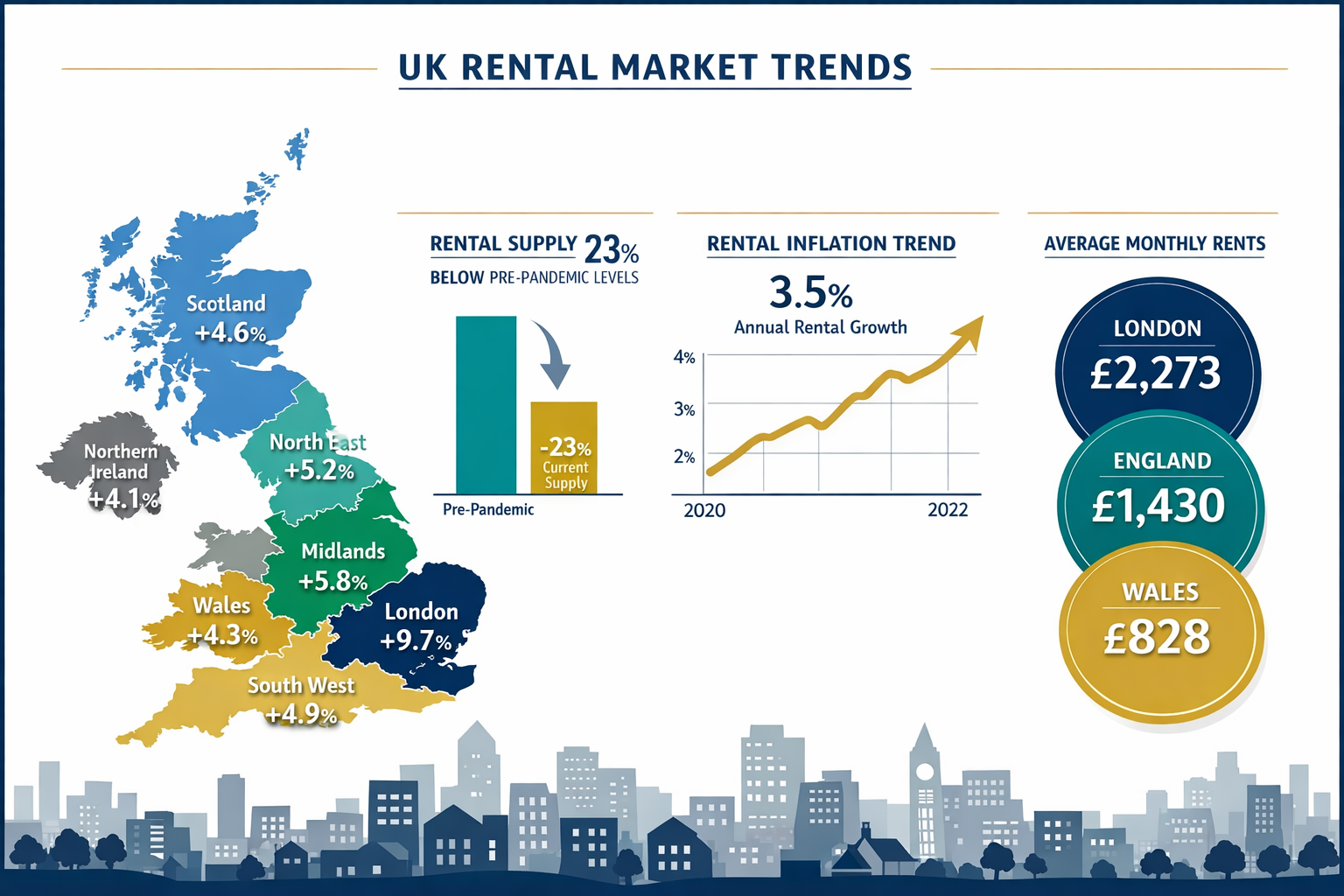
The UK rental market in 2026 presents a compelling paradox: rental inflation has stabilized at 3.5% annually, yet landlords and institutional investors face unprecedented challenges navigating supply-constrained lettings markets.[1] With rental supply remaining 23% below pre-pandemic levels despite growing tenant demand in core city center locations,[3] the role of building surveyors has never been more critical in assessing investment properties. Understanding Rental Growth and Supply Constraints: Building Surveyors' Role in Assessing Investment Properties Amid Tight Lettings Markets in 2026 requires a comprehensive framework that balances technical property assessment with market dynamics analysis.
Strong occupier demand in prime urban locations continues to drive rental growth, even as national figures suggest market stabilization. For buy-to-let investors and institutional property funds, this creates both opportunity and risk—making professional building survey assessments essential for informed decision-making in today's competitive lettings environment.

Key Takeaways
✅ Rental inflation stabilized at 3.5% nationally in February 2026, but regional variations reveal significant opportunities in supply-constrained markets like the North East (7.6% growth) and Wales (5.5% growth).[1][2]
✅ Supply remains 23% below pre-pandemic levels despite an 11% year-on-year increase in available rental properties, creating structural advantages for well-positioned investment properties.[3]
✅ Building surveyors provide critical due diligence through comprehensive property assessments that evaluate structural integrity, compliance requirements, and rental yield potential in tight lettings markets.
✅ Regional market dynamics vary significantly, with London showing lowest growth at 1.7% despite highest average rents (£2,273 monthly), while the North East demonstrates strongest growth potential.[1]
✅ Professional survey frameworks must integrate market analysis with technical property assessment to identify investment opportunities that capitalize on supply constraints and occupier demand.
Understanding the 2026 Rental Market Landscape
Current Rental Growth Trends and Regional Variations
The UK rental market has entered a period of stabilization following years of rapid inflation. National rental growth held steady at 3.5% annually through February 2026, marking the joint-lowest annual growth rate since March 2022.[1] However, this headline figure masks significant regional disparities that savvy investors must understand.
Regional Performance Breakdown:
| Region | Annual Growth | Average Monthly Rent | Market Trend |
|---|---|---|---|
| North East England | 7.6% | £770 | Strong growth, affordability advantage |
| Wales | 5.5% | £828 | Cooling from 8.9% peak (March 2025) |
| England | 3.6% | £1,430 | First increase since November 2024 |
| Scotland | 2.4% | £1,022 | Lowest growth in four years |
| London | 1.7% | £2,273 | Highest rents, lowest growth |
The North East England demonstrates the most compelling growth trajectory at 7.6%, though slightly below January's 8.0%.[1] This region offers the lowest average rents at £770 monthly, presenting opportunities for investors seeking strong yields in supply-constrained markets.
Wales shows the second-strongest rental growth at 5.5%, with average monthly rents of £828.[2] Importantly, this represents a cooling trend from the recent peak of 8.9% in March 2025, suggesting the market is transitioning toward sustainability.[2]
London presents a unique case: despite maintaining the highest average rent at £2,273 monthly, the capital shows the lowest rental growth at just 1.7%.[1] This marks the first increase since November 2024's peak of 11.5%, indicating potential market stabilization after years of rapid appreciation.
Supply Constraints Driving Market Dynamics
The fundamental driver behind rental growth in 2026 remains the chronic imbalance between supply and demand. Propertymark CEO Nathan Emerson identified "far too few homes available to meet tenant need," with rental supply sitting 23% below pre-pandemic levels according to March 2026 analysis.[1][3]
Despite an 11% year-on-year increase in homes available for rent, the structural supply shortage persists.[3] This creates favorable conditions for property investors who can secure well-positioned assets in high-demand locations.
Interestingly, demand for rented homes has declined 14% year-on-year through March 2026, signaling a shift in market dynamics.[3] This demand softening, combined with improving supply, has contributed to more moderate rental inflation projections of 2-3% throughout 2026.[3]
For investors considering buy-to-let opportunities, understanding these supply-demand dynamics is essential. A comprehensive building survey provides the technical foundation for assessing whether a specific property can capitalize on supply constraints in its local market.
Building Surveyors' Critical Assessment Framework for Investment Properties
Technical Property Evaluation in Supply-Constrained Markets
Building surveyors play an indispensable role in evaluating investment properties amid tight lettings markets. Their technical expertise extends far beyond basic property inspection—they provide comprehensive analysis that directly impacts investment returns and risk management.
Core Assessment Components:
🔍 Structural Integrity Analysis: Surveyors evaluate the fundamental condition of the property, identifying defects that could impact rental income or require significant capital expenditure. In supply-constrained markets, properties with deferred maintenance may still command strong rents, but investors need accurate cost projections for remediation.
🔍 Building Pathology: Understanding moisture ingress, damp issues, and structural movement is critical for rental properties. A building pathology assessment identifies underlying problems that could lead to tenant complaints, void periods, or regulatory non-compliance.
🔍 Environmental Compliance: With increasing regulatory focus on energy efficiency, surveyors assess EPC ratings and MEES (Minimum Energy Efficiency Standards) compliance. Properties failing to meet minimum standards face rental restrictions, making EPC and MEES assessments essential for investment due diligence.
🔍 Regulatory Compliance: Beyond energy efficiency, surveyors evaluate compliance with fire safety regulations, electrical safety standards, and gas safety requirements—all critical for landlord legal obligations and tenant safety.
Advanced Survey Technologies for Investment Assessment
Modern building surveyors employ advanced technologies that provide deeper insights into property condition and investment viability:
Drone Surveys: Premium drone technology enables comprehensive roof and external facade inspections without costly access equipment. For multi-unit residential investments, this technology provides detailed visual documentation of hard-to-reach areas.
Thermal Imaging: Identifying heat loss, insulation deficiencies, and hidden moisture problems helps investors understand energy efficiency improvements needed to maximize rental appeal and meet regulatory requirements.
Moisture Detection: Advanced moisture meters and hygrometers detect dampness issues that may not be visible during standard inspections, preventing costly surprises post-purchase.
Rental Yield and Investment Return Analysis
Beyond technical condition, building surveyors increasingly incorporate market analysis into their assessment frameworks. This holistic approach evaluates:
- Rental income potential based on property condition and local market comparables
- Capital expenditure requirements for compliance, repairs, and improvements
- Void period risk associated with property condition and tenant appeal
- Long-term maintenance costs that impact net rental yields
For investors targeting supply-constrained markets, understanding the relationship between property condition and rental demand is crucial. Properties in excellent condition command premium rents and experience shorter void periods, even in markets with moderating growth.
A Level 3 Full Building Survey provides the comprehensive technical analysis needed for significant investment decisions, particularly for older properties or those in areas with strong rental demand.
Strategic Investment Considerations in Tight Lettings Markets

Identifying High-Potential Investment Locations
The regional variations in rental growth present distinct opportunities for investors with different risk appetites and investment strategies. Building surveyors must contextualize their technical assessments within local market dynamics to provide actionable investment guidance.
High-Growth Opportunity Markets:
North East England offers the strongest growth trajectory at 7.6% annual rental inflation, combined with the lowest average rents at £770 monthly.[1] For investors seeking strong rental yields, this region presents compelling opportunities—provided properties meet technical standards and regulatory requirements.
Building surveyors assessing properties in high-growth, lower-rent markets must pay particular attention to:
- Tenant demand drivers (employment centers, transport links, amenities)
- Property condition relative to local competition
- Improvement costs required to achieve market-leading rents
- Compliance with increasingly stringent regulatory standards
Wales demonstrates solid growth at 5.5% with average rents of £828 monthly.[2] The cooling trend from March 2025's 8.9% peak suggests the market is finding sustainable equilibrium—an attractive characteristic for long-term investors seeking stability.
Stable, Premium Markets:
London presents a different investment proposition: highest average rents at £2,273 monthly but lowest growth at 1.7%.[1] For institutional investors and high-net-worth individuals, London properties offer:
- Capital preservation through prime asset ownership
- Strong tenant demand from professional occupiers
- Lower rental growth volatility
- Premium rental income despite moderate percentage increases
Building surveyors assessing London investment properties must focus on:
- Competitive positioning within micro-markets
- Premium finishes and amenities that justify higher rents
- Compliance with stringent London-specific regulations
- Long-term capital appreciation potential beyond rental yield
Buy-to-Let Investment Due Diligence
For individual landlords entering the buy-to-let market in 2026, comprehensive building surveys provide essential risk mitigation. The combination of supply constraints and regulatory complexity makes professional assessment non-negotiable.
Critical Due Diligence Elements:
Compliance Verification: Surveyors verify that properties meet all current regulatory requirements, including:
- EPC rating of E or above (MEES compliance)
- Electrical Installation Condition Reports (EICR) within five years
- Gas Safety Certificates (annual requirement)
- Smoke and carbon monoxide alarm compliance
- HMO licensing where applicable
Maintenance Cost Projection: Accurate forecasting of maintenance and repair costs over a 5-10 year investment horizon enables realistic cash flow modeling. Building surveyors provide detailed schedules of:
- Immediate repairs required before letting
- Short-term maintenance (1-3 years)
- Medium-term capital expenditure (3-7 years)
- Long-term structural considerations (7+ years)
Tenant Appeal Assessment: Beyond technical condition, surveyors evaluate features that impact tenant demand and rental premiums:
- Modern kitchens and bathrooms
- Energy efficiency and heating systems
- Storage and living space configuration
- Outdoor space (gardens, balconies, parking)
- Proximity to transport and amenities
Regular rental property inspections help landlords maintain property condition and tenant satisfaction, protecting rental income and asset value over time.
Institutional Investment and Portfolio Strategy
For institutional investors and property funds, building surveyors provide portfolio-level analysis that informs acquisition strategy in supply-constrained markets. This includes:
Portfolio Diversification: Assessing properties across multiple regions to balance high-growth opportunities (North East, Wales) with stable premium markets (London, South East).
Risk-Adjusted Returns: Evaluating technical condition, compliance status, and market positioning to calculate risk-adjusted rental yields that account for void periods, maintenance costs, and regulatory changes.
ESG Compliance: Increasingly, institutional investors require environmental, social, and governance assessments. Building surveyors evaluate:
- Energy efficiency and carbon reduction potential
- Accessibility and inclusive design features
- Community impact and social value
- Long-term sustainability and climate resilience
Value-Add Opportunities: Identifying properties where strategic improvements can unlock rental growth above market rates. Surveyors assess:
- Refurbishment potential and associated costs
- Planning permission prospects for extensions or conversions
- Energy efficiency upgrades that improve EPC ratings
- Modernization that appeals to target tenant demographics
For complex investment decisions, sourcing additional specialist advice through building surveyors' professional networks ensures comprehensive due diligence.
Market Outlook and Strategic Positioning
Looking ahead through 2026 and beyond, the rental market is projected to maintain moderate growth of 2-3% annually as supply and demand dynamics continue to rebalance.[3] This stabilization creates a more predictable investment environment, but success still depends on:
Property Selection: Choosing well-located, well-maintained properties that appeal to target tenant demographics in supply-constrained markets.
Technical Excellence: Ensuring properties meet or exceed regulatory standards, minimizing compliance risk and maximizing tenant appeal.
Professional Assessment: Engaging qualified building surveyors who understand both technical property evaluation and local rental market dynamics.
Active Management: Maintaining properties to high standards through regular inspections, preventative maintenance, and responsive repairs.
The chronic supply shortage identified by industry experts means that well-positioned investment properties will continue to benefit from strong occupier demand, even as overall market growth moderates.[1] Building surveyors who can identify these opportunities and assess them comprehensively provide invaluable guidance for investors navigating the 2026 rental landscape.
Understanding property market legislation changes ensures investors remain compliant as regulatory requirements evolve, protecting both rental income and asset value.
Maximizing Investment Returns Through Professional Survey Insights
Negotiation Leverage and Price Adjustment
One often-overlooked benefit of comprehensive building surveys is their value in purchase price negotiations. When surveyors identify defects, compliance issues, or necessary improvements, investors gain concrete evidence to negotiate house prices downward.
In tight lettings markets where property prices remain elevated, this negotiation leverage becomes particularly valuable. Typical price adjustments based on survey findings include:
- Structural defects: 5-15% price reduction depending on severity
- Compliance failures: 2-10% reduction based on remediation costs
- Deferred maintenance: 3-8% reduction for accumulated repairs
- Energy efficiency upgrades: 2-5% reduction for EPC improvements
These adjustments directly impact investment returns by reducing initial capital outlay while maintaining rental income potential.
Renovation and Improvement Strategies
Building surveyors also guide strategic property improvements that maximize rental appeal and income. Understanding which property renovations add value for tenants ensures capital is deployed effectively.
High-Impact Improvements:
💰 Kitchen and Bathroom Modernization: Typically generates 10-20% rental premium and reduces void periods significantly.
💰 Energy Efficiency Upgrades: Improved EPC ratings reduce tenant energy costs, increase property appeal, and ensure regulatory compliance.
💰 Additional Bedrooms: Where feasible, converting lofts or reconfiguring space to add bedrooms can increase rental income by 15-30%.
💰 Outdoor Space Enhancement: Gardens, balconies, and outdoor areas command significant rental premiums, particularly post-pandemic.
Surveyors provide cost-benefit analysis for proposed improvements, ensuring renovation investments generate positive returns through increased rental income or reduced void periods.
Long-Term Asset Management
Beyond initial acquisition, building surveyors support ongoing asset management that protects rental income and property value. This includes:
Planned Maintenance Programs: Developing multi-year maintenance schedules that prevent costly emergency repairs and maintain tenant satisfaction.
Condition Monitoring: Periodic re-inspections that identify emerging issues before they impact rental income or require major capital expenditure.
Regulatory Compliance Updates: Staying ahead of evolving regulations through proactive assessments and timely improvements.
Tenant Retention Strategies: Maintaining properties to standards that encourage long-term tenancies, reducing void periods and turnover costs.
For landlords managing multiple properties, understanding building inspection and survey requirements ensures consistent standards across the portfolio.
Conclusion
Rental Growth and Supply Constraints: Building Surveyors' Role in Assessing Investment Properties Amid Tight Lettings Markets in 2026 represents a critical intersection of technical expertise and market analysis. As the UK rental market stabilizes at 3.5% annual growth while maintaining supply levels 23% below pre-pandemic norms, the expertise of qualified building surveyors becomes indispensable for successful property investment.[1][3]
The regional variations in rental performance—from the North East's robust 7.6% growth to London's modest 1.7% increase—demonstrate that location-specific analysis is essential for identifying high-potential investment opportunities.[1] Building surveyors who understand these market dynamics can provide comprehensive assessments that go beyond technical condition to evaluate rental yield potential and investment viability.
Key success factors for property investment in 2026 include:
✅ Comprehensive technical assessment through Level 3 Building Surveys that identify structural issues, compliance gaps, and improvement opportunities
✅ Market-informed analysis that contextualizes property condition within local rental demand and supply constraints
✅ Regulatory compliance verification ensuring properties meet EPC, safety, and licensing requirements that protect rental income
✅ Strategic improvement planning that maximizes rental appeal and yields through targeted renovations and upgrades
✅ Long-term asset management through planned maintenance and periodic condition monitoring
Actionable Next Steps
For investors considering property acquisitions in supply-constrained rental markets:
-
Engage qualified building surveyors early in the acquisition process to conduct comprehensive property assessments before purchase commitments.
-
Request market-informed analysis that evaluates rental yield potential alongside technical condition, particularly in high-growth regions like the North East and Wales.
-
Verify regulatory compliance across all requirements, with particular attention to EPC ratings, electrical safety, and fire safety standards.
-
Develop improvement strategies based on surveyor recommendations that balance capital expenditure with rental income enhancement.
-
Establish maintenance programs that protect asset value and tenant satisfaction over the long term.
The combination of persistent supply constraints and strong occupier demand in core city center locations creates favorable conditions for well-selected investment properties. However, success depends on thorough due diligence, professional assessment, and strategic property management—all areas where building surveyors provide essential expertise.
As the rental market continues its transition toward sustainable growth in 2026, investors who leverage comprehensive building survey insights will be best positioned to capitalize on opportunities while managing risks effectively. The role of building surveyors extends far beyond property inspection—they are strategic advisors whose expertise directly impacts investment returns in today's complex lettings markets.
References
[1] Uk Private Rents Rise 35 In February 2026 Ons – https://www.propertyreporter.co.uk/uk-private-rents-rise-35-in-february-2026-ons.html
[2] March2026 – https://www.ons.gov.uk/economy/inflationandpriceindices/bulletins/privaterentandhousepricesuk/march2026
[3] Uk Rental Market Report March 2026 – https://assets.ctfassets.net/2zc2pc2uwamh/4ytGOrzcBHJCz2biMu14Ea/aead7412968a18fcf1123c37e8ece446/UK_Rental_Market_Report_March_2026.pdf
[4] Uk Rental Price Growth Stays Flat At 3 5 In February Ons – https://www.mortgagesolutions.co.uk/news/2026/03/25/uk-rental-price-growth-stays-flat-at-3-5-in-february-ons/