

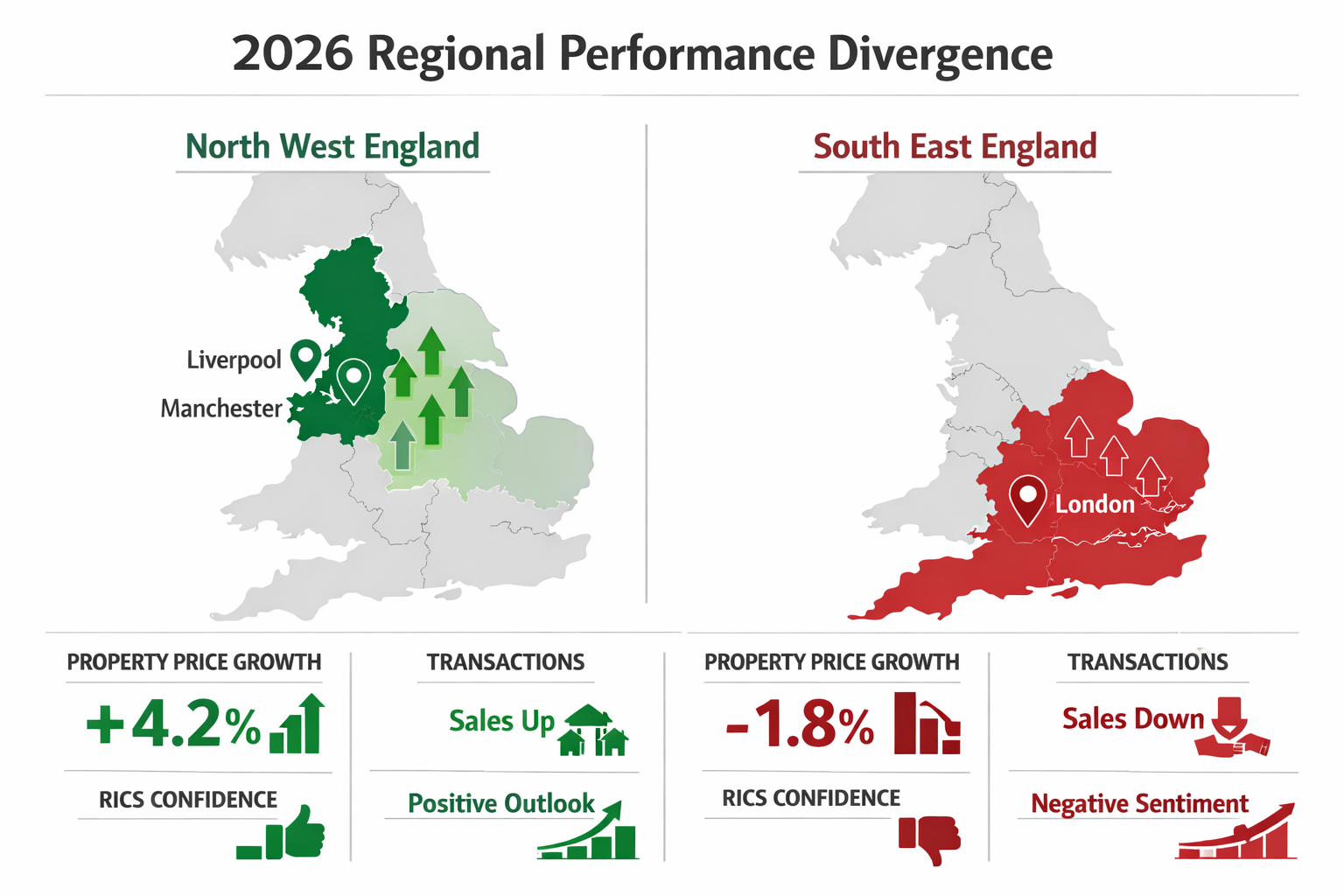
The UK property market has entered an unprecedented phase of regional polarisation. RICS data from January 2026 reveals that while the North West and Northern England experience robust price growth and rising transaction volumes, London and the South East face persistent stagnation—a complete reversal of historical patterns that dominated for decades. This regional market divergence demands immediate strategic adaptation from chartered surveyors, valuers, and property professionals who must now recalibrate their methodologies, comparable selection criteria, and risk assessments to reflect fundamentally different market dynamics across regions.

Understanding Regional Market Divergence in 2026: How Surveyors Should Adapt Valuation and Survey Strategies for North West Growth vs. South East Stagnation is no longer optional—it's essential for maintaining professional competence and delivering accurate valuations that reflect genuine market conditions rather than outdated national assumptions.
Key Takeaways
- 📊 North West property prices are experiencing growth rates 6+ percentage points higher than the South East, creating distinct valuation challenges
- 🏗️ Construction and development activity in Northern regions requires surveyors to adopt growth-market methodologies previously reserved for Southern hotspots
- 📉 South East inventory surplus and price corrections demand conservative comparable selection and enhanced risk disclosure in valuation reports
- 🔄 Comparable property selection must now prioritise regional micro-market data over broader national trends to ensure accuracy
- 💼 Surveyors operating across multiple regions need dual strategy frameworks that recognise fundamentally different market conditions
Understanding the 2026 Regional Market Divergence: Data and Drivers
The shift in UK property market geography represents more than cyclical fluctuation—it reflects structural economic realignment. While global patterns show similar regional divergence, with the US experiencing supply-constrained markets in the Northeast and Midwest contrasted against excess inventory in the South and West[2], the UK's specific dynamics centre on the North-South divide.
North West and Northern England: Supply Constraints Drive Growth
The North West has emerged as the UK's unexpected property market leader in 2026. Manchester, Liverpool, and surrounding conurbations are experiencing:
- Price growth outpacing national averages by 3-5 percentage points
- Transaction volumes increasing 12-18% year-over-year
- Development pipeline expansion with major residential and commercial schemes
- Investor confidence returning to levels not seen since pre-2008 peaks
This growth stems from fundamental supply-demand imbalances. Years of underinvestment in Northern housing stock, combined with improving transport infrastructure (Northern Powerhouse Rail initiatives) and remote working flexibility, have created genuine scarcity in desirable areas.
"The development gap between the Northeast and Southeast continues to widen, with Northeastern markets pivoting toward adaptive reuse and experience-driven design to stay competitive."[1]
For surveyors conducting property development valuations, this growth environment demands optimistic but evidence-based assumptions about future value appreciation and rental growth trajectories.
South East and London: Inventory Surplus and Price Corrections
Conversely, the South East faces challenges that would have seemed impossible just five years ago:
- Price stagnation or modest declines in many submarkets (-1% to -3% annually)
- Inventory levels 25-40% above five-year averages
- Days on market extending significantly (average 85+ days vs. 45 days in North West)
- Buyer hesitancy driven by affordability constraints and economic uncertainty
The Federal Housing Finance Agency's Q3 2025 data showed similar patterns in US markets, with California, Colorado, and Florida experiencing outright price declines[2]—a reminder that even historically strong markets face correction when supply overwhelms demand.
London's traditional resilience has been undermined by multiple factors: reduced international investment, corporate office space reductions affecting employment, and a demographic shift as younger professionals relocate to more affordable regions.
Regional Market Divergence in 2026: Adapting Valuation Methodologies for Growth Markets
Surveyors operating in the North West and other growth regions must fundamentally recalibrate their approach to property valuations to avoid systematic undervaluation.
Comparable Selection in Supply-Constrained Markets
Traditional comparable selection prioritises recent transactions within 3-6 months. However, in rapidly appreciating markets, this creates a backward-looking bias that fails to capture current market sentiment.
Adaptation strategies include:
- Weight recent comparables more heavily (30-45 days) and apply time adjustments to older sales
- Expand geographic search radius cautiously while maintaining neighbourhood character consistency
- Incorporate off-market intelligence from estate agents about offer levels and bidding wars
- Analyse asking price trends alongside achieved prices to gauge momentum
- Consider pending sales where reliable information exists about agreed terms
For inheritance tax valuations and matrimonial valuations, this approach ensures fair market value reflects genuine current conditions rather than outdated historical data.
Risk Assessment and Market Sentiment Indicators
Growth markets carry different risk profiles than stagnant ones. Surveyors must evaluate:
- Sustainability of growth through employment data, infrastructure investment, and demographic trends
- Speculative activity levels that might indicate bubble conditions
- Mortgage availability and lending criteria in the region
- Development pipeline that could introduce future supply pressure
The North West's growth appears fundamentally driven rather than speculative, supported by genuine economic expansion and employment growth in technology, professional services, and advanced manufacturing sectors.
Development Viability Assessments
For surveyors advising on property development schemes, growth markets offer opportunities but require careful analysis:
Key considerations:
| Factor | Growth Market Approach | Stagnant Market Approach |
|---|---|---|
| Exit Values | Apply modest appreciation (2-4% annually) | Use current values with no growth assumption |
| Sales Velocity | Assume faster absorption rates | Extend sales periods by 25-50% |
| Contingency | Standard 5-10% | Increase to 15-20% |
| Profit Margin | 15-20% acceptable | Target 20-25% minimum |
The widening Northeast-Southeast development divide in the US provides a cautionary tale—markets can shift rapidly, and today's growth region may face oversupply tomorrow[1].
How Surveyors Should Adapt Survey Strategies for South East Market Stagnation
Operating in correction-phase markets like the South East requires equally significant methodological adjustments, prioritising conservative assumptions and enhanced risk disclosure.
Conservative Comparable Selection and Adjustments
In markets with declining or flat prices, surveyors face the opposite challenge: avoiding overvaluation based on historical peak prices.
Essential practices:
- Prioritise very recent sales (ideally within 30 days) as older comparables likely reflect higher values
- Identify distressed sales carefully to avoid using unrepresentative comparables while acknowledging genuine market conditions
- Apply negative time adjustments where evidence supports declining trends (-0.5% to -1.5% monthly in some submarkets)
- Weight withdrawn listings as market intelligence about overpricing
- Consider rental yield compression as indicator of value pressure
For annual tax valuations and other purposes requiring market value assessments, this conservative approach protects clients from overstated values that could create tax liabilities or financial exposure.
Enhanced Risk Disclosure and Market Context
Professional standards require surveyors to provide adequate market context. In stagnant markets, this becomes critical:
✅ Explicitly state market conditions (e.g., "The local market is experiencing price stagnation with inventory 35% above five-year averages")
✅ Quantify uncertainty ranges where appropriate (e.g., "Market value between £475,000-£495,000 reflecting current volatility")
✅ Highlight liquidity concerns affecting marketability and realistic sale timeframes
✅ Reference regional divergence to explain why local conditions differ from national headlines
This transparency protects both the surveyor professionally and the client commercially, ensuring informed decision-making.
Building Survey Adaptations for Stagnant Markets
Beyond valuations, Level 3 full building surveys in stagnant markets should emphasise different considerations:
Maintenance and deferred repairs become more significant when properties have been on the market extended periods—vendors may have delayed maintenance knowing sale was imminent.
Negotiation leverage exists for buyers in oversupplied markets—surveyors should clearly quantify repair costs to enable effective price renegotiation.
Future marketability concerns should be highlighted—features that reduce appeal in buyer's markets (e.g., poor energy efficiency, outdated layouts) deserve emphasis.
Surveyors in Surrey, Sussex, and Oxfordshire must adapt their reporting to reflect these challenging market realities.

Regional Market Divergence in 2026: Practical Implementation for Multi-Region Practices
Surveying firms operating across multiple regions face unique challenges in maintaining consistent quality while adapting to divergent market conditions.
Developing Regional Market Intelligence Systems
Successful adaptation requires systematic market monitoring rather than ad-hoc adjustments:
Infrastructure requirements:
- 📈 Regional dashboards tracking key metrics (prices, inventory, days on market, transaction volumes)
- 🗺️ Micro-market mapping identifying specific postcodes or neighbourhoods with distinct trends
- 📊 Comparable databases organised by region with time-adjustment factors
- 🤝 Local agent networks providing qualitative intelligence about buyer sentiment and competition levels
- 📱 Technology integration using PropTech tools for real-time market data
Firms with operations in both growth regions (North West) and stagnant markets (South East) must resist the temptation to apply uniform national assumptions.
Staff Training and Quality Control
Regional divergence creates training challenges:
Essential training components:
- Market-specific workshops covering regional economic drivers and trends
- Comparable selection exercises using real-world scenarios from different market conditions
- Peer review systems where regional specialists validate cross-region valuations
- RICS Red Book compliance specifically addressing regional variation considerations
- Client communication training to explain regional differences effectively
Junior surveyors particularly benefit from understanding that methodologies appropriate in Manchester may be inappropriate in Guildford or Richmond.
Client Education and Expectation Management
Clients often struggle to understand regional divergence, particularly when national media headlines suggest uniform market conditions.
Effective communication strategies:
💬 Use visual aids showing regional price trend comparisons
💬 Provide context about local economic drivers (employment, infrastructure, demographics)
💬 Explain methodology differences transparently so clients understand why approaches vary
💬 Set realistic expectations about value, marketability, and timeframes based on regional realities
💬 Reference authoritative data from RICS, Land Registry, and regional economic reports
This educational role enhances professional credibility while ensuring clients make informed decisions.
Future Outlook: Preparing for Continued Regional Divergence
Current projections suggest regional divergence will persist through 2026 and potentially beyond, requiring surveyors to embed these adaptations into standard practice rather than treating them as temporary adjustments.
Projected Regional Trends Through Late 2026
Economic forecasts indicate:
North West and Northern England:
- Continued growth but deceleration expected in Q3-Q4 2026 as inventory loosens[2]
- Development pipeline expansion may introduce supply pressure by late 2026
- Employment growth supporting fundamentals but at moderating pace
South East and London:
- Modest correction mode continuing with flat to slight negative price movements[2]
- Potential stabilisation in Q4 2026 if inventory normalises
- High inflation (particularly shelter costs) may constrain recovery[2]
These patterns mirror US regional dynamics where Northeast and Midwest markets are projected to decelerate while South and West remain in correction mode[2].
Emerging Opportunities and Risks
Opportunities for surveyors:
🔹 Specialisation advantages for firms establishing strong regional expertise and networks
🔹 Advisory services expansion helping investors and developers navigate regional complexity
🔹 Technology differentiation through superior regional data analytics capabilities
🔹 Cross-regional arbitrage advising clients on portfolio rebalancing between regions
Risks to monitor:
🔸 Oversupply risk in currently hot markets as development accelerates
🔸 Economic shock vulnerability if regional economic drivers (e.g., specific industries) face headwinds
🔸 Policy changes affecting regional investment incentives or planning frameworks
🔸 Demographic shifts potentially reversing current migration patterns
Regulatory and Professional Standards Considerations
RICS and other professional bodies may need to provide enhanced guidance on regional valuation adjustments. Surveyors should:
- Engage with professional bodies to share experiences and advocate for clearer regional guidance
- Document methodology decisions thoroughly to demonstrate compliance with professional standards
- Maintain professional indemnity insurance adequate for regional market volatility
- Participate in continuing professional development focused on regional market analysis
The property market legislation changes landscape continues evolving, and regional considerations may feature more prominently in future guidance.
Conclusion
The Regional Market Divergence in 2026: How Surveyors Should Adapt Valuation and Survey Strategies for North West Growth vs. South East Stagnation represents a fundamental shift in UK property market geography that demands immediate professional adaptation. Surveyors can no longer rely on national-level assumptions or historical patterns that placed the South East as the perpetual market leader.
Key action steps for surveyors:
✅ Implement regional-specific comparable selection criteria that reflect local market velocity and trends
✅ Develop systematic market intelligence systems providing real-time regional data and sentiment indicators
✅ Adjust risk assessment frameworks to recognise fundamentally different risk profiles across regions
✅ Enhance client communication to explain regional divergence and its implications for value and strategy
✅ Invest in regional expertise through training, networking, and local market presence
✅ Monitor leading indicators for potential trend reversals or acceleration
The surveyors who successfully navigate this regional divergence will be those who embrace flexibility, maintain rigorous market analysis, and resist the temptation to apply uniform methodologies across fundamentally different market conditions. Whether conducting right to buy valuations in growth markets or independent property valuations in stagnant ones, regional context must drive methodology.
The next 12 months will test professional adaptability as these trends continue evolving. Surveyors who establish robust regional frameworks now will be positioned for success regardless of how market dynamics shift, maintaining accuracy, professional standards, and client trust through this period of unprecedented regional divergence.
References
[1] Regional Construction Demand Exposes A Widening Northeast Southeast Divide – capitalanalyticsassociates.com
[2] Top Us Regional Economic Insights 2026 – spglobal.com