

Staffordshire is currently at the centre of one of the most concentrated infrastructure investment cycles in the English Midlands, with HS2 construction corridors, a newly approved Local Transport Plan, and a national pipeline of 734 projects worth £718 billion all converging on a region that has fewer qualified building surveyors than it needs. The regional demand surge for building surveyors in Staffordshire — driven by infrastructure projects and 2026 opportunities — is not a forecast. It is already under way, and the gap between supply and demand is widening every quarter.
Key Takeaways
- HS2 construction and Staffordshire's Local Transport Plan 2026 are generating sustained, multi-year demand for qualified building surveyors across the county.
- The UK government's updated Infrastructure Pipeline identifies 734 projects worth £718 billion, with workforce projections requiring between 629,000 and 706,000 construction professionals annually over the next five years.
- A national skills shortage in building surveying is intensifying competition for qualified professionals, creating strong career and commercial opportunities for those already in the market.
- The Building Safety Act 2022 has added compliance layers that increase the scope and frequency of surveying work on both new-build and legacy structures.
- Surveyors who understand planning constraints, environmental risk, and construction law will be best positioned to capture the highest-value commissions in 2026 and beyond.
The Infrastructure Boom Reshaping Staffordshire in 2026
Staffordshire County Council approved its comprehensive Local Transport Plan in December 2025, setting out a long-term strategy for roads, public transport, cycling routes, and active travel corridors [1]. The plan is designed to guide investment decisions through 2026 and well beyond, creating a durable pipeline of construction and refurbishment activity across the county.
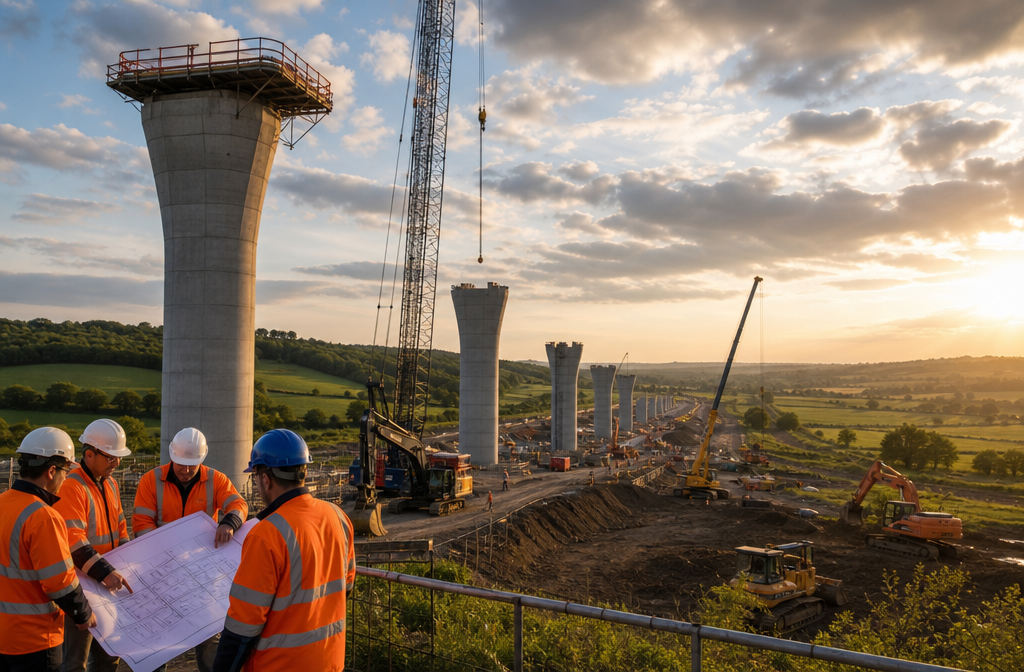
At the same time, HS2 construction remains active throughout Staffordshire. Multiple structures — including viaducts, earthworks, and utility diversions — are progressing along the Phase One corridor [2]. These projects require detailed pre-construction assessments, condition surveys on adjacent properties, and ongoing monitoring of structural impact, all of which fall squarely within the remit of a qualified building surveyor.
The scale of national investment amplifies local demand. The UK government's updated Infrastructure Pipeline, released in March 2026, lists 734 planned projects with a combined value of £718 billion over the next decade [3]. Delivering that pipeline will require an estimated annual average construction workforce of between 629,000 and 706,000 professionals over the next five years [3]. Building surveyors are a critical component of that workforce, particularly on complex mixed-use and transport-adjacent schemes.
What This Means for Property Owners Near Active Construction Zones
Property owners and developers in areas adjacent to HS2 works or new transport corridors face a specific set of risks. Ground movement, vibration, and altered drainage patterns can affect foundations, walls, and rooflines in ways that are not always immediately visible. A thorough building defects survey is often the first step in establishing a baseline condition record — essential for any future compensation or dilapidations claim.
For those purchasing property near active development sites, understanding the consequences of failing to act on early survey findings can be the difference between a manageable repair bill and a structural crisis.
Understanding the Regional Demand Surge for Building Surveyors in Staffordshire
The regional demand surge for building surveyors in Staffordshire is not a single-cause phenomenon. It reflects the convergence of several independent pressures that happen to be peaking simultaneously in 2026.

Infrastructure Workloads Are Outperforming the Broader Market
While overall UK construction workloads remained broadly stable through late 2025, infrastructure-related activity proved comparatively resilient [9]. Water, energy, and regulated utilities are particularly active, with many clients midway through five-year funding cycles that lock in spending commitments regardless of wider economic conditions [6]. Staffordshire sits within this pattern: its utility upgrade programmes, road improvements, and rail-adjacent developments are all proceeding on pre-committed timescales.
The infrastructure sector is expected to continue underpinning construction activity throughout 2026, supported by a substantive, long-term pipeline across transport, utilities, energy, and national infrastructure [5]. For building surveyors, this translates into a steady flow of pre-construction assessments, dilapidations reports, party wall matters, and condition monitoring commissions.
The Skills Shortage Is Compressing Supply
Demand is rising at the same time that qualified supply is constrained. The UK is experiencing a notable shortage of qualified building surveyors, a situation made worse by the combined effect of increased infrastructure projects and tightening regulatory requirements [4]. Firms across the Midlands are actively competing for the same pool of RICS-accredited professionals, driving up salaries and extending project timelines where surveying bottlenecks emerge.
The Building Safety Act 2022 has added a further layer of complexity. More stringent compliance requirements mean that surveyors must now dedicate more time per project to documentation, sign-off procedures, and liaison with the Building Safety Regulator [4]. The result is that each surveyor can handle fewer concurrent commissions — reducing effective capacity even when headcount remains stable.
"Infrastructure-related workloads are comparatively resilient, particularly in water, energy, and regulated utilities, where many clients are midway through five-year funding cycles." — Gardiner & Theobald TPI Survey, Q1 2026 [6]
Urban Regeneration and Housing Pressure
Beyond transport infrastructure, Staffordshire's towns — including Stafford, Lichfield, Tamworth, and Burton upon Trent — are experiencing regeneration pressure. Town centre renewal schemes, housing estate refurbishments, and mixed-use developments all require surveying input at multiple stages.
For buyers entering this market, knowing which building survey is most appropriate for a given property type is a practical starting point. Properties in regeneration zones often have complex histories involving prior industrial use, altered structures, or deferred maintenance — all factors that elevate the importance of a comprehensive Level 3 assessment.
Understanding what is included in a Level 3 building survey helps clients make informed decisions about the depth of investigation they need, particularly when purchasing in areas where ground conditions or construction history are uncertain.
Key Sectors Driving Surveying Demand Across Staffordshire
The following table summarises the primary sectors generating surveying demand in Staffordshire in 2026, alongside the typical surveying services required.
| Sector | Key Activity | Surveying Services Required |
|---|---|---|
| Transport Infrastructure | HS2, Local Transport Plan roads | Condition surveys, party wall, monitoring |
| Utilities and Energy | Water network upgrades, power infrastructure | Pre-construction assessments, dilapidations |
| Urban Regeneration | Town centre renewal, housing refurbishment | Level 3 surveys, defect analysis, planning support |
| Commercial Development | Logistics, distribution, data centres | Measured surveys, structural assessments |
| Public Sector Housing | Affordable housing programmes | Snagging, compliance, maintenance planning |
Data centres and rising power demand are also contributing to utility and communications construction growth across the Midlands [10], creating demand for surveyors with experience in commercial and industrial property assessment.
Party Wall Compliance in High-Density Development Areas
As development density increases in Staffordshire's urban centres, party wall matters are becoming a more frequent source of surveying work. Any excavation or structural alteration near a shared boundary triggers obligations under the Party Wall etc. Act 1996. Developers and homeowners alike need qualified surveyors to navigate this process correctly.
Understanding construction law advice is increasingly valuable in this context, as disputes between adjoining owners can delay projects and generate significant legal costs if not managed professionally from the outset.
For projects where environmental factors — such as contaminated land from prior industrial use, flood risk, or ground instability — are relevant, surveyors must also address environmental issues as part of their assessment. Staffordshire's industrial heritage means this is a more common concern than in many other regions.
2026 Opportunities: Strategies for Surveyors and Clients
The regional demand surge for building surveyors in Staffordshire — shaped by infrastructure projects and 2026 opportunities — creates distinct strategic openings for both surveying professionals and the clients who commission them.

For Surveying Professionals
Specialisation pays. The highest-value commissions in 2026 are concentrated in areas that require specialist knowledge: transport-adjacent structural monitoring, Building Safety Act compliance, and dilapidations on commercial leases. Surveyors who invest in these competencies will command premium fees and face less competition.
Regional positioning matters. There is a steady demand for skilled professionals across project management, commercial management, engineering, and specialist roles driven by major infrastructure projects [7]. Surveyors who establish a visible presence in Staffordshire — through local professional networks, RICS regional events, and targeted marketing — are better placed to capture commissions from developers and public sector clients who prefer local expertise.
Megaproject risk awareness is essential. Delays in UK megaprojects pose genuine risks to infrastructure growth [8]. Surveyors working on or adjacent to large schemes should build contractual protections and programme flexibility into their engagements to manage the impact of programme slippage.
For Property Owners and Developers
Commission surveys early. In a market where surveying capacity is constrained, early engagement secures access to qualified professionals and avoids programme delays. Waiting until a project is fully designed before commissioning a condition survey or party wall assessment can push critical work into an already congested market.
Use surveys to negotiate. A detailed survey report is a powerful tool in purchase negotiations. Understanding the average price reduction achievable after a survey helps buyers and investors quantify the financial value of thorough pre-purchase due diligence.
Plan for maintenance, not just purchase. Infrastructure-adjacent properties require ongoing monitoring. A good survey report should include a maintenance plan that sets out the timing and approximate cost of future works — essential for budgeting in a period of construction cost volatility.
Budget for repairs accurately. For properties requiring significant remediation, budgeting for repairs and restoration at the survey stage prevents cost overruns and ensures that financing arrangements are appropriately sized.
Regulatory Compliance as a Competitive Advantage
The Building Safety Act 2022 has fundamentally changed the compliance landscape for higher-risk buildings. Surveyors who understand the new regime — including the requirements for building assessment certificates, safety cases, and resident engagement — are in a strong position to serve the growing number of clients who need help navigating it.
For clients unsure about what a survey will cover or how long the process takes, resources such as how long a building survey takes and what questions to ask during a building survey provide practical guidance that reduces uncertainty and improves the quality of the client-surveyor relationship.
Risks and Challenges to Monitor in 2026
No market opportunity is without risk. Several factors could moderate the pace of demand growth or create complications for surveyors operating in Staffordshire.
- Megaproject delays: Arcadis has warned that delays in UK megaprojects threaten infrastructure growth, with prompt decision-making and reform needed to keep programmes on track [8]. HS2 in particular has a history of programme adjustments that can shift surveying demand unpredictably.
- Cost inflation: Construction material and labour costs remain elevated. Surveyors providing cost estimates must account for ongoing price volatility to avoid underestimating repair or remediation budgets.
- Capacity constraints: The skills shortage means that even willing clients may face delays in securing survey appointments. This creates reputational risk for firms that cannot meet demand and reinforces the importance of early commissioning.
- Regulatory complexity: The Building Safety Act's implementation is still bedding in. Surveyors who are not up to date with the latest guidance from the Building Safety Regulator risk providing advice that is technically non-compliant.
Conclusion
The regional demand surge for building surveyors in Staffordshire — driven by infrastructure projects and 2026 opportunities — represents one of the most significant shifts in the county's professional property services market in a generation. HS2 construction, the Local Transport Plan, national infrastructure investment, urban regeneration, and tightening regulatory requirements have combined to create a sustained, multi-year demand cycle that qualified surveyors are well placed to serve.
Actionable next steps for stakeholders:
- Property owners near active construction zones should commission a baseline condition survey now, before further ground movement or structural change occurs. This protects against future disputes and ensures any compensation claims are well evidenced.
- Developers and investors should engage surveyors at the earliest possible stage of project planning to avoid capacity bottlenecks and ensure compliance with the Building Safety Act from the outset.
- Surveying professionals should consider targeted specialisation in transport-adjacent monitoring, Building Safety Act compliance, or commercial dilapidations to capture the highest-value work in the current market.
- Firms seeking to grow their Staffordshire presence should invest in regional networking, early-career recruitment, and clear communication of their specialist capabilities to stand out in a competitive market.
The window of opportunity is open. Those who act with clarity and preparation in 2026 will be best positioned to benefit from the years of infrastructure-driven demand that follow.
References
[1] Local Transport Plan 2026 – staffordshire.gov.uk
[2] Autumn 2025 Construction Look Ahead Staffordshire Pdf 1 – assets.hs2.org.uk
[3] Infrastructure Pipeline Update Signals Future Workforce Needs – gov.uk
[4] Building Surveyor Skills Shortage 2026 Strategies For Firms To Attract Talent Amid Infrastructure Booms And Regulatory Pressures – nottinghillsurveyors.com
[5] Reset And Rebalance What Will Shape Construction In 2026 – gardiner.com
[6] Tpi Survey Feedback – gardiner.com
[7] London Construction Market Update Spring 2026 – ssaltd.com
[8] Arcadis Warns Uk Megaproject Delays Threaten Infrastructure Growth – arcadis.com
[9] Construction Activity Remains Flat But Infrastructure Does The Heavy Lifting Says Rics Report 05 02 2026 – constructionnews.co.uk
[10] 2026 Outlook Bright For Utility And Communications Construction Markets – undergroundinfrastructure.com