

One-third of UK construction firms now classify the quantity surveyor shortage as "critical" — and that figure is no longer a forecast. It is the present-day reality shaping every project brief, every procurement decision, and every building survey commissioned in 2026. [1]
The scale of quantity surveyor shortages impacting building surveys: adaptation tactics for chartered surveyors in 2026 projects has moved from a background HR concern to a front-line commercial threat. With 92% of UK construction firms struggling to hire qualified workers [4] and a 20% retirement rate among senior QS staff recorded over the last two years [1], the pipeline of experienced talent is draining faster than it can be refilled.
For chartered surveyors, this is not simply a staffing problem to be solved by HR. It is a strategic inflection point — one that demands new skills, new service models, and a willingness to expand professional scope before project margins and client relationships suffer irreparable damage.
Key Takeaways 📌
- One-third of UK firms rate the QS shortage as critical, with 92% struggling to recruit qualified workers across the surveying profession. [1][4]
- A 20% retirement rate among senior QS professionals over 24 months is the primary structural driver — and it outpaces replacement hiring. [1]
- Critical technical gaps exist in NEC4 contract management, digital cost modelling, and carbon surveying — skills that cannot be recruited quickly. [1]
- 70% of project managers and QSs report that AI take-off tools reduce workload, yet few can fully integrate them with traditional surveying practice. [1]
- Chartered surveyors who expand into cost control, risk assessment, and integrated services are best positioned to protect project margins in 2026.
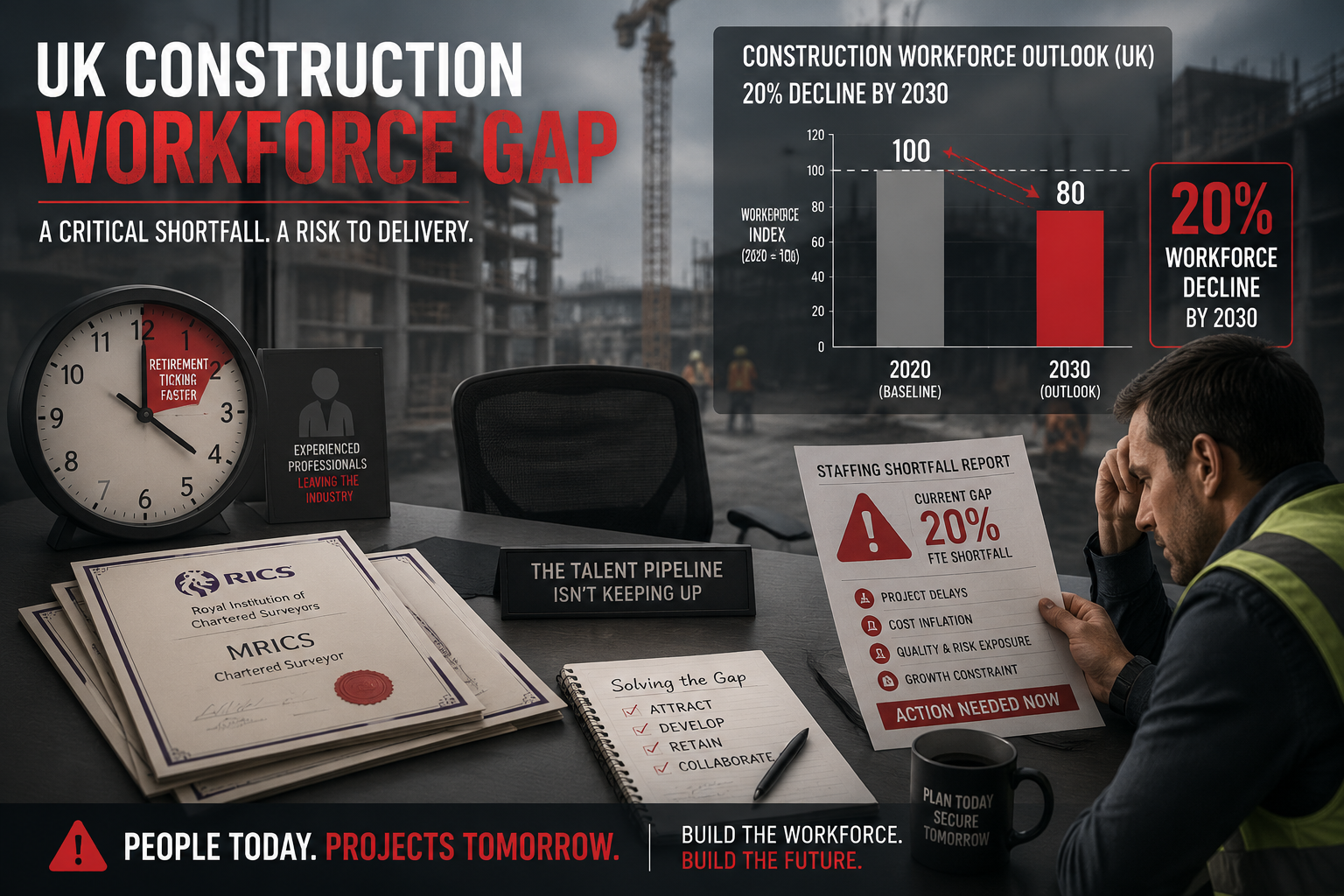
Understanding the Scale of Quantity Surveyor Shortages Impacting Building Surveys in 2026
What the Data Actually Shows
The RICS 2025 Skills Survey confirmed what many practitioners already suspected: the QS workforce crisis is structural, not cyclical. [2] Even in periods of flat market activity, the shortage persists — meaning demand fluctuations are not the cause. The workforce pipeline itself has been depleted. [2]
Here is a snapshot of the key data points driving this crisis:
| Metric | Figure | Source |
|---|---|---|
| Firms rating QS shortage as "critical" | 33% | RICS 2025 Skills Survey [2] |
| Firms struggling to hire qualified workers | 92% | Nottinghill Surveyors [4] |
| Senior QS retirement rate (last 24 months) | 20% | Onboard Jobs [1] |
| PMs/QSs reporting AI tools reduce workload | 70% | Onboard Jobs [1] |
The Retirement Cliff Edge
The demographic driver is stark. Approximately 20% of the senior QS workforce has retired over the last two years alone. [1] These are the professionals who carried deep institutional knowledge — lifecycle costing, final account negotiation, procurement strategy — built over decades. That knowledge does not transfer automatically to junior hires or digital tools.
The result is knowledge erosion in critical commercial disciplines. Genuine expertise in procurement routes, risk allocation, and contractual management is leaving the industry faster than replacement expertise can be developed. [1]
Technical Skills Gaps Making the Crisis Worse
Beyond raw headcount, the shortage has a qualitative dimension that makes it harder to resolve:
- 🔴 NEC4 contract management — a specialised skill increasingly required on public and infrastructure projects
- 🔴 Digital cost modelling and BIM integration — essential for complex project types but poorly represented in the current workforce
- 🔴 Carbon surveying — described as an even sharper skills gap than the general QS shortage, creating sustainability compliance risks [1]
- 🟡 AI-assisted quantity take-off — 70% of practitioners say these tools help, but few can bridge traditional practice with digital data outputs [1]
"The QS shortage is no longer a secondary HR issue. It is a live commercial problem affecting programme delivery, procurement routes, project margins, and overall project viability." [1]
The Infrastructure Demand Paradox
The timing could hardly be worse. Strong infrastructure demand — data centres, renewable energy installations, high-complexity mixed-use schemes — is increasing precisely when QS supply is most constrained. [1] These project types require specialised technical procurement, sophisticated risk allocation, and detailed cost modelling. All are skills in critically short supply.
RICS-qualified personnel scarcity directly threatens cost control during inflationary periods. Firms unable to secure qualified resources face uncontrolled cost exposure and procurement vulnerabilities that can erode project margins entirely. [1]

Adaptation Tactics: How Chartered Surveyors Can Respond to Quantity Surveyor Shortages Impacting Building Surveys
The shortage creates genuine commercial risk — but it also creates a clear opportunity for chartered surveyors who are willing to expand their professional scope. The tactics below are grounded in the realities of 2026 project delivery.
1. Expand into Integrated Cost Control Services
When QS capacity is unavailable, building surveyors with cost awareness can step into the gap. This does not mean replacing a qualified QS — it means offering integrated services that reduce the client's dependency on a separate QS appointment for every stage.
Practically, this includes:
- Providing elemental cost estimates based on survey findings
- Flagging cost risk areas identified during a Level 3 full building survey — damp, structural movement, roof condition — with indicative remediation costs
- Producing maintenance cost schedules alongside defect reports to support lifecycle planning
Clients commissioning a building defects survey increasingly expect cost context alongside technical findings. Surveyors who provide that context in a single report reduce the client's coordination burden and strengthen their own commercial position.
2. Develop NEC4 and Procurement Competency
The technical skills gap in NEC4 contract management is one of the most cited deficiencies in 2026. [1] Chartered surveyors working on public sector or infrastructure-adjacent projects who invest in NEC4 training position themselves as genuinely scarce resources.
This is not a minor CPD exercise. It requires:
- Formal NEC4 training through accredited providers
- Practical exposure to early warning systems, compensation events, and programme management under NEC4 conditions
- Understanding of how procurement routes affect cost risk — particularly relevant when advising on building regulation compliance and project delivery structures
3. Embed Digital Tools Without Losing Technical Judgement
The partial automation paradox is real. Seventy percent of practitioners report that AI-assisted quantity take-off tools reduce workload [1], but the ability to critically evaluate digital outputs — and connect them to traditional surveying judgement — remains rare.
Chartered surveyors should:
- ✅ Adopt AI-assisted take-off tools for routine measurement tasks
- ✅ Invest time in understanding how BIM data connects to cost models
- ✅ Maintain critical review skills so that automated outputs are validated, not blindly accepted
- ✅ Use digital tools to increase throughput without sacrificing report quality
For surveyors conducting building materials assessments, digital tools can accelerate data capture while freeing time for the interpretive analysis that clients actually pay for.
4. Build Carbon Surveying Capability
Carbon surveying represents the sharpest skills gap in the entire surveying profession right now. [1] With regulatory pressure around energy performance and sustainability compliance intensifying, this gap creates both a risk and a revenue opportunity.
Chartered surveyors who develop competency in:
- Embodied carbon assessment
- Operational carbon benchmarking
- EPC and MEES compliance analysis (see: EPC, MEES and building surveys)
…will be able to offer services that very few competitors can match. This is especially relevant for commercial clients facing MEES compliance deadlines and investors managing ESG obligations.
5. Reframe the Building Survey as a Risk Management Tool
One of the most effective adaptation tactics is repositional rather than technical. When QS resource is unavailable to price risk at project inception, a thorough building survey becomes the primary risk management instrument.
Chartered surveyors should actively communicate this value to clients:
- A building pathology assessment identifies latent defects before they become contractual disputes
- Areas of further investigation flagged in a survey report protect clients from cost surprises during construction
- Building survey timeframes planned early in the project programme reduce the risk of procurement decisions being made on incomplete information
"A building survey commissioned early is not a cost — it is a hedge against the cost overruns that an absent QS cannot prevent."
6. Adopt Collaborative Service Models
No single professional can fill every gap created by the QS shortage. The most resilient firms in 2026 are building collaborative networks — formal or informal arrangements between chartered surveyors, structural engineers, project managers, and specialist consultants.
This approach:
- Allows firms to offer broader service coverage without carrying full-time specialist staff
- Reduces client risk by ensuring the right expertise is available at each project stage
- Creates referral relationships that strengthen business development
Firms offering project management services alongside survey work are already demonstrating this model in practice.

Building Long-Term Resilience: Talent, Training, and Strategic Positioning
Attracting and Retaining QS-Adjacent Talent
The shortage will not resolve quickly. Structural intervention in the talent pipeline — not reactive recruitment — is the only sustainable solution. [2] For surveying firms, this means:
- Graduate development programmes that combine building surveying and cost management training
- Mentorship structures that capture knowledge from retiring senior staff before it leaves the organisation
- Flexible working models that retain experienced practitioners who might otherwise exit the profession entirely
- Clear CPD pathways into specialist areas like carbon surveying, NEC4, and digital cost modelling
Communicating Expanded Capability to Clients
Adaptation tactics only deliver commercial value if clients understand what is being offered. Surveyors expanding into cost control and risk management services need to update how they present their work:
- Proposals should explicitly reference cost risk identification alongside technical findings
- Reports should include maintenance cost context — not just defect descriptions
- Client communications should position the survey as a commercial document, not just a technical one
Clients who understand which building survey they need are better equipped to commission the right level of service — and to appreciate the full value of an integrated approach.
The Regulatory Pressure Multiplier
Regulatory complexity is adding further pressure to an already strained workforce. Building safety legislation, energy performance requirements, and planning reforms all demand specialist knowledge that sits at the intersection of surveying, cost management, and compliance.
Chartered surveyors who position themselves at this intersection — offering compliance-aware surveys that address both technical condition and regulatory risk — are delivering something that a QS alone cannot replicate.
Conclusion: Actionable Next Steps for Chartered Surveyors in 2026
The quantity surveyor shortages impacting building surveys are not a temporary disruption. The retirement of 20% of senior QS professionals [1], the persistence of the shortage through flat market conditions [2], and the acute gaps in carbon surveying and digital cost modelling [1] all point to a structural challenge that will define the profession for years.
For chartered surveyors, the path forward is clear — though not easy:
Immediate actions (next 90 days):
- 📋 Audit current service offering against client cost risk needs — identify where integrated cost context could be added to existing survey reports
- 🖥️ Evaluate and trial at least one AI-assisted quantity take-off or cost modelling tool
- 🤝 Identify two or three specialist collaborators (structural engineers, NEC4 specialists, carbon assessors) to form a referral or collaboration network
Medium-term actions (6–12 months):
4. 📚 Complete formal NEC4 training or enrol in a carbon surveying CPD programme
5. 🌱 Establish or formalise a graduate mentorship structure to begin rebuilding internal knowledge capital
6. 📣 Update client-facing proposals and website content to reflect expanded service capability
The firms that treat the QS shortage as a signal to evolve — rather than a problem to wait out — will be the ones protecting project margins, winning complex commissions, and building durable client relationships through 2026 and beyond.
References
[1] The Quantity Surveyor Shortage A Technical Outlook For 2026 – onboard-jobs.co.uk
[2] Watch (RICS 2025 Skills Survey) – youtube.com
[3] Quantity Surveyor Shortage Crisis 2026 How Building Surveyors Can Adapt Service Delivery And Protect Project Margins – nottinghillsurveyors.com
[4] Building Surveyor Skills Shortage 2026 Strategies For Firms To Attract Talent Amid Infrastructure Booms And Regulatory Pressures – nottinghillsurveyors.com
[5] Future Of Surveying – rics.org