

Fewer than 15% of UK building surveyors currently embed carbon management data into their residential hazard assessments — a gap that is becoming increasingly difficult to justify as Awaab's Law enforcement timelines tighten and government procurement signals shift decisively toward PAS 2080:2023 compliance. For surveyors working across the private rented sector (PRS), understanding where PAS 2080:2023 integration in building surveys for domestic hygiene and food safety hazards fits within a 2026 compliance framework is no longer optional — it is a professional necessity.
This guide addresses that gap directly. It explains what PAS 2080:2023 actually covers, where its scope ends, how it can be applied alongside Awaab's Law when assessing hygiene and food safety hazards in PRS properties, and what practical survey templates look like in 2026.
Key Takeaways
- PAS 2080:2023 is a carbon management standard for infrastructure and the built environment — it does not directly regulate domestic hygiene or food safety, but its whole-life carbon methodology informs how surveyors assess building fabric defects that drive those hazards.
- Awaab's Law, now active for social and private rented properties, imposes strict response timelines for damp, mould, and related hazards — surveyors must document these alongside carbon data.
- Integrating PAS 2080:2023 carbon assessments with Housing Health and Safety Rating System (HHSRS) hazard logging creates a defensible, dual-purpose survey record.
- Practical survey templates in 2026 should capture whole-life carbon metrics, ventilation performance, moisture ingress evidence, and food safety risks in a single structured report.
- Government procurement requirements for PAS 2080 compliance are expanding rapidly, making early adoption a competitive advantage for surveying firms.
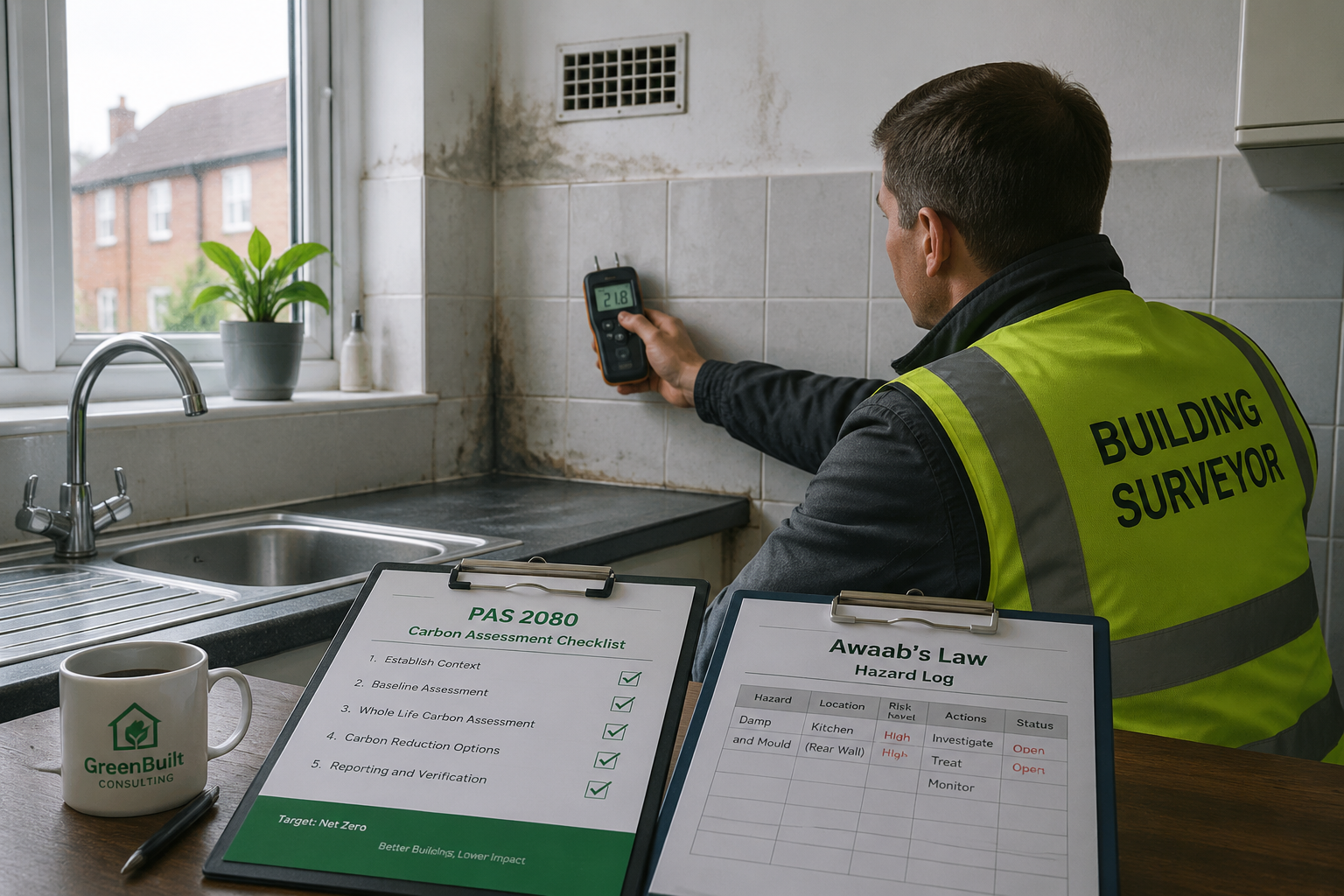
What PAS 2080:2023 Actually Covers — and What It Does Not
Before integrating any standard into a survey workflow, its scope must be understood precisely. PAS 2080:2023 is published by the British Standards Institution (BSI) and is titled "Carbon Management in Infrastructure and the Built Environment." It provides a framework for measuring, managing, and reducing whole-life carbon across design, construction, operation, and end-of-life phases [1].
The standard aligns closely with EN 15978, the European standard for assessing the environmental performance of buildings using life cycle assessment. This alignment means that carbon data produced under PAS 2080:2023 is internationally comparable and suitable for inclusion in Environmental Product Declarations [2].
What PAS 2080:2023 is not:
- It is not a hygiene certification or food safety standard
- It does not replace or replicate the HHSRS
- It does not set thresholds for mould, damp, or pest infestation
- It is not a product certification scheme
This distinction matters enormously. Industry summaries from the Construction Leadership Council and the Institution of Civil Engineers (ICE) consistently emphasise that PAS 2080 is a carbon management process standard, not a building condition or occupant health framework [4][9]. Surveyors who conflate the two risk producing reports that misrepresent both the carbon data and the hazard assessment.
However, the building fabric defects that generate domestic hygiene and food safety hazards — inadequate ventilation, moisture ingress, thermal bridging, and degraded building materials — are precisely the elements that a whole-life carbon assessment examines in detail [5]. That is the legitimate integration point, and it is where this guide focuses.
"The value of PAS 2080 in residential survey work lies not in what it regulates, but in the quality of building fabric evidence it generates — evidence that directly supports hazard identification under HHSRS and Awaab's Law."
For surveyors who want to understand the broader regulatory environment, a review of building regulation compliance testing provides useful context on how standards interact with statutory requirements.
The Awaab's Law Framework and Its Implications for 2026 Surveys
Awaab's Law, introduced through the Social Housing (Regulation) Act 2023 and extended to the private rented sector through subsequent regulations, imposes legally enforceable timelines on landlords and their agents to investigate and remediate hazardous conditions. In 2026, the key deadlines are:
| Hazard Type | Investigation Deadline | Emergency Repair Deadline | Full Remediation Deadline |
|---|---|---|---|
| Damp and mould (serious) | 14 days from report | 24 hours (emergency) | Defined by severity |
| Inadequate ventilation | 14 days from report | Not applicable | Case by case |
| Pest infestation (food safety risk) | 14 days from report | 24 hours (emergency) | Defined by severity |
| Structural moisture ingress | 14 days from report | 24 hours if structural | Case by case |
For surveyors, these timelines create a documentation imperative. A survey report that identifies damp or mould but fails to quantify severity, locate the source in the building fabric, or connect the defect to a carbon or thermal performance failure is legally and professionally insufficient in 2026.
This is where PAS 2080:2023 integration in building surveys for domestic hygiene and food safety hazards becomes practically valuable. By applying the whole-life carbon lens to building fabric assessment, surveyors generate the precise data — thermal bridging coefficients, ventilation performance metrics, moisture accumulation risk scores — that Awaab's Law investigations require [3].
Surveyors conducting Level 3 full building surveys are already positioned to capture this data. The integration step is structuring the report to present it in a format that serves both carbon compliance and hazard documentation simultaneously.
Domestic Hygiene and Food Safety Hazards: The Building Fabric Connection
Food safety hazards in domestic properties are rarely caused by occupant behaviour alone. The HHSRS identifies several Category 1 hazards that originate in building fabric failures:
- Damp and mould growth — driven by inadequate vapour control, thermal bridging, and poor ventilation
- Pest entry — enabled by gaps in building envelope, degraded seals around service penetrations, and poorly maintained drainage
- Inadequate food storage conditions — linked to temperature regulation failures, condensation on cold surfaces, and inadequate kitchen ventilation
- Contaminated water supply — associated with degraded pipework, inadequate insulation causing freezing, and backflow risks
Each of these has a direct building fabric cause. PAS 2080:2023's whole-life carbon methodology requires surveyors to assess the operational performance of building elements — including ventilation systems, insulation continuity, and envelope integrity [6]. That assessment, when documented correctly, provides the evidence base for HHSRS hazard scoring.
For properties with complex environmental conditions, the environmental issues assessment within a full building survey provides additional depth on contamination, drainage, and site-specific risks that affect both carbon performance and occupant health.
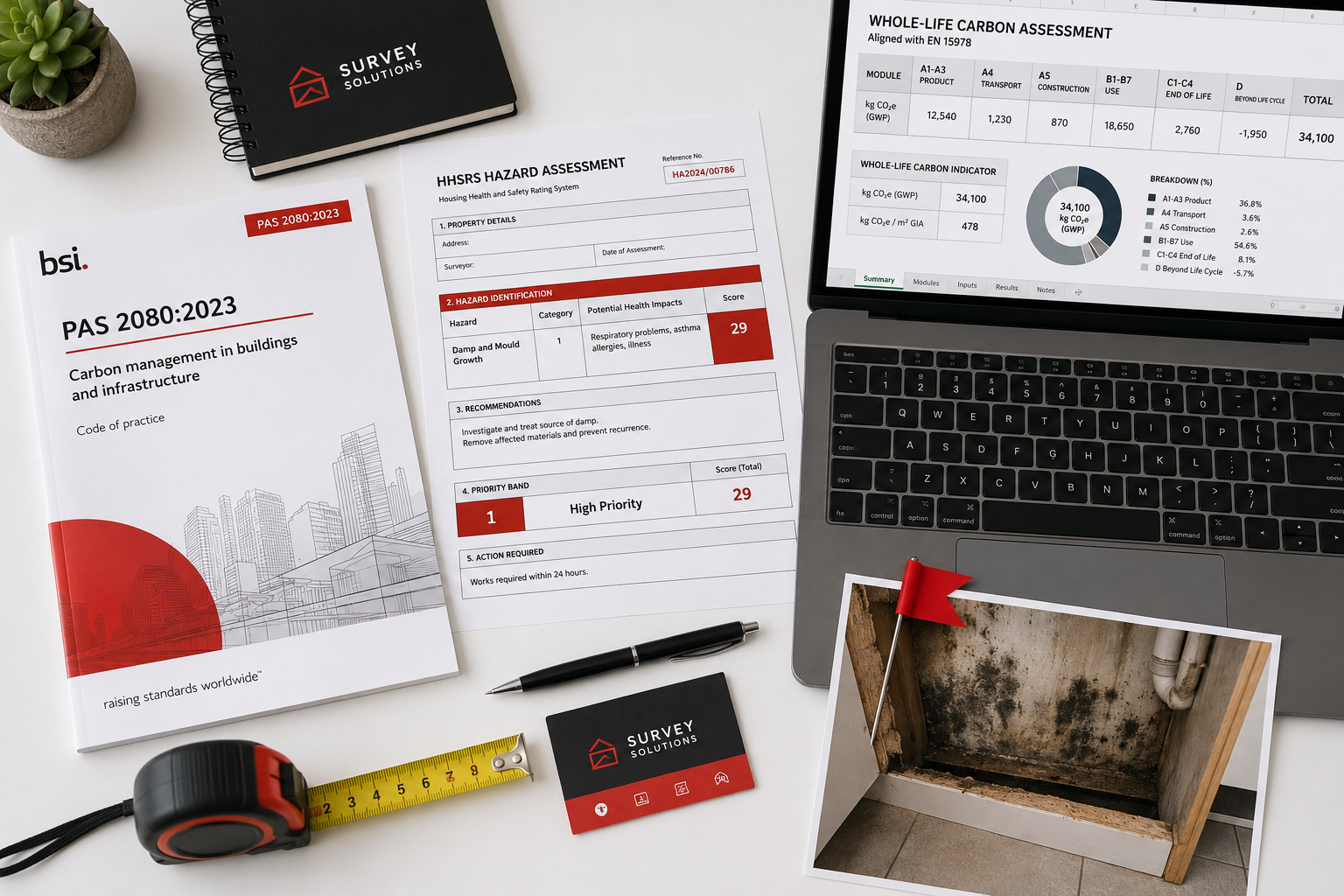
Building a Dual-Purpose Survey Template: PAS 2080 and HHSRS in 2026
The practical challenge for surveyors is producing a single report that satisfies PAS 2080:2023 carbon management requirements, HHSRS hazard documentation, and Awaab's Law evidence standards. The following template structure achieves this without duplicating effort.
Section 1: Building Fabric Carbon Assessment (PAS 2080:2023 Aligned)
This section captures the whole-life carbon data required under PAS 2080:2023, following the life cycle stages defined in EN 15978 [7]. For residential survey purposes, the operational carbon stage (B6) and maintenance stage (B2) are most relevant.
Required data points:
- Thermal envelope performance (U-values for walls, roof, floor, windows)
- Air permeability test results or estimated infiltration rate
- Ventilation system type, condition, and measured or estimated airflow rates
- Heating system efficiency and fuel type
- Evidence of thermal bridging at junctions
- Building materials condition relevant to carbon performance
The building materials assessments service provides the detailed material analysis that feeds directly into this section of the template.
Section 2: HHSRS Hazard Log (Awaab's Law Compliant)
This section maps building fabric findings from Section 1 to HHSRS hazard categories. The critical discipline is traceability — every hazard score must reference a specific building fabric observation.
Mapping examples:
| Building Fabric Finding (PAS 2080 Data) | HHSRS Hazard Category | Awaab's Law Trigger |
|---|---|---|
| Ventilation airflow below 8 l/s in kitchen | Excess cold / damp | Yes — investigate within 14 days |
| Thermal bridging at window reveals with surface condensation | Damp and mould growth | Yes — investigate within 14 days |
| Degraded DPC with rising damp evidence | Damp and mould growth | Yes — investigate within 14 days |
| Gaps in building envelope at service penetrations | Entry of pests | Yes — investigate within 14 days |
| Cold water pipe without insulation in unheated space | Domestic hygiene (water supply) | Case by case |
Section 3: Food Safety Specific Assessment
This section addresses kitchen and food storage conditions specifically. It is not required by PAS 2080:2023 but is triggered by HHSRS Category 1 findings and Awaab's Law obligations.
Assessment checklist:
- Kitchen extract ventilation: type, condition, measured or estimated airflow
- Surface condensation risk on cold walls adjacent to food storage areas
- Evidence of pest activity (droppings, entry points, damage)
- Drainage condition and backflow prevention
- Cold water supply quality indicators (discolouration, odour, temperature)
- Food storage temperature conditions (ambient temperature in larder or storage areas)
Section 4: Remediation Priorities and Carbon Impact
This section closes the loop between hazard remediation and carbon management. For each hazard identified, the remediation recommendation should include:
- The primary remediation action (e.g., install MVHR, repoint DPC, seal penetrations)
- The estimated carbon impact of the remediation (embodied carbon of materials, operational carbon saving)
- The Awaab's Law response timeline applicable
- The PAS 2080 life cycle stage affected by the remediation
This integrated approach is consistent with the BSI's positioning of PAS 2080:2023 as a tool for decision-making across the whole life of a building, not just at design stage [1].
For surveyors working on blocks of flats or multi-unit PRS properties, the health and safety inspections framework provides a complementary structure for managing hazard documentation across multiple units simultaneously.
Government Procurement Signals and 2026 Compliance Expectations
The Department for Transport's 2026 policy direction requires PAS 2080 compliance for centrally funded infrastructure projects. National Highways and Tier-1 contractors have already embedded PAS 2080-based requirements into their supply chain contracts [2]. While this initially affects infrastructure rather than residential property, the signal is clear: PAS 2080 compliance is becoming a baseline expectation across the built environment sector.
For surveying firms, this creates both a risk and an opportunity. Firms that develop PAS 2080:2023 integration in building surveys for domestic hygiene and food safety hazards as a defined service offering in 2026 will be positioned ahead of regulatory requirements that are likely to extend to residential compliance frameworks within the next two to three years [8].
The NQA guidance on PAS 2080 implementation notes that organisations adopting the standard early consistently report improved data quality, stronger client relationships, and reduced rework costs compared to those who adopt reactively [3]. For surveying practices, the equivalent benefit is survey reports that withstand legal scrutiny under Awaab's Law and provide clients with actionable, carbon-aware remediation plans.
Surveyors who want to understand how this fits within broader property compliance obligations should review guidance on new property management laws and the evolving regulatory landscape for PRS landlords.
Practical Implementation: Getting Started in 2026
Implementing PAS 2080:2023 integration does not require a complete overhaul of existing survey workflows. The following steps allow surveying firms to build capability incrementally.
Step 1: Training and Competency
Ensure at least one surveyor per team has completed PAS 2080:2023 awareness training. NQA and ICE both offer structured programmes [9]. This surveyor becomes the internal reference point for carbon data quality.
Step 2: Template Adaptation
Adapt existing Level 3 building survey templates to include the four sections described above. The carbon assessment section can initially rely on estimated values (using published default U-values and airflow rates) before moving to measured data.
Step 3: Data Integration
Invest in survey software that allows carbon data and HHSRS hazard scores to be captured in the same record. Several platforms now support this dual-data structure, reducing report preparation time significantly.
Step 4: Client Communication
Develop a one-page explainer for landlord clients that describes the dual-purpose survey approach, explains Awaab's Law timelines, and sets out the carbon remediation benefits. This positions the firm as a compliance partner, not just a condition reporter.
Step 5: Quality Assurance
Establish a peer review process for dual-purpose reports, with specific checks on the traceability between carbon data and hazard scores. This is the most common failure point in early implementations.
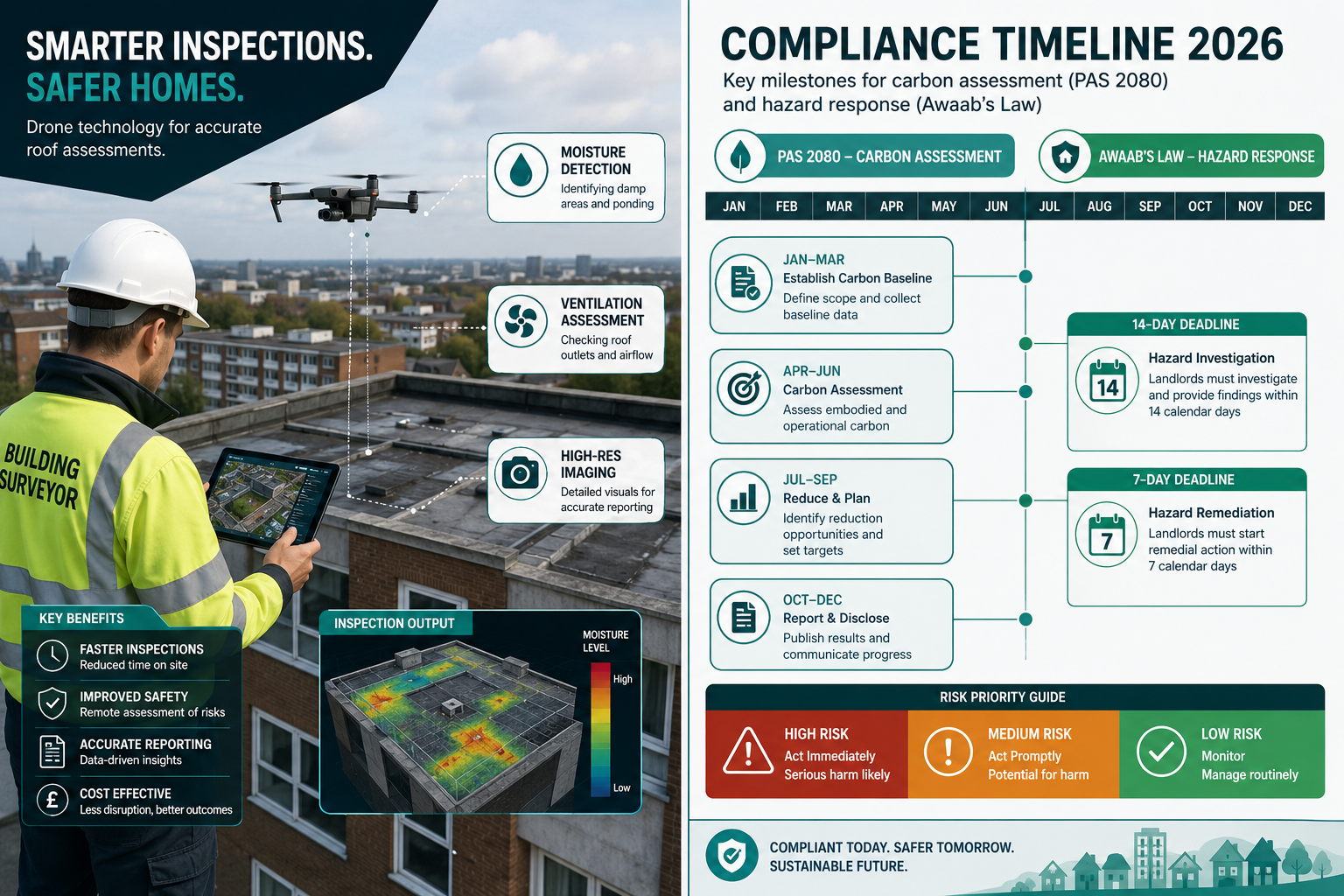
For firms considering drone-assisted inspection to improve data quality on roofs and external fabric, the premium drone survey service offers a practical solution for capturing thermal and visual data that feeds directly into the PAS 2080 fabric assessment.
Surveyors working with landlords on rental property compliance will also find the guidance on how often rental units should be inspected useful for structuring ongoing monitoring programmes that maintain PAS 2080 and Awaab's Law compliance between major surveys.
Conclusion
The integration of PAS 2080:2023 into building surveys for domestic hygiene and food safety hazards represents a significant but achievable evolution in professional practice. The standard's whole-life carbon methodology generates precisely the building fabric evidence that Awaab's Law investigations require — surveyors who recognise this connection and structure their reports accordingly will deliver measurably better outcomes for clients, occupants, and their own professional standing.
Actionable next steps for 2026:
- Audit current Level 3 survey templates against the four-section structure described in this guide and identify gaps in carbon data capture.
- Complete PAS 2080:2023 awareness training through ICE or NQA before the end of Q2 2026.
- Update client engagement letters to reference both PAS 2080:2023 and Awaab's Law obligations, setting clear expectations for dual-purpose reporting.
- Pilot the integrated template on three PRS properties and use the results to refine the carbon-to-hazard traceability mapping.
- Review government procurement updates quarterly — PAS 2080 requirements are expanding, and early compliance positions firms ahead of mandatory adoption.
The firms that act now will not be scrambling to retrofit compliance when regulatory requirements extend further into residential property. They will already have the systems, the skills, and the track record to demonstrate it.
References
[1] PAS 2080 – bsigroup.com
[2] PAS 2080 Your Ticket To UK Low Carbon Infrastructure – epd.guide
[3] NQA Webinar PAS 2080 Introduction 15 03 24 – nqa.com
[4] Guidance Document For PAS 2080 – constructionleadershipcouncil.co.uk
[5] PAS 2080 Standard Implementation – tunley-environmental.com
[6] Building Decarbonization – envigilance.com
[7] PAS 2080 Carbon Management In Infrastructure And Built Environment – bsigroup.com
[8] PAS 2080 Webinar – nqa.com
[9] Guidance Document PAS 2080 – ice.org.uk
[10] PAS 2080 2023 Guidance Document For PAS 2800 – scribd.com