

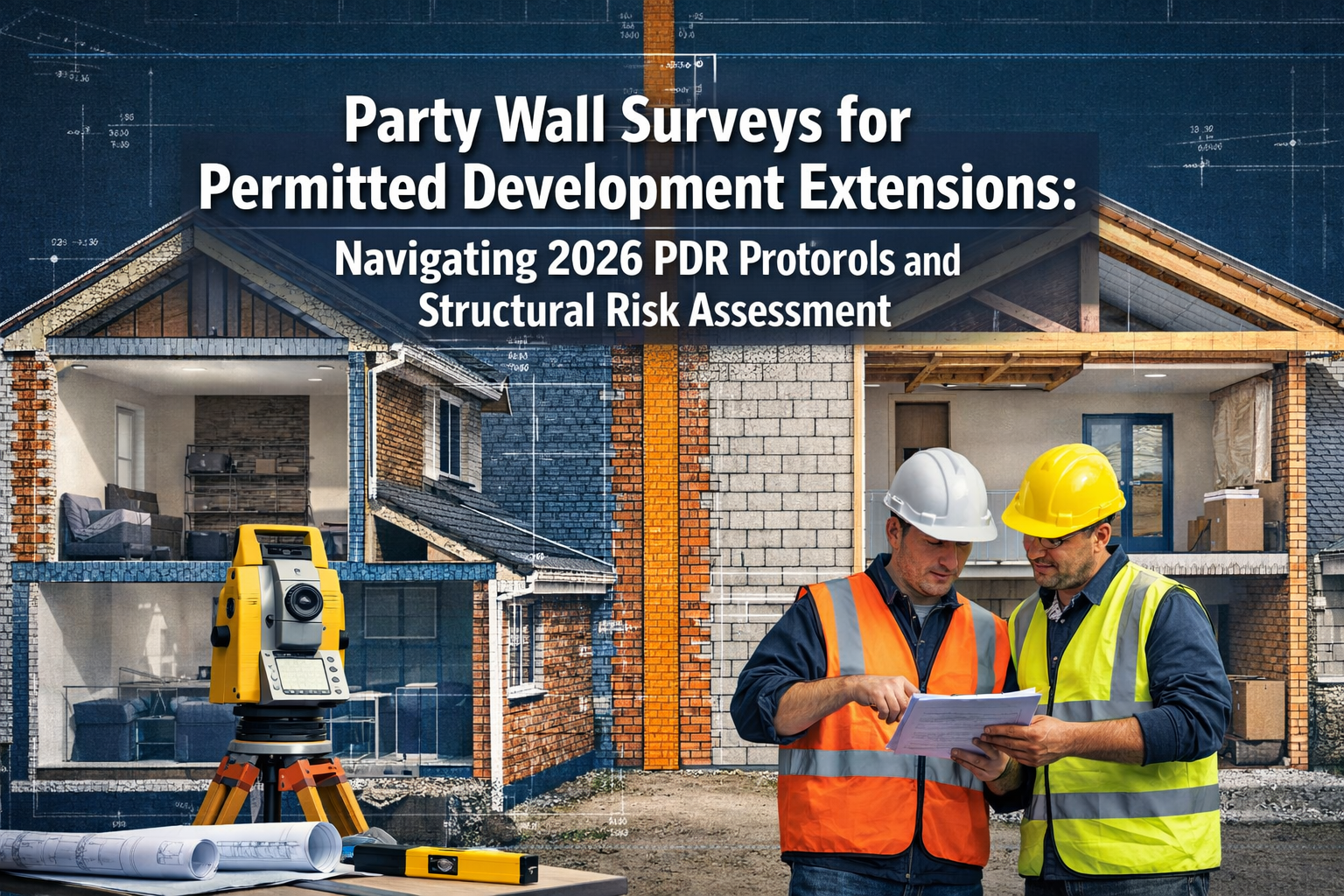
Over 47,000 homeowners in England completed rear and side extensions under Permitted Development Rights (PDR) in 2025, with projections showing a 23% increase in 2026 as property values recover and homeowners seek cost-effective expansion solutions. Yet fewer than 40% properly addressed party wall obligations before construction commenced. As the market rebounds and PDR-enabled extensions surge, understanding Party Wall Surveys for Permitted Development Extensions: Navigating 2026 PDR Protocols and Structural Risk Assessment has become critical for avoiding costly disputes, structural damage claims, and construction delays.
The intersection of simplified planning permissions and complex party wall legislation creates unique challenges. While PDR removes many planning barriers, it does not exempt property owners from Party Wall Act 1996 obligations. The 2026 protocols bring enhanced documentation requirements and stricter structural assessment standards that directly impact how surveyors approach PDR extension projects.
Key Takeaways
- Notice timing is non-negotiable: PDR extensions require party wall notices at least two months before construction starts, regardless of simplified planning routes[3]
- 2026 protocols mandate enhanced documentation: New ALTA/NSPS standards require detailed documentation of all walls and improvements within five feet of boundary lines[2]
- Structural risk assessment protects all parties: Comprehensive schedules of condition prevent post-construction disputes and establish baseline property conditions
- Surveyor liability has increased: Updated 2026 guidelines place greater responsibility on surveyors for accurate party wall relationship documentation[1]
- PDR doesn't bypass party wall obligations: Simplified planning permissions create a false sense of reduced legal requirements
Understanding Party Wall Surveys for Permitted Development Extensions in 2026
What Makes PDR Extensions Different?
Permitted Development Rights allow homeowners to extend properties without full planning permission, subject to specific size and design limitations. Single-storey rear extensions can extend up to six meters for attached houses and eight meters for detached properties under current PDR rules.
However, this planning simplification creates confusion about party wall requirements. Many homeowners mistakenly believe that bypassing planning permission also bypasses party wall legislation—a costly misunderstanding.
The critical distinction: Planning permission and party wall agreements are separate legal frameworks. PDR addresses what you can build; the Party Wall Act 1996 addresses how your construction affects neighboring properties.
2026 Protocol Updates Affecting PDR Projects
The 2026 ALTA/NSPS standards, effective February 23, 2026, introduced significant changes to survey documentation requirements. These standards now mandate that surveyors must document "the character and location of all walls, buildings, fences, and other improvements within five feet of each side of boundary lines" during fieldwork[2].
For PDR extensions, this means:
✅ Mandatory party wall identification on all survey documents
✅ Precise location measurements relative to property boundaries
✅ Character assessment of existing party wall structures
✅ Relationship documentation between adjoining properties
The Missouri Housing Development Commission (MHDC) 2026 survey guidelines, revised in February 2026, further reinforce these requirements by stipulating that "all party walls must be shown on surveys" and surveyors must "determine the relationship and location of division or party walls with respect to adjoining properties as designated by the client"[1].
When Party Wall Surveys Are Required for PDR Extensions
Not all PDR extensions trigger party wall requirements, but most do. Understanding when you need to serve notice prevents legal complications and construction delays.
Party wall notices are required when your PDR extension involves:
🏗️ Building on or astride the boundary line between properties
🏗️ Building within three meters of a neighbor's structure if excavating below their foundation level
🏗️ Building within six meters of a neighbor's structure if excavating below a plane drawn at 45 degrees from their foundation bottom
🏗️ Work directly to an existing party wall (cutting into, raising, or underpinning)
For comprehensive guidance on your rights and obligations, review our detailed resource on what your party wall rights entail.
The Two-Month Notice Requirement
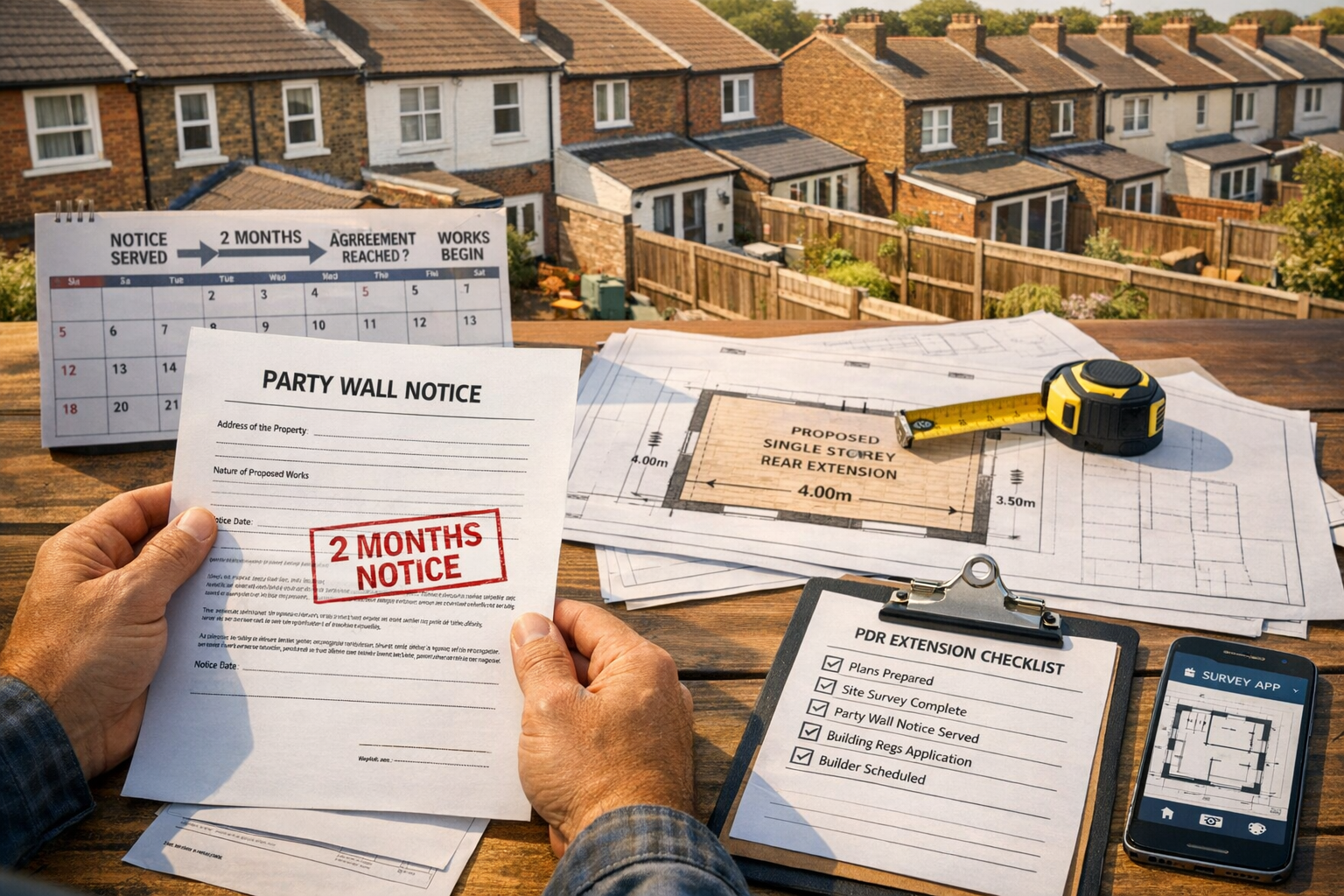
The Party Wall Act 1996 requires building owners to serve proper notice at least two months before construction work begins (one month for certain expedited processes)[3]. This timeline is absolute and applies regardless of PDR status.
Common timeline mistakes:
❌ Assuming PDR approval means immediate construction start
❌ Serving notice after receiving PDR confirmation
❌ Beginning work before the notice period expires
❌ Failing to account for neighbor response time
The proper sequence: Confirm PDR eligibility → Serve party wall notice → Wait for neighbor consent or surveyor appointment → Complete party wall agreement → Begin construction.
Structural Risk Assessment Requirements for Party Wall Surveys in PDR Projects
Why Structural Assessment Matters More in 2026
The 2026 protocols place unprecedented emphasis on structural risk documentation. This shift responds to increased post-construction disputes and insurance claims related to inadequate pre-work assessments.
For PDR extensions, structural risk assessment serves three critical functions:
- Baseline establishment: Documents pre-construction conditions to resolve future disputes
- Risk identification: Highlights potential structural vulnerabilities before work begins
- Mitigation planning: Enables proactive measures to prevent damage
The enhanced documentation requirements within five feet of boundary lines[2] mean surveyors must now capture significantly more detail about existing structural conditions, particularly for party walls and adjacent improvements.
Components of a Comprehensive Schedule of Condition
A schedule of condition forms the cornerstone of party wall protection for PDR extensions. This detailed record documents the neighbor's property condition before construction begins.
Essential elements include:
📋 Photographic evidence: High-resolution images of all rooms, walls, ceilings, and external elevations
📋 Crack mapping: Precise measurements and locations of existing cracks
📋 Structural observations: Notes on wall alignment, floor levels, and settlement indicators
📋 Decorative condition: Current state of finishes, fixtures, and fittings
📋 Measurement data: Specific dimensions and levels for comparison
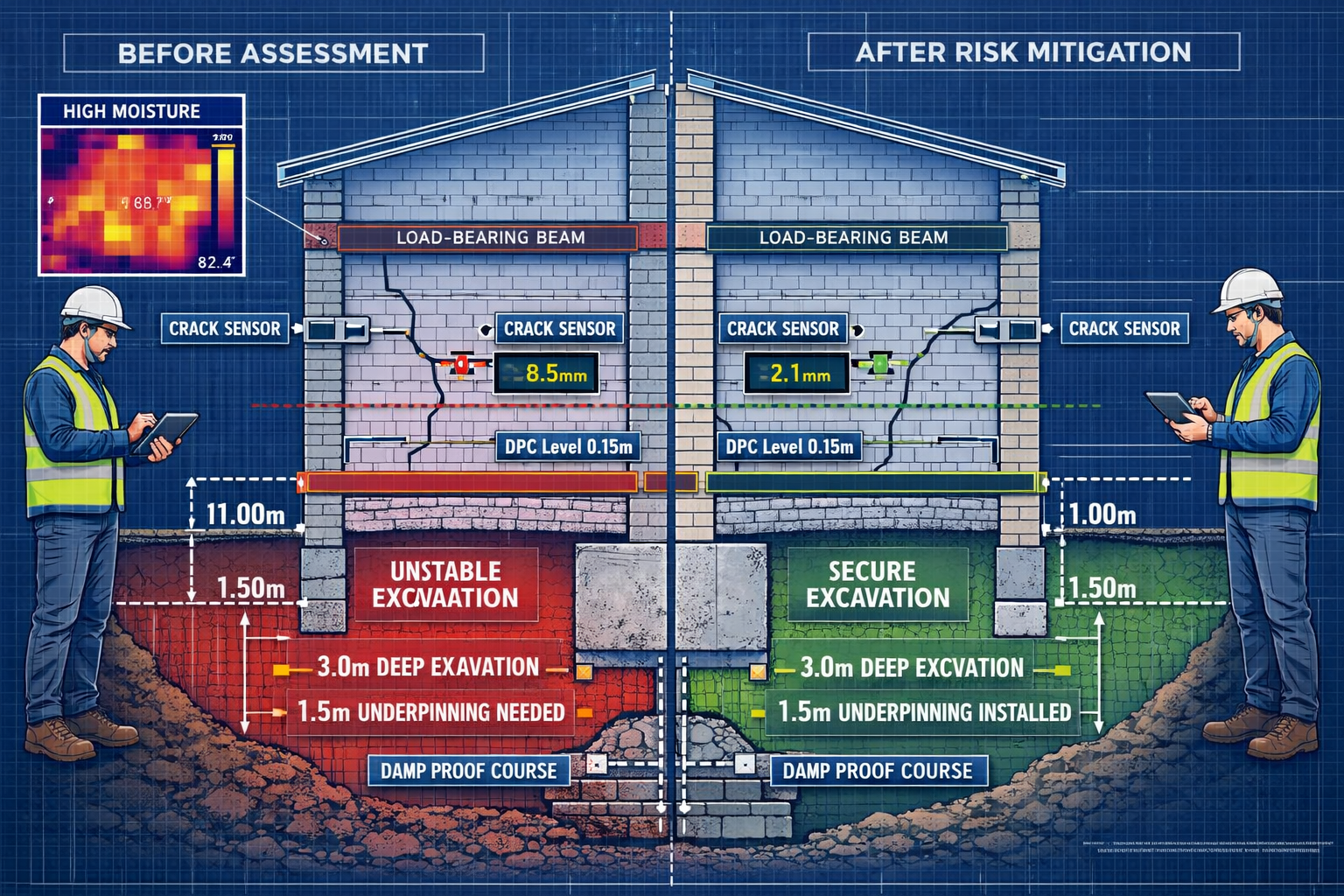
Best practices for schedules of condition in party wall works have evolved significantly in 2026, with greater emphasis on digital documentation and photographic evidence[3]. Professional surveyors now employ laser measurement tools, thermal imaging, and detailed crack-width gauges to establish baseline conditions.
For detailed guidance on creating effective schedules of condition, explore our specialized service for party wall schedule of condition documentation.
Identifying High-Risk Structural Scenarios
Certain PDR extension configurations present elevated structural risks that require enhanced assessment protocols.
High-risk scenarios requiring additional scrutiny:
⚠️ Deep excavations near party walls: Extensions requiring foundations below neighboring property levels
⚠️ Older party wall construction: Victorian or Edwardian properties with lime mortar joints
⚠️ Previous settlement evidence: Properties showing existing structural movement
⚠️ Asymmetric loading: Extensions creating uneven weight distribution on party walls
⚠️ Clay soil conditions: Properties on shrinkable clay requiring deeper foundations
In these situations, engaging structural engineers alongside party wall surveyors provides comprehensive risk assessment. Understanding when you need structural engineer involvement ensures appropriate expertise for complex scenarios.
Foundation Depth and Excavation Protocols
The three-meter and six-meter rules create specific assessment requirements for PDR extensions involving excavation near party boundaries.
Foundation assessment checklist:
| Assessment Element | Requirement | Documentation Standard |
|---|---|---|
| Neighbor's foundation depth | Trial pit or building records | Measured to nearest 50mm |
| Proposed excavation depth | Structural engineer calculation | Detailed foundation drawings |
| Soil type and bearing capacity | Ground investigation report | Laboratory test results |
| Underpinning necessity | Structural engineer determination | Method statement if required |
| Temporary support measures | Shoring/propping specifications | Safety certification |
The 2026 protocols require this information to be documented on survey plans, with clear indication of the relationship between proposed excavations and existing foundations[1][2].
Monitoring and Protection Measures
Modern party wall agreements for PDR extensions increasingly incorporate monitoring provisions to track structural performance during construction.
Common monitoring approaches:
🔍 Crack monitoring: Tell-tales or digital sensors on existing cracks
🔍 Level monitoring: Regular surveys to detect settlement
🔍 Vibration monitoring: Sensors during excavation or piling work
🔍 Photographic progression: Staged documentation throughout construction
These measures provide early warning of structural issues, enabling prompt intervention before significant damage occurs. They also create objective evidence for resolving disputes about construction impact.
Navigating the Party Wall Survey Process for PDR Extensions
Selecting the Right Party Wall Surveyor
The surveyor selection significantly impacts the efficiency and outcome of the party wall process. For PDR extensions, choosing surveyors with specific experience in residential extension work proves valuable.
Key selection criteria:
✓ RICS membership: Ensures professional standards and insurance
✓ PDR extension experience: Familiarity with common issues and solutions
✓ Local knowledge: Understanding of regional construction practices
✓ Communication skills: Ability to explain technical matters clearly
✓ Availability: Capacity to meet project timelines
Many neighbors choose to appoint the building owner's surveyor as the "agreed surveyor" to reduce costs and streamline the process. This approach works well for straightforward PDR extensions with cooperative neighbors.
However, if concerns exist about the proposed work or previous relationship issues, neighbors may prefer to appoint their own surveyor. Understanding common misconceptions about party wall agreements helps set realistic expectations for the process.
The Party Wall Notice and Response Process
Serving proper notice initiates the formal party wall process. For PDR extensions, the notice must clearly describe the proposed work, including drawings and specifications.
Notice must include:
📄 Building owner's name and address
📄 Detailed description of proposed works
📄 Architectural drawings showing the extension
📄 Indication of when work will start
📄 Statement of rights under the Party Wall Act
Neighbors have 14 days to respond. Three possible outcomes exist:
- Consent: Neighbor agrees, and work can proceed after the notice period
- Dissent: Neighbor objects, triggering surveyor appointment
- No response: Treated as dissent after 14 days
If your neighbor refuses party wall works, the surveyor appointment process ensures the project can still proceed while protecting both parties' interests.
Party Wall Award Requirements
When surveyors are appointed (either agreed surveyor or separate surveyors), they prepare a Party Wall Award—the legally binding document governing the construction work.
Award typically includes:
📜 Detailed work description: Precise specifications of permitted activities
📜 Schedule of condition: Baseline documentation of neighbor's property
📜 Access provisions: Rights to enter neighbor's property for surveys
📜 Working hours: Restrictions on construction times
📜 Protection measures: Required safeguards during construction
📜 Dispute resolution: Process for addressing issues
The award must be served on both parties before work commences. Both building owner and neighbor have 14 days to appeal the award to the county court if they disagree with its terms.
Cost Allocation and Fee Structures
The Party Wall Act places the financial burden of the party wall process on the building owner—the person initiating the work. This includes:
💰 Surveyor fees (both the building owner's and neighbor's surveyors if separately appointed)
💰 Schedule of condition costs
💰 Any required structural reports or investigations
💰 Award preparation and administration
For straightforward PDR extensions with an agreed surveyor, total costs typically range from £700-£1,500. Complex projects with separate surveyors, extensive documentation requirements, or disputes can cost £2,000-£5,000 or more.
Understanding these costs early in the planning process prevents budget surprises. Many homeowners fail to account for party wall expenses when calculating PDR extension costs, leading to financial strain mid-project.
Common Pitfalls and How to Avoid Them
Years of party wall work with PDR extensions reveal recurring mistakes that cause delays, disputes, and additional costs.
Top pitfalls to avoid:
❌ Starting work before the award: Even with neighbor consent, formal documentation must be complete
❌ Inadequate schedule of condition: Rushed or incomplete documentation creates dispute vulnerability
❌ Poor contractor communication: Builders unaware of party wall obligations may violate award terms
❌ Ignoring access requirements: Failing to coordinate neighbor access for surveys causes delays
❌ Dismissing minor cracks: Small issues during construction can become major disputes if unreported
The consequences of ignoring the Party Wall Act include injunctions stopping work, liability for neighbor's damage, and legal costs—all far exceeding proper compliance costs.
Managing Party Wall Disputes During PDR Extensions
Early Warning Signs of Potential Disputes
Recognizing dispute indicators early enables proactive resolution before positions harden and relationships deteriorate.
Red flags requiring immediate attention:
🚩 Neighbor expressing concerns about construction noise or duration
🚩 New cracks appearing in neighbor's property during work
🚩 Contractor working outside agreed hours
🚩 Excavation deeper than specified in the award
🚩 Neighbor reporting vibration or movement concerns
Addressing these issues promptly—through surveyor communication, additional monitoring, or work modifications—prevents escalation into formal disputes.
Resolution Mechanisms Under 2026 Protocols
The Party Wall Act provides structured dispute resolution processes that avoid costly litigation in most cases.
Resolution hierarchy:
- Direct communication: Building owner and neighbor discussion
- Surveyor mediation: Appointed surveyors facilitate agreement
- Third surveyor determination: Selected third surveyor makes binding decision
- County court appeal: Legal challenge to award or third surveyor decision
The 2026 emphasis on comprehensive documentation[1][2] strengthens the evidentiary foundation for resolving disputes, as detailed schedules of condition and monitoring data provide objective facts rather than competing claims.
For guidance on managing conflicts, review our resource on party wall disputes and resolution strategies.
Insurance Considerations
Adequate insurance coverage protects building owners from party wall-related claims. Standard home insurance policies often exclude or limit coverage for party wall disputes and damage claims.
Essential insurance provisions:
🛡️ Party wall dispute cover: Legal expenses for surveyor fees and third surveyor costs
🛡️ Damage liability: Coverage for accidental damage to neighbor's property
🛡️ Professional indemnity: If using surveyors, their insurance protects against negligent advice
🛡️ Contractor liability: Builder's insurance covering party wall damage
Reviewing insurance coverage before serving party wall notices ensures protection throughout the construction process.
Integrating Party Wall Surveys with Broader Building Assessment
Relationship to Building Surveys and Structural Reports
Party wall surveys focus specifically on the shared boundary and potential construction impact. However, comprehensive PDR extension projects benefit from broader building assessment.
Complementary survey types:
🏘️ Level 3 Building Survey: Comprehensive property condition assessment before major works
🏘️ Structural engineer report: Foundation design and load calculations
🏘️ Drainage survey: Ensuring extension doesn't compromise existing drainage
🏘️ Boundary survey: Confirming exact property lines before construction
Understanding which building survey you need helps coordinate multiple assessment requirements efficiently. A Level 3 full building survey provides comprehensive baseline documentation beyond party wall-specific requirements.
Coordination with Planning and Building Control
While PDR removes full planning permission requirements, building control approval remains mandatory for structural work, drainage, and compliance with building regulations.
Coordination timeline:
📅 Weeks 1-2: Confirm PDR eligibility and design finalization
📅 Weeks 3-4: Serve party wall notices (if required)
📅 Weeks 5-8: Party wall surveyor appointments and award preparation
📅 Weeks 9-10: Submit building control application
📅 Week 11+: Construction commencement after all approvals
This sequencing ensures party wall obligations are addressed before building control inspections begin, preventing conflicts between different regulatory requirements.
Documentation Standards for 2026 Compliance
The enhanced 2026 documentation requirements[1][2] create higher standards for survey deliverables. Professional party wall surveys for PDR extensions should now include:
✓ Digital survey plans showing party walls and five-foot boundary zone
✓ Photographic schedules with date stamps and location metadata
✓ Measurement data in standardized formats for comparison
✓ Structural assessment reports for high-risk scenarios
✓ Monitoring protocols with baseline readings
These enhanced standards improve dispute resolution outcomes and reduce surveyor liability exposure by establishing clear, objective documentation of pre-construction conditions and assessment methodologies.
Conclusion
Party Wall Surveys for Permitted Development Extensions: Navigating 2026 PDR Protocols and Structural Risk Assessment requires understanding that simplified planning routes do not eliminate party wall obligations. The 2026 protocol updates have raised documentation standards and placed greater emphasis on comprehensive structural risk assessment, particularly for work within five feet of property boundaries.
Success with PDR extensions depends on early party wall planning—ideally before finalizing extension designs. The two-month notice requirement means party wall processes should begin immediately upon deciding to proceed with a PDR extension, not after design completion or contractor selection.
The enhanced documentation requirements introduced in 2026[1][2] provide better protection for all parties through objective baseline evidence and clear structural assessment protocols. While these standards increase initial survey costs and time requirements, they significantly reduce dispute risk and post-construction claim exposure.
Actionable Next Steps
For homeowners planning PDR extensions in 2026:
- Assess party wall applicability based on your extension location and design
- Engage a qualified party wall surveyor before serving notices
- Serve notices at least 10 weeks before planned construction start to allow for process completion
- Ensure comprehensive schedule of condition documentation meeting 2026 standards
- Coordinate party wall requirements with building control submissions
- Maintain open communication with neighbors throughout the process
- Brief contractors thoroughly on party wall award requirements and restrictions
The intersection of PDR simplification and party wall complexity creates challenges, but proper navigation protects your investment, preserves neighbor relationships, and ensures legal compliance. The 2026 protocols provide clearer frameworks for assessment and documentation—use them to your advantage.
For expert guidance on your specific PDR extension and party wall requirements, consult with experienced chartered surveyors who understand both the planning and structural aspects of residential extensions. The cost of proper party wall compliance represents a small fraction of potential dispute costs, construction delays, and damage claims.
References
[1] 2026 Mhdc Survey Guidelines – mhdc.com
[2] 2026 Alta Nsps Iplsa 20260206 – iplsa.org
[3] Schedules Of Condition In Party Wall Works Best Practices To Prevent Post Construction Claims In 2026 – nottinghillsurveyors.com