

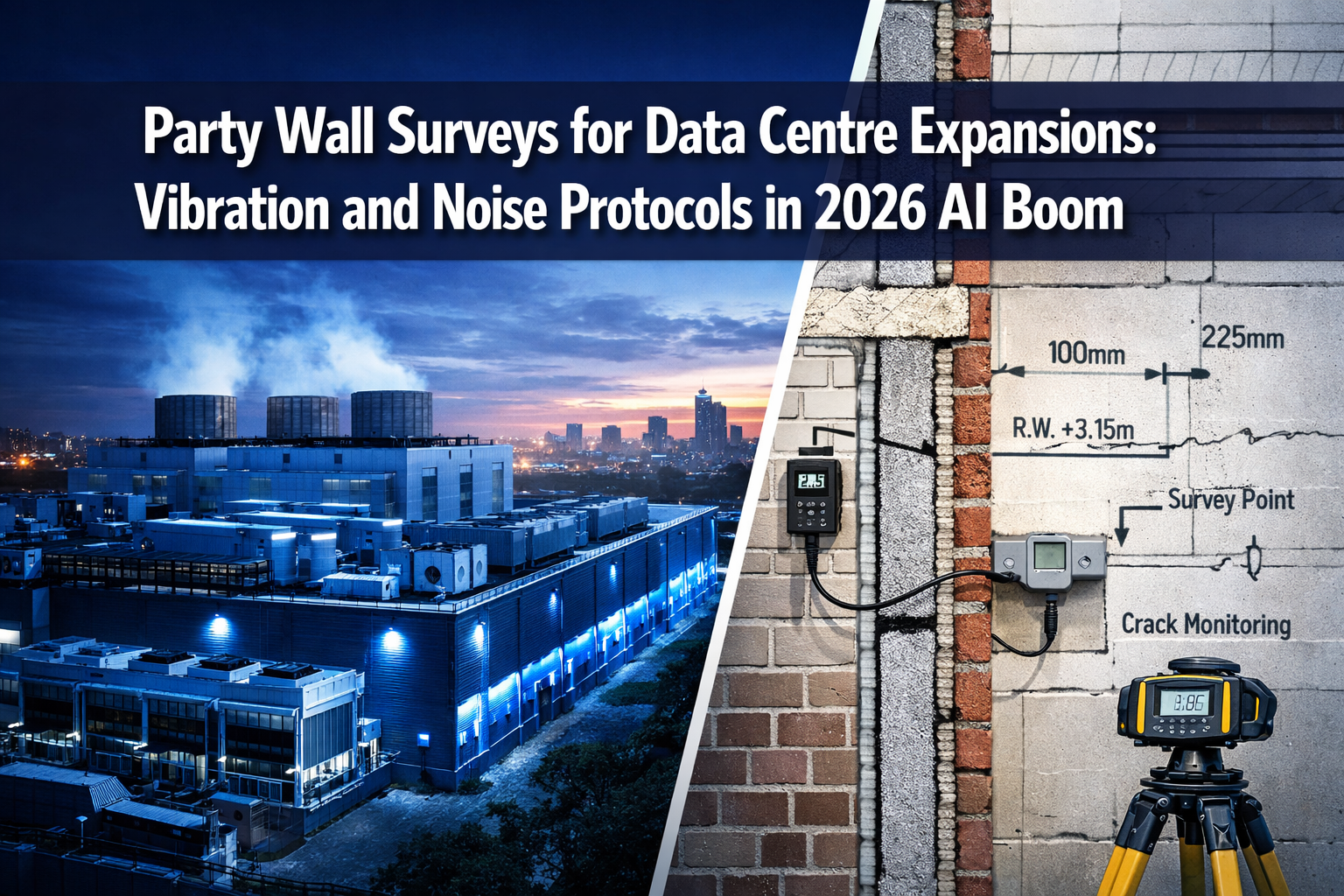
The artificial intelligence revolution is reshaping the UK's urban landscape in unexpected ways. As data centres race to expand capacity to meet surging AI computational demands in 2026, a critical challenge emerges at the boundaries between these industrial-scale facilities and neighbouring properties. Party Wall Surveys for Data Centre Expansions: Vibration and Noise Protocols in 2026 AI Boom have become essential safeguards, protecting both infrastructure investments and community relationships as hyperscale developments push into established urban areas.
With nearly 100 GW of new data centre capacity scheduled between 2026 and 2030—effectively doubling global capacity—the pressure on urban sites has intensified dramatically [2]. These expansions bring unprecedented construction activity, powerful cooling systems, and continuous operational noise that can significantly impact adjacent properties. Understanding the specialized party wall protocols for these unique developments is no longer optional for property owners, developers, or surveyors.
Key Takeaways
- 🏗️ AI-driven data centre expansion in 2026 is creating complex party wall scenarios requiring specialized vibration and noise monitoring protocols
- 📊 Nearly 100 GW of new capacity scheduled through 2030 means unprecedented construction activity near existing properties, demanding rigorous party wall agreements
- 🔊 Continuous operational noise from cooling systems and generators requires long-term monitoring beyond traditional construction-phase assessments
- ⚖️ RICS best practices now incorporate data centre-specific protocols addressing 24/7 operational impacts and hyperscale facility requirements
- 🤝 Proactive neighbour engagement and comprehensive party wall surveys prevent costly disputes and project delays in urban data centre developments
Understanding Party Wall Requirements for Data Centre Developments
The Party Wall Act and Data Centre Construction
The Party Wall etc. Act 1996 governs construction work affecting shared walls, boundaries, and excavations near neighbouring properties throughout England and Wales. For data centre expansions, this legislation takes on heightened significance due to the scale and intensity of development work involved.
Data centre projects typically trigger Party Wall Act requirements through:
- Excavation work for underground cooling infrastructure and cable trenches within three to six metres of adjoining structures
- Building on boundary lines when expanding facilities in constrained urban sites
- Structural alterations to existing buildings being converted or expanded for data centre use
- Foundation work for heavy equipment installations that may affect neighbouring properties
The consequences of ignoring the Party Wall Act can be severe, including injunctions halting construction, mandatory remediation work, and substantial legal costs. For data centre developers working to tight deployment schedules, these delays can translate into millions in lost revenue as clients seek alternative facilities.
Why Data Centres Present Unique Party Wall Challenges
Unlike residential or standard commercial developments, data centres operate continuously with significant environmental impacts that extend far beyond the construction phase. The 2026 AI boom has accelerated deployment of hyperscale facilities—massive structures housing tens of thousands of servers generating substantial heat, vibration, and noise.
Key differentiators include:
| Factor | Traditional Development | Data Centre Expansion |
|---|---|---|
| Operational Noise | Minimal after construction | Continuous 24/7 cooling systems |
| Vibration Sources | Construction phase only | Ongoing from generators and HVAC |
| Power Infrastructure | Standard utilities | High-voltage substations and backup generators |
| Construction Timeline | Defined end date | Phased expansion with ongoing work |
| Structural Loading | Typical commercial | Extremely heavy equipment loads |
Understanding these distinctions is crucial when preparing party wall agreements that adequately protect neighbouring property owners while allowing essential infrastructure development to proceed.
The 2026 AI Infrastructure Context
The current data centre expansion wave differs markedly from previous growth cycles. With vacancy rates holding at approximately 1% and nearly two-thirds of new capacity being developed outside established hubs [1], developers are increasingly targeting urban sites with existing infrastructure but also existing neighbours.
This urban densification creates scenarios where multi-million pound hyperscale facilities sit adjacent to residential properties, small businesses, and historic structures. The technical demands of AI workloads—requiring more power, cooling, and computational density than traditional data processing—amplify every potential party wall concern.
Vibration Monitoring Protocols for Data Centre Party Wall Surveys
Establishing Baseline Conditions
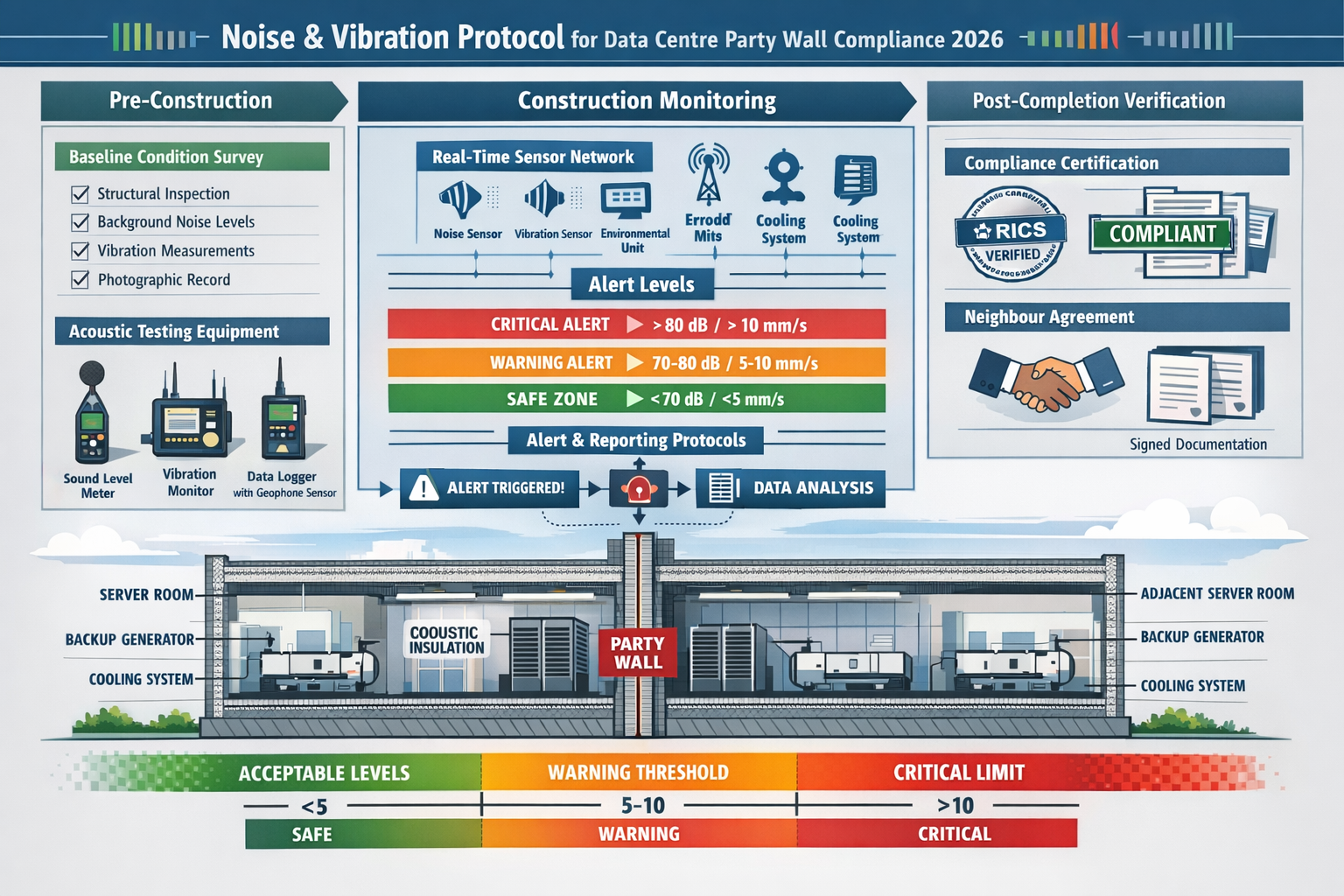
Before any construction begins, comprehensive baseline surveys form the foundation of effective party wall protection. For data centre projects, this process extends beyond standard photographic condition surveys to include detailed vibration and structural assessments.
A thorough baseline survey should document:
- 📸 Photographic evidence of existing cracks, settlement, and structural conditions in neighbouring properties
- 📏 Precise measurements of existing defects using crack monitoring gauges and datum points
- 🔊 Ambient vibration levels recorded over multiple days to establish normal background conditions
- 🏗️ Structural integrity assessments identifying vulnerable elements that may be sensitive to vibration
- 📋 Detailed written descriptions correlating visual evidence with structural significance
The party wall schedule of condition serves as a legally binding record of pre-construction status, essential for resolving any subsequent damage claims. For data centre projects, this documentation must be extraordinarily thorough given the extended construction timelines and substantial ground disturbance involved.
Construction Phase Vibration Monitoring
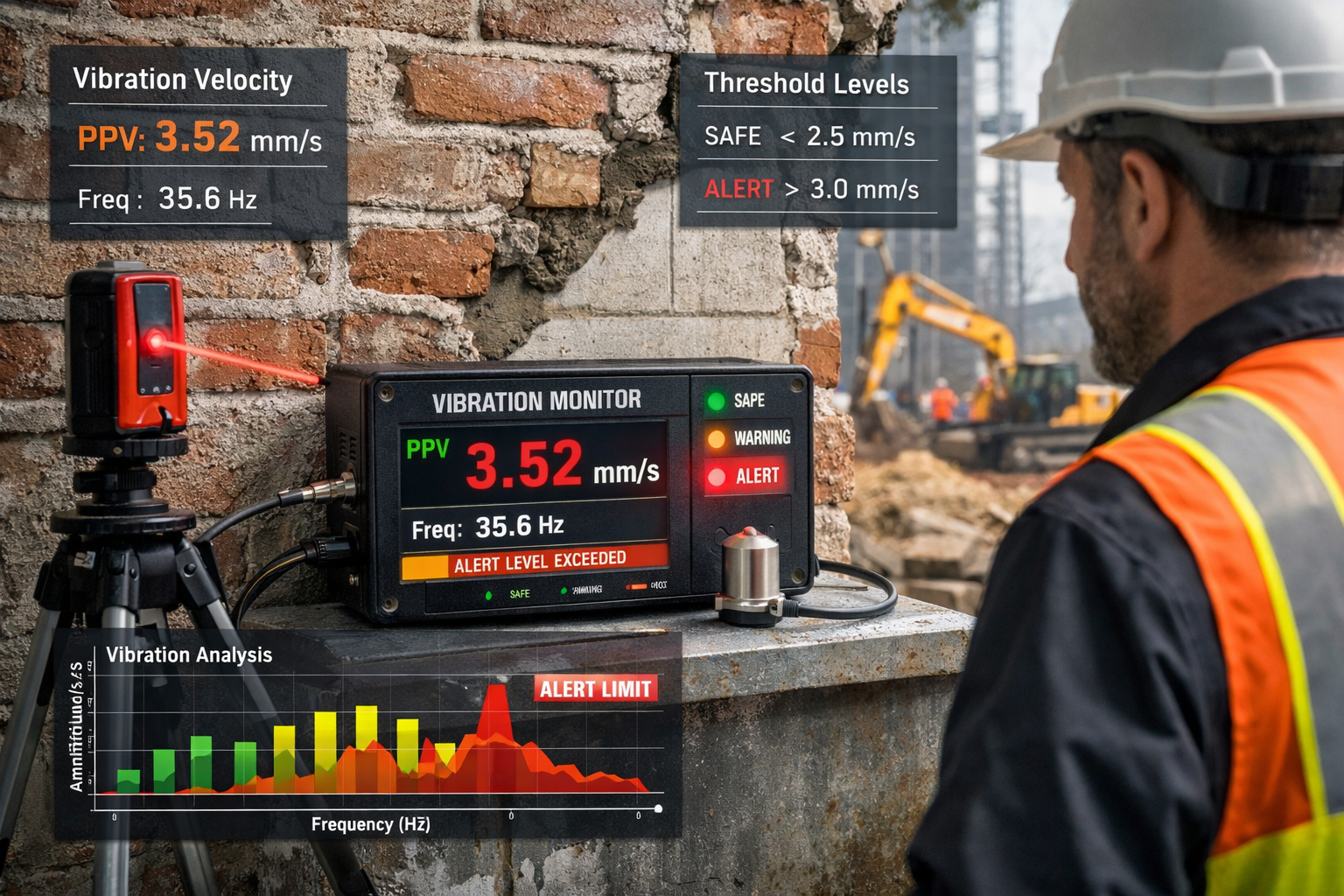
Data centre construction involves activities that generate significant vibration: deep excavations for cooling infrastructure, pile driving for heavy equipment foundations, and demolition of existing structures. Modern vibration monitoring protocols employ continuous automated systems rather than periodic manual checks.
Best practice vibration monitoring includes:
- Real-time sensors mounted on party walls and sensitive structures, transmitting data continuously to cloud platforms
- Threshold alerts configured to notify surveyors and contractors immediately when vibration levels approach concerning limits
- Multiple measurement points capturing vibration at various heights and locations along shared boundaries
- Frequency analysis distinguishing between different vibration sources and their potential structural impacts
- Correlation with construction activities linking vibration events to specific operations for targeted mitigation
The British Standard BS 7385 provides guidance on vibration levels likely to cause cosmetic damage (typically 15-20 mm/s peak particle velocity for residential structures). However, data centre projects often adopt more conservative thresholds—sometimes as low as 5-10 mm/s—to provide additional protection and maintain positive neighbour relations.
Operational Phase Considerations
Unlike traditional construction projects, data centres continue generating vibration long after construction completes. Cooling systems, backup generators, and even the collective vibration from thousands of spinning hard drives (in non-solid-state installations) create ongoing structural loading.
Long-term vibration management requires:
- 🔄 Post-completion monitoring for at least 12 months after data centre becomes operational
- ⚙️ Equipment isolation systems including spring mounts and vibration dampening pads beneath heavy machinery
- 📊 Quarterly vibration surveys comparing operational levels against baseline and construction-phase measurements
- 🔧 Maintenance protocols ensuring isolation systems remain effective as equipment ages
- 📝 Ongoing party wall obligations documented in awards covering operational phase responsibilities
This extended monitoring period is particularly important for AI-focused facilities, where computational loads—and therefore cooling demands—may increase substantially as utilization ramps up over the first year of operation.
Noise Assessment and Mitigation in Data Centre Party Wall Protocols
Pre-Construction Acoustic Baseline Studies
Noise represents perhaps the most persistent concern for properties adjacent to data centre facilities. While construction noise is temporary, operational noise continues indefinitely, making thorough pre-construction assessment essential.
Comprehensive acoustic baseline surveys measure:
- Ambient noise levels at multiple times of day and week, capturing residential area's typical acoustic environment
- Frequency spectrum analysis identifying existing noise sources and their characteristics
- Internal noise levels within neighbouring properties, establishing baseline for potential internal impact assessments
- Sensitive receptor identification locating bedrooms, offices, and other spaces where noise impact would be most significant
- Seasonal variations accounting for differences in window usage, vegetation screening, and weather patterns
These measurements establish the acoustic context against which data centre noise will be evaluated. Planning authorities typically require operational noise not to exceed background levels by more than 5 dB(A) during daytime and 0 dB(A) at night—extremely challenging thresholds for facilities requiring massive cooling capacity.
Construction Noise Management
Data centre construction generates substantial noise from multiple sources: excavation equipment, concrete pours, steel erection, and mechanical system installation. Effective party wall agreements incorporate specific noise management provisions beyond standard planning conditions.
Construction phase noise protocols should include:
- 📅 Restricted working hours limiting noisy activities to agreed timeframes
- 🚧 Acoustic barriers erected along party wall boundaries before noisy work commences
- 🔇 Equipment specifications requiring use of sound-attenuated machinery where practical
- 📞 Communication procedures providing neighbours advance notice of particularly noisy operations
- 🎯 Noise monitoring stations recording actual levels and demonstrating compliance with agreed limits
The party wall drawings prepared during the agreement process should clearly indicate locations of acoustic barriers, monitoring points, and sensitive receptors to ensure all parties understand the noise management strategy.
Operational Noise Control Strategies
The continuous hum of data centre cooling systems represents the most challenging acoustic issue. Modern hyperscale facilities can require cooling capacity equivalent to small power stations, with corresponding noise generation.
Effective operational noise mitigation employs:
- Acoustic enclosures surrounding cooling towers and air handling units, incorporating sound-absorbing materials
- Directional discharge orienting cooling system exhausts away from sensitive receptors
- Low-noise equipment selection specifying fans, chillers, and pumps with reduced acoustic output
- Vibration isolation preventing structure-borne noise transmission through building elements
- Landscaping and barriers using strategic planting and solid barriers to provide additional attenuation
For urban sites with particularly sensitive neighbours, some developers have invested in advanced cooling technologies—such as liquid cooling systems or underground thermal storage—that significantly reduce acoustic impact compared to traditional air-cooled approaches. While expensive, these solutions can prove more cost-effective than extended planning delays or ongoing neighbour disputes.
RICS Standards for Data Centre Acoustic Assessments
The Royal Institution of Chartered Surveyors (RICS) provides professional standards for noise and vibration assessments in party wall contexts. For data centre projects, surveyors increasingly reference these standards alongside BS 4142 (industrial noise assessment) to develop comprehensive acoustic protocols.
RICS best practices emphasize:
- 🎓 Competent assessment by qualified acoustic consultants with relevant data centre experience
- 📊 Comprehensive reporting documenting methodology, measurements, and predicted impacts
- ⚖️ Independent verification using agreed surveyors to validate developer-commissioned assessments
- 🤝 Transparent communication ensuring neighbouring owners understand acoustic implications
- 🔄 Adaptive management incorporating feedback and adjusting mitigation as operational experience develops
These professional standards help ensure party wall awards for data centre projects provide genuine protection rather than merely satisfying procedural requirements.
Navigating Party Wall Agreements for Data Centre Projects in 2026
The Party Wall Notice Process for Large-Scale Developments
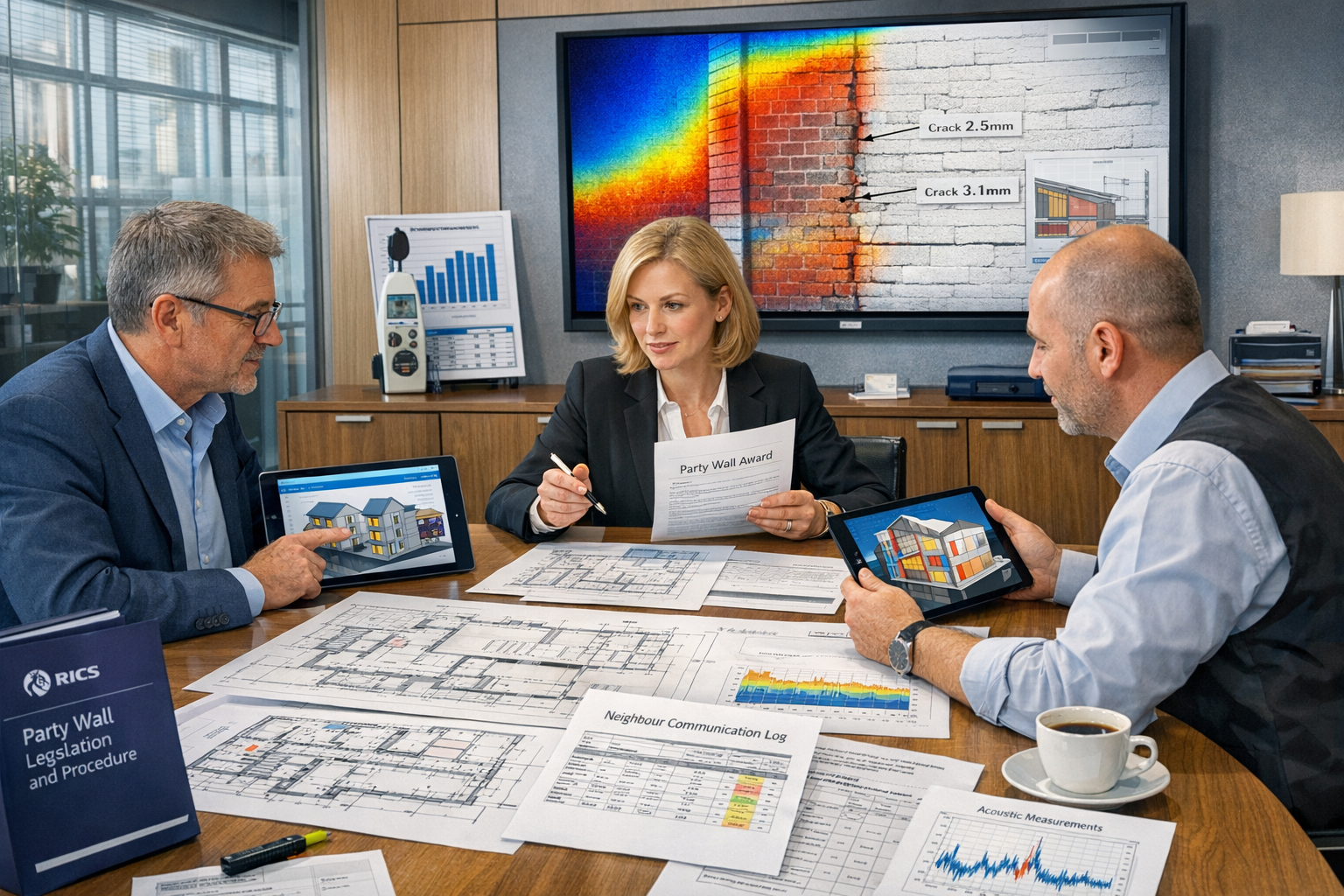
Data centre developers must serve appropriate notices under the Party Wall Act well before construction begins. Given the complexity of these projects, the notice period becomes crucial for thorough assessment and agreement negotiation.
The process typically unfolds as follows:
- Initial consultation with neighbouring owners explaining project scope and timeline
- Formal notice service at least two months before construction (for excavation/new building work)
- Neighbour response period during which owners may consent or dissent
- Surveyor appointment if owners dissent or fail to respond within 14 days
- Award preparation documenting agreed procedures, protections, and monitoring protocols
- Ongoing compliance throughout construction and operational phases
For data centre projects, this timeline often extends considerably beyond minimum statutory periods. Developers increasingly engage neighbours six months or more before formal notices, allowing time to address concerns and design appropriate mitigation measures before positions become entrenched.
Selecting Appropriate Surveyors for Technical Assessments
The specialized nature of data centre developments demands surveyors with relevant technical expertise. Not every party wall surveyor possesses the acoustic engineering, structural dynamics, and facilities management knowledge necessary to properly assess these projects.
When selecting surveyors, consider:
- 🏆 Relevant experience with industrial or data centre projects, not just residential party wall work
- 🔬 Technical qualifications including acoustic engineering or structural engineering credentials
- 🤝 Independence and impartiality particularly for agreed surveyors serving both parties
- 💼 Professional indemnity insurance adequate for the project's scale and complexity
- 📱 Communication skills able to explain technical matters clearly to lay clients
The cost of party wall surveyors for data centre projects typically exceeds residential work due to the additional technical assessments required. However, this investment proves worthwhile when it prevents disputes that could delay critical infrastructure deployment.
Common Dispute Points and Resolution Strategies
Despite careful planning, data centre party wall projects frequently encounter disagreements. Understanding common friction points enables proactive mitigation.
Typical disputes involve:
- Operational noise concerns where neighbours fear continuous disturbance affecting property values and quality of life
- Vibration damage claims alleging construction or operational activities caused structural damage
- Access requirements for monitoring equipment or remediation work within neighbouring properties
- Compensation demands for inconvenience, property devaluation, or actual damage
- Timeline disagreements regarding duration of construction impacts
Effective resolution strategies emphasize early intervention and transparent communication. Many successful data centre developers establish community liaison roles, providing neighbours with direct contacts for concerns rather than forcing formal dispute procedures.
When disputes do arise, the party wall award should specify resolution mechanisms, typically involving the agreed surveyor making binding determinations. For particularly contentious issues, expert witness reports from independent specialists can provide objective technical assessments that facilitate resolution.
Integrating Party Wall Requirements with Planning and Building Control
Data centre party wall obligations don't exist in isolation—they intersect with planning conditions, building regulations, and environmental permits. Coordinating these overlapping requirements prevents conflicting obligations and streamlines approval processes.
Key integration points include:
- Planning conditions often requiring noise and vibration monitoring that can fulfill party wall obligations simultaneously
- Building regulation compliance for structural work affecting party walls requiring coordinated inspections
- Environmental permits for cooling system discharges potentially imposing stricter noise limits than party wall awards
- CDM regulations (Construction Design and Management) requiring health and safety coordination that encompasses party wall access and monitoring
Experienced developers establish coordination frameworks early in project planning, ensuring party wall surveyors, planning consultants, and building control bodies work from consistent information and aligned objectives. This integration proves particularly valuable for phased data centre expansions where ongoing construction occurs adjacent to operational facilities.
Future-Proofing Party Wall Awards for Expansion Phases
The 2026 data centre boom represents just the beginning of AI infrastructure development. Many facilities will undergo multiple expansion phases over coming years, making forward-looking party wall agreements essential.
Effective awards incorporate:
- 📈 Expansion provisions addressing procedures for future construction phases
- 🔄 Review mechanisms allowing periodic reassessment of noise and vibration protocols as technology evolves
- 💰 Cost allocation frameworks establishing how future party wall expenses will be shared
- 📋 Documentation standards ensuring consistent record-keeping across multiple construction phases
- 🤝 Relationship management provisions maintaining communication channels between developments
These forward-looking provisions reduce the need to renegotiate fundamental terms for each expansion phase, providing certainty for both developers and neighbours while streamlining future approval processes.
Best Practices for Property Owners Adjacent to Data Centre Developments
Protecting Your Interests When Served Party Wall Notice
Receiving party wall notice regarding adjacent data centre construction can be concerning. However, the Act provides substantial protections when properly utilized.
Property owners should:
- ✅ Respond promptly within the 14-day period to preserve rights and influence the process
- 🔍 Seek independent advice from qualified party wall surveyors before consenting to proposals
- 📸 Document existing conditions thoroughly, even before formal surveys, creating personal records
- 💬 Engage constructively with developers while ensuring concerns receive proper consideration
- 📄 Review awards carefully before signing, ensuring all protections and monitoring provisions are adequate
Many property owners mistakenly believe that consenting to party wall notices means accepting whatever the developer proposes. In reality, consent simply acknowledges the right to proceed—the detailed protections are negotiated through the surveyor appointment and award preparation process.
Understanding Your Rights and Remedies
The Party Wall Act provides specific rights and remedies when neighbouring work affects your property. For data centre projects, understanding these protections is particularly important given the extended impact timelines.
Your rights include:
- 🛡️ Protection from damage with developers liable for making good any harm caused by their work
- 👁️ Access for inspection allowing your surveyor to monitor work and verify compliance
- 📊 Regular monitoring reports documenting vibration, noise, and structural conditions throughout construction
- 💷 Reasonable costs coverage for your surveyor's fees and related professional advice
- ⚖️ Dispute resolution through the agreed surveyor or, ultimately, through courts
If damage occurs, the party wall award typically requires the building owner to remedy it promptly at their expense. For data centre projects, this obligation extends to damage from operational vibration or settlement, not just construction-phase impacts.
When to Seek Specialist Technical Assessments
Standard party wall surveys may not adequately address all concerns arising from data centre developments. In some circumstances, commissioning additional specialist assessments provides valuable protection.
Consider specialist reports for:
- Historic or listed buildings where standard vibration thresholds may still risk damage to sensitive features
- Commercial properties where operational noise could affect business activities or customer experience
- Properties with existing defects requiring detailed analysis to distinguish pre-existing conditions from new damage
- High-value improvements such as recent renovations that may be particularly vulnerable to vibration
- Health concerns where continuous noise exposure could affect vulnerable occupants
These additional assessments typically fall outside standard party wall surveyor fees, but the investment proves worthwhile when it prevents disputes or ensures adequate compensation for genuine impacts. The checking engineers party wall role can provide valuable independent verification of structural calculations and risk assessments.
Conclusion
The intersection of the 2026 AI boom and urban data centre expansion has created unprecedented challenges for party wall practice. As nearly 100 GW of new capacity comes online through 2030, the specialized protocols for managing vibration and noise impacts will only grow more important. Party Wall Surveys for Data Centre Expansions: Vibration and Noise Protocols in 2026 AI Boom represent an evolving field where traditional surveying expertise meets cutting-edge infrastructure demands.
For developers, investing in comprehensive party wall processes—including continuous vibration monitoring, thorough acoustic assessments, and proactive neighbour engagement—prevents costly delays and protects critical infrastructure investments. For neighbouring property owners, understanding rights under the Party Wall Act and engaging qualified surveyors ensures adequate protection from construction and operational impacts.
The key to successful outcomes lies in recognizing that data centre party wall matters extend far beyond standard construction scenarios. The continuous operational impacts, extreme structural loads, and substantial acoustic outputs require specialized protocols that anticipate long-term implications rather than merely satisfying short-term procedural requirements.
Next Steps
If you're involved in a data centre party wall matter:
- Engage qualified specialists early with relevant data centre or industrial experience
- Establish comprehensive monitoring protocols addressing both construction and operational phases
- Document everything thoroughly creating detailed baseline records before work begins
- Communicate proactively with all stakeholders to address concerns before they become disputes
- Plan for the long term incorporating expansion provisions and review mechanisms into agreements
The 2026 AI infrastructure boom presents both challenges and opportunities. With proper party wall protocols, these essential facilities can coexist successfully with neighbouring properties, supporting technological advancement while protecting community interests. Whether you're developing the next generation of AI infrastructure or own property adjacent to these facilities, understanding and implementing robust party wall procedures ensures that progress and protection advance together.
References
[1] New Data Center Developments March 2026 – https://www.datacenterknowledge.com/data-center-construction/new-data-center-developments-march-2026
[2] Party Wall Surveys For Data Centre Expansions Navigating Agreements In The 2026 Investment Surge – https://nottinghillsurveyors.com/blog/party-wall-surveys-for-data-centre-expansions-navigating-agreements-in-the-2026-investment-surge