

Basement excavations in dense urban areas cause more neighbour disputes than almost any other type of residential construction work — and the financial and structural stakes are exceptionally high. When a homeowner digs below the foundations of a shared wall, the risk of settlement, cracking, and subsidence to adjacent properties is real and measurable. The updated RICS 8th Edition guidance on party wall practice, introduced following a public consultation process, directly addresses these risks by tightening the protocols that govern party wall surveys for basement excavations: risk assessment and neighbour protection protocols under RICS 8th Edition are now more rigorous, more technically demanding, and more legally robust than at any previous point in the guidance's history [1].
For building owners, adjoining owners, and the surveyors appointed to serve them, understanding what the 8th Edition requires is no longer optional — it is the foundation of every compliant basement project in 2026.
Key Takeaways
- The RICS 8th Edition introduces stricter competence, impartiality, and documentation requirements for surveyors handling basement excavation projects.
- Three distinct notice types apply to basement works under the Party Wall etc. Act 1996: Party Structure Notices, Line of Junction Notices, and Adjacent Excavation Notices.
- A comprehensive Schedule of Condition — including thermal imaging, crack measurements, and high-resolution photography — must be completed before any excavation begins.
- Surveyors must formally declare conflicts of interest before accepting appointments, and third surveyors face enhanced impartiality obligations.
- Failing to follow correct party wall procedures exposes building owners to injunctions, compensation claims, and significant project delays.
Why Basement Excavations Demand a Higher Standard of Party Wall Practice
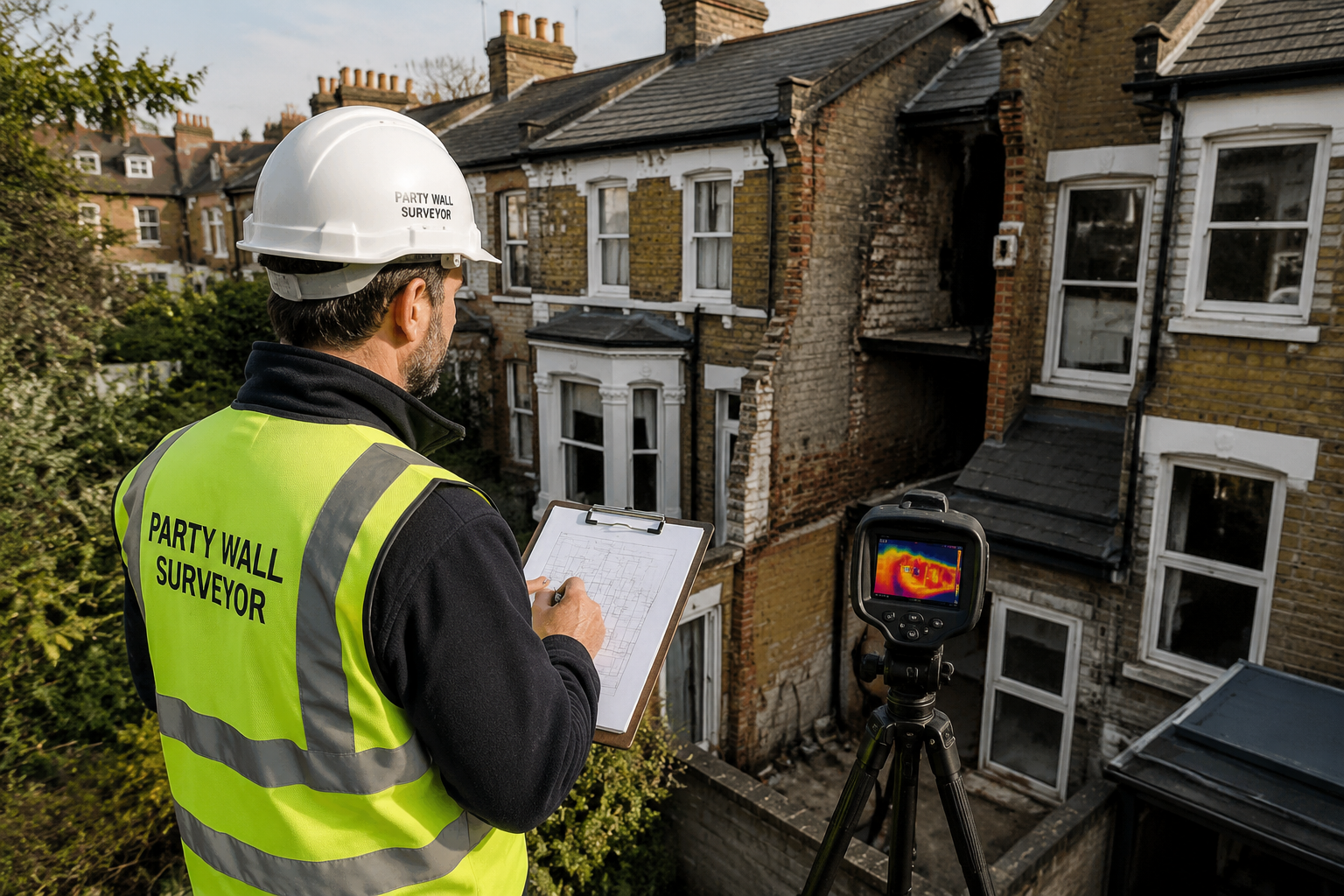
Not all construction work covered by the Party Wall etc. Act 1996 carries equal risk. Replacing a loft joist or building an extension at ground level is unlikely to undermine a neighbour's foundations. Basement excavation is fundamentally different. Digging below existing foundation depth — particularly in London's clay-rich soils — can cause ground movement that propagates laterally, affecting structures several metres away from the actual works.
The RICS 8th Edition acknowledges this distinction explicitly. It frames basement excavation as a category of work requiring elevated technical scrutiny, and it places the burden of demonstrating competence squarely on the appointed surveyor [1]. A surveyor who lacks specific expertise in geotechnical risk, underpinning methodology, or structural monitoring is not considered fit to manage a basement excavation award under the updated guidance.
The three legal triggers for basement excavation notices are:
| Notice Type | When It Applies | Minimum Notice Period |
|---|---|---|
| Party Structure Notice | Works to or adjacent to a shared wall | 2 months |
| Line of Junction Notice | Building on or at the boundary line | 1 month |
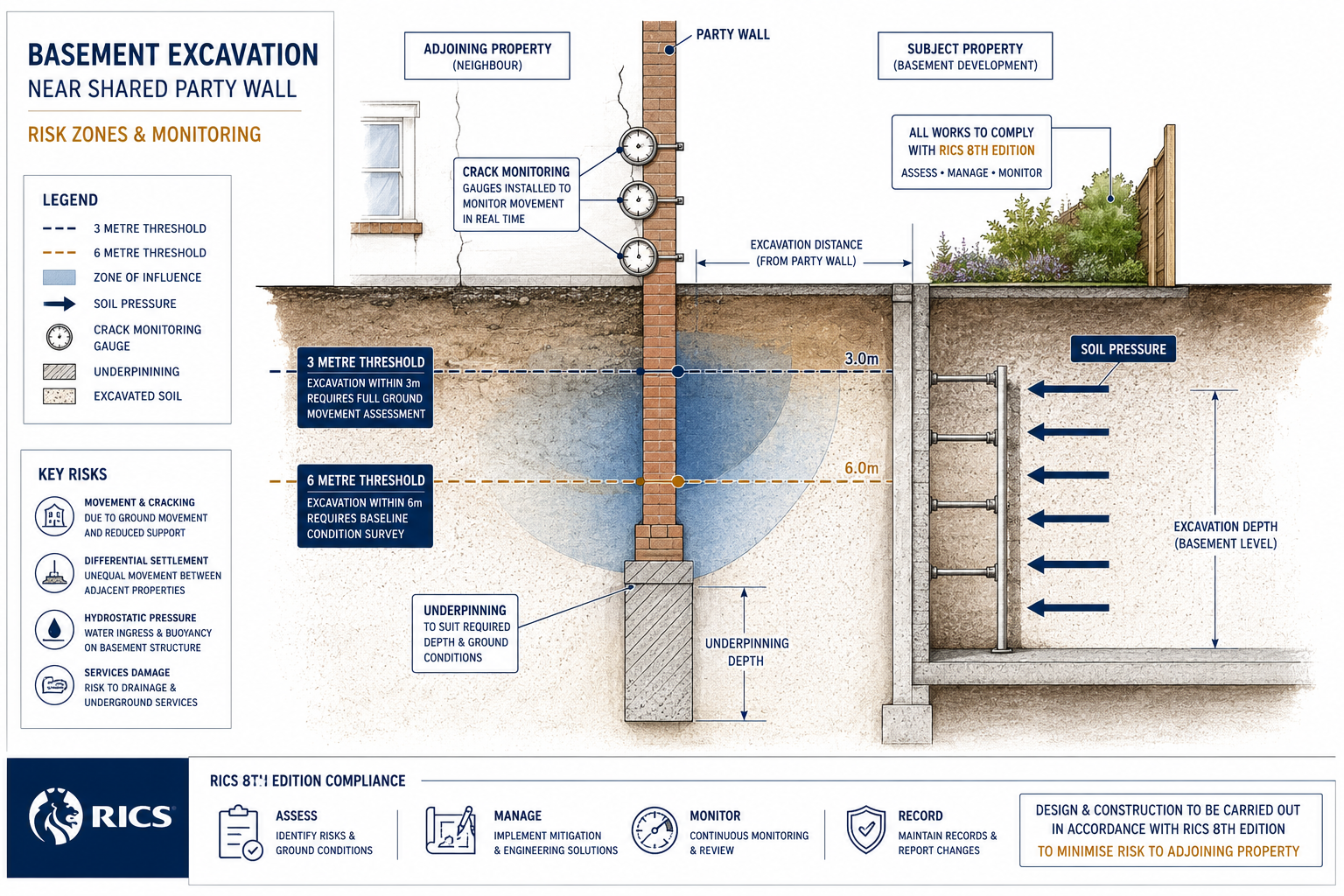
| Adjacent Excavation Notice | Excavating within 3m (to foundation depth) or 6m (below a 45-degree line) | 1 month |
For most basement projects, both a Party Structure Notice and an Adjacent Excavation Notice will be required simultaneously. Surveyors must verify that the correct notices have been served and are valid before accepting any appointment — a requirement now formalised under the 8th Edition's jurisdiction verification protocols [3]. For a broader overview of how these rights interact, the guide to party wall rights for property owners provides useful context.
The Consequences of Getting This Wrong
Ignoring or mismanaging party wall obligations during a basement dig is not a minor administrative oversight. Courts have awarded injunctions halting works mid-excavation, leaving properties open to the elements and neighbouring structures temporarily destabilised. Compensation claims for crack repairs, professional fees, and loss of enjoyment can run into tens of thousands of pounds. The detailed risks are explored further in this resource on the consequences of ignoring the Party Wall Act.
Risk Assessment Protocols Under RICS 8th Edition for Basement Excavation Projects
The most substantive changes in the 8th Edition relate to how surveyors assess and document structural risk before, during, and after basement excavation. The guidance provides comprehensive protocols that go well beyond the previous edition's requirements [5].
Pre-Excavation Structural Risk Assessment
Before any award is drafted, the appointed surveyor must carry out a structured risk assessment of the proposed works and their likely impact on adjoining structures. This assessment should consider:
- Foundation depth and type of both the building owner's property and the adjoining owner's property
- Soil conditions, including bearing capacity, clay shrink-swell potential, and groundwater level
- Proximity of the excavation to shared foundations and load-bearing walls
- Method of excavation — hand-dig, mechanical, or a combination — and its vibration implications
- Proposed retention system, such as contiguous piled walls, sheet piling, or traditional underpinning
The surveyor is expected to engage with the building owner's structural engineer at this stage, reviewing calculations and drawings rather than simply accepting them at face value. Where the surveyor lacks the geotechnical expertise to evaluate the proposals independently, the 8th Edition is clear: specialist input must be obtained [1].
For projects with significant structural complexity, structural engineering services can provide the technical underpinning that surveyors need to complete a credible risk assessment. Understanding why this matters is also covered in the article on 3 reasons to hire a structural engineer.
The Schedule of Condition: Now a Technical Document
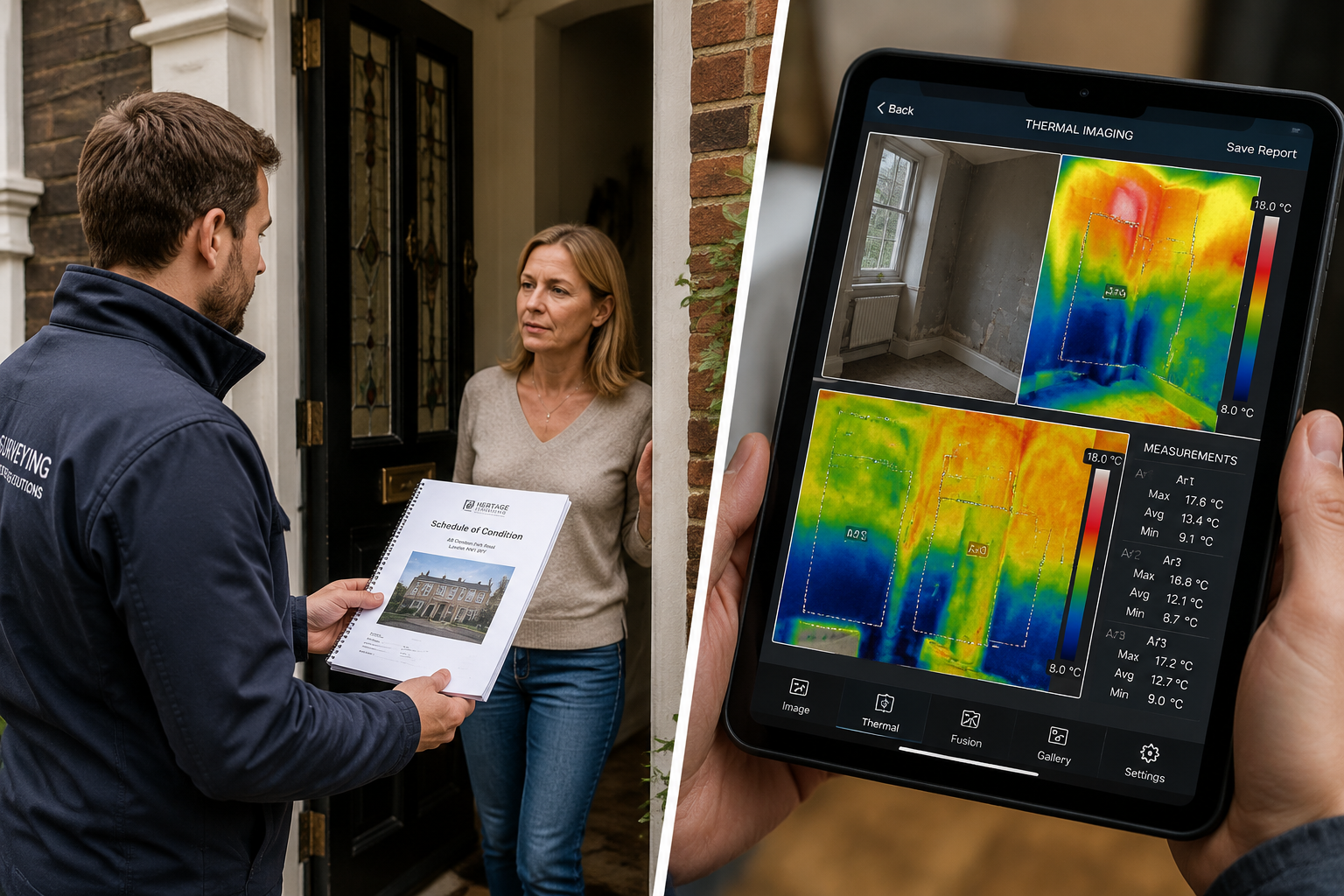
Under the 8th Edition, the Schedule of Condition is no longer a simple photographic record. It has been elevated to a technical baseline document that must capture the pre-works condition of all adjoining properties likely to be affected by the excavation [2].
A compliant Schedule of Condition for a basement excavation project should include:
- High-resolution photographs of all internal and external elevations, with particular attention to existing cracks, settlement patterns, and previous repairs
- Precise crack measurements using a calibrated crack gauge, recorded in millimetres
- Thermal imaging scans of walls, floors, and ceilings to identify hidden moisture, voids, or pre-existing structural anomalies [6]
- A written narrative describing the condition of each element surveyed
- Dated, geotagged photographic evidence to prevent later disputes about when damage occurred
"The Schedule of Condition is the single most important document in protecting both the building owner and the adjoining owner. A thorough baseline makes post-works disputes significantly easier to resolve — and significantly harder to fabricate."
The integration of thermal imaging into party wall survey methodology is one of the most significant practical changes introduced under the 8th Edition framework [6]. Thermal cameras can detect moisture ingress behind plaster, delamination of render, and voids in masonry that are entirely invisible to the naked eye. When these conditions are documented before excavation begins, the surveyor has an objective record against which any post-works claims can be measured.
Ongoing Monitoring During Excavation
Risk assessment does not end when the award is made. The 8th Edition encourages surveyors to specify monitoring requirements within the award itself, including:
- Installation of crack monitors (tell-tales) on walls adjacent to the excavation
- Regular inspection intervals — typically weekly during active excavation phases
- Threshold values at which works must pause pending further investigation
- Reporting obligations from the building owner's contractor to the surveyor
This approach transforms the party wall award from a one-time permission into an active risk management framework — a shift that reflects the genuine dangers of deep excavation in built-up areas [3].
Surveyor Impartiality, Competence, and Neighbour Protection Protocols Under RICS 8th Edition
The 8th Edition places renewed and explicit emphasis on surveyor impartiality. This matters enormously in basement excavation disputes, where the financial interests of building owners can be substantial and the pressure on appointed surveyors to accommodate ambitious programmes is real [4].
Formal Conflict of Interest Declarations
Surveyors — and particularly third surveyors — are now mandated to formally declare any conflicts of interest before accepting an appointment [1]. This includes:
- Prior professional relationships with either party
- Financial interests in the outcome of the works
- Previous appointments on the same or adjacent properties that might create a perception of bias
The declaration requirement is not merely procedural. It is designed to ensure that the dispute resolution mechanism at the heart of the Party Wall etc. Act 1996 retains its integrity. An award made by a surveyor with an undisclosed conflict of interest is vulnerable to challenge in the county court.
Acting Impartially Regardless of Appointment
A point that frequently confuses building owners is that their appointed surveyor does not act as their advocate. The 8th Edition reiterates this clearly: all party wall surveyors, regardless of who appoints them, must act impartially in the interests of the process [4]. The surveyor's duty is to the Act, not to the party who pays their fee.
This distinction is particularly important in basement excavation cases, where the adjoining owner may feel that the building owner's surveyor is simply rubber-stamping a risky scheme. A surveyor who fails to raise legitimate concerns about excavation methodology or who produces a superficial Schedule of Condition is not fulfilling their statutory duty — and may face professional sanction under RICS disciplinary procedures.
For homeowners navigating these dynamics for the first time, understanding common party wall disputes and how they arise can help set realistic expectations before appointing a surveyor.
Neighbour Notification and the Consent Process
Effective neighbour protection begins before any surveyor is appointed. The building owner must serve the correct notices with the required notice periods. Adjoining owners then have three options:
- Consent to the works — no award is required, though a Schedule of Condition is still strongly advisable
- Dissent and appoint their own surveyor — leading to an agreed or third surveyor process
- Dissent and agree to use the building owner's surveyor — a single agreed surveyor acts for both parties
In basement excavation cases, dissent and separate appointment is by far the most common outcome, given the level of risk involved. The top five party wall agreement considerations for renovation projects outlines the practical steps that follow dissent.
What the Award Must Cover for Basement Works
A party wall award for a basement excavation project should be considerably more detailed than one for a simple loft conversion. Under the 8th Edition, a compliant award for basement works should address:
- Approved method of excavation and retention
- Permitted working hours and noise/vibration limits
- Access rights for the surveyor to inspect works in progress
- Obligations to reinstate any damage caused to the adjoining property
- Security for expenses — a financial deposit held against the cost of potential repairs
- Monitoring regime and reporting requirements
- Dispute escalation procedure if threshold values are exceeded
The security for expenses provision is particularly valuable for adjoining owners in basement excavation cases. It ensures that if damage occurs and the building owner becomes insolvent or uncooperative, there are funds available to cover remediation.
For those considering basement projects in Surrey and the surrounding area, the dedicated resource on basement party wall surveying in Surrey provides region-specific guidance on how these protocols apply in practice.
Practical Steps for Building Owners and Adjoining Owners in 2026
The regulatory environment for basement excavation in 2026 is more demanding than it has ever been, but the framework is also clearer. Both building owners and adjoining owners benefit from understanding their rights and obligations before works begin.
For building owners:
- Appoint a surveyor with demonstrable experience in basement excavation party wall work — not simply any RICS member
- Ensure your structural engineer's drawings are complete and peer-reviewed before serving notice
- Budget for a thorough Schedule of Condition and ongoing monitoring — these are not optional extras
- Allow realistic timescales: notice periods, award preparation, and monitoring add weeks to any programme
For adjoining owners:
- Appoint your own surveyor promptly after receiving notice — do not leave this until the last moment
- Request a copy of the structural engineer's drawings and risk assessment as part of the award process
- Ensure the Schedule of Condition covers every room that could plausibly be affected
- Understand that you have the right to request security for expenses in high-risk cases
The party wall resources category provides a comprehensive library of guidance for both parties navigating complex excavation projects.
Conclusion
Party wall surveys for basement excavations: risk assessment and neighbour protection protocols under RICS 8th Edition represent the most technically demanding area of party wall practice. The updated guidance raises the bar for surveyor competence, documentation standards, and impartiality in ways that directly protect adjoining owners from the genuine structural risks that deep excavation creates.
Actionable next steps for anyone involved in a basement excavation project in 2026:
- Verify that the surveyor you appoint has specific basement excavation experience and can demonstrate competence under the RICS 8th Edition framework.
- Insist on a Schedule of Condition that includes thermal imaging, calibrated crack measurements, and a written narrative — not just photographs.
- Ensure the party wall award includes a monitoring regime with defined threshold values and a clear escalation procedure.
- If you are an adjoining owner, request security for expenses as a standard protection measure on any basement project within 3 or 6 metres of your property.
- Seek specialist advice early — the cost of a thorough party wall process is always less than the cost of resolving a dispute after damage has occurred.
The RICS 8th Edition has made the rules clearer and the protections stronger. Using them properly is the most effective risk management tool available to everyone involved in basement excavation in the urban environment.
References
[1] Rics Launches Consultation On Updated Party Wall Practice Guidance – rics.org
[2] Party Wall Surveys For Basement Excavations Structural Risk Assessment And Neighbour Protection Under Rics 8th Edition – nottinghillsurveyors.com
[3] Excavation Near Party Walls For Basements Advanced Surveyor Monitoring And Award Safeguards Post Rics 8th Edition – partywallsurveyorlondon.uk
[4] Party Wall Surveyors Impartiality – ww3.rics.org
[5] Party Wall Awards Under New 2026 Rics Matrics Essentials For Basement Conversions In Recovering Markets – canterburysurveyors.com
[6] Thermal Imaging Applications In Party Wall Surveys Rics 8th Edition Protocols For Hidden Defect Detection – wimbledonsurveyors.com
[7] Party Wall Surveys For Basement Conversions In 2026 Rics Protocols Amid Rising Urban Demand – Party wall surveys for basement conversions in 2026 rics protocols amid rising urban demand
How Prince Surveyors can help: explore our party wall surveyors or learn about our party wall surveyor costs.