

{"cover":"Professional landscape format (1536x1024) editorial image showing a Victorian-era British high street building with ground floor commercial units and upper floors, one half displaying 'For Lease' office signs with empty windows, the other half transformed into modern residential apartments with warm lighting and plants on balconies, RICS surveyor in hard hat and hi-vis vest examining the shared party wall with clipboard and laser measure, architectural drawings and Party Wall Act documents visible on tablet device, urban regeneration theme with scaffolding, deep blue sky, warm brick tones, professional surveying aesthetic, no text overlays","content":["Landscape format (1536x1024) detailed cutaway architectural illustration showing a typical high street building party wall between two Victorian commercial properties undergoing office-to-residential conversion, exposed brick party wall in center with structural annotations, one side showing original office layout with cubicles and fluorescent lighting, other side showing new residential floor plan with kitchen, living areas and bedrooms, RICS surveyor conducting schedule of condition inspection with camera and measuring tools, visible foundation excavation work at base showing 3-6 meter proximity zones, notice documents and agreement templates on clipboard, professional technical drawing style with clean lines and measurement indicators, warm brick reds, blueprint blues, safety orange accents","Landscape format (1536x1024) professional scene inside a converted high street building showing three people around a large table reviewing party wall documentation and architectural plans, RICS chartered surveyor in business attire pointing to schedule of condition photographs spread across table showing before and after images of party wall, building owner and adjoining owner's representative examining Party Wall Award document with visible clauses and cost breakdowns, laptop displaying digital inspection reports and photographic evidence, background showing exposed original Victorian brickwork alongside new residential finishes, large windows revealing high street outside, warm natural lighting, professional consultation atmosphere, document folders labeled with timelines and notice periods, no text overlays","Landscape format (1536x1024) urban regeneration scene showing revitalized British high street with multiple converted buildings, wide street view with mix of ground floor retail shops and upper floor residential apartments with balconies and modern windows, construction hoarding around one building mid-conversion with RICS party wall notices posted, surveyors conducting external inspection with laser distance measurers and tablets, scaffolding on shared walls between properties, pedestrians walking past cafes and shops, evening golden hour lighting creating warm glow from residential windows above commercial units, before-and-after visual contrast showing transformation from empty offices to thriving mixed-use development, vibrant community atmosphere, architectural heritage preserved, professional documentary photography style, warm brick tones, green accents from plants"]}

Britain's high streets are experiencing a renaissance. Empty office spaces above shops and standalone commercial buildings are being transformed into much-needed residential units, breathing new life into urban centers. However, this wave of Party Wall Surveys for 2026 Office-to-Residential Conversions: RICS Guidance for High Street Revival Projects requires careful navigation of legal frameworks, particularly the Party Wall etc. Act 1996. 🏢➡️🏠
As developers and property owners pursue these conversion projects, understanding party wall obligations becomes critical. The shared walls between adjacent properties—common features in high street architecture—require formal agreements, detailed surveys, and proper dispute resolution mechanisms before any work begins.
Key Takeaways
✅ Legal compliance is mandatory: The Party Wall etc. Act 1996 applies to all office-to-residential conversions in England and Wales affecting shared walls, requiring formal notices 1-2 months before work commences.
✅ RICS surveys protect all parties: Professional party wall surveys document existing conditions, prevent disputes, and create binding agreements that outline costs, methods, and responsibilities.
✅ Neighbors cannot block lawful conversions: While adjoining owners must be notified and consulted, they cannot prevent permitted development under the Act—only ensure proper protections are in place.
✅ Costs are predictable: Party wall surveyor fees typically range from £150-£200 per hour, with complete awards costing approximately £1,000, representing a small fraction of total conversion costs[3].
✅ Urban regeneration depends on compliance: High street revival projects succeed when developers follow proper party wall procedures, building trust with neighbors and avoiding costly delays.
Understanding the Party Wall Framework for Office Conversions
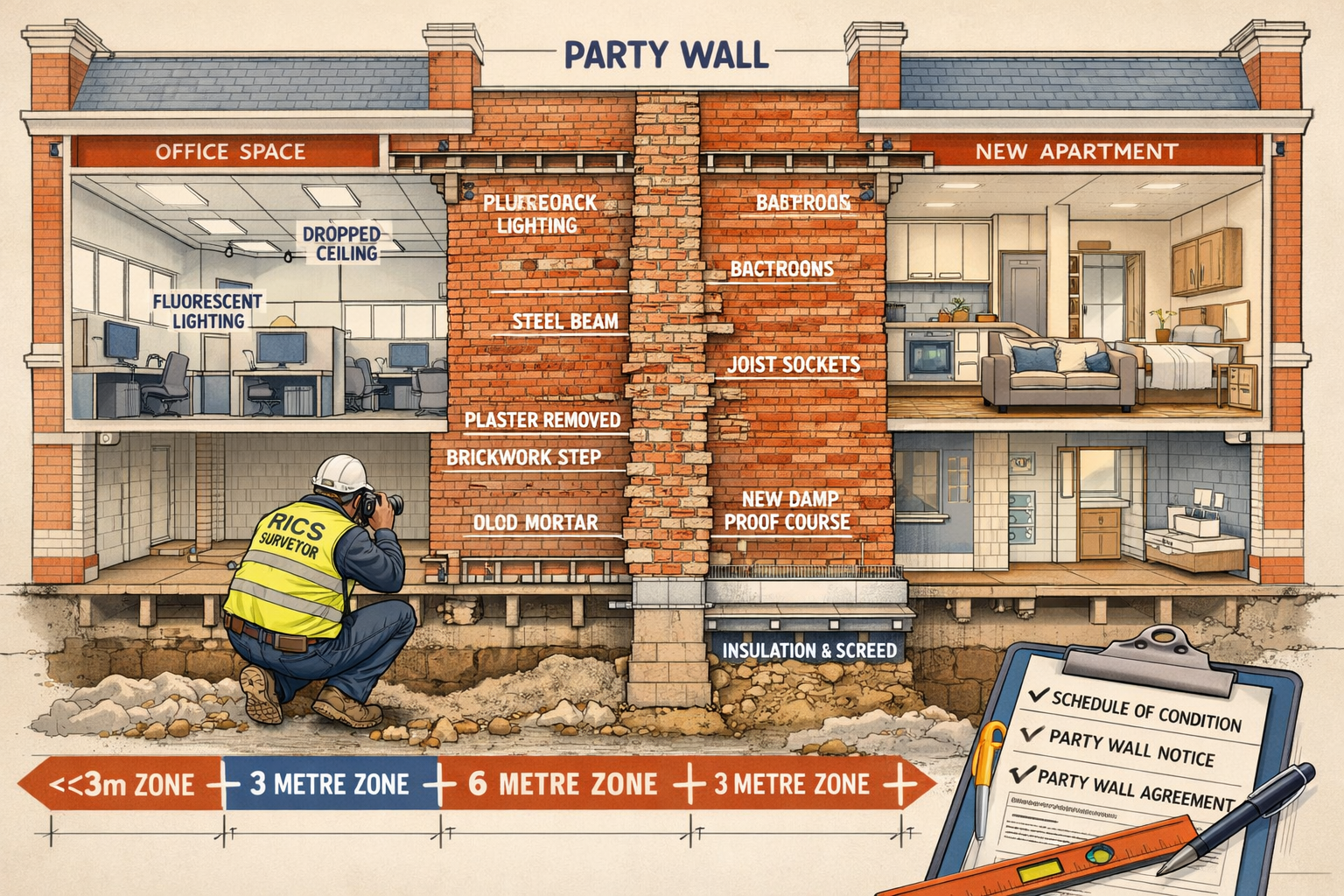
The Party Wall etc. Act 1996 provides the legal foundation for all conversion projects affecting shared structures in England and Wales[2]. This legislation balances property owners' rights to develop their buildings with neighbors' rights to protection from damage or disruption.
What Qualifies as Party Wall Work in Conversions?
Office-to-residential conversions typically involve several types of party wall work:
- Structural alterations to shared walls between properties
- Foundation excavations within 3-6 meters of adjoining buildings
- New openings or modifications to party walls for staircases or utilities
- Removal of chimney breasts that form part of the party structure
- Underpinning work to strengthen existing foundations
- Installation of damp-proof courses affecting the party wall
When converting a former office building on a high street, developers often encounter Victorian-era party walls that were never designed for residential use. These structures may require reinforcement, sound insulation upgrades, or fire safety improvements—all triggering party wall obligations[4].
Geographic Application and Limitations
The Party Wall etc. Act 1996 applies exclusively to England and Wales[2][3]. Properties in Scotland and Northern Ireland operate under different legal frameworks. This distinction matters particularly for national developers working on multiple high street revival projects across the UK.
For projects in England and Wales, compliance isn't optional. Proceeding without proper party wall agreements can result in injunctions, costly legal disputes, and project delays that undermine the financial viability of conversions.
RICS Survey Requirements for 2026 Office-to-Residential Conversions
The Royal Institution of Chartered Surveyors (RICS) sets professional standards for party wall surveys. These requirements ensure thorough documentation and fair treatment of all parties involved in high street conversion projects.
Comprehensive Schedule of Condition
A schedule of condition forms the cornerstone of party wall protection. RICS-qualified surveyors conduct detailed inspections of adjoining properties before conversion work begins, creating an evidence-based record that includes:
| Survey Component | Documentation Required |
|---|---|
| Photographic Evidence | High-resolution images of all rooms, walls, ceilings, and external elevations |
| Crack Mapping | Detailed measurements and locations of existing cracks or defects |
| Structural Assessment | Evaluation of wall stability, foundation condition, and load-bearing capacity |
| Written Descriptions | Room-by-room narrative documenting existing conditions |
| Video Walkthroughs | Supplementary video evidence for complex or extensive properties |
This comprehensive documentation protects both the building owner pursuing the conversion and the adjoining owner whose property might be affected. Should any damage occur during construction, the schedule of condition provides objective evidence of pre-existing conditions versus new damage[1].
Understanding party wall schedule of condition requirements helps developers budget appropriately and set realistic timelines for their conversion projects.
Notice Periods and Documentation
Timing is critical for party wall compliance. The Act mandates specific notice periods:
- ⏰ Two months' notice for building works affecting party walls
- ⏰ One month's notice for excavation work or new boundary walls[3]
The formal notice must include:
- Detailed description of the proposed conversion works
- Technical drawings showing the party wall and planned modifications
- Proposed start date and estimated duration
- Contact information for the building owner and their surveyor
- Explanation of rights under the Party Wall Act
For high street conversions, developers should serve notices early in the planning process. This allows time for potential party wall disputes to be resolved before construction schedules are finalized.
The Party Wall Award Process
When neighbors consent to the works, or when a surveyor is appointed following dissent, a Party Wall Award is created. This legally binding document specifies:
- Scope of permitted works affecting the party wall
- Working hours and access arrangements
- Protection measures to minimize disruption and damage
- Cost allocation for survey fees and any necessary repairs
- Dispute resolution procedures if disagreements arise during construction
- Inspection schedules for monitoring work progress
The Award provides certainty for all parties. Developers know exactly what work is permitted, while adjoining owners have enforceable protections against unreasonable damage or disruption.
Party Wall Surveys for 2026 Office-to-Residential Conversions: Practical Implementation
Implementing Party Wall Surveys for 2026 Office-to-Residential Conversions: RICS Guidance for High Street Revival Projects requires systematic planning and professional expertise. Successful urban regeneration depends on developers following established procedures while maintaining positive relationships with neighbors.
Surveyor Selection and Appointment
Choosing the right surveyor significantly impacts project outcomes. RICS-qualified party wall surveyors bring:
- Technical expertise in structural assessment and building pathology
- Legal knowledge of the Party Wall Act and case law
- Impartiality when acting as the Agreed Surveyor for both parties
- Experience with similar conversion projects in urban settings
- Communication skills to explain complex issues to non-technical stakeholders
Three surveyor appointment scenarios exist:
- Agreed Surveyor: Both parties jointly appoint one RICS surveyor (most cost-effective)
- Two Surveyors: Each party appoints their own surveyor who work together
- Third Surveyor: Appointed to resolve disagreements between the two party-appointed surveyors
For high street conversions, the Agreed Surveyor approach typically works well when developers engage neighbors early and demonstrate commitment to proper procedures. This approach reduces costs while maintaining professional oversight[1].
Managing Neighbor Relationships
Communication prevents disputes. Developers pursuing office-to-residential conversions should:
✅ Meet neighbors in person before serving formal notices
✅ Explain the benefits of high street regeneration for the community
✅ Address concerns proactively about noise, dust, and disruption
✅ Provide regular updates throughout the conversion process
✅ Demonstrate professionalism through proper documentation and qualified contractors
When neighbors refuse party wall works, understanding that they cannot actually prevent lawful development helps maintain perspective. The Act provides a dispute resolution mechanism that ensures projects proceed while protecting legitimate interests.
Cost Management and Budgeting
Party wall survey costs represent a small but necessary investment in conversion projects. Typical fee structures include:
Surveyor Fees:
- Hourly rates: £150-£200 per hour[3]
- Complete Party Wall Award: approximately £1,000[3]
- Complex multi-party situations: £2,000-£5,000
Additional Costs:
- Schedule of condition photography: £300-£600
- Structural monitoring during works: £500-£1,500
- Post-completion inspection: £200-£400
For a typical high street conversion project costing £200,000-£500,000, party wall expenses of £1,500-£3,000 represent less than 1% of total costs—a worthwhile investment to prevent disputes that could delay projects for months.
Developers should also understand the consequences of ignoring the Party Wall Act, which can include injunctions, mandatory remedial work, and legal fees far exceeding proper compliance costs.
Dispute Resolution and Award Enforcement

Despite best efforts, disagreements sometimes arise during Party Wall Surveys for 2026 Office-to-Residential Conversions: RICS Guidance for High Street Revival Projects. The Act provides structured mechanisms for resolving conflicts without resorting to expensive litigation.
Common Dispute Scenarios
High street conversion projects face several typical dispute triggers:
🔧 Structural concerns: Adjoining owners worry about damage to their property from excavation or wall modifications
🔊 Noise and disruption: Residential neighbors above or beside the conversion site object to extended working hours
💰 Cost allocation: Disagreements about who pays for protective measures or remedial work
📋 Scope of works: Disputes about whether proposed activities actually require party wall notices
⏱️ Timeline conflicts: Neighbors request delays due to personal circumstances or business operations
Understanding these common issues allows developers to anticipate objections and address them proactively in Party Wall Awards.
The Surveyor-Led Resolution Process
When neighbors dissent from proposed works or fail to respond within 14 days, a deemed dispute arises. The resolution process follows these steps:
- Surveyor Appointment: Each party appoints an RICS surveyor (or one Agreed Surveyor serves both)
- Site Inspection: Surveyors visit both properties to assess conditions and proposed works
- Negotiation: Surveyors discuss protective measures, working methods, and schedules
- Award Drafting: The surveyor(s) prepare a detailed Party Wall Award
- Award Service: The Award is formally served on both parties
- Appeal Period: Parties have 14 days to appeal to the Third Surveyor
- Implementation: Works proceed according to Award terms
This structured process typically resolves disputes within 4-8 weeks, allowing conversion projects to proceed with legal certainty.
For developers concerned about potential conflicts, reviewing general party wall services helps clarify the professional support available throughout the process.
Enforcement and Compliance Monitoring
Party Wall Awards are legally binding documents. Both building owners and adjoining owners must comply with their terms. Enforcement mechanisms include:
- Surveyor inspections at key construction stages
- Photographic documentation comparing conditions to the schedule
- Immediate notification of any damage or deviations from agreed methods
- Stop work orders if serious breaches occur
- County Court enforcement for persistent non-compliance
For high street conversions, maintaining compliance protects the project timeline and budget. Contractors should receive clear instructions about Award requirements, working hours, and access limitations.
High Street Revival: Urban Regeneration Through Conversions
The broader context for Party Wall Surveys for 2026 Office-to-Residential Conversions: RICS Guidance for High Street Revival Projects is Britain's ongoing urban regeneration effort. Converting empty office spaces into residential units addresses multiple policy objectives simultaneously.
Planning Policy and Permitted Development
Government policy actively encourages office-to-residential conversions through permitted development rights. These streamlined planning processes allow many conversions to proceed without full planning applications, reducing costs and timelines.
However, permitted development rights don't eliminate party wall obligations. Even when planning permission isn't required, the Party Wall Act still applies to any works affecting shared structures[2].
This dual framework means developers must navigate:
- Planning regulations (or permitted development criteria)
- Building regulations for safety, insulation, and accessibility
- Party wall legislation for neighbor protection
- Fire safety requirements for residential use
- Sound insulation standards between units and commercial spaces
Successful high street revival projects integrate all these requirements into cohesive conversion strategies.
Economic Benefits of Compliant Conversions
Proper party wall compliance supports project economics by:
📈 Preventing delays: Formal agreements eliminate the risk of injunctions or stop-work orders
💵 Reducing legal costs: Surveyor-led resolution costs far less than litigation
🏗️ Enabling financing: Lenders require evidence of party wall compliance before releasing funds
🤝 Building community support: Professional conduct fosters positive relationships with neighbors
📊 Protecting property values: Documented compliance adds value for future sales
For developers working on multiple high street conversions, establishing reputation for proper party wall procedures facilitates smoother approvals and neighbor cooperation on subsequent projects.
Case Study: Typical High Street Conversion
Consider a representative scenario:
Property: Three-story Victorian building with ground floor retail and two floors of vacant office space
Conversion Plan: Transform upper floors into four residential apartments
Party Wall Implications:
- Shared walls with properties on both sides
- Foundation work within 3 meters of adjoining buildings
- New staircase requiring opening in party wall
- Sound insulation installation affecting party structure
Timeline:
- Month 1: Serve party wall notices to both neighbors
- Month 2: Conduct schedules of condition, negotiate Award terms
- Month 3: Finalize Party Wall Award, begin construction
- Months 4-9: Construction with periodic surveyor inspections
- Month 10: Final inspection, compare to schedule of condition
Costs:
- Party wall surveys: £2,500
- Total conversion: £350,000
- Party wall costs: 0.7% of project budget
This example demonstrates how systematic party wall compliance integrates into realistic conversion timelines and budgets.
Surveyor Checklists and Agreement Templates
Practical tools streamline Party Wall Surveys for 2026 Office-to-Residential Conversions: RICS Guidance for High Street Revival Projects. RICS guidance provides frameworks that surveyors and developers can adapt to specific situations.
Pre-Conversion Survey Checklist
Before serving party wall notices, developers should complete:
- Property title review to identify all adjoining owners
- Structural assessment to determine party wall work scope
- Architect consultation to finalize conversion plans affecting party structures
- Surveyor appointment to prepare notices and conduct inspections
- Neighbor identification including tenants who may be affected
- Notice preparation with detailed work descriptions and drawings
- Timeline planning allowing for required notice periods
This systematic approach prevents common mistakes that delay projects or create disputes.
Party Wall Notice Template Components
Effective party wall notices for conversions include:
Section 1: Property Identification
- Building owner's name and address
- Adjoining owner's name and address
- Description of the party wall or structure
Section 2: Proposed Works
- Detailed description of conversion activities
- Technical drawings showing party wall modifications
- Proposed start date and estimated duration
- Working hours and access requirements
Section 3: Legal Information
- Reference to Party Wall etc. Act 1996
- Explanation of adjoining owner's rights
- Response deadline (14 days)
- Surveyor appointment procedures
- Contact information for questions
Section 4: Supporting Documentation
- Architectural plans
- Structural engineer's assessments
- Proposed protective measures
- Insurance information
Templates should be customized for each project while ensuring all statutory requirements are met.
Schedule of Condition Format
Professional schedules of condition follow standardized formats:
Cover Page:
- Property address
- Date of inspection
- Surveyor's name and qualifications
- Purpose of survey
Room-by-Room Documentation:
- Numbered photographs with descriptions
- Crack measurements and locations
- Existing defects or damage
- Structural observations
- Moisture readings if relevant
External Elevations:
- Photographs from multiple angles
- Condition of brickwork, pointing, and render
- Window and door conditions
- Roof and chimney observations
Summary and Limitations:
- Overall property condition assessment
- Areas not accessible during inspection
- Recommendations for protective measures
This documentation provides objective evidence that protects all parties throughout the conversion process.
Future Trends in Office-to-Residential Conversions
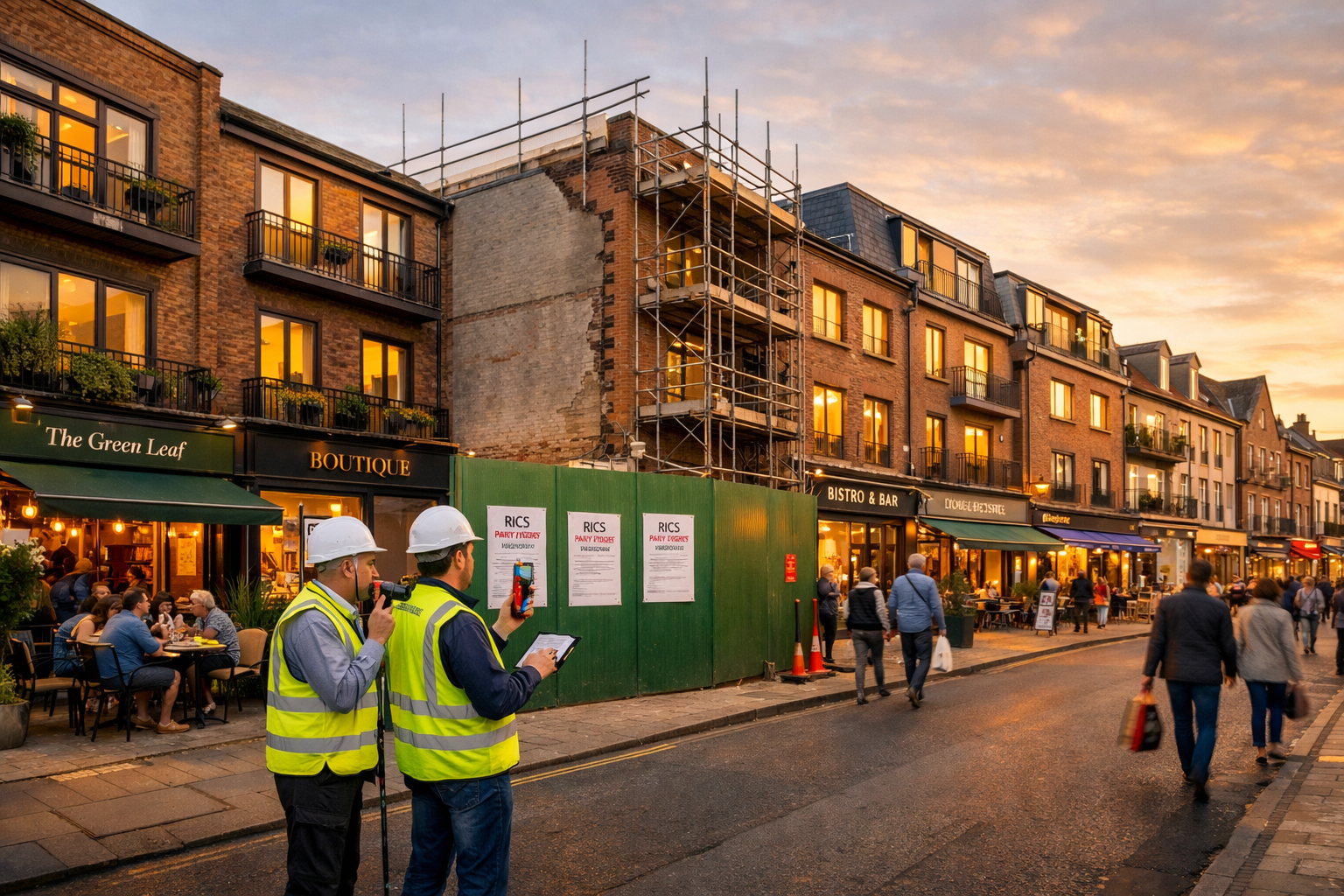
As we progress through 2026, several trends are shaping Party Wall Surveys for 2026 Office-to-Residential Conversions: RICS Guidance for High Street Revival Projects.
Digital Documentation and BIM Integration
Building Information Modeling (BIM) is transforming party wall surveys. Digital tools enable:
- 3D modeling of party walls and proposed modifications
- Drone photography for external condition surveys
- Digital crack monitoring using photogrammetry
- Cloud-based documentation accessible to all parties
- Virtual inspections reducing surveyor visit requirements
These technologies improve accuracy while reducing costs, making party wall compliance more efficient for high street conversion projects.
Sustainability and Energy Performance
Converting offices to residential use must address energy efficiency standards. Party wall work often includes:
- Insulation upgrades to meet Building Regulations
- Air tightness improvements at party wall junctions
- Thermal bridging elimination at structural connections
- Acoustic insulation for residential comfort
These sustainability measures require careful coordination with party wall procedures, as they often involve modifications to shared structures.
Regulatory Evolution
Party wall legislation continues evolving through case law and practice guidance. Recent trends include:
- Stricter interpretation of notice requirements
- Enhanced protection for heritage buildings in conservation areas
- Greater emphasis on photographic evidence quality
- Clarification of cost allocation principles
- Recognition of digital communication methods
Developers pursuing high street conversions should work with surveyors who stay current with regulatory developments and case law.
Conclusion
Party Wall Surveys for 2026 Office-to-Residential Conversions: RICS Guidance for High Street Revival Projects represent essential components of successful urban regeneration. The Party Wall etc. Act 1996 provides a balanced framework that enables property development while protecting neighbors' legitimate interests.
For developers and property owners pursuing office conversions, the key success factors are:
🎯 Early engagement: Serve party wall notices well before construction deadlines
🎯 Professional expertise: Appoint RICS-qualified surveyors with conversion experience
🎯 Comprehensive documentation: Create detailed schedules of condition with photographic evidence
🎯 Open communication: Build positive relationships with adjoining owners
🎯 Budget appropriately: Allocate £1,500-£3,000 for typical party wall compliance
🎯 Follow procedures: Adhere to statutory notice periods and Award requirements
The investment in proper party wall surveys pays dividends through smoother project execution, reduced dispute risk, and enhanced community relationships. As Britain's high streets transform through office-to-residential conversions, professional party wall management ensures this regeneration benefits all stakeholders.
Next Steps for Your Conversion Project
If you're planning an office-to-residential conversion affecting party walls:
- Conduct preliminary assessment to identify all party wall implications
- Appoint RICS surveyor experienced in conversion projects
- Engage neighbors early to explain plans and address concerns
- Prepare comprehensive notices with detailed work descriptions
- Allow adequate timeline for notice periods and Award preparation
- Budget for compliance including surveys, Awards, and monitoring
- Maintain documentation throughout construction and completion
For complex conversions or properties with multiple adjoining owners, professional guidance is invaluable. Understanding when to seek specialist advice—whether through building surveys for structural assessment or dedicated party wall services—ensures your high street revival project proceeds smoothly from planning through completion.
The future of Britain's high streets depends on successful conversions that respect both development rights and neighbor protection. By following RICS guidance and Party Wall Act requirements, developers contribute to vibrant, sustainable urban communities while achieving their commercial objectives.
References
[1] Rics Party Wall Survey – https://fourthwallbc.com/commercial-services/rics-party-wall-survey/
[2] Home Extensions Improvements – https://www.rics.org/consumer-guides/home-extensions-improvements
[3] Party Wall Agreement – https://hoa.org.uk/advice/guides-for-homeowners/i-am-improving/party-wall-agreement/
[4] Building Surveys For Office To Resi Conversions 2026 Assessing Structural Viability In Underpriced Markets – https://nottinghillsurveyors.com/blog/building-surveys-for-office-to-resi-conversions-2026-assessing-structural-viability-in-underpriced-markets