

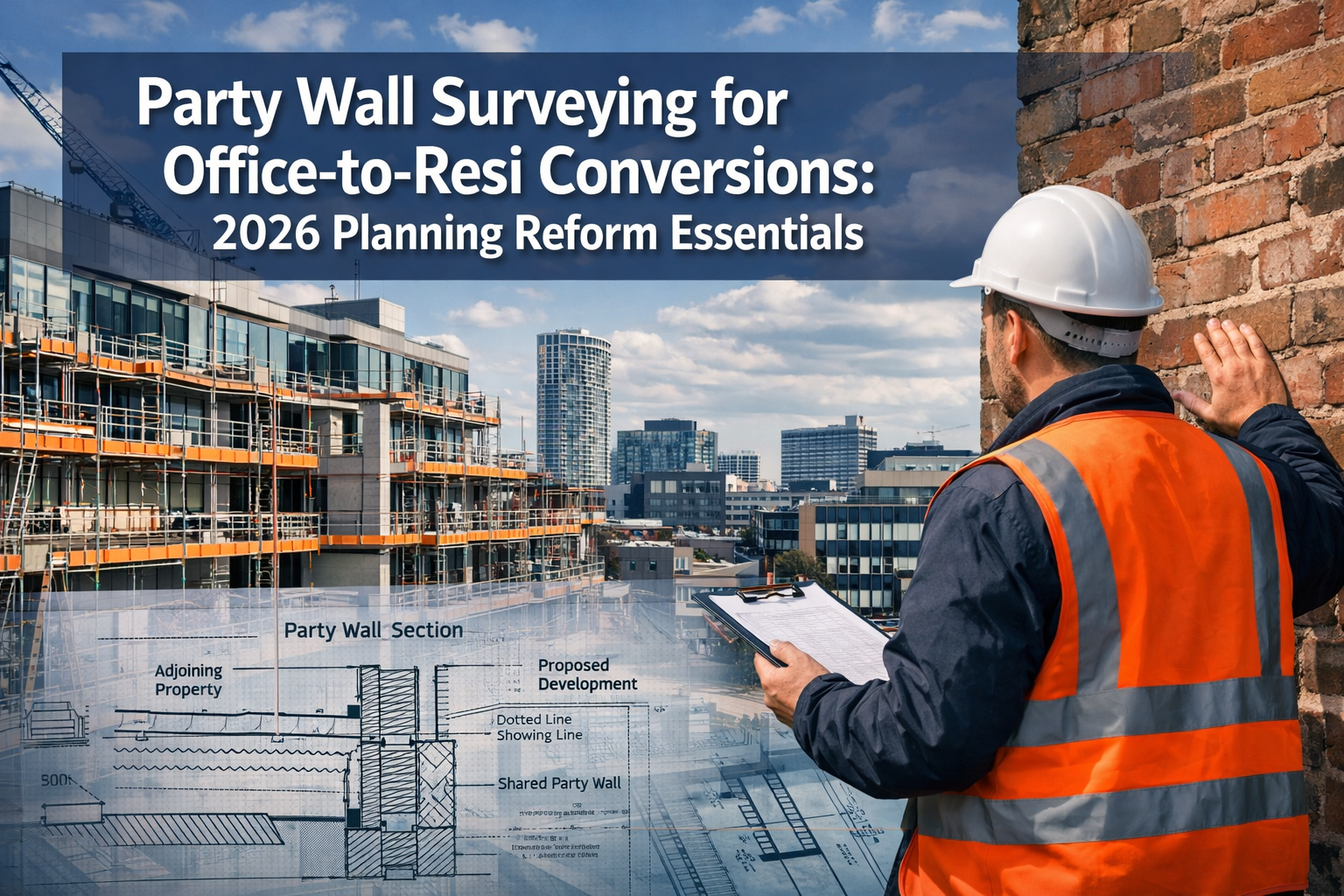
The transformation of empty office buildings into vibrant residential spaces is reshaping Britain's urban landscape in 2026. As cities like Manchester and Leeds embrace urban recovery initiatives, developers and property owners face a critical compliance challenge: Party Wall Surveying for Office-to-Resi Conversions: 2026 Planning Reform Essentials. Understanding the intricate requirements of party wall notices, awards, and neighbour agreements has become paramount for successful conversion projects under the latest planning reforms.
Office-to-residential conversions present unique party wall challenges that differ significantly from traditional residential projects. These conversions often involve substantial structural modifications to shared walls, requiring comprehensive assessments of acoustic separation, fire resistance, and structural integrity. With the party wall surveying industry experiencing unprecedented demand in 2026, developers must navigate complex legal frameworks while maintaining positive neighbour relations in dense urban environments.
Key Takeaways
- Mandatory compliance: Party wall procedures are legally required when office-to-resi conversions affect shared walls, with specific notice periods and documentation requirements under the Party Wall Act 1996
- Acoustic challenges: Office buildings typically lack adequate sound insulation for residential use, requiring extensive party wall assessments and upgrades during conversion
- Cost considerations: Party wall awards typically range from £1,000, with surveyor rates between £150-£200 per hour in 2026, representing a significant but necessary investment[3]
- Urban focus: Manchester and Leeds urban recovery zones present specific party wall challenges due to dense building configurations and mixed-use developments
- Early engagement: Proactive neighbour consultation and professional surveyor appointment prevent costly delays and disputes in conversion projects
Understanding Party Wall Requirements for Office-to-Resi Conversions
The Party Wall etc. Act 1996 governs all work affecting shared walls, boundaries, and excavations near neighbouring properties. For office-to-residential conversions, this legislation becomes particularly complex due to the scale and nature of structural modifications required.
What Triggers Party Wall Procedures?
Office-to-resi conversions typically trigger party wall requirements through several common scenarios:
Structural modifications to party walls represent the most frequent trigger. Converting open-plan office floors into individual residential units often requires creating new walls, doorways, or reinforcing existing party structures. Any work that involves cutting into, underpinning, or raising a party wall requires proper notices and agreements.
Installation of damp-proof courses in older office buildings frequently necessitates party wall procedures. Many commercial buildings converted to residential use require enhanced moisture protection, which may involve work affecting shared walls.
Acoustic insulation upgrades constitute a critical aspect of office-to-resi conversions. Office buildings often lack adequate sound separation for residential standards, and installing proper acoustic barriers typically involves significant party wall work[1].
Foundation work and excavations near neighbouring properties trigger specific requirements under Section 6 of the Act. When converting offices in urban recovery zones like Manchester and Leeds, ground-level alterations for creating residential entrances or utilities often fall within three or six metres of adjoining structures.
The Three Types of Party Wall Notices
Developers must understand which notice type applies to their conversion project:
| Notice Type | Purpose | Timeline | Common Office-to-Resi Applications |
|---|---|---|---|
| Party Structure Notice | Work directly to party walls | 2 months | Creating new openings, reinforcing walls, installing beams |
| Line of Junction Notice | Building new walls on boundary lines | 1 month | Separating converted units, creating fire compartments |
| 3/6 Metre Notice | Excavations near neighbours | 1 month | Basement conversions, foundation work, utility installations |
Understanding when you need a party wall surveyor becomes essential during the planning phase of any conversion project.
Key Differences from Residential Party Wall Work
Office-to-residential conversions present distinct challenges compared to standard residential party wall procedures:
🏢 Scale and complexity: Commercial buildings typically involve multiple adjoining owners, particularly in mixed-use urban developments. A single office building conversion might require coordinating with dozens of neighbouring residential and commercial property owners.
🔊 Acoustic performance requirements: Residential properties require significantly higher sound insulation standards than offices. Party wall surveys must assess existing construction and specify upgrades to meet Building Regulations Approved Document E requirements[1].
🔥 Fire safety considerations: Converting offices to residential use demands enhanced fire resistance in party walls, often requiring additional fire-rated boarding, cavity barriers, and compartmentation measures.
⚖️ Commercial lease complications: Existing commercial leases may contain restrictive covenants affecting party wall work, requiring legal review before proceeding with conversion plans.
Party Wall Surveying for Office-to-Resi Conversions: Notice Procedures and Timelines
Navigating the notice procedures correctly prevents costly delays and legal complications. The 2026 planning reforms have emphasised streamlined processes, but party wall compliance remains non-negotiable.
Preparing and Serving Party Wall Notices
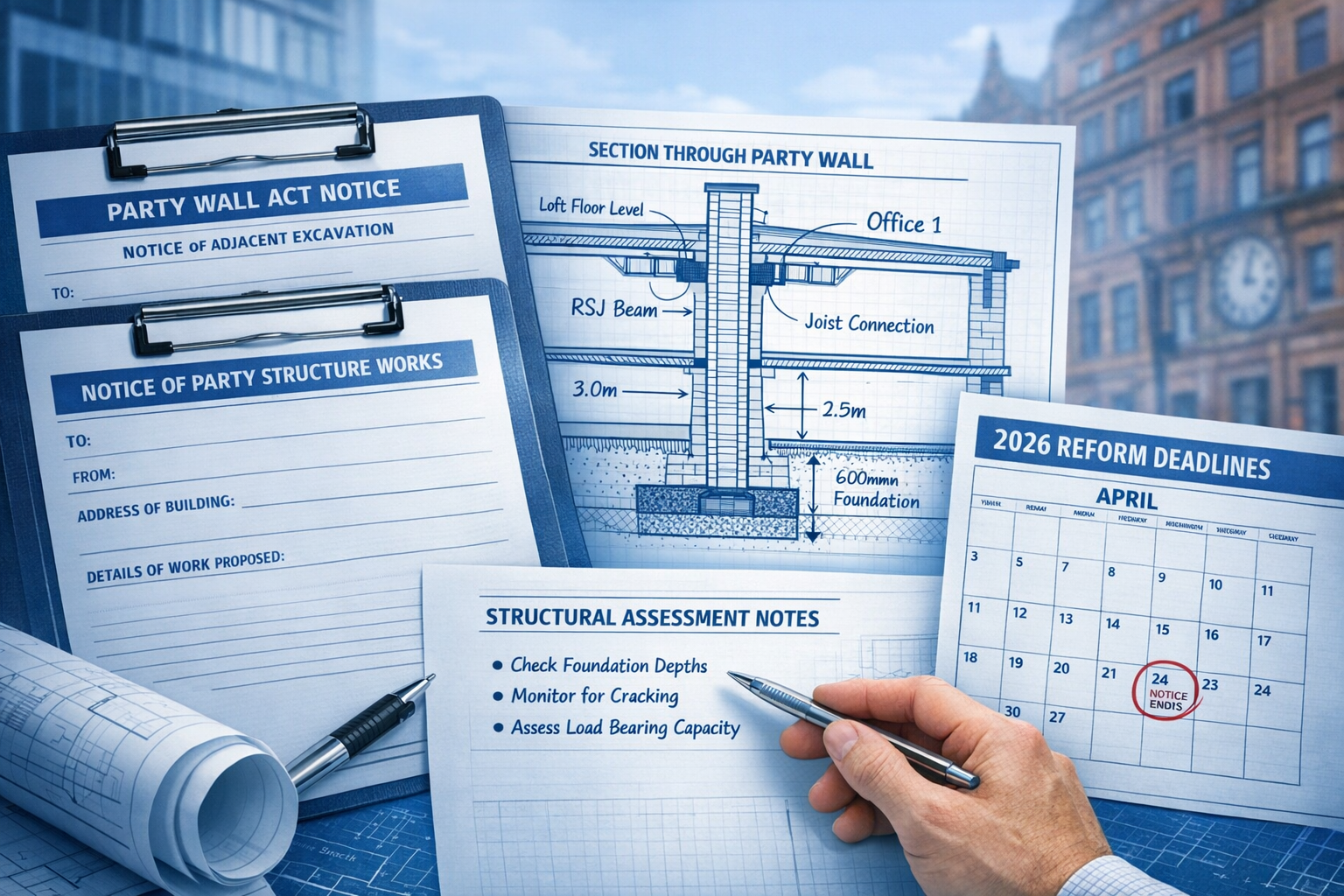
Timing is critical for office-to-resi conversion projects. Developers must serve notices well before commencing work, with statutory minimum periods of one to two months depending on notice type. However, practical experience suggests allowing three to four months for the complete party wall process, particularly in urban recovery zones with multiple adjoining owners.
Notice content requirements are strictly prescribed by the Act. Each notice must include:
- Full details of the proposed work with technical specifications
- Accurate plans and drawings showing party wall locations
- Clear identification of all affected party structures
- Proposed start date for works
- Building owner's contact details and appointed surveyor information
Serving notices correctly requires delivering documents to all adjoining owners. In office-to-resi conversions, this often includes commercial tenants, residential leaseholders, freeholders, and managing agents. Proof of service through recorded delivery or hand delivery with signed receipts protects against future disputes.
Adjoining Owner Responses and Appointing Surveyors
Once notices are served, adjoining owners have 14 days to respond with one of three options:
✅ Consent to the works: The adjoining owner agrees without requiring a party wall award. While ideal, this rarely occurs in complex office-to-resi conversions due to the scale of work involved.
📋 Dissent or non-response: Either formal dissent or failure to respond triggers the party wall award process, requiring surveyor appointment.
🤝 Request for additional information: Adjoining owners may seek clarification before deciding, which doesn't stop the clock on the 14-day response period.
The surveyor appointment process follows specific procedures:
When an adjoining owner dissents, the building owner appoints a surveyor. The adjoining owner then either:
- Appoints their own surveyor (creating a "two surveyor" scenario)
- Agrees to use the same surveyor as the building owner (creating an "agreed surveyor" scenario)
In two-surveyor situations, both appointed surveyors jointly select a third surveyor who resolves any disagreements. Understanding the cost of party wall surveyors helps developers budget appropriately for these professional fees.
2026 Reform Impacts on Notice Procedures
Recent planning reforms affecting office-to-residential conversions have indirect implications for party wall procedures:
Permitted Development Rights extensions for certain office-to-resi conversions don't override party wall requirements. Developers sometimes mistakenly believe PDR eliminates the need for party wall compliance—this is incorrect. The Party Wall Act operates independently of planning permission.
Urban recovery zone designations in cities like Manchester and Leeds have accelerated conversion activity, creating higher demand for party wall surveying services. The industry is experiencing a surge in 2026, with some surveyors reporting 40-60% increases in instruction volumes[2].
Streamlined planning processes mean conversion projects progress faster, but party wall timelines remain fixed by statute. Developers must factor these non-negotiable timeframes into project schedules.
Party Wall Awards: Structural Assessments and Neighbour Agreements
The party wall award represents the formal legal document governing how conversion work proceeds, protecting both building and adjoining owners' interests.

What a Party Wall Award Contains
A comprehensive party wall award for office-to-resi conversions typically includes:
Detailed work descriptions specifying exactly what structural modifications are permitted. For conversions, this covers wall reinforcement methods, acoustic insulation specifications, fire protection measures, and any temporary support requirements.
Condition schedules documenting the pre-work state of adjoining properties through photographs, written descriptions, and sometimes crack monitoring. This evidence proves invaluable if disputes arise about damage caused by conversion works.
Access rights and working hours establishing when contractors may access party walls and any restrictions on noisy operations. In mixed-use urban areas, balancing residential neighbour concerns with construction efficiency requires careful negotiation.
Cost allocation and payment terms clarifying who pays for what. Generally, building owners bear all costs associated with their chosen works, including surveyor fees for both parties. Understanding the cost of party wall agreements helps developers budget accurately.
Security for expenses provisions may require building owners to provide financial guarantees, particularly for large-scale conversions where potential damage risks are higher.
Structural Assessment Requirements
Office-to-residential conversions demand thorough structural assessments as part of the party wall process:
🔍 Existing party wall construction analysis: Surveyors must evaluate whether existing party walls provide adequate structural support, fire resistance, and acoustic separation for residential use. Many office buildings feature lightweight partition systems unsuitable for residential standards[1].
📐 Load calculations and structural capacity: Converting offices often involves redistributing loads as open-plan spaces become individual units. Party walls may require strengthening to support new floor layouts, additional storeys, or altered load paths.
🎯 Acoustic performance testing: Pre-conversion acoustic testing identifies deficiencies in sound insulation. Awards specify required improvements, typically involving dense blockwork, resilient bars, acoustic plasterboard, and mineral wool insulation to achieve Building Regulations standards.
🛡️ Fire resistance verification: Party walls must provide minimum fire resistance periods (typically 60 minutes for residential conversions). Surveys assess existing fire performance and specify necessary upgrades.
Professional structural engineering input often complements party wall surveying for complex conversions. Engaging structural engineering services ensures technical specifications in awards are robust and compliant.
Negotiating Terms with Adjoining Owners
Successful office-to-resi conversions require diplomatic neighbour management alongside technical compliance:
Early engagement strategies prove most effective. Approaching adjoining owners before formal notices with project information, timelines, and proposed mitigation measures builds goodwill and reduces adversarial responses.
Addressing common concerns proactively:
- Noise and disruption: Offer detailed construction schedules with restricted working hours
- Structural damage fears: Explain protective measures and insurance coverage
- Property value impacts: Demonstrate how quality residential conversions can enhance neighbourhood appeal
- Privacy and amenity: Show how design respects adjoining properties
Compromise and flexibility within legal frameworks help resolve disputes. While building owners have rights to undertake necessary works, accommodating reasonable adjoining owner requests regarding timing, methods, or additional protections facilitates smoother projects.
Documentation of agreements: All negotiated terms must appear in the formal party wall award. Verbal agreements or side letters lack legal enforceability under the Act.
Costs and Fee Structures in 2026
Party wall costs for office-to-resi conversions vary based on project complexity:
Typical surveyor fees in 2026 range from £150-£200 per hour, with total party wall awards averaging around £1,000 for straightforward cases[3]. However, complex urban conversions involving multiple adjoining owners and extensive structural work can cost significantly more.
Fee responsibility: Building owners pay both their own surveyor's fees and the adjoining owner's surveyor fees. This dual responsibility reflects the Act's principle that those initiating work bear the administrative costs.
Factors affecting costs:
- Number of adjoining owners requiring separate awards
- Complexity of structural assessments needed
- Extent of condition surveys and documentation
- Disputes requiring third surveyor involvement
- Geographic location (London and major cities command premium rates)
Value proposition: While party wall costs represent an additional expense, they're modest compared to overall conversion budgets and provide essential legal protection. Attempting to avoid party wall procedures risks injunctions halting work, costly litigation, and damaged neighbour relations.
Urban Recovery Zones: Manchester and Leeds Case Studies
Manchester and Leeds exemplify how urban recovery initiatives drive office-to-residential conversions while presenting unique party wall challenges.
Manchester's Urban Core Conversions
Manchester's city centre has witnessed substantial office-to-resi conversion activity, particularly in the Spinningfields, Northern Quarter, and Ancoats districts. These areas feature dense building configurations where party wall compliance becomes complex.
Typical challenges in Manchester conversions:
Victorian and Edwardian commercial buildings with shared walls often lack cavity construction. Converting these structures requires extensive party wall work to achieve modern acoustic and thermal standards while preserving historic fabric.
Mixed-use developments mean office conversions frequently adjoin existing residential properties, restaurants, and retail spaces. Coordinating party wall procedures across diverse ownership structures demands meticulous planning.
Basement and lower-ground conversions for creating residential amenity spaces trigger Section 6 excavation notices affecting multiple neighbouring foundations. Manchester's varied geology adds complexity to structural assessments.
Height extensions adding residential floors atop existing office buildings require party wall procedures for raising party walls and ensuring adequate structural support through adjoining properties.
Leeds Urban Recovery Zone Developments
Leeds has designated specific urban recovery zones encouraging office-to-residential conversions, particularly in the Wellington Place, South Bank, and Holbeck areas.
Leeds-specific considerations:
Modern office blocks from the 1960s-1980s dominate conversion pipelines. These buildings often feature concrete frame construction with non-loadbearing party walls requiring significant modification for residential subdivision.
Cladding and external wall issues intersect with party wall requirements when conversions involve façade improvements. Coordinating Building Safety Act compliance with party wall procedures requires integrated professional input.
Flood risk areas in parts of Leeds necessitate foundation and ground-level modifications during conversions, triggering excavation notices and requiring careful assessment of impacts on adjoining properties.
Transport corridor locations mean many conversion candidates sit in high-noise environments. Party wall awards must specify enhanced acoustic insulation not just for party walls but for external walls to achieve residential habitability standards.
Best Practices for Urban Conversion Projects
Successful office-to-resi conversions in urban recovery zones follow established best practices:
✅ Comprehensive pre-acquisition due diligence: Before purchasing office buildings for conversion, commission preliminary party wall assessments identifying potential complications, adjoining owner situations, and likely compliance costs.
✅ Integrated professional teams: Coordinate party wall surveyors with architects, structural engineers, and acoustic consultants from project inception. Party wall drawings integrated with architectural plans prevent conflicts and rework.
✅ Phased notice strategies: For large conversions, serve party wall notices in phases aligned with construction sequences. This prevents overwhelming adjoining owners and allows focused attention on each work stage.
✅ Community engagement: Beyond statutory notice requirements, host information sessions for neighbouring properties explaining conversion benefits, timelines, and contact procedures for concerns.
✅ Contingency planning: Build 8-12 weeks of party wall contingency into project programmes. Disputes, third surveyor appointments, or complex negotiations can extend timelines beyond statutory minimums.
✅ Insurance verification: Ensure contractor insurance specifically covers party wall works and adjoining property damage. Standard policies may exclude certain party wall scenarios.
Avoiding Common Pitfalls in Office-to-Resi Party Wall Compliance
Even experienced developers encounter party wall challenges in conversion projects. Understanding common mistakes prevents costly errors.
Critical Mistakes to Avoid
❌ Assuming Permitted Development Rights eliminate party wall requirements: PDR and party wall compliance are completely separate legal frameworks. Even conversions proceeding under PDR must comply with the Party Wall Act when work affects shared structures.
❌ Serving notices too late: Statutory notice periods represent absolute minimums. Serving notices just weeks before planned construction starts leaves no buffer for disputes or negotiations, risking project delays.
❌ Inadequate identification of adjoining owners: Office buildings in urban areas may have complex ownership structures including freeholders, head leaseholders, and occupational tenants. Failing to serve notices on all relevant parties invalidates the process.
❌ Underestimating acoustic requirements: Many developers discover mid-project that party walls require more extensive acoustic upgrading than initially planned. Early acoustic testing and realistic specifications in party wall awards prevent this costly surprise[1].
❌ Neglecting condition surveys: Thorough pre-work condition surveys protect against unfounded damage claims. Photographic and written evidence of existing cracks, settlement, or defects proves invaluable if disputes arise.
❌ Poor contractor briefing: Construction teams must understand party wall award terms and work restrictions. Violations of agreed working hours, access rights, or methods can trigger injunctions halting work.
Dispute Resolution Strategies
When party wall disputes arise during office-to-resi conversions:
Third surveyor determination provides the statutory resolution mechanism. The third surveyor's decision is binding and enforceable, though either party may appeal to county court within 14 days.
Mediation and negotiation before formal dispute escalation often resolves issues more quickly and economically. Experienced party wall surveyors facilitate compromise while protecting their appointing owner's interests.
Legal advice becomes necessary when disputes involve complex lease arrangements, restrictive covenants, or allegations of negligence. Understanding your party wall rights helps navigate contentious situations.
Damage claims procedures: The party wall award establishes how damage claims are assessed and resolved. Independent expert determination typically resolves factual disputes about whether conversion works caused specific damage.
Integration with Building Control and Planning
Party wall compliance intersects with other regulatory requirements:
Building Regulations approval proceeds independently but party wall awards should align with Building Control submissions. Specifications for acoustic insulation, fire resistance, and structural modifications must be consistent across both frameworks.
Planning conditions sometimes require specific treatments of party walls, particularly in conservation areas or listed buildings. Coordinate party wall surveyors with conservation officers to ensure compatible approaches.
CDM Regulations place health and safety duties on developers. Party wall awards should reference CDM requirements for safe working practices affecting adjoining properties.
Building Safety Act considerations for higher-risk buildings require coordination between party wall procedures and the new regulatory framework. Accountable persons must understand how party wall works affect building safety cases.
Professional Support for Party Wall Surveying in Conversions
Engaging qualified professionals ensures compliant, efficient party wall processes for office-to-resi conversions.
Selecting the Right Party Wall Surveyor
Qualifications and experience matter significantly. Look for surveyors who are:
- Members of the Royal Institution of Chartered Surveyors (RICS)
- Specialists in party wall matters with specific conversion experience
- Familiar with urban recovery zone projects in your target area
- Able to provide references from similar office-to-resi projects
Local knowledge proves valuable in cities like Manchester and Leeds where building types, construction methods, and typical party wall configurations follow regional patterns.
Communication skills are essential. Effective party wall surveyors explain complex technical issues clearly to adjoining owners, reducing anxiety and facilitating agreements.
Independence and impartiality: When acting as an agreed surveyor, the professional must serve both parties fairly. Even when appointed by one party, ethical surveyors maintain professional standards rather than adversarial approaches.
Complementary Professional Services
Office-to-resi conversions benefit from integrated professional input:
Structural engineers work alongside party wall surveyors to design strengthening works, assess load capacities, and specify safe construction methods. This collaboration ensures party wall awards contain technically sound specifications.
Acoustic consultants provide specialist testing and design for sound insulation upgrades. Their input ensures party wall specifications achieve Building Regulations compliance for residential use[1].
Building surveyors conducting comprehensive building surveys identify party wall issues during pre-acquisition assessments, informing purchase decisions and budget planning.
Planning consultants coordinate party wall requirements with planning applications, ensuring timelines align and regulatory requirements complement rather than conflict.
Cost-Benefit Analysis of Professional Engagement
Investing in quality party wall surveying delivers multiple benefits:
Risk mitigation: Professional surveyors prevent legal challenges, construction delays, and neighbour disputes that cost far more than surveyor fees.
Technical accuracy: Proper specifications in party wall awards ensure work meets building regulations, avoiding costly remediation.
Negotiation efficiency: Experienced surveyors facilitate agreements that might otherwise escalate into protracted disputes requiring legal intervention.
Documentation quality: Comprehensive condition surveys and awards provide legal protection if damage claims arise years after conversion completion.
Project certainty: Clear party wall awards give contractors definitive instructions, preventing on-site confusion and variations.
The typical investment of £1,000-£5,000 in party wall compliance represents less than 1% of most conversion project costs while protecting against risks that could jeopardize entire developments[3].
Conclusion
Party Wall Surveying for Office-to-Resi Conversions: 2026 Planning Reform Essentials represents a critical compliance area that developers cannot afford to overlook. As urban recovery zones in Manchester, Leeds, and other British cities drive conversion activity, understanding party wall procedures, notices, awards, and neighbour agreements becomes essential for project success.
The key principles for effective party wall compliance in office-to-resi conversions include:
🔑 Early engagement: Serve notices well ahead of planned construction starts, allowing adequate time for surveyor appointments, negotiations, and award preparation.
🔑 Professional expertise: Engage qualified party wall surveyors with specific conversion experience who understand the unique challenges of transforming commercial spaces into residential properties.
🔑 Comprehensive assessments: Ensure party wall awards address structural capacity, acoustic performance, fire resistance, and all technical requirements for residential use.
🔑 Neighbour relations: Approach adjoining owners proactively with clear information, reasonable accommodations, and professional courtesy that facilitates cooperation.
🔑 Integrated planning: Coordinate party wall procedures with planning applications, building control submissions, and construction programmes for seamless project delivery.
The 2026 planning reforms have streamlined certain aspects of office-to-residential conversions, but party wall compliance remains governed by the unchanged requirements of the Party Wall etc. Act 1996. Developers who treat party wall procedures as essential project foundations rather than bureaucratic obstacles position their conversions for successful, dispute-free completion.
Next Steps for Your Conversion Project
If you're planning an office-to-residential conversion:
- Commission a preliminary party wall assessment during your feasibility study to identify adjoining owners, likely notice requirements, and estimated compliance costs
- Engage a qualified party wall surveyor at least 3-4 months before your planned construction start date
- Coordinate with your professional team including architects, structural engineers, and acoustic consultants to ensure integrated technical specifications
- Approach adjoining owners proactively with project information before formal notices to build positive relationships
- Build realistic timelines and budgets that account for statutory notice periods, potential disputes, and professional fees
For expert guidance on party wall compliance in your office-to-resi conversion project, consider consulting with experienced professionals who understand both the legal requirements and the practical realities of urban conversion developments. Whether you're buying a property that requires party wall consideration or managing a complex urban conversion, professional support ensures your project proceeds smoothly, legally, and successfully.
The transformation of underutilized office space into vibrant residential communities offers tremendous opportunities for developers and benefits for cities. By mastering party wall surveying essentials and approaching compliance professionally, you position your conversion project for success in 2026 and beyond.
References
[1] Building Survey Checklists For Office To Resi Conversions Under 2026 Planning Reforms – https://nottinghillsurveyors.com/blog/building-survey-checklists-for-office-to-resi-conversions-under-2026-planning-reforms
[2] Party Wall Surveying Surge In 2026 Loft Conversions Navigating High Demand Compliance During Housing Uptick – https://nottinghillsurveyors.com/blog/party-wall-surveying-surge-in-2026-loft-conversions-navigating-high-demand-compliance-during-housing-uptick
[3] Party Wall Agreement – https://hoa.org.uk/advice/guides-for-homeowners/i-am-improving/party-wall-agreement/