

Approximately 40% of party wall disputes in England and Wales stem from homeowners assuming their project is too small to require formal notification — and that assumption costs them dearly [1]. Party wall risks in small residential refurbishments represent one of the most consistently misunderstood areas of property law, yet the Party Wall etc. Act 1996 draws no distinction between a modest bathroom refit and a full rear extension when certain structural thresholds are crossed. The overlooked works that still trigger the Act are hiding inside everyday renovation projects, and the consequences of missing them range from injunctions to forced demolition.
This article breaks down exactly which small-scale works carry party wall obligations, why designers and homeowners routinely miss them, and how chartered surveyors can deliver practical, low-cost advisory services that protect everyone involved.
Key Takeaways
- The Party Wall etc. Act 1996 applies to specific types of work, not project size — small refurbishments can and do trigger formal obligations.
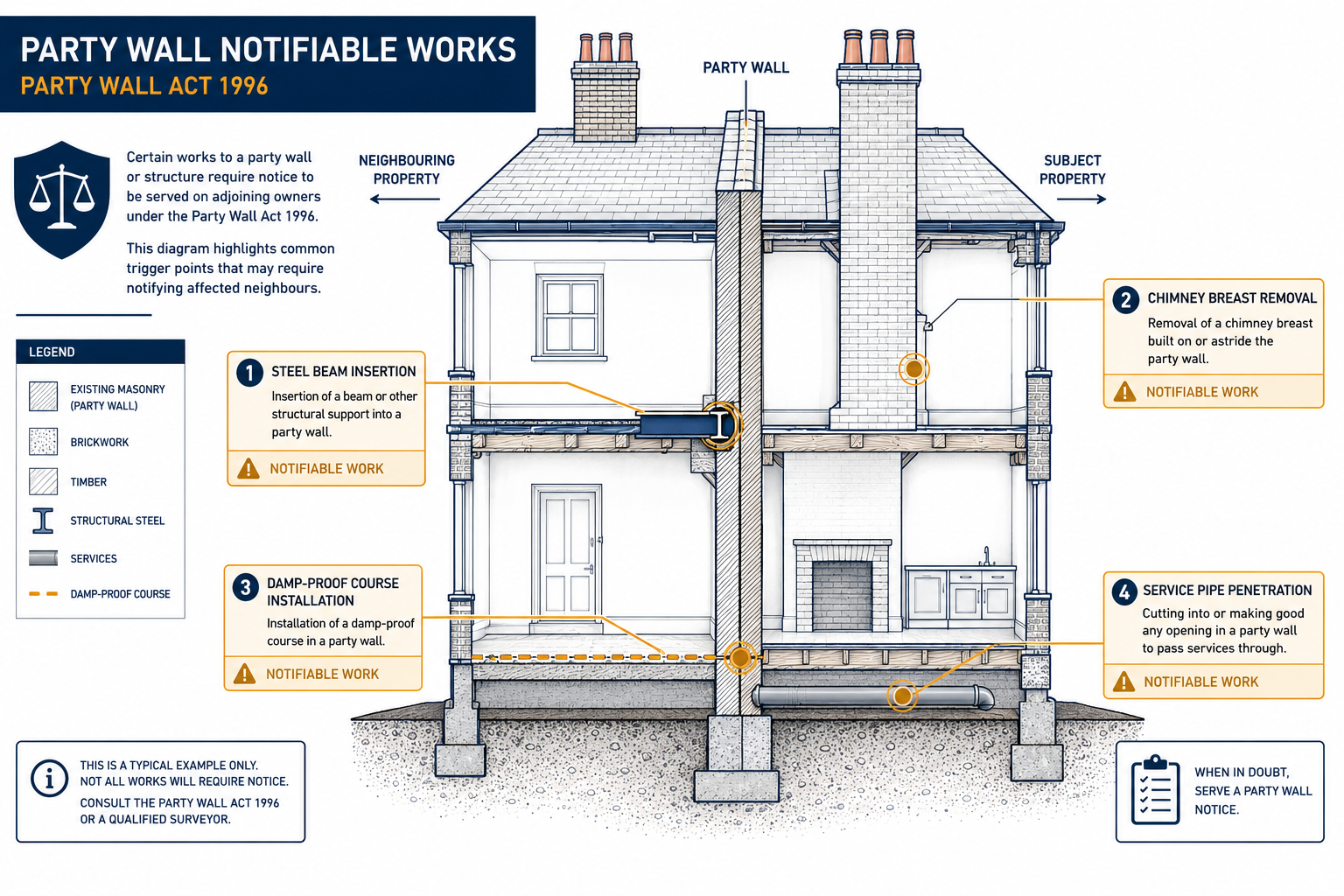
- Chimney breast removals, steel beam insertions, bathroom drainage penetrations, and damp-proof course installations are among the most commonly overlooked notifiable works.
- Failing to serve notice before starting work can result in injunctions, costly delays, and damaged neighbour relationships.
- Notice periods are either one or two months depending on the type of work, and neighbours have 14 days to respond before a dispute process begins.
- Engaging a chartered surveyor early — even for an informal advisory review — is the most cost-effective way to manage party wall risk on small projects.
What the Party Wall Act Actually Covers — and What It Does Not
The Party Wall etc. Act 1996 governs three distinct categories of work in England and Wales [2]:
- Works to an existing party wall or party structure — including cutting into, raising, underpinning, or inserting beams into a shared wall.
- New building on or at the boundary line — constructing a wall astride or immediately adjacent to the boundary.
- Excavations near a neighbour's foundations — specifically, digging within 3 metres of a neighbouring structure where the excavation goes deeper than the neighbour's foundations, or within 6 metres where the excavation intersects a 45-degree line drawn from the base of the neighbour's foundations.
What does NOT require notice is equally important to understand. Minor works such as plastering a party wall surface, replacing electrical sockets, fitting shelves with standard fixings, or redecorating do not fall within the Act's scope [2]. The line between notifiable and non-notifiable work is often thinner than homeowners expect, which is precisely where party wall risks in small residential refurbishments become most dangerous.
"The Act is not about project scale — it is about the nature of the work and its proximity to shared structures."
Understanding this distinction is the foundation of sound party wall compliance. For a broader overview of your legal entitlements and obligations, the guide on party wall rights for homeowners provides useful context.
The Everyday Projects That Carry Hidden Party Wall Obligations
Chimney Breast Removals
Removing a chimney breast from an internal room is one of the most frequently undertaken small refurbishments in Victorian and Edwardian terraced housing stock — and one of the most frequently notified late or not at all. Where the chimney stack is shared with a neighbouring property, the breast and stack form part of the party structure. Cutting away from it, inserting a steel angle or padstone to carry the remaining stack, or altering the flue arrangement all constitute works to a party structure under Section 2 of the Act.
Even where the chimney breast sits entirely within the building owner's property, the stack above roof level is often a shared structure. Any work that affects the structural integrity or loading of that stack requires a party wall notice with a two-month notice period [2].
Steel Beam Insertions
Inserting a steel beam (RSJ or universal beam) into a party wall to carry a new load — whether for an open-plan ground floor, a loft conversion, or a first-floor extension — is explicitly notifiable under the Act. This applies even when the beam bears only minimally on the party wall, because the Act covers any cutting into or notching of the shared structure [2].
Architects and designers sometimes overlook this because the steel work appears to be a purely internal alteration. The trigger is not the scale of the project but the physical act of cutting into or bearing upon the party wall. Homeowners planning loft conversions should be aware that steel insertions are almost always involved — the costs and considerations of home extensions article covers the broader financial picture of such projects.
Bathroom Refits and Service Penetrations
A standard bathroom refit rarely raises party wall concerns in a detached property. In a terraced or semi-detached house, however, the picture changes considerably. The following scenarios within a bathroom refit can trigger the Act:
| Work Type | Trigger Condition | Notice Period |
|---|---|---|
| Soil pipe through party wall | Cutting new opening in party wall | 2 months |
| New waste pipe penetration | Creating opening in party wall | 2 months |
| Damp-proof course insertion | Installing DPC into party wall | 2 months |
| Tanking/waterproofing to party wall | Depends on method and depth | Advisory review recommended |
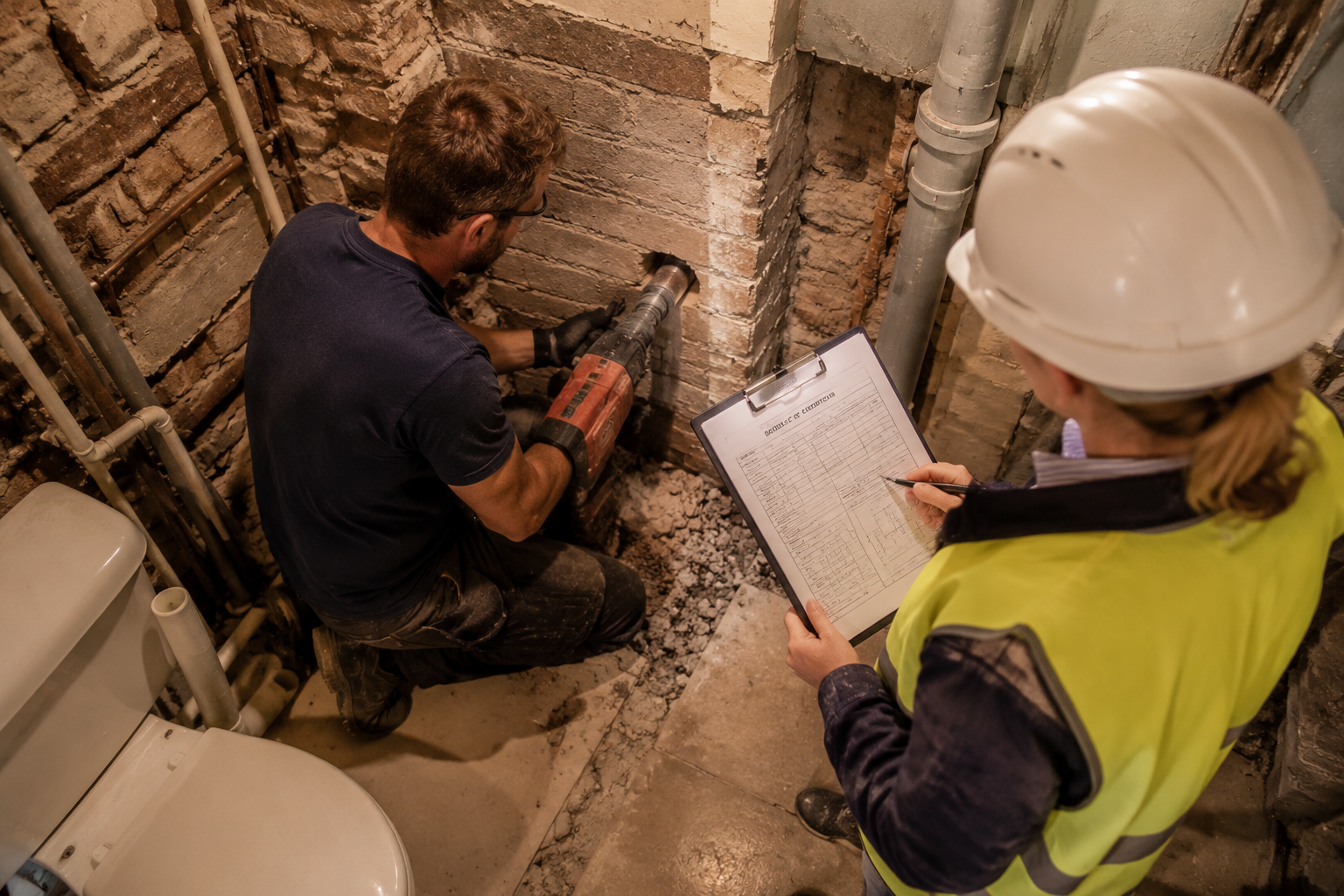
Drilling a small hole for a pipe might seem trivial, but if that hole is cut through a party wall, it constitutes a notifiable opening. The Act does not specify a minimum diameter — any new opening requires notice [1].
Damp-Proof Course Installations
Damp-proof course (DPC) work is another category where party wall risks in small residential refurbishments are consistently underestimated. Installing a chemical DPC by injection into a party wall requires notice under Section 2(2)(f) of the Act, which covers making good, repairing, or underpinning a party wall. Because DPC work is often commissioned as a standalone remedial job — sometimes by a specialist damp contractor rather than a main contractor — the party wall dimension is easily overlooked. The consequences of ignoring the Party Wall Act can be severe, including injunctions that halt work already underway.
Basement Conversions and Excavations
Basement conversions are increasingly popular in urban areas, and they carry some of the most serious party wall obligations. Underpinning — which is almost always required when converting a basement beneath a party wall — falls squarely within the Act. Excavations within 3 metres of a neighbour's foundation that go deeper than those foundations also require a one-month notice [2]. For anyone considering basement work in Surrey or similar areas, the specialist guidance on basements and party wall surveyors is directly relevant.
Notice Periods, Neighbour Responses, and the Dispute Process
Serving Notice Correctly
The Act requires the building owner (the person carrying out the work) to serve written notice on all adjoining owners. The notice must include:
- The building owner's name and address
- The address of the property where work will take place
- A description of the proposed works
- The planned start date
Notice periods are fixed by the type of work:
- Two months' notice for works to an existing party wall or party structure (Section 2 works)
- One month's notice for new boundary wall construction (Section 1 works) and most excavation works (Section 6 works) [2]
These periods cannot be waived unilaterally by the building owner. Work cannot legally commence until either the notice period expires with consent, or a party wall award is in place.
How Neighbours Can Respond
Once notice is served, the adjoining owner has 14 days to respond [3]. Three outcomes are possible:
- Consent in writing — Work can proceed. No surveyor is required, though a Schedule of Condition is still strongly advisable.
- Dissent with agreement to appoint an agreed surveyor — A single surveyor acts for both parties, reducing cost.
- Dissent or no response — A dispute is deemed to have arisen. Each party appoints their own surveyor (or agrees on one), and a party wall award is drawn up.
The party wall award is a legally binding document that sets out the rights and responsibilities of both parties, the manner in which the works are to be executed, and any compensation provisions. Understanding the cost of a party wall agreement helps homeowners budget realistically before starting any notifiable project.
Common Misconceptions That Lead to Disputes
Several persistent myths cause homeowners to skip the notice process entirely. The 5 common misconceptions about party wall agreements article addresses these in detail, but the most damaging include:
- "My neighbour is fine with it verbally" — Verbal consent has no legal standing under the Act. Written consent is required.
- "It's only a small job" — The Act is triggered by the nature of the work, not its scale or cost.
- "I've already started, so it's too late to serve notice" — Notice can still be served retrospectively, but the legal position is significantly weakened and an injunction remains possible.
- "My builder said I don't need it" — Builders are not qualified to give party wall advice. Only a party wall surveyor can do so authoritatively.
How Chartered Surveyors Can Deliver Low-Cost Advisory Services for Small Projects
The Advisory Review Model
For small refurbishments, a full party wall award may not always be necessary — but professional guidance almost always is. Chartered surveyors are increasingly offering preliminary advisory reviews as a standalone service, typically covering:
- A desktop review of the proposed works against the Act's trigger criteria
- Written confirmation of whether notice is required and what type
- Guidance on notice wording and service
- Advice on whether a Schedule of Condition should be commissioned
This service can be delivered at a fraction of the cost of a full award and gives homeowners and their designers the certainty they need before committing to a programme. The cost of a party wall surveyor varies depending on the complexity of the project, but early engagement almost always reduces total cost.
Schedule of Condition Surveys
Even where a neighbour consents to works without a formal award, commissioning a Schedule of Condition is strongly advisable. This is a photographic and written record of the neighbouring property's condition before work begins. If a dispute arises later about whether a crack or defect was caused by the refurbishment, the Schedule of Condition is the primary evidence.
For small projects — a chimney breast removal, a bathroom refit with drainage penetrations, a steel beam insertion — a Schedule of Condition can be completed in a few hours and provides substantial protection for both parties.
Packaging Party Wall Services Around Small Projects
Surveyors working with residential clients, architects, and interior designers can create genuine value by packaging party wall advisory services alongside other survey products. For example:
- A building survey or structural inspection commissioned before purchase can flag party wall obligations for planned works before contracts are exchanged.
- A condition survey commissioned at the start of a refurbishment project can double as a Schedule of Condition for party wall purposes.
- Designers and architects benefit from early surveyor input because it prevents programme delays caused by late notice service.
This integrated approach positions the surveyor as a project risk manager rather than a reactive dispute resolver — a far more valuable and commercially sustainable role.

The Real Cost of Getting It Wrong
Legal and Financial Exposure
A building owner who starts notifiable work without serving notice is in breach of the Act. The adjoining owner can apply to the courts for an injunction to stop the works immediately. In cases where work has already caused damage, the building owner is liable for all reasonable costs of making good, plus the adjoining owner's surveyor fees [4].
In practice, the financial exposure from an injunction — including contractor standing-time costs, legal fees, and remediation — can easily exceed the cost of proper party wall compliance by a factor of ten or more. The top 5 party wall agreement renovation mistakes article documents how these situations unfold in real projects.
Relationship and Resale Implications
Beyond the legal risk, party wall disputes damage neighbour relationships in ways that are difficult to repair. In a terraced street, a homeowner may live next to the same neighbour for decades. A dispute that escalates to court proceedings creates lasting tension and can complicate future property transactions.
When a property is sold, solicitors routinely ask whether any party wall works were carried out and whether proper notice was served. An absence of documentation where notifiable works were clearly undertaken can delay or derail a sale. For anyone buying an older property, the guide to what to look out for when buying an old house highlights party wall history as a key due diligence item.
Conclusion
Party wall risks in small residential refurbishments are not theoretical — they are a routine feature of the everyday renovation projects that homeowners and designers undertake without a second thought. Chimney breast removals, steel beam insertions, bathroom drainage penetrations, and damp-proof course installations all carry formal obligations under the Party Wall etc. Act 1996, regardless of how modest the overall project appears.
Actionable next steps for homeowners and designers in 2026:
- Before instructing a contractor, have the proposed works reviewed by a chartered party wall surveyor to confirm whether notice is required.
- Serve notice early — two months before the planned start date for most party wall works, one month for excavations and new boundary walls.
- Commission a Schedule of Condition even where the neighbour consents without a formal award.
- Do not rely on verbal consent — written confirmation is the only legally valid form of agreement.
- Budget for party wall costs at the project outset — they are predictable and manageable when planned in advance, and far less costly than a dispute.
The Act exists to protect both building owners and their neighbours. Engaging a qualified surveyor early is not a bureaucratic burden — it is the single most effective way to keep a small refurbishment project on time, on budget, and out of court.
References
[1] Party Wall Notices For Structural Alterations When Drilling Fixings And Small Openings Still Trigger The Act – partywallsurveyorlondon.uk
[2] Work Tell Your Neighbour About – gov.uk
[3] What Is The Party Wall Act – partywalldiy.com
[4] Party Walls – rics.org
How Prince Surveyors can help: explore our party wall surveyors or learn about our party wall surveyor costs.