

The Levelling-Up and Regeneration Act 2023 did not simply reshape planning policy — it quietly redrew the financial landscape that party wall surveyors must navigate every time they draft an award. By formalising Infrastructure Levy mechanisms and embedding planning gain value (PGV) calculations into the development consent process, the legislation created a direct link between a neighbour's planning uplift and the obligations a party wall award can legitimately address. For surveyors working on 2026 development awards, understanding the party wall implications of planning gain value reforms: surveyor checklists for 2026 development awards is no longer optional background reading — it is a core professional competency.
Key Takeaways
- Planning gain value reforms under the Levelling-Up and Regeneration Act 2023 directly affect how party wall awards are structured for 2026 development projects.
- The RICS 8th edition guidance, launched for consultation in April 2026, introduces ESG compliance checkpoints, mandatory schedules of condition, and stricter surveyor independence rules.
- Surveyors must now quantify planning uplift when negotiating with adjoining owners, particularly where extensions or basement works generate measurable value increases.
- Fee transparency, conflict of interest disclosure, and pre-works inspection protocols are now explicitly required under updated RICS conduct standards.
- A structured surveyor checklist aligned with both the Party Wall etc. Act 1996 and 2026 planning gain value metrics is essential for defensible, dispute-resistant awards.
How Planning Gain Value Reforms Change the Party Wall Landscape in 2026
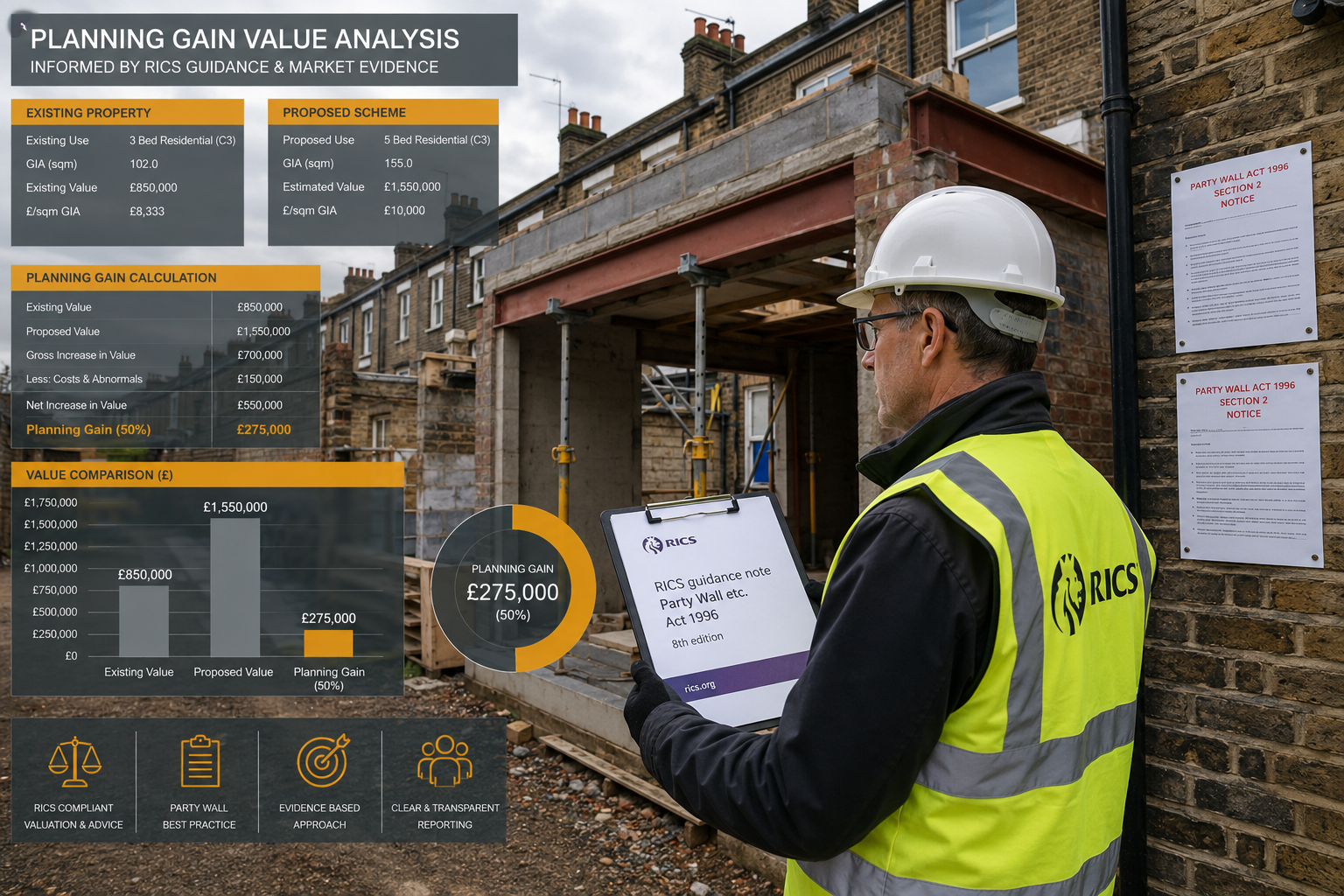
Planning gain value — the uplift in a property's worth generated by the grant of planning permission — has always existed in the background of neighbour disputes. What changed with the Levelling-Up and Regeneration Act 2023 is that PGV is now a quantified, documented figure attached to specific development consents. Local planning authorities are required to calculate and record the value uplift that a permission generates, partly to inform Infrastructure Levy contributions. That documented uplift figure has significant consequences for party wall practice.
Why PGV Figures Matter to Adjoining Owners
When a building owner receives planning permission for a rear extension, loft conversion, or basement excavation, the associated PGV figure signals the scale of financial benefit they stand to gain. Adjoining owners and their surveyors can now reference this figure when:
- Assessing whether proposed works are proportionate to the risk imposed on the adjoining property
- Negotiating security for expenses under Section 12 of the Party Wall etc. Act 1996
- Arguing for more comprehensive schedules of condition or monitoring regimes
- Evaluating whether a building owner's cost-cutting on materials or methodology is justified given the profit margin available
This is not about extracting a share of the uplift for the adjoining owner — the Act does not permit that. It is about using PGV as a calibration tool: the larger the financial gain, the less defensible it becomes for a building owner to resist reasonable protective measures.
The Levelling-Up Act's Indirect Effect on Award Drafting
The Act's Infrastructure Levy provisions mean that some of the value uplift is now formally captured by the local authority. However, the remainder accrues to the building owner, and that remainder is often substantial in high-value urban markets. Surveyors drafting awards for London extensions, for example, should be aware that PGV figures in prime boroughs can run to hundreds of thousands of pounds for a single-storey rear extension. Understanding your party wall rights in this context means recognising that the financial stakes justify thorough protective measures in the award.
"The larger the planning gain, the stronger the case for robust protective provisions in the party wall award — proportionality cuts both ways."
RICS 8th Edition Guidance: What the 2026 Updates Mean for Surveyor Checklists
In April 2026, the Royal Institution of Chartered Surveyors launched a consultation on the draft 8th edition of "Party Wall Legislation and Procedure," with the consultation period running through May 2026 [1]. The timing is deliberate: the profession needed updated guidance that reflects both the post-Levelling-Up Act environment and the growing complexity of urban development awards. The changes are substantial and affect every stage of a surveyor's engagement.
Surveyor Independence and Statutory Appointments
The 8th edition explicitly states that a party wall surveyor's appointment is personal and statutory, reinforcing the requirement to act impartially regardless of who appoints or pays them [1]. This clarification directly addresses a pattern of complaints where surveyors were perceived to be advocating for their appointing client rather than acting as independent officers of the Act.
For 2026 development awards, this means:
- A surveyor appointed by the building owner must still protect the adjoining owner's legitimate interests in the award
- Fee arrangements that create financial incentives to expedite or minimise awards must be disclosed and justified
- Any prior relationship with the building owner, developer, or contractor must be declared before acceptance of appointment
This is not merely ethical guidance — it has practical implications for the enforceability of awards. An award made by a surveyor who failed to act independently can be challenged under Section 10(17) of the Act. Understanding the consequences of ignoring the Party Wall Act extends to awards that are procedurally defective due to surveyor conduct failures.
Fee Transparency and Terms of Engagement
The updated guidance places significant emphasis on professional conduct, particularly around fee transparency and conflict of interest disclosure [2]. Surveyors are now required to provide clear terms of engagement that address:
| Requirement | Detail |
|---|---|
| Fee basis | Hourly rate, fixed fee, or stage-based — must be stated upfront |
| Conflict disclosure | Any relationship with the appointing party or their agents |
| Scope of appointment | Works covered, properties inspected, award type anticipated |
| Communication standards | Response times, format of correspondence, record-keeping |
These requirements align with the broader professional conduct expectations that RICS has been tightening across all surveying disciplines. For party wall work specifically, the transparency requirements are particularly important because the adjoining owner — who may have no prior relationship with the surveyor — is directly affected by the award.
ESG Compliance Checkpoints in 2026 Awards
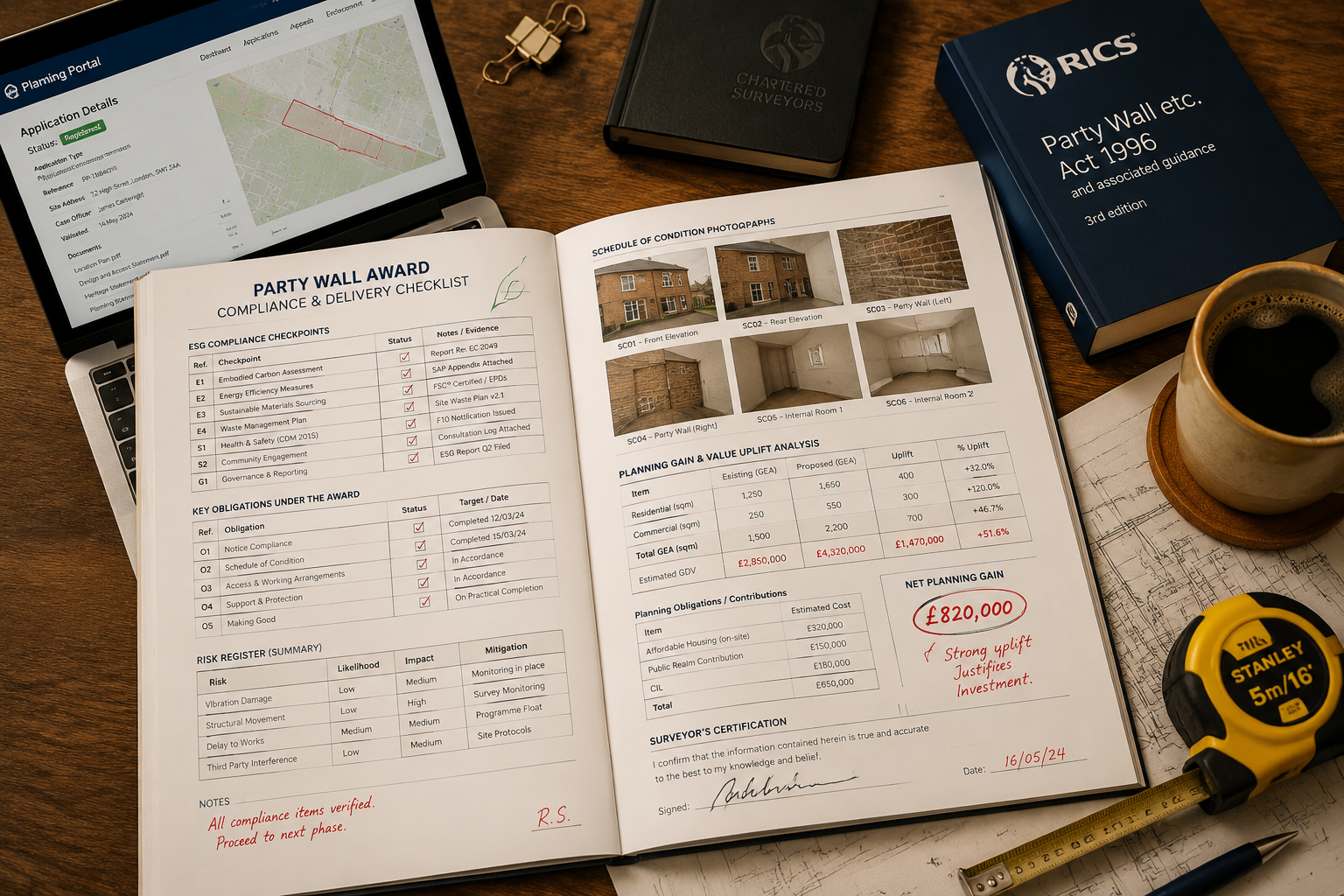
One of the most significant innovations in the 8th edition is the introduction of Environmental, Social, and Governance (ESG) compliance checkpoints within party wall awards [2]. Surveyors are encouraged to:
- Reference relevant planning conditions that carry environmental requirements
- Document material choices proposed by the building owner that may affect the adjoining owner's property in terms of thermal or acoustic performance
- Record whether proposed insulation, glazing, or structural materials meet or exceed the environmental standards attached to the planning consent
This ESG integration is directly connected to planning gain value reform. Where a planning permission has been granted partly on the basis of sustainability commitments — increasingly common under 2026 local plan policies — those commitments become relevant to the party wall award. A building owner who substitutes lower-specification materials to reduce costs may be both breaching planning conditions and creating a legitimate basis for the adjoining owner's surveyor to object.
For surveyors working on basement excavation projects, ESG checkpoints are particularly relevant given the thermal mass implications of deep excavations and the acoustic impact of mechanical waterproofing systems.
Party Wall Implications of Planning Gain Value Reforms: Surveyor Checklists for 2026 Development Awards in Practice
Translating the regulatory changes into a workable process requires a structured checklist approach. The following framework integrates the RICS 8th edition requirements with the planning gain value considerations specific to 2026 development awards.

Pre-Appointment Checklist
Before accepting appointment, surveyors should confirm and document:
Conflict and Independence Checks
- No prior financial relationship with the building owner, developer, or principal contractor
- No current or recent appointment on an adjacent property that could create a conflict
- Ability to act independently and impartially throughout the award process
Planning Gain Value Review
- Obtain a copy of the planning permission and any associated Infrastructure Levy assessment
- Identify the recorded PGV figure or calculate an estimate using comparable consents
- Note any environmental or sustainability conditions attached to the consent
- Assess whether the scale of works is proportionate to the adjoining owner's risk exposure
Scope Confirmation
- Confirm which sections of the Party Wall etc. Act 1996 are engaged (Section 1, 2, or 6)
- Identify all affected adjoining owners and their properties
- Confirm service of valid notices and check response status
Pre-Works Inspection Checklist
The 8th edition strongly recommends that surveyors visit both the building owner's and adjoining owner's properties before making an award [1]. This pre-works inspection should produce:
Schedule of Condition
- Photographic record of all existing cracks, their location and measured width
- Documentation of existing settlement, movement, or structural defects
- Record of existing finishes, decorative condition, and any pre-existing damage
- Assessment of foundations where relevant to excavation or underpinning works
Structural and Fabric Assessment
- Construction type and age of the party wall or structure
- Evidence of previous works, alterations, or repairs
- Assessment of how proposed works will interact with existing fabric
- Identification of any pre-existing vulnerabilities that require specific protective provisions
This pre-works inspection protocol is particularly important where party wall disputes arise after completion. A comprehensive schedule of condition, prepared before works begin, is the single most effective tool for resolving damage claims fairly and efficiently.
Award Drafting Checklist
When drafting the award itself, the following elements should be addressed systematically:
Core Award Provisions
- Description of permitted works with reference to approved drawings
- Working hours and noise management conditions
- Notification requirements before commencement of specific operations
- Access rights for monitoring and inspection during works
- Reinstatement obligations for any temporary works or access
PGV-Informed Protective Provisions
- Security for expenses under Section 12, calibrated to the scale of financial risk relative to PGV
- Structural monitoring requirements (crack monitors, settlement gauges) where excavation depth or proximity warrants
- Material specification requirements aligned with planning conditions
- Post-completion inspection obligations
ESG Compliance Checkpoints
- Reference to specific planning conditions with environmental requirements
- Documentation of agreed materials and their thermal/acoustic performance specifications
- Record of any sustainability commitments made in the planning application that affect the party wall works
Fee and Costs Provisions
- Clear statement of which party bears surveyor fees and on what basis
- Mechanism for resolving fee disputes
- Provisions for additional costs arising from unforeseen conditions
Post-Award Monitoring Checklist
The award is not the end of a surveyor's responsibilities. Post-award obligations under 2026 best practice include:
- Regular site inspections at agreed intervals during works
- Review of monitoring data from any installed instruments
- Prompt response to notifications from either party
- Documentation of any variations to agreed works
- Final inspection and sign-off on reinstatement
Quantifying Planning Uplift in Neighbour Negotiations
One of the most practically useful applications of PGV data is in negotiations between surveyors where the adjoining owner is seeking enhanced protective measures that the building owner resists on cost grounds. The negotiation framework works as follows:
Step 1: Establish the PGV baseline. Use the planning authority's Infrastructure Levy assessment, comparable consent data, or a valuation estimate to establish the approximate uplift the building owner will realise.
Step 2: Quantify the proposed protective measure. Obtain a cost estimate for the disputed provision — for example, installing vibration monitoring equipment or using a more robust underpinning method.
Step 3: Apply the proportionality test. If the cost of the protective measure represents less than 1-2% of the PGV, the building owner's resistance is difficult to sustain on proportionality grounds. If it represents a material fraction of the PGV, a more nuanced negotiation is appropriate.
Step 4: Document the analysis. Record the proportionality assessment in the award file. If the matter proceeds to the Third Surveyor, this documented analysis demonstrates that both surveyors approached the dispute rationally and in good faith.
This approach is particularly relevant for renovation projects that add significant value in competitive urban markets, where the gap between the cost of protective measures and the development profit margin is often very wide.
For surveyors working across London and the South East, understanding how party wall agreements affect major renovation projects is essential when PGV figures are high and adjoining owners are understandably cautious about the impact of ambitious development schemes.
Common Pitfalls in 2026 Party Wall Awards
Even experienced surveyors can fall into traps that become more consequential as PGV figures rise and regulatory expectations tighten. The most frequent errors include:
Inadequate schedules of condition. A schedule that records only major defects and omits hairline cracks or cosmetic damage creates disputes that are almost impossible to resolve fairly. The 8th edition's emphasis on detailed pre-works records is a direct response to this recurring problem [1].
Failure to engage with planning conditions. Awards that ignore the environmental or sustainability conditions attached to a planning consent create a disconnect between the planning and party wall regimes. Where a planning condition specifies minimum insulation standards, the party wall award should reference and reinforce that requirement.
Inadequate fee transparency. Surveyors who fail to provide clear terms of engagement before commencing work risk fee disputes that undermine the entire award process and expose them to professional conduct complaints [2].
Treating the award as a formality. Where PGV is high, the temptation for building owners — and sometimes their appointed surveyors — is to treat the party wall process as a bureaucratic hurdle rather than a substantive protection mechanism. Awards that lack genuine protective provisions are vulnerable to challenge and, more importantly, fail to protect the adjoining owner from real harm.
If a neighbour refuses to engage with the party wall process, surveyors should be familiar with the statutory procedures available. Guidance on what to do when a neighbour refuses party wall works is an important reference point for managing these situations within the framework of the Act.
Conclusion
The party wall implications of planning gain value reforms: surveyor checklists for 2026 development awards represent a genuine shift in professional practice, not merely an administrative update. The combination of formalised PGV documentation under the Levelling-Up and Regeneration Act 2023 and the RICS 8th edition guidance creates a more demanding but ultimately more defensible framework for party wall work.
Actionable next steps for surveyors in 2026:
- Review the RICS 8th edition draft guidance and align your terms of engagement, schedule of condition templates, and award clauses with the updated requirements before accepting new appointments.
- Develop a PGV review process as a standard pre-appointment step for all development awards, particularly in high-value urban markets.
- Integrate ESG compliance checkpoints into your standard award drafting workflow, cross-referencing planning conditions as a matter of course.
- Audit your current fee transparency practices against the 8th edition conduct requirements and update your client-facing documentation accordingly.
- Invest in pre-works inspection protocols that produce genuinely comprehensive schedules of condition — the cost of thoroughness at this stage is always less than the cost of a disputed damage claim.
For building owners, developers, and adjoining owners navigating the 2026 development landscape, engaging a qualified party wall surveyor who understands both the statutory framework and the planning gain value context is the most effective way to protect interests on all sides of the party wall.
References
[1] Viewcompounddoc – consultations.rics.org
[2] Rics 8th Edition Party Wall Guidance Post Consultation Changes And Immediate 2026 Implementation For Surveyors – canterburysurveyors.com
How Prince Surveyors can help: explore our party wall surveyors or learn about our party wall surveyor costs.