

The digital revolution is moving north. As data center developers race to capitalize on Northern England's affordable land, abundant power, and strategic location, they're encountering an unexpected obstacle: party wall disputes. With the UK government designating data centers as Critical National Infrastructure[1] and Yorkshire and the North East emerging as prime development zones[3], the intersection of rapid construction timelines and century-old property boundaries is creating unprecedented surveying challenges that demand immediate attention.
The 2026 infrastructure boom isn't just about laying fiber optic cables and installing cooling systems—it's about navigating the complex legal framework of the Party Wall Act 1996 while meeting aggressive deployment schedules. For developers, neighboring property owners, and chartered surveyors alike, understanding these challenges has never been more critical. 🏗️
Key Takeaways
- Northern England is experiencing unprecedented data center growth in 2026, with regional diversification creating new party wall surveying demands in areas like Yorkshire and the North East[3]
- Party wall disputes are increasing as rapid construction timelines clash with traditional surveying processes and neighboring property rights
- Critical infrastructure designation means data center projects face heightened scrutiny while simultaneously requiring faster approval processes[1]
- Specialized surveying expertise is essential for addressing unique challenges including vibration monitoring, foundation work adjacent to existing structures, and electrical system installations near party walls
- Proactive party wall management can prevent costly delays, with proper notices and awards protecting both developers and neighboring owners throughout the construction process
Understanding Party Wall Challenges in Northern England Data Centers: Surveying for 2026 Infrastructure Boom
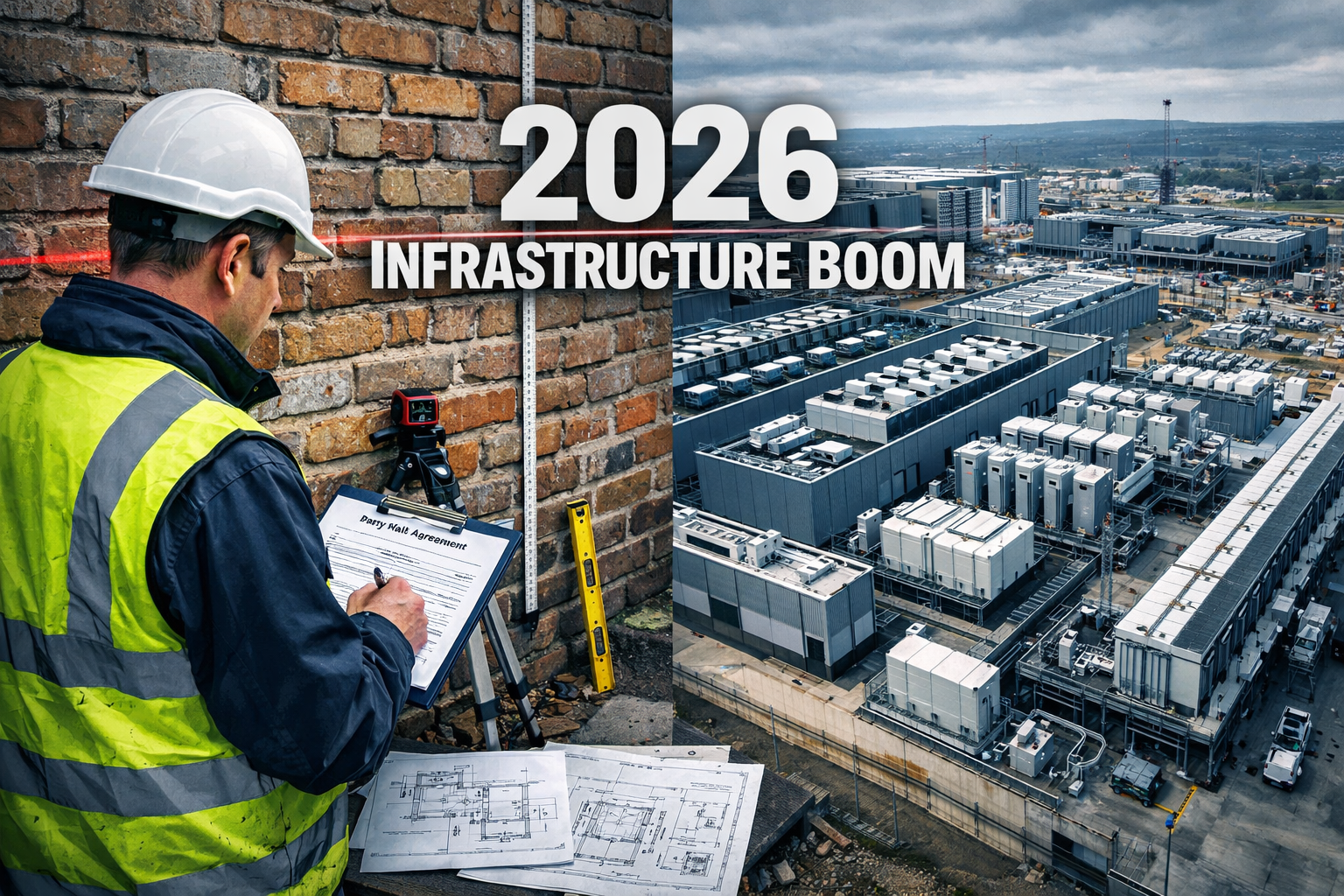
The Northern England Data Center Explosion
Northern England has become the epicenter of the UK's data center expansion in 2026. The region offers compelling advantages: lower land costs, available grid capacity, and cooler ambient temperatures that reduce cooling expenses[3]. Cities like Manchester, Leeds, and Newcastle are witnessing a construction frenzy as hyperscale operators and colocation providers scramble to establish presence before prime sites disappear.
This rapid development creates a perfect storm for party wall complications. Unlike greenfield sites in rural areas, many Northern England data centers are being constructed in industrial parks and former manufacturing zones where property boundaries are tightly packed. Adjacent property owners—ranging from logistics companies to commercial warehouses—suddenly find themselves neighbors to facilities requiring massive foundations, continuous vibration from cooling systems, and round-the-clock construction schedules.
The Party Wall Act 1996 applies to England and Wales, making it a critical consideration for all Northern England developments. However, many data center developers, accustomed to building on isolated campuses, lack experience with party wall agreements and the surveying processes they require.
What Makes Data Center Party Wall Surveys Unique?
Data centers present surveying challenges that differ dramatically from residential or traditional commercial developments:
Foundation Depth and Load Requirements
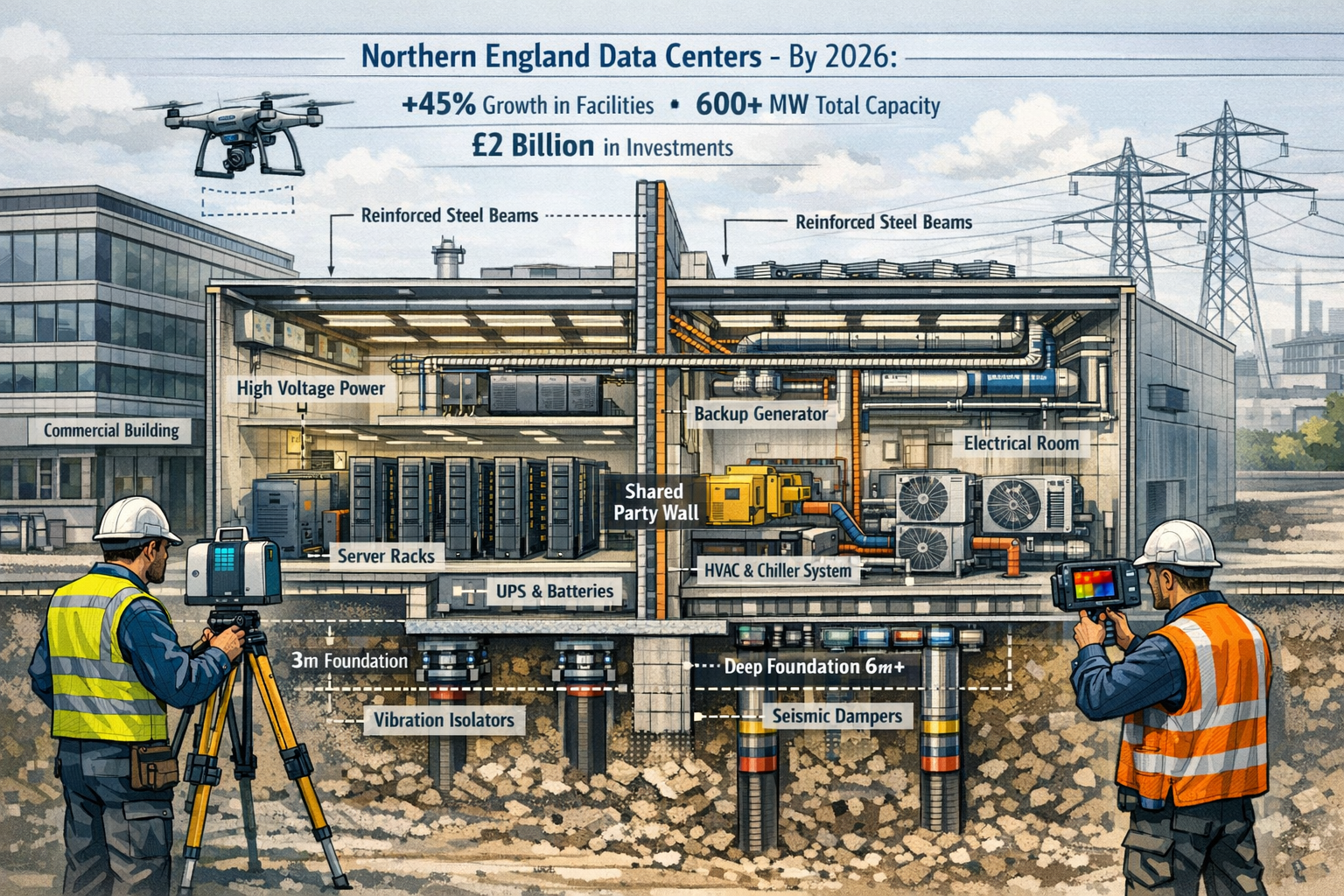
Modern data centers require foundations capable of supporting extraordinary loads. Server racks, UPS systems, and cooling infrastructure create concentrated weight distributions that necessitate deep foundations—often extending 3-5 meters below grade. When these foundations approach or cross party wall boundaries, surveyors must carefully assess potential impacts on neighboring structures.
Vibration and Structural Movement
Unlike static office buildings, data centers house equipment that generates continuous vibration. Diesel generators, HVAC systems, and cooling towers operate 24/7, creating persistent structural stresses. Party wall surveyors must establish baseline conditions through detailed building surveys and implement ongoing monitoring protocols to detect any movement or damage to adjoining properties.
Electrical and Mechanical Penetrations
Data centers require substantial electrical infrastructure, often including substations and transformer yards. When these systems must be positioned near party walls, surveyors face complex challenges around electromagnetic interference, fire safety, and structural integrity. Understanding your party wall rights becomes crucial when negotiating these installations.
Accelerated Construction Timelines
The 2026 infrastructure boom operates on compressed schedules driven by market demand and power availability windows[1]. Developers cannot afford months-long delays waiting for party wall disputes to resolve. This pressure creates tension between proper surveying protocols and commercial imperatives.
Regional Planning Policy Shifts Affecting Party Wall Matters
The UK government's designation of data centers as Critical National Infrastructure in 2024[1] has created both opportunities and complications for party wall surveying in Northern England. While this status streamlines certain planning approvals, it doesn't exempt developers from Party Wall Act obligations.
Recent planning policy changes emphasize carbon resilience and water sustainability[1][4], adding layers of complexity to party wall considerations. When data centers install rainwater harvesting systems or ground-source cooling that extends beneath party walls, surveyors must address both environmental compliance and neighboring property rights.
Local authorities in Northern England are developing specific guidance for data center developments, but party wall procedures remain governed by the 1996 Act and established case law. This creates a dual-track approval process where developers must simultaneously navigate planning permission and party wall awards.
Critical Party Wall Surveying Considerations for 2026 Data Center Projects
Pre-Construction Assessment and Notice Requirements
Successful party wall management begins long before ground breaking. Data center developers must conduct thorough boundary surveys and title searches to identify all potentially affected neighboring properties. In Northern England's industrial zones, this often reveals complex ownership structures with multiple stakeholders.
The Party Wall Act requires serving notices for three types of work:
- New building work on or astride the boundary line (Section 1)
- Work to existing party walls (Section 2)
- Excavation within 3-6 meters of neighboring structures (Section 6)
Data center projects frequently trigger all three categories simultaneously. Excavation for foundations, installation of boundary walls for security, and modifications to existing structures all require proper notices. Understanding when you need a party wall surveyor helps developers avoid costly mistakes.
Notice Timing Considerations
The Act requires serving notices at least two months before starting work for most activities, or one month for excavations. However, prudent developers in the 2026 boom are serving notices much earlier—often 4-6 months in advance—to allow time for:
- Neighboring owners to appoint surveyors
- Condition surveys of adjacent properties
- Negotiation of party wall awards
- Resolution of any disputes through the surveying process
This extended timeline conflicts with the rapid deployment schedules that characterize 2026 data center development, creating significant project management challenges.
Appointing Qualified Party Wall Surveyors
Not all chartered surveyors possess the specialized knowledge required for data center party wall matters. The ideal surveyor combines:
- Deep understanding of the Party Wall Act 1996 and relevant case law
- Technical knowledge of data center construction including MEP systems, structural requirements, and operational characteristics
- Experience with industrial and commercial properties rather than just residential work
- Local knowledge of Northern England building practices and geological conditions
Many developers make the mistake of appointing residential-focused surveyors who lack experience with the scale and complexity of data center projects. This often leads to inadequate awards that fail to address critical issues, resulting in disputes during construction.
The cost of party wall surveyors varies significantly based on project complexity. For major data center developments, budgeting £5,000-£15,000 for comprehensive surveying services is reasonable—a small fraction of potential delay costs.
The Party Wall Award: Essential Protections
The party wall award is the legally binding document that governs construction activities affecting shared boundaries. For data center projects, awards must address specific technical considerations:
Structural Protection Measures
Awards should specify:
- Maximum allowable vibration levels during construction
- Foundation design requirements to prevent subsidence
- Underpinning procedures if needed
- Temporary support systems for adjacent structures
- Monitoring protocols with defined trigger points
Access Rights and Restrictions
Data center construction often requires temporary access to neighboring properties for:
- Installing monitoring equipment
- Conducting inspections
- Emergency repairs
- Equipment delivery and positioning
Awards must clearly define these access rights while protecting neighboring owners' operational continuity. For industrial neighbors, even brief access restrictions can cause significant business disruption.
Condition Surveys and Photographic Records
Comprehensive pre-construction condition surveys protect both parties. For data center projects, these surveys should document:
- Structural condition of party walls and adjacent structures
- Existing cracks, settlement, or defects
- Baseline vibration and noise levels
- Photographic evidence of current conditions
- Any pre-existing damage or deterioration
This documentation becomes critical if disputes arise about construction-related damage. Party wall awards that lack detailed condition surveys create significant liability exposure.
Common Disputes and Resolution Strategies
Despite careful planning, party wall disputes frequently emerge during data center construction. Understanding common flashpoints helps surveyors develop proactive solutions:
Vibration and Noise Complaints
Data center construction generates substantial vibration from piling, excavation, and equipment installation. Even when vibration levels remain within award specifications, neighboring owners may raise concerns about:
- Cosmetic cracking in adjacent buildings
- Disruption to sensitive operations (laboratories, precision manufacturing)
- Perceived structural damage
- Noise affecting neighboring businesses
Resolution Strategy: Implement continuous vibration monitoring with real-time data sharing. Establish clear communication protocols and regular liaison meetings. Consider temporary operational adjustments for neighbors during critical construction phases.
Foundation Work and Subsidence Concerns
Deep excavations for data center foundations can affect groundwater levels and soil stability. Neighboring property owners legitimately worry about:
- Settlement of their foundations
- Groundwater infiltration
- Soil movement affecting structural integrity
- Long-term stability issues
Resolution Strategy: Conduct detailed geotechnical surveys before construction. Install groundwater monitoring wells. Use underpinning or soil stabilization techniques where needed. Provide regular updates on excavation progress and monitoring results.
Access and Operational Disruption
Industrial neighbors facing their own tight deadlines may resist access requests or construction activities that affect their operations. Common conflicts include:
- Blocked access routes during deliveries
- Crane oversailing without proper permissions
- Dust and debris affecting sensitive processes
- Construction traffic disrupting logistics operations
Resolution Strategy: Develop detailed construction logistics plans shared in advance. Coordinate activities around neighbors' critical operations. Offer compensation for genuine operational impacts. Maintain open communication channels with neighboring facility managers.
Navigating the 2026 Infrastructure Boom: Practical Guidance for Stakeholders
For Data Center Developers and Operators
The unprecedented pace of Northern England's 2026 data center expansion demands a strategic approach to party wall management:
Early Stakeholder Engagement
Begin party wall discussions during site selection, not after land acquisition. Conduct preliminary boundary surveys and identify potential neighboring property concerns. Early engagement allows:
- Realistic timeline planning
- Budget allocation for surveying and potential compensation
- Site layout optimization to minimize party wall impacts
- Relationship building with neighboring owners
Integrated Project Planning
Party wall procedures should integrate seamlessly with overall project timelines. Create detailed Gantt charts showing:
- Notice serving deadlines
- Survey appointment windows
- Award negotiation periods
- Construction activity dependencies
- Contingency buffers for disputes
Many developers treating party wall matters as administrative checkboxes discover too late that unresolved disputes can halt entire projects.
Specialist Team Assembly
Assemble a project team with relevant expertise:
- Party wall surveyors experienced with industrial/commercial properties
- Structural engineers familiar with data center requirements
- Legal advisors versed in Party Wall Act case law
- Construction managers skilled in neighbor liaison
- Environmental consultants for vibration and noise assessment
This multi-disciplinary approach prevents siloed decision-making that creates party wall complications.
Risk Mitigation and Insurance
Despite careful planning, party wall disputes can escalate. Ensure adequate insurance coverage for:
- Professional indemnity for appointed surveyors
- Construction all-risks policies covering neighboring property damage
- Business interruption insurance for construction delays
- Legal expenses for dispute resolution
Review policy exclusions carefully—some insurers exclude party wall disputes or impose specific notification requirements.
For Neighboring Property Owners
If you own property adjacent to a planned data center development in Northern England, understanding your rights and options is crucial:
Responding to Party Wall Notices
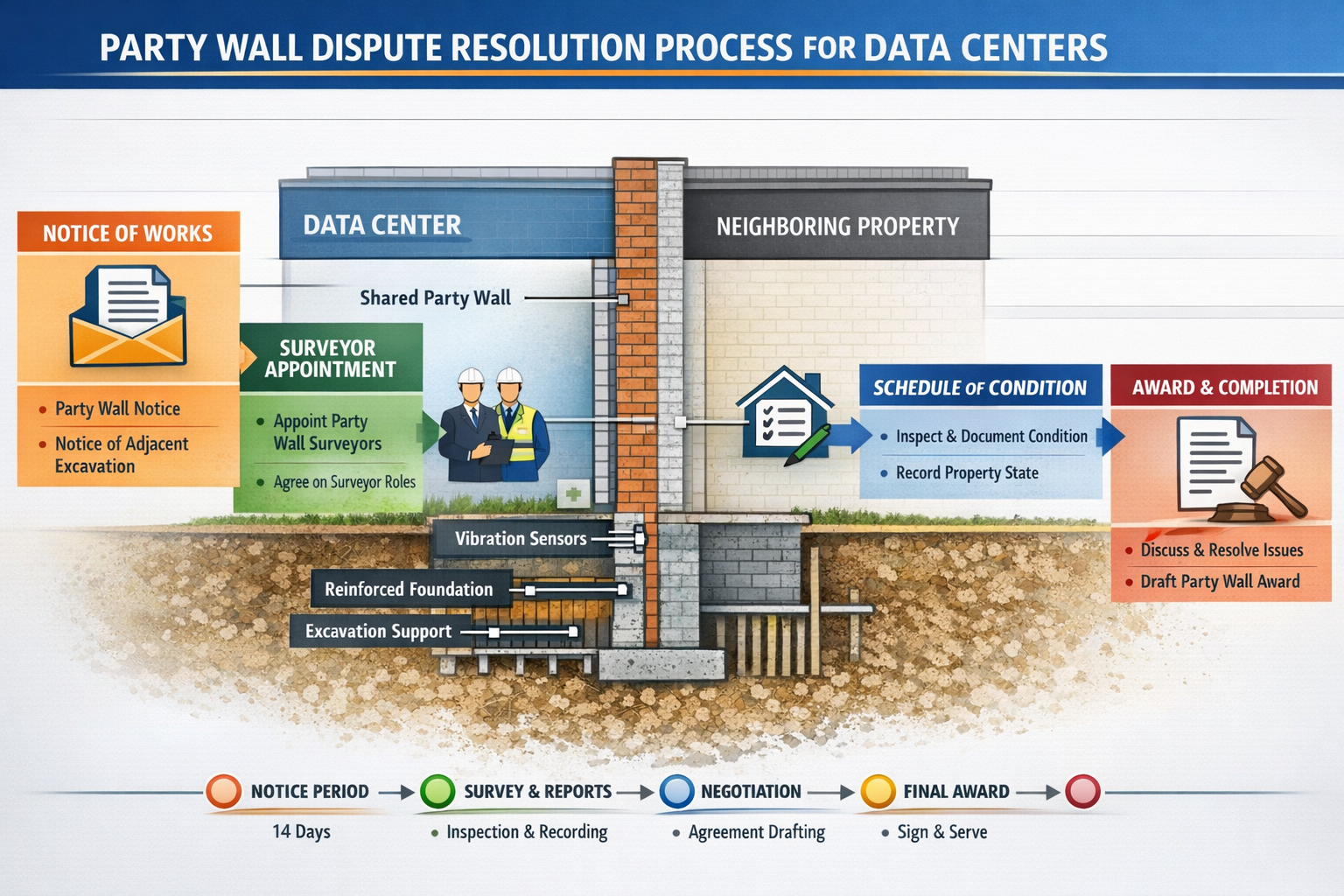
Upon receiving a party wall notice, you have 14 days to respond in writing. Your options include:
- Consent to the proposed work (ending the party wall procedure)
- Dissent or fail to respond (triggering the surveying process)
- Consent with conditions (though this still typically triggers surveying)
Most property advisors recommend dissenting or remaining silent to ensure proper surveying protection, even if you don't oppose the work. This ensures:
- Professional assessment of potential impacts
- Detailed condition surveys protecting your interests
- Formal award documenting protections and remedies
- Independent expert oversight throughout construction
Appointing Your Surveyor
You can either:
- Appoint your own surveyor (the "building owner's surveyor")
- Agree to a single "agreed surveyor" acting for both parties
While agreed surveyors reduce costs, appointing your own surveyor provides stronger advocacy for your interests. For major data center projects, the additional protection justifies the expense—and the developer typically pays surveyor fees under the Act.
Choose a surveyor with:
- Relevant industrial/commercial experience
- Understanding of data center construction impacts
- Strong negotiation skills
- Local knowledge of Northern England conditions
Don't hesitate to ask important questions during the surveying process to ensure your interests receive proper protection.
Protecting Your Business Operations
If your adjacent property houses active business operations, the party wall award should address:
- Construction timing to minimize operational disruption
- Access restrictions protecting your security and workflow
- Vibration limits appropriate for your equipment/processes
- Compensation provisions for demonstrable business losses
- Emergency protocols if construction creates urgent issues
Document your operational requirements clearly and provide them to your surveyor for incorporation into award negotiations.
Long-Term Considerations
Data centers operate 24/7 for decades. Beyond construction impacts, consider:
- Ongoing noise from cooling systems and generators
- Light pollution from security lighting
- Traffic from maintenance and staff
- Future expansion plans
- Property value impacts
While the Party Wall Act primarily addresses construction activities, the award can include provisions for ongoing monitoring and future work notifications.
For Party Wall Surveyors and Construction Professionals
Surveyors working on Northern England data center projects in 2026 face unique professional challenges requiring specialized approaches:
Technical Knowledge Requirements
Effective data center party wall surveying demands understanding:
- Structural systems: Raised floors, heavy equipment loads, seismic bracing
- MEP infrastructure: Electrical distribution, cooling systems, backup power
- Operational requirements: Uptime expectations, redundancy needs, maintenance access
- Construction methodologies: Modular deployment, fast-track schedules, specialized trades
Invest in continuing professional development focused on data center and industrial construction. Site visits to operating facilities provide invaluable context for assessing proposed work impacts.
Award Drafting Best Practices
Data center party wall awards should include:
Detailed Work Descriptions
- Specific foundation types, depths, and locations
- Excavation methodologies and sequencing
- Structural connection details at party walls
- MEP penetrations and installations
- Construction phasing and timelines
Comprehensive Monitoring Protocols
- Vibration monitoring locations and frequency
- Crack monitoring methodologies
- Settlement monitoring for adjacent structures
- Trigger levels requiring work cessation
- Reporting procedures and escalation paths
Clear Remediation Procedures
- Responsibility allocation for different damage types
- Repair standards and methodologies
- Timing requirements for remedial work
- Dispute resolution procedures
- Financial security provisions
Specific Technical Provisions
- Underpinning requirements if needed
- Temporary works and shoring systems
- Party wall construction details
- Fire resistance requirements
- Acoustic separation measures
Vague or incomplete awards create disputes. Invest time in thorough drafting to prevent construction delays and professional liability claims.
Managing Compressed Timelines
The 2026 infrastructure boom creates pressure for rapid award completion. Resist shortcuts that compromise thoroughness:
- Conduct comprehensive condition surveys even under time pressure
- Insist on adequate investigation before finalizing awards
- Document all assumptions and limitations clearly
- Communicate realistic timelines to all parties
- Build contingency periods into project schedules
Your professional reputation and potential liability depend on thorough work, regardless of developer pressure.
Continuing Monitoring and Dispute Resolution
Party wall surveyors' responsibilities extend throughout construction. Establish clear protocols for:
- Regular site inspections at critical construction phases
- Prompt response to neighbor concerns or complaints
- Objective assessment of alleged damage or impacts
- Mediation between parties when disputes arise
- Documentation of all decisions and communications
Many disputes arise from poor communication rather than actual construction defects. Proactive liaison and transparent information sharing prevent escalation.
Future-Proofing Party Wall Practices for Continued Data Center Growth
Emerging Challenges in 2026 and Beyond
The Northern England data center boom shows no signs of slowing. Industry forecasts predict continued surge in demand through 2026 and beyond[2][3], driven by artificial intelligence, cloud computing, and digital transformation. This sustained growth creates evolving party wall challenges:
Increased Retrofit and Expansion Projects
As initial data center facilities reach capacity, operators will pursue expansions and retrofits. These projects often present more complex party wall issues than greenfield construction:
- Working around live operations with strict uptime requirements
- Modifications to existing party wall structures
- Phased construction with multiple notice periods
- Coordination with ongoing facility operations
Higher Density and Deeper Foundations
Next-generation data centers pack more computing power into smaller footprints, requiring:
- Heavier structural loads necessitating deeper foundations
- More extensive excavation near party boundaries
- Increased cooling infrastructure with greater vibration potential
- Higher electrical capacity installations
Sustainability Requirements
Growing emphasis on carbon reduction and water conservation[1][4] drives adoption of technologies with party wall implications:
- Ground-source cooling systems extending beneath boundaries
- Rainwater harvesting with underground storage
- Solar panel installations on party walls
- Green roofs requiring structural modifications
Party wall surveyors must develop expertise in these emerging technologies and their boundary implications.
Technology and Innovation in Party Wall Surveying
Modern surveying technology offers powerful tools for managing data center party wall challenges:
3D Laser Scanning and Digital Twins
Advanced drone surveys and laser scanning create detailed digital models of existing conditions. Benefits include:
- Precise measurement of party wall positions and conditions
- Baseline documentation for future comparison
- Virtual inspection capabilities reducing site visits
- Enhanced communication through visual models
- Integration with BIM for construction coordination
Real-Time Monitoring Systems
IoT sensors enable continuous monitoring of:
- Vibration levels at multiple locations
- Crack propagation and structural movement
- Groundwater levels and soil conditions
- Temperature and humidity affecting structures
- Noise levels impacting neighbors
Cloud-based dashboards provide all stakeholders with transparent access to monitoring data, building trust and enabling rapid response to emerging issues.
Digital Award Management
Cloud-based platforms streamline party wall administration:
- Electronic notice serving with delivery confirmation
- Digital signature and approval workflows
- Centralized document repositories
- Automated compliance tracking
- Integration with project management systems
These tools reduce administrative burden while improving record-keeping and compliance.
Regulatory and Legal Developments
The intersection of Critical National Infrastructure designation[1] and party wall law continues evolving. Potential developments surveyors should monitor:
Streamlined Procedures for CNI Projects
Government may introduce expedited party wall procedures for designated Critical National Infrastructure, balancing rapid deployment needs against neighboring property rights. Surveyors should engage with industry consultations shaping these policies.
Enhanced Environmental Requirements
Increasing focus on sustainability may create additional party wall considerations around:
- Carbon impact assessments for construction activities
- Water usage and drainage affecting neighboring properties
- Biodiversity net gain requirements
- Circular economy and material reuse
Case Law Evolution
Data center party wall disputes will generate case law clarifying Act application to modern infrastructure. Key areas likely to see litigation include:
- Appropriate vibration and noise standards for industrial neighbors
- Compensation methodologies for business disruption
- Scope of "necessary" work under the Act
- Surveyor liability for inadequate awards
Staying current with legal developments through professional organizations and continuing education is essential.
Conclusion: Navigating Party Wall Challenges in Northern England's Data Center Future
The convergence of Northern England's 2026 infrastructure boom and established party wall law creates both challenges and opportunities. Data center developers must recognize that party wall compliance isn't merely a procedural hurdle but a critical success factor requiring early attention, specialist expertise, and adequate resources. The costs of proper party wall management pale compared to construction delays, litigation expenses, and reputational damage from neighbor disputes.
Neighboring property owners should view party wall procedures as essential protections, not obstacles. Engaging qualified surveyors and actively participating in the award process safeguards both property interests and business operations. The Party Wall Act provides robust protections—but only when properly invoked and diligently administered.
Party wall surveyors face unprecedented demand for their services as Northern England's data center sector expands. This opportunity carries professional responsibility to develop specialized knowledge, maintain rigorous standards, and balance competing stakeholder interests fairly. The quality of surveying work performed in 2026 will shape industry practices and legal precedents for years to come.
Actionable Next Steps
For Developers Planning Data Center Projects:
- Conduct boundary surveys immediately upon site identification, before finalizing acquisitions
- Engage party wall surveyors during design development, not just before construction
- Build 4-6 month party wall timelines into project schedules with contingency buffers
- Establish neighbor liaison protocols with dedicated communication resources
- Budget adequately for surveying, monitoring, and potential compensation
- Review insurance coverage ensuring party wall risks receive proper attention
For Property Owners Receiving Party Wall Notices:
- Respond within 14 days to preserve your rights under the Act
- Appoint a qualified surveyor with relevant industrial/commercial experience
- Document existing conditions through photographs and written descriptions
- Communicate operational requirements clearly to your surveyor
- Understand common misconceptions about party wall agreements to make informed decisions
- Maintain records of all correspondence and survey documents
For Surveyors and Construction Professionals:
- Develop specialized data center knowledge through site visits and technical training
- Invest in modern surveying technology including 3D scanning and monitoring systems
- Create comprehensive award templates addressing data center-specific issues
- Build professional networks with data center specialists and local authorities
- Stay current on regulatory developments affecting Critical National Infrastructure
- Maintain professional indemnity insurance with adequate coverage limits
The Party Wall Challenges in Northern England Data Centers: Surveying for 2026 Infrastructure Boom represent a defining moment for the industry. Those who approach these challenges with foresight, expertise, and professionalism will not only navigate successfully but establish best practices shaping the sector's future. The digital infrastructure powering tomorrow's economy depends on getting party wall matters right today. 🏗️⚡
References
[1] Planning For Data Centres In 2026 Whats Changed And What Will Matter Most – https://pwaplanning.co.uk/planning-for-data-centres-in-2026-whats-changed-and-what-will-matter-most/
[2] 2026 Data Centre Trends – https://www.onnecgroup.com/2025/12/04/2026-data-centre-trends/
[3] Data Centre Demand Expected To Surge In 2026 – https://www.placeyorkshire.co.uk/data-centre-demand-expected-to-surge-in-2026/
[4] Building The Future Facing The Neighbours Gigawatt Data Centres In 2026 – https://digitalisationworld.com/blogs/58653/building-the-future-facing-the-neighbours-gigawatt-data-centres-in-2026