

}
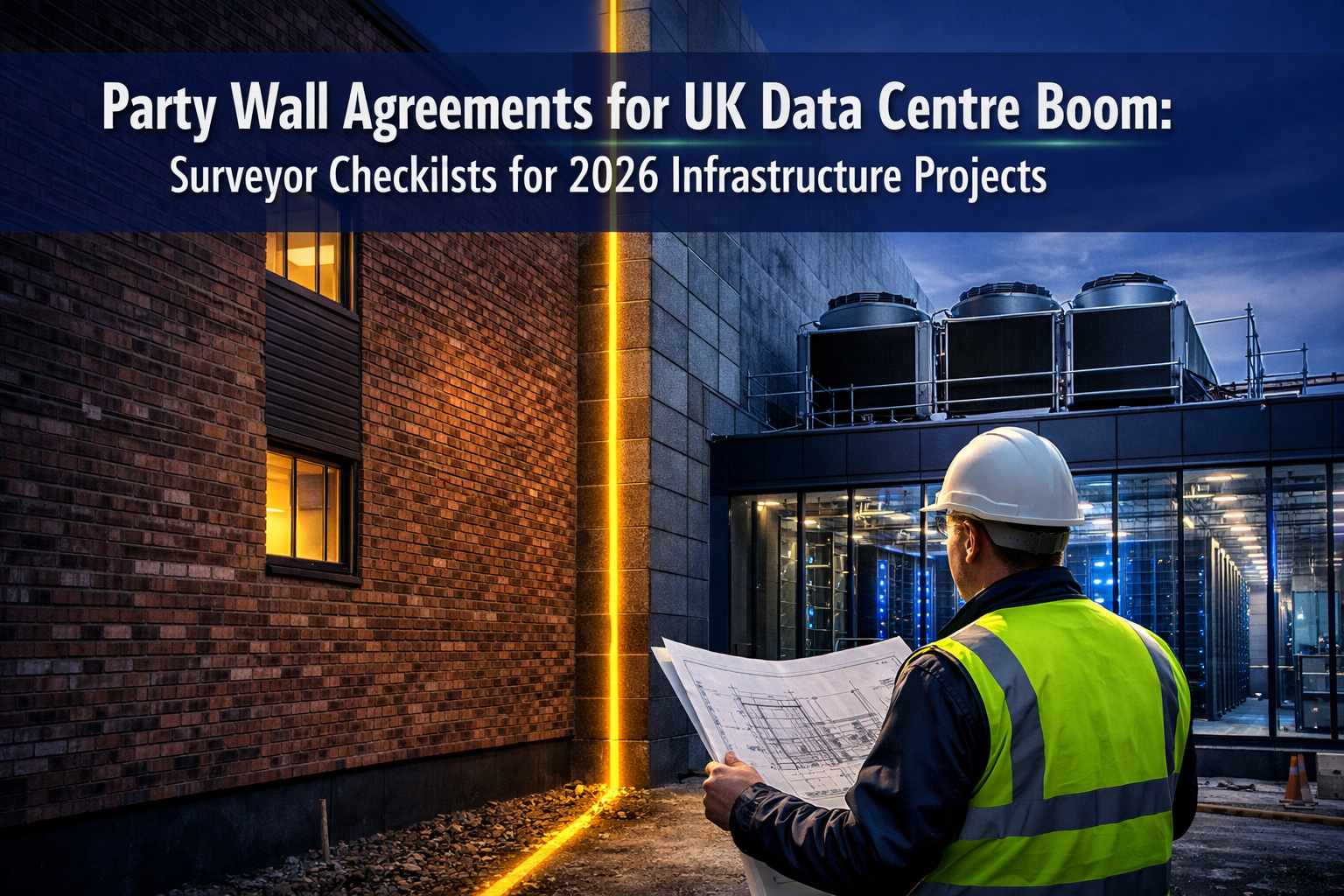
The UK's data centre sector is experiencing unprecedented growth in 2026, driven by artificial intelligence demands and data residency mandates. As developers race to construct cutting-edge facilities across London, Manchester, and emerging tech hubs, party wall agreements have become critical bottlenecks that can delay multi-million-pound projects by months. Understanding the intersection of the Party Wall etc. Act 1996 and modern data centre requirements is no longer optional—it's essential for surveyors, developers, and infrastructure investors navigating this high-stakes landscape.
Party Wall Agreements for UK Data Centre Boom: Surveyor Checklists for 2026 Infrastructure Projects represent a specialized field where traditional construction law meets the unique demands of mission-critical infrastructure. With fortress-grade security requirements, 24/7 operational needs, and technology-proofing clauses becoming standard[2], surveyors must adapt their approach to accommodate these sophisticated facilities.
Key Takeaways
- 🏗️ Data centre party wall agreements require specialized assessments covering electrical loads, cooling infrastructure, vibration thresholds, and security perimeters beyond standard construction projects
- ⚖️ Early engagement prevents costly delays: Serving party wall notices 1-2 months before work begins is crucial for time-sensitive data centre deployments driven by AI demand
- 📋 RICS-compliant checklists must address unique factors including 24/7 operational continuity, emergency egress routes, and multi-layered security zones
- 🔧 Technology-proofing clauses in party wall awards protect future infrastructure upgrades like direct-to-chip liquid cooling systems[2]
- 🤝 Third surveyor appointments provide essential dispute resolution mechanisms for high-value projects where downtime costs exceed £100,000 per hour
Understanding the Party Wall Act 1996 in Data Centre Context
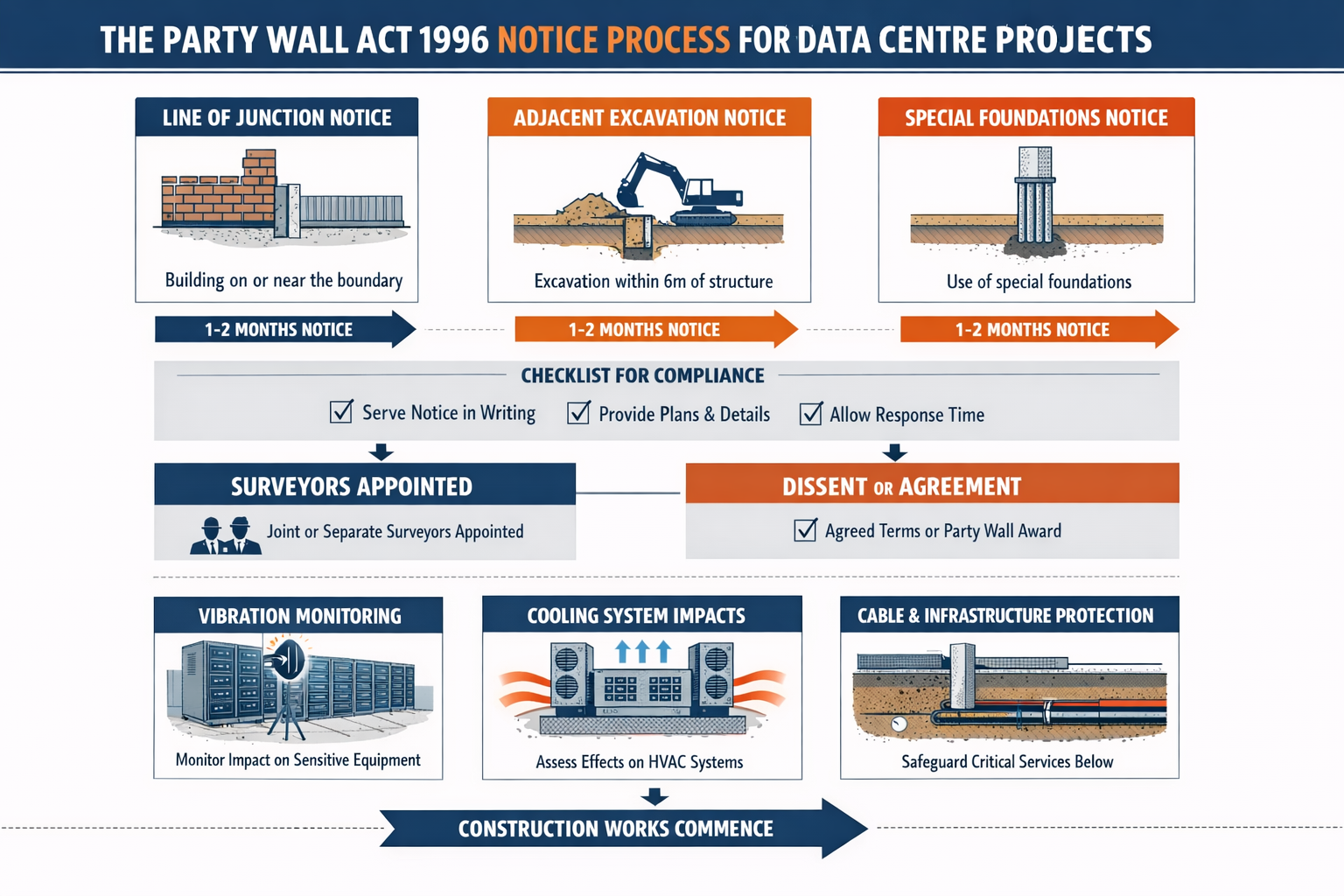
The Party Wall etc. Act 1996 governs construction work on shared walls, boundaries, and excavations near neighbouring properties across England and Wales. For data centre developments, this legislation takes on heightened significance due to the critical infrastructure designation many facilities receive.
Core Notice Requirements for Data Centre Projects
Three primary notice types apply to data centre construction:
Line of Junction Notices (Section 1) cover new walls built on boundary lines—common when data centres expand onto adjacent parcels. These require at least one month's notice before work commences.
Party Structure Notices (Section 2) address work on existing shared walls, including underpinning, raising walls, or cutting into party walls for service penetrations. Data centres frequently require these when installing high-capacity electrical conduits or cooling pipes through shared structures. Two months' notice is mandatory.
Adjacent Excavation Notices (Section 6) become critical when data centres require deep foundations for heavy server loads or underground cooling systems. Any excavation within 3 metres of a neighbouring building's foundation, or within 6 metres if deeper than the neighbour's foundation, triggers notice requirements.
"Data residency mandates ensuring EU and UK personal data remains within domestic facilities are driving unprecedented construction activity, making party wall compliance more complex than ever."[2]
Professional party wall services help navigate these requirements efficiently, particularly when multiple notices apply to a single project.
Data Centre-Specific Complications
Unlike residential developments, data centres present unique challenges:
- Continuous operation requirements mean construction phasing must avoid disrupting existing facilities
- Security clearances may restrict surveyor access to certain areas during inspections
- Electromagnetic interference from construction equipment can affect sensitive server operations
- Vibration thresholds are significantly lower than standard construction tolerances
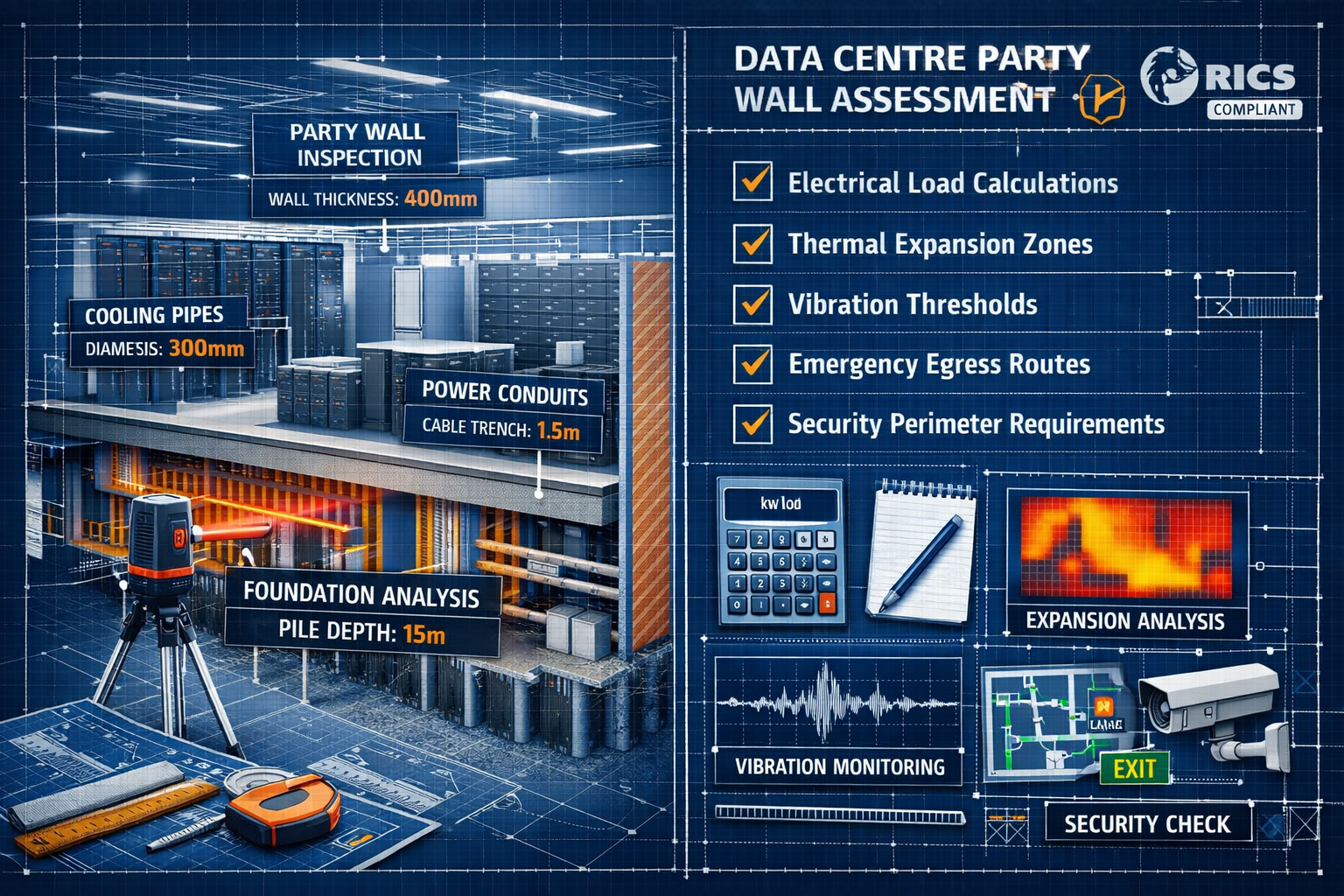
RICS-Compliant Surveyor Checklists for 2026 Data Centre Assessments
Party Wall Agreements for UK Data Centre Boom: Surveyor Checklists for 2026 Infrastructure Projects demand comprehensive pre-construction assessments that go far beyond traditional schedule of condition reports.
Structural Assessment Checklist
Foundation Analysis:
- ✅ Soil bearing capacity calculations for server rack loads (typically 1,500-2,000 kg/m²)
- ✅ Groundwater table assessment for below-grade cooling systems
- ✅ Vibration isolation requirements for adjacent precision equipment
- ✅ Differential settlement risk between existing and new structures
- ✅ Pile cap design compatibility with neighbouring foundations
Wall Integrity Evaluation:
- ✅ Load-bearing capacity for additional storeys or equipment platforms
- ✅ Fire resistance ratings (minimum 2-hour rating for data centre compartmentation)
- ✅ Acoustic insulation requirements (critical for diesel generator enclosures)
- ✅ Moisture barrier effectiveness to protect against cooling system condensation
- ✅ Existing service penetrations that may compromise structural integrity
Understanding party wall rights helps building owners protect their interests during these assessments.
Mechanical and Electrical Infrastructure Checklist
Data centres in 2026 consume unprecedented power densities, with AI-focused facilities reaching 100-150 kW per rack. Surveyors must evaluate:
Electrical Load Considerations:
- ✅ Cable routing paths through party walls (fire-stopping requirements)
- ✅ Electromagnetic field impact on neighbouring properties
- ✅ Emergency generator exhaust and fuel storage proximity to boundaries
- ✅ Uninterruptible Power Supply (UPS) battery room ventilation requirements
- ✅ Busbar trunking systems and their structural support needs
Cooling System Integration:
- ✅ Chiller plant vibration transmission through shared structures
- ✅ Cooling pipe penetrations and condensation management
- ✅ Direct-to-chip liquid cooling infrastructure provisions[2]
- ✅ Free cooling economizer airflow paths
- ✅ Heat rejection equipment noise levels at party wall boundaries
Security and Access Control Assessment
The enhanced security requirements for 2026 data centres[2] create unique party wall considerations:
Multi-Layered Security Zones:
- ✅ Perimeter fencing setback distances from party boundaries
- ✅ Anti-climb measures that don't encroach on neighbouring airspace
- ✅ Biometric access point locations relative to shared walls
- ✅ CCTV camera fields of view and privacy implications
- ✅ Vehicle barriers and their foundation impact on party structures
Emergency Egress Compliance:
- ✅ Fire escape routes that may require rights of way across boundaries
- ✅ Emergency vehicle access compatibility with party wall works
- ✅ Smoke ventilation systems and their impact on adjacent properties
- ✅ Refuge area locations in multi-storey facilities
| Assessment Category | Standard Construction | Data Centre Requirements |
|---|---|---|
| Vibration Limits | 5-10 mm/s PPV | 0.5-2 mm/s PPV (server areas) |
| Noise Thresholds | 70 dB(A) daytime | 45 dB(A) continuous (cooling) |
| Fire Ratings | 1 hour typical | 2-4 hours compartmentation |
| Floor Loading | 250-500 kg/m² | 1,500-2,000 kg/m² |
| Power Density | 50-100 W/m² | 10,000-15,000 W/m² |
Party Wall Notice Procedures and Timeline Management
Time is money in data centre construction, where delays can cost developers £50,000-£100,000 per day in lost revenue and contractual penalties. Efficient party wall notice procedures are essential.
Strategic Notice Timing for Multi-Site Deployments
The growing use of Master Services Agreement (MSA) structures for multi-site data centre deployments[2] requires coordinated party wall strategies across multiple locations. Consider:
Parallel Processing Approach:
- Serve notices simultaneously across all sites in a regional cluster
- Appoint the same surveying team for consistency
- Negotiate standard award templates for repeated building types
- Build party wall timelines into critical path project schedules
Phased Development Coordination:
- Structure notices to accommodate modular data hall construction
- Allow for future expansion rights in initial awards
- Include technology-proofing clauses for infrastructure upgrades[2]
- Establish ongoing access protocols for maintenance
Dispute Resolution Mechanisms
When neighbours disagree with proposed works, the Party Wall Act provides a structured resolution process. For high-stakes data centre projects, understanding these mechanisms prevents catastrophic delays.
Surveyor Appointment Protocols:
- Agreed Surveyor Route: Both parties appoint a single surveyor (fastest option)
- Two Surveyor Route: Each party appoints their own surveyor, who jointly prepare the award
- Third Surveyor Appointment: When party-appointed surveyors disagree, a third surveyor makes binding decisions
Data centre projects increasingly require the two or three surveyor approach due to the technical complexity and financial stakes involved. Specialist knowledge of critical infrastructure is essential—general building surveyors may lack the expertise to assess cooling system impacts or power density implications.
For complex disputes, professional guidance on party wall disputes can prevent escalation and maintain project momentum.
Award Documentation for Critical Infrastructure
Party wall awards for data centre projects must address unique provisions:
Operational Continuity Clauses:
- Working hours restrictions during live facility operations
- Vibration monitoring protocols with automatic work-stop triggers
- Emergency contact procedures for 24/7 facility management teams
- Compensation mechanisms for service interruptions
Future-Proofing Provisions:
- Rights to install additional cooling infrastructure
- Allowances for power capacity upgrades
- Provisions for emerging technologies (quantum computing cooling, etc.)
- Review mechanisms for changing security requirements
Financial Securities:
- Performance bonds reflecting project values (often £50M-£500M)
- Professional indemnity insurance minimums (typically £10M+)
- Escrow arrangements for remediation works
- Indexation clauses for long-term maintenance obligations
"Technology-proofing clauses allowing future infrastructure upgrades such as direct-to-chip liquid cooling are becoming standard in 2026 data centre agreements."[2]
Regulatory Compliance and Building Safety Considerations
The UK's evolving construction regulatory landscape adds complexity to party wall agreements for data centre projects in 2026.
Building Safety Act Integration
The Building Safety Act and the proposed single construction regulator[4] create new compliance layers for high-risk buildings. While most data centres don't meet the 18-metre height threshold for Higher-Risk Buildings, their critical infrastructure status may trigger enhanced scrutiny.
Gateway Process Alignment:
- Gateway 1 (Planning): Early party wall engagement during design development
- Gateway 2 (Pre-construction): Party wall awards completed before Building Control approval
- Gateway 3 (Completion): Final party wall condition surveys before occupation
Golden Thread Documentation:
- Digital records of all party wall notices and awards
- As-built drawings showing actual party wall construction details
- Ongoing maintenance records for shared structures
- Change management documentation for infrastructure upgrades
Environmental and Sustainability Requirements
Modern data centres face stringent environmental regulations that intersect with party wall considerations:
Energy Efficiency Obligations:
- Heat recovery systems that may affect party wall thermal performance
- Renewable energy installations (solar panels, wind turbines) on shared roofs
- Battery energy storage systems and their fire safety implications
- Power Usage Effectiveness (PUE) optimization affecting building services
Water Management:
- Rainwater harvesting systems for cooling towers
- Greywater recycling infrastructure
- Flood risk mitigation measures at boundaries
- Sustainable drainage systems (SuDS) affecting party wall foundations
Surveyors should coordinate party wall assessments with broader building survey requirements to ensure comprehensive compliance.
Risk Mitigation Strategies for High-Value Projects
Party Wall Agreements for UK Data Centre Boom: Surveyor Checklists for 2026 Infrastructure Projects must incorporate robust risk management approaches given the financial stakes involved.
Insurance and Liability Frameworks
Professional Indemnity Coverage:
- Minimum £10M coverage for surveyors working on major data centre projects
- Run-off cover for long-term latent defect periods (typically 12 years)
- Cyber liability insurance for digital documentation breaches
- Pollution liability for cooling system leaks or generator fuel spills
Project-Specific Protections:
- Joint Names insurance policies covering all parties to the award
- Contractors' All Risks (CAR) policies with party wall endorsements
- Decennial insurance for structural elements affecting shared walls
- Business interruption coverage for operational data centres
Monitoring and Verification Protocols
Advanced monitoring technology enables real-time party wall compliance verification:
Automated Monitoring Systems:
- Vibration sensors with cloud-based alerting (threshold: 0.5 mm/s for server areas)
- Crack width monitoring using digital gauges (0.01mm precision)
- Tilt meters for foundation settlement tracking
- Dust and noise monitoring at party boundaries
Inspection Schedules:
- Pre-commencement condition surveys with photographic/video documentation
- Weekly inspections during critical phases (excavation, underpinning)
- Monthly reviews during standard construction periods
- Post-completion verification surveys
- Annual maintenance inspections for ongoing obligations
Contractual Integration with Construction Agreements
Party wall awards must align with main construction contracts:
JCT/NEC Contract Coordination:
- Party wall obligations incorporated into contractor scope
- Delay events and compensation event definitions
- Insurance requirements cross-referenced
- Dispute resolution procedures harmonized
Design and Build Implications:
- Contractor responsibility for obtaining party wall consents
- Employer's requirements specifying party wall standards
- Novation of surveyor appointments at contract award
- Performance specifications for party wall works
For projects requiring broader oversight, project management services can coordinate party wall compliance with overall delivery.
Case Study Applications and Practical Examples
Real-world scenarios illustrate how Party Wall Agreements for UK Data Centre Boom: Surveyor Checklists for 2026 Infrastructure Projects function in practice.
London Docklands Hyperscale Facility
A major cloud provider's 50MW hyperscale data centre in East London required excavation to 15 metres depth for underground cooling infrastructure, triggering Section 6 notices for three adjacent commercial properties.
Key Challenges:
- One neighbouring building housed a precision manufacturing facility with 0.2 mm/s vibration limits
- Existing Victorian-era party walls required underpinning before excavation
- Security requirements prevented neighbouring surveyors accessing certain areas
Solutions Implemented:
- Appointed specialist data centre surveyor as agreed surveyor for all parties
- Installed real-time vibration monitoring with automatic excavator shutdown at 0.15 mm/s
- Created secure viewing corridors for neighbour inspections
- Phased excavation to maintain manufacturing operations
- Established £2M escrow fund for potential remediation
Outcome: Project completed on schedule with zero formal disputes, demonstrating the value of proactive party wall management.
Manchester AI Research Campus Expansion
A university's AI research data centre expansion involved building a new server hall along a shared boundary with a residential terrace, requiring Line of Junction and Party Structure notices.
Unique Considerations:
- Residents concerned about noise from 24/7 cooling system operation
- Existing party wall already supported by neighbour's extension
- Emergency diesel generator exhaust proximity to residential windows
Survey Checklist Adaptations:
- Acoustic assessment showing 42 dB(A) at party wall (below 45 dB limit)
- Structural analysis confirming party wall capacity for additional loading
- Generator exhaust rerouting to opposite elevation
- Noise attenuation measures including acoustic louvres and barriers
- Compensation agreement for temporary construction disruption
Understanding renovation party wall requirements helped frame the residential interface approach.
Future Trends and Emerging Considerations

The data centre sector continues evolving rapidly, creating new party wall challenges for 2026 and beyond.
Quantum Computing Infrastructure
Next-generation quantum data centres require cryogenic cooling systems operating at near absolute zero temperatures, introducing unprecedented party wall considerations:
- Extreme temperature differentials affecting party wall thermal movement
- Vibration isolation requirements exceeding current standards
- Specialized fire suppression systems (helium-based)
- Electromagnetic shielding requirements
Edge Computing Proliferation
The shift toward edge computing is distributing data centre infrastructure into urban areas, increasing party wall complexity:
- Smaller footprint facilities in mixed-use developments
- Conversion of existing buildings with multiple party walls
- Integration with residential and retail neighbours
- 5G antenna installations on shared roofs
Sustainability Mandates
Emerging net-zero requirements will drive party wall innovations:
- Waste heat recovery systems supplying neighbouring district heating
- Shared renewable energy infrastructure
- Circular economy approaches to construction materials
- Biodiversity net gain affecting boundary treatments
Data centre compliance requirements continue evolving[3], requiring surveyors to maintain current knowledge of regulatory changes.
Conclusion
Party Wall Agreements for UK Data Centre Boom: Surveyor Checklists for 2026 Infrastructure Projects represent a critical specialization within the surveying profession. As AI-driven demand propels unprecedented data centre construction across the UK, the intersection of the Party Wall etc. Act 1996 and mission-critical infrastructure requirements creates both challenges and opportunities.
Key success factors include:
✅ Early engagement with party wall procedures during project planning phases
✅ Specialist expertise in data centre infrastructure requirements beyond general construction knowledge
✅ Comprehensive checklists addressing electrical loads, cooling systems, security perimeters, and operational continuity
✅ Robust monitoring using automated systems to verify compliance throughout construction
✅ Future-proofing through technology-enabling clauses in party wall awards
For developers, understanding that party wall compliance is not merely a legal formality but a strategic project enabler can prevent costly delays and disputes. The typical 1-2 month notice period, when properly managed, becomes an opportunity to build collaborative relationships with neighbours rather than a regulatory burden.
For surveyors, developing expertise in this specialized field requires understanding both traditional party wall principles and cutting-edge data centre technology. The financial stakes—with projects often valued at £50M-£500M—demand the highest professional standards and comprehensive professional indemnity coverage.
Actionable Next Steps
For Data Centre Developers:
- Engage party wall surveyors during feasibility stage, before land acquisition
- Build 3-4 month party wall timelines into project critical paths
- Establish relationships with specialist data centre surveyors
- Review party wall services options early in project planning
For Building Owners:
- Respond promptly to party wall notices (14-day response period)
- Appoint surveyors with data centre infrastructure experience
- Document existing conditions thoroughly before works commence
- Understand your rights under the Party Wall Act
For Surveyors:
- Develop specialized knowledge of data centre mechanical and electrical systems
- Invest in monitoring technology for real-time compliance verification
- Build networks with data centre design consultants and operators
- Maintain current awareness of evolving regulatory requirements[4]
The UK data centre boom shows no signs of slowing in 2026, with data residency mandates and AI computing demands driving continued investment. Surveyors who master the specialized requirements of Party Wall Agreements for UK Data Centre Boom: Surveyor Checklists for 2026 Infrastructure Projects will find themselves at the forefront of one of the construction sector's most dynamic and lucrative specializations.
References
[1] Party Wall Agreements For Office Retrofit Expansions 2026 Navigating Underpriced London Market Recovery – https://nottinghillsurveyors.com/blog/party-wall-agreements-for-office-retrofit-expansions-2026-navigating-underpriced-london-market-recovery
[2] Structuring The Next Generation Of Data 3993873 – https://www.jdsupra.com/legalnews/structuring-the-next-generation-of-data-3993873/
[3] Data Center Compliance In 2026 What Changed What S Next And How To Prepare – https://www.datacenterknowledge.com/compliance/data-center-compliance-in-2026-what-changed-what-s-next-and-how-to-prepare
[4] Single Construction Regulator Prospectus Consultation Document – https://www.gov.uk/government/consultations/single-construction-regulator-prospectus/single-construction-regulator-prospectus-consultation-document