

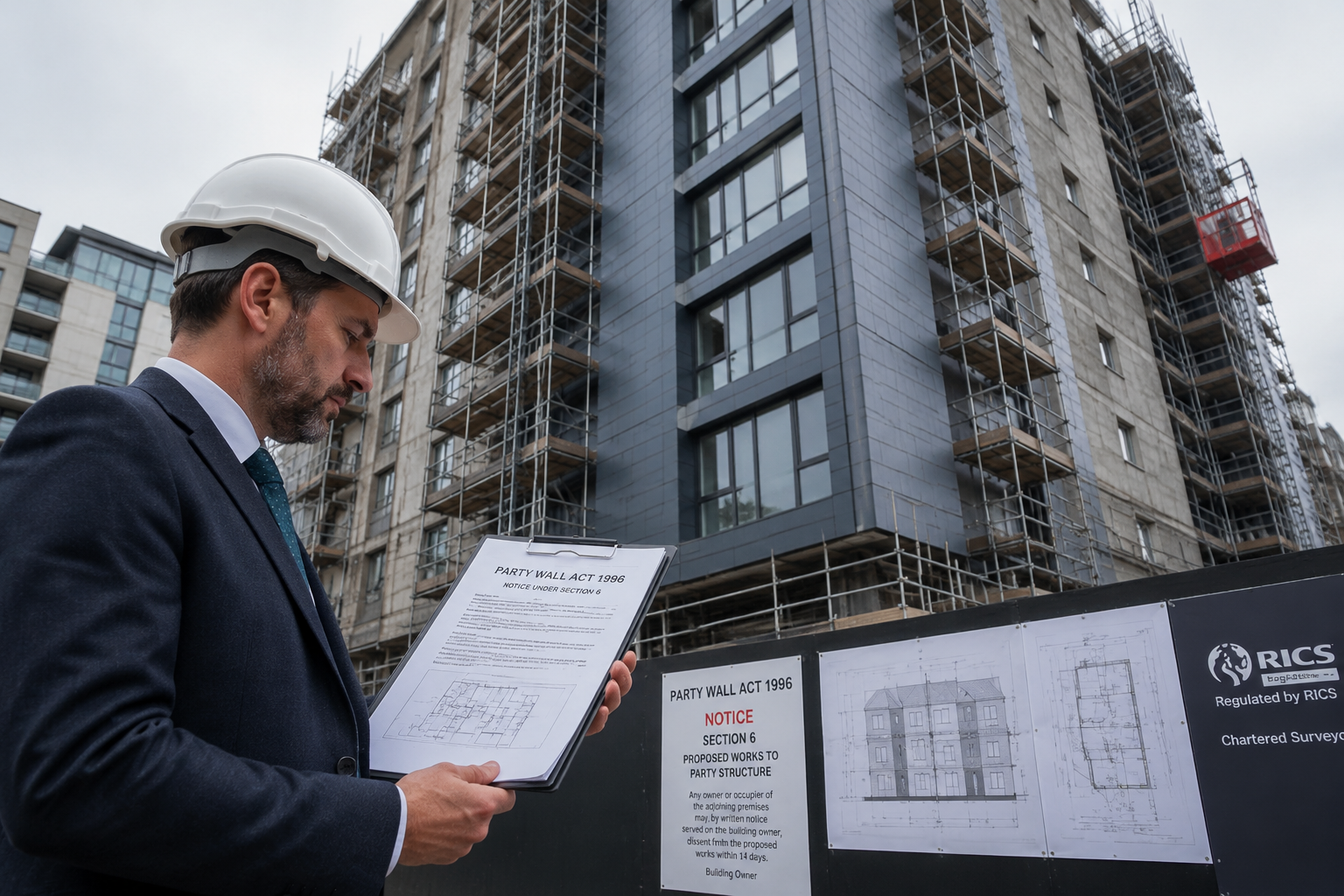
More than 4,600 residential buildings in England still require cladding remediation as of 2026, according to government tracking data — and the majority sit in dense urban environments where shared walls, multiple leaseholders, and complex ownership structures make legal compliance a daily challenge. For surveyors managing these projects, Party Wall Act compliance in high-density urban retrofit projects: surveyor strategies for 2026 cladding remediation has moved from a procedural formality to a critical risk management discipline. Get it wrong, and projects stall in dispute. Get it right, and remediation moves forward safely, on time, and with protected legal standing for every party involved.
Key Takeaways
- Cladding remediation on multi-storey urban blocks almost always triggers the Party Wall Act 1996, requiring formal notices and, in most cases, party wall awards before work begins.
- The Building Safety Act 2022 has added new documentation requirements to party wall notices for high-rise remediation, including Fire Risk Appraisal of External Walls (FRAEW) report excerpts.
- Proactive neighbour engagement before serving formal notices is the single most effective strategy for avoiding disputes and project delays.
- Schedule of condition surveys must be completed before any remediation work starts to protect all parties from false damage claims.
- The agreed surveyor approach can significantly reduce costs and timescales in straightforward urban retrofit cases.
Why Cladding Remediation Triggers the Party Wall Act
The Party Wall Act 1996 applies whenever a building owner proposes to carry out work that affects a shared wall, boundary, or structure. In multi-storey residential blocks, external wall replacement — the core task in cladding remediation — almost always engages the Act. This is because removing and replacing external cladding systems typically involves cutting into, exposing, or altering elements that form part of a party structure or that sit within three to six metres of an adjoining owner's property.
For surveyors, the first step is identifying which sections of the Act apply. Section 2 covers work to existing party structures and is most commonly triggered in cladding remediation. Section 6 may also apply where excavations or structural alterations near boundaries are involved. Understanding your party wall rights as both a building owner and an adjoining owner is essential before any notice is served.
Common triggers in cladding remediation projects include:
- Removal of existing external wall insulation (EWI) or rainscreen cladding systems
- Exposure of the structural frame or inner leaf masonry during stripping
- Installation of new fire-barrier cavity systems that penetrate the party wall line
- Scaffolding erected within the statutory proximity of neighbouring properties
- Temporary weatherproofing measures that attach to shared structures
Failing to serve the correct notices before work begins carries serious consequences. Courts have granted injunctions halting remediation projects mid-programme, causing enormous cost overruns and leaving buildings in a vulnerable interim state. The consequences of ignoring the Party Wall Act extend beyond financial penalties — they can expose building owners to civil liability for any damage caused without a formal award in place.
The Building Safety Act Layer: New Compliance Demands for 2026
Post-Grenfell legislation has fundamentally changed the compliance landscape. The Building Safety Act 2022, now fully embedded in practice, adds a parallel layer of obligations that surveyors must integrate with party wall procedures. For higher-risk buildings — those over 18 metres or seven storeys with at least two residential units — the Building Safety Regulator (BSR) must be notified at key project gateways.
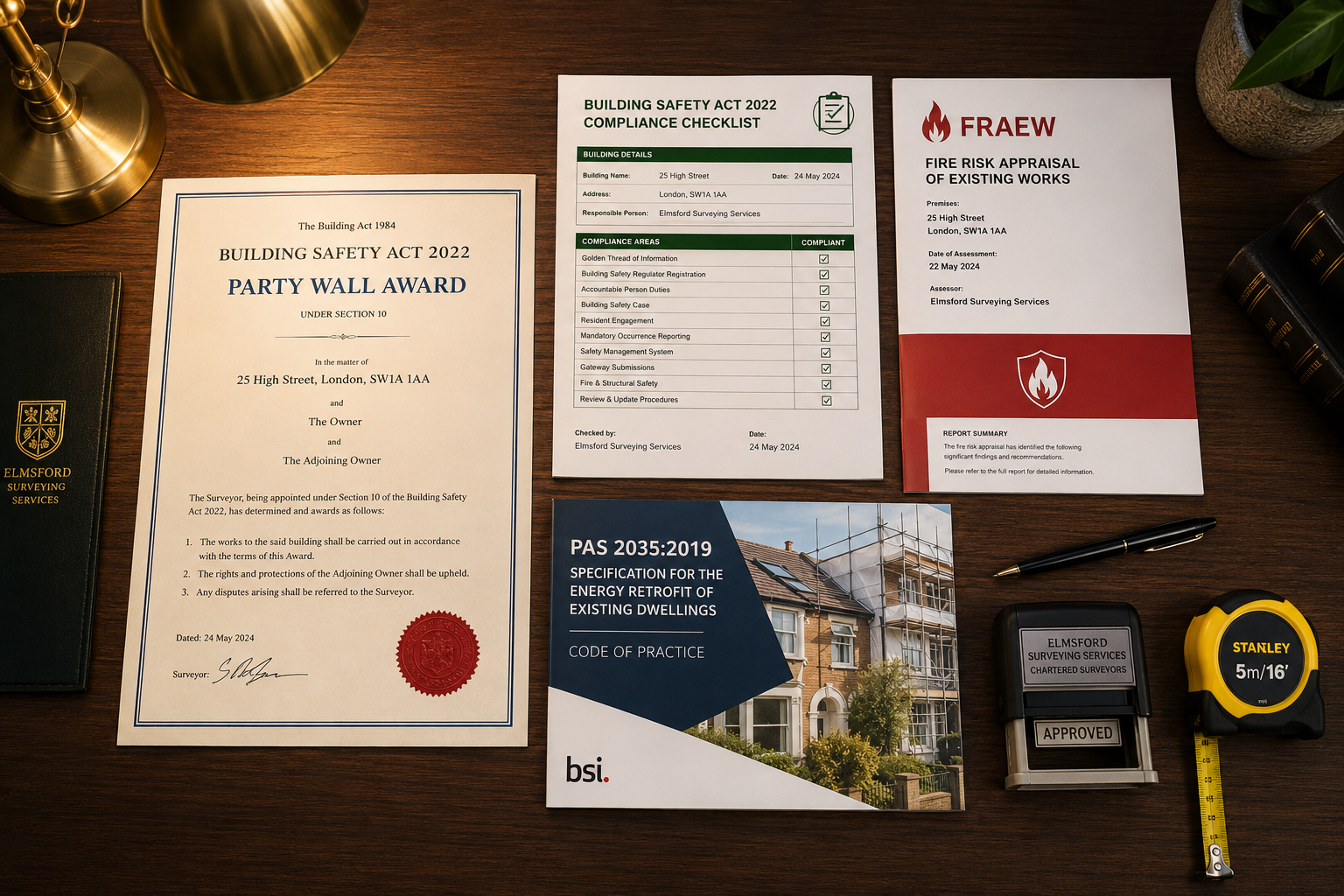
The critical development for 2026 practice is that party wall notices for cladding remediation on these buildings must now include additional technical documentation. Specifically, notices should attach or reference excerpts from the Fire Risk Appraisal of External Walls (FRAEW) report, demonstrate alignment with the Principal Accountable Person's building safety case, and include correspondence confirming BSR engagement [1]. This is not merely best practice — it is the standard that adjoining owners and their surveyors are increasingly demanding before they consent to work proceeding.
"Party wall notices for cladding remediation projects must now integrate Building Safety Act requirements, including FRAEW report excerpts and BSR correspondence, to achieve comprehensive compliance and transparency." [1]
Key documents to attach to Section 2 notices in 2026 cladding projects:
| Document | Purpose |
|---|---|
| FRAEW report summary | Demonstrates fire risk assessment basis |
| BSR gateway confirmation | Evidences regulatory compliance |
| Proposed cladding specification | Allows adjoining owner to assess impact |
| Structural method statement | Shows how party structures will be protected |
| Programme and access schedule | Sets expectations for duration and disruption |
This integration of Building Safety Act requirements with party wall procedures represents one of the most significant shifts in surveyor practice in the post-Grenfell era. Surveyors who are not familiar with the BSR gateway process risk producing notices that adjoining owners' surveyors will immediately challenge as inadequate.
Surveyor Strategies for High-Density Urban Retrofit Projects
Mapping the Ownership Landscape Before Serving Notices
In high-density urban settings — think a 15-storey block of 60 flats in Southwark, or a converted Victorian terrace row in North West London — the number of adjoining owners can be substantial. Each leaseholder, freeholder, and commercial tenant with a qualifying interest must receive a notice. Managing this process requires systematic ownership mapping before a single notice is drafted.
Experienced surveyors working on urban retrofit projects recommend obtaining the Land Registry title register for every adjoining property at the outset. In blocks with shared freehold or complex leasehold structures, this can reveal dozens of qualifying adjoining owners. Each one has the right to appoint their own surveyor, which could create a sprawling panel of professionals if not managed carefully [2].
For projects in areas like North West London or South East London, where high-density blocks are concentrated, surveyors often develop a tiered notice strategy: serving notices in logical phases aligned with the construction programme, rather than all at once, to manage response timescales and avoid simultaneous disputes across multiple ownerships.
Pre-Notice Neighbour Engagement: The Most Effective Dispute Prevention Tool
The single most impactful strategy for avoiding party wall disputes in cladding remediation projects is engagement that happens before formal notices are served. Research into 2026 retrofit practice consistently identifies proactive communication as the difference between projects that proceed smoothly and those that become mired in dispute [3].
Effective pre-notice engagement includes:
- Personal meetings with adjoining owners or their managing agents, ideally face-to-face
- Visual materials such as rendered drawings of the proposed new cladding system, showing how it will look and how it interfaces with neighbouring properties
- Clear timelines covering notice periods, award preparation, and construction phases
- Plain-language summaries of what the Party Wall Act means for each neighbour and what their rights are
- Named contact points so neighbours know exactly who to call with concerns
A 2026 case study from a 15-storey residential block involving 60 flats demonstrates the value of this approach. By engaging a specialist surveyor early, running information sessions for leaseholders, and serving detailed Section 2 notices that incorporated all Building Safety Act documentation, the project achieved full compliance without a single formal dispute. Total party wall costs for the entire project came to £18,500 — a fraction of what contested proceedings would have cost [1].
Schedule of Condition Surveys: Non-Negotiable Protection
Before any cladding remediation work begins, a thorough schedule of condition survey must be completed for every adjoining property that could be affected. This is a detailed photographic and written record of the existing state of those properties — every crack, stain, settlement mark, and surface defect documented before the first scaffold board goes up [4].
The schedule of condition serves two critical functions. First, it protects the building owner from false or exaggerated damage claims after work is complete. Second, it protects adjoining owners by establishing an objective baseline that makes genuine damage claims straightforward to evidence and resolve.
In urban retrofit projects, access for condition surveys can be challenging. Residents may be reluctant to allow entry, particularly in blocks where there is already tension about the remediation programme. Surveyors should plan for this by including access provisions in the party wall award and, where necessary, seeking agreement through the managing agent or residents' association.
For a deeper understanding of what thorough building surveys involve, the Level 3 Full Building Survey methodology provides a useful benchmark for the standard of documentation that condition surveys should aspire to.
The Agreed Surveyor Approach: Cutting Costs and Timescales
When adjoining owners consent to the appointment of a single agreed surveyor acting impartially for both parties, the compliance process becomes significantly faster and more cost-effective. Under Section 10 of the Party Wall Act, an agreed surveyor can prepare and serve the party wall award without the need for each party to appoint their own professional [5].
This approach is gaining traction in urban cladding remediation projects for several reasons:
- It reduces the total professional fees substantially
- It avoids the delays that arise when multiple surveyors need to coordinate
- It works particularly well where the adjoining owner has no specific objections to the works, only a need for formal protection
- It can be completed in weeks rather than months in straightforward cases
The agreed surveyor must, however, remain genuinely impartial. In complex cases — where the adjoining owner has specific concerns about noise, access, or structural impact — separate surveyors for each party may be more appropriate. The key is assessing the complexity of each individual adjoining owner relationship and choosing the right approach accordingly.
Integrating PAS 2035:2023 with Party Wall Procedures
The PAS 2035:2023 framework sets out the quality standard for domestic retrofit projects in the UK, covering assessment, design, installation, and post-installation evaluation. For cladding remediation projects that also involve thermal performance improvements — which is increasingly common as buildings address both fire safety and energy efficiency simultaneously — party wall procedures must align with PAS 2035 requirements [6].
In practice, this means that the party wall award should reference the retrofit assessor's recommendations, confirm that the proposed works align with the whole-house retrofit plan, and include provisions for post-installation inspection that may require access to adjoining properties. Surveyors who understand both the party wall framework and the PAS 2035 process are better positioned to draft awards that stand up to scrutiny from all parties, including the Building Safety Regulator.
The growing emphasis on sustainable materials in party wall solutions — including mineral wool cavity barriers, non-combustible insulation boards, and thermally efficient render systems — also means that specifications attached to party wall notices are becoming more technically detailed than in previous years [8].
Managing Multiple Adjoining Owners in Dense Urban Blocks
High-density urban environments present unique challenges that suburban or rural party wall practice simply does not encounter. A single cladding remediation project on a large urban block may involve:
- Residential leaseholders on multiple floors
- Commercial tenants at ground level with different operating hours and noise sensitivities
- Neighbouring blocks owned by housing associations or local authorities
- Shared amenity spaces or podium structures that complicate the boundary picture
In areas like Southwark, managing both residential and commercial adjoining owners requires tailored notice protocols. Commercial tenants, for example, may have specific concerns about access disruption to loading bays or customer entrances that residential leaseholders would not raise. Residential owners in the same block may have very different levels of engagement — some will appoint surveyors immediately, others will consent without question [7].
Practical strategies for multi-owner urban projects:
- Develop a master notice schedule with individual reference numbers for each adjoining owner
- Use a dedicated project email address and phone line for party wall queries
- Appoint a single lead surveyor to coordinate across all adjoining owner relationships, even where separate surveyors are appointed by individual owners
- Build buffer time into the programme for the statutory 14-day response period and any dissent periods
- Consider block management expertise when coordinating with residents' management companies
Effective project management is inseparable from party wall compliance in these environments. The construction programme, the notice timetable, and the award preparation schedule must be coordinated so that work does not begin in any area before the relevant awards are in place [9].
Party Wall Awards: What Cladding Remediation Awards Must Cover
A party wall award for cladding remediation is more detailed than a standard award for a loft conversion or extension. Given the scale of the works, the fire safety context, and the Building Safety Act overlay, surveyors should ensure that awards address the following:
- Scope of works: A precise description of the cladding removal and replacement process, including details of cavity barrier installation
- Working hours: Specific restrictions on noisy operations, particularly in residential blocks where occupants are present during the day
- Access provisions: Detailed protocols for scaffold erection, material delivery, and any temporary enclosure of common areas
- Noise and vibration monitoring: Requirements for monitoring during high-impact activities such as mechanical cladding removal
- Damage resolution procedure: A clear process for reporting, inspecting, and resolving any damage claims during the works
- Post-completion inspection: A requirement for a joint inspection once works are complete to confirm no damage has occurred
The party wall awards process, when handled correctly, creates a legally binding framework that protects all parties and gives the construction team clear parameters within which to operate.
For surveyors who want a comprehensive grounding in the essentials, the key things you must know about party wall agreements provide a solid foundation before tackling the additional complexity of high-rise remediation.
Conclusion
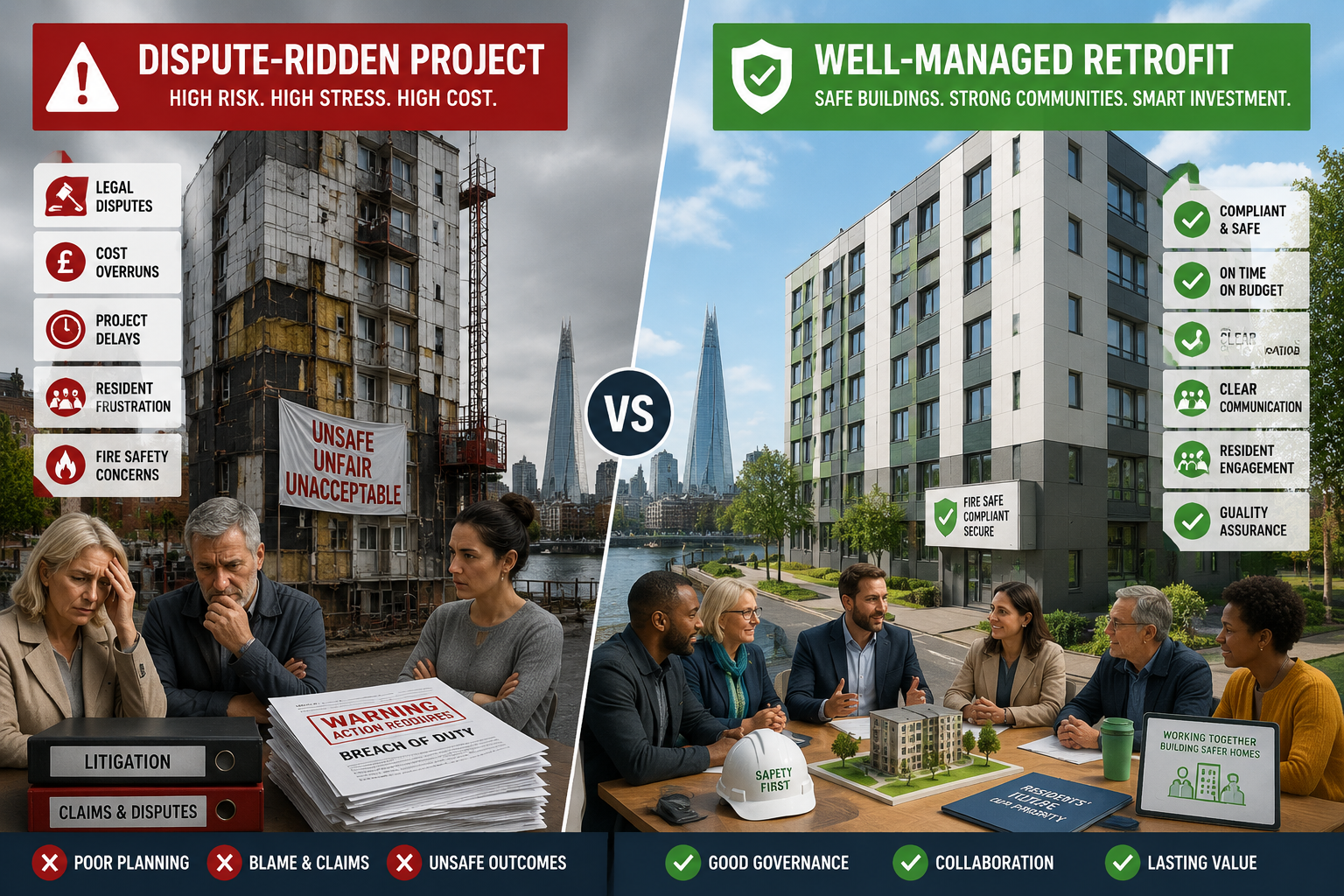
Party Wall Act compliance in high-density urban retrofit projects: surveyor strategies for 2026 cladding remediation demands a level of technical depth, legal precision, and interpersonal skill that goes well beyond standard party wall practice. The convergence of the Building Safety Act 2022, PAS 2035:2023, and the sheer complexity of urban block ownership structures means that surveyors must approach every cladding remediation project as a bespoke compliance exercise.
Actionable next steps for surveyors and building owners:
- Commission an ownership mapping exercise before drafting any notices — know exactly who must be served and in what order.
- Engage neighbouring owners personally before formal notices are served; invest in clear visual materials and plain-language briefings.
- Ensure all Section 2 notices for higher-risk buildings include FRAEW report excerpts and evidence of BSR engagement.
- Complete schedule of condition surveys for all adjoining properties before work begins — without exception.
- Assess each adjoining owner relationship individually to determine whether an agreed surveyor or separate surveyors is the right approach.
- Draft party wall awards with cladding-specific provisions covering working hours, noise monitoring, access, and post-completion inspection.
- Align the party wall programme with the PAS 2035 retrofit plan and the construction programme from day one.
Cladding remediation is one of the most consequential building programmes in a generation. The surveyors who master party wall compliance in this context are not just protecting their clients from legal risk — they are helping to make the country's housing stock safer, faster.
References
[1] Party Wall Surveys For High Rise Remediation Projects Navigating Building Safety Act Noticing Requirements – wimbledonsurveyors.com
[2] Party Wall Act Compliance In Regional Market Contrasts Survey Strategies For North Vs South 2026 Developments – wimbledonsurveyors.com
[3] Party Wall Surveys For 2026 Retrofit Boom Rics Standards And Dispute Avoidance Post Quality Summit – wimbledonsurveyors.com
[4] Party Wall Act Compliance In Northern Englands 2026 Housing Boom Surveyor Protocols For High Activity Zones – wimbledonsurveyors.com
[5] Agreed Surveyors Under Party Wall Act 2026 Cost And Time Savings For Urban Extensions – kingstonsurveyors.com
[6] Party Wall Agreements For Retrofit And Renovation Projects Meeting 2026 Rics Retrofit Summit Standards – kingstonsurveyors.com
[7] Party Wall Surveyor Southwark – surveyofpartywall.co.uk
[8] 50354 Sustainable Party Wall Solutions Urban Architecture – illustrarch.com
[9] Cladding Remediation How To Mitigate Risks And Delay 2 – ridge.co.uk