

As property values surge across London and other high-demand urban centers in 2026, homeowners are increasingly looking downward rather than upward to expand their living space. Basement conversions have become the gold standard for adding value without altering a property's footprint—but they come with complex legal requirements. Understanding Party Wall Act compliance for basement conversions 2026 is crucial for surveyors navigating the intricate protocols required in densely populated terraced neighborhoods where properties share walls and foundations.
The recovering property market has sparked a basement conversion boom, particularly in Victorian and Edwardian terraced homes where space comes at a premium. However, excavating beneath existing structures triggers specific Party Wall Act requirements that many property owners underestimate. For surveyors, mastering Section 6 notices for deeper excavations has become essential to preventing costly disputes and project delays.
Key Takeaways
- Section 6 of the Party Wall Act applies when excavating within 3 meters of a neighboring building, or within 6 meters where the work involves deeper foundations than the adjoining property
- Formal Party Wall Notices must be served on all affected neighbors before basement excavation begins, with specific timeframes and response protocols
- Appointed surveyors play a critical role in creating Party Wall Awards that protect both building owners and adjoining owners throughout the construction process
- Schedule of Condition documentation is essential for preventing disputes about structural damage and should be completed before any excavation work starts
- Non-compliance can result in court injunctions, significant financial penalties, and months of project delays
Understanding Party Wall Act Requirements for Basement Conversions in 2026
The Party Wall etc. Act 1996 remains the cornerstone legislation governing basement conversions in England and Wales. While the Act itself hasn't changed, its application has become increasingly critical as urban densification continues in 2026.
What Triggers Party Wall Act Compliance?
Basement excavation projects typically trigger Section 6 of the Party Wall Act, which specifically addresses excavations near neighboring buildings. This section applies in two distinct scenarios:
Scenario 1: The 3-Meter Rule 🏗️
When excavating within 3 meters of a neighboring building and the excavation will go deeper than the neighbor's foundation, Party Wall procedures must be followed.
Scenario 2: The 6-Meter Rule 📏
When excavating within 6 meters of a neighboring building and the work involves cutting a line drawn downward at 45 degrees from the bottom of the neighbor's foundation, Party Wall protocols are mandatory.
In high-demand urban areas with tightly packed terraced properties, virtually all basement conversions trigger these requirements. The proximity of neighboring foundations means surveyors must carefully calculate excavation depths and distances to determine which notices apply.
Key Sections of the Party Wall Act for Basement Work
| Section | Application | Notice Period |
|---|---|---|
| Section 1 | Building on or astride the boundary line | 1 month |
| Section 2 | Work to existing party walls | 2 months |
| Section 6 | Excavation near neighboring buildings | 1 month |
For basement conversions, Section 6 is most commonly triggered, though Section 2 may also apply if underpinning existing party walls becomes necessary during the excavation process.
Understanding your party wall rights is essential before beginning any basement conversion project, as these rights protect both building owners and their neighbors.
Surveyor Protocols for Section 6 Notices in Terraced Properties
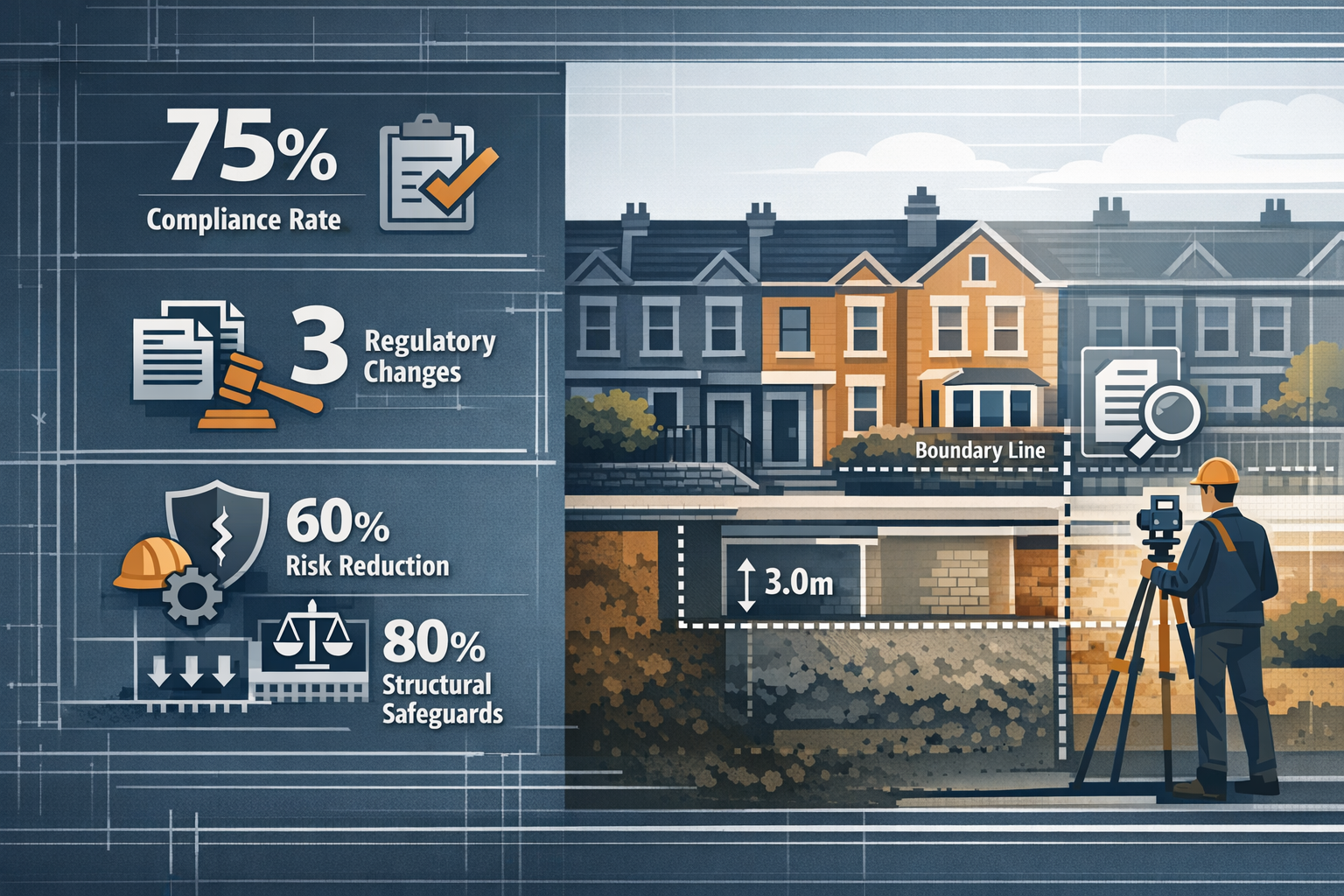
Navigating Section 6 notices requires precision and thorough documentation. In 2026, surveyors working in high-demand urban areas face increased scrutiny as basement conversions have become more common and neighbors more aware of their rights.
The Notice Serving Process
Step 1: Pre-Notice Assessment 🔍
Before serving any notice, surveyors should conduct a comprehensive site assessment including:
- Measuring exact distances to neighboring properties
- Determining foundation depths of adjoining buildings
- Identifying all affected neighbors within the 3-meter or 6-meter zones
- Reviewing existing structural conditions
- Assessing potential risks to neighboring properties
Step 2: Preparing the Section 6 Notice
The notice must include specific details:
- Clear description of the proposed excavation work
- Depth and extent of the excavation
- Methods of construction to be used
- Start date for the works (at least 1 month from notice date)
- Technical drawings showing excavation zones
Step 3: Serving the Notice
Notices must be served on all affected adjoining owners. In terraced properties, this often means multiple neighbors on both sides and potentially to the rear if excavating near back additions.
Neighbor Response Options
Once a Party Wall Notice is served, adjoining owners have 14 days to respond with one of three options:
- Written Consent ✅ – The neighbor agrees to the work as described
- Written Dissent ❌ – The neighbor formally objects or requests modifications
- No Response ⏰ – After 14 days of silence, this constitutes "deemed dissent"
When dissent occurs (either formal or deemed), the Party Wall Award process begins, requiring the appointment of surveyors to resolve the matter formally.
The Role of Appointed Surveyors
When neighbors dissent, three surveyor appointment scenarios exist:
Option 1: Agreed Surveyor 🤝
Both parties agree to appoint a single surveyor to act impartially for both sides. This is often the most cost-effective approach.
Option 2: Two Surveyors
Each party appoints their own surveyor, and these two surveyors work together to produce the Award. If they cannot agree, they appoint a third surveyor to make the final decision.
Option 3: Building Owner Appoints for Non-Responsive Neighbor
If the adjoining owner doesn't appoint a surveyor within 10 days of being requested, the building owner can appoint one on their behalf.
Professional surveyors specializing in party wall awards understand the nuances of these appointments and can guide both parties through the process efficiently.
Creating Comprehensive Party Wall Awards
The Party Wall Award is a legal document that sets out:
- Detailed description of the works to be undertaken
- Time and manner of executing the work
- Schedule of Condition of adjoining properties
- Access arrangements for inspections
- Security for expenses (if required)
- Dispute resolution procedures
For basement conversions in 2026, awards have become increasingly detailed, often including:
- Vibration monitoring protocols to protect neighboring structures
- Noise limitation clauses to minimize disruption
- Working hours restrictions particularly important in residential areas
- Emergency contact procedures for immediate issues
- Insurance requirements to cover potential damage
Risk Mitigation Strategies for Basement Excavations in Urban Settings
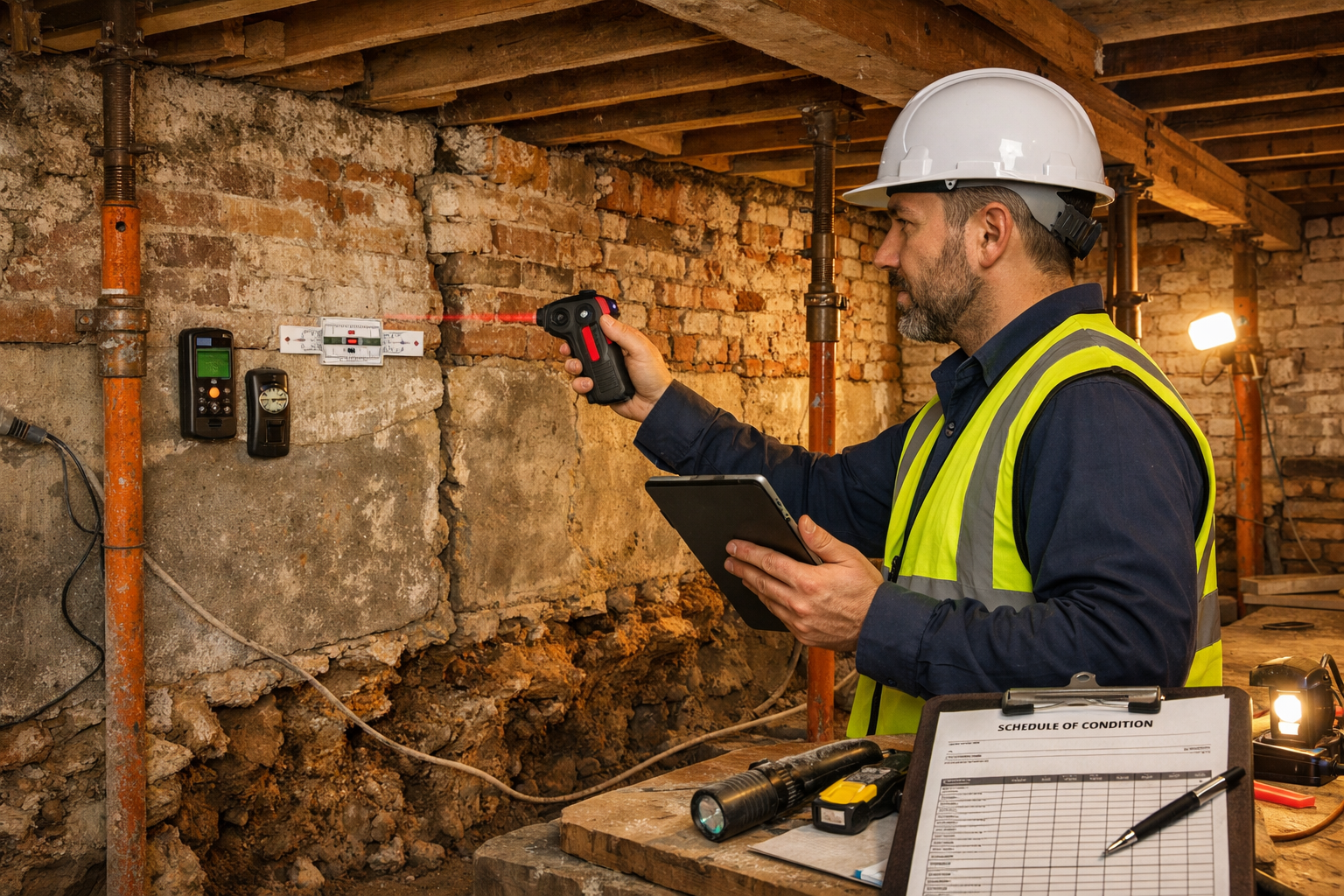
High-demand urban areas present unique challenges for basement conversions. The proximity of neighboring properties, aging Victorian and Edwardian foundations, and the potential for subsidence all require careful risk management.
Schedule of Condition: Your First Line of Defense
A Schedule of Condition is arguably the most important risk mitigation tool for basement conversions. This detailed photographic and written record documents the existing condition of neighboring properties before work begins.
What to Include in a Schedule of Condition:
- 📸 Comprehensive photographs of all rooms in adjoining properties
- 📝 Detailed written descriptions of existing cracks, settlement, or defects
- 📐 Measurements of significant cracks or structural issues
- 🎥 Video walkthroughs for additional documentation
- 📅 Date-stamped evidence with witness signatures
Without this documentation, proving that damage existed before your excavation work began becomes nearly impossible. Many disputes arise from pre-existing conditions that neighbors attribute to recent construction work.
Structural Monitoring During Excavation
Modern basement conversions in 2026 increasingly incorporate real-time monitoring systems:
Crack Monitoring Devices
Electronic sensors placed across existing cracks in neighboring properties provide instant alerts if movement exceeds predetermined thresholds.
Vibration Monitoring
Seismograph-style equipment measures vibration levels during excavation, ensuring they remain within safe parameters for neighboring structures.
Settlement Monitoring
Precise leveling equipment tracks any vertical movement in adjoining properties, allowing immediate intervention if settlement begins.
These monitoring systems provide objective data that protects both building owners and neighbors, reducing disputes and enabling rapid response to genuine concerns.
Working with Structural Engineers
Basement conversions require close collaboration between party wall surveyors and structural engineers. The engineer's designs must account for:
- Underpinning requirements for existing party walls
- Temporary support systems during excavation
- Permanent structural solutions for the completed basement
- Waterproofing and tanking specifications
- Load transfer from existing structures
Surveyors should verify that engineers understand Party Wall Act requirements and that their designs facilitate compliance. Understanding the relationship between engineers and party wall procedures ensures smoother project delivery.
Managing Neighbor Relations Throughout the Project
Even with perfect legal compliance, maintaining positive neighbor relationships is crucial for project success in 2026's tight urban environments.
Best Practices for Neighbor Management:
- Overcommunicate – Provide regular updates even when not required
- Be accessible – Ensure neighbors have direct contact information for concerns
- Respect boundaries – Honor agreed working hours and access arrangements
- Address concerns promptly – Respond to complaints within 24 hours
- Document everything – Keep written records of all communications
Many experienced surveyors recommend monthly progress meetings with adjoining owners during basement excavations, even when not formally required. This proactive approach prevents small concerns from escalating into formal disputes.
Common Pitfalls and How to Avoid Them
Understanding the top 5 party wall agreement challenges for renovations helps surveyors anticipate problems before they occur.
Pitfall 1: Inadequate Notice Periods ⚠️
The Problem: Serving notices too close to the intended start date leaves insufficient time for the Award process if neighbors dissent.
The Solution: Serve Section 6 notices at least 2-3 months before the planned excavation start date, allowing time for potential surveyor appointments and Award preparation.
Pitfall 2: Incomplete Identification of Adjoining Owners
The Problem: Failing to identify all affected neighbors, particularly in complex property arrangements with multiple freeholders or leaseholders.
The Solution: Conduct thorough Land Registry searches and physically verify property boundaries. In leasehold properties, both the leaseholder and freeholder may need to be served.
Pitfall 3: Vague Work Descriptions
The Problem: Notices that lack specific details about excavation depths, methods, or timescales create uncertainty and increase the likelihood of dissent.
The Solution: Include detailed party wall drawings showing cross-sections, measurements, and construction methodology with every notice.
Pitfall 4: Ignoring Building Regulations
The Problem: Focusing solely on Party Wall Act compliance while neglecting Building Regulations requirements for basement conversions.
The Solution: Ensure parallel compliance with Building Regulations covering fire escape, ventilation, ceiling height, damp-proofing, and structural stability. These are separate legal requirements.
Pitfall 5: Underestimating Costs and Timeframes
The Problem: Property owners often budget for construction costs but not for Party Wall surveyor fees, monitoring equipment, or potential delays from the Award process.
The Solution: Budget for surveyor fees (typically £1,000-£3,000 per party wall matter), monitoring costs, and add 2-3 months to project timelines for Party Wall procedures.
Regional Variations in High-Demand Urban Areas
While the Party Wall Act applies uniformly across England and Wales, practical application varies by location based on property types and local market conditions.
London and Inner Urban Boroughs
Areas like Camden, Islington, and Westminster see the highest volume of basement conversions in 2026. These locations feature:
- Predominantly Victorian terraced properties with shared foundations
- Extremely high property values justifying significant conversion costs
- Sophisticated neighbors familiar with their Party Wall rights
- Established networks of experienced party wall surveyors
Surveyors working in London and South East London report that nearly all basement conversions now proceed through the full Award process, with consent without surveyor involvement becoming increasingly rare.
Home Counties Commuter Towns
Areas like Hertfordshire, Watford, and St Albans have seen growing basement conversion activity as London prices push buyers outward.
These areas typically feature:
- Mix of Victorian terraces and semi-detached properties
- Less neighbor familiarity with Party Wall procedures
- Greater opportunity for agreed surveyor appointments
- More variation in property foundation types
Suburban and Semi-Rural Areas
Locations like Oxfordshire and Hampshire see fewer basement conversions but those that occur often involve unique challenges:
- Older properties with uncertain foundation depths
- Greater distances between properties (though still potentially within 6-meter zones)
- Less established party wall surveyor networks
- More scope for informal neighbor agreements
The Future of Party Wall Compliance in 2026 and Beyond
The basement conversion market continues evolving in 2026, with several trends shaping surveyor protocols:
Technology Integration 🖥️
Digital tools are transforming party wall procedures:
- 3D scanning for precise Schedule of Condition documentation
- Drone surveys for external property condition assessment
- Digital Awards with electronic signatures and cloud storage
- Real-time monitoring dashboards accessible to all parties
- AI-assisted risk assessment for excavation planning
Increased Regulatory Scrutiny
Local authorities in high-demand areas are paying closer attention to basement conversions, with some implementing:
- Additional planning requirements beyond Party Wall Act compliance
- Basement impact assessments for cumulative neighborhood effects
- Stricter enforcement of Building Regulations
- Enhanced monitoring of construction noise and disruption
Sustainability Considerations ♻️
Modern basement conversions increasingly incorporate:
- Sustainable drainage systems to prevent groundwater issues
- Energy-efficient design with improved insulation
- Renewable energy integration including ground-source heat pumps
- Circular economy principles with material reuse and recycling
Surveyors must now consider environmental impacts alongside traditional structural concerns, particularly in conservation areas and environmentally sensitive zones.
Professional Development for Surveyors
The complexity of basement conversions in 2026 demands specialized expertise. Professional surveyors should pursue:
- Continuing Professional Development (CPD) in party wall matters
- Structural engineering knowledge specific to excavation work
- Dispute resolution training for managing conflicts effectively
- Local authority liaison skills for navigating planning requirements
- Insurance expertise to advise on adequate coverage
Many surveyors now specialize exclusively in party wall matters, recognizing that the technical and legal complexity requires dedicated focus rather than treating it as an occasional sideline to other surveying work.
Legal Consequences of Non-Compliance
Understanding the serious ramifications of Party Wall Act non-compliance helps emphasize why proper protocols matter.
Court Injunctions and Work Stoppages 🚫
Neighbors can apply for court injunctions to immediately halt basement excavation work that proceeds without proper Party Wall procedures. These injunctions can:
- Stop work for months while disputes are resolved
- Require expensive temporary support systems to maintain excavation safety
- Generate significant legal costs for both parties
- Damage professional reputations for surveyors and contractors
Financial Penalties and Damage Claims 💰
Property owners who proceed without Party Wall compliance face:
- Liability for all damage to neighboring properties without the protection of a properly prepared Award
- Legal costs for both their own defense and potentially the neighbor's legal expenses
- Compensation claims that may exceed the original project budget
- Reduced property value if disputes create legal charges against the property
Professional Liability for Surveyors
Surveyors who fail to advise clients properly about Party Wall requirements risk:
- Professional negligence claims
- Professional indemnity insurance claims
- Regulatory action from professional bodies
- Reputational damage affecting future business
The common misconceptions about party wall agreements often lead to these compliance failures, making client education a crucial part of the surveyor's role.
Practical Checklist for Surveyors Managing Basement Conversions
To ensure comprehensive Party Wall Act compliance for basement conversions in 2026, surveyors should follow this systematic checklist:
Pre-Notice Phase ✓
- Conduct site survey measuring distances to all neighboring properties
- Obtain structural engineer's excavation design and foundation depths
- Identify all adjoining owners through Land Registry searches
- Verify leasehold/freehold arrangements for all affected properties
- Prepare detailed technical drawings showing excavation zones
- Calculate whether 3-meter or 6-meter rules apply
- Photograph existing external conditions of neighboring properties
Notice Serving Phase ✓
- Prepare Section 6 notices with complete work descriptions
- Include all required technical information and drawings
- Serve notices on all identified adjoining owners
- Maintain proof of service (recorded delivery recommended)
- Diarize 14-day response deadline
- Prepare for potential surveyor appointments
Award Preparation Phase ✓
- Arrange Schedule of Condition inspections if dissent occurs
- Coordinate with appointed surveyors (if applicable)
- Prepare comprehensive photographic and written condition records
- Draft Party Wall Award with all required clauses
- Include monitoring protocols and access arrangements
- Specify working hours and noise limitations
- Obtain signatures from all parties
- Distribute executed Awards to all parties
Construction Phase ✓
- Install monitoring equipment before excavation begins
- Maintain construction logs documenting compliance
- Conduct regular inspections of neighboring properties
- Respond promptly to any neighbor concerns
- Document all communications in writing
- Ensure contractors understand Party Wall requirements
- Maintain insurance coverage throughout the project
Post-Completion Phase ✓
- Conduct final Schedule of Condition comparison
- Address any legitimate damage claims promptly
- Remove monitoring equipment
- Provide final report to all parties
- Archive all documentation for future reference
- Obtain neighbor sign-off where possible
When to Engage Professional Party Wall Surveyors
While some straightforward party wall matters can be handled directly between neighbors, basement conversions in high-demand urban areas typically warrant professional surveyor involvement from the outset.
Consider professional surveyor engagement when:
- Excavating deeper than 1.5 meters below ground level
- Working within 3 meters of neighboring properties
- Dealing with Victorian or Edwardian terraced properties
- Neighbors have previously expressed concerns about construction work
- The property value exceeds £1 million (higher stakes for all parties)
- Multiple adjoining owners are affected
- Structural underpinning is required
- Previous settlement or structural issues exist in neighboring properties
Understanding when you need a party wall surveyor helps property owners make informed decisions about professional representation versus attempting to manage the process independently.
Conclusion
Party Wall Act compliance for basement conversions in 2026 represents a critical intersection of legal requirements, technical expertise, and neighbor relations management. As high-demand urban areas continue experiencing basement conversion booms, surveyor protocols must evolve to address increasingly complex scenarios while maintaining the Act's fundamental purpose: protecting the rights of both building owners and their neighbors.
The key to successful basement conversions lies in proactive compliance rather than reactive problem-solving. Surveyors who master Section 6 notice procedures, create comprehensive Party Wall Awards, and implement robust risk mitigation strategies position their clients for smooth project delivery with minimal disputes.
Actionable Next Steps
For Property Owners Planning Basement Conversions:
- Engage a party wall surveyor at least 3-4 months before planned excavation
- Budget adequately for surveyor fees, monitoring costs, and potential delays
- Communicate early with neighbors about your plans before formal notices
- Ensure your structural engineer understands Party Wall Act requirements
- Maintain comprehensive insurance covering party wall risks
For Surveyors Managing Basement Projects:
- Conduct thorough pre-notice assessments measuring all distances precisely
- Prepare detailed technical documentation leaving no ambiguity about proposed works
- Implement Schedule of Condition protocols before any excavation begins
- Establish monitoring systems appropriate to the project's risk profile
- Maintain clear communication channels with all parties throughout the project
For Adjoining Owners Receiving Notices:
- Seek professional advice before consenting to or dissenting from notices
- Respond within the 14-day timeframe to maintain control over surveyor appointments
- Insist on comprehensive Schedule of Condition documentation
- Understand your rights under the Party Wall Act
- Consider agreed surveyor appointments to reduce costs while maintaining protection
The recovering property market of 2026 shows no signs of slowing basement conversion demand in high-value urban areas. Surveyors who develop specialized expertise in Party Wall Act protocols for these complex projects will find themselves increasingly essential to successful property development in densely populated neighborhoods. By prioritizing thorough documentation, proactive risk management, and professional neighbor relations, surveyors can facilitate basement conversions that enhance property values while protecting the interests of entire communities.