

The commercial property landscape is witnessing an extraordinary transformation in 2026. Office Sector Recovery and Building Survey Standards: Preparing for Increased Transaction Volumes as Deals Surge 21-Fold represents more than just a headline—it signals a fundamental shift in how building surveyors must approach their operations. With office property deals over £100 million nearly doubling from 11 transactions in 2024 to 21 in 2025, the sector is experiencing unprecedented momentum that demands immediate attention from surveying professionals. 📈
This remarkable surge creates both opportunity and challenge. Building surveyors face mounting pressure to scale their operations while maintaining rigorous quality standards. The convergence of market recovery and evolving survey protocols means that firms must simultaneously expand capacity and refine their methodologies to meet heightened client expectations.

Key Takeaways
- Transaction volumes have surged dramatically, with office deals over £100m increasing from 11 to 21 between 2024-2025, representing a 91% growth rate
- Building survey standards are evolving with new 2026 ALTA/NSPS requirements introducing enhanced accuracy specifications and modernized protocols [1]
- Operational capacity must scale rapidly as surveying firms prepare for sustained increases in commercial property assessments and due diligence requirements
- Standardized protocols become critical for maintaining quality and consistency across high-volume transaction environments
- Technology integration is essential for meeting faster turnaround times while adhering to more stringent technical specifications
Understanding the Office Sector Recovery Trajectory
The commercial office market has emerged from a challenging period with remarkable resilience. After years of uncertainty driven by remote work trends and economic headwinds, the sector is experiencing a robust recovery characterized by increased investor confidence and strategic repositioning.
Market Dynamics Driving the Recovery
Several interconnected factors are fueling this dramatic upturn in office property transactions:
Flight to Quality: Investors are increasingly focusing on premium office spaces that offer modern amenities, sustainability features, and flexible configurations. This selectivity has concentrated transaction activity in high-value properties, explaining the concentration of deals exceeding £100 million.
Portfolio Rebalancing: Institutional investors are repositioning their commercial real estate holdings, selling underperforming assets while acquiring properties aligned with post-pandemic workplace requirements. This strategic shift has accelerated transaction volumes across major markets.
Valuation Opportunities: Price corrections in certain segments have created attractive entry points for opportunistic buyers, particularly for properties requiring repositioning or renovation. These value plays are contributing significantly to deal flow.
Return-to-Office Momentum: Despite continued hybrid work arrangements, many organizations are committing to physical office space with renewed purpose. This commitment translates into leasing activity that supports property valuations and investment appetite.
The 21-Fold Surge: Breaking Down the Numbers
While the headline figure of "21-fold" captures attention, understanding the context provides crucial insight. The increase from 11 to 21 deals represents a near-doubling of transaction volume in the ultra-high-value segment (properties over £100 million). This concentration in premium assets indicates:
- Institutional confidence returning to the office sector
- Capital availability for large-scale acquisitions
- Market stabilization after prolonged uncertainty
- Strategic positioning for long-term growth
For building surveyors, this translates into more complex, high-stakes assignments requiring enhanced technical capabilities and faster delivery timelines.
Office Sector Recovery and Building Survey Standards: The Critical Connection
The intersection of market recovery and evolving survey standards creates a unique challenge for surveying professionals. As transaction volumes increase, the technical requirements for commercial property assessments are simultaneously becoming more rigorous.
New 2026 ALTA/NSPS Standards
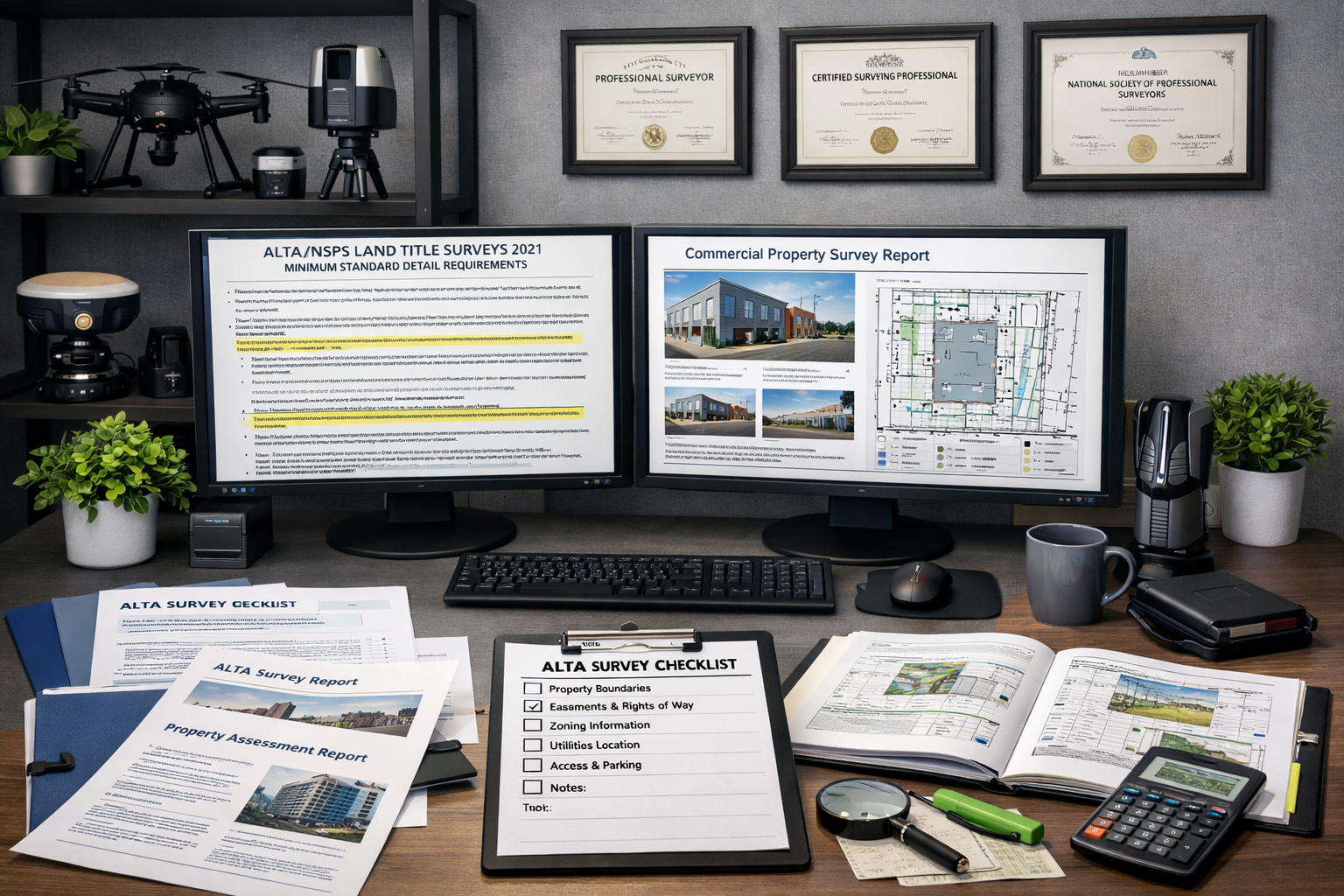
The American Land Title Association (ALTA) and National Society of Professional Surveyors (NSPS) have introduced updated standards for 2026 that significantly impact commercial property surveys [1]. While these standards are U.S.-based, they influence international best practices and set benchmarks for professional excellence globally.
Key changes include:
| Standard Area | 2026 Update | Impact on Surveyors |
|---|---|---|
| Accuracy Requirements | Enhanced precision specifications for boundary determinations [3] | Requires upgraded equipment and calibration protocols |
| Digital Deliverables | Mandatory electronic formats with specific metadata [1] | Necessitates technology investment and training |
| Environmental Considerations | Expanded documentation of site conditions [5] | Increases scope and time requirements |
| Accessibility Features | New requirements for ADA compliance documentation [3] | Adds specialized knowledge requirements |
Adapting UK Survey Practices
While UK building surveyors follow RICS standards rather than ALTA/NSPS protocols, the international trend toward enhanced rigor and digital integration influences domestic practice. The principles underlying the 2026 updates—greater accuracy, comprehensive documentation, and technology integration—align with evolving client expectations in the UK commercial property market.
Level 3 building surveys for commercial properties increasingly incorporate:
- Advanced measurement technologies including laser scanning and photogrammetry
- Comprehensive digital documentation with 3D models and interactive reports
- Enhanced due diligence covering sustainability, accessibility, and regulatory compliance
- Integrated risk assessment addressing structural, environmental, and operational factors
Quality Versus Velocity
The fundamental tension in Office Sector Recovery and Building Survey Standards: Preparing for Increased Transaction Volumes as Deals Surge 21-Fold lies in balancing thoroughness with speed. High-value transactions demand:
✅ Comprehensive technical analysis to identify potential issues
✅ Rapid turnaround times to support transaction timelines
✅ Detailed documentation for lender and investor requirements
✅ Professional liability protection through rigorous protocols
Achieving this balance requires strategic operational planning and investment in both human capital and technology infrastructure.
Preparing Surveying Operations for Increased Transaction Volumes
Building surveying firms must proactively prepare for sustained increases in commercial property assessment demand. This preparation encompasses multiple operational dimensions.

Capacity Planning and Resource Allocation
Workforce Expansion: Firms should evaluate current capacity against projected demand, considering:
- Lead times for recruiting and training qualified surveyors
- Seasonal variations in transaction activity
- Geographic distribution of opportunities
- Specialization requirements for different property types
Strategic Partnerships: Establishing relationships with complementary professionals—structural engineers, environmental consultants, and specialist advisors—enables firms to scale rapidly without permanent overhead increases. Understanding when to source extra advice becomes crucial for managing complex assignments.
Technology Investment: Modern surveying operations require:
- Digital measurement tools (laser scanners, total stations, drones)
- Software platforms for data processing and report generation
- Project management systems for workflow coordination
- Cloud infrastructure for data storage and collaboration
Standardizing Survey Protocols
Consistency becomes paramount when transaction volumes increase. Firms should develop and document:
Standard Operating Procedures (SOPs) covering:
- Initial property assessment and scope definition
- Site inspection protocols and safety procedures
- Documentation requirements and formats
- Quality control checkpoints
- Client communication standards
Template Libraries including:
- Report structures for different property types
- Inspection checklists tailored to specific building categories
- Risk assessment frameworks
- Photographic documentation standards
Quality Assurance Processes such as:
- Peer review requirements for high-value assignments
- Technical accuracy verification protocols
- Client satisfaction monitoring
- Continuous improvement mechanisms
Training and Professional Development
The evolving technical landscape demands ongoing investment in surveyor capabilities. Priority areas include:
🎓 Technical Skills Enhancement
- Advanced measurement techniques
- Building pathology for modern construction
- Sustainability assessment methodologies
- Technology platform proficiency
🎓 Regulatory Knowledge
- Updated building regulations and compliance requirements
- Accessibility standards and ADA considerations
- Environmental legislation affecting commercial properties
- Planning and development frameworks
🎓 Client Service Excellence
- Communication skills for complex technical concepts
- Stakeholder management in multi-party transactions
- Report writing for diverse audiences
- Conflict resolution and professional judgment
Organizations should consider what questions surveyors should be asking to ensure comprehensive assessments that meet evolving client needs.
Technology Integration for Enhanced Survey Delivery
Modern building surveying increasingly relies on advanced technology to meet accuracy requirements and delivery timelines. The 2026 standards emphasize digital deliverables and enhanced precision [1], making technology adoption essential rather than optional.
Digital Measurement and Documentation
3D Laser Scanning: Provides comprehensive spatial data capturing millions of measurement points, enabling:
- Accurate as-built documentation
- Detailed dimensional analysis
- Virtual site revisits without additional access
- Integration with BIM (Building Information Modeling) systems
Drone Technology: Facilitates safe, efficient inspection of:
- Roof conditions and high-level building elements
- Large site areas and property boundaries
- Difficult-to-access building facades
- Surrounding context and site relationships
Digital Photography and Videography: Creates comprehensive visual records supporting:
- Condition documentation and defect identification
- Client communication and stakeholder briefings
- Historical reference for future assessments
- Marketing and property presentation
Software Solutions for Efficiency
Survey Data Processing: Specialized software converts raw measurement data into actionable information, including:
- Point cloud processing and analysis
- CAD drawing generation
- 3D model creation
- Dimensional verification
Report Generation Platforms: Modern tools streamline documentation through:
- Template-based report structures
- Automated data integration from field measurements
- Collaborative editing and review workflows
- Client portal delivery systems
Project Management Systems: Coordinate complex assignments across multiple stakeholders:
- Task assignment and tracking
- Deadline management and alerts
- Resource allocation optimization
- Client communication logging
Measured building surveys particularly benefit from technology integration, delivering enhanced accuracy while reducing site time and associated costs.
Data Management and Security
With increasing digital information flows, robust data management becomes critical:
Storage Infrastructure: Cloud-based systems providing:
- Secure data backup and redundancy
- Scalable capacity for large datasets
- Access controls and audit trails
- Long-term archival for professional liability protection
Cybersecurity Measures: Protecting sensitive client information through:
- Encryption for data transmission and storage
- Multi-factor authentication
- Regular security audits
- Incident response protocols
Compliance Frameworks: Ensuring adherence to:
- GDPR and data protection regulations
- Professional indemnity requirements
- Client confidentiality obligations
- Industry standards and best practices
Office Sector Recovery and Building Survey Standards: Regional Considerations
The office sector recovery manifests differently across geographic markets, requiring surveyors to understand local dynamics and adapt their approaches accordingly.
London and Southeast England
The capital and surrounding regions concentrate much of the high-value transaction activity, with particular hotspots in:
- Central London: Premium office space commanding highest values, requiring specialized expertise in central London property assessment
- West London: Technology and media sector concentration driving demand in areas like Chiswick
- North London: Emerging office markets in Islington and surrounding areas
- Surrey: Suburban office parks and headquarters facilities requiring specialized surveying expertise
Regional Markets
Beyond London, significant office investment activity occurs in:
- Regional cities: Manchester, Birmingham, Leeds, and Edinburgh experiencing strong investor interest
- Science and technology parks: Specialized facilities requiring technical assessment capabilities
- Business parks and logistics hubs: Mixed-use developments with office components
Surveyors operating across multiple markets must understand regional variations in:
- Construction types and building ages
- Local planning and regulatory frameworks
- Market dynamics and valuation approaches
- Environmental considerations and site conditions
Risk Management in High-Volume Environments
As transaction volumes increase, so does professional liability exposure. Building surveyors must implement robust risk management frameworks to protect their practices while delivering quality services.
Professional Indemnity Considerations
Coverage Adequacy: Ensure professional indemnity insurance reflects:
- Increased transaction volumes and aggregate exposure
- Higher property values in the portfolio
- Expanded service offerings and technical capabilities
- Geographic scope of operations
Claims Prevention: Proactive measures including:
- Comprehensive engagement letters defining scope and limitations
- Clear communication of assumptions and exclusions
- Thorough documentation of inspection findings and recommendations
- Timely delivery of reports within agreed timelines
Quality Control Frameworks
Multi-Level Review: Implement verification processes such as:
- Self-review checklists before report issuance
- Peer review for complex or high-value assignments
- Technical director oversight for specialized assessments
- Random quality audits across the portfolio
Continuous Improvement: Establish feedback loops including:
- Client satisfaction surveys and testimonials
- Post-transaction reviews identifying lessons learned
- Regular team meetings discussing challenging cases
- Professional development addressing identified gaps
Scope Management
Clear scope definition prevents disputes and manages expectations:
Pre-Engagement: Detailed discussions establishing:
- Property access arrangements and limitations
- Specific areas of focus or concern
- Deliverable formats and timelines
- Fee structures and payment terms
During Assignment: Proactive communication about:
- Unexpected findings requiring additional investigation
- Access limitations affecting assessment completeness
- Timeline adjustments due to unforeseen circumstances
- Additional services that may benefit the client
Post-Delivery: Professional follow-up including:
- Clarification of report findings and recommendations
- Responses to client questions and concerns
- Coordination with other transaction professionals
- Documentation of all communications
Understanding the differences between survey types helps ensure appropriate scope selection for different property categories.
Collaboration with Transaction Stakeholders
Commercial property transactions involve multiple professionals whose work intersects with building surveys. Effective collaboration enhances outcomes for all parties.
Coordinating with Valuers
Building surveyors and commercial valuers serve complementary roles:
Information Sharing: Survey findings inform valuation assumptions regarding:
- Property condition and maintenance requirements
- Structural integrity and remaining useful life
- Compliance with current regulations
- Capital expenditure needs
Timing Coordination: Aligning survey and valuation activities to:
- Support transaction timelines
- Enable efficient site access
- Facilitate integrated reporting where appropriate
- Minimize disruption to building occupants
Supporting Legal Due Diligence
Solicitors rely on survey information for:
Risk Identification: Highlighting potential liabilities including:
- Structural defects affecting property value
- Regulatory compliance issues
- Environmental concerns
- Accessibility limitations
Transaction Documentation: Supporting legal processes through:
- Detailed condition schedules
- Photographic evidence of property state
- Technical specifications for remedial work
- Professional opinions on materiality of defects
Engaging with Lenders
Financing institutions require comprehensive property assessments to:
Secure Lending Decisions: Providing confidence through:
- Independent verification of property condition
- Assessment of maintenance and capital expenditure needs
- Identification of factors affecting security value
- Professional opinions on property suitability for intended use
Ongoing Monitoring: Supporting portfolio management via:
- Periodic condition assessments
- Compliance verification
- Reinstatement cost valuations for insurance purposes
- Market intelligence on property performance
Future-Proofing Survey Operations
Sustained success in the recovering office sector requires forward-thinking operational strategies that anticipate market evolution and client needs.
Emerging Trends Shaping Requirements
Sustainability and ESG: Environmental, Social, and Governance considerations increasingly influence property investment decisions. Surveyors must develop capabilities in:
- Energy performance assessment
- Carbon footprint evaluation
- Sustainable building certification requirements
- Climate risk and adaptation strategies
Technology in Buildings: Modern office properties incorporate sophisticated systems requiring assessment expertise:
- Smart building technologies and IoT integration
- Advanced HVAC and energy management systems
- Security and access control infrastructure
- Connectivity and telecommunications capabilities
Flexible Space Design: Post-pandemic workplace evolution demands understanding of:
- Adaptable floor plate configurations
- Collaborative versus focused work environments
- Wellness features and occupant experience
- Hybrid work support infrastructure
Continuous Market Intelligence
Maintaining competitive advantage requires ongoing market awareness:
Transaction Monitoring: Tracking deal flow to identify:
- Emerging investment hotspots
- Property types attracting capital
- Pricing trends and valuation movements
- Buyer and seller motivations
Regulatory Developments: Staying current with:
- Building regulation updates
- Planning policy changes
- Environmental legislation
- Professional standards evolution
Competitive Landscape: Understanding market positioning through:
- Service offering differentiation
- Technology adoption rates
- Pricing strategies
- Client satisfaction benchmarks
Building Strategic Relationships
Long-term success depends on cultivating networks across the commercial property ecosystem:
Professional Associations: Active participation in:
- RICS and other professional bodies
- Industry conferences and events
- Working groups and standards committees
- Continuing professional development programs
Client Relationships: Deepening connections through:
- Proactive communication and thought leadership
- Value-added insights beyond core services
- Responsive service delivery
- Transparent pricing and billing practices
Referral Networks: Developing relationships with:
- Commercial property agents and brokers
- Legal firms specializing in real estate
- Financial institutions and lenders
- Property consultants and advisors
Conclusion
Office Sector Recovery and Building Survey Standards: Preparing for Increased Transaction Volumes as Deals Surge 21-Fold represents a defining moment for building surveying professionals. The dramatic increase in high-value office property transactions—from 11 to 21 deals over £100 million between 2024 and 2025—signals robust market recovery that demands strategic operational preparation.
Success in this dynamic environment requires building surveyors to simultaneously:
✅ Scale operational capacity through workforce development, technology investment, and strategic partnerships
✅ Enhance technical capabilities to meet evolving standards exemplified by the 2026 ALTA/NSPS updates and increasingly sophisticated client requirements
✅ Implement standardized protocols ensuring consistency and quality across high-volume transaction environments
✅ Integrate advanced technologies including 3D scanning, drones, and digital documentation platforms
✅ Manage professional risks through robust quality control, clear scope definition, and adequate insurance coverage
✅ Collaborate effectively with valuers, legal professionals, lenders, and other transaction stakeholders
✅ Maintain market intelligence on emerging trends, regulatory developments, and competitive dynamics
The firms that proactively address these imperatives will position themselves as trusted advisors in the recovering office sector, capturing market share while maintaining the professional standards that protect clients and support sustainable business growth.
Actionable Next Steps
For surveying practices seeking to capitalize on the office sector recovery:
- Conduct a capacity audit assessing current resources against projected demand over the next 12-24 months
- Invest in technology infrastructure prioritizing tools that enhance accuracy and efficiency
- Develop standardized protocols documenting procedures for common assignment types
- Enhance training programs addressing technical skills, regulatory knowledge, and client service
- Review risk management frameworks ensuring adequate professional indemnity coverage and quality controls
- Strengthen stakeholder relationships through proactive communication and collaborative approaches
- Monitor market developments tracking transaction volumes, pricing trends, and regulatory changes
The office sector recovery presents unprecedented opportunity for building surveyors prepared to meet the moment with operational excellence, technical expertise, and professional integrity. Those who rise to the challenge will thrive in this transformed market landscape.
References
[1] Alta Nsps Key Changes And Updates In The 2026 Standards – https://www.beneschlaw.com/insight/alta-nsps-key-changes-and-updates-in-the-2026-standards/
[2] Why Alta Surveys Matter In Commercial Real Estate – https://mcsteen.com/why-alta-surveys-matter-in-commercial-real-estate/
[3] Alta Nsps 2026 Survey Standards Whats Changed And What It Means For The Industry – https://atwell.com/news-and-insights/alta-nsps-2026-survey-standards-whats-changed-and-what-it-means-for-the-industry/
[4] 2026 Alta Nsps Iplsa 20260206 – https://www.iplsa.org/uploads/1/4/1/2/141294891/2026_alta-nsps_iplsa_20260206.pdf
[5] New 2026 Alta Nsps Survey Standards What Developers And Counsel Should Know – https://hallrender.com/2026/02/23/new-2026-alta-nsps-survey-standards-what-developers-and-counsel-should-know/