

The land surveying profession stands at a critical juncture. On February 23, 2026, the most significant revisions to the ALTA/NSPS Land Title Survey Standards in five years take effect, fundamentally reshaping how surveyors document property boundaries, utilities, and title evidence.[1] For real estate professionals, title insurers, lenders, and surveyors navigating the 2026 ALTA/NSPS Land Title Survey updates, understanding these key changes and compliance strategies isn't optional—it's essential to avoiding costly errors and legal complications.
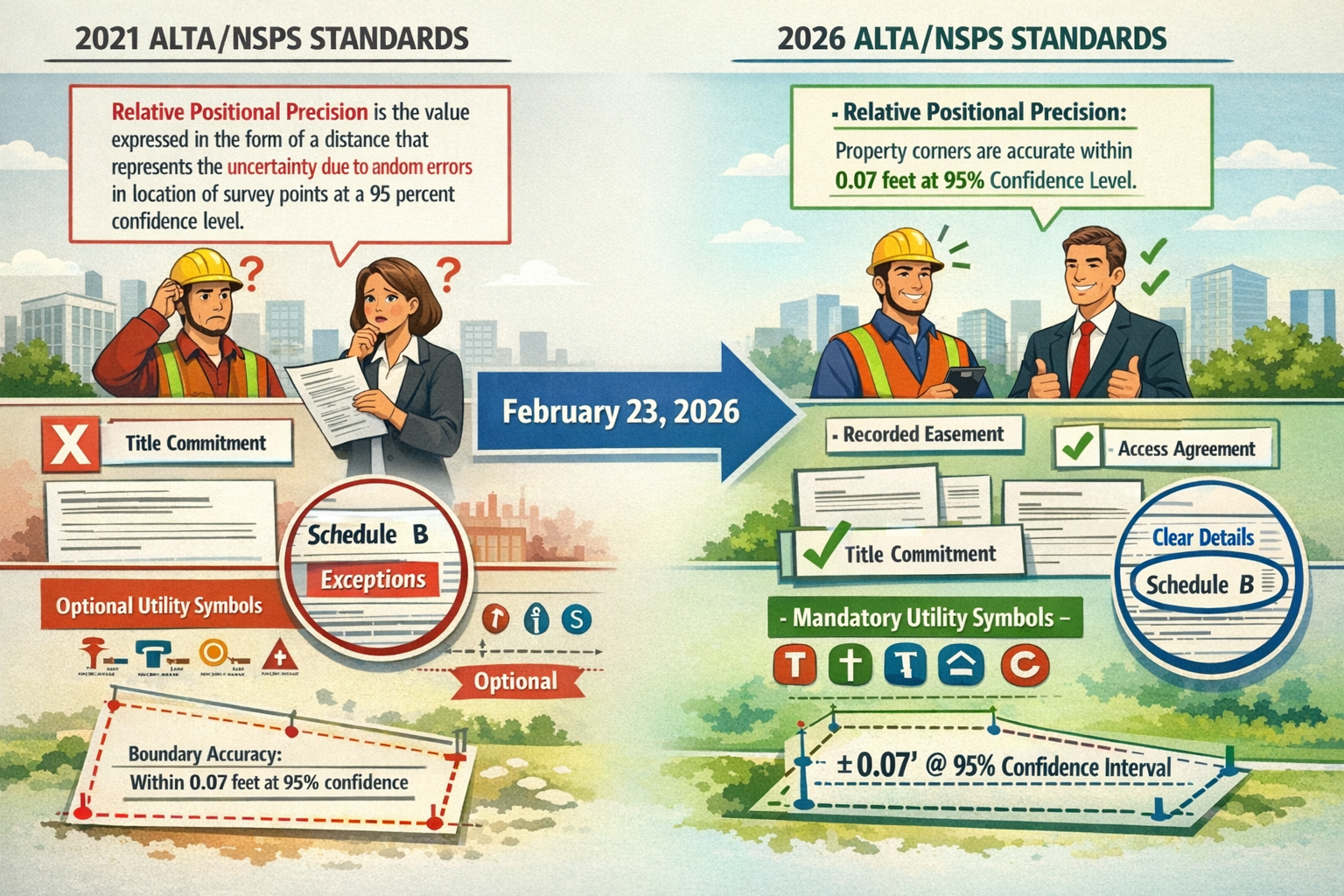
These updated standards represent more than routine maintenance of technical specifications. They address decades-old oversights in field precision requirements, transform previously optional elements into mandatory components, and introduce clearer communication protocols that benefit all stakeholders in property transactions.[5] The revisions emphasize transparency, enhanced documentation, and refined precision requirements that reduce risk across the entire real estate ecosystem.[2]
Whether you're a surveyor preparing for compliance, a title professional interpreting new survey deliverables, or a real estate investor evaluating property documentation, this comprehensive guide provides the practical checklists and strategic insights needed to successfully navigate this transition.
Key Takeaways
📋 Critical compliance points for the 2026 ALTA/NSPS standards:
- Effective Date: February 23, 2026 marks the official implementation of revised standards, though contracts executed before this date may continue using 2021 standards depending on legal interpretation[1][5]
- Mandatory Utility Documentation: Observed evidence of utilities transitions from optional (Table A Item 11(a)) to required on all surveys, addressing longstanding surveyor challenges[5]
- Refined RPP Definition: The updated Relative Positional Precision definition provides clearer statistical measurements accessible to non-technical stakeholders[1][2]
- Expanded Property Scope: Easements are now explicitly included as legitimate subjects for ALTA/NSPS Land Title Surveys[5]
- Enhanced Title Evidence Requirements: Surveyors must receive the most recent title commitment or acceptable alternatives, with mandatory easement reporting and legal description relationship notes[5]
Understanding the 2026 ALTA/NSPS Standards Framework
The Five-Year Update Cycle and Its Significance
The American Land Title Association (ALTA) and National Society of Professional Surveyors (NSPS) jointly maintain these standards on a five-year revision cycle, with the previous update occurring in 2021.[3] This systematic approach ensures that surveying practices evolve alongside technological advancements, legal developments, and industry best practices.
The 2026 revisions represent the culmination of extensive stakeholder feedback, addressing practical challenges that surveyors, title professionals, and real estate practitioners encountered during the 2021 standards period. Unlike minor technical adjustments, these updates fundamentally alter several core requirements that impact daily surveying operations.
Who Benefits from Navigating the 2026 ALTA/NSPS Land Title Survey Updates
The enhanced standards create measurable value for multiple stakeholder groups:
Buyers and Sellers 🏡
- Clearer understanding of property boundaries and encumbrances
- Reduced transaction delays from survey-related disputes
- Enhanced confidence in property documentation accuracy
Title Insurers and Underwriters 📄
- Improved risk assessment through standardized utility documentation
- Reduced claims from undisclosed easements or boundary disputes
- Clearer communication protocols with surveying professionals
Lenders and Investors 💰
- Enhanced due diligence capabilities for property financing
- Standardized documentation across diverse property portfolios
- Reduced exposure to title defects and boundary issues
Land Surveyors 📐
- Clearer performance expectations and deliverable requirements
- Reduced liability through improved documentation standards
- Better alignment between client expectations and professional obligations
For professionals seeking comprehensive property assessments, understanding how these surveying standards complement other evaluation methods is crucial. Building survey services often work in conjunction with land title surveys to provide complete property due diligence.
Key Changes in the 2026 Standards: A Detailed Analysis
1. Revised Relative Positional Precision (RPP) Definition
The most significant technical change in the 2026 standards involves the updated definition and clarification of Relative Positional Precision—a statistical measurement indicating how accurately surveyors locate property boundaries relative to one another.[1][2]
What Changed and Why It Matters
The previous RPP definition used highly technical language that created confusion among non-surveying professionals. The 2026 revision provides:
- Simplified explanatory language accessible to title professionals, lenders, and property owners
- Clearer statistical confidence intervals for boundary location accuracy
- Enhanced transparency in communicating measurement uncertainty
- Standardized reporting formats that facilitate comparison across different surveys
This refinement doesn't alter the underlying mathematical precision requirements but makes the concept comprehensible to stakeholders who rely on survey accuracy without possessing technical surveying expertise.[2]
Practical Implications for Compliance
Surveyors must now:
✅ Provide RPP statements using the updated definition language
✅ Ensure field crews understand the refined precision requirements
✅ Update survey report templates to reflect new explanatory standards
✅ Educate clients on what RPP measurements indicate about boundary confidence
2. Mandatory Utility Documentation Requirements
Perhaps the most operationally impactful change involves utility evidence transitioning from optional to required on all ALTA/NSPS Land Title Surveys.[5]
The Shift from Optional to Mandatory
Under the 2021 standards, observed evidence of utilities was classified as Table A Item 11(a)—an optional element that clients could request for additional cost. The 2026 standards eliminate this optionality, making utility documentation a baseline requirement for all surveys.
| Aspect | 2021 Standards | 2026 Standards |
|---|---|---|
| Status | Optional (Table A Item 11(a)) | Mandatory baseline requirement |
| Client Request | Required for inclusion | Automatically included |
| Cost Structure | Additional fee item | Incorporated in base survey cost |
| Surveyor Obligation | Only if requested | Required on all surveys |
Why This Change Addresses Industry Challenges
This revision responds to several persistent industry problems:
Client Expectation Misalignment 🔌
Many property buyers and lenders assumed utility documentation was standard, creating disputes when surveys lacked this information. The mandatory requirement eliminates this confusion.
One-Call Locate Response Difficulties 📞
Surveyors frequently struggled with incomplete or delayed responses from utility locate services. The mandatory status provides stronger justification for delaying survey completion until adequate utility information is obtained.
Plan Acquisition Challenges 🗺️
Obtaining utility plans from municipalities and service providers often proved time-consuming. The standardized requirement creates industry-wide expectations that may improve response times.
Compliance Checklist for Utility Documentation
Surveyors navigating the 2026 ALTA/NSPS Land Title Survey updates must implement these compliance strategies:
- Initiate utility locate requests at project commencement, not as an afterthought
- Document all utility locate responses including non-responses and incomplete information
- Clearly identify observed utility evidence on survey plats using standardized symbols
- Note utilities that cross or serve the property with appropriate legends
- Include disclaimers regarding subsurface utilities not visibly evident
- Maintain records of utility company contacts and response timelines
- Update fee structures to reflect mandatory utility investigation costs
For properties requiring funding for land development, comprehensive utility documentation becomes particularly critical for lender due diligence.
3. Expanded Property Scope: Easements as Survey Subjects
The 2026 standards explicitly clarify that easements qualify as legitimate subjects for ALTA/NSPS Land Title Surveys.[5] While many surveyors previously surveyed easements, the explicit inclusion removes ambiguity about whether standalone easement surveys meet ALTA/NSPS standards.
Practical Applications
This clarification proves particularly valuable for:
- Utility easement acquisitions requiring precise boundary documentation
- Access easement disputes needing authoritative location verification
- Conservation easement monitoring with standardized documentation requirements
- Easement valuation for tax or compensation purposes
Survey Requirements for Easement-Focused Projects
When the primary survey subject is an easement rather than a fee simple parcel:
✅ Apply all standard ALTA/NSPS requirements to the easement area
✅ Clearly identify the dominant and servient estates
✅ Show the easement's relationship to surrounding property boundaries
✅ Document any encroachments or conflicts within the easement area
✅ Include appropriate title commitment references specific to the easement
4. Enhanced Title Evidence Standards
The 2026 standards refine requirements for the title evidence that surveyors must receive before commencing work.[5]
Primary Requirement: Most Recent Title Commitment
Surveyors must be provided with the most recent title commitment for the property being surveyed. This ensures that the survey addresses current title conditions rather than outdated information.
Acceptable Alternatives When Title Commitment Unavailable
Recognizing that title commitments aren't always immediately available—particularly for certain transaction types or in specific jurisdictions—the standards permit alternative title evidence satisfactory to the title insurer, including:
- Abstracts of title
- Title opinions from qualified attorneys
- Previous title insurance policies
- Equivalent title products recognized in the jurisdiction
This flexibility prevents survey delays while maintaining adequate title information standards.
Mandatory Easement Reporting (Section 5.E.ii)
A critical new requirement mandates that surveys include a summary of plottable easements and servitudes listed in Schedule B2 of the title commitment, accompanied by a statement indicating whether each item appears on the survey plat.[5]
Example Format:
Schedule B2 Easement Summary
- Utility easement recorded in Book 1234, Page 567 — Shown on survey
- Drainage easement per instrument #2023-45678 — Shown on survey
- Pipeline easement described in Deed Book 890, Page 123 — Not plottable from legal description provided
This requirement enhances transparency and helps identify discrepancies between title records and physical conditions.
5. Legal Description Relationship Notes (Section 6.B.ii)
When surveyors prepare new legal descriptions based on survey results, the 2026 standards require an explanatory note describing how the new description relates to the record description.[5]
Why This Matters
Property legal descriptions often contain technical errors, ambiguities, or outdated references. When surveyors create corrected descriptions, stakeholders need to understand:
- Whether the new description represents the same property as the record description
- What discrepancies exist between the descriptions
- Whether boundary adjustments or corrections are involved
- The surveyor's rationale for the revised description
Compliance Example
Required Note Format:
"The legal description prepared by this surveyor and attached hereto as Exhibit A describes the same property as the record description in Deed Book 2345, Page 678, with corrections to bearing and distance errors identified during the survey. The corrected description closes mathematically and reflects the property boundaries as monumented and occupied."
This transparency reduces confusion and potential disputes arising from description discrepancies.
Navigating the 2026 ALTA/NSPS Land Title Survey Updates: Compliance Strategies for Surveyors
Pre-Implementation Preparation Checklist
With the February 23, 2026 effective date approaching, surveyors should complete these preparatory steps:
Administrative and Documentation Updates
- Review all survey report templates and update language to reflect 2026 standards
- Revise fee schedules to incorporate mandatory utility documentation costs
- Update client engagement letters explaining new standard requirements
- Modify proposal templates to reference 2026 standards for new contracts
- Create client education materials explaining key changes and their benefits
- Establish utility locate request protocols with earlier timeline initiation
- Develop easement summary templates for Schedule B2 compliance
Staff Training and Education
- Conduct internal training sessions on revised RPP definition and explanation
- Review utility documentation requirements with field crews
- Practice easement reporting formats with office staff
- Train personnel on legal description relationship notes and appropriate language
- Update quality control checklists to verify 2026 compliance elements
Technology and Systems Updates
- Update survey software templates with 2026-compliant formats
- Modify CAD standards to accommodate mandatory utility documentation
- Review data collection protocols for RPP compliance verification
- Establish digital file naming conventions distinguishing 2021 vs 2026 standard surveys
- Create automated compliance checklists within project management systems
Similar to how professionals must understand the differences between Level 2 and Level 3 surveys for building assessments, surveyors must clearly communicate the distinctions between 2021 and 2026 ALTA/NSPS standards to clients.
Contract Execution Date Considerations
A critical compliance question involves contracts executed before February 23, 2026 but with surveys completed after that date.[5]
The Transition Period Ambiguity
The standards indicate that surveys under contracts executed before the effective date may continue using 2021 standards, though this depends on legal interpretation by individual transaction parties.[5]
Best Practice Recommendations:
✅ Include explicit standard version language in all survey proposals and contracts
✅ Clarify with clients which standard version will govern the survey
✅ Document the agreement in writing to prevent disputes
✅ Consider offering 2026 compliance even for pre-effective-date contracts to avoid confusion
✅ Consult with professional liability insurers regarding coverage implications
Sample Contract Language
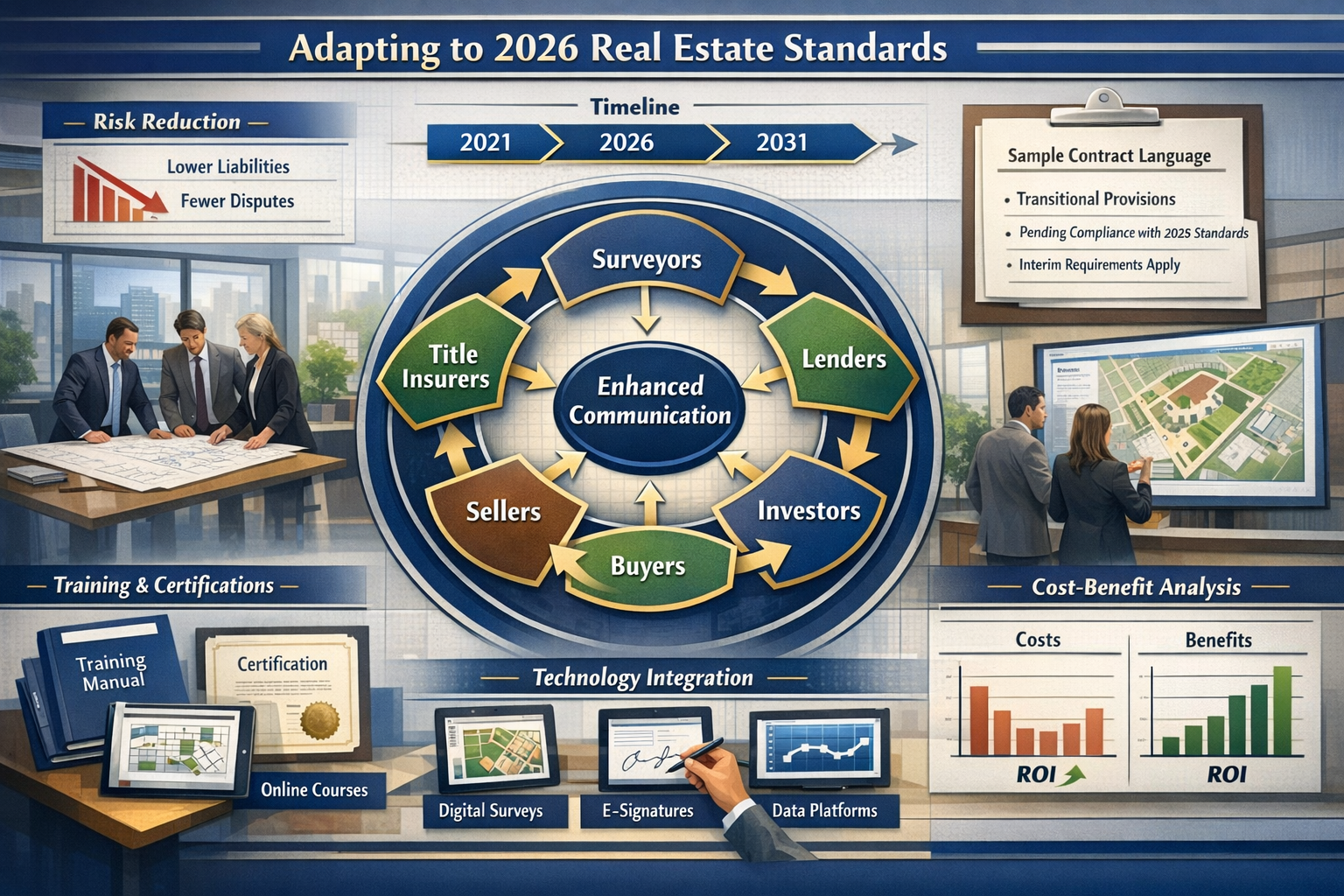
"This survey will be performed in accordance with the [2021 / 2026] Minimum Standard Detail Requirements for ALTA/NSPS Land Title Surveys as jointly established and adopted by ALTA and NSPS, effective [date]. Client acknowledges that [describe any standard-specific implications]."
Quality Control Protocols for 2026 Compliance
Implementing robust quality control ensures consistent compliance with navigating the 2026 ALTA/NSPS Land Title Survey updates:
Multi-Stage Review Process
Stage 1: Field Data Review
- Verify RPP measurements meet refined definition requirements
- Confirm all observed utilities documented with appropriate detail
- Check that easement areas are properly located and monumented
Stage 2: Office Compilation Review
- Verify easement summary completeness against Schedule B2
- Confirm legal description relationship notes when applicable
- Check title evidence documentation in survey files
Stage 3: Final Deliverable Review
- Confirm all 2026-specific elements present on survey plat
- Verify certification language references correct standard version
- Review client communication materials for accuracy
Stage 4: Peer Review (for complex projects)
- Independent surveyor verification of 2026 compliance
- Technical review of RPP calculations and documentation
- Assessment of easement reporting completeness
For professionals working in specific regions, understanding local surveying requirements complements ALTA/NSPS standards. Chartered surveyors in London and other major markets often encounter unique local regulations alongside national standards.
Strategic Implications for Title Professionals and Lenders
Enhanced Due Diligence Capabilities
The 2026 standards provide title professionals and lenders with more comprehensive property information as a baseline expectation rather than an optional add-on.
Mandatory Utility Documentation Benefits
For Title Insurers:
- Reduced exposure to utility easement claims
- Earlier identification of potential conflicts
- Enhanced underwriting accuracy for title policies
For Lenders:
- Improved collateral assessment for property financing
- Better identification of access and utility risks
- Reduced post-closing disputes affecting loan security
Easement Transparency Improvements
The mandatory Schedule B2 easement summary creates a direct correlation between title commitment exceptions and survey depictions, making discrepancies immediately apparent.
Risk Mitigation Applications:
- Identify easements that should appear on surveys but don't
- Flag easements shown on surveys but not listed in title commitment
- Detect potential title curative needs before closing
- Support more accurate property valuation
Updating Internal Procedures and Expectations
Title companies and lending institutions should revise their procedures to leverage the enhanced 2026 standards:
Title Company Action Items
- Update survey ordering procedures to specify 2026 standards for new orders
- Revise underwriting guidelines to reflect mandatory utility documentation
- Train underwriters on new easement summary requirements
- Modify title commitment templates to facilitate surveyor compliance
- Establish protocols for providing alternative title evidence when commitments are unavailable
- Create surveyor communication templates explaining title evidence requirements
Lender Action Items
- Update loan policy requirements to reference 2026 ALTA/NSPS standards
- Revise appraisal review procedures to consider enhanced utility documentation
- Train loan officers on new standard implications for property evaluation
- Modify closing checklists to verify 2026 compliance when applicable
- Establish contract date tracking to determine applicable standard version
Similar to how property owners must understand how long building surveys take, lenders and title professionals should adjust timeline expectations to accommodate the enhanced documentation requirements of 2026 standards.
Common Compliance Pitfalls and How to Avoid Them
Pitfall #1: Inadequate Utility Investigation
The Problem:
Treating mandatory utility documentation as a checkbox exercise rather than a substantive investigation leads to incomplete surveys and potential liability.
The Solution:
✅ Initiate utility locate requests immediately upon project acceptance
✅ Follow up persistently with non-responsive utility companies
✅ Document all investigation efforts, even when unsuccessful
✅ Clearly note on surveys which utilities could not be verified
✅ Include appropriate disclaimers about subsurface conditions
Pitfall #2: Incomplete Easement Summary
The Problem:
Failing to address all Schedule B2 easements or omitting the required statement about whether each appears on the survey.
The Solution:
✅ Create a standardized easement summary template
✅ Cross-reference every Schedule B2 item systematically
✅ Include explicit statements for non-plottable easements
✅ Explain why certain easements cannot be depicted
✅ Request additional information from title companies when descriptions are insufficient
Pitfall #3: Ambiguous Legal Description Relationship Notes
The Problem:
Providing vague or technically confusing explanations of how new legal descriptions relate to record descriptions.
The Solution:
✅ Use clear, plain language accessible to non-surveyors
✅ Specifically identify the record description being referenced
✅ Explain the nature of any corrections or adjustments
✅ Indicate whether the new description represents the same property
✅ Consult with title professionals when relationship is complex
Pitfall #4: Contract Standard Version Confusion
The Problem:
Uncertainty about which standard version applies to surveys straddling the February 23, 2026 effective date.
The Solution:
✅ Include explicit standard version language in all contracts
✅ Clarify applicability with clients before commencing work
✅ Document agreements in writing
✅ Maintain clear project records indicating applicable standards
✅ Consider adopting 2026 standards universally to avoid confusion
Pitfall #5: Inadequate RPP Explanation
The Problem:
Using the updated RPP definition without ensuring clients understand its practical meaning.
The Solution:
✅ Provide supplementary client education materials
✅ Explain RPP in proposal and engagement communications
✅ Use visual aids to illustrate precision concepts
✅ Relate RPP to practical boundary confidence levels
✅ Offer to discuss technical aspects with interested clients
For professionals managing multiple property assessments, understanding compliance across different survey types is essential. Building pathology assessments and land title surveys often complement each other in comprehensive property due diligence.
Technology Solutions for 2026 Compliance
Survey Software Updates and Automation
Modern surveying software platforms are incorporating 2026 standard requirements through:
Automated Compliance Checklists
- Digital verification of all mandatory elements
- Warning systems for missing required components
- Version control distinguishing 2021 vs 2026 deliverables
Template Libraries
- Pre-formatted easement summary tables
- Standard legal description relationship note language
- Updated certification blocks with correct standard references
Utility Documentation Tools
- Integrated utility locate request tracking
- Digital markup tools for utility evidence
- Standardized utility legend libraries
Data Collection and RPP Verification
Advanced total stations and GPS equipment facilitate RPP compliance through:
- Real-time precision monitoring during field observations
- Automated calculation of relative positional precision
- Digital documentation of measurement redundancy
- Quality control alerts when precision thresholds aren't met
Digital Collaboration Platforms
Cloud-based collaboration tools enhance compliance by:
- Facilitating title evidence sharing between title companies and surveyors
- Enabling real-time review and feedback on draft surveys
- Maintaining audit trails of standard version specifications
- Streamlining easement information exchange
Regional Considerations and Variations
While ALTA/NSPS standards provide national consistency, regional variations affect implementation:
Jurisdictional Title Evidence Differences
Some states and localities have unique title evidence practices that affect surveyor compliance:
Abstract States
- Title commitments may be less common
- Alternative title evidence provisions become particularly relevant
- Surveyors should establish relationships with local abstractors
Attorney Opinion States
- Title opinions may serve as primary title evidence
- Surveyors should understand local opinion formats
- Communication protocols with attorneys become essential
Title Insurance Variations
- Different title companies may have varying easement documentation practices
- Surveyors should establish company-specific communication protocols
Local Surveying Regulations
State licensing boards may impose additional requirements beyond ALTA/NSPS standards:
- Specific certification language mandates
- Additional monumentation requirements
- Enhanced precision standards for certain property types
- Supplementary disclosure obligations
Professionals working in specific markets should understand both national standards and local requirements. Chartered surveyors in North London and other regional specialists often navigate complex local regulatory environments alongside ALTA/NSPS compliance.
Cost Implications and Fee Structure Adjustments
Impact on Survey Pricing
The mandatory utility documentation requirement fundamentally alters cost structures for ALTA/NSPS surveys:
Previous Model (2021 Standards):
- Base survey fee + optional Table A items
- Utility documentation as additional charge
- Client choice regarding optional elements
New Model (2026 Standards):
- Comprehensive base fee including utility documentation
- Fewer optional add-ons
- More predictable pricing for standard surveys
Communicating Value to Clients
Surveyors should emphasize the enhanced value proposition of 2026-compliant surveys:
✅ Comprehensive baseline information reduces need for supplementary investigations
✅ Mandatory utility documentation prevents costly post-closing surprises
✅ Enhanced easement reporting facilitates more accurate property valuation
✅ Improved transparency reduces transaction delays and disputes
✅ Standardized deliverables simplify comparison and review processes
Competitive Positioning
Firms that effectively navigate the 2026 ALTA/NSPS Land Title Survey updates can differentiate themselves through:
- Early adoption and demonstrated expertise
- Client education initiatives explaining new standard benefits
- Technology investments enabling efficient compliance
- Quality assurance programs ensuring consistent deliverables
- Specialized services for complex easement surveys
Training and Professional Development Resources
Industry Association Programs
American Land Title Association (ALTA)
- Webinars explaining 2026 standard changes
- Sample survey deliverables demonstrating compliance
- Title professional education on survey interpretation
National Society of Professional Surveyors (NSPS)
- Technical training on RPP requirements
- Best practice guidance for utility documentation
- Continuing education credits for compliance training
State Surveying Societies
Local professional organizations often provide:
- Regional compliance workshops
- Peer discussion forums
- State-specific implementation guidance
- Networking opportunities with title professionals
Internal Training Programs
Surveying firms should develop comprehensive internal training covering:
Technical Competencies
- Updated RPP calculation and documentation
- Utility investigation protocols
- Easement location and reporting techniques
Communication Skills
- Client education on standard changes
- Title company collaboration
- Legal description explanation abilities
Quality Control Procedures
- 2026 compliance verification checklists
- Peer review protocols
- Deliverable review standards
Future Outlook: The 2031 Standards Cycle
Understanding the 2026 updates provides insight into the ongoing evolution of ALTA/NSPS standards:
Emerging Trends to Monitor
Technology Integration
- Increased use of drone surveys and photogrammetry
- Enhanced GPS precision capabilities
- Digital delivery format standardization
- Blockchain applications for survey recordation
Environmental Considerations
- Climate change impact documentation
- Flood zone verification requirements
- Environmental contamination disclosure
Data Privacy and Security
- Protected information handling protocols
- Cybersecurity standards for digital deliverables
- Client data retention requirements
Preparing for Continuous Evolution
Successful firms adopt a continuous improvement mindset rather than reactive compliance:
✅ Monitor industry discussions and proposed changes
✅ Participate in standards development comment periods
✅ Invest in adaptable technology platforms
✅ Maintain flexible operational procedures
✅ Cultivate relationships with standards organizations
For professionals managing diverse property portfolios, understanding how surveying standards evolve alongside other assessment methodologies is crucial. Building defects surveys and other specialized assessments similarly undergo periodic updates to reflect industry advancements.
Case Studies: Practical Applications of 2026 Standards
Case Study 1: Commercial Property with Complex Utility Infrastructure
Scenario:
A 5-acre commercial property with multiple utility easements, underground services, and access rights required an ALTA/NSPS survey for acquisition financing.
2021 Standards Approach:
- Client requested utility documentation as optional Table A item
- Additional fee and timeline for utility investigation
- Potential for incomplete utility information if budget-constrained
2026 Standards Approach:
- Comprehensive utility documentation included as baseline requirement
- Earlier project initiation to accommodate utility locate timelines
- Complete utility evidence provided without additional negotiation
- Enhanced lender confidence in collateral assessment
Outcome:
The mandatory utility requirement prevented a potential post-closing discovery of conflicting utility easements that could have affected the property's development potential.
Case Study 2: Easement-Only Survey for Conservation Purposes
Scenario:
A land trust required an ALTA/NSPS survey of a conservation easement encumbering a 50-acre agricultural property.
2021 Standards Ambiguity:
- Uncertainty about whether easement-only surveys met ALTA/NSPS requirements
- Potential for non-standard deliverables
- Questions about applicability of various standard elements
2026 Standards Clarity:
- Explicit inclusion of easements as survey subjects
- Clear applicability of all standard requirements to easement area
- Standardized deliverable format for easement surveys
Outcome:
The explicit easement inclusion provided confidence that the survey met national standards, facilitating the land trust's documentation requirements and potential future enforcement needs.
Case Study 3: Residential Property with Title Description Errors
Scenario:
A residential property survey revealed significant discrepancies between the record legal description and actual monumented boundaries.
2021 Standards Approach:
- Surveyor prepared corrected legal description
- Limited explanation of relationship to record description
- Potential for title company confusion about property identity
2026 Standards Approach:
- Surveyor prepared corrected legal description with comprehensive relationship note
- Clear explanation that corrected description represents same property with technical corrections
- Specific identification of bearing and distance errors in record description
Outcome:
The enhanced explanation facilitated title company understanding and streamlined the title curative process, preventing closing delays.
Conclusion: Embracing the 2026 Standards for Professional Excellence
Navigating the 2026 ALTA/NSPS Land Title Survey updates represents both a compliance obligation and a professional opportunity. The revised standards—with their enhanced utility documentation, refined RPP definitions, expanded easement scope, and improved title evidence requirements—create a more transparent, comprehensive, and reliable surveying framework that benefits all real estate transaction stakeholders.[1][2][5]
The February 23, 2026 effective date is rapidly approaching, making immediate preparation essential for surveyors, title professionals, lenders, and real estate practitioners. Those who proactively implement these changes will position themselves as industry leaders, while those who delay risk compliance gaps, client confusion, and competitive disadvantage.
Actionable Next Steps
For Surveyors:
- Complete template and documentation updates before February 23, 2026
- Conduct comprehensive staff training on all standard revisions
- Establish utility investigation protocols with earlier timeline initiation
- Update fee structures to reflect mandatory utility documentation
- Create client education materials explaining standard benefits
- Implement quality control checklists verifying 2026 compliance
For Title Professionals:
- Revise survey ordering procedures to specify 2026 standards
- Update underwriting guidelines incorporating new requirements
- Establish surveyor communication protocols for title evidence provision
- Train staff on easement summary interpretation
- Modify title commitment formats to facilitate surveyor compliance
For Lenders and Investors:
- Update loan policies referencing 2026 ALTA/NSPS standards
- Revise due diligence checklists to verify appropriate standard version
- Adjust timeline expectations for comprehensive utility documentation
- Leverage enhanced survey information for improved risk assessment
- Establish vendor qualification criteria ensuring surveyor compliance capabilities
For Real Estate Professionals:
- Educate clients about enhanced survey deliverables under 2026 standards
- Adjust transaction timelines to accommodate thorough survey completion
- Coordinate with surveyors and title companies on standard applicability
- Recognize value of comprehensive baseline documentation
- Incorporate survey findings into property marketing and negotiation strategies
The 2026 ALTA/NSPS Land Title Survey standards represent a significant advancement in property documentation practices. By understanding the key changes, implementing robust compliance strategies, and embracing the enhanced transparency these standards provide, real estate professionals can navigate this transition successfully while delivering superior value to clients and stakeholders.
The five-year standards cycle ensures continuous evolution, making ongoing professional development and adaptability essential competencies. Those who view these updates not as burdensome compliance requirements but as opportunities for professional excellence will thrive in an increasingly sophisticated real estate marketplace.
For comprehensive property assessment services that complement land title surveys, consider exploring full building survey options and specialized environmental assessments that together provide complete property due diligence.
References
[1] 20251125 Key Updates To The 2026 Altansps Land Title Survey Standards – alta.org
[2] New 2026 Minimum Standard Detail 3684174 – jdsupra.com
[3] 2026 Alta Nsps Land Title Survey Standards – partneresi.com
[4] New 2026 Altansps Minimum Standard Detail Requirements – osls.org
[5] nsps.us – nsps.us.com
[6] Alta Standards Updated – cretelligent.com