

The UK property market stands at the threshold of its most significant transformation in decades. With proposed reforms to mandate upfront property condition assessments before homes are listed for sale, the surveying industry faces unprecedented changes that could reshape demand patterns, pricing structures, and operational models. As 2026 progresses and potential implementation looms in 2027, Mandatory Property Condition Assessments and Surveyor Demand: Preparing for Potential Homebuying Reform Implementation in 2026-2027 has become the central concern for chartered surveyors, property professionals, and homebuyers alike.
The shift from buyer-initiated surveys to mandatory seller-commissioned assessments represents more than a procedural change—it fundamentally alters when, how, and why building surveys are conducted[1]. For surveying practices, this means preparing for a potential surge in demand, restructuring service delivery models, and adapting pricing strategies to accommodate a completely different client base.
Key Takeaways
- Responsibility Transfer: Proposed reforms will shift property condition assessment responsibility from buyers to sellers, requiring surveys before listing rather than during purchase negotiations[2]
- Demand Surge Expected: Surveying practices should prepare for substantial workload increases as every property listing could require mandatory upfront assessments
- Operational Transformation: Firms will need to restructure capacity, pricing models, and service delivery to accommodate seller-focused rather than buyer-focused workflows
- Timeline Uncertainty: While reforms are under active consultation in 2026, implementation timing remains uncertain, requiring flexible preparation strategies
- Strategic Opportunity: Early-adopting surveyors who prepare infrastructure and marketing now will gain competitive advantage when reforms take effect
Understanding the Proposed Reform Framework
What Are Mandatory Property Condition Assessments?
The proposed mandatory property condition assessments represent a fundamental restructuring of the UK homebuying process. Rather than buyers commissioning surveys after making offers—the current standard practice—sellers would be required to obtain professional property condition reports before listing their homes for sale.
This approach mirrors successful models in other jurisdictions and aims to address several chronic problems in the UK property market:
- Reduced transaction fall-throughs caused by unexpected survey findings late in the process
- Greater transparency for buyers making initial offers
- Fewer aborted surveys when multiple buyers commission separate assessments on the same property
- Accelerated transaction timelines with condition information available upfront
The assessments would likely follow standardized formats similar to existing building survey reports, but with specific requirements tailored to the pre-listing context.
Timeline and Implementation Prospects for 2026-2027
As of 2026, the reform proposals remain under active consultation. While housing policy has become a major federal priority, with multiple legislative initiatives underway[5], the specific timeline for mandatory assessment implementation remains uncertain.
Current Status (2026):
- Consultation papers circulated among industry stakeholders
- Pilot programs under consideration in select regions
- Professional bodies providing feedback on practical implementation challenges
- Technology providers developing digital platforms to support the new workflow
Potential Implementation Scenarios:
| Scenario | Timeline | Probability | Impact on Surveyors |
|---|---|---|---|
| Fast-Track | Q3-Q4 2026 | Low | Immediate surge, limited preparation time |
| Phased Rollout | Q1 2027 onwards | Moderate | Gradual demand increase, regional variation |
| Delayed Implementation | 2028+ | Moderate | Extended preparation period, market uncertainty |
| Modified Reform | Varies | High | Voluntary schemes or limited mandatory requirements |
The most likely scenario involves phased implementation beginning in 2027, giving surveying practices throughout 2026 to prepare infrastructure, staffing, and operational models.
How This Differs from Current Practice
The transformation from current practice to mandatory upfront assessments involves several critical shifts that will fundamentally reshape when and how building surveys are conducted[1]:
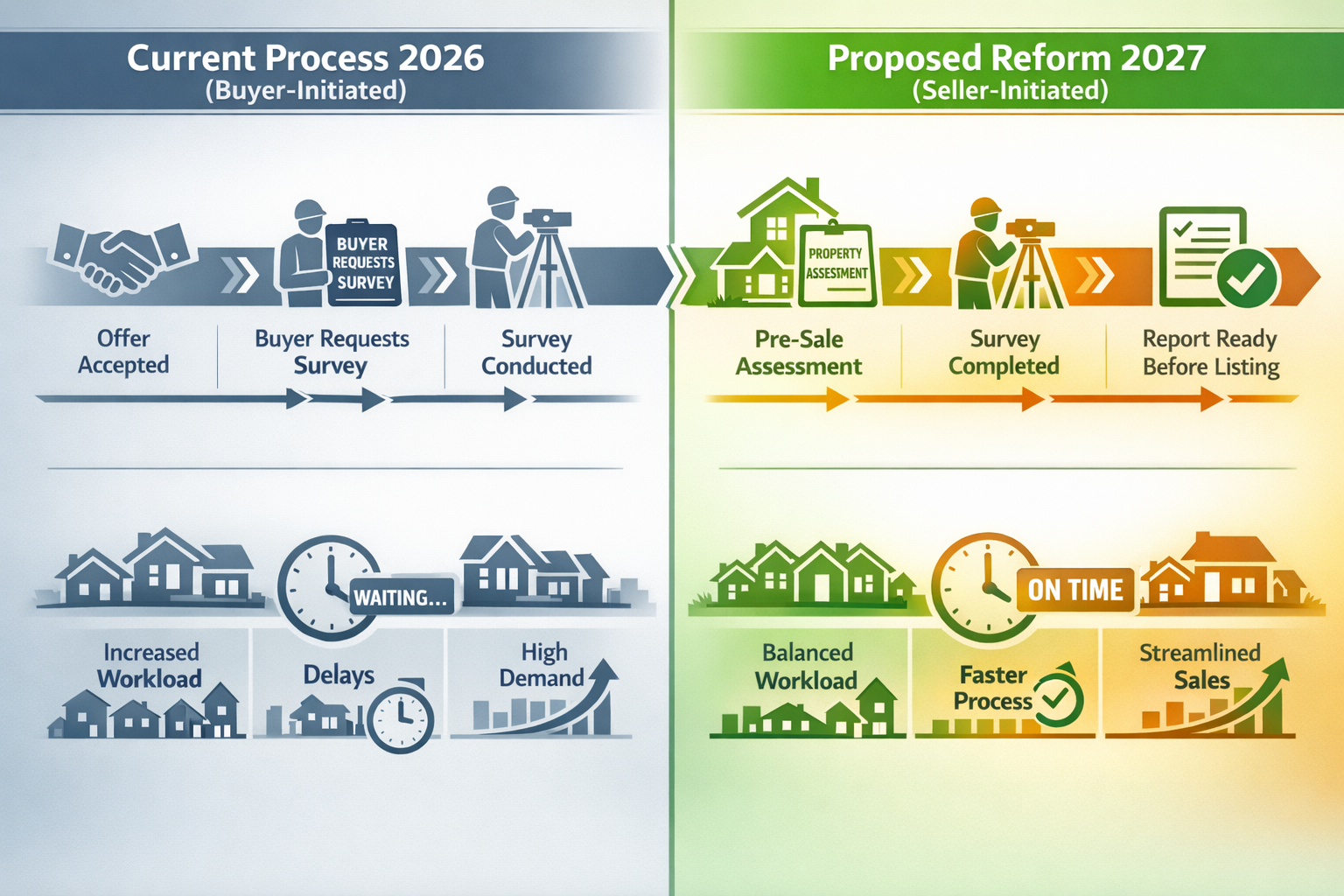
Current Model (2026):
- Buyer identifies property and makes offer
- Offer accepted subject to survey
- Buyer commissions surveyor of choice
- Survey conducted during conveyancing period
- Results may trigger renegotiation or withdrawal
Proposed Model (2027+):
- Seller commissions assessment before listing
- Property marketed with condition report attached
- Buyers review assessment before making offers
- Offers reflect known property condition
- Buyers may still commission additional specialist surveys
This shift transfers both responsibility and timing, creating entirely different demand patterns for surveying services.
Mandatory Property Condition Assessments and Surveyor Demand: Analyzing the Capacity Challenge
Projected Demand Increases
The introduction of mandatory upfront assessments will substantially transform building surveyor workloads[2]. While precise projections vary, industry analysts suggest several demand factors:
Volume Considerations:
- Approximately 1.2 million residential property transactions occur annually in the UK
- Current survey penetration estimated at 60-70% of transactions
- Mandatory assessments would require surveys for 100% of listings
- Properties may remain listed for extended periods, requiring periodic reassessments
Multiplier Effects:
- Properties that previously never received surveys (cash purchases, certain investor transactions) would now require assessments
- Failed sales would necessitate updated assessments for re-listing
- Buyers may still commission additional Level 3 full building surveys for added assurance
Conservative estimates suggest demand could increase by 40-60% in the first year following implementation, with sustained elevated demand thereafter.
Regional Variation in Impact
The impact of mandatory assessments will vary significantly across UK regions based on current survey penetration rates and market characteristics:
High-Impact Regions:
- London and Southeast: Already high survey rates, but transaction volumes will drive substantial absolute demand increases
- Hot markets with rapid turnover will see compressed timelines and capacity pressure
- Areas served by chartered surveyors in Central London, Fulham, and South West London should prepare for immediate surge
Moderate-Impact Regions:
- Commuter belt areas including Hemel Hempstead, Weybridge, and Epsom
- County markets in Buckinghamshire, Oxfordshire, and Sussex
Transformation Regions:
- Areas with historically low survey penetration will see proportionally larger increases
- Rural markets where cash purchases are common
- Investment property hotspots
Capacity Constraints and Bottlenecks
The surveying profession faces several capacity constraints that could create bottlenecks during transition:
Workforce Limitations:
- Limited pipeline of newly qualified chartered surveyors
- Aging workforce with retirements reducing capacity
- Training requirements of 2-3 years for full qualification
- Competition from other construction professions for talent
Geographic Imbalances:
- Surveyor concentration in major urban centers
- Rural and suburban areas already underserved
- Travel time constraints limiting daily inspection capacity
Seasonal Pressures:
- Traditional spring/summer property market peaks
- Compressed timelines during high-demand periods
- Weather-dependent inspection requirements
Practices that fail to address these constraints risk losing market share to better-prepared competitors or new market entrants.
Strategic Preparation for Surveying Practices

Workforce Planning and Recruitment
Preparing for Mandatory Property Condition Assessments and Surveyor Demand: Preparing for Potential Homebuying Reform Implementation in 2026-2027 requires proactive workforce strategies:
Immediate Actions (2026):
- 📊 Conduct capacity audits: Map current surveyor availability against projected demand scenarios
- 🎯 Begin recruitment campaigns: Start hiring processes now for positions needed in 2027
- 📚 Invest in training programs: Develop internal training to accelerate junior surveyor development
- 🤝 Establish partnerships: Create relationships with surveying schools and professional programs
Medium-Term Strategies:
- Apprenticeship programs to build long-term pipeline
- Retention initiatives to prevent talent loss to competitors
- Flexible working arrangements to attract broader talent pool
- Specialist teams focused on pre-listing assessments
Alternative Capacity Solutions:
- Subcontracting arrangements with vetted independent surveyors
- Regional partnerships for geographic coverage
- Technology solutions to increase surveyor productivity
- Administrative support to free surveyors for technical work
Technology and Process Innovation
Technology will play a crucial role in managing increased demand efficiently:
Digital Survey Tools:
- Premium drone surveys for roof and elevation assessment
- Thermal imaging for moisture and insulation analysis
- Digital reporting platforms for faster turnaround
- Mobile inspection apps with real-time data capture
Workflow Optimization:
- Automated scheduling systems to maximize surveyor utilization
- Template libraries for common property types
- Quality assurance protocols for consistency
- Client portals for seamless report delivery
Data Management:
- Centralized databases for property condition histories
- Analytics tools for identifying common defects by property type
- Integration with estate agent listing platforms
- Compliance tracking for regulatory requirements
Practices that invest in technology infrastructure now will achieve competitive advantages in efficiency and service quality.
Pricing Strategy Considerations
The shift to seller-commissioned surveys requires fundamental pricing model adjustments:
Current Buyer-Focused Pricing:
- Individual transaction basis
- Price varies by property size and survey level
- Buyer controls timing and urgency
- Limited price sensitivity (embedded in transaction costs)
New Seller-Focused Pricing:
- Volume discounts for estate agents or developers with multiple listings
- Subscription models for property management companies
- Tiered pricing based on turnaround time requirements
- Package deals combining assessment with other pre-listing services
Strategic Pricing Questions:
- Should pre-listing assessments be priced lower than current buyer surveys?
- How to structure pricing for assessment updates when properties don't sell quickly?
- What premium for expedited service during market peaks?
- How to price additional buyer-commissioned surveys on properties with existing assessments?
Successful practices will develop flexible pricing structures that accommodate different seller segments while maintaining profitability.
Marketing and Client Relationship Shifts
The client transformation from buyers to sellers requires completely different marketing approaches:
New Target Audiences:
- 🏠 Individual sellers preparing to list properties
- 🏢 Estate agents requiring assessments for all listings
- 🏗️ Property developers with multiple units to assess
- 💼 Institutional landlords with portfolio turnover
Marketing Messages:
- Emphasis on faster sales through upfront transparency
- Risk mitigation by identifying issues before listing
- Competitive advantage of condition-certified properties
- Regulatory compliance with mandatory requirements
Relationship Building:
- Partnerships with estate agents for referral arrangements
- Educational content for sellers about assessment benefits
- Streamlined onboarding processes for new seller clients
- Service level agreements for consistent turnaround times
Practices should begin developing seller-focused marketing materials and relationships now, before implementation creates urgent demand.
Operational Challenges and Solutions
Quality Assurance Under Volume Pressure
Maintaining survey quality while managing increased volume presents significant challenges:
Quality Risks:
- Rushed inspections missing critical defects
- Inconsistent reporting standards across surveyors
- Reduced detail in standardized pre-listing formats
- Pressure to minimize findings that might deter buyers
Quality Protection Strategies:
- Standardized checklists ensuring comprehensive coverage
- Peer review systems for quality control
- Continuing education on common defects and building problems
- Professional indemnity insurance review for increased exposure
- Clear scope definitions distinguishing pre-listing assessments from detailed building surveys
Maintaining professional standards while scaling operations will separate successful practices from those that struggle with reform implementation.
Managing Seller Expectations
Sellers as survey clients present different expectation management challenges than buyers:
Seller Concerns:
- Fear that negative findings will reduce property value
- Pressure to minimize or downplay defects
- Desire for fastest possible turnaround
- Cost sensitivity (new expense not previously incurred)
Professional Responses:
- Clear communication about surveyor independence and professional obligations
- Education about how transparency actually facilitates sales
- Evidence from pilot programs showing benefits of upfront disclosure
- Standardized formats that prevent perception of bias
- Realistic timelines that balance speed with thoroughness
Developing seller-specific client communication protocols will be essential for successful practice adaptation.
Integration with Estate Agency Workflows
Seamless integration with estate agent processes will be critical for efficiency:
Coordination Requirements:
- Timing assessments to align with listing preparation
- Digital report formats compatible with listing platforms
- Clear protocols for assessment updates and validity periods
- Handling situations where assessments reveal significant issues before listing
Partnership Opportunities:
- Preferred provider arrangements with estate agencies
- Technology integration for automated referrals
- Joint marketing of "assessment-ready" listing services
- Shared client education about reform benefits
Practices that establish strong estate agent relationships early will secure advantageous referral positions.
Preparing for Different Implementation Scenarios
Scenario Planning Framework
Given uncertainty about exact implementation timing and requirements, successful practices should prepare for multiple scenarios:
Scenario 1: Comprehensive Mandatory Implementation (2027)
- Preparation: Full capacity expansion, complete process redesign, aggressive recruitment
- Investment Level: High
- Risk: Over-preparation if delayed or modified
Scenario 2: Phased Regional Rollout (2027-2028)
- Preparation: Flexible capacity that can scale by region
- Investment Level: Moderate, staged
- Risk: Regional imbalances in capacity
Scenario 3: Voluntary Scheme with Incentives (2027+)
- Preparation: Marketing-focused approach, premium positioning
- Investment Level: Lower, marketing-heavy
- Risk: Limited demand increase
Scenario 4: Modified Requirements (2027+)
- Preparation: Flexible service offerings, multiple assessment levels
- Investment Level: Moderate, adaptable
- Risk: Uncertainty in service design
Recommended Approach: Develop core capabilities applicable across scenarios (technology, training, seller marketing) while maintaining flexibility in capacity expansion timing.
Learning from International Models
Several jurisdictions have implemented mandatory seller disclosure or assessment requirements, offering lessons for UK implementation:
France (Diagnostics Immobiliers):
- Mandatory technical diagnostics before sale
- Standardized assessment categories
- Lesson: Clear scope definitions prevent disputes
Australia (Building and Pest Inspections):
- Common but not universally mandatory
- Strong market expectation drives adoption
- Lesson: Cultural shift takes time but becomes normalized
United States (Seller Disclosure):
- Disclosure requirements vary by state
- Professional inspections common but buyer-initiated
- Lesson: Hybrid models possible with both seller disclosure and buyer verification
UK practices should study these models while recognizing unique aspects of the UK property market and legal framework.
Regulatory and Professional Standards Development
As reforms approach implementation, regulatory frameworks will evolve:
Expected Developments:
- Standardized assessment formats defining minimum scope
- Qualification requirements for pre-listing assessors
- Validity periods for assessments before requiring updates
- Liability frameworks clarifying surveyor responsibilities
- Complaint mechanisms for inadequate assessments
Practice Preparation:
- Monitor Royal Institution of Chartered Surveyors (RICS) guidance development
- Participate in consultation processes
- Ensure professional indemnity insurance coverage adapts
- Develop internal standards exceeding minimum requirements
- Train staff on new regulatory frameworks
Staying ahead of regulatory developments will position practices as industry leaders rather than reactive followers.
Opportunities Beyond Compliance
Value-Added Service Development
Mandatory assessments create opportunities for complementary services:
Enhanced Assessment Packages:
- Basic mandatory assessment plus optional detailed surveys
- Specialist inspections (electrical, drainage, structural)
- Energy efficiency assessments and EPC considerations
- Pre-sale repair prioritization guidance
Seller Support Services:
- Pre-assessment property preparation consultations
- Defect remediation project management
- Property renovation advice to maximize value
- Documentation packages for historical property issues
Buyer Verification Services:
- Independent review of seller-commissioned assessments
- Specialist follow-up surveys for specific concerns
- Negotiation support based on assessment findings
- Post-purchase defect prioritization planning
Diversified service offerings will generate additional revenue streams beyond basic mandatory assessments.
Market Positioning Strategies
Different practices will adopt different competitive positioning:
Volume Provider Strategy:
- High-efficiency, technology-enabled operations
- Competitive pricing through scale
- Estate agent partnerships for volume referrals
- Standardized service delivery
Premium Quality Strategy:
- Enhanced assessment detail beyond minimum requirements
- Specialized expertise (period properties, older homes, specific construction types)
- Higher pricing justified by superior service
- Individual seller relationships
Specialist Niche Strategy:
- Focus on specific property types or regions
- Deep expertise in particular building issues
- Premium pricing for specialized knowledge
- Referral-based business model
Technology Leader Strategy:
- Cutting-edge inspection technology
- Superior digital reporting and client experience
- Efficiency advantages in turnaround time
- Innovation-focused marketing
Practices should consciously choose positioning aligned with their strengths and market opportunities.
Building Long-Term Client Relationships
The seller-client model enables different relationship dynamics:
Repeat Business Opportunities:
- Sellers may own multiple properties over time
- Estate agents provide ongoing referral relationships
- Property investors require regular assessments for portfolio turnover
- Developers need assessments for multiple units
Relationship Development Tactics:
- Client portals providing long-term access to assessment records
- Educational content about property maintenance and value preservation
- Periodic check-ins for properties that haven't sold
- Loyalty programs for repeat clients
Cross-Selling Opportunities:
- Valuation services for estate planning
- Party wall services for renovation projects
- Specialized valuations (inheritance tax, SIPP pension, leasehold extension)
- Ongoing property consultancy relationships
The shift to seller clients creates opportunities for deeper, more sustained professional relationships than transactional buyer surveys typically allow.
Conclusion
Mandatory Property Condition Assessments and Surveyor Demand: Preparing for Potential Homebuying Reform Implementation in 2026-2027 represents both the most significant challenge and opportunity facing the surveying profession in decades. The proposed shift from buyer-initiated surveys to mandatory seller-commissioned assessments will fundamentally reshape demand patterns, client relationships, operational models, and competitive dynamics.
While implementation timing remains uncertain as consultations continue through 2026, the direction of travel is clear. Surveying practices that begin preparing now—expanding capacity, investing in technology, developing seller-focused marketing, and building estate agent partnerships—will be positioned to thrive when reforms take effect. Those that delay preparation risk being overwhelmed by demand surges or losing market share to better-prepared competitors.
Key Action Steps for Surveying Practices
✅ Immediate (Q2-Q3 2026):
- Conduct capacity audits and demand scenario modeling
- Begin recruitment processes for additional surveyors
- Invest in digital survey technology and workflow systems
- Develop seller-focused marketing materials and messaging
- Establish initial estate agent partnership discussions
✅ Near-Term (Q4 2026-Q1 2027):
- Implement training programs for existing staff
- Launch seller-focused marketing campaigns
- Finalize estate agent referral arrangements
- Test new pricing models and service packages
- Monitor regulatory guidance development
✅ Implementation Phase (2027):
- Scale capacity based on actual demand patterns
- Refine processes based on early implementation experience
- Expand value-added service offerings
- Build long-term client relationships
- Position as industry leader in reformed market
The practices that view these reforms not as regulatory burden but as strategic opportunity will emerge as market leaders in the transformed property transaction landscape. The time to prepare is now—2026 offers a critical window for building the infrastructure, relationships, and capabilities that will define success when mandatory property condition assessments become reality.
For surveyors committed to professional excellence and buying a home stakeholders seeking to understand the coming changes, proactive preparation will separate those who thrive from those who merely survive the transformation ahead.
References
[1] Homebuying Process Reforms 2026 Impact On Early Building Surveys And Valuation Timing – nottinghillsurveyors.com
[2] Homebuying Process Reforms 2026 How Mandatory Upfront Surveys Will Transform Building Surveyor Workloads – nottinghillsurveyors.com
[3] State Legislatures And Housing Reform January 2026 – housingaffordabilityinstitute.org
[4] Housing Reform States Menu Options 2026 – mercatus.org
[5] Housing 2026 Preview – capstonedc.com