

Buyer demand has plummeted to its weakest point in nearly three years, with new buyer enquiries falling to a net balance of -39% in March 2026—a stark deterioration from -29% just one month earlier [5]. This dramatic shift, driven by Middle East conflict and rising borrowing costs, has fundamentally altered how property buyers approach due diligence in an increasingly uncertain market. Level 3 RICS Surveys in Cautious 2026 Markets: Enhancing Buyer Certainty Amid Flat Prices and Geopolitical Volatility have become essential tools for navigating subdued demand and protecting investments when traditional market signals offer little guidance.
The property landscape in 2026 presents unique challenges. Transaction volumes have softened considerably, with agreed sales dropping to -34% in March from -13% in February [5]. Near-term house price expectations collapsed from -19% to -43% in the same period [5], while twelve-month outlook projections shifted from a robust +43% in January to a barely positive +2% by March [5]. Against this backdrop of flattening prices and heightened geopolitical risk, comprehensive property surveys have transformed from optional extras into critical risk management instruments.
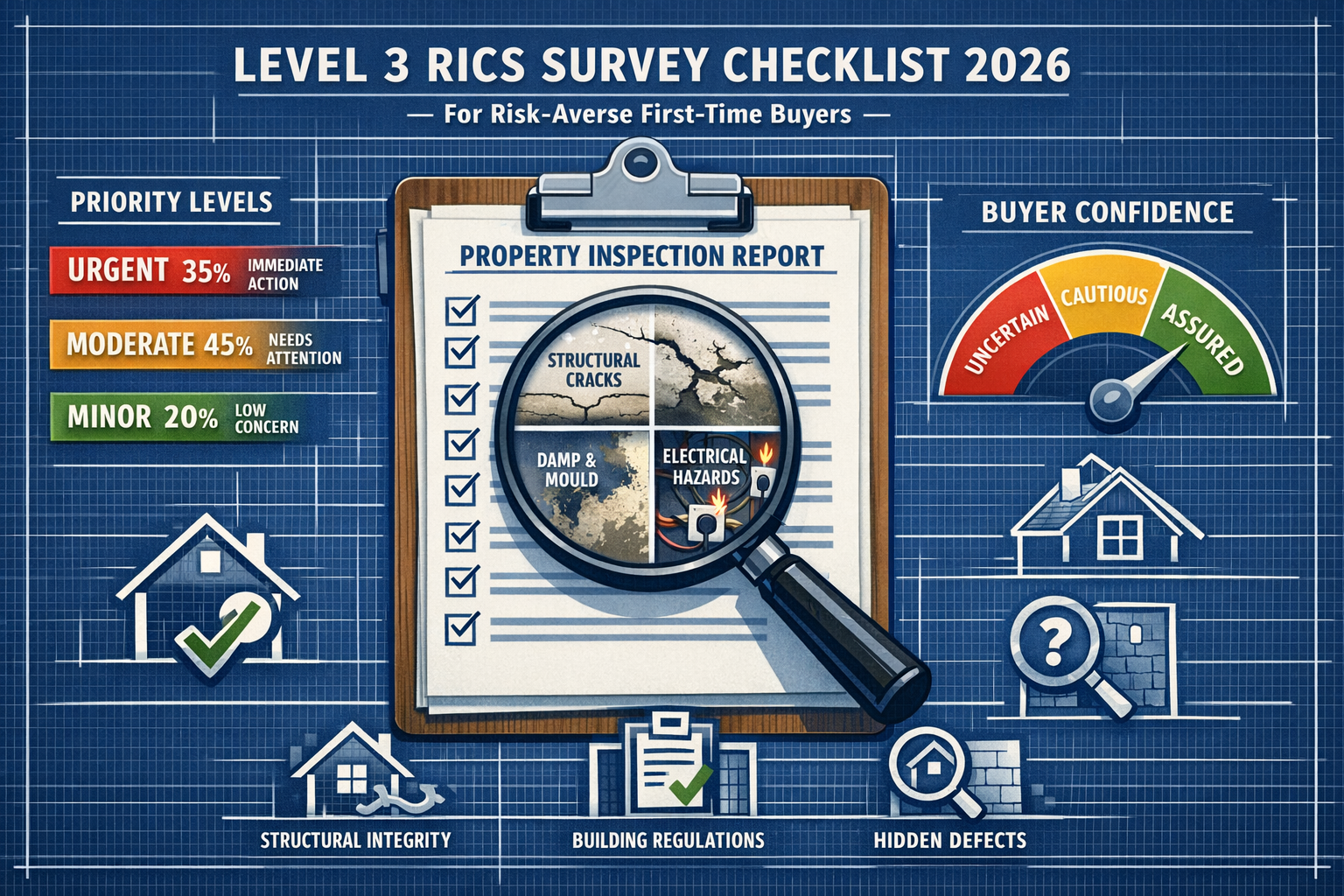
Key Takeaways
- Buyer confidence has reached its lowest point since August 2023, with enquiries down -39% in March 2026, making thorough property assessments more critical than ever [5]
- Level 3 RICS surveys provide comprehensive defect identification that protects risk-averse buyers from hidden costs in a market where price growth has stalled at just +2% annually [5]
- Geopolitical volatility and mortgage rate increases attributed to Middle East conflict have created unprecedented uncertainty, requiring enhanced due diligence protocols [1]
- First-time buyers need customized survey checklists that prioritize structural integrity, urgent defects, and compliance issues in subdued market conditions
- Transaction volumes turned sharply negative (approximately -20% in March), making each purchase decision more consequential and survey findings more valuable [1]
Understanding the 2026 Market Context: Why Level 3 RICS Surveys Matter More Than Ever
The residential property market in 2026 bears little resemblance to the optimistic conditions of early January. While the start of the year showed tentative recovery signals—with several activity indicators recording their least negative readings in months and +35% of participants expecting increased sales activity [3]—the subsequent deterioration has been swift and severe.
The Geopolitical Impact on Buyer Behavior
Capital Economics notes that the rise in mortgage rates since the start of the Iran conflict is "continuing to take an increasingly heavy toll on buyer sentiment" [1]. This external shock has fundamentally altered purchasing psychology. Buyers who might have previously accepted standard survey reports now demand exhaustive property investigations before committing capital in an uncertain environment.
The March 2026 RICS survey reveals that conflict in the Middle East and rising borrowing costs have weighed heavily on both buyer confidence and sales activity [4]. When geopolitical events can trigger sudden mortgage rate increases and market downturns, comprehensive property assessments become insurance policies against compounding risks.
From Growth Expectations to Flat Prices
The shift in twelve-month house price expectations tells a sobering story:
| Month | 12-Month Price Expectation | Change |
|---|---|---|
| January 2026 | +43% | Baseline |
| February 2026 | +33% | -10 points |
| March 2026 | +2% | -31 points |
This dramatic compression of growth expectations [5] means buyers can no longer rely on property appreciation to offset overpaying or overlooking defects. In a flat market, every pound spent on repairs directly impacts net equity—making Level 3 full building surveys essential for accurate cost forecasting.
Transaction Volume Collapse
Housing transaction growth rates tell an equally concerning story, slowing from +0.8% in February to approximately -20% in March [1]. This collapse in activity means:
- Fewer comparable sales for valuation accuracy
- Extended time on market for properties with known issues
- Greater negotiating leverage for buyers armed with detailed survey findings
- Increased importance of identifying deal-breakers early in the process
For buyers navigating these conditions, understanding the difference between Level 2 and Level 3 surveys becomes crucial for matching survey depth to market risk.
Level 3 RICS Surveys in Cautious 2026 Markets: Customized Checklists for Risk-Averse Buyers
The subdued demand environment of 2026 requires surveyors to recalibrate their reporting priorities. Risk-averse buyers—particularly first-time purchasers—need actionable intelligence that directly addresses their heightened concerns about value protection and hidden costs.
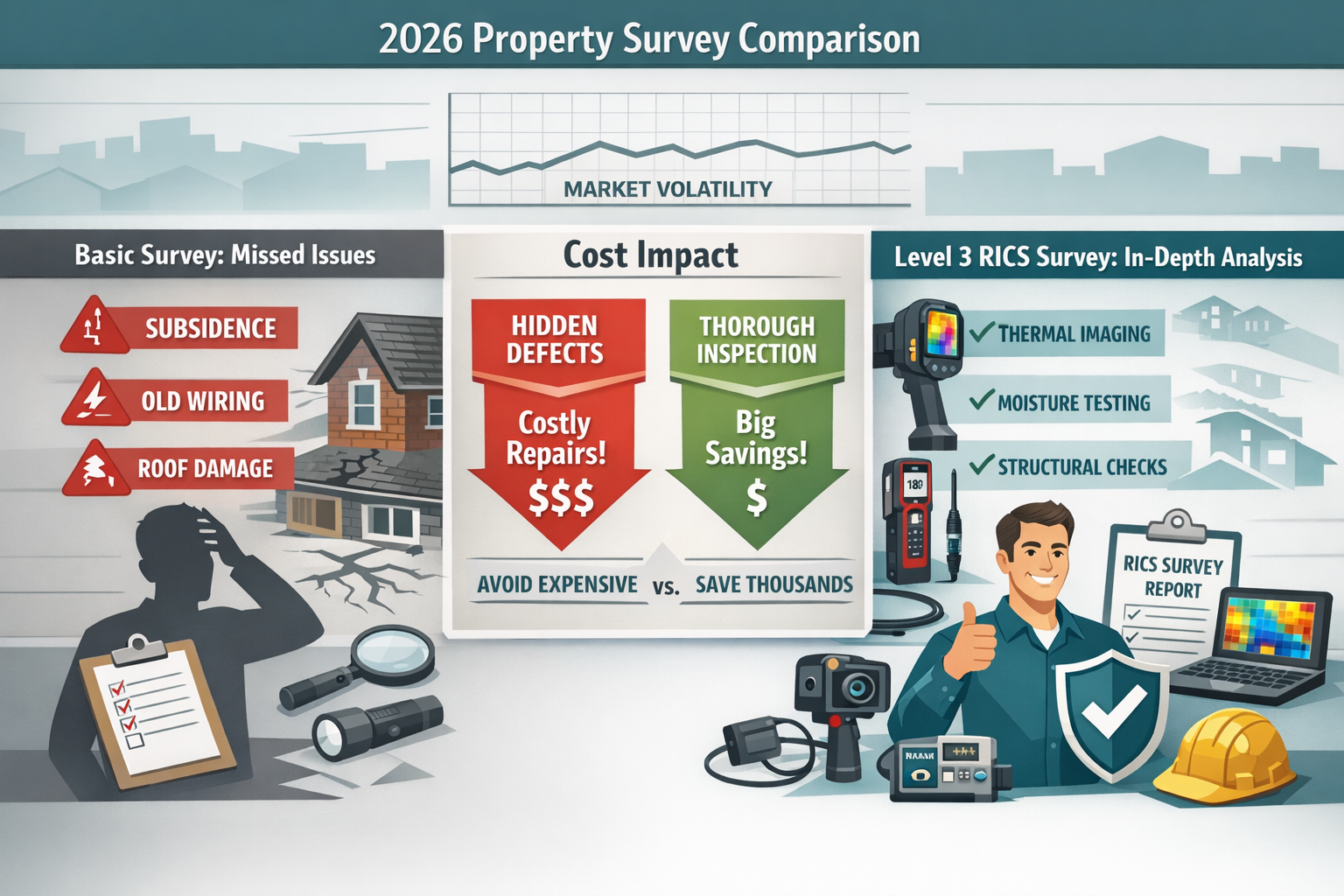
Priority 1: Structural Integrity and Urgent Defects ⚠️
In a market where near-term sales expectations have turned pessimistic (-33% in March from -4% in February) [5], buyers cannot afford to inherit structural problems that may be difficult to resell. Level 3 surveys must prioritize:
Critical Structural Elements:
- Foundation movement and subsidence indicators
- Load-bearing wall integrity and cracking patterns
- Roof structure condition and water ingress evidence
- Floor joist condition and deflection measurements
- Chimney stack stability and pointing deterioration
The identification of urgent or dangerous building issues provides immediate value by preventing buyers from inheriting life-safety hazards or properties requiring immediate capital expenditure they haven't budgeted for.
First-Time Buyer Checklist: Structural Priorities
✅ Request thermal imaging to identify hidden damp and insulation failures
✅ Demand invasive investigations where surface conditions suggest underlying issues
✅ Obtain repair cost estimates for all structural defects identified
✅ Verify that all structural alterations have building regulation approval
✅ Document any signs of ongoing movement or progressive deterioration
Priority 2: Building Regulation Compliance and Legal Risks
With transaction volumes at soft levels and buyers increasingly cautious, properties with compliance issues face extended marketing periods. Level 3 surveys should thoroughly investigate:
Compliance Verification Areas:
- Electrical installation safety and certification status
- Gas installation safety records and appliance condition
- Drainage system functionality and building control approval
- Extension and conversion building regulation compliance
- Fire safety measures in converted properties
Understanding building regulation compliance testing requirements helps buyers avoid properties that may be difficult to mortgage or insure—critical considerations when market liquidity has deteriorated.
Priority 3: Hidden Defects and Long-Term Maintenance
In a flat price environment where appreciation cannot be assumed, buyers need complete visibility of future maintenance obligations. Comprehensive Level 3 surveys should detail:
Long-Term Cost Projections:
- Roof covering remaining lifespan and replacement costs
- Window and door condition with replacement timeline
- Heating system efficiency and expected replacement date
- Drainage system condition and upgrade requirements
- External decoration cycle and material durability
Many buyers benefit from understanding what building inspections and surveys reveal to properly budget for ownership costs beyond the purchase price.
Priority 4: Environmental and Energy Considerations
With rental market showing resilience (tenant demand at +10% in March, rental price expectations at +29%) [5], buyers considering future letting potential need energy performance insights:
Energy Performance Factors:
- Current EPC rating and improvement potential
- Insulation levels in walls, roof, and floors
- Heating system efficiency and upgrade options
- Window glazing performance and replacement priorities
- Renewable energy installation feasibility
For those considering rental income, reviewing EPC and MEES requirements ensures compliance with minimum energy efficiency standards.
Strategic Use of Level 3 RICS Survey Findings in Negotiations
The combination of subdued demand and flat price expectations creates unique negotiation opportunities for buyers armed with comprehensive survey findings. When seller expectations formed during more optimistic market conditions meet current reality, detailed defect reports become powerful negotiation tools.
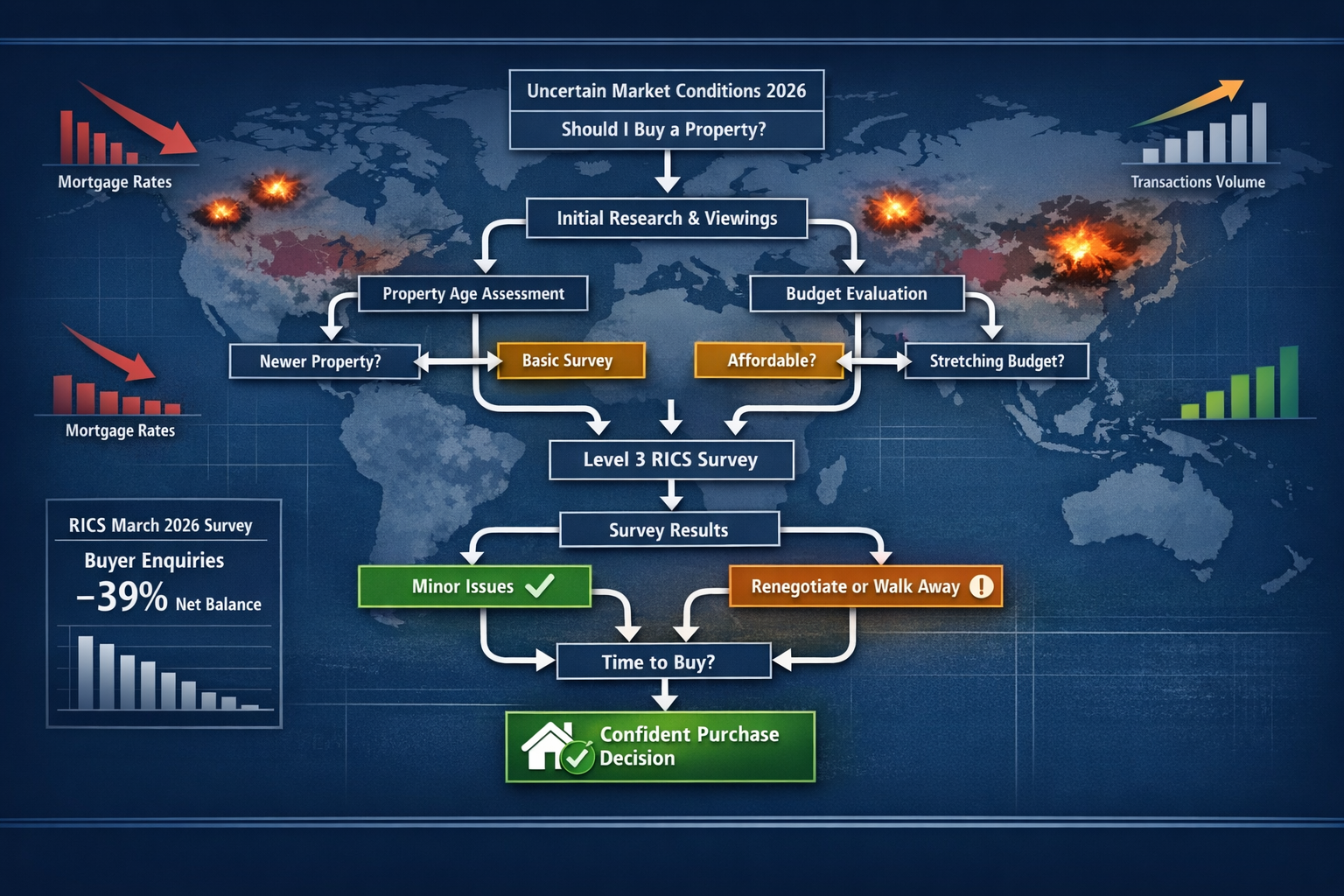
Quantifying Defects in Flat Markets
Capital Economics has expressed increased concern about downside risks to its baseline forecast for house prices to rise just 1.5% by Q4 2026 [1]. In this environment, every identified defect carries enhanced weight:
Negotiation Framework:
- Urgent/Dangerous Issues: Seek pound-for-pound price reduction or require remediation before completion
- Significant Defects: Request 80-100% of estimated repair costs as reduction
- Moderate Issues: Negotiate 50-70% of repair costs depending on market conditions
- Minor Items: Use collectively to justify 2-5% overall price reduction
When near-term house price expectations sit at -43% [5], sellers face limited alternative buyer pools and may be more receptive to evidence-based price adjustments.
Timing Considerations in Volatile Markets
The sharp deterioration from January's tentative optimism to March's pessimism [3][5] demonstrates how quickly market sentiment can shift. Buyers should:
- Act decisively when survey findings justify walking away—alternative properties may offer better value
- Leverage market data by referencing RICS survey statistics in negotiations
- Consider seasonal factors as spring typically brings increased supply
- Monitor geopolitical developments that may further impact mortgage rates and sentiment
Documentation Standards for Negotiation
Level 3 RICS surveys provide the detailed, professional documentation necessary for credible negotiations:
Essential Documentation Elements:
- Photographic evidence of all significant defects
- Professional cost estimates for remediation work
- Regulatory compliance assessments with specific citations
- Prioritized action plans with urgency classifications
- Expert opinion on property value impact
This comprehensive approach aligns with how millennial homebuyers are changing home ownership by demanding transparency and data-driven decision making.
Rental Market Resilience: Survey Considerations for Buy-to-Let Investors
While sales markets struggle, the rental sector shows remarkable resilience. Tenant demand increased to +10% in March 2026, with rental price expectations remaining positive at +29% [5]. However, landlord instructions remained firmly negative at -25%, indicating continued supply constraints [5].
Survey Priorities for Investment Properties
Buy-to-let investors require different survey emphases than owner-occupiers:
Investment-Specific Assessment Areas:
📊 Rental Income Optimization
- Property layout suitability for target tenant demographic
- Energy efficiency impact on tenant appeal and void periods
- Compliance with Housing Health and Safety Rating System (HHSRS)
- Maintenance requirements that may cause tenant disruption
🔧 Operational Cost Management
- Heating system efficiency and running costs
- Common repair issues that generate tenant complaints
- Accessibility of services for routine maintenance
- Durability of fixtures and fittings under rental use
⚖️ Regulatory Compliance
- Electrical Installation Condition Report (EICR) validity
- Gas safety certificate requirements
- Smoke and carbon monoxide alarm placement
- Energy Performance Certificate rating and improvement costs
Understanding these factors helps investors capitalize on the supply-demand imbalance while avoiding properties that generate negative cash flow through excessive maintenance.
The Role of Professional Surveyors in Uncertain Markets
The deterioration in market conditions throughout early 2026 places increased responsibility on surveying professionals to deliver exceptional value. When buyers face their weakest confidence levels in nearly three years [5], surveyors must adapt their communication and reporting approaches.
Enhanced Reporting Standards
Professional surveyors should consider:
Client Communication Enhancements:
- Executive summaries with clear priority classifications
- Visual aids including annotated photographs and diagrams
- Repair cost ranges with current market pricing
- Urgency timelines for addressing identified issues
- Market context explanations for significant findings
Technical Depth Appropriate to Market Conditions:
- More invasive investigations when surface indicators suggest hidden defects
- Specialist referrals for complex issues (structural engineers, damp specialists)
- Follow-up inspection offers for seasonal or weather-dependent conditions
- Detailed regulatory compliance verification beyond standard checks
Ethical Considerations in Subdued Markets
With sales expectations for the next three months at -33% [5], surveyors face ethical obligations to:
- Avoid understatement of defects that may trap buyers in problematic properties
- Resist pressure from agents or sellers to minimize findings
- Maintain independence despite market pressures affecting all parties
- Provide context without creating unwarranted alarm about normal property conditions
The professional standards outlined in the Home Survey Standard 2nd Edition April 2026 Update [4] provide essential guidance for maintaining quality during challenging market periods.
Regional Variations and Market-Specific Considerations
The RICS residential market survey aggregates national data, but regional variations significantly impact how Level 3 surveys should be approached and interpreted.
Geographic Risk Factors
Different regions face distinct challenges in 2026:
Urban Markets:
- Higher exposure to geopolitical sentiment shifts
- Greater mortgage rate sensitivity
- More competitive rental markets offsetting sales weakness
- Building regulation compliance complexities in converted properties
Suburban and Rural Areas:
- Potentially less severe demand deterioration
- Different property age profiles requiring specialized survey approaches
- Septic systems, private water supplies, and other rural-specific considerations
- Agricultural building conversions with unique structural challenges
Buyers should consider consulting with local chartered surveyors who understand regional market dynamics and common property issues specific to their target areas.
Property Age and Type Considerations
The 2026 market affects different property types variably:
Period Properties (Pre-1919):
- Require most comprehensive Level 3 surveys
- Hidden defects more common due to age and construction methods
- Traditional materials requiring specialist knowledge
- Potential for significant undisclosed alterations
Inter-War and Post-War (1919-1980):
- Known construction defects (cavity wall tie corrosion, concrete degradation)
- Modernization quality varies significantly
- Asbestos presence requiring specialist surveys
- Original services likely requiring replacement
Modern Properties (Post-1980):
- May still benefit from Level 3 surveys in uncertain markets
- New-build snagging issues if recently completed
- Building regulation compliance verification essential
- Warranty coverage investigation important
For new or recently completed properties, specialized snagging reports complement Level 3 surveys by identifying finishing defects before they become costly problems.
Cost-Benefit Analysis: Level 3 Surveys as Risk Insurance
When house price growth expectations have collapsed from +43% to +2% in just two months [5], the relative cost of comprehensive surveys becomes negligible compared to the financial risks they mitigate.
Financial Protection Quantified
Typical Cost Scenarios:
| Survey Type | Average Cost | Defects Identified | Potential Savings |
|---|---|---|---|
| Level 2 (HomeBuyer) | £500-800 | Surface-level only | £5,000-15,000 |
| Level 3 (Building Survey) | £800-1,500 | Comprehensive | £15,000-50,000+ |
The incremental £300-700 investment in a Level 3 survey over a Level 2 typically identifies:
✅ Hidden structural issues worth £10,000-30,000 in repairs
✅ Compliance deficiencies that could prevent future sales
✅ Urgent safety hazards requiring immediate attention
✅ Long-term maintenance needs enabling proper financial planning
Opportunity Cost in Flat Markets
With transaction volumes down approximately 20% [1] and agreed sales at -34% [5], buyers face:
- Limited alternative options if they proceed with a problematic property
- Extended marketing periods if they need to resell quickly
- Reduced negotiating power as sellers in future markets may be equally cautious
- Mortgage valuation risks if defects emerge during refinancing
The cost of a comprehensive Level 3 survey represents 0.2-0.5% of a typical property purchase—a modest insurance premium against risks that could consume 5-10% or more of property value.
Practical Action Steps for Buyers in 2026 Markets
Given the challenging conditions revealed by March 2026 RICS data, prospective buyers should follow a structured approach to property acquisition.
Pre-Survey Preparation
Before commissioning a Level 3 survey:
1️⃣ Research property history through Land Registry, planning records, and local authority searches
2️⃣ Conduct preliminary inspections noting obvious concerns to highlight for surveyor attention
3️⃣ Gather documentation including EPC, gas safety certificates, electrical reports, and warranty information
4️⃣ Identify specialist concerns requiring additional expert input beyond standard survey scope
5️⃣ Set clear budget parameters including maximum acceptable repair costs post-survey
Survey Briefing and Scope
When commissioning the survey:
- Communicate specific concerns based on property age, type, and condition
- Request invasive investigations for areas of concern
- Ask for repair cost estimates to facilitate negotiations
- Specify any intended alterations requiring structural assessment
- Confirm surveyor's professional indemnity insurance coverage
Post-Survey Decision Framework
After receiving the Level 3 report:
Option 1: Proceed as planned ✅
- Minor defects only, within expected parameters
- Repair costs acceptable and budgeted
- No urgent safety or compliance issues
- Property value justified despite identified issues
Option 2: Renegotiate price 💰
- Significant defects requiring substantial expenditure
- Compliance issues affecting insurability or mortgageability
- Repair costs exceeding initial expectations
- Market conditions supporting price adjustment
Option 3: Request remediation 🔧
- Urgent safety hazards requiring immediate attention
- Compliance deficiencies that could prevent completion
- Structural issues affecting property integrity
- Seller has capacity and willingness to undertake works
Option 4: Withdraw from purchase ❌
- Fundamental structural problems making property unviable
- Repair costs exceeding available budget by significant margin
- Undisclosed issues suggesting broader property concerns
- Better value alternatives available in current market
For additional guidance on property decision-making, buyers may find value in understanding what homeowners should know about their property.
Conclusion: Navigating Uncertainty with Professional Due Diligence
The residential property market in 2026 presents unprecedented challenges. Buyer demand at its weakest point in nearly three years, transaction volumes turning sharply negative, and house price expectations collapsing from robust growth projections to barely positive outlooks—all compounded by geopolitical volatility affecting mortgage rates and consumer confidence [1][5].
In this environment, Level 3 RICS Surveys in Cautious 2026 Markets: Enhancing Buyer Certainty Amid Flat Prices and Geopolitical Volatility represent essential risk management tools rather than optional extras. The comprehensive defect identification, regulatory compliance verification, and long-term maintenance forecasting they provide become invaluable when traditional market signals offer little guidance and price appreciation cannot be assumed.
Risk-averse buyers—particularly first-time purchasers navigating their first property acquisition during uncertain times—benefit enormously from the detailed intelligence that Level 3 surveys deliver. The customized checklists prioritizing structural integrity, urgent defects, and compliance issues enable informed decision-making that protects both immediate financial interests and long-term investment value.
Take Action Today
If you're considering a property purchase in the current market:
🔍 Commission a Level 3 RICS survey for any property built before 1980 or showing signs of alteration
📋 Use the customized checklists provided in this guide to brief your surveyor on priority concerns
💼 Leverage survey findings in negotiations, armed with market context from RICS data
🏠 Consider professional guidance from experienced chartered surveyors who understand 2026 market dynamics
📊 Monitor market indicators including monthly RICS surveys to time your purchase optimally
The subdued demand and flat price environment of 2026 creates both challenges and opportunities. Buyers who invest in comprehensive professional surveys position themselves to identify value, avoid costly mistakes, and negotiate effectively—transforming market uncertainty into competitive advantage through superior information and professional due diligence.
References
[1] Uk Rics Residential Market Survey Mar 2026 – capitaleconomics.com
[2] Valuation Adjustments For March 2026 Rics Survey Navigating Softer House Prices And Middle East Conflict Impacts – nottinghillsurveyors.com
[3] Uk Residential Market Survey January 2026 – rics.org
[4] Home Survey Standard 2nd Edition April 2026 Update – rics.org
[5] Uk Residential Market Survey March 2026 – rics.org
[6] Uk Residential Market Survey February 2026 – rics.org
[7] Valuation Strategies Amid January 2026 Rics Residential Survey Spotting Early Market Recovery Signals – nottinghillsurveyors.com