

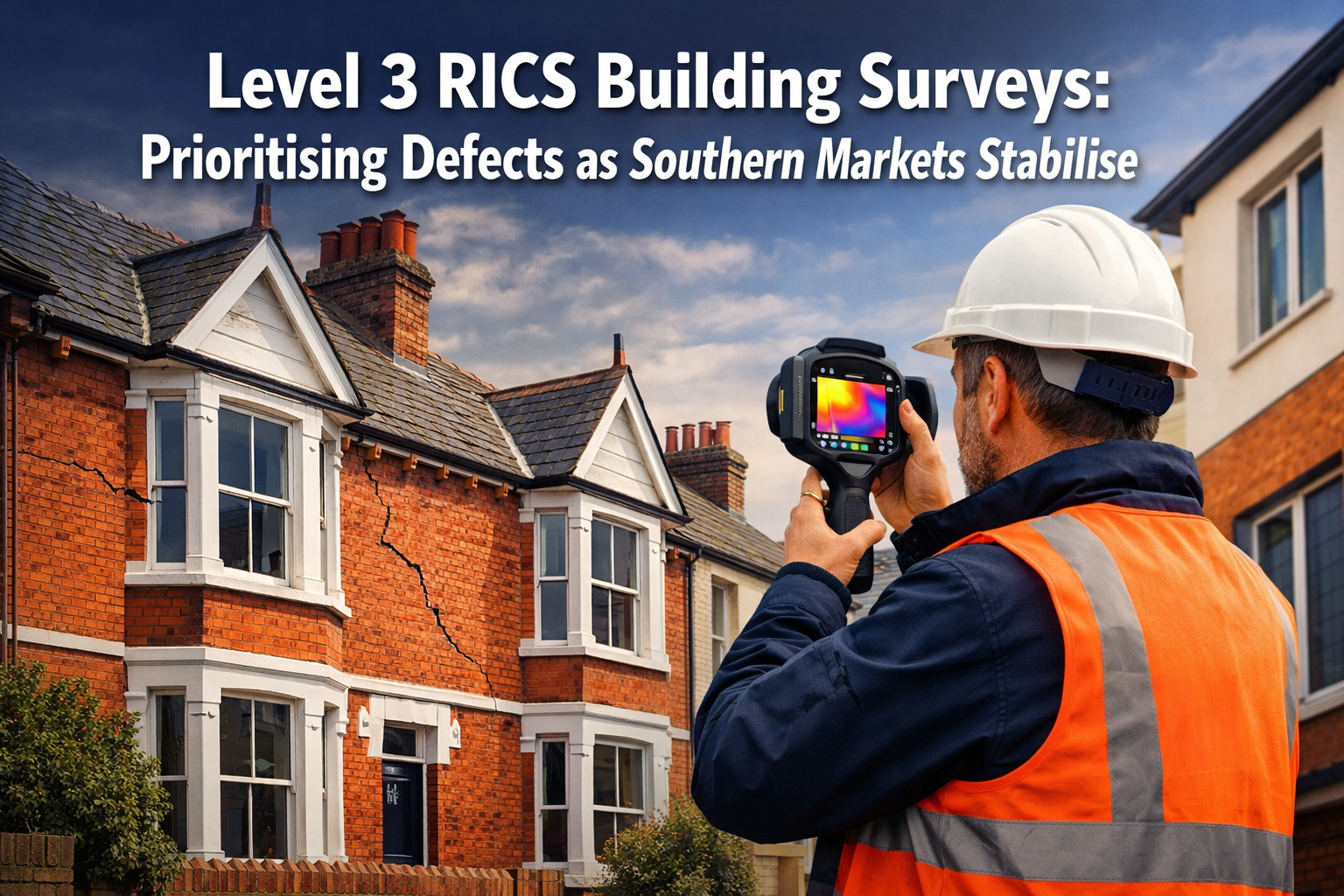
As property transactions in southern England show signs of recovery in 2026, Level 3 RICS Building Surveys in Stabilising Southern Markets: Prioritising Defects as Buyer Confidence Returns has become more critical than ever. With house prices flattening after years of volatility, buyers are shifting their focus from bidding wars to thorough due diligence. The emphasis now falls squarely on identifying hidden defects—from RAAC concrete concerns to subsidence risks—that could turn a seemingly stable purchase into a financial burden.
The southern property markets, encompassing regions from Surrey to Hampshire and across London's commuter belt, are experiencing a fundamental shift. Buyers returning to the market aren't just looking at valuations anymore. They're demanding comprehensive insights into property condition, prioritising defect identification over pure market value assessments. This transformation makes Level 3 full building surveys an essential tool for informed decision-making.
Key Takeaways
- 🏘️ Flatter pricing in southern markets shifts buyer focus from bidding competition to thorough defect identification and risk assessment
- 🔍 Hidden structural issues like RAAC concrete, subsidence, and moisture ingress now dominate buyer concerns as confidence returns
- 📊 Level 3 surveys provide detailed defect prioritisation that enables accurate repair budgeting and informed negotiation strategies
- 💰 Survey findings directly influence property valuations and purchase decisions, with defects often leading to 5-15% price reductions
- ✅ Comprehensive assessments combine structural analysis with maintenance planning, offering long-term value beyond the initial purchase
Understanding the Southern Market Stabilisation in 2026
The southern property markets have entered a period of stabilisation characterised by flatter price trajectories and renewed buyer activity. Unlike the frenzied conditions of previous years, 2026 presents a more measured marketplace where due diligence trumps speed.
The Shift from Price Competition to Quality Assessment
When prices were climbing rapidly, many buyers felt pressured to skip detailed surveys or settle for basic assessments. The current market stability has fundamentally altered this dynamic. Buyers now have:
- Time to conduct thorough investigations without fear of losing properties to competing offers
- Leverage to negotiate based on survey findings rather than accepting properties "as-is"
- Opportunity to prioritise long-term property condition over short-term market gains
- Capacity to budget accurately for necessary repairs and maintenance
This shift makes building defects surveys particularly valuable, as they provide the detailed intelligence buyers need to make confident decisions.
Regional Variations Across Southern England
The stabilisation isn't uniform across all southern markets. Different areas present unique characteristics:
| Region | Market Condition | Primary Defect Concerns |
|---|---|---|
| Central London | Modest price softening | Period property deterioration, RAAC in 1960s-80s buildings |
| Surrey/Hampshire | Stable with selective growth | Subsidence in clay soil areas, aging infrastructure |
| Coastal South | Recovery from previous decline | Moisture ingress, coastal weathering, cavity wall issues |
| Commuter Belt | Steady transaction volumes | Extension quality, roof condition, drainage problems |
Understanding these regional nuances helps buyers tailor their survey requirements to local risk profiles.
Level 3 RICS Building Surveys in Stabilising Southern Markets: The Defect Prioritisation Framework
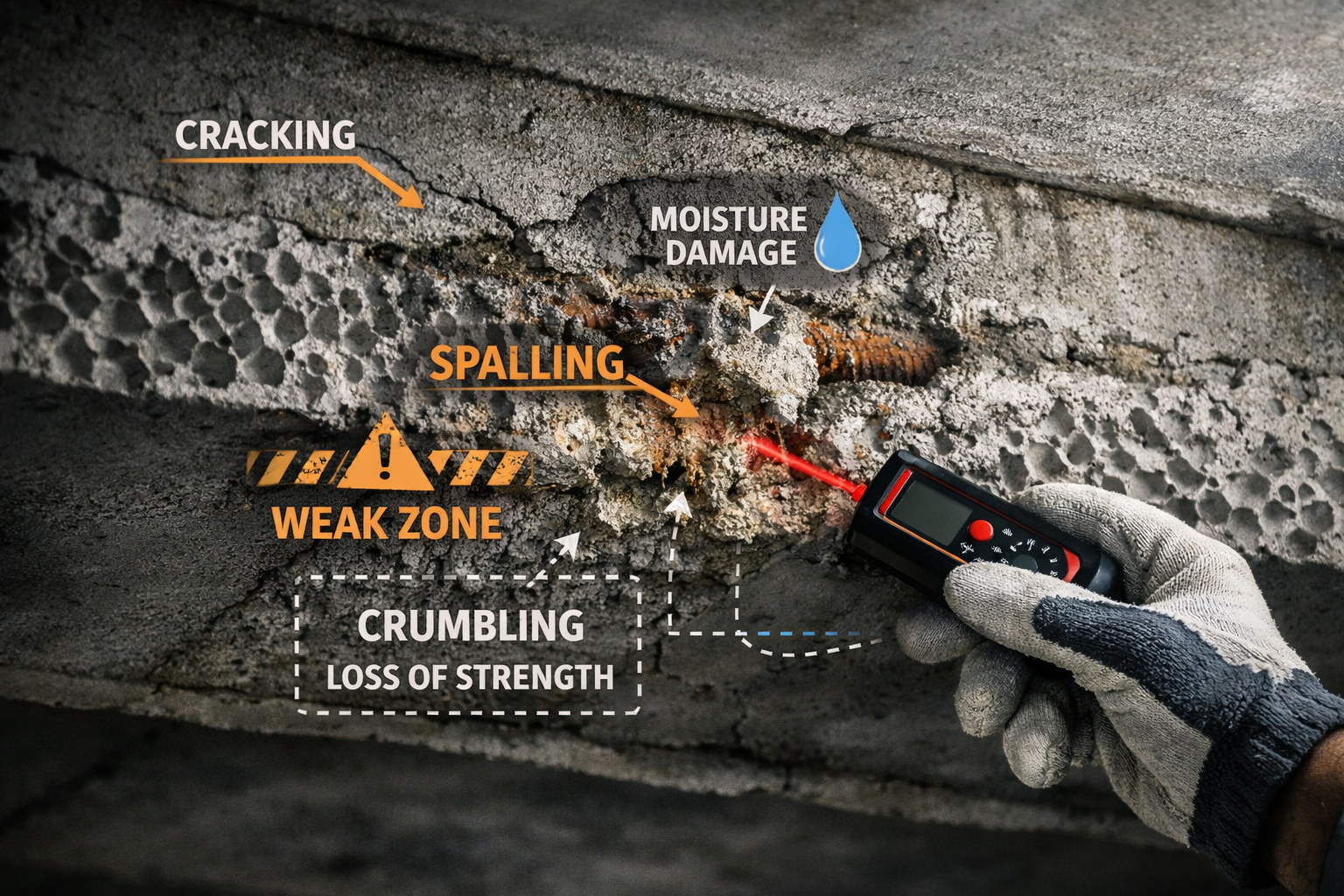
The core value of Level 3 RICS Building Surveys in Stabilising Southern Markets: Prioritising Defects as Buyer Confidence Returns lies in systematic defect categorisation. Unlike basic surveys, Level 3 assessments provide granular analysis of property conditions, enabling buyers to distinguish between minor cosmetic issues and serious structural concerns.
Critical Defects Dominating 2026 Surveys
Several defect categories have emerged as primary concerns in southern property surveys:
RAAC Concrete: The Hidden Structural Threat
Reinforced Autoclaved Aerated Concrete (RAAC) has become a major focus in 2026 surveys, particularly for properties built between 1950 and 1995. This lightweight concrete material, commonly used in roof and floor construction, has a limited lifespan and can fail catastrophically.
Key RAAC concerns include:
- Identification challenges – RAAC often lies hidden behind ceilings and finishes
- Structural integrity – Material deteriorates over time, especially when exposed to moisture
- Replacement costs – Remediation can cost £50,000-£150,000+ depending on extent
- Safety implications – Sudden failure risk requires immediate action when identified
Level 3 surveys employ specialist inspection techniques, including non-invasive testing and targeted exposure, to identify RAAC presence and assess its condition.
Subsidence and Ground Movement
Southern England's clay-rich soils make subsidence a persistent concern, particularly after periods of drought followed by wet weather. Survey findings typically reveal:
- Progressive cracking patterns indicating ongoing movement
- Differential settlement affecting structural stability
- Tree root damage to foundations and drainage systems
- Historical underpinning requiring assessment of effectiveness
"In stabilising markets, buyers have the luxury of walking away from properties with significant subsidence issues or negotiating substantial price reductions. Level 3 surveys provide the evidence needed for these critical decisions." – Senior RICS Surveyor
Moisture Ingress and Damp-Related Defects
Moisture problems remain among the most common defects identified in southern property surveys:
- Rising damp from failed or absent damp-proof courses
- Penetrating damp through defective roofing, guttering, or masonry
- Condensation issues in poorly ventilated properties
- Timber decay resulting from prolonged moisture exposure
Understanding what's included in a Level 3 survey helps buyers appreciate the comprehensive moisture investigation these assessments provide.
The Three-Tier Defect Classification System
RICS Level 3 surveys employ a standardised classification system that prioritises defects by urgency and severity:
Condition Rating 1 (Green) ✅
- No repair currently needed
- Normal maintenance required
- Property elements performing as expected
Condition Rating 2 (Amber) ⚠️
- Defects requiring repair or replacement
- Not urgent but should be addressed
- May affect property value
- Typical examples: aging boiler, worn roof coverings, minor cracking
Condition Rating 3 (Red) 🚨
- Serious defects requiring urgent attention
- Structural concerns or safety hazards
- Significant cost implications
- Examples: RAAC presence, active subsidence, roof failure, electrical hazards
This classification enables buyers to:
- Prioritise repair budgets based on urgency
- Negotiate purchase prices with evidence-based justification
- Plan maintenance schedules for medium-term issues
- Make informed decisions about property suitability
Comparing Level 3 Surveys with Property Valuations for Informed Decisions
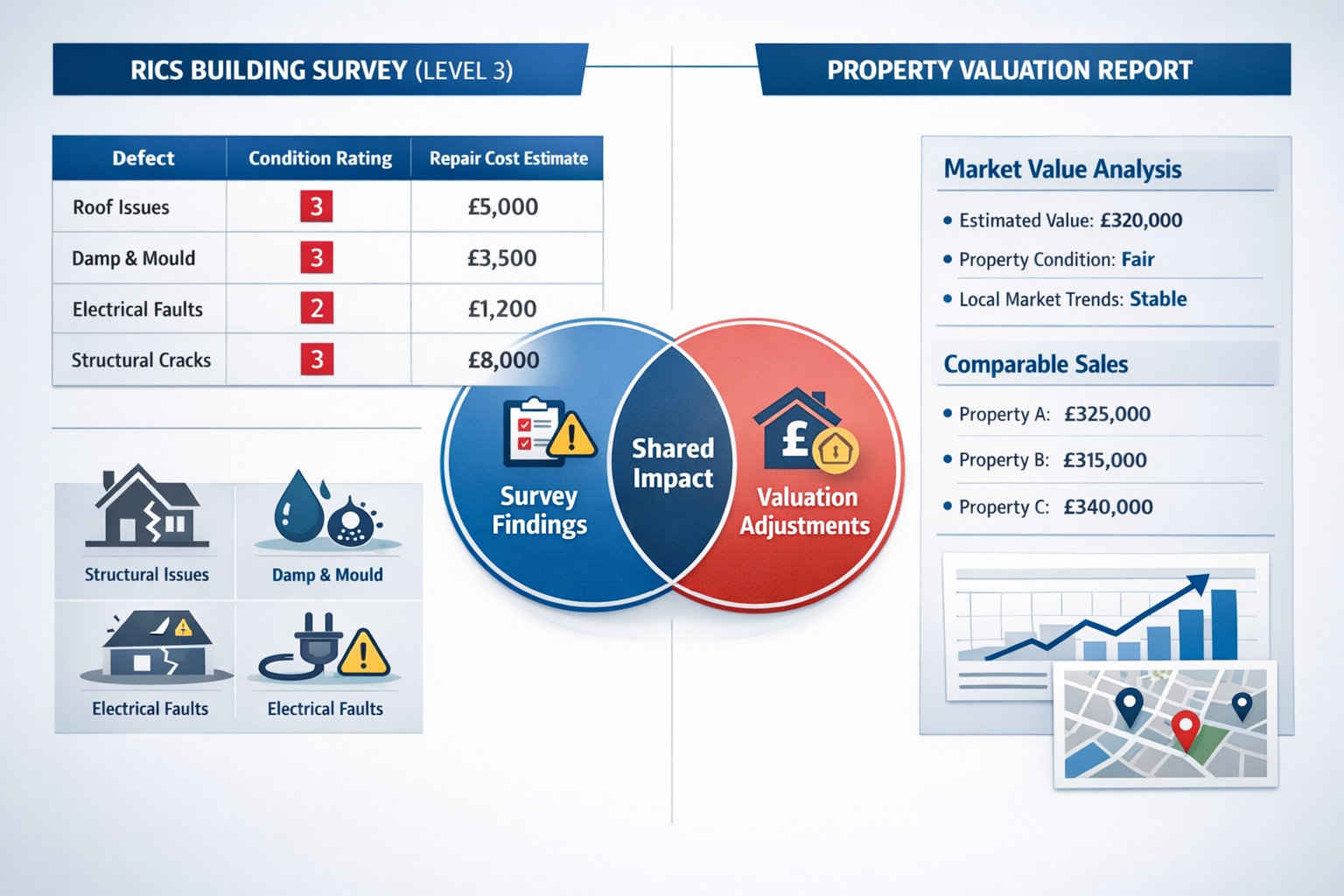
A critical aspect of Level 3 RICS Building Surveys in Stabilising Southern Markets: Prioritising Defects as Buyer Confidence Returns involves understanding how survey findings interact with property valuations. These two assessments serve different but complementary purposes.
Survey vs Valuation: Understanding the Distinction
Many buyers confuse building surveys with valuations, but they serve fundamentally different functions:
| Aspect | Level 3 Building Survey | Property Valuation |
|---|---|---|
| Primary Purpose | Assess physical condition and defects | Determine market value |
| Focus | Structural integrity, materials, systems | Comparable sales, market trends |
| Detail Level | Comprehensive, element-by-element | Overview with market context |
| Typical Length | 40-80+ pages | 10-20 pages |
| Cost Range | £800-£2,500+ | £250-£600 |
| Timeframe | 3-6 hours on-site | 30-60 minutes on-site |
Understanding this distinction helps buyers commission the right assessments for their needs. Those considering whether they need a Level 2 or Level 3 survey should weigh property age, condition, and complexity.
How Survey Findings Influence Valuations
While surveys and valuations are separate assessments, defect findings significantly impact property values:
Direct Value Adjustments
Serious defects identified in Level 3 surveys typically lead to:
- Immediate price reductions of 5-15% for significant structural issues
- Repair cost deductions from agreed purchase prices
- Renegotiation leverage backed by professional evidence
- Transaction withdrawals when defects prove too severe
For example, discovering RAAC in a £600,000 property might justify a £60,000-£100,000 reduction to account for replacement costs and disruption.
Long-Term Value Implications
Beyond immediate price adjustments, survey findings affect:
- Resale potential – documented defects must be disclosed to future buyers
- Insurance costs – subsidence history increases premiums
- Mortgage availability – severe defects may prevent lending
- Rental income – condition issues reduce achievable rents
Integrating Survey and Valuation Intelligence
Sophisticated buyers in 2026's stabilised markets use both assessments strategically:
Step 1: Commission the Valuation
Understand the property's market value in current condition, providing a baseline for negotiations.
Step 2: Conduct the Level 3 Survey
Identify all defects with detailed cost estimates for repairs, as outlined in budgeting for repairs and restoration.
Step 3: Calculate Adjusted Value
Subtract repair costs and factor in disruption to determine true property value:
True Value = Market Valuation – Repair Costs – Disruption Factor – Risk Premium
Step 4: Negotiate Strategically
Present survey findings with cost evidence to justify price reductions or seller-funded repairs.
Step 5: Make Informed Decision
Proceed, renegotiate, or withdraw based on comprehensive intelligence rather than emotion.
Why Level 3 Surveys Matter More in Recovering Markets
As buyer confidence returns to southern markets, the role of comprehensive building surveys becomes increasingly important. The stabilisation creates conditions where thorough due diligence pays dividends.
The Psychology of Returning Buyer Confidence
Market psychology in 2026 differs markedly from previous years:
- Risk aversion – Buyers are cautious after market volatility
- Value seeking – Focus shifts to property quality over location prestige
- Long-term thinking – Buyers plan to hold properties longer
- Informed decision-making – Research and professional advice valued highly
This psychological shift makes RICS building surveys essential for homebuyers who want confidence in their investments.
Cost-Benefit Analysis of Level 3 Surveys
While Level 3 surveys represent a significant upfront cost, the return on investment is substantial:
Typical Survey Investment: £1,200-£2,000
Potential Savings and Benefits:
- 💷 Price reductions: £10,000-£50,000+ based on defect findings
- 🔧 Avoided surprises: Prevention of unexpected £20,000-£100,000+ repair bills
- 📋 Maintenance planning: Structured approach to property upkeep
- 🛡️ Risk mitigation: Identification of safety hazards before purchase
- 💪 Negotiation power: Professional evidence supporting price discussions
The mathematics clearly favour comprehensive surveys, particularly for properties:
- Built before 1970
- With visible signs of deterioration
- In areas prone to subsidence
- With complex construction or extensions
- Valued above £400,000
Specific Property Types Requiring Level 3 Assessments
Certain southern property types particularly benefit from comprehensive surveys:
Period Properties (Pre-1919) 🏛️
Victorian and Edwardian homes dominate southern markets but present unique challenges:
- Solid wall construction without cavity insulation
- Aging drainage systems and service infrastructure
- Historic alterations of varying quality
- Timber decay in original structural elements
Inter-War Properties (1919-1939) 🏘️
This era introduced cavity walls but also construction shortcuts:
- Early cavity wall construction with potential issues
- Metal window frames requiring replacement
- Asbestos presence in various forms
- Foundation designs inadequate for clay soils
Post-War Properties (1945-1980) 🏗️
Rapid construction during housing shortages created specific risks:
- RAAC presence in flat-roofed sections
- Non-standard construction methods
- Concrete frame deterioration
- Inadequate insulation and ventilation
Modern Properties (1980-Present) 🏡
Even newer properties benefit from Level 3 surveys:
- Building regulation compliance verification
- Extension and conversion quality assessment
- New-build defect identification
- Energy efficiency evaluation
Practical Implementation: Commissioning Your Level 3 Survey
Understanding the value of Level 3 RICS Building Surveys in Stabilising Southern Markets: Prioritising Defects as Buyer Confidence Returns is one thing; implementing this knowledge effectively is another.
Selecting the Right Surveyor
Not all RICS surveyors offer equivalent expertise. Key selection criteria include:
✅ RICS Accreditation – Verify current membership and professional standing
✅ Local Market Knowledge – Familiarity with southern property types and regional issues
✅ Specialist Experience – Expertise in period properties, RAAC identification, or specific construction types
✅ Professional Indemnity Insurance – Adequate coverage for property value
✅ Sample Reports – Review previous work to assess detail and clarity
✅ Communication Style – Accessibility for questions and follow-up discussions
Timing Your Survey Strategically
In stabilised markets, timing flexibility allows strategic survey scheduling:
Optimal Timing:
- After offer acceptance but before exchange of contracts
- During dry weather for roof and external inspections
- When property is vacant for unrestricted access
- With sufficient time before contractual deadlines
Avoid:
- Rushed surveys under tight completion deadlines
- Winter months when defects may be hidden
- Periods when occupiers restrict access to key areas
Maximising Survey Value
To extract maximum value from your Level 3 survey investment:
- Attend the Survey – Many surveyors welcome buyer presence for final walkthrough
- Prepare Questions – Compile specific concerns based on viewing observations
- Provide Context – Share property history, previous surveys, or known issues
- Request Clarification – Follow up on unclear findings or technical terminology
- Obtain Cost Estimates – Ask for repair budget ranges for identified defects
- Discuss Priorities – Understand which defects require immediate attention
Those wondering what questions to ask during a building survey can prepare more effectively with professional guidance.
Acting on Survey Findings
The survey report is only valuable if acted upon appropriately:
For Minor Defects (Rating 1-2):
- Factor repair costs into long-term budgets
- Plan maintenance schedules
- Proceed with purchase confidence
For Significant Defects (Rating 3):
- Obtain specialist reports for major issues
- Request detailed repair quotations
- Renegotiate purchase price with evidence
- Consider transaction withdrawal if defects are too severe
For Deal-Breaking Defects:
- RAAC requiring complete structural replacement
- Active subsidence without remediation
- Extensive structural timber decay
- Dangerous electrical installations
- Severe contamination issues
Understanding average price reductions after surveys helps set realistic negotiation expectations.
The Future of Property Due Diligence in Southern Markets
As 2026 progresses, several trends are shaping how buyers approach property assessments in southern England:
Technology Integration
Modern surveys increasingly incorporate advanced technologies:
- Thermal imaging for moisture detection and insulation assessment
- Drone surveys for roof and chimney inspections without scaffolding access
- 3D laser scanning for accurate spatial documentation
- Digital reporting with interactive photographs and annotations
These technologies enhance traditional survey methods, providing more comprehensive evidence of property condition.
Regulatory Evolution
Building regulations and safety standards continue evolving:
- Enhanced RAAC screening requirements for certain property types
- Updated electrical safety standards (18th Edition compliance)
- Energy Performance Certificate (EPC) integration with survey findings
- Fire safety assessments particularly for converted flats
Buyers benefit from surveys that address current regulatory landscapes alongside traditional defect identification.
Market Maturation
The southern property markets are maturing toward Continental European norms:
- Standard survey commissioning becoming expected rather than optional
- Seller-commissioned surveys gaining acceptance to accelerate transactions
- Survey portability reducing duplicate assessments
- Defect disclosure requirements increasing transparency
This maturation benefits buyers through improved information availability and reduced transaction risks.
Conclusion
Level 3 RICS Building Surveys in Stabilising Southern Markets: Prioritising Defects as Buyer Confidence Returns represents more than a prudent precaution—it's become an essential component of property acquisition strategy in 2026. As southern England's property markets stabilise after years of volatility, the emphasis has shifted decisively from price competition to quality assessment.
The flattening price trajectories across regions from London to Hampshire create ideal conditions for thorough due diligence. Buyers now have time to commission comprehensive surveys, analyse findings carefully, and negotiate based on evidence rather than emotion. This fundamental shift empowers informed decision-making that protects both immediate investments and long-term property value.
The critical defects dominating 2026 surveys—RAAC concrete, subsidence, moisture ingress, and aging infrastructure—require professional identification and assessment. Level 3 surveys provide the detailed intelligence needed to distinguish between manageable maintenance issues and serious structural concerns that could derail property ownership plans.
By understanding how survey findings interact with property valuations, buyers can calculate true property values that account for necessary repairs and remediation. This integrated approach to property assessment transforms surveys from simple condition reports into powerful negotiation tools and risk management instruments.
Your Next Steps
If you're considering a property purchase in southern England's stabilising markets:
- Commission a Level 3 survey for any property built before 1990 or showing visible defect signs
- Select an experienced RICS surveyor with local market knowledge and relevant specialist expertise
- Review findings carefully with particular attention to Condition Rating 3 defects
- Obtain specialist reports for any serious structural concerns identified
- Calculate adjusted property values accounting for repair costs and disruption
- Negotiate confidently using professional evidence to support price discussions
- Plan long-term maintenance based on survey recommendations
For comprehensive property assessments that prioritise defects and protect your investment, explore professional construction and condition survey services tailored to southern market conditions.
The return of buyer confidence to southern property markets creates opportunities for those who approach purchases with thorough due diligence. Level 3 RICS building surveys provide the foundation for these informed decisions, transforming uncertainty into confidence and risk into opportunity.